Community

On the hunt for salmonberries in Dillingham

Credit Hannah Colton/KDLG

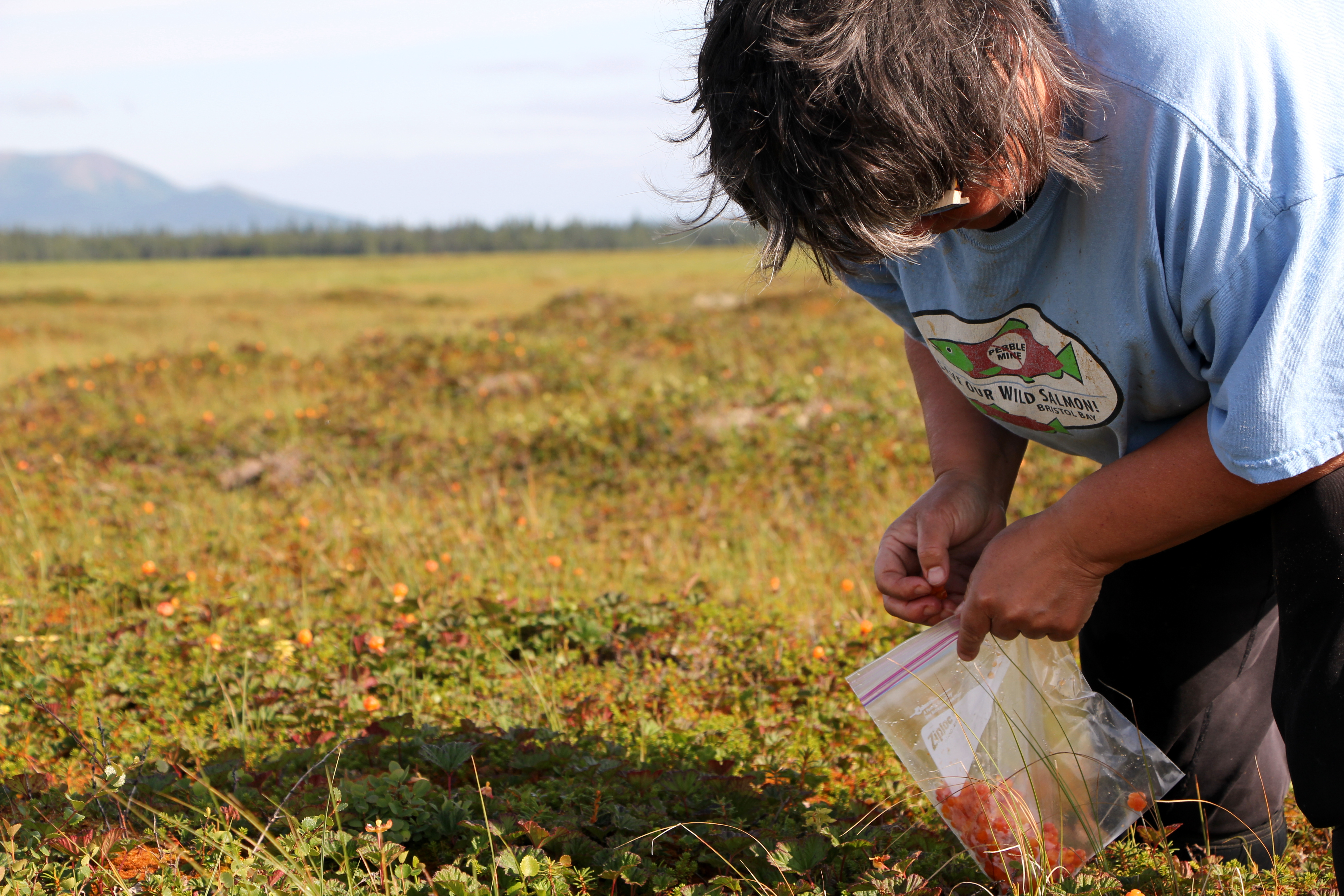
Each July and August, dozens of Bristol Bay residents take to the berry flats. Some are casual gatherers, picking handfuls here and there. Others set out to harvest enough salmonberries to rival the year’s salmon harvest.

Kim Williams, her sister-in-law Liz Johnson and aunt Judy Samuelson are the latter.

Around 9 a.m., the three women embark on their tenth day of salmonberry season. Williams says it’s been a good haul so far.

“How many bags you put away?” she asks the group. One says 37; another says 40.

They load plastic buckets and quart-sized Ziploc bags onto their four-wheelers. Williams leads the group onto the tundra, picking her way between swampy patches. She’s heading toward one of their closely guarded berry spots.

“We have spots that we regularly look at beause we’ve been [going] there for at least 30 years,” She says. “We have spots that we go back and check. Some years they’re there and some years they’re not.”

Last year was an off year with no salmonberries to be found. Williams says heavy wind and a late frost killed the delicate blossoms.

“These berries are really fragile,” she says. “They’re a white blossom – a lot of rain can knock the blossom off [or] the wind … a lot of things can happen so they don’t berry.”

This time around the conditions were right and the berries early. Williams says they started scouting for June 9, more than a week earlier than usual.

“We always know that when you hear the cranes out on the berry flat, berries are ready. And when the fireweed is blooming, berries are ready. That’s the sign to tell you to go look,” she says.
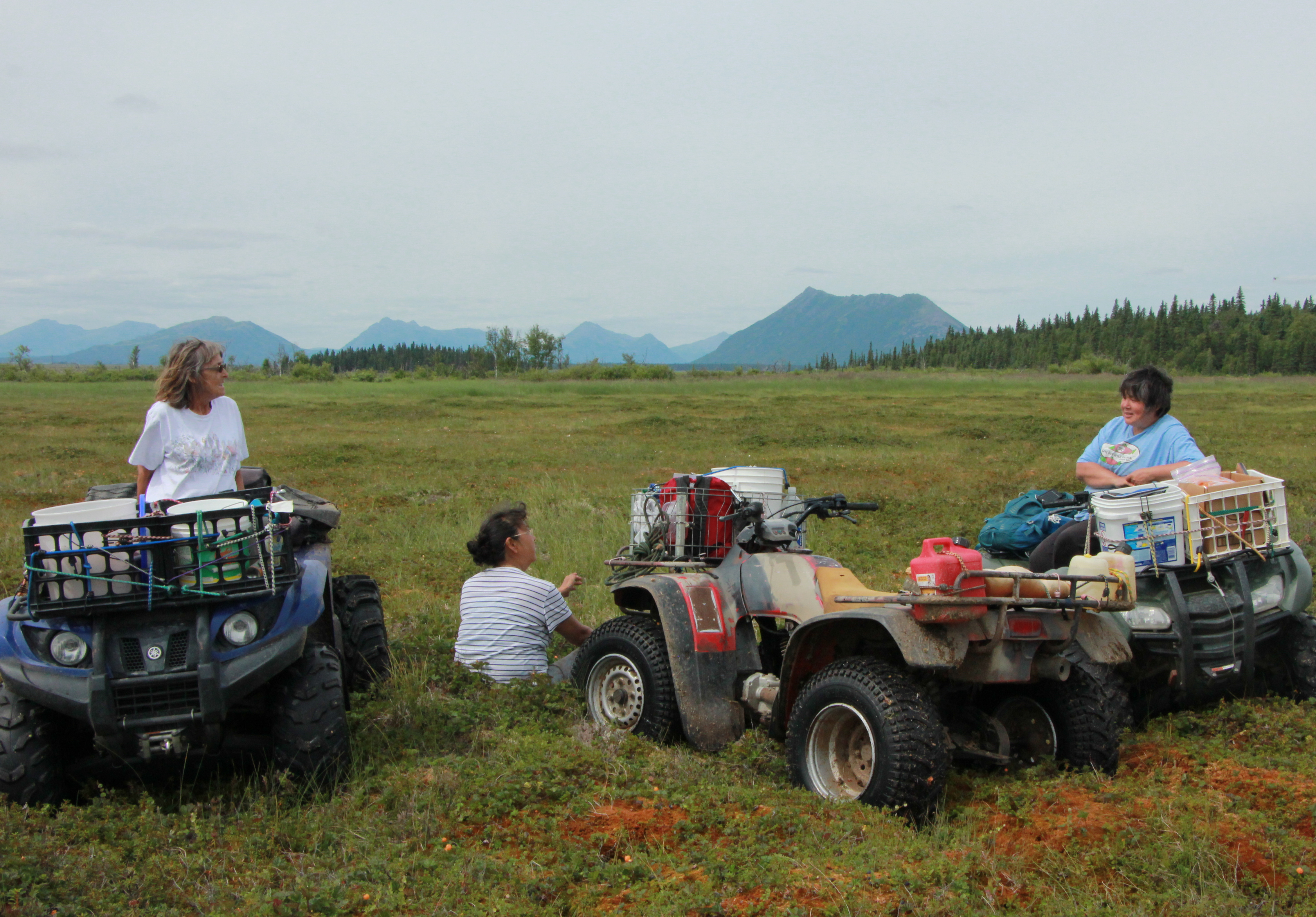
Judy Samuelson, Liz Johnson and Kim Williams take a mid-afternoon rest after leaving one patch of berries picked nearly clean. Credit Hannah Colton/KDLG
Judy Samuelson, Liz Johnson and Kim Williams take a mid-afternoon rest after leaving one patch of berries picked nearly clean.
Credit Hannah Colton/KDLG

Today’s destination is a prime berry spot the ladies have visited before. We arrive to find the flats thick with the big, bright orange berries that Williams says they favor.

“We want them big. We leave the small ones,” she says. “We don’t like them white, we don’t like them with black dots, we we don’t like them hard so you have to clean ‘em … they have to be just right.”
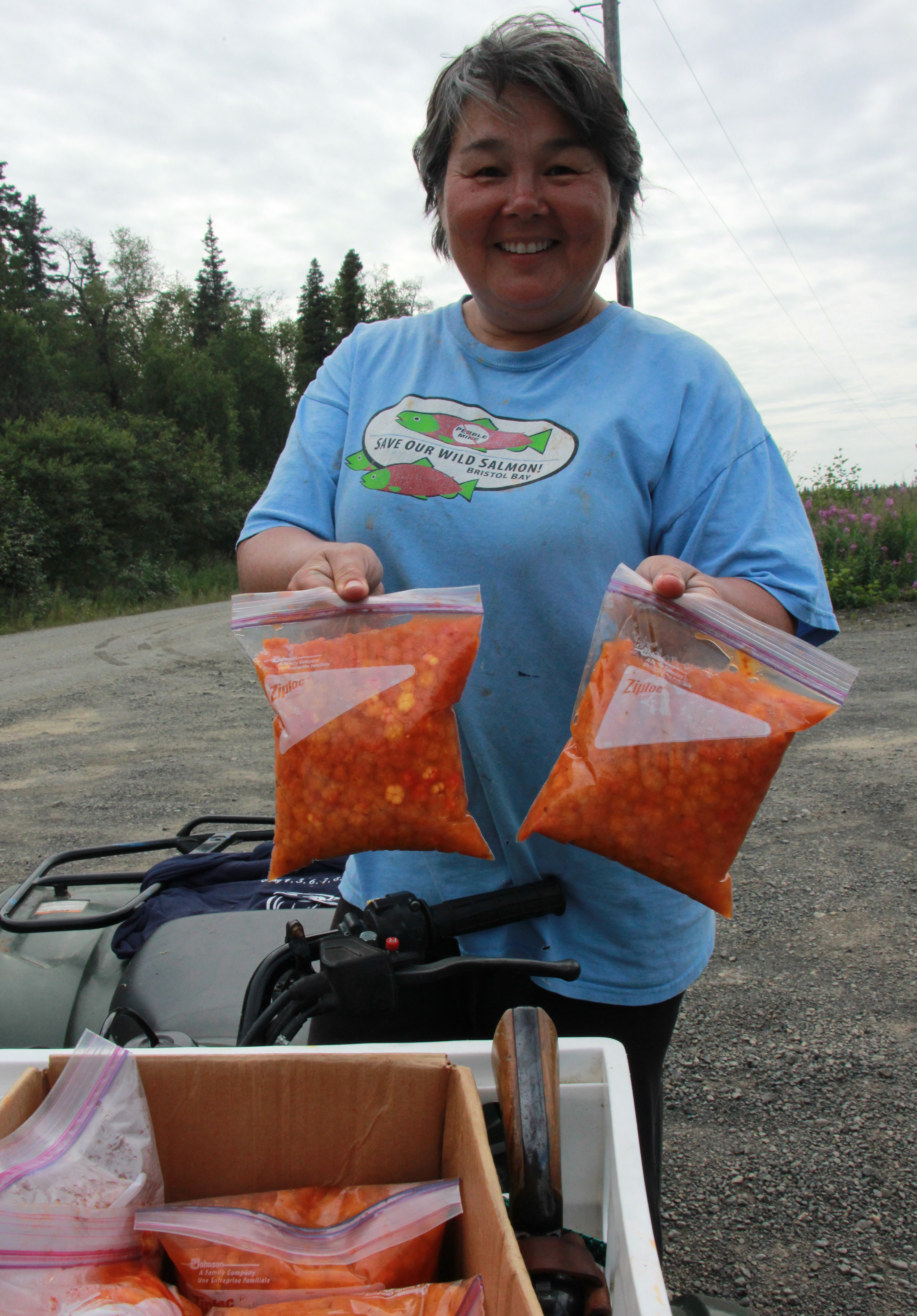
Kim Williams with part of a day's haul. Credit Hannah Colton/KDLG
Kim Williams with part of a day’s haul.
Credit Hannah Colton/KDLG

These flawless berries could sell for $100 a gallon or more, but Williams says they won’t put them on the market.

“We never sell. I did sell one year, my old ones, when I had like 80-some bags,” she laughs. “We’re not hoarders!”

William’s says her berries will go straight into her father’s freezer. Her family will enjoy a year’s worth of akutaq, a dessert made with berries mixed into shortening and sugar.

“Usually for my family we take out two bags when we’re going to have a meal of salmonberry akutaq, and I take blackberries or blueberries and I add it and it stretches it,” she says. “Now auntie Judy, she likes just strictly salmonberry akutaq. But she’s a picking fiend!”

The three women pick the area for several hours, with a light breeze keeping the bugs off. Before leaving for new territory, they try to tally up their haul from this one spot…

“Forty-four!” she exclaims. “Eleven gallons! That’s really good! … That’s lots, no wonder our backs are hurting!”

By late afternoon, they’re running low on Ibuprofen and freezer space, making it about time to call it the end of a successful salmonberry season.
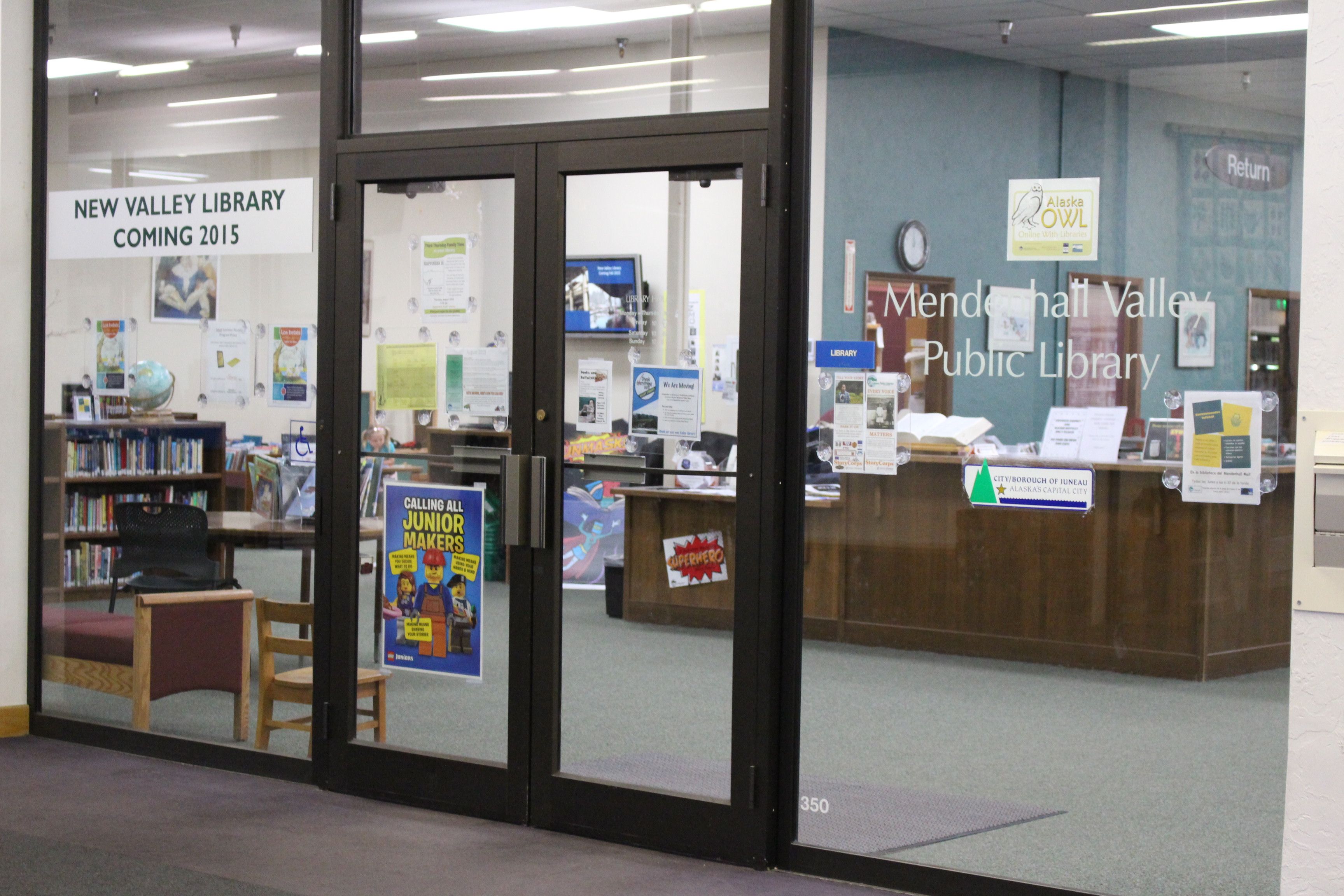
After more than 30 years, the Mendenhall Valley Library is moving out of the mall

The next time Amelia Jenkins reads a book for storytime will be at the library's new location. (Photo by Elizabeth Jenkins/KTOO)
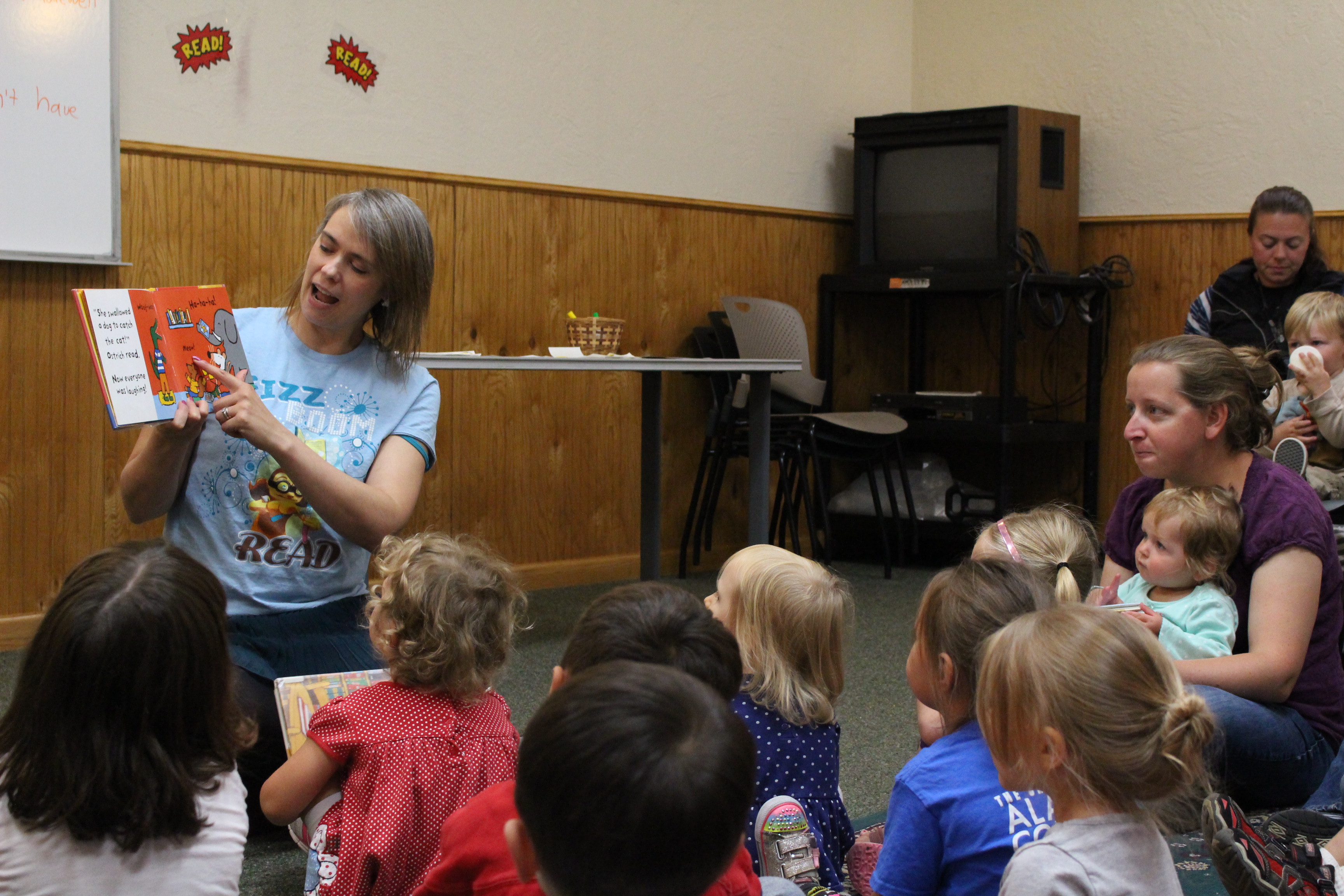
Amelia Jenkins reads a book for the last storytime at the Mendenhall Mall library location. (Photo by Elizabeth Jenkins/KTOO)

Friday was the last children’s storytime at a Juneau library branch that’s been in the Mendenhall Mall for over 30 years. The days of checking out books and grabbing a slice of pizza are over because the branch is moving to a new location at the end of the month.

About 15 kids are sitting crisscross applesauce listening to Amelia Jenkins read a picture book. She works at the Mendenhall Valley Library.

Her audience is sometimes captive, sometimes not. But she knows how to handle the crowd by breaking into song and dance.

“There’s some weeks when everybody wants to sit on a lap and listen quietly and these other weeks like today when everyone wants to do the hokey pokey straight for half an hour,” Jenkins says.

Kids can check out the books at the end of storytime, which is exactly what library staff want. Left behind materials have to be transported to the new location so patrons are encouraged to check out up to 40 books.

You can check out all the Harry Potter, Game of Thrones, Hunger Games and Fifty Shades books and you’d only be halfway.

M.J. Grande, the youth services librarian, has worked for the library for 15 years and is excited about the new 20,000-square-foot space at Dimond Park.

It wasn't uncommon to see a library in mall in the late 70s early 80s, says M.J. Grande. (Photo by Elizabeth Jenkins)
The advent of the mall library was in the late 70s early 80s, says M.J. Grande. (Photo by Elizabeth Jenkins)

It cost $14 million to build, paid for by a grant from the state and city sales tax. Another million was contributed by the Friends of the Juneau Public Libraries.

Of all the perks, there’s one Grande says she’s looking forward to the most.

“Space. We are almost doubling our footage here so the kids programing is a really dominant part of the library,” Grande says.”We have these wonderful reading cubicles that are extra padded and cozy.”

There’s also wheelchair accessible reading nooks and a room that has its own teen advisory committee to decide function and decor. But probably the biggest difference is it won’t be sandwiched between a restaurant and a tanning salon.

Grande says not too long ago, it wasn’t uncommon to see a library in a mall.

“You know, kind of in the 70s when malls were really getting established as a one-stop shop, you can do your shopping, you can do your library, you can do your other business. That role in the evolution of malls has changed.”

The new library building at Dimond park. (Photo courtesy of Friends of the Juneau Public Libraries.)
The new library at Dimond Park is expected to open in November. (Photo courtesy of Friends of the Juneau Public Libraries)

For Letha Bethel, the old location has been convenient. She’s a stay-at-home mom with two kids and another one she watches during the day.

She says the kids love dancing and singing at the reading circle, the toys in the children’s section and of course the books.

They walk to the Mendenhall Mall on sunny days and Bethel says she’s sad the library will be closed for a few months as it moves to its new location.

“It’ll be nice though that it’ll be bigger hopefully and more space to run around. They’re excited to see it and it’s right by the pool,” Bethel says.

But will she check out 40 books?

“For their sake, probably not. Because I don’t know if they’d last at our house.”

Bethel says she might consider checking out one or two before the Mendenhall Valley Library closes on Aug. 31, opening back up at Dimond Park sometime in November.

Rain or shine, Dave Seaman delivers the mail to Kachemak Bay communities

Dave Seaman has been delivering mail to small communities around the Kenai Peninsula for 30 years. (Photo by Shady Grove Oliver/KBBI

Like many rural areas, the south side of Kachemak Bay doesn’t get traditional mail service. Instead, communities rely on a mail boat to deliver the mail. It’s the kind of job that attracts a special type of person who’s willing to make the voyage across the bay — rain or shine, snow or ice — twice a week year-round. Dave Seaman is the man who’s been doing just that for the last 30 years.

Seaman lives up to his name. He’s a lanky 60-something fisherman. He wears durable pants and old sweaters and sets his week around the days when he delivers the mail.

“I wouldn’t know what day it was if it wasn’t Tuesday or Friday to hang it on,” he says.

We meet at the Homer post office to pick up the mail. He doesn’t really like coming to town; that’s why he lives across Kachemak Bay in Little Tutka, his one stop on today’s mail route.

When he shows up, he brusquely walks in the back door, punches his time card and heads straight for a tray marked “RED MOUNTAIN” — the name given to Little Tutka’s mail drop back before the old chrome mine shut down.

In recent years, the name has been reduced to the code RDO, a casualty of modern technology.

He tosses mail in different piles. He knows to forward a few letters to Homer addresses for Tutka residents summering in town.

“Oh, I know everybody,” he says. “I know where they are in the summer and in the winter and everything else.”

He stuffs everything into a large yellow mail bag and hightails it out the door.

“All right, that’s it. We got all our stuff; we can go head across the bay. The fun part begins,” he says.

We head down to the harbor and onto his old, green and white beast of a boat. As soon as we’re out on open water, he relaxes and starts to smile.

“I started it in 1987, so that makes almost 30 years. It’s kind of the thing that holds my whole life in line, really,” he says.

Less than an hour later, we arrive in Little Tutka Bay. Seaman grounds the front of his boat on the rocks and like a seafaring Santa Claus, tosses the mail sack over his shoulder and jumps off the bow.

The mail shed is a shack-like cabin haphazardly perched on a steep incline not too far above the water.

“Well you stumble up the beach, and then you climb up on a rock, and then you go up on top of this log and then there you are — you’re right in the back door, which the bear tore off,” he explains.

Inside the shack, there’s a big fish tote.

He’s lucky that today there’s only a handful of mail. He once served as the de facto moving company for a family coming from Bethel, hauling everything from the boat to the shack.

“That was fun. That was the biggest collection of Blaz-o boxes I’ve ever seen,” he says.

Once he’s done, he hops down. Back on the beach Seaman stops and looks around.

“Listen, there’s no noise here. There’s no noise here — no noise of tires on the highway. That’s the main thing, it’s just quiet and beautiful,” he says. “I lived over here for 20 years when I first got to the Homer area, raised a family here and always missed it when we moved to town to put the kids in school and all that. So I lived 20 years in town and now I’m back. This is my home.”

He says his job pays for his boat habit, keeps him connected to his neighbors and friends, and allows him to give back to his community.

“If I didn’t have somewhere I had to go, I’d stay back here and never go out, probably turn into a hermit,” he says. “It’s just fun. I’d probably do it for nothing, but don’t tell them I said that.”

And he believes in the mail. It’s more personal, perhaps more genuine, and it’s managed to hang on through the hustle and bustle of modern life. Little Tutka resident Gregor Welpton agrees.

“David provides a vital link for us here. He’s the guy who, no matter what’s going on in the bay, in the middle of winter, or in the beautiful days of summer, goes across and provides the link for us to pay our bills and get what comes in the mail,” Welpton says.

Back on the shore, it’s time to head out. Seaman still has some letters for his neighbors that he’ll hand deliver on his way back home to his little cabin.

We haul ourselves back onto the bow of his boat. As he starts it up, he bemoans the loss of the old Little Tutka mailing address once again — Red Mountain via Homer replaced by plain old RDO, the code for the nearest airstrip miles away.

“It’s not a really good fit, but it’s what we got. Maybe we could get it changed back. I always thought it would be fun to have our own ZIP code and get a stamp so we could be one of those places that people collect postal stamps from,” he says. “Maybe that would put us on the map.”

He reconsiders.

No … I don’t want us on the map. What am I saying?”

He says he’ll do this job until the day he dies — providing an important connection for the folks who live out here and hoping they won’t have to get too much more connected as the years go by.

Fish waste-to-compost project starting in Dillingham this month

Around this time next year, Dillingham gardeners should have access to compost made from the waste of locally caught salmon. A grant-funded project is taking off at the local landfill in August, and it will need some good fish waste to get going. 

“I’m calling it the Fish Waste Compost Project,” says Gabe Dunham, the Marine Advisory Program Agent in Bristol Bay. Dunham inherited the project and is nudging it past the planning phase this month.

Producing the compost will take a fair amount of fish waste this year, and the plan calls for a focus on making use of subsistence fish waste. Though it’s a little late in the season for most people’s fishing efforts, Dunham is hoping that the scraps from whatever salmon are caught, likely silvers, and ends up in a separate waste bin marked UAF Sea Grant that’ll be available by the second week in August.

The City has allowed the project to use a portion of a closed landfill cell, and final approval from the state is still pending.

Dunham says the composting technique has been proven at other projects. An electric fence should help deter bears and covering each compost row with top soil and fabric should cut down on the stench.

Since the project is grant funded for now, the compost will be free next year and probably up for sale after that.

JPD closes racial slur graffiti case pending new information

(Creative Commons photo by PiXeL_Fleck)

Without any leads or suspects, the Juneau Police Department has closed an investigation on a vandalism case that involves racial slurs.

Spokeswoman Erann Kalwara says the department received at least three reports of graffiti on Mendenhall Loop Road on Wednesday morning. The Juneau Empire reports the vandalism began on Haloff Way and continued toward the Mendenhall Glacier to Back Loop Road.

Kalwara says there were 10 separate instances of words and phrases found on fences, electrical panels and other private and public property.

“Some of them were racially influenced. Some of them, honestly, I don’t know what they mean. They were a little bit nonsensical, perhaps initials. But a few of them were definitely racially influenced,” Kalwara says.

Kalwara says officers responded to the scene, took photographs and interviewed multiple people in the neighborhood. No one came forward with any information on suspects.

“It’s pretty common for this to be activity that’s conducted by teenagers. There can be different motivations for it – someone looking for attention, someone who’s bored, acting out. There are times when it is racially motivated and there’s times when it’s just somebody with nothing better to do with their time,” Kalwara says.

The graffiti totaled more than $900 in damage. Kalwara says most of it has been cleaned up by the homeowners and the state Department of Transportation.

Kalwara says JPD will further investigate the case if any new information comes forward.

Can A 32-Year-Old Doctor Cure Baltimore’s Ills?

Leana Wen hands out awards to business owners for their efforts to support breastfeeding at the Baltimore City Health Department on Tuesday. Meredith Rizzo/NPR
Leana Wen hands out awards to business owners for their efforts to support breastfeeding at the Baltimore City Health Department on Tuesday.
Meredith Rizzo/NPR

Neighborhoods in Baltimore are still struggling to recover from the riots that broke out following the funeral of Freddie Gray, who suffered a fatal injury to his spine while in police custody. In the aftermath of the unrest, we here at NPR spent many hours trying to understand the raw anger on display. We looked at police brutality, economic disparities and housing segregation in Baltimore.

Our conversations eventually led us to Leana Wen.

Wen, a 32-year old emergency physician, had become Baltimore’s health commissioner just a few months earlier. With Baltimore leading the news day after day, she seized the moment to get her message out, including on this blog, where she has been an essayist.

She wrote about the health department’s immediate response to the unrest, making sure hospitals were protected and that staff and patients could get to them, and that ensuring seniors could still get prescriptions when their pharmacies were looted and burned.

After calm was restored, she turned her focus to the city’s more chronic issues. For years, she argued, Baltimore has been traumatized by poverty, violence and drug abuse, problems that can be treated through public health.

“We have to make the case that actually, everything comes back to health,” she told us in May. “My hope is that we can really make Baltimore into a model for the rest of the country to follow when it comes to treating the core roots of our problems.”

That left us wondering, does everything actually come back to health? If so, what can you accomplish in city government? And can a health commissioner really make a difference?

Starting today, we’re going to try to answer those questions. We’re following Leana Wen over the coming months as she takes on some of Baltimore’s thorniest problems. One thing already clear is that she’s in a hurry.

Deputy Commissioner Olivia Farrow, a veteran at the health department, laughs remembering how Wen was holding meetings before she’d even officially started the job.

“Someone was telling me a joke,” she says. “It’s not ‘Wen,’ it’s ‘Went.’ I mean, she’s already ahead of you and gone, trying to make the fix.”

New to Baltimore, Wen is relying heavily on Farrow and other senior staff to help her navigate the often murky politics of the city. Farrow believes Wen’s lack of political experience is a plus.

“There’s something about people who come from the outside,” she says. “Just their ability to kind of say, ‘Hey, let’s think about things differently.’ A lot of times that can rub people the wrong way. Some people survive that and some people don’t.”

Leana Wen was born in Shanghai and came to the United States at the age of 8. Her parents were Chinese dissidents who sought political asylum here, first landing in Logan, Utah, and a couple of years later moving on to Los Angeles. They lived in Compton and East Los Angeles, neighborhoods Wen describes as not so different from the poorer parts of Baltimore.

As a child, she dreamed of becoming a doctor. She entered college at the age of 13 and majored in biochemistry. After medical school, however, she was confronted by a sad reality. In the emergency room you can resuscitate victims of gun violence and overdose, she found, but you can’t prevent them from returning over and over again.

“It is not a satisfying cycle for us to be in, when we’re treating problems at the very end of those problems, rather than preventing them from happening in the first place,” she recently told her staff.

This summer, homicides in Baltimore have soared to levels not seen in four decades. The heroin epidemic is showing no sign of abating, and throughout the city there is a sense of frustration that no matter what happens, and no matter how many leaders speak out, nothing changes.

So Wen is asking her team to think big, to come up with innovative approaches to these festering problems. She believes that given all the focus on Baltimore since the death of Freddie Gray, this is a rare opportunity to act.

“I don’t want that window of opportunity to close for us,” she says. “I don’t want to be the person who isn’t leading us toward this vision at a time that’s so critical in Baltimore’s history.”

Copyright 2015 NPR. To see more, visit http://www.npr.org/.
Read Original Article – Published AUGUST 06, 2015 3:26 PM ET
Site notifications
Update notification options
Subscribe to notifications