A drive-by shooting occurred at a Juneau couple’s home early Thursday morning near Point Lena Loop Road. No one was hurt, but an item close to the home was struck. It has left the family shaken up, and wondering if it may be a form of intimidation.
Brian Weed received a panicked phone call from his wife while he was working at Lemon Creek Correctional Center and immediately dialed emergency dispatch.
He says his spouse, Mareta Bates Weed, was too shook up to comment, and he feels like the night shift patrol dropped the ball.
When Juneau police did arrive, they searched the area but didn’t check in on Weed’s wife or take evidence photos.
“Didn’t do what they were supposed to,” he said. “This would have been nice being a correctional officer. You know, you get death threats from inmates often. They threaten to hurt your family and stuff and as a fellow law enforcement officer and I’m stuck at work, it really would have been nice if they would have supported my family.”
Lt. David Campbell says an officer followed up Thursday afternoon after Weed complained on Facebook about the response.
“In talking to the sergeant who went out and talked to the homeowner, we did have a report of a white Jeep in the area that was driving erratically,” Campbell said. He couldn’t confirm it was related to the gunshots.
But Weed is concerned that, several hours after the crime, any evidence was washed away by the morning rain. He’s offering a cash reward to anyone who can identify the suspect.
“I’d be willing to give several hundred dollars to whoever else was in that vehicle who knows who pulled that trigger at my house.”
Weed intends to turn that information over to the cops. Juneau police are conducting their own investigation.
Editor’s Note: The Facebook complaint to police response was made in the comments section of the post.
Christine Quick, 23, and CJ Umbs, 21, competed in the Special Olympics World Games in L.A. (Photo by Michelle Umbs)
Two Juneau swimmers returned from the Special Olympics World Games in Los Angeles with five medals. CJ Umbs and Christine Quick competed alongside 6,500 athletes with intellectual disabilities from around the world.
Juneau swimmer Christine Quick says Michael Phelps is taller than she thought he was. The most decorated Olympic athlete of all time took pictures with Special Olympians and jumped in the pool for a swim.
“What was that like?” I asked.
“Happy,” Quick says. “Our team was crazy to see him.”
Quick earned two gold medals and a seventh place finish in backstroke and freestyle events. She says the cheering from the crowd helped motivate her. She’s never received so much attention.
“Everybody said, ‘Yay!’ People took pictures of us,” Quick says.
CJ Umbs is another Juneau swimmer. He received gold, silver and bronze medals, and a fourth place ribbon in backstroke and freestyle events. His mother Michelle Umbs is a coach for Juneau’s Special Olympics program.
“The finish on the fourth place ribbon and the finish on the silver medal, he was just as happy as a clam both times,” Umbs says. “It didn’t matter. He was just so glad to finish.”
Umbs was in L.A. for the games with her husband and other family members. She watched every event her son and Quick competed in.
“The whole week was amazing watching both of them act independently and responsibly. But to see them both as young adults get up on a stage, accept their medals in an environment where they were treated with a lot of respect is over the top for me,” Umbs says.
CJ Umbs and Christine Quick were part of Team USA with fellow Alaska athletes Garrett Stortz from the Mat-Su and Brittany Tregarthen from Kodiak. Stortz competed in golf and Tregarthen in powerlifting.
All four Alaska athletes medaled, but Jim Balamaci says competing in the Special Olympics isn’t about winning.
“It’s really about doing your personal best and really performing and training,” says Balamaci, president and CEO of Special Olympics Alaska.
Prior to 1968, people with intellectual disabilities didn’t have a sports organization.
“Now, almost 50 years later, we transcend the world,” Balamaci says. “People with intellectual disabilities can achieve and that through sports, there’s no better way of gaining friendships and confidence that come back to your community and to your school.”
Both Juneau athletes get to take a short break from training as they enjoy the afterglow of the World Games. Quick will start swimming again in the winter and Umbs will start bowling in a few weeks.
RSVP patrons enjoy the drag performances during Monday night’s event. (Photo by Lakeidra Chavis/KTOO)
On Monday afternoon, nearly 2,000 people arrived in Juneau for their first stop on the 30th anniversary RSVP Vacations cruise. The cruise line caters exclusively to gay and lesbian people.
The Southeast Alaska LGBTQ+ Alliance, also known as SEAGLA, hosted an event for cruise patrons at the Imperial Saloon downtown. Nearly 200 patrons mingled, drank and played billiards during the 2-hour event.
SEAGLA decorated the outside of the Imperial with various gradient flags from the LGBT community, including the pride, bisexual, transgender, leather, bear flags. (Photo by Lakeidra Chavis/KTOO)
“It’s just important to remember that we are in the community, that we’re neighbors, but also to welcome people who are traveling, who might be looking for community,” says Lauren Tibbitts-Travis, SEAGLA outreach coordinator.
She helped organize the event.
“It’s one thing to go somewhere that you’ve never been and see the sights, but if you’re going there [and you] immediately identify with [the place], that makes it a much better experience. That’s what we’re trying to do at these events,” Tibbitts-Travis says.
This week’s cruise will take tourists to Glacier Bay, Sitka, Ketchikan and Victoria, British Columbia. Although the passengers are predominantly male, the cruise caters both to gay and lesbian people.
Ticket prices ranged from $900 to almost $3,000. Joe Fallon and his husband David Rodes says the cruise was worth it.
“We’d never been to Alaska and we’d always wanted to do an Alaska cruise, but a straight cruise never seemed like that much because we figured we’d be with a lot of old people,” Fallon says.
Fallon and Rodes, who are both in their late 50s, decided to take the cruise to celebrate paying off their mortgage.
“We met working in the same shopping center when we were like 17 and 18 years old.” Fallon says.
They’ve been together for 39 years, says Rodes.
Both men says they’re most excited to see Glacier Bay.
Sam Wilson, 47, sits in the Imperial with his best friend and travel partner. (Photo by Lakeidra Chavis/KTOO)
For 47-year old Sam Wilson, he decided to go on the cruise because it’s something his best friend has always wanted to do.
“He actually wanted to go for a very long time, and we finally found time to go. We travel a lot, this is like my fourth cruise. I did a couple in the Caribbean and a Mediterranean one, so this was like on the bucket list — definitely one to come and see,” Wilson says.
Wilson and his friend have traveled everywhere from Egypt to Greece. He says the cruise is like a party every night and there’s always a chance to meet new people.
Halfway through the event, four local drag performers took the dance floor to entertain the crowd. Performer Vanessa LaVoce-Kellie — who preferred to be identified by her stage name — was one of them.
For her the event symbolized a larger effort to create a more inclusive community.
“I performed tonight because there’s not very many opportunities to do drag here in Juneau; it’s been getting a lot better. We’ve been having more exposure, but any chance that I get to step out inface and give somebody a show, I’ll take it,” La-Voce-Kellie says.
For LaVoce-Kellie, the bigger the drag queen presence in Juneau, the better.
“These events give people that safe place, and help us to build the conversation for more acceptance and tolerance. The more you can do for love the better,” LaVoce-Kellie says.
The cruise left late Monday night to travel to its next destination, Sitka, before making a stop in Glacier Bay.
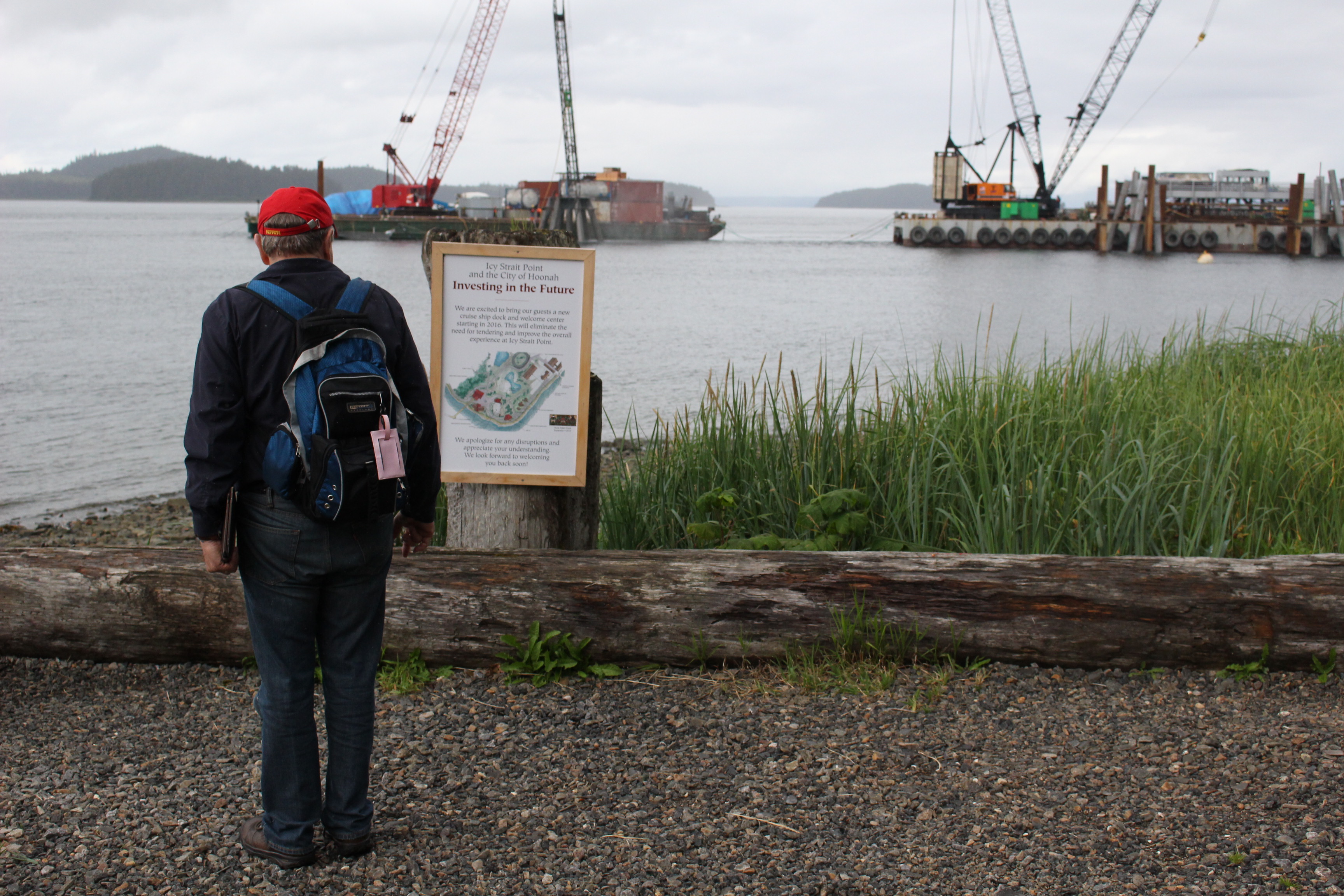
The location of the new dock at Icy Strait Point. (Photo by Elizabeth Jenkins/KTOO)
The final pilings for a new cruise ship dock are being driven at a Hoonah tourist attraction, marking an end to the nearly decade-long saga that divided the community. The publicly financed dock is being built where it serves a local Native corporation’s interests, only indirectly benefiting residents — although many are also shareholders.
On the grounds, tourists wander in and out of a historic salmon cannery turned museum. They skim the treetops on more than a mile of zipline and bask in front of a crackling wood fire that an employee keeps going.
Tyler Hickman is the vice president of Icy Strait Point, owned by the Huna Totem Corp. He says it’s important to maintain the cannery’s off-beat charm.
“It just starts feeling fake when you overdo something,” he says. “We try to make sure that everything we do is authentic.”
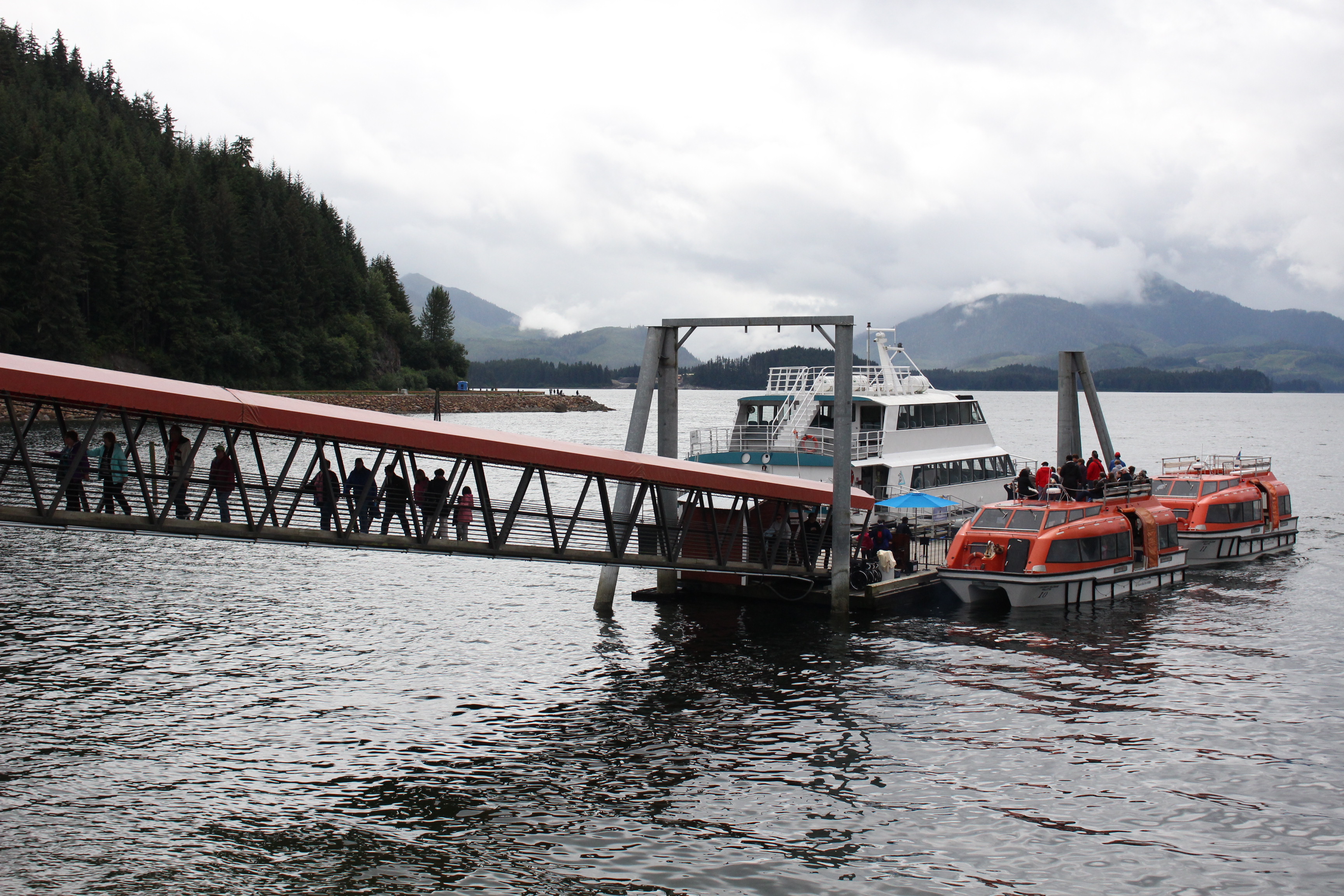
Tender boats drop off passengers from the ship. (Photo by Elizabeth Jenkins/KTOO)
Part of that is making sure visitors feel comfortable when they arrive and leave. About 150,000 cruise ship passengers travel to Hoonah each year. To get to Icy Strait Point, they have to schlep over on a small tender boat. There’s no place for the big ships to dock.
Hickman points to 60 people on a cruise ship waiting for a tender to transport them to shore. In the future, he says, those passengers will be able to grab their raincoat and wander off the boat on their own.
From there, they could walk through second-growth forest. Not everyone is as enchanted with the location of what Hickman estimates is a $22 million dock, paid for primarily by a grant from the state.
Ken Skaflestad is a shareholder in the Native corporation. He says before the cruise ships started arriving back in 2004, the village felt like a different place. Its population was around 750.
“I remember a day when somebody might wear their pajamas down to pick up the newspaper or groceries on a Saturday morning. If a cruise ship’s in town, that’s changed now,” he says.
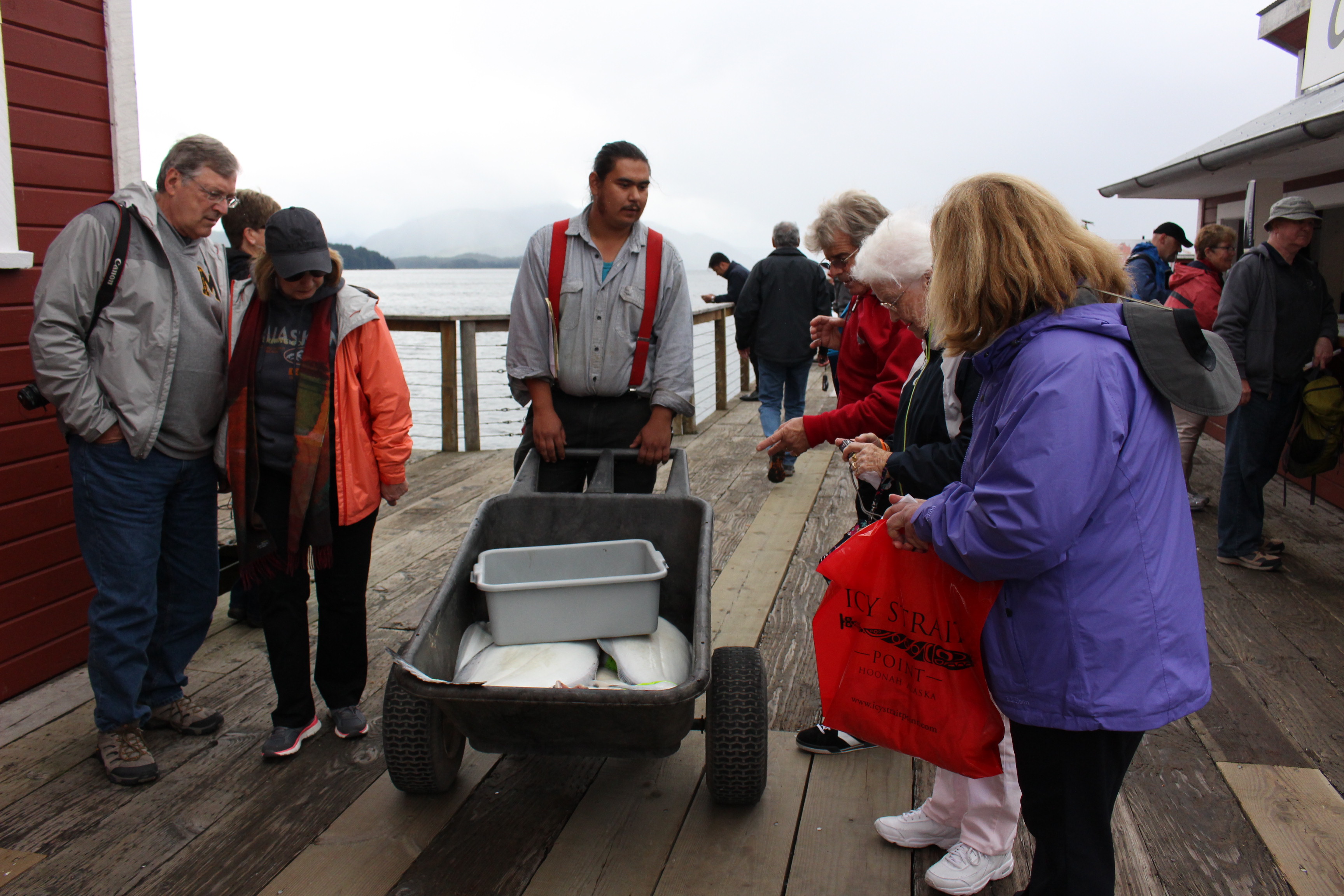
An employee in uniform answers tourists questions about a real halibut carted around the boardwalk. (Photo by Elizabeth Jenkins/KTOO)
A mile past Icy Strait Point’s traffic gate is the city of Hoonah. Tourists shuttle through for bear watching tours and to ride the zipline.
Back in the mid-2000s, the city proposed a multi-use dock located closer to the city center.
“This commercial dock that was going to help with barging, that was going to help with freighting, was going to be a place for fishing boats to tie up to,” he says.
Cruise ships weren’t the main focus, but Skaflestad says the conversation shifted after the success of Icy Strait Point as a tourist destination. A public-private partnership was created. The state put in $14 million to build the dock; the corporation put in $8 million. Although the inclusion of cruise ships was decided, the location of the dock wasn’t.
Skaflestad says the Icy Strait Point developers disagreed with where the community wanted the dock, which was about 800 feet toward town from their existing facility.
The city selected Shaman Point. He says the argument became not only about where it should be, but also what: a multipurpose dock close to downtown or a cruise ship dock on private land.
“I can say that I was one … that adamantly took opposition to that whole initiative.”
And the town, he says, was split down the middle.
“I refer to it as World War III. It was horrible,” he says.
A Royal Caribbean executive sent a letter to the city stating that if the dock was built at Shaman Point, cruise lines might not moor there. Skaflestad says the cruise ship passenger experience outweighed the community’s interests in the dock.
“The opinion of the customer’s experience was touted to far outweigh the community’s need to all of the other uses other than a cruise ship dock,” Skaflestad says.
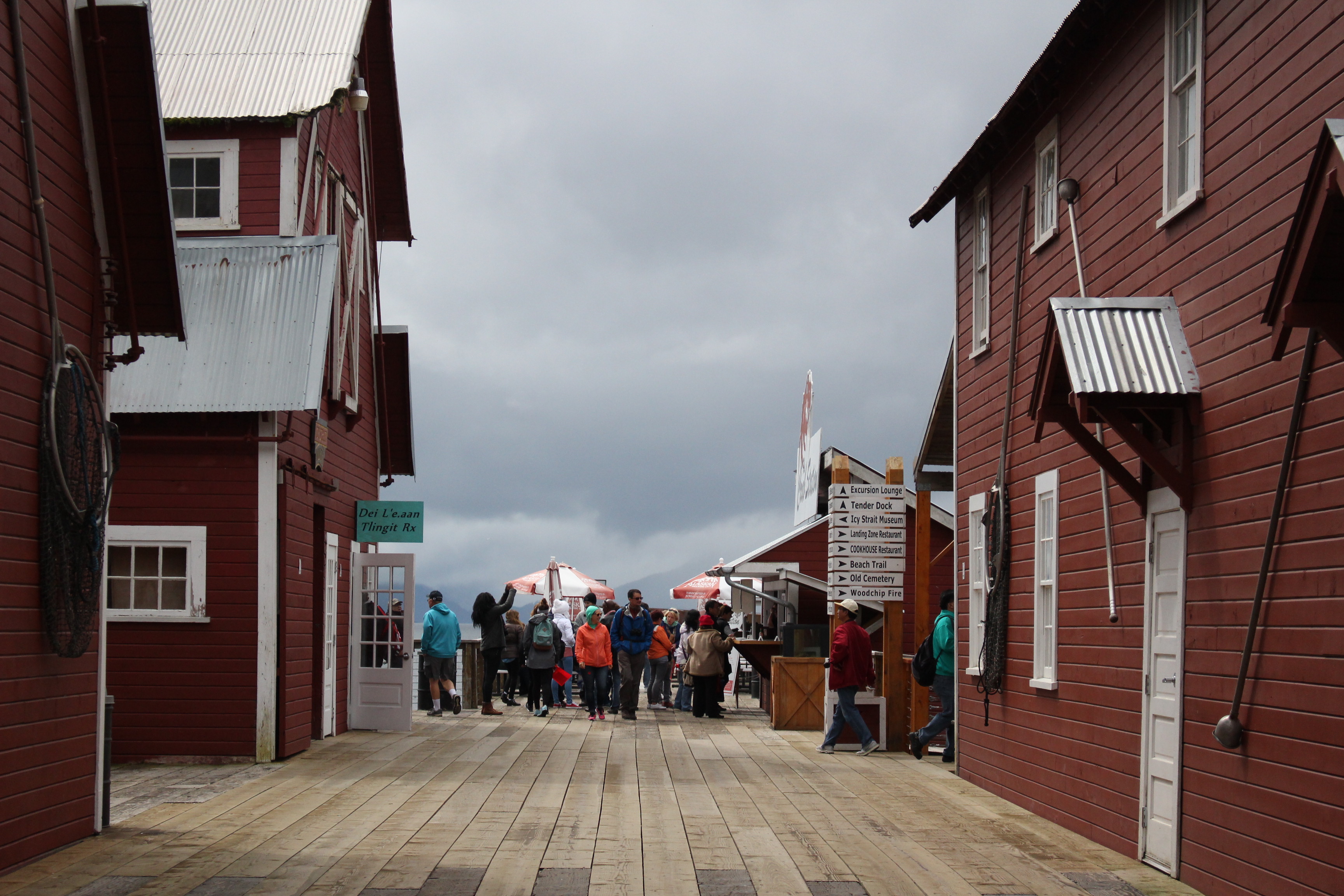
Tourists explore the grounds of Icy Strait Point. (Photo by Elizabeth Jenkins/KTOO)
Eventually, the city council turned over. A new mayor was elected and it was decided the dock would be built at Icy Strait Point. Skaflestad says he never did agree with how everything went down. But when he became mayor in 2014, he wanted to make the best of it.
“I had to really work to be open minded about this and listen to the other points of view. The other opinions were that right now the important thing is the development of this industry and that those other uses are really relatively small uses. They’re not going to be big booms to our economy or anything,” he says. “Truthfully, this dock, it’s primarily income that’s going to come through the cruise ships.”
As the final pilings go in, Tyler Hickman says there’s no need to discuss what happened in the past.
“To me, it’s about today. When you go and walk around the corner, it’s being installed where it is and it’s in the right place,” Hickman says. “The experience the cruise ship guest is going to have is going to be the best in the world.”
The new dock could attract more cruise lines such as Disney, which would mean more visitors to Icy Strait Point and Hoonah.
Skaflestad says he’s trying to be welcoming. He leads the bear watching tours when they get overbooked. He says before, the locals just wanted the tourists to pass right through.
“This metamorphosis has happened and the town is saying ‘I can make a buck here,’ ‘Hey, I’m finding a little niche over here,’ or ‘I’m just going to sit here like I used to sit and watch the birds on the beach and now I’m going to watch tourists,'” Skaflestad says. “There’s this significant change that the presence of these visitors has brought to Hoonah.”
The dock is expected to be completed in October just as Icy Strait Point closes for the season.
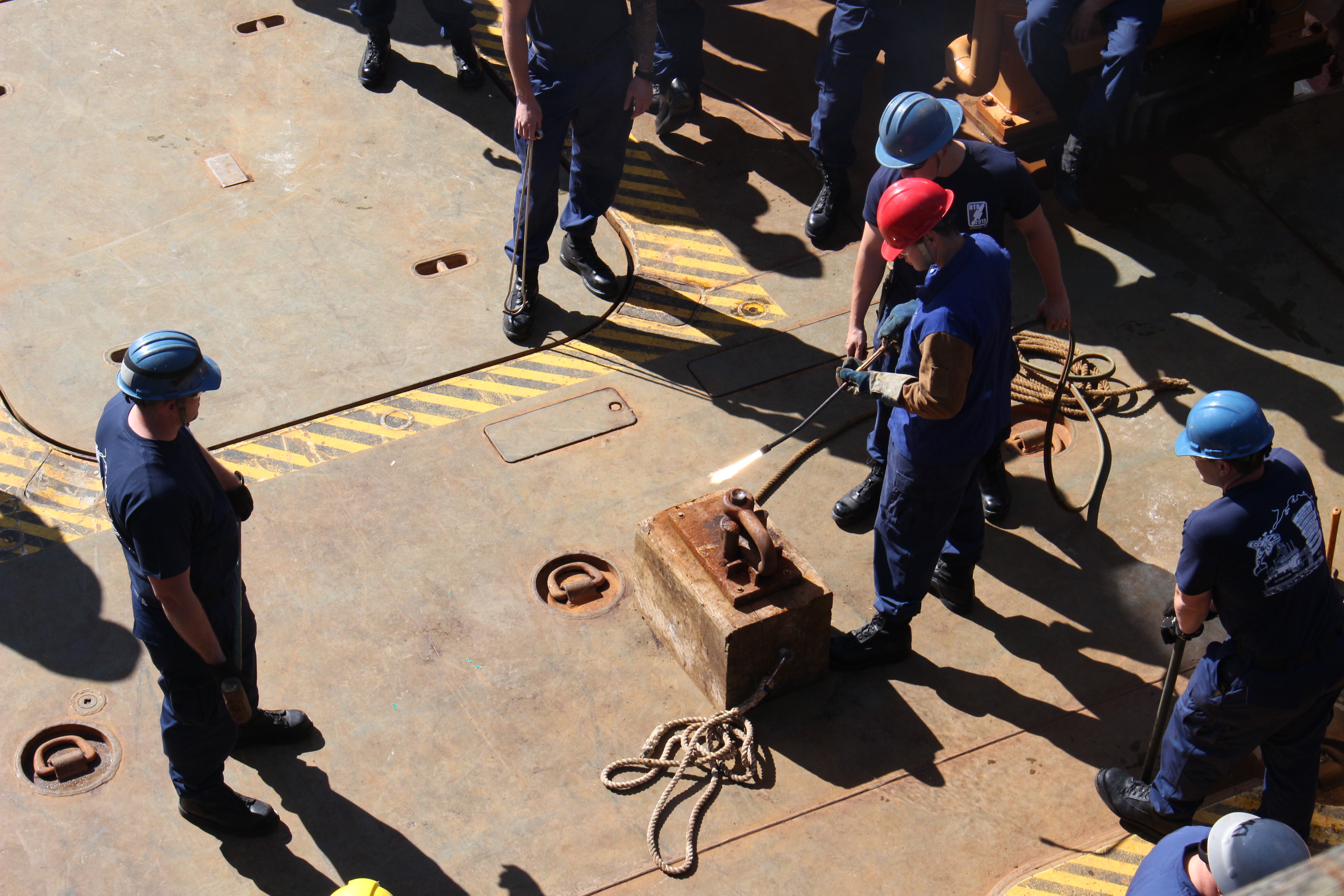
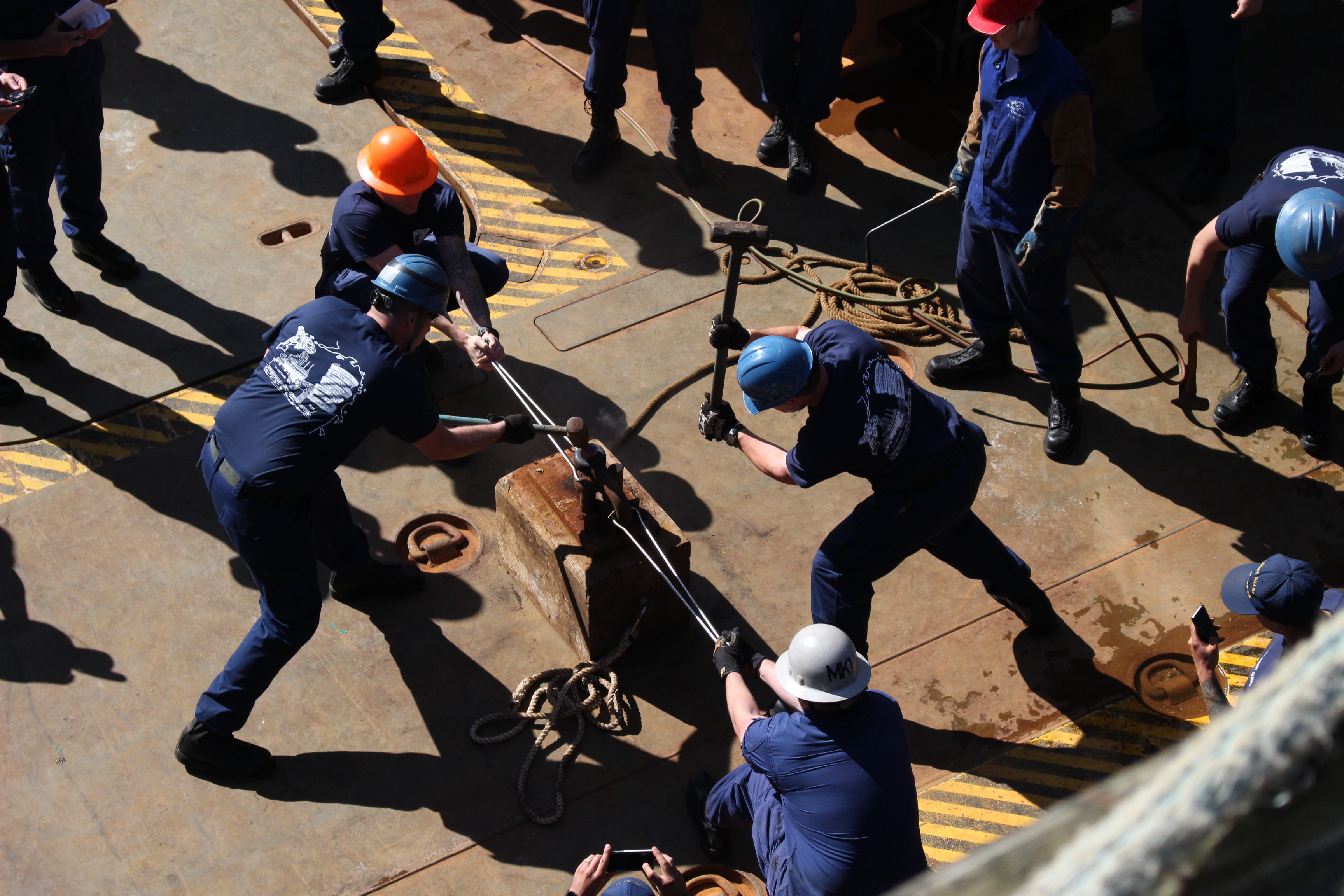
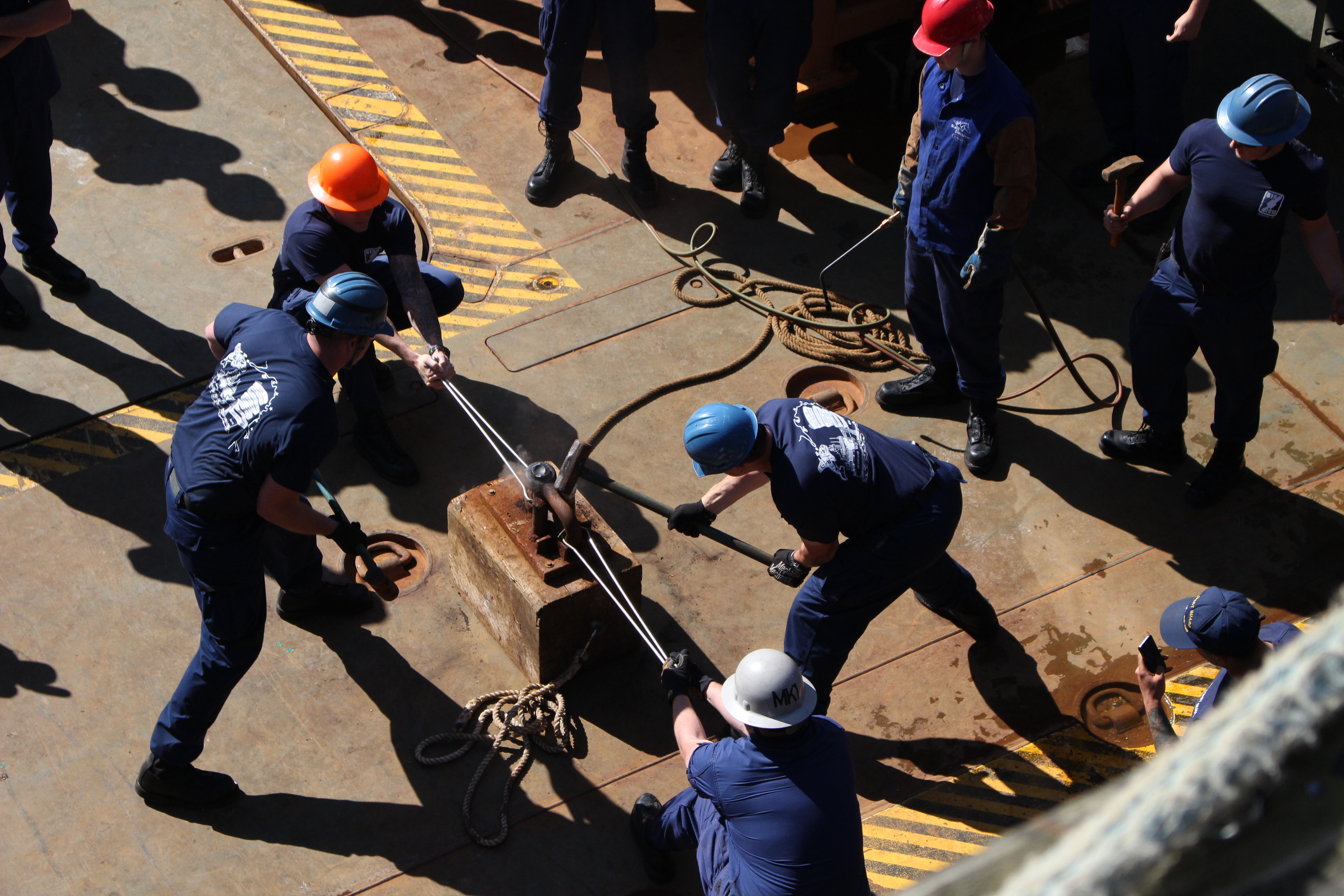
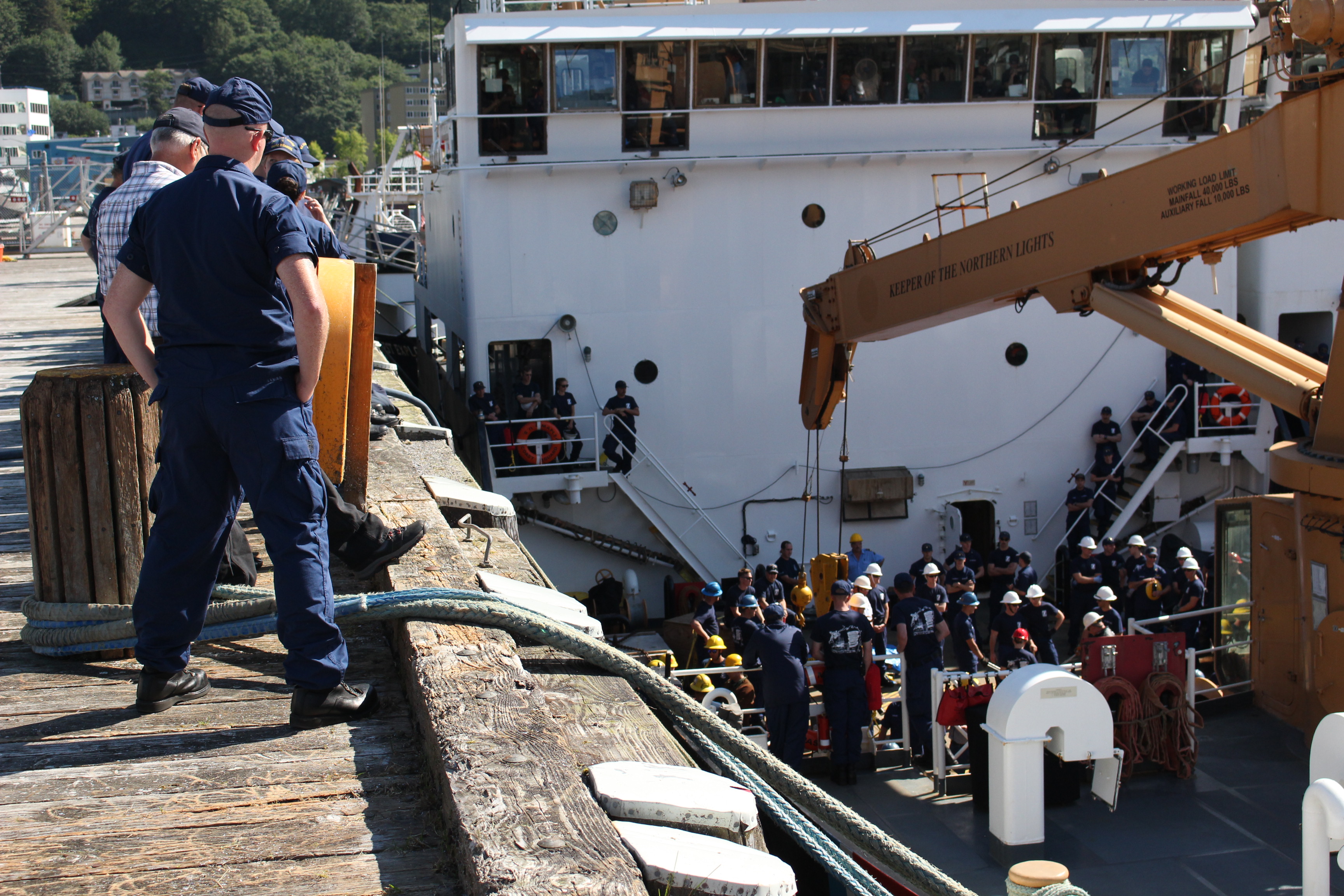
The Coast Guard’s annual Buoy Tender Roundup is in Juneau this week for the first time since 2012. Service members from Alaska, Washington, Oregon and the Canadian Coast Guard are participating. The week is filled with training and intense competition, like Tuesday’s “heat and beat” challenge.
Coast Guard members watch competitors in the heat and beat challenge. (Photo By Elizabeth Jenkins/KTOO)
On Coast Guard Cutter Maple, team members heat up a chain to make it malleable. (Photo by Elizabeth Jenkins/KTOO)
Onlookers cheer as the team beats the chain with a sledgehammer. (Photo by Elizabeth Jenkins/KTOO)
In the field, the maneuver is done to switch out the chain attached to buoy. The Coast Guard sometimes has to do this several times a day. (Photo by Elizabeth Jenkins/KTOO)
(Photo by Elizabeth Jenkins/KTOO)
The Coast Guard is offering public tours of the pier and a buoy tender from 4 to 6 p.m. Wednesday.
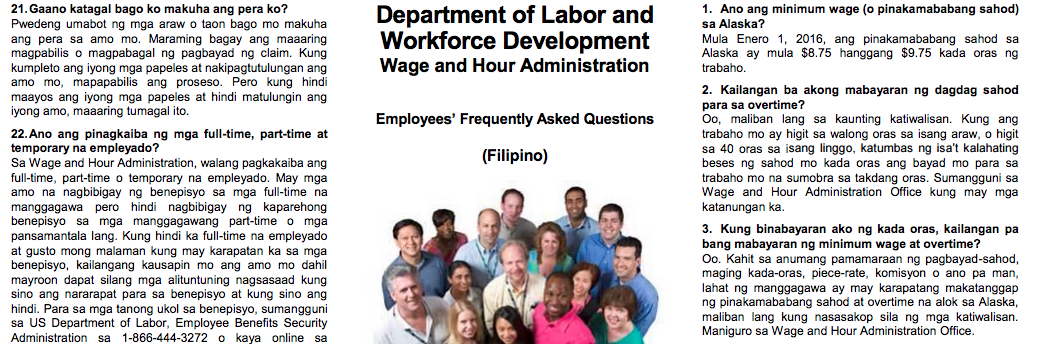
The state Department of Labor and Workforce Development’s ‘Employees’ Frequently Asked Questions” pamphlet in Tagalog.
Not all employees in Alaska speak English proficiently, but the State Department of Labor and Workforce Development wants to make sure that all of them understand their rights. The department recently released several translations of its employee “frequently asked questions” pamphlet in different languages, including Yup’ik, Korean, Spanish and Tagalog. According to the 2010 census, 2.6 percent of Juneau’s population speaks Tagalog at home; for Spanish it’s 2.4 percent.
Kodiak also has a significant Filipino population. In 2010, Asians were the largest racial minority in the Kodiak Borough at almost 20 percent of the population, with Filipinos making up around 17 percent.
The statewide supervising investigator for the Wage and Hour Administration, Joe Dunham, says the 23 questions in the pamphlet are an overview of basic wage and hour laws for overtime and minimum-wage eligible employees.
“What is minimum wage? What about overtime? Who gets overtime? Who does not get overtime? Can I be paid salary? What about my final paycheck?” says Dunham. “Can they make deductions from my wages without my permission? So, it’s just simple everyday wage and hour questions that most of us come into contact with those questions at any particular job.”
While wage theft and labor abuse can occur, Dunham says some workers’ ignorance about United States labor laws could also be a matter of cultural difference.
“What turns out to be common in their culture turns out to be a violation in ours and very often, neither the employer nor the employee even knows about it,” says Dunham. “These questions are just something where employer-employee can look at this and say ‘Wow, I never knew that, maybe I should call up the Department of Labor and sit down and talk about it.’”
In the case that an employee feels they are being taken advantage of, they can report the issue to DOL investigators.
Close
Update notification options
Subscribe to notifications
Subscribe
Get notifications about news related to the topics you care about. You can unsubscribe anytime.