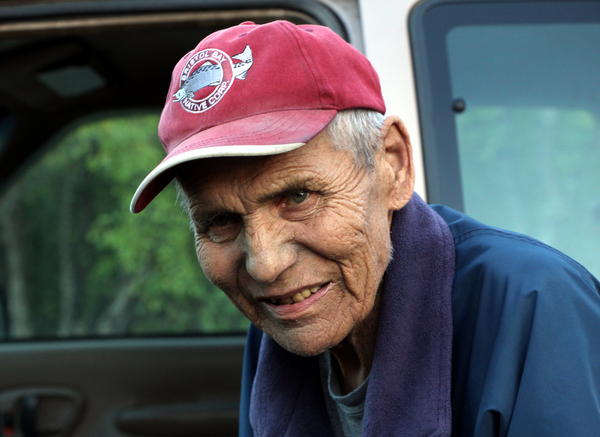
This picture was taken early June, after Ofi and some friends gathered for dinner around a first king salmon of the season. (Photo by Hannah Colton/KDLG)
Bristol Bay elder Hjalmar E. “Ofi” Olson passed away at an Anchorage hospital at the age of 75. Olson was a Bristol Bay fisherman, and was the longtime president, CEO and chairman of the board of the Bristol Bay Native Corporation. He also sat on a number of other boards, commissions, and panels throughout an active career as one of the region’s most prominent leaders.
Olson was battling kidney failure, and his health was deteriorating in recent months. He was medevaced to Anchorage Sunday, and according to a family friend, was taken off dialysis mid-week. He succumbed late Wednesday or early Thursday, surrounded by family.
“I think we all knew that he wasn’t in the best of health, and I just learned very early this morning that he had passed,” said Rep. Bryce Edgmon Thursday morning. “A big shock to everyone, even though we all knew his health was in decline. Very sorry to see him go.”
Edgmon spent Saturday evening with Ofi, driving around town, the harbor, boat yard and visiting subsistence sites all the way down Kananakak Beach.
“We watched a number of the set net boats being launched, and listened to the Fish and Game announcements, and really just had a very nice, quiet, reflective evening,” he said.
Olson remained in good spirits and his mind was sharp, even as his health grew worse and he spent more time at a hospital in Anchorage.
“We were down in the boat yard, and he was naming off all the boats that were still there, and why they weren’t going out, engine problems, whatever was the case. He was absolutely very sharp up until the very end,” said Edgmon.
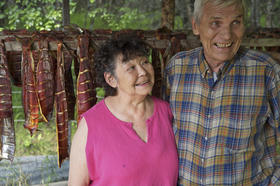
Ofi and Anuska Olson (Photo by Clark James Mishler)
I think his legacy is so rich, and so profound, that it’s only going to grow over time. Ofi was the chairman of the BBNC board, I think, for the longest tenure of any chairman in the history of the state. As iconic figures are known, all you had to say was “Ofi” and people knew who you were talking about.”
As of Thursday morning, there was no information about funeral arrangements. A family friend did say there was consideration of delaying a funeral until after the commercial fishing season.
“I think as time goes on, and his service is held, we’re going to find that a lot of people throughout the state, a lot of Alaska Native leaders, a lot of people in the Native corporation world and elsewhere, are going to be coming to town and paying their respects to Ofi,” said Edgmon.
KDLG reporters Molly Dischner and Hannah Colton contributed to this story.
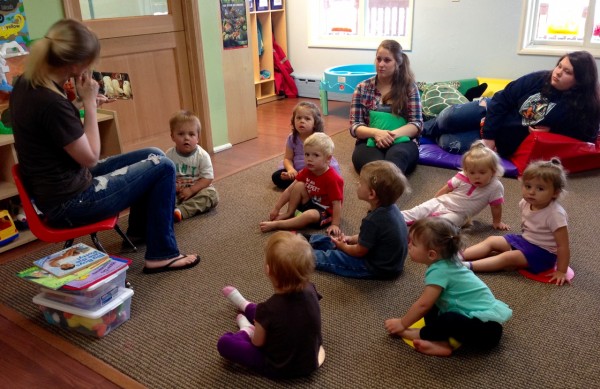
Teacher Theressa Phillips reads to the toddler class with Assistant teacher, Brina Compton and teen worker, Kallie Caples looking on. (Photo by Angela Denning/KFSK)
There is not enough child care in Petersburg. One of the preschools, the Petersburg Children’s Center, has a waiting list of 45 kids. A planned expansion could help drop that number.
It’s mid-morning and a handful of toddlers are stomping and growling around a colorful room. These kids are in the toddler room at the Petersburg Children’s Center.
The center cares for 45 children ages six weeks to prekindergarten. The center also runs an after school program for kids kindergarten through sixth grade called Eagle’s Nest. There are 24 children in that program with a waiting list as well.
The toddlers find their places and settle into story time.
Through the door is Brandi Heppe’s office. She is the Director of the children’s center. She says she takes calls all the time from parents needing childcare.
“I’m very honest with them and I let them know right off the bat that we do have a wait list,” she said, “and I have no problem putting them on there because you never know with people moving or classrooms adjusting or changing.”
The waiting list has increased in the last few years especially with the 3 to 4 year olds.
Five-year-old Arielle Tucker paints in the Rainbow classroom. Photo/Angela Denning
The center just can’t take more children without a larger space and additional workers. It is a state-licensed private non-profit and follows State of Alaska guidelines which set class sizes. The center employs 11 full time workers and four part-time.
Heppe says smaller class sizes work better anyway.
“We just want to make sure that children are being taken care of and valued and just the quality of child care that we want to come out of here just to go on for years and years because I remember coming here as a child and the quality of the care is the exact same as it is now,” she said.
Across town, Glorianne Wollen is in the Petersburg Harbor Office answering a constant stream of calls. She’s the borough’s harbor master and summer is her busy time. She’s also a well-known volunteer in town and helping the Children’s Center is her new focus.
She says she learned about the center’s long waiting list during a borough assembly meeting.
“So I just started thinking about that: what a wonderful problem to have here in a community where we have too many kids and people who want to go to work,” Wollen said. “So I thought, you know, gosh this should be something that we should try and do something about.”
She heard that the center wanted to build an addition in order to take more kids so she decided to donate her own money to the project. Then she checked in with the borough’s Economic Development Council to see if it was an economic issue. The answer was yes and the council’s board donated $10,000 to the cause. A few more people have come on board and Wollen hopes the momentum continues.
“This is a project that maybe we could help ourselves with rather than going to the state and waiting for them to give us money and know-how to do this,” she said.
The seed money has grown to $22,000. With that, the center is going ahead with the project with the hopes that more funds will come forward. Construction is set to start this fall.
The plan includes adding two classrooms to the west side of the building. The labor would be all volunteer happening on nights and weekends. Local businesses have agreed to help get supplies at cost. The project’s estimated price tag is less than $100,000.
Wollen says it will be money well spent. The expansion will allow 12 more kids into the center.
“Now they just have wonderful programs and these little kids are learning things and sparking interests at young ages and I’m just so impressed with what they’re doing up there,” she said.
The expansion project comes just as the Petersburg Children’s Center celebrates its 40th anniversary this year.
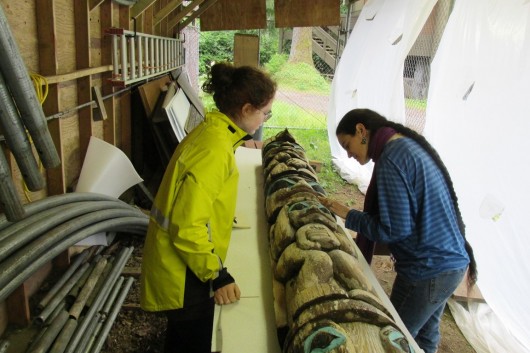
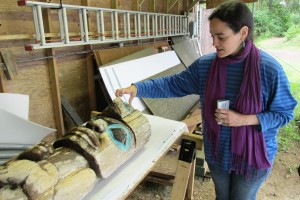
From left, conservation intern AnnMarie Guerin and Alaska State Museum Conservationist Ellen Carlee inspect a pole, donated to Ketchikan’s Totem Heritage Center by Tsimshian master carver David Boxley. (Photo by Leila Kheiry/KRBD)
Ketchikan’s Totem Heritage Center has a new pole, relatively speaking. It’s actually 30 years old, but the pole is a new addition to the center’s collection of historic Alaska Native artifacts. Alaska State Museum conservators from Juneau traveled to Ketchikan to help clean and preserve the pole, and to find out what kind of stories might be hidden in the wood.
Ellen Carlee has a tiny lump of metal twisted up in a piece of paper. She’s been trying to find someone who knows what it is.
She shows it to John Radzilowski, a summer guide at the center, who also happens to be a history professor at Ketchikan’s University of Alaska Southeast campus. He doesn’t know either, so she puts it away for the moment.
The Boxley pole where that bit of metal was found is a 30-year-old totem pole, donated to the center by master carver David Boxley.
Ellen Carlee points out a detail on a 30-year-old totem pole, donated to Ketchikan’s Totem Heritage Center by the carver, David Boxley. (Photo by Leila Kheiry/KRBD)
Carlee is based in Juneau and says she got a call last summer from two Heritage Center employees.
“They said, ‘Hey, we’re under a house in Metlakatla looking at this totem pole, it’s covered with lichen, we think it has an infestation problem. David Boxley wants to donate it to the museum. What do you think we should do?’” she says. “I’m like, ‘Well, I’m in Fred Meyer right now, but here’s what I think.’”
A year later, Carlee and two graduate-level conservation interns have flown to Ketchikan to clean the pole and prepare it for display. She says the artist didn’t really want the pole restored, just preserved.
The cleaning process is meticulous. They had to remove the lichen without damaging the paint. As they gently nudged the vegetation away, that’s when they found the imbedded lumps of metal.
“It looked like it may be some sort of pellet,” she says. “Now that we cleaned it, we’ve seen this in a couple of spots. This pole stood outside the Boxley family home for decades, so probably I should send a picture of this to somebody from Metlakatla and say, what is this? What was it doing in the pole? Because that’s part of the story.”
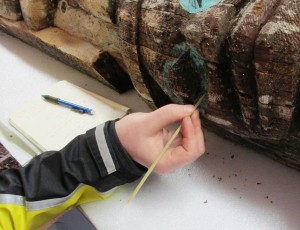
As Carlee continued talking, intern AnnMarie Guerin carefully wielded a bamboo skewer, scraping remaining bits of lichen tendrils from the pole’s many cracks.
AnnMarie Guerin carefully scrapes lichen tendrils from the cracks of an old totem pole. (Photo by Leila Kheiry/KRBD)
“So, I’ll just test it and see if maybe it’s falling off on its own, and if it is, then I keep going, but if it’s stubborn, I just kind of let it be,” Guerin explained. “I would definitely call it meditative. That was one of the reasons I wanted to get into conservation. I knew there was a lot of meticulous and long-term work, and I know I liked doing that kind of thing. So, I could spend hours doing this. It’s great!”
Leaving the Totem Heritage Center, senior curator of programs Anita Maxwell walks up to say that Radzilowski had found out what the metal pellets are.
“It is from a pellet gun,” Maxwell says. “There’s a specific kind of hollow-core lead pellet, and he even has the website to buy some more. Google is amazing.”
The next step was to find out how it got there. A call to the artist revealed BB guns as the culprit.
“Oh, I’m pretty sure that’s where that came from,” Boxley says, laughing. “There’s lots of little neighbor kids without a whole lot of supervision.”
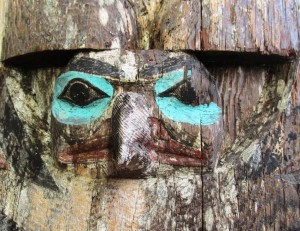
A detail from the historic pole donated to the Totem Heritage Center by its carver, Tsimshian artist David Boxley. (Photo by Leila Kheiry/KRBD)
Boxley says he carved the pole in 1982 to coincide with a potlatch he organized in honor of his grandparents, who raised him. He says it wasn’t the first pole he ever carved, but it was the first large one, for the first potlatch in that community.
“The actual putting on of the potlatch, I didn’t have a lot of help because our people had not had one up ’til then, and I’d never even seen one, been at one. It was all research,” he says. “A few people in my family and a few people from the other clans helped put it together. It was something I had to do.”
While a replacement pole, carved by Boxley and his son, has gone up in the original pole’s place. Boxley says the original is an important part of Tsimshian Native culture and history in Metlakatla.
“It was kind of the symbol of the revitalization of potlatching in Metlakatla,” he says. “It was the first one: first potlatch, first ceremony, first pole-raising.”
Much of the Native culture had been left behind, he says, when the first residents followed missionary Father William Duncan from British Columbia in 1891.
“The education process has been slow, but it’s come a long way,” Boxley says. “I’m pretty proud of my people for everything they’ve done. All the other clans, all the artists who are doing their best.”
With the pole that Boxley donated, the history and significance of an event that began the Tsimshian renaissance will be preserved for generations to come.
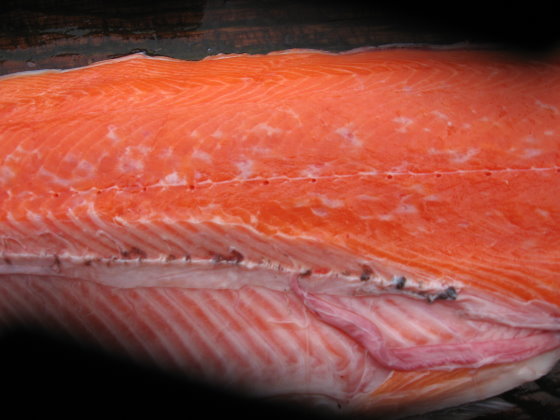
A severe case of ichthyophonus in a Yukon Chinook filet. (Photo courtesy of RapidResearch.com)
As Yukon salmon continue their summer runs, subsistence fishermen are expressing frustration about gear restrictions, closures, and now potentially infected fish.
When managers and fishermen met for their weekly teleconference Tuesday, they heard reports of discoloration and pus in chum salmon from callers in Pilot Station, Russian Mission and Fairbanks.
Stephanie Schmidt, summer season area management biologist for the Yukon for the Alaska Depart of Fish and Game, says the parasite ichthyophonus could be the culprit
“Folks here complaining about summer chums having white patches and pus sacs … A lot of these fish have pus in the meat, so that’s a bummer … Kind of little pockets of pus when you fillet the fish. That’ll be about the size of a pea or maybe a little smaller. And I know that in warm water, which is what we have right now, that ichthyophonus really grows rapidly if the fish is infected.”
Fish and Game says the pathogen is not harmful to humans, and Schmidt invites fishermen to submit samples for testing if they’re concerned.
The summer chum run is now estimated at 1.3 to 1.5 million fish, which is average but below Fish and Game’s preseason predictions. The first pulses are passing through Tanana, Koyukuk, and Kaltag, but many stragglers are still lingering in the lower river. Schmidt says that’s led to record numbers for commercial fishermen.
“There have been record catches of summer chum salmon with dipnets this year in district one and district two. To date, the dip net and beach seine commercial fishery in these lower districts have caught 185,700 summer chum salmon and they’ve released just over 8,000 Chinook salmon,” Schmidt says.
Meanwhile, subsistence fishing has been a mixed bag. Abundant chums on the lower Yukon have helped fishermen in Nunam Iqua to fill his racks. But fishermen upriver have struggled to meet their subsistence needs, citing plenty of activity but little production.
Fish and Game is continuing efforts to protect the kings through strategic closures, but Chinook numbers are still weak. More than 80,000 kings passed through Pilot Station by the end of June — about 20-thousand fish fewer than the historical average.
The possibility for incidental harvest of Chinook has been discussed and even allowed for short periods in areas with strong passages of chum. But the general call for immediate release, coupled with gear restrictions, hasn’t allowed for much.
Schmidt says it’s possible that king escapement goals will be reached this year, but conservative management strategies will continue to ensure that happens.
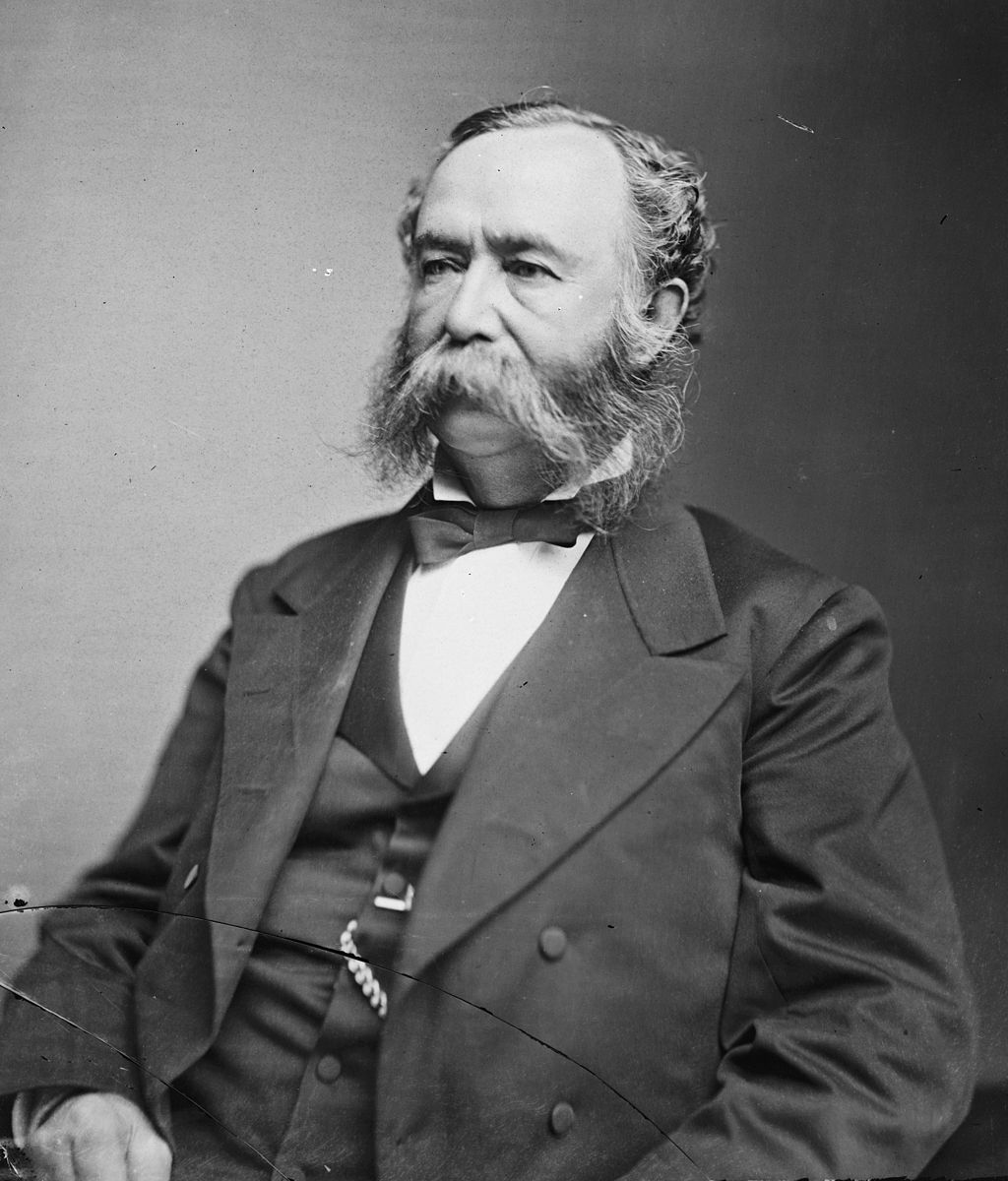
Wade Hampton was a Confederate general and senator from South Carolina. HIs son-in-law was a territorial judge in Western Alaska and named the census district for him. (Photo courtesy of the Library of Congress)
The Western Alaska census district named for a confederate slave owner and Civil War general has a new name. Gov. Bill Walker wrote Wednesday to the Census Bureau to begin the process of changing the name from the Wade Hampton Census District to Kusilvak Census District.
The city and tribe of the largest community in the area, Hooper Bay, passed a resolution in support of a change and came up with the new local name. A recent Alaska Dispatch News article brought the history to the forefront. Local and state politicians voiced their support for shedding the name of a Confederate general whose rise to political power was in tandem with terror campaign by a violent white power group, the Red Shirts.
“Everyone knows in the early times, that man was a slaver and never had stepped into Alaska. Why should our area be named after a man we don’t even know about,” says Edgar Hoelscher, the tribal chief for the Native Village of Hooper Bay.
Hoelscher says having a local Yup’ik name honors the region’s people.
“It shows that our elders and forefather were there, and we’re still living on the ground where they were,” Hoelscher says.
Wade Hampton’s son-in-law was a territorial judge and named a nearby mining district after the South Carolina politician. The name first showed up in census data in 1920 and it stuck.
Myron Naneng leads the Association of Village Council Presidents and Sea Lion Corporation of Hooper Bay. He’s been organizing behind the scenes to get a new name.
“Kusilvak means the high one. It’s the mountain located between Scammon Bay and Mountain Village. It’s highest mountain in the area and there’s a lot of history associated with it,” Naneng says.
The name is used for statistical record keeping. There’s no regional government with the name, but it shows up in countless publications for borough-level information. That will change going forward.
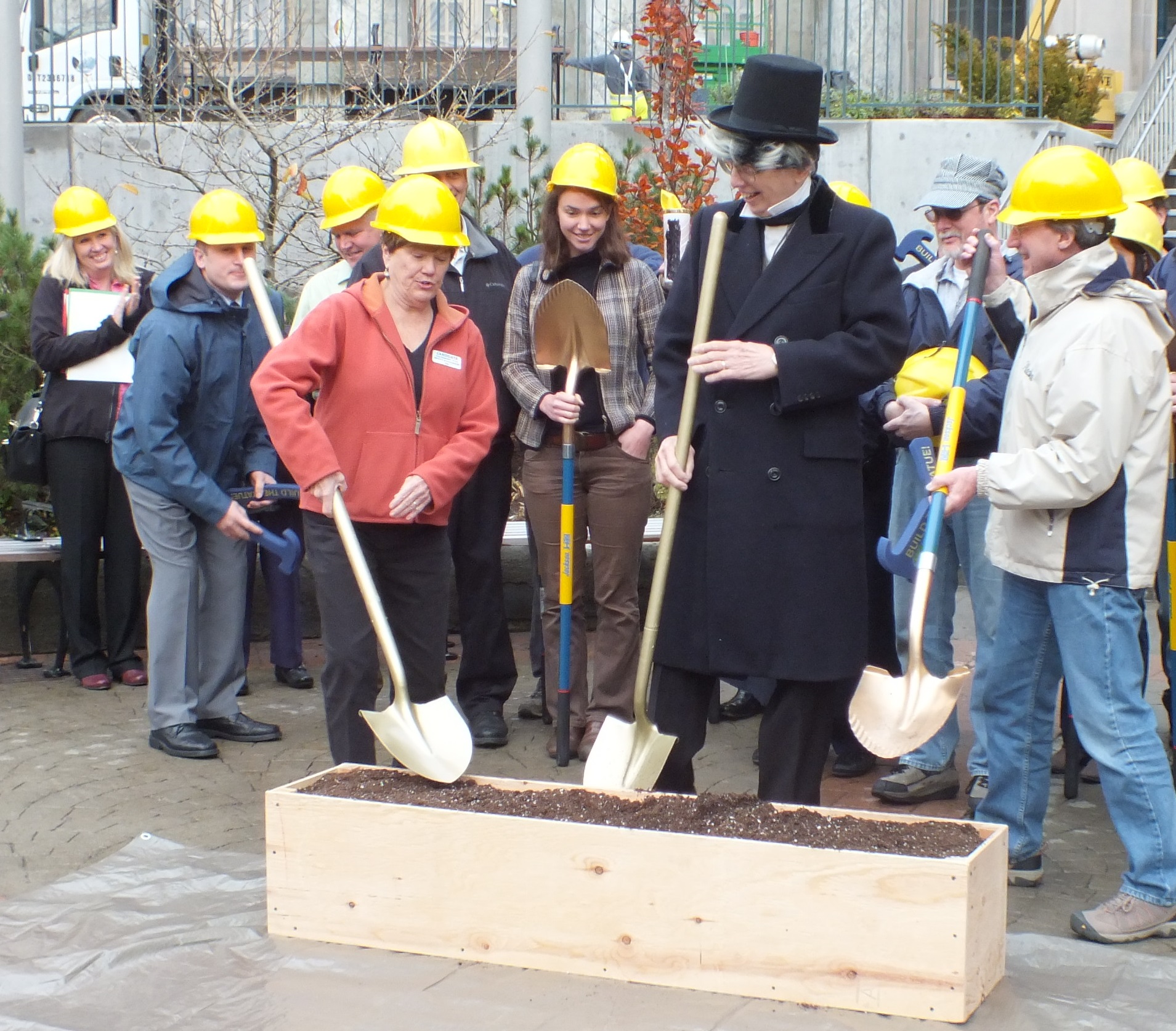
John Venables in character as Secretary of State William Seward in at a statue groundbreaking ceremony in October 2013. (Photo by Matt Miller/KTOO News)
Venables often played Judge James Wickersham. Wickersham was a delegate to Congress who was a key advocate for legislation that gave Alaska territorial status in 1912. Venables, in character as Wickersham in 2013, described a colorful bump in Wickersham’s political career:
“Actually, in 1916, I lost the election due to shenanigans,” he said. “And it took about a year before they threw the election out and I got restored to my position. But they actually had in one district a lot of votes for my opponent, and the number of votes filed in that district elected the number of registered voters in the district! So that tells you right then and there, there’s a bunch of shenanigans.”
William Venables described his father’s passion for history for the Empire:
“There’s a spark in certain people and they love to pass on the knowledge they’ve been able to acquire.”
Another role he often played was Secretary of State William Seward. Seward was instrumental in the United States’ purchase of Alaska from Russia in 1867. One of Venables last public projects he was involved in was the push to recognize Seward with a bronze statute outside the Dimond Courthouse.
The statue is expected to be complete in 2017.
Watch John Venables as Judge James Wickersham in 2013:
Watch John Venables as William Seward, James Wickersham and Bob Bartlett:
Close
Update notification options
Subscribe to notifications
Subscribe
Get notifications about news related to the topics you care about. You can unsubscribe anytime.