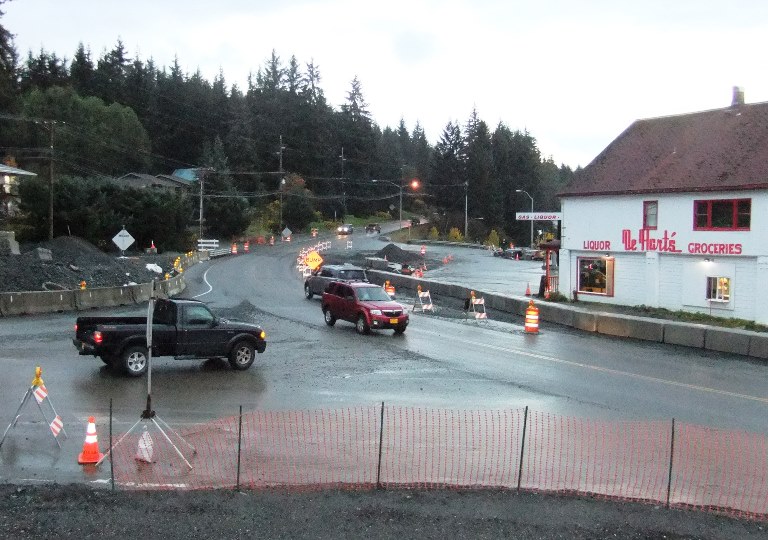
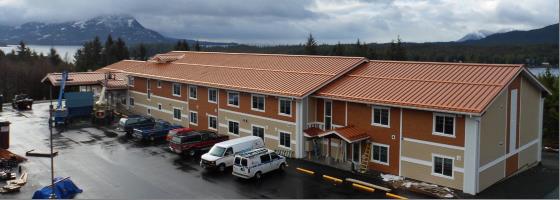
Roundabout construction at Auke Bay. Photo by Rosemarie Alexander/KTOO.
The city is looking for citizen input on the future of Auke Bay.
A survey is already underway and the first in a series of planning meetings starts Tuesday.
The city and borough development department will hold two sessions this week where residents can stop by, hear what’s going on, ask questions and register their ideas and concerns.
Senior planner Ben Lyman says CBJ staff assigned to the project are in listening mode.
“We want to be hearing what the community wants out of this planning process; what they want for the future of Auke Bay. We do have some direction in our Comprehensive Plan that was adopted in 2008 by the CBJ Assembly, but we need to flesh that out and make sure that we as staff are looking at the right geographic area,” he said. “Are we just looking at the core of Auke Bay, or a larger are that would include maybe Auke Lake, Fritz Cove Road and out to Auke Rec? Where exactly are the parameters and what does the community hope to get out of this process?”
Tuesday’s meeting is from 6 p.m. to 9 p.m. at the UAS Glacier View Room in the Egan Library, with a presentation at the top of each hour so people can come and go. A similar meeting will be held Saturday at UAS with presentations at 9, 10 and 11 a.m., also in the Glacier View Room.
An Auke Bay steering committee will be appointed in November. Lyman says more public meetings will be scheduled over the coming months with a draft plan due later in 2014.
Major changes are already underway in the Auke Bay village area, where the state Transportation Department is building a roundabout, a new boat launch and parking facility are planned for Statter Harbor, and the elementary school is undergoing renovation.
Click here for more information on the Auke Bay planning process.
Eighth grader Kathy Tran and seventh grader Leah Kleinman. The Floyd Dryden Middle School students helped collect signatures for a petition opposing the sports travel ban. (Photo by Jeremy Hsieh/ KTOO)
Students and parents protest the middle school sports travel ban during a school summit at Thunder Mountain High School in September 2013. (Photo by Heather Bryant/ KTOO)
Students and parents protest the middle school sports travel ban during a school summit at Thunder Mountain High School last month. About 40 people protested. (Photo by Heather Bryant/ KTOO)
The marquee outside Floyd Dryden Middle School on Saturday. The school board's ban on middle school sports travel takes effect next school year. (Photo by Rosemarie Alexander/ KTOO)
Floyd Dryden Middle School eighth grader Kathy Tran is one of many venting about the policy – and the way it was adopted.
“They said that there was a lot of people that supported this ban. And I was like, ‘Who?’” Tran said.
In more than a dozen interviews with board members, school officials, students and parents, no one has been willing or able to answer that question. Not one person spoke in favor of the ban during public testimony at the school board’s two meetings on the policy.
Board members say there is community support for the ban, but are unwilling to identify from whom.
School Board member Barbara Thurston
“At this point, you know, we’re hearing it off the record,” said school board member Barbara Thurston, one of the three “no” votes.
Meanwhile, parents are organizing opposition. About 40 people picketed a school board meeting last month at Thunder Mountain High School. A Facebook group called Save our Middle School Sports created in February has 209 members. And in a nearly empty room in a nearly empty mall on a Tuesday, a dozen people were putting together a repeal campaign.
Jennifer Lindley, a Floyd Dryden mom and repeal organizer, said the school board acted undemocratically.
“They voted in favor of an unspoken minority that none of us can seem to find,” Lindley said. “I don’t know who my counterpart is.”
School board members on both sides said there is no hidden agenda, and that the board itself raised the travel policy issue.
The four school board members who voted for the ban argued it reduces the burden on already strained budgets and reduces the fundraising borne by local businesses and the community. They said it eliminates unfair differences between how travel requests are handled at Juneau’s two main middle schools.
School Board VP Sean O’Brien
School Board Vice President Sean O’Brien, said casting his “yes” vote was “agonizing.”
“The challenge is, is we have an obligation to kinda create a, a relatively equitable playing field,” O’Brien said.
Floyd Dryden Principal Tom Milliron uses a case-by-case approach, weighing the amount of time lost in the classroom against the potential benefits of travel.
DHMS Principal Molly Yerkes
Dzantik’i Heeni Middle School Principal Molly Yerkes does not allow out-of-town sports travel. She said it’s not right to spend so much time and effort arranging travel when staffing cuts have left her school without a fulltime certified nurse and sometimes a single adult supervising 150 students at lunch.
Neither principal asked the school board to weigh in, though Yerkes said she does support the ban because it clarifies district priorities.
O’Brien said significant differences in kids’ opportunities, like sports travel, could lead to school shopping.
School Board member Lisa Worl
School board member Lisa Worl voted against the travel ban. She said the travel policy is one of many differences between the schools, for example, with classes offered and community involvement.
“So there just is a real difference between the schools. I mean, there’s no right and wrong, it just is.”
Worl said the travel ban sets a board precedent favoring uniformity over local control.
If the budget and staffing situation changes, Yerkes said she expects the school board would lift the ban and said she would reinstitute out-of-town travel.
“And so I think that Molly Yerkes has done the best that she can with what she has, and focus it on more of an intramural, cause that way she can get more kids to play in sports,” Worl said.
How’d they vote?
School board policies are introduced at one meeting, then voted up or down on second reading at a later meeting. The middle school travel ban’s initial reading was Aug. 22. At the school board’s Sept. 10 meeting, it voted 4-3 to adopt the policy.
Sally Saddler, Sean O’Brien, Andi Story and Phyllis Carlson voted yes.
Destiny Sargeant, Barbara Thurston, and Lisa Worl voted no.
The school board’s next meeting is at 6:15 p.m. Tuesday at Juneau-Douglas High School.
Opponents say the budget effects of out-of-town travel are negligible, because it’s paid for almost exclusively with fundraising. The school district pays indirect costs, such as substitutes for teachers traveling as coaches. They say if Juneau cannot or is not willing to support fundraising, it fails.
The Juneau Chamber of Commerce, whose members independently bear much of that cost, has not taken a position. President and CEO Cathie Roemmich says her board of directors intended to discuss the ban last month, but put it off because several members were out of town.
The district did erroneously identify one party in favor of the ban, its Activities Advisory Committee.
A district memo plainly states, “The Activities Advisory Committee is in agreement with the revision.”
“That couldn’t be farther from the truth,” said Activities Advisory Committee member Tom Rutecki. He’s been a member since it was founded in 2008. The committee discussed middle school travel last school year, but never made recommendations to the school board.
“And I pointed that out to them, I sent them individual emails, and I said, ‘Why are, why are you saying this? We never did this,’” Rutecki said.
It was not corrected in the memo, though Superintendent Glenn Gelbrich verbally noted the error during the meeting. He declined interview requests about the ban.
Seventh grader Leah Kleinman plays basketball at Floyd Dryden. The night the school board adopted the travel ban policy, she presented a 350-signature petition opposing it.
“You play, and you have fun, then you want to like, travel somewhere,” Kleinman said. “It’s like, ‘Hey guys, let’s go Ketchikan, yeah.’ But, now it’s like, you’re just gonna stay there and you’re just gonna play DZ. And then they will eventually stop coming to us.”
That’s already begun, even though the ban doesn’t take full effect until next school year. Middle school officials in Ketchikan and Sitka say their athletes aren’t as likely to come to Juneau, if Juneau stops traveling.
Floyd Dryden students Kathy Tran and Leah Kleinman said they have learned something from the ban: There’s a lot of politics in sports.
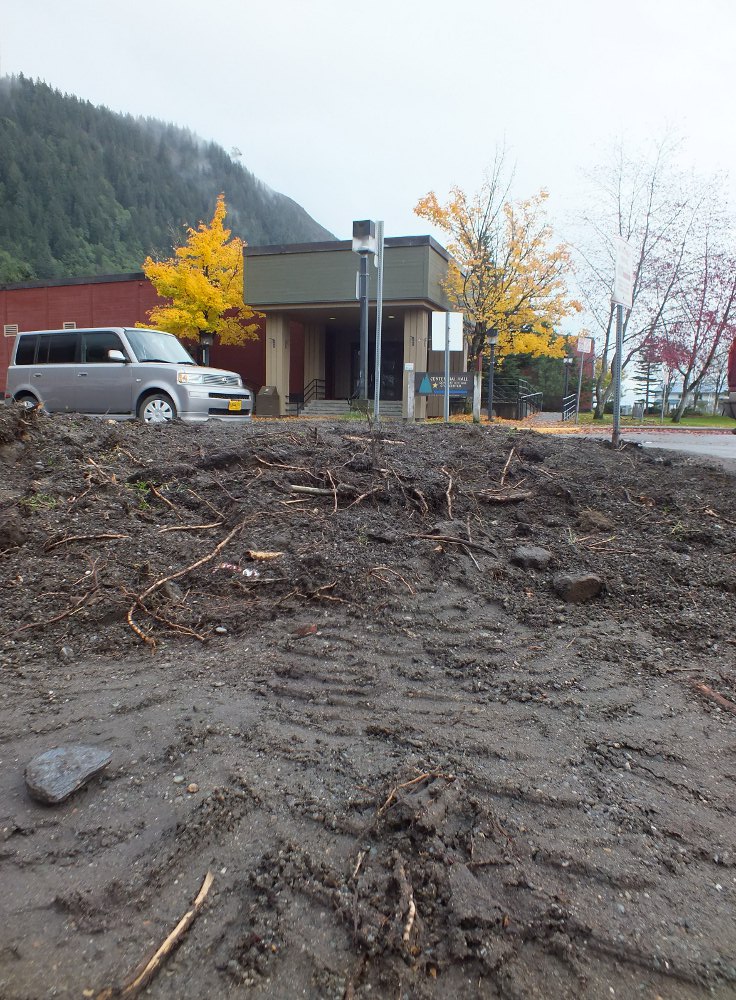
The old cottonwood trees in the Centennial Hall parking lot were starting to lean heavily and lose branches. Rather than let them become even more of a hazard, the city decided recently to remove them. Photo by Casey Kelly/KTOO.
If you’ve walked through the Centennial Hall parking lot lately, you may have noticed that landscape crews cut down some trees last week.
The convention center’s manager, Steven Pfister, says the old cottonwoods were starting to lean heavily and lose branches. Rather than allow them to become a hazard, Pfister says the city decided to remove them.
He says new trees will be planted, but probably not until next year.
“So we just thought, do we wait for a tree to fall over and hurt somebody? Or damage property? Or do we go ahead and just take care of it now?” Pfister says. “And then we also looked at it as a unique opportunity to beautify it.”
Pfister says he’s not sure what kind of trees will replace the old ones. But he hopes they’ll be more colorful, like the maples planted around the building.
The city’s Willoughby District plan calls for a portion of the Centennial Hall parking lot to eventually be turned into a mall-style street, with green spaces and landscaped sidewalks.
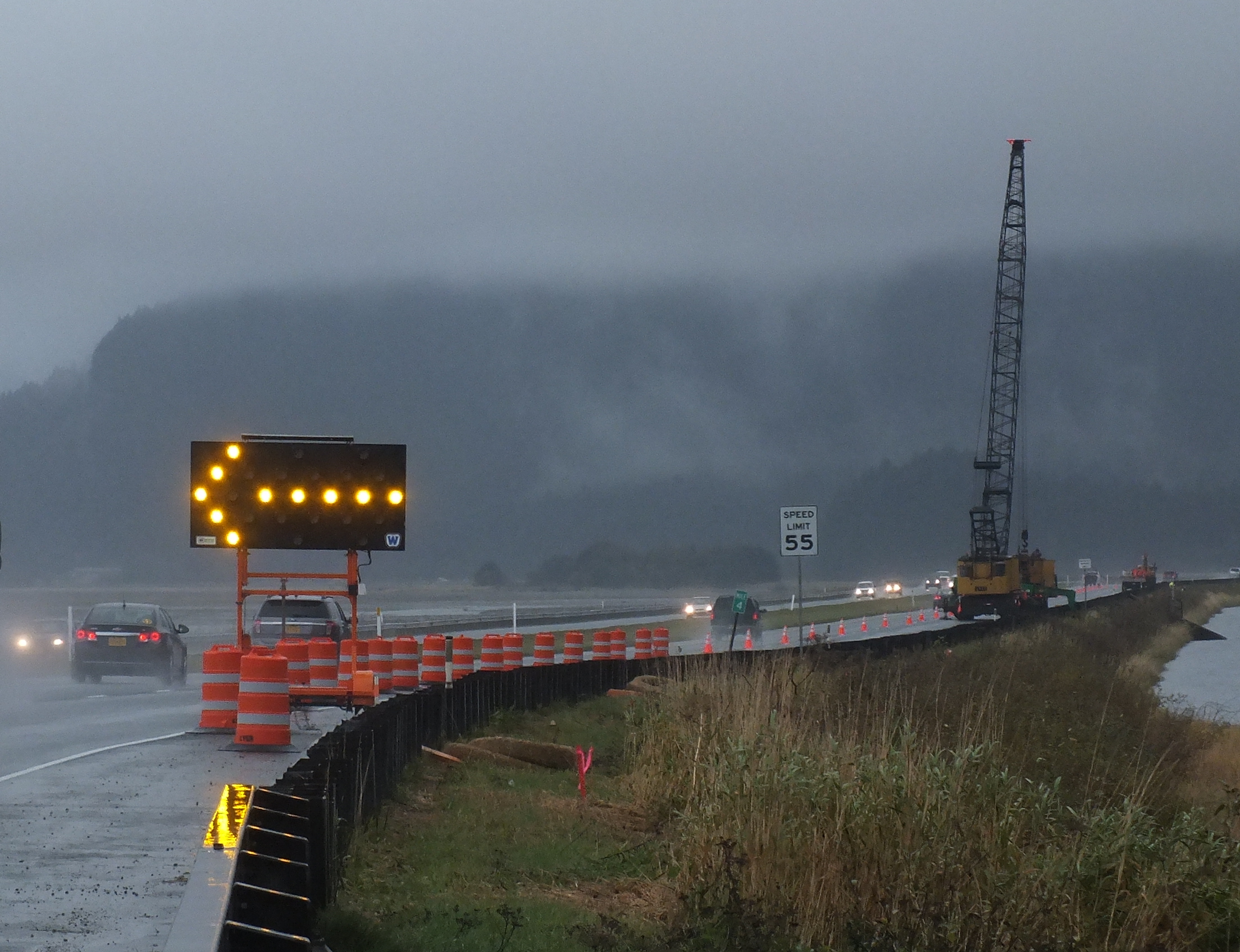
Crews from Ever Electric and North Pacific Erectors are constructing as many as 148 light poles along Egan Drive. Photo by Matt Miller/KTOO News
Meanwhile, work is already underway to make Egan Drive safer with better roadway illumination. Crews are now in the first phase of the project to erect 148 light poles along darkened areas on Egan Drive from Norway Point to Yandukin Drive. Each pole will be 35 feet tall with 250-watt high pressure sodium lights.
Everyone is slowing down to view the crane (operator) who’s driving the support members for the poles.”
John Garvey of Ever Electric said North Pacific Erectors is helping with the job to drive pilings, weld on caps, and bore underground.
Garvey said work on outbound lanes will occur only before 4 pm, and then inbound lanes will only occur between 9 am and 4 pm. Crews will work for the next few weeks until the weather gets sloppy, and then they’ll take a break until March. Garvey hopes to complete the project in June.
He said on KTOO’s A Juneau Afternoon program on Wednesday that drivers should be careful and watch for crews, equipment, and traffic control measures.
“We just ask that (drivers) merge quickly,” said Garvey. He suggests that drivers start merging when they first see the right lane closure and merge signs.
So when you get to the light, you’re not trying to cut in. That’s where accidents happen. That and people viewing what’s going on and then the people behind it not slowing down. We’ve had a couple close calls. No accidents yet, thank goodness.”
The latest state capital projects budget included $4.2 million in federal funds for the Egan Drive Illumination Project. Ever Electric won the contract with a $3.7 million dollar bid in July. Total cost for the project is currently expected to be just over $3.8 million.
Casey Kelly and Matt Miller contributed to this report.
This bear was determined to get inside this trash can out the road on Thursday morning. (Video courtesy Greg Culley)
Juneau police say a bear was struck by two vehicles on Glacier Highway near Jensine Street Thursday afternoon.
Lieutenant David Campbell says the bear scampered into the woods after being struck. He says it likely suffered some injuries, but it’s not known how severe. There’s no word on how old the bear was or the amount of damage to the vehicles.
Campbell says the report came in around 1 p.m. and was turned over to Alaska State Troopers.
State Wildlife Biologist Ryan Scott says while most bears in Juneau are starting to take their long winter naps, some are still active.
“We know of a few bears downtown, we’re working with a resident here on Douglas with one too. What you’re seeing right now is really the last push for these animals before they go up into hibernation,” says Scott. “And every year about this time of year we get a pulse of activity and so it’s not necessarily a surprise. But it just reminds us that we’re not quite out of the woods yet.”
And just as during the height of bear season, Scott says it’s important to properly secure trash and not allow bear attractants to build up on your property.
Gillette is on the society’s board. He says project costs could reach $35,000.
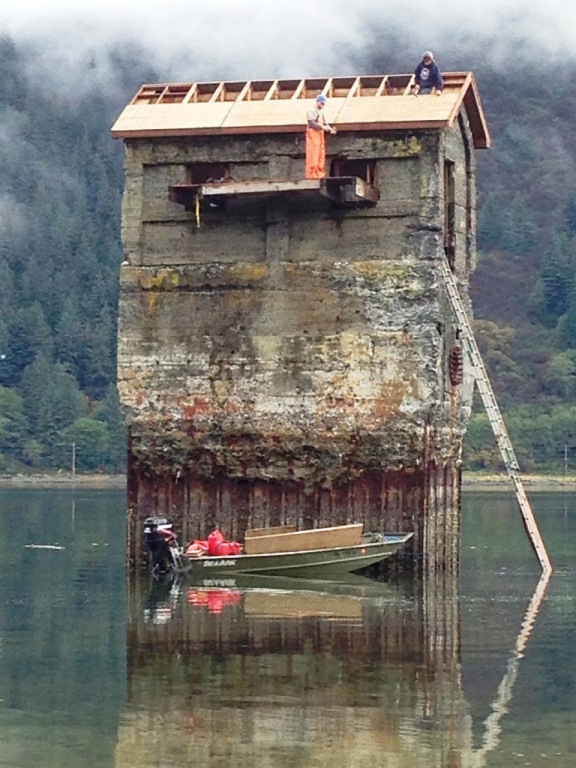
“It sounds high. The materials are probably 6 or 7 thousand of that, but when you also consider the logistics of getting materials out there, dealing with the tide, getting up to that structure, they had to build a platform to work from, it’s pretty involved for such a little project,” he says.
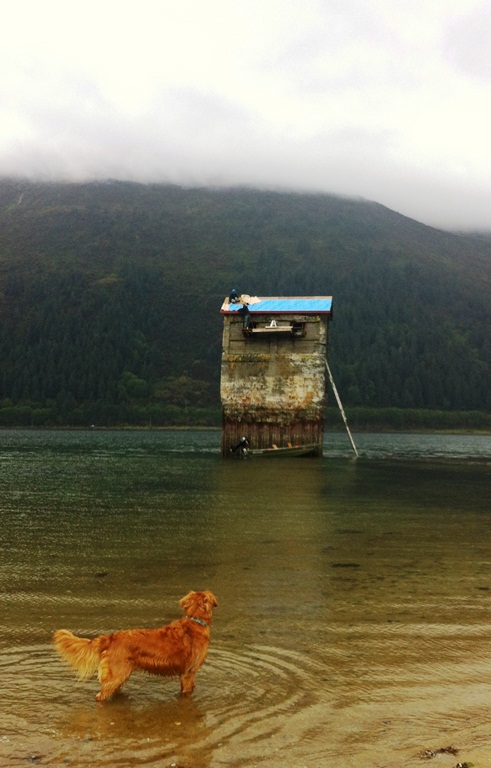
The society has a state grant matched by local donations of materials and cash to repair the concrete structure that’s an icon of the old Treadwell mining days. He says the society needs to raise another $8,000.
Workers are using treated wood for new interior walls and the roof, so Gillette says it should last another 50 to 100 years.
Not all the work can be seen.
“They had to build a platform inside to work from then they had to build the walls inside because they didn’t want to rest the roof on the existing walls,” he says. “The concrete is not strong enough to take it, so there’s more than meets the eye there.”
Ruby checks out progress on the pump house roof. Photo by Jim Mahan.
To help preserve the new roof, the window openings will also be covered.
“Part of the problem is the wind gets through there and puts a lot of lifting forces on the roof and lets rain and stuff get in there,” Gillette says, “so we’re covering over the windows with a black material.”
He says the windows will still look like a black hole in the concrete structure.
“It’s called Dibond and it’s like two layers of really thin aluminum with a high density foam core,” he says. “I think it’s an eighth or a quarter-inch thick.”
The Treadwell pump house was used to pump salt water for the milling process and fire suppression when the fresh water in Treadwell Ditch froze in the winter.
The pump house project is part of the Treadwell society’s effort to preserve the old mining area. Last year interpretive signs were put up along the trail. Gillette says the society also has some state grant funds to design a new roof for the old concrete office building that’s left near the trail.
For the past five years, the housing authority has received federal funds for an elder service coordinator on Prince of Wales Island. This year, two new communities will be included in the program, which helps seniors access things like health care, financial information, events and activities.
“Programs like gardening, language classes, storytelling, or cultural events,” says Ricardo Worl, the housing authority’s chief executive officer.
He says additional grant money will be used to hire coordinators in Yakutat and Saxman, where Tlingit and Haida recently opened new senior centers.
“A lot of our tenants in these senior housing facilities have spent their entire lives in that community, and they want to remain there. Their family lives there, their grandchildren live there,” Worl says.
The housing authority contracts with Catholic Community Service to run the program. Marianne Mills is director of Southeast Senior Services for CCS, which operates similar programs in Juneau and the entire region.
“The main thing is to keep them active, healthy, and connected with other people,” Mills says. “Not just staying in their place by themselves.”
Mills says the elder service coordinators in Yakutat and Saxman will tailor programs and activities to the needs of their community. She says the program on Prince of Wales has benefited from partnerships with other agencies.
“For example, with the SEARHC clinic, they did a sit and be fit class, got some exercise equipment in the senior apartments there, and arranged for doctor and physical therapy visits on a regular basis,” she says. “Just made a variety of different health promotion activities available.”
Tlingit and Haida this year received a total of $246,000 for elder service coordinators from the U.S. Department of Housing and Urban Development. The money is part of HUD’s Resident Opportunities and Self Sufficiency grant program. Despite the federal shutdown and sequestration budget cuts, Worl says he’s fairly confident the money will continue to be available.
“If they don’t have programs that allow our elders to age in place, in the rural communities, it’s going to be even more expensive to bring them to our urban centers, where it’s a lot more competitive,” says Worl. “The wait lists to get into these senior housing and health care programs are tremendous.”
He says the housing authority will just need to remain diligent in communicating to Alaska’s Congressional delegation the importance of such programs.
Close
Update notification options
Subscribe to notifications
Subscribe
Get notifications about news related to the topics you care about. You can unsubscribe anytime.