A student count period at public schools across Alaska closed Friday. The average daily membership over the last four weeks determines state funding to local schools. (Photo by Images of Money/Flickr Creative Commons)
Across Alaska, Friday was the last day in a four-week period where student attendance translates into school funding.
Public schools receive a major chunk of their funding from the state under what’s known as the foundation formula. It’s complex, but generally, the more students in attendance in October, the more state funding each school receives.
This year, a typical student with perfect attendance between Sept. 30 and Oct. 25 is worth $5,680 to his or her school. That’s the figure that legislators and education officials call the “base student allocation.”
Funding adjustments, including extra money for students with special needs, cost-of-living differences from district to district, and reductions for efficiencies at larger schools, introduce more complexity.
Huge tables of data due to the state Nov. 8 are being compiled to count every public school student in Alaska.
The Juneau School District is expected to announce its final numbers early next week. Preliminary counts are about 106 students lower than expected – and that means the district is over budget by about $1 million this year. That amount covers salary and benefits for about 10 teachers.
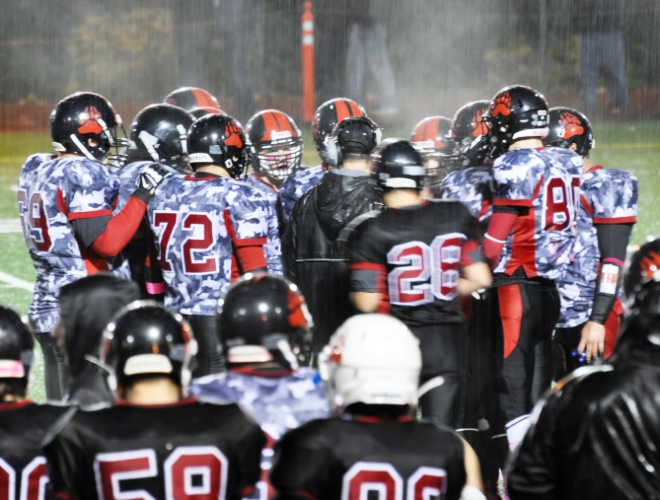
The Bears huddle during a rainy game earlier this season on home turf, Adair Kennedy Field. They are the runner up in the medium schools bracket and also given the Sportsmanship Award by ASAA.
The Juneau-Douglas Crimson Bears should be considered proud runners-up for Alaska’s medium-schools football championship.
While the Bears lost to the Stars, it was a well-fought game, with Juneau ahead most of the time, and the two teams tied for much of the second half.
The game was played at Anchorage Football Stadium and carried in Juneau on cable television and KINY Radio.
In a cellphone call just after the game, head coach Rich Sjoross aptly described it as a game marked by constant momentum swings.
Juneau brings home a silver football trophy and another award that they should feel very good about: The Alaska School Activities Association gave the Crimson Bears the Sportsmanship Award.
Check back later for statistics and more details of the game.
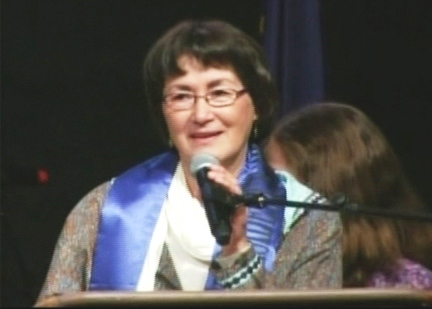
Retired Juneau Toni Mallott has been named the Alaska Federation of Natives 2013 Citizen of the Year. The annual AFN convention is being broadcast live from Fairbanks on KTOO’s cable channel 360 North. The convention ends Saturday.
Juneau’s Toni Mallott is the AFN Citizen of the Year.
Mallott was selected for the award because of her work in education as a public school elementary teacher and her work with students who speak English as a second language. She taught for more than 30 years in Anchorage, Juneau and Yakutat.
Mallott received the award Friday morning during the annual Alaska Federation of Natives convention being held in Fairbanks.
AFN president Julie Kitka said Mallott was given the award for the impact she has had on so many young children’s lives.
“Toni Mallott is such a remarkable person that you can see her character through the lives of the children she has loved and taught,” Kitka said. “Toni embodies our traditional Native values and all that we admire in a teacher, an educator and a citizen of our community.”
Mallott said she was shocked to receive the award. She said she accepted it on behalf of all teachers, who spend every day trying to make a difference in the lives of their students. Mallott also called for a strong partnership between teachers and parents.
“The parents are the primary teachers of their children, and it’s really crucial that we have a teacher and parent relationship that’s cemented,” she said.
She accepted the award flanked by a number of family members, including a sister and brother, two of Mallott’s five children, several grandchildren, and her husband, gubernatorial hopeful and former Juneau Mayor Byron Mallott.
Toni Mallott grew up in Rampart and has a master’s degree in education from the University of Alaska Fairbanks.
Iconic photo of the steamship Princess Sophia grounded on Vanderbilt Reef on October 24, 1918. Photo courtesy of Alaska State Library Historical Collections, Winter and Pond. Photographs, 1893-1943. ASL PCA-87 ASL-P87-1701
This week marks the 95th anniversary of the most tragic Alaska voyage that may have also changed the course of history of the Far North.
Or, did it?
It was very late on the night of Oct. 23, 1918 when the steamship Princess Sophia had just departed Skagway for its trip south to Vancouver, Victoria, and Seattle. Many on board were Yukoners and Interior Alaskans heading for a warmer climate during the winter. Others were leaving for good.
The crew of the 245-foot vessel Princess Sophia struggled against blowing snow and strong winds as they headed down Lynn Canal in the dark. The steamship grounded on Vanderbilt Reef northwest of Juneau and remained there for close to forty hours as a storm blew through the area.
Other local vessels waited out the weather before trying to approach the reef and help evacuate at least 343 and, perhaps, as many as 356 passengers and crew. But they never had the chance. Sometime during the following night of Oct. 24, the vessel pivoted in place on the reef, its stern pushed by northwesterly winds. With the hull severely damaged, the vessel flooded and slipped backward beneath waves. Everyone on board — men, women, and children — had perished.
Another classic shot of steamship Princess Sophia about ten hours after she grounded on Vanderbilt Reef. Photo courtesy of the Alaska State Library Historical Collections, Winter and Pond. Photographs, 1893-1943. ASL-PCA-87 ASL-P87-1702
They included Juneau’s customs collector, as much as ten percent of Dawson City’s population, all of the Princess Sophia’s crew that lived in Vancouver and Victoria, over 85 riverboat crewmembers and captains from the White Pass and Yukon Railway company and their family who traveled on the Princess Sophia. Also on board were laborers, businesspeople, and civil servants from all over the Yukon and Alaska.
“The thing is we did our research 25 years ago, which was the 70th anniversary of the sinking. It’s now the 95th anniversary and there’s a lot of time has passed,” said professor emeritus of history Bill Morrison.
Morrison was co-author of the definitive history of the disaster, The Sinking of the Princess Sophia: Taking the North Down With Her.
Morrison was in Juneau last weekend for the Al-Can Summit organized by the Juneau World Affairs Council and University of Alaska Southeast. He was also the featured speaker on the Princess Sophia disaster during the University’s Evening at Egan presentation.
In an interview with KTOO before his presentation, Morrison talked about his initial research in Victoria for the book roughly 25 years ago.
Someone phoned me and said ‘Did you know that a crewmember from the Sophia is still alive?’ I said, ‘Can’t be. They’re all dead.'”
Morrison describes finding Phillip A. Hole, 95-year old man in a Victoria seniors home who served as a purser on the Princess Sophia in 1916.
“I said to him ‘How did they navigate in the dark?’ Because you’re coming down the Lynn Canal, in 1916, you don’t have radar, how did you navigate? ‘How did you keep from running into Vanderbilt Reef every time you went down?’,” remembers Morrison.
“And he said ‘What we did is blow the whistle or the ship’s horn, and then listen for the echoes off the steep sides of the canal.'”
“I still remember this frail old man, shifting on his left foot, then right foot, ‘A thousand-one, a thousand-two. Boom, boom.'”
Morrison remembers asking Hole “‘What did they do when it was screaming wind and snowing?’ He didn’t have an answer.”
Morrison said enlistment for World War One and the decline of hand mining and the rise of mechanized dredge mining had more of an impact on the Yukon Territory then the loss of a large number of residents on the Princess Sophia.
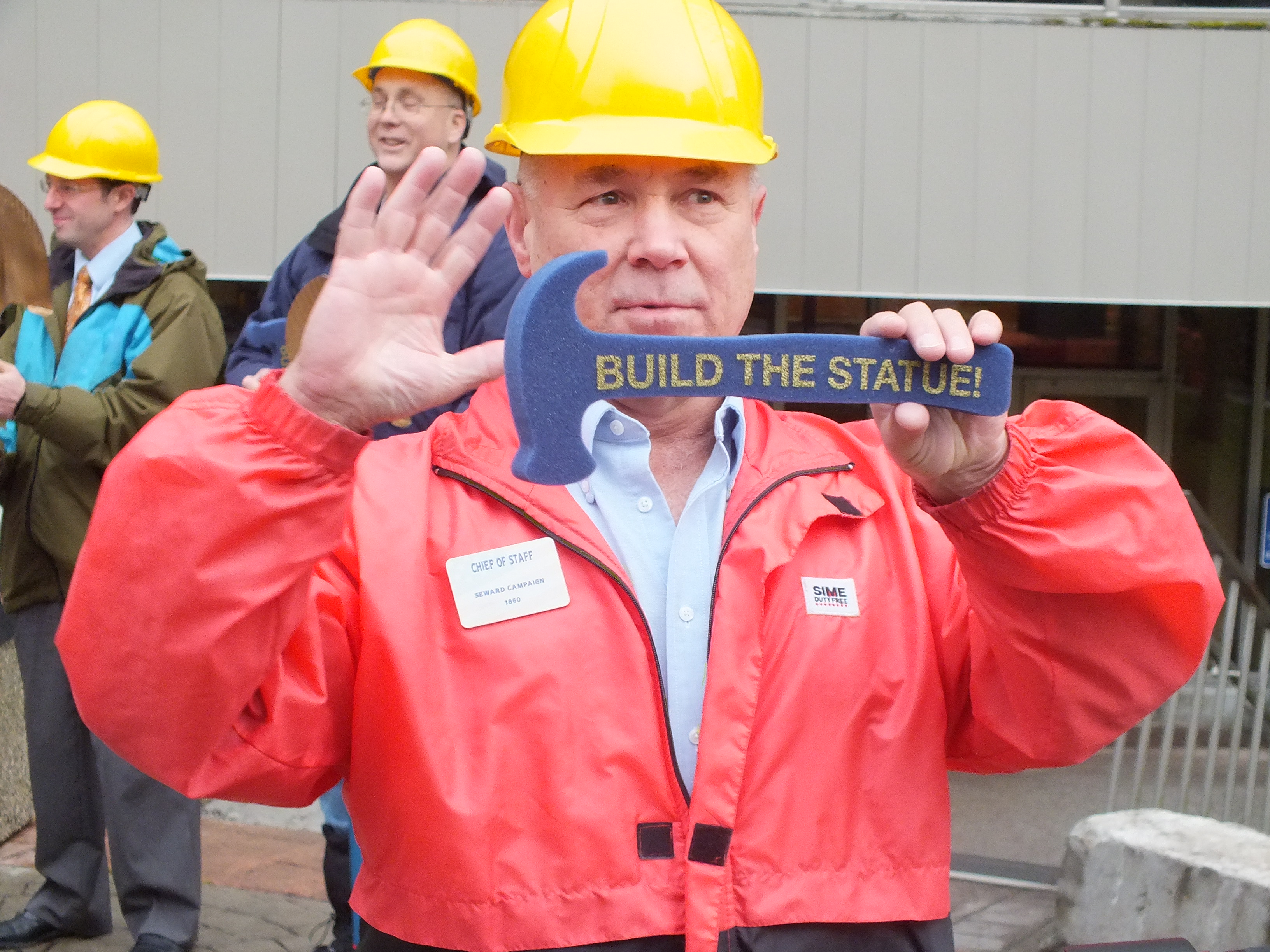
Assemblymember Mary Becker (left in red sweater) and architect Wayne Jensen (right in white coat) take turns breaking ground along with John Venables (center) on Thursday in the Dimond Court Building Plaza. Photo by Matt Miller/KTOO News
A ceremonial groundbreaking was held on Thursday on the Dimond Court Building Plaza across the street from the Alaska State Capitol for a proposed statue of William H. Seward, the Secretary of State under President Lincoln.
Members of the community, wearing hard hats and nametags designating their position within a proposed Seward Cabinet, used shovels to pitch dirt in a plywood planter.
The statue project is the brainchild of historic re-enactor John Venables who frequently brings Seward and James Wickersham to life.
“A great day for Juneau, Alaska. We are here as a committed group made up of committed individuals,” said Venables during the groundbreaking.
Juneau architect Wayne Jensen is one of many people helping with the project. He said statues of Seward exist elsewhere in the country, but such a pivotal figure in Alaska history should have a statue in the state.
The groundbreaking kicks off the fundraising and design of the Seward statue.
Jensen said that it’s hoped that the project will be completed by 2017, or the 150th anniversary of the United States’ $7.2 million dollar purchase of Russian America from Russia.
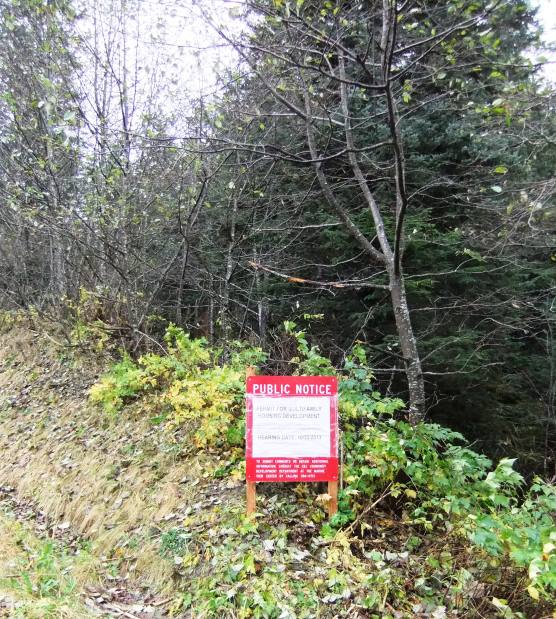
Volunteers of America has received a conditional use permit for a 40-apartment development on Vista Dive in West Juneau.
Volunteers of America have been given the OK to build up to 75 apartments in West Juneau.
The Planning Commission Tuesday night approved a conditional use permit for the two-phase project on Vista Drive. It includes 40 apartments in the first phase, with site work to begin next spring.
CBJ Community Development Director Hal Hart says Volunteers of America must still raise funds for the second phase of 35 units, scheduled to start in 2015.
While the non-profit organization is one of the largest providers of affordable housing in the U.S., more than a third of the Juneau units will rent at market rates. Some units will be set aside for people making less than $50,000 a year.
“There are definitely going to be units that are set aside at 50 percent of the area median income, but there are 15 in this first phase of 40 set aside for market rate,” he says.
Hart says the Volunteers of America development is the first this year to be directed at residents having difficulty finding a house or apartment that is reasonably priced for their income.
“The folks I’m talking about are working but at less than what the median income for Juneau is, so they’re spending more of their income on housing than others are, and it may require a second job for the housing, or two incomes to qualify for housing,” he says.
Hart calls the VOA project very important for a town short on affordable housing. So far in 2013, the city has received 132 applications for housing permits. But most of the proposed condominiums, homes or apartments will be rented or sold at what the market will bear.
Volunteers of America with Alaska Development Partners have been building multi-family housing projects across the state, with most units in Anchorage. The Juneau project would be adjacent to Crest Condominiums. The plan preserves about 25 percent of large trees as well as existing vegetation along Vista Drive. Hart says the apartment complex will be managed onsite by VOA.
Close
Update notification options
Subscribe to notifications
Subscribe
Get notifications about news related to the topics you care about. You can unsubscribe anytime.