Alaska Native Corporations

House passes bill granting thousands of acres of National Forest to Sealaska

The U.S. House passed a bill on June 19, ceding tens of thousands of acres of the Tongass National Forest to the Sealaska Native Corporation. However, the vote is just one step the bill needs to clear Congress.

This is the furthest along the legislative process the Sealaska bill has made it. It passed the Republican controlled House with 232 votes including 16 Democrats.

The bill would transfer control of tens of thousands of acres of the Tongass from the U.S. Forest Service to the Sealaska Corporation, the final Regional Native Corporation to settle its land claims. The land is outside the plots originally agreed to in the Alaska Native Claims Settlement Act 40 years ago.

Some of the land will be used for logging, with some future sites left open to other possible ventures. Those future sites have Andi Burgess worried. She’s with the Alaska Wilderness League.

“There’s no prohibition on what can be done at these sites,” Burgess said.

Those sections of land could be parceled off as heritage sites or be designated for money-making projects, like ecotourism. While Burgess’s fears may be stoked by the bill’s passage in the House, it still has some way to go before it becomes law.

The bill needs to clear the Senate, and if its current pace there is any indication, that probably won’t come quickly. Senator Lisa Murkowski introduced her version into committee last year, but has yet to receive a markup – let alone a vote.

Aides to Murkowski say it’s possible the House vote will speed along the process, at least out of committee, but the full Senate is another story.

Murkowski’s plan is more scaled back than the House version.

“To have limited impact into those old-growth areas, to have limited impact in those watershed areas. That’s why we’ve gone through the negotiated process,” Murkowski said.

She’s says that process has taken years –years of negotiations with Sealaska, the U.S. Forest Service and Southeast residents. And those negotiations could make for a more pleasing bill for both parties in the Senate.

And While Young’s bill did earn some Democratic votes – it lost more Republicans, a sign it could be hard to move his version down the line.

Senator Murkowski says the chairman of the Senate Energy and Natural Resources Committee, Jeff Bingaman, hasn’t committed to another hearing on the bill, but she’s trying.

“We keep sitting down,” Murkowski said. “And I suppose the fact that we’re still talking about it is good.”


Sealaska offers scholarship bonus

Descendents of Sealaska shareholders have until March to apply for corporate scholarships. But those submitting applications this month will receive an extra $50.
About 400 college, university and vocational school students receive the scholarships every year.

The money comes from Sealaska, the regional Native corporation for Southeast. It’s distributed by the Sealaska Heritage Institute, the businesses’ cultural arm.

Institute President Rosita Worl says the merit-based scholarships run from about $1,000 to $4,000 a year. The amount is based on each student’s year in school, as well as his or her grades.

“They have to be in good standing in their school. And we require a minimum of a 2.0 (grade-point average). If they fall below a 2.0, they go on probation for a semester and they have a semester to bring their grades up,” she says.

Applications must be filed online, through the institute’s website.

Forms, transcripts and letters of recommendation must be submitted by March 1st. Those completing paperwork by February 1st get the extra $50.

Students must attend an accredited institution full-time.

“One of the objectives is to train our future managers and employees of not only Sealaska, but our Native organizations. So in addition to the scholarship, we also have an intern program,” Worl says.

Students do not have to be Sealaska shareholders to receive scholarships. But they must prove they are a lineal descendent. The corporation has more than 20,000 shareholders, about half living in Alaska.

Sealaska and tribe sign land agreement

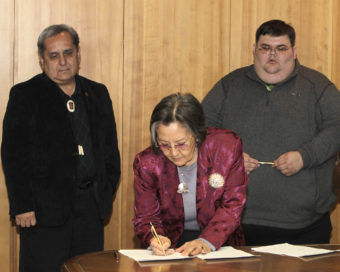
Albert Kookesh, Rosita Worl and Richard Peterson sign MOA. Photo by Brian Wallace, courtesy of Sealaska Corp.
Sealaska Corporation and the Organized Village of Kasaan have signed an agreement to allow the village to manage its cultural properties.

It’s the first of many agreements to be made with Southeast tribes to preserve and protect cemetery, shamanic, historic, sacred and archaeological sites within their territory, says Sealaska Board President Albert Kookesh.

Only the regional corporation has title to the lands under the 1971 Alaska Native Claims Settlement Act.

“The only choice we had as a corporation was to select those sites and to protect them ourselves,” Kookesh says. “We’re the only train left at the station. Nobody else has an entitlement in Southeast Alaska among the Native community where they could get title to these sites and protect them.”

Kookesh says the corporation and its board of directors have made a conscientious effort to identify some Sealaska economic lands as cultural sites for protection.

Under the agreement, Kasaan will work with Sealaska Heritage Institute to develop a preservation program and ensure that uses will not compromise historical and cultural integrity of the sites.

Sealaska Heritage President Rosita Worl says the most sacred thing to Native people is their land. She says the agreement will extend to lands in the Kasaan territory yet to be identified.

“It’s not only these particular historic sites, but it will be the yet undiscovered shamanic sites that we know are out there but our ancestors did not want to put on the map,” Worl says. “They did not want to put that on the map because they were fearful that people would come and desecrate those lands.”

The agreement was signed yesterday (Wednesday) by Kookesh, Worl, and Richard Peterson, president of the Organized Village of Kasaan.

Peterson says the Memorandum of Agreement between Sealaska Corporation, the Heritage Institute and Kasaan is very significant to the small tribe, and a testament that tribes and regional corporation can work together.

He says the tribe will be managing land it still uses.

“It’s important to not only mention that these are our ancestral homes, but that we still utilize these areas. Today we are still our own people,” Peterson says. “We live our lives as traditional people we still gather the foods, medicines, resources we need to survive as Haida, Tlingit, as Tshimian.”

Under ANCSA, the only way to put lands in Native ownership is through Sealaska Corporation’s remaining entitlement, or through the federal historical site program, which Worl calls a difficult process that takes years to complete.

The Sealaska Lands legislation currently before Congress includes a portion of Sealaska’s remaining entitlement to be used for cemetery and historical properties.

Sealaska to distribute shareholder dividend in December

Shareholders for Southeast’s regional Native Corporation can look forward to another dividend payment next month.

Sealaska’s board of directors has approved a dividend distribution of nearly 12-million dollars to the corporation’s more than 20-thousand shareholders.

It’s the second payment this year and will mean $1.02 per share for village and descendant shareholders, and twice that for elders.

Sealaska Chief Investment Officer Anthony Mallott says the dividend reflects losses from the economic downturn.

“The operations distribution and the permanent fund distribution have been in the just over a dollar range, we have now for a couple years, mainly affected by the fact that we average our distributions over a long time period and we’re still averaging the negative effects of 2008 where there were significant losses within our investment portfolio and there were some operational losses as well,” Mallott says

Urban and at-large shareholders also receive $6.12 per share under revenue sharing among Alaska’s regional corporations, required by section “7-i” of the Alaska Native Claims Settlement Act.

Additional payments are made to the various village corporations that can pass the money on to shareholders or use it for operations.

Dividends are paid from revenue sharing, earnings from a corporation permanent fund as well as earnings off investments and Sealaska’s subsidiary companies. The corporation owns timber, construction and environmental services businesses. It also has invested in plastics manufacturing and information technology.

Mallott anticipates payments could increase as the economy improves.

“One of the long term goals of Sealaska is to create and provide meaningful distributions to their shareholder base and we continually strive for that,” Mallott says. “The amounts recently are probably under our goal if you don’t count the 7i but again we’re working out of the great depression and great recession and we’ll continue to build those distributions to a point where both the winter and spring distributions are meaningful to those shareholders that are in our villages and elsewhere.”

Including last spring’s payment, the corporation’s total dividend this year will be nearly 24-million dollars. Fall dividend payments will be made by direct deposit or U.S. mail around December 8th.

Omnibus lands bill could include Sealaska measure

It looks like the Sealaska land-selection legislation will become part of a larger bill that could be easier to pass. At least that’s the case in the U.S. Senate. Meanwhile, opponents continue lobbying against the measure.

There are a couple of ways to get a bill through Congress.

One is to push the measure through on its merits or its sponsor’s connections – or both. Another is to combine it with similar legislation.

That’s what Senator Lisa Murkowski is trying to do with the Sealaska legislation.

“Historically what the energy committee has done is taken a whole package of lands bill, roll them into what is called an omnibus public lands bill, and then advance them to the floor that way,” she says.

The Alaska Republican is working on such a bill with Natural Resources and Energy Committee Chairman Jeff Bingaman. Murkowski says the New Mexico Democrat expressed some concerns she’s trying to address.

She says the timber acreage to be selected is pretty much set. Sections addressing cultural and economic-development areas are more flexible.

“Still some questions remaining on the sacred sites and some of the futures sites. But I would suggest that after years of input from Alaskans and those that have an interest we have gotten to a point where we’ve got a final bill that we can put before the committee,” Murkowski says.

“The idea of the Sealaska land bill being part of an omnibus bill in the Senate has really always been our expectation,” says Rick Harris, executive vice president of Sealaska.

He says bill changes mostly have to do with the futures sites, which could be used for ecotourism or energy development.

“I think they just want to confirm that we’ve done as good a job as we can in the selections to avoid conflict, but to still craft a suitable solution,” he says.

But there’s still plenty of conflict.

“I think it’s a bad idea,” says Davey Lubin, who runs a sea-taxi and ecotourism business in Sitka. He’s opposed to the omnibus approach, or any version of the bill so far.

“There’s some sense that some of the senators from certain states who stand to gain small wilderness areas are willing to throw the Tongass under the bus,” he says.

Lubin traveled to Washington, D.C., last month to lobby against the legislation. He’s concerned about impacts on wildlife, tourism, subsistence, and the overall future of the Tongass National Forest, where the land would be selected.

He says he tells people in Washington that the legislation is a corporate land grab.

“I was giving them a frontline view of what the sentiment here is about privatizing some of the most significant, important, beautiful gems of the Tongass. Most of the time the response was ‘Wow, we didn’t realize that this was anything other than a Native rights bill,” he says.

He’s not alone. Some environmental, tribal and outdoors groups, plus small Southeast communities, have also come out against the measure.

One of the latest to join is the Alaska Outdoor Council. The Fairbanks-based group includes seven Southeast affiliates and is the official state association of the National Rifle Association.

“We’re still battling here in the Interior to try to keep the easements across corporation lands to public lands behind them. And we have not been that successful at keeping that access,” says Rod Arno, the council’s executive director.

He’s among those worried that hunters, hikers and fishermen will be limited by the corporation’s new land ownership.

“The main concern is having more federal Alaska lands legislation when there should be adequate lands in the original withdrawals from ANCSA to meet the needs of the Sealaska Corporation,” he says.

Sealaska could select land now from areas of the Tongass near Southeast communities. Officials say much of that acreage should be protected as fish and wildlife habitat, or community watersheds.

Instead, the corporation wants Congress’ permission to select other lands in the region, much of it valuable timber property. Officials say they will maintain access and be environmentally sensitive.

Murkowski points to support from timber industry, economic development and Native groups, and businesses. She says she hopes the omnibus bill, cosponsored by Alaska Democrat Mark Begich, will move soon.

Meanwhile, Alaska Republican Representative Don Young’s version has cleared its only committee. It could head directly to the House floor, or, like the Senate, also be wrapped into an omnibus lands measure.

Earlier reports:
Both sides prepare for Sealaska bill’s next stop
Murkowski, Young post new Sealaska bills
Sealaska lands bill passes House committee

Sealaska defaults on part of California casino land

Sealaska has lost some its California casino land to foreclosure. But the regional Native corporation says it won’t hinder the project.

Sealaska has been working for several years to build a hundred-million-dollar-plus hotel and casino project about 85 miles north of San Francisco. Its partner is the Cloverdale Rancheria, a Pomo Indian group.

It lost two acres to foreclosure this week. The corporation’s Rick Harris says it’s a small part of a 65-acre project. A recent study showed it was not needed.

“What we chose to do is try to negotiate a better price because the property wasn’t going to be used for casino property. The individual who owned it was not interested in any further discussion, so we felt that it was not necessary for the project. So we chose to let it go and it just goes through the normal structured foreclosure process,” Harris says.

Sealaska bought the two acres for $1.3 million, according to the Santa Rosa Press Democrat. The newspaper reports the corporation owed just under $1 million when it defaulted on the land and it reverted to the previous owner.

The Press Democrat, about 30 miles south of Cloverdale, has covered the casino extensively. Some residents strongly oppose the project, saying it would create too much traffic and change the town’s character.

Harris says any money lost in the foreclosure will ultimately be recovered.

” We did invest some initial purchase price on the property. But it’s included as part of the overall gaming project. And as Sealaska is repaid, we’ll cover our investment,” he says.

Sealaska’s 2010 financial report, issued earlier this year, shows gaming operations losing more than $7 million during the previous two years.

The same report also said the corporation moved to end some agreements with its tribal partners in Cloverdale. But Harris says the project continues.

“We have agreements with the tribe to go forward with how to secure the financing for the project. And based upon that financing, that will help chart the course for the future,” he says.

The corporation earlier invested about $15 million in a San Diego-area casino run by the San Pasqual Indian Band. It made a sizable profit from that investment.

13Foreclose AM/AM/AM/MID/PM

3-cut wrap, about 2:20 Schoenfeld, 10/13/11

Sealaska has lost some its California casino land to foreclosure. But the regional Native corporation says it won’t hinder the project.

Sealaska has been working for several years to build a hundred-million-dollar-plus hotel and casino project about 85 miles north of San Francisco. Its partner is the Cloverdale Rancheria (RANCH-ur-ee-ah), a Pomo (POE-moe) Indian group.

It lost two acres to foreclosure this (last) week. The corporation’s Rick Harris says it’s a small part of a 65-acre project. A recent study showed it was not needed.

13Foreclose, 22 seconds: What we chose to do is try to negotiate a better price because the property wasn’t going to be used for casino property. The individual who owned it was not interested in any further discussion, so we felt that it was not necessary for the project. So we chose to let it go and it just goes through the normal structured foreclosure process.

Sealaska bought the two acres for $1.3 million, according to the Santa Rosa Press Democrat. The newspaper reports the corporation owed just under $1 million when it defaulted on the land and it reverted to the previous owner.

The Press Democrat, about 30 miles south of Cloverdale, has covered the casino extensively. Some residents strongly oppose the project, saying it would create too much traffic and change the town’s character.

Harris says any money lost in the foreclosure will ultimately be recovered.

13Foreclose, 13 seconds: We did invest some initial purchase price on the property. But it’s included as part of the overall gaming project. And as Sealaska is repaid, we’ll cover our investment.

Sealaska’s 2010 financial report, issued earlier this year, shows gaming operations losing more than $7 million during the previous two years.

The same report also said the corporation moved to end some agreements with its tribal partners in Cloverdale. But Harris says the project continues.

13Foreclose, 10 seconds: We have agreements with the tribe to go forward with how to secure the financing for the project. And based upon that financing, that will help chart the course for the future.

The corporation earlier invested about $15 million in a San Diego-area casino run by the San Pasqual (PASS-kwall) Indian Band. It made a sizable profit from that investment.

###

Site notifications
Update notification options
Subscribe to notifications