Business

Kensington leads Coeur to increased gold production

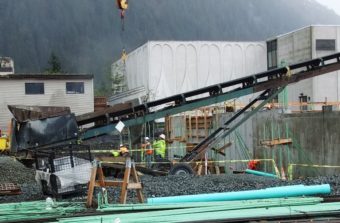
Higher production at Kensington Gold Mine near Juneau and a Nevada mine led Coeur d’Alene Mines to a 30 percent increase over the year in gold production.

The company says it produced 56,913 ounces of gold during the first quarter of 2013, compared to 43,901 in the first quarter of 2012.

A company news release says Kensington produced 25,206 ounces of gold in the first three months of this year, more than triple the production during the same period last year.

Coeur’s silver production of 3.8 million ounces was 22 percent less than first quarter 2012, due to lower grade ore processed from the Palmarejo  mine in Mexico.

Realized gold prices during the first quarter of this year averaged $1,630 an ounce, down 4 percent over the first quarter of 2012.  Silver was down 6 percent, averaging $30.61  per ounce.

Coeur is scheduled to report first quarter full operating and financial results on May 9th.


Lynden committed to purchasing Northland Marine Services

A barge departs from the Alaska Marine Lines dock in downtown Juneau.
A barge departs from the Alaska Marine Lines dock in downtown Juneau. (Photo by Heather Bryant/KTOO. Taken Oct. 10, 2012)

Lynden, a freight shipping company, has signed a purchase agreement to buy Northland Marine Services.

Lynden has several different operating companies including Alaska Marine Lines, Lynden Transport and Lynden International. Adding Northland to the corporate family will increase Lynden’s reach, according to AML President Kevin Anderson.

“It opens up a whole bunch more markets. Right now, our barge company which is Alaska Marine Lines, they serve southeast Alaska and Prince William Sound,” says Anderson. “Northland will give them the ability to serve westward, the chain which is Dutch Harbor and Kodiak and Bristol Bay and then all the way the west coast. It also opens up the market of Hawaii.”

Northland will join the group but continue to be operated separately.

“Northland will keep their current management and they’ll run separately. They won’t be folded into AML at all,” Anderson says.

“We have seen significant growth in our business over the past decade, and bringing two great companies and teams together will help improve and expand service in the communities we serve,” says Northland President Larry Stauffer in a press release.

Lynden and Northland are the currently the only freight carriers operating in Juneau.

Lynden has a series of regulatory hurdles to clear first, but if all goes well, Anderson expects the purchase to be completed later this year.

Webster loses BOF seat as legislature holds confirmation votes

Vince Webster Tom Kluberton Orville Huntington Feb 2012
Vince Webster (right) talks with fellow Board of Fisheries members Orville Huntington (left) and Tom Kluberton (middle) at a meeting in Ketchikan in February 2012. Photo by Ed Schoenfeld/CoastAlaska.

The Alaska Legislature on Monday voted by the narrowest of margins to reject one of Governor Sean Parnell’s appointments to the state Board of Fisheries.

Vince Webster of King Salmon served two terms on the board after being appointed in 2007 by then-Governor Sarah Palin. He also happens to be a Bristol Bay setnetter, like Palin’s husband Todd.

The Kenai River Sportfishing Association lobbied lawmakers hard to oppose a third consecutive term for Webster based on the board’s controversial votes on management of Cook Inlet king salmon. Chinook numbers in the inlet have dwindled in recent years, and Webster chaired the board’s Cook Inlet King Salmon Task Force.

Chugiak Republican Representative Bill Stoltze charged that Webster is biased toward commercial fishermen over sport anglers.

“Any good fish manager manages for the resource, not for politics, and not to secure reappointment, and not to favor one user group over another,” Stoltze said.

Much of the criticism directed at Webster was for a March vote to lower the escapement goal for Kenai River Chinook. The vote came out of cycle, meaning at a meeting where the board was not scheduled to consider Cook Inlet issues. But as Webster’s supporters pointed out, the board’s vote was unanimous, 7-0.

Soldotna Republican Senator Peter Micciche said he was impressed by how Webster handled the King Salmon Task Force meetings last summer.

“I didn’t see a leaning toward commercial fisheries,” Micciche said. “What I’m doing here is appealing to a sense of fairness to all of you. If those of us in these two bodies were replaced each time a group disagreed with a particular decision made by any of us, there’d be 60 new seats every four years. That’s just a fact. It’s a tough job.”

The vote to confirm Webster failed, 30-29. Lawmakers were split largely on regional lines, with Anchorage, Mat Su and Fairbanks legislators voting against confirmation, and rural lawmakers voting in favor of Webster.

The rest of Governor Parnell’s appointments were confirmed, most by unanimous consent. That includes Labor Commissioner Diane Blumer and Department of Transportation Commissioner Pat Kemp.

Parnell released a statement thanking lawmakers. But in reference to Webster, he said it is “disappointing, discouraging and disheartening when bad information or politics prevent a qualified Alaskan from serving our state.” The release from the governor’s office says Parnell called Webster personally after the vote to thank him for his six years of service on the Board of Fisheries.

The governor will make a new appointment to the board, who will be allowed to serve until confirmed by the legislature.

“Un-Cruise” line boosts Alaska sailings

Un-Cruise Adventures’ Laurie Cooper, left, and Larry West stand by the Wilderness Explorer, which begins sailings soon between Juneau and Sitka. Photo by Ed Schoenfeld/CoastAlaska.

It’s still a few weeks before the tourist season begins. But the small cruise ship Wilderness Explorer is already tied up at a Juneau dock.

“One thing you’ll notice if you look at the back of the vessel is that it’s been modified to accommodate a platform that can be easily lowered into the water to launch kayaks and things,” says Larry West,  an Un-Cruise Adventures staffer providing the tour.

“Once you’ve done your active adventure, we always have saunas and hot tubs on all of our vessels, so you can come back on board and relax until the next day’s adventure,” adds Laurie Cooper, an expedition guide for Un-Cruise Adventures. 

Kayaks are stacked up on the stern of the small cruise ship Wilderness Explorer.

The 76-guest Wilderness Explorer is one of several ships added to the company’s line-up in recent years.

This year’s addition is the 88-passenger Legacy, where West will lead a team of costumed guides.

“We will be focusing especially on recreating authentic historical moments,” he says.

The living history theme is a different approach for Un-Cruise Adventures, the new name for sister lines InnerSea Discoveries and American Safari.

“The vessel itself is designed to look like and be patterned after a vessel from the late 19th century that would have brought anxious miners to Alaska in search for gold in the Klondike,” West says.

The Legacy will have its first sailing in August.

It used to be the Spirit of ’98, one of a fleet of small ships operated by Cruise West, which went out of business in 2010.

Other companies, including Sitka-based Alaskan Dream, have purchased and renovated other Cruise West ships for Inside Passage operations.

“I think this coming season, we’ll actually be seeing more small cruise vessels in Southeast than ever before,” says Joel Hanson of Sitka, who works for The Boat Company, a two-ship line sailing between Juneau and his hometown.

Unlike the big cruisers, there’s no centralized database of small-ship sailings. But Hanson’s convinced capacity is increasing.

“I think the trend is: It may not grow rapidly, but it does seem to be and it has the potential to continue to grow,” he adds.

The Baranof Dream is operated by Sitka-based small cruise line Alaskan Dream.

The small ships are particularly valuable to Southeast’s smaller ports.

“It’s always nice to have visitors come to town and be interested in our unique culture,” says Liz Cabrera of the Petersburg Economic Development Council.

Her town sees no large cruise ships dock during the summer. So when a new small vessel ties up, the passengers are noticed.

“And hopefully spending a little bit of their money on our local shops downtown. And that’s great for our merchants and also for our sales tax revenue for our borough,” she says.

Many small-ship passengers have more money. Their cruises often run in the range of $3,000 to $12,000 per person. Larger ships offer deals below $1,000 — or less.

A number of the small lines employ regional residents.

Sitka’s Alaskan Dream cruises make that part of its marketing with the slogan, “True Alaska with True Alaskans.”

Dan Blanchard, of the Un-Cruise line, says his company is opening an office in the Capital City this May.

“We are slowly moving more and more up to Juneau, particularly in the form of our operations end of the company. It’s hard to say how far we’re going to go with that, but we’re definitely headed into that direction,” he says.

His company’s 60-passenger Wilderness Adventurer leaves Seattle for Alaska at the end of this month. Other small lines will follow, sailing along with the much larger ships, through September.

Companies sailing small ships in Southeast include:


Spring Sealaska dividends total $12 million

Sealaska Plaza in Juneau, headquarters of the Southeast regional Native corporation.

Sealaska’s approximately 21,000 shareholders will get their spring dividends around April 12thSealaska’s Board of Directors approved the more than $12 million distribution at a meeting today at its Juneau headquarters.

Here are details of how the distribution is divided up. Totals assume ownership of 100 shares, the most common number.

  • Urban and At-Large Shareholders: $698
  • Elder Urban and At-Large Shareholders: $852
  • Non-Elder Village and Leftout Shareholders: $154
  • Elder Village and Leftout Shareholders: $308
  • Descendant Shareholders: $154

Here‘s how the shareholder categories are defined:  

  • Urban: Also a shareholder in an urban Native corporation, such as Juneau’s Goldbelt or Sitka’s Shee Atiká.
  • At-Large: Not a shareholder in any urban or village Native corporation.
  • Village: Also a shareholder in a village Native corporation, such as Huna Totem, Kake Tribal, Klukwan and Cape Fox corporations.
  • Leftout: Those who were eligible in 1971, when the Alaska Native Claims Settlement Act became law, but enrolled later.
  • Elder: Original Sealaska shareholder who has reached the age of 65.
  • Descendent: Direct descendents of original shareholders who are at least one-quarter Alaska Native.

Here’s where the money comes from, per 100 shares: 

  • $544 from ANCSA Section 7(i) (regional corporation resources earnings) revenue sharing. A $5.44 per share payment will be made.
  • $100 from corporate earnings. 35 percent of the corporate consolidated net earnings averaged over five years, minus earnings associated with the Permanent Fund. The distribution includes an operations dividend of $1.00 per share.
  • $54 from dividends from the Marjorie V. Young Permanent Fund, which are based on a percent of market value (POMV) of the fund balance. Based on the POMV calculation, the 2013 April dividend will be $0.54 per share.

Some members of the Juneau-based regional Native corporation have more or fewer than 100 shares due to inheritance or gifting.

Much of the dividend – close to $550 – comes from a pool of regional Native corporation resource earnings. Most of that money comes from Northwest Alaska’s NANA, an owner of the Red Dog Mine.

Sealaska’s urban shareholders receive that part of their dividend directly. The corporation pays village members’ share to their local corporations, which decide whether to pass it on.

Last spring’s distribution was about 20 percent more for urban shareholders and about the same amount less for village members.

Sealaska’s shareholders are mostly of Tlingit, Haida or Tsimshian descent. Close to half live in Southeast.

Parnell satisfied with Senate oil tax reform bill

Governor Sean Parnell
Governor Sean Parnell speaks to the Juneau Chamber of Commerce on March 21, 2013. Photo by Casey Kelly/KTOO.

Governor Sean Parnell says the Senate’s version of his oil tax reform bill meets the guiding principles he had in mind when it was introduced. But he says the House of Representatives should take its own look at the legislation, and make any changes members deem necessary.

Parnell says Senate Bill 21 meets his main objectives for the overhaul, namely simplifying the overall oil tax system, protecting Alaskans at low oil prices, encouraging new production, and being competitive with other oil producing areas.

“I’m urging those House members to look at the proposal that’s there – look at SB 21 as it is now – and the dials or nobs that are there,” Parnell said Thursday in a speech to the Juneau Chamber of Commerce. “And if you think the system as passed to you as House members needs adjustment, then work those nobs and dials and come up with what you think is a competitive tax system, one that is fair to Alaskans, and one that will inspire new production. But use those nobs and levers that are there. Don’t try to make it more complicated by putting in new levers, new nobs, new dials.”

Senate Bill 21 raises the base tax rate charged to oil companies from 25 percent to 35 percent. It eliminates some tax credits currently offered to oil companies, but replaces them with a $5 credit for every barrel of oil produced. It also would eliminate the progressivity feature of the current ACES tax system, which raises taxes as oil prices go up.

The overall effect is a tax cut estimated at $6 billion over five years for oil companies. Opponents say without any guarantee of new production, the bill is a massive giveaway.

SB 21 officially passed the Senate Thursday after a reconsideration vote. The margin was as narrow as possible, with eleven Republicans supporting the measure and all seven Democrats and two moderate Republicans opposing it.

Parnell touched on oil taxes for only about five minutes of his brief chamber speech.

He started his remarks by remembering Manokotak Village Public Safety Officer Thomas Madole, who was shot and killed in the line of duty this week. Parnell said he met Madole about a year ago on a trip to Southwest Alaska.

“He was a kind and gentle man,” Parnell said. “And I sat down at a Dillingham (Alaska State Trooper) post with him, and asked about how life was in Manokotak.”

Parnell said Madole’s death underscores the importance of public safety programs. He noted that on March 28th, his “Choose Respect” campaign to end domestic violence and sexual assault in Alaska marks its third year, with marches across the state.

“We have a long way to go when it comes to safety for all Alaskans,” the governor said. “Not just our VPSOs, but in our homes and in our families.”

Parnell also highlighted some of the economic successes the state has experienced during his administration. He said mining activity is on the rise, especially in Southeast; and the number of business license applications for land-based tourism transportation has increased from 19 in 2009 to more than 140 so far this year.

Parnell also touted the Alaska Class ferry redesign, saying the state expects the same or better service with shuttle ferries rather than the earlier large boat concept. The Department of Transportation is taking public comments on the draft Day Boat Alaska Class ferry plan through March 29th.

Site notifications
Update notification options
Subscribe to notifications