Housing

‘Amazing to see it happening’: Team Rubicon volunteers help with Haines storm cleanup

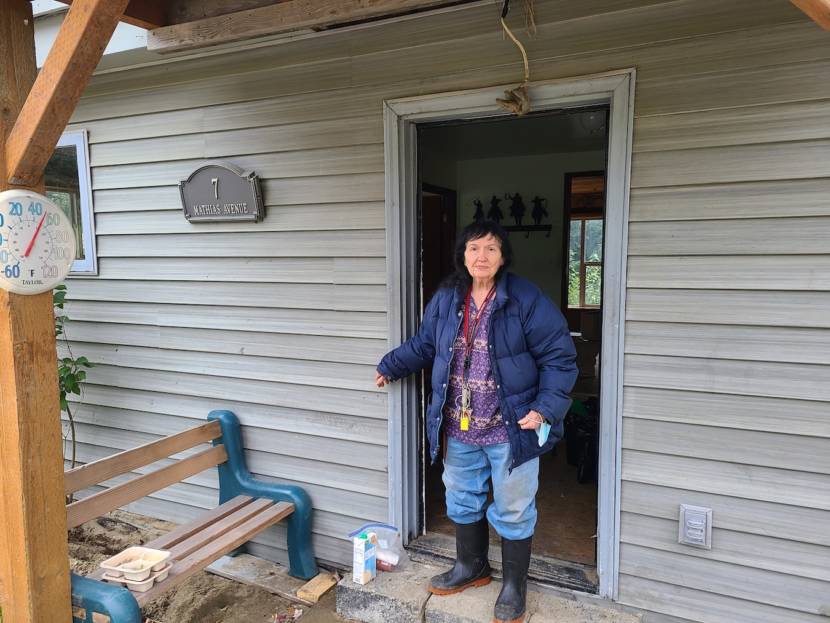
Lemmie Spradlin, 83, wants to return to her home (Corinne Smith/KHNS)

83-year-old Lemmie Spradlin has lived in Haines for 20 years. Since her husband passed away more than a decade ago, she’s lived alone in a two-bedroom house on Mathius Road.

Last year, on Dec. 2, she woke at 2 a.m. with water pouring through her front door. She says she’s felt numb since then.

“That numbness has not left me yet,” Spradlin said. “A deep numbness inside. Something was going on that I had no involvement with and had no idea what to do about.”

Spradlin’s home was effectively destroyed by water and mud. Ever since, she’s been living in a converted garage with rental assistance and support through local non-profits.

Nine months later, volunteers with Team Rubicon, known as “grey shirts,” hammered in flooring reinforcements and began final cleanup on Spradlin’s house.

“It’s essentially becoming a brand new house in a way,” Joshua Strange said.

It’s his first deployment with Team Rubicon, which is mostly veterans and first responders volunteering their time to do disaster recovery missions around the world. He leads the way to the ground floor, now stripped to the studs and cleared out.

“So the bottom floor, we totally deconstructed,” Strange said. “And we ripped out all the insulation, all the ceilings, we pulled up all the flooring because it was just totally moldy and full of muck.”
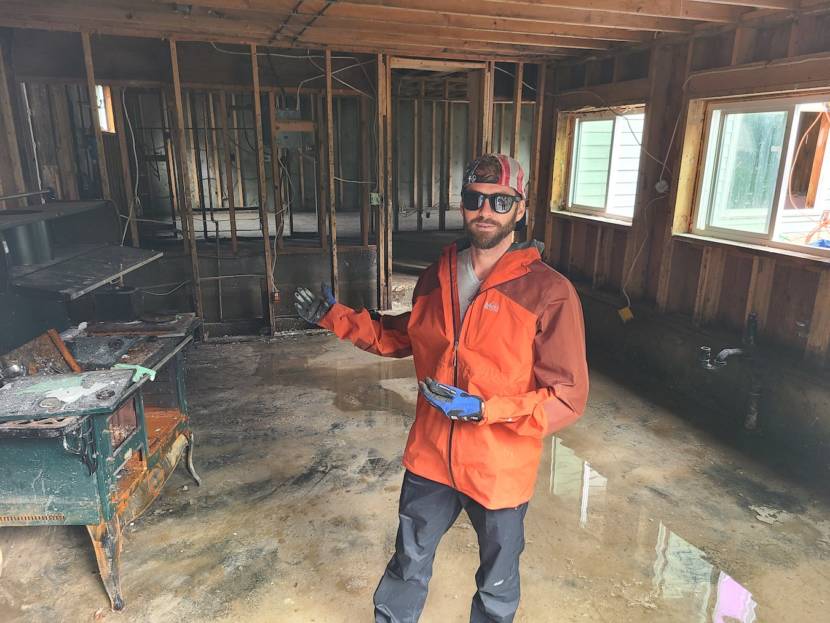
Joshua Strange shows off the progress made on the ground floor of Lemmie Spradlin’s home, which had been flooded with water and debris up until last week (Corinne Smith/KHNS)

Strange is a 10-year veteran of the US Air Force from San Diego, California. He decided to volunteer after finishing college and before starting a new job. He’s one of 11 volunteers that traveled to Haines.

He says he’d signed up to help with earthquake recovery in Haiti but was deployed to Alaska. For the past week, he and the group have been removing debris  — 43,760 pounds of it — from nine properties, then loading it up and dropping it off at the dump.

Strange says it feels good to be a part of a mission.

“I came out here, I didn’t know what to expect,” Strange said. “But most of these guys are veterans, and they’re all very hard working. It was incredible to join the team and just be part of something, where you actually see the difference that you’re making.”

Brian Rougie is a veteran of the Army National Guard and was deployed in Iraq in 2003. He lives in Haines and says he’s been  interested in volunteering with Team Rubicon for a while. But this was his first time.

“It was daunting. You walk in and like, oh man, this is going to take forever. But with a lot of people, you just keep moving,” he said. “I feel lucky to help out and pitch in locally, so that’s pretty cool.”

The Southern California-based organization was invited by the Haines Long Term Recovery Group to help with debris removal, which has been a top priority since the deadly December storms. It’s part of a federally funded project, and residents have up to Sept. 18 to collect debris for removal.
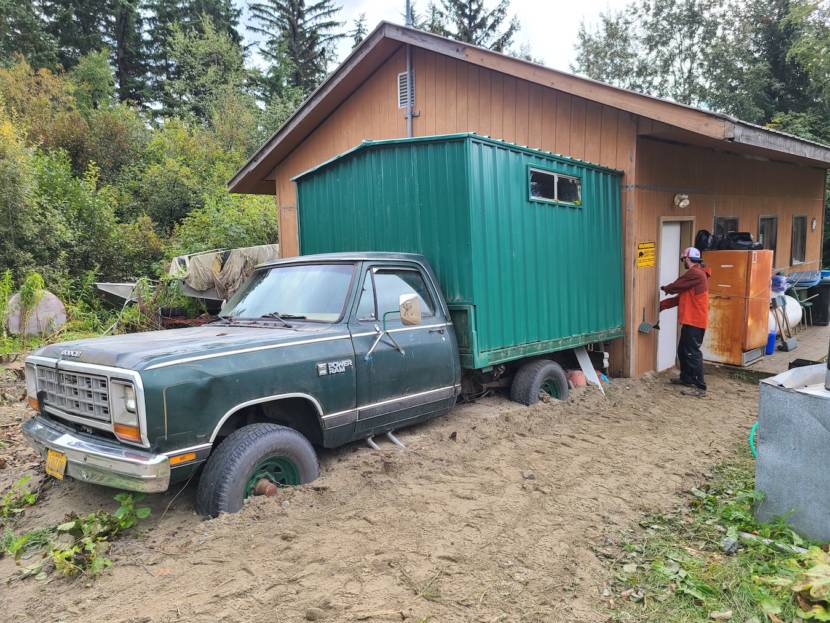
Lemmie Spradlin’s truck and garage were flooded during last December’s storms (Corinne Smith/KHNS)

Haines Long Term Recovery Group coordinator Sylvia Heinz says it’s a major step forward.

“It’s just amazing to see it happening, because since the snow melted, it just seemed impossible,” she said.

For Spradlin, the work had been too much to tackle alone. After the snow melted, she began catching the senior bus to her property most days to try to clean things up, but she couldn’t afford the labor or dump fees.

She says she’s grateful to Team Rubicon and just wishes she could have made them a meal.

“Any of them wander back to town, as long as I got a floor space they’ll have a place to get in and shelter,” Spradlin said. “As long as I’ve got food around, they’ll have some belly waddin, and that’s just how it is. The Rubicon guys will always be welcome.”

Her home is stripped to the studs now, and there’s no running water, but it’s ready for construction. And there’s still power. Spradlin says she needs a culvert dug to divert the water, new flooring, walls and appliances — then she’ll move back in. It’s her home.
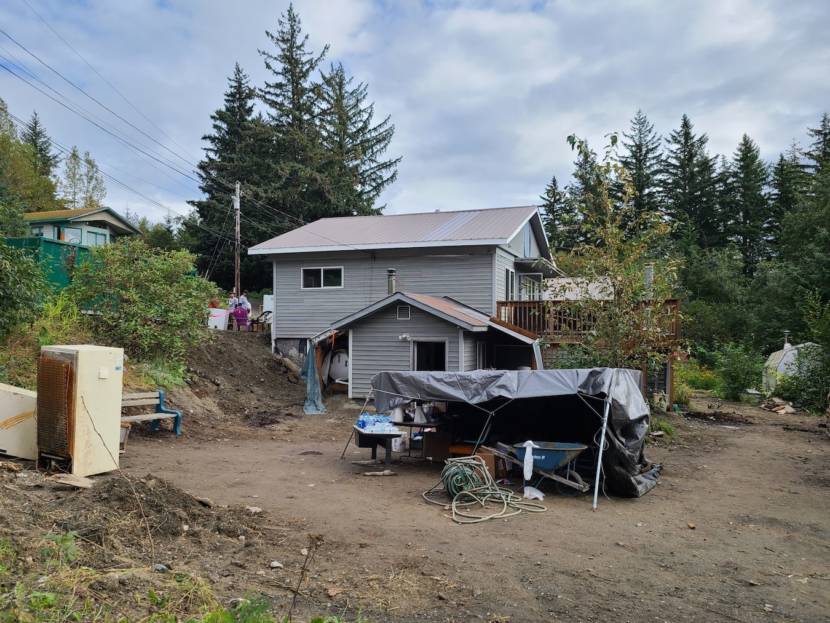
Spradlin’s home is about half a mile uphill from Haines’ Main Street. Team Rubicon mucked out the house, cleared natural debris from the property, and sorted and salvaged items into dry storage (Corinne Smith/KHNS)

The volunteers with Team Rubicon are about done with a final cleanup of her property, and they’re ahead of schedule by a few days.

“We’ve been able to exceed expectations, and that’s a good thing,” said Craig Dickerson, the group’s incident commander.

So now the team gets to play tourist. They’re headed to Haines Hammer Museum.

“We’re really excited about that,” Dickerson said. “We checked the map, saw that was a thing here, and just have been over the top. So big thanks to them for opening up for us.”

The group departed Haines last Sunday. But they say they’ll be back if needed.
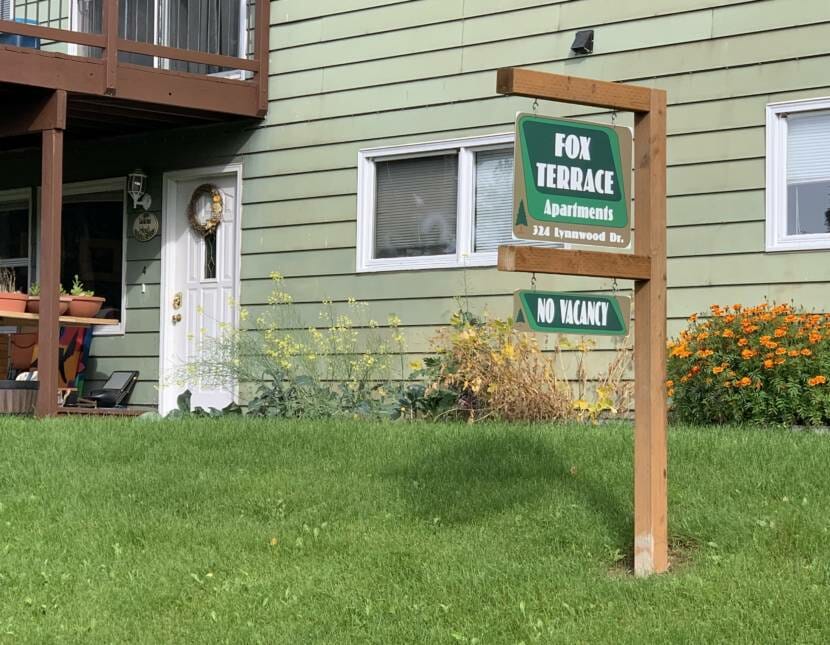
Rents up, vacancy down: How the pandemic impacted Alaska’s rental market

A “no vacancy” sign at an apartment complex in the Midtown Anchorage area on Saturday, Sept. 11, 2021. (Alaska Public Media file photo)

The cost to rent a home or apartment has gone up in Alaska during the pandemic, according to state economists. A survey published this month by the Alaska Department of Labor and Workforce Development shows a 2% bump in rents since spring 2020.

According to the survey, the median adjusted rent for all unit types in Alaska was $1,179 a month in 2021. Comparing Alaska communities: Sitka came in with the highest rent bill at $1,323, while Wrangell and Petersburg were lowest at $950. In Anchorage, the median rent was $1,172 and in the Matanuska-Susitna Borough it was $1,051.

The biggest increase was in Ketchikan, where the median rent went up more than 10% between 2020 and 2021. In Anchorage, rent rose 2.8%.

At the same time, statewide vacancy rates — the percentages of available rental units — were down.

That makes sense, according to state economist Rob Krieger. Rental prices and vacancy rates tend to be connected, he said.

“When you see a rise in rental prices, you generally see a fall in vacancy rates,” he said. “As the market tightens, prices come up. And that would work in the other direction: In a market where prices are coming down, you’d generally see more vacant units available.”

Vacancy rates dropped almost everywhere in Alaska a year into the pandemic, according to state data, ranging from 2.5% in the Mat-Su in 2021 to 13.1% on Kodiak. In Anchorage, the vacancy rate declined from 5.7% in 2020 to 4.3% in 2021.

The fall in vacancy rates statewide is happening for a number of reasons, some of which are related to the pandemic, said Krieger. The biggest driver, he said, was an influx of military personnel and their families to Eielson Air Force Base near Fairbanks, brought on by the new batch of F-35 fighter jets stationed at the base.

At the same time, the pandemic rental market isn’t experiencing the usual level of churn of people moving into and out of apartments, said Krieger.

“People are staying in place,” he said. “They may have been dislocated from their employment, and it’s just a matter of just not making major changes at this point. Or for safety reasons, or other things, nobody’s really moving that much.”

Rising home prices are also at play. Low interest rates are making it more difficult for first-time buyers to break into the competitive housing market, said Krieger.

“Especially when you consider that an average mortgage payment is now significantly higher than the average rent,” Krieger said.

More people are choosing to continue renting for now, he said.

A looming question on the horizon is what will happen now that the federal eviction moratorium has been lifted. Krieger said it’s hard to say how many people could be facing eviction or even whether Alaska will see a large wave of newly-evicted renters.

“In order for evictions to happen on such a large scale, you have to assume that there’s a bunch of people waiting to occupy those vacant units. And I just don’t think that’s the case,” he said.

In cases where renters are struggling to find work and holding out for rental assistance, he said, it makes more sense for landlords to work with tenants to keep them in their units.

“I don’t think it would do anybody any good to just have a massive number of evictions — especially landlords, because without the ability to refill them, they’re no better off in terms of collecting revenue and rent,” he said.

Alaska Housing Finance Corporation recently announced a new round of rental assistance, up to three months rent for eligible Alaskans. Applications open Monday.

Local officials look for housing solutions while seasonal workers do the Skagway shuffle

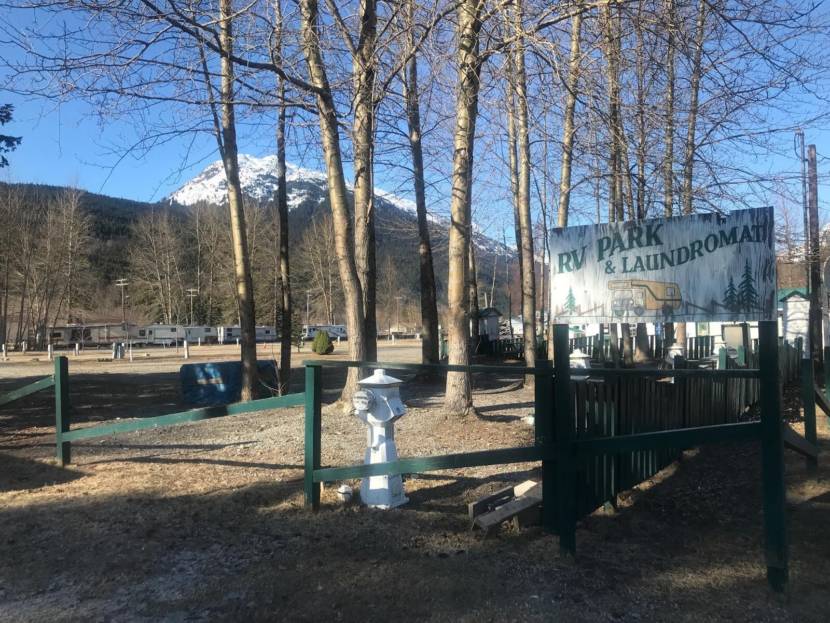
The Garden City RV Park in Skagway in April, 2021. (Mike Swasey/KHNS)

It’s called the Skagway shuffle. During busy cruise ship summers, seasonal employees show up to work with no place to live.

They might crash on somebody’s couch or split a room until they eventually find a job that offers reasonable housing. Some end up sleeping in their cars parked on side streets or sleeping in tents in the woods.

Some employers will cram a dozen people into bunk rooms, others have seasonal housing that has no heat.

Some seasonal workers have found their best option was to live in an RV at one of the local campgrounds.

“Especially when you’re married and you have a dog, you don’t want to live with a bunch of other people, you just want to have like your own little space. You know,” said Raymie Eatough, a local tour operator.

Eatough used to live seasonally in Garden City RV park. She and her husband Joe both own small businesses and travel to the Lower 48 in the winter to find work.

“It’s not like there’s a lot of jobs in the winter. So we choose to leave so that we can still bring in an income into our lives,” Eatough said.

That leaves them with the unenviable position of trying to find a place to live each summer. And in May, municipal officials closed Garden City RV park to seasonal housing.

The couple is in a rental now, but they say it won’t be available to them next summer.

“We’re having a hard time finding seasonal housing, we’ve been here for 25 years. Think about how it’s going to be for people that haven’t been here this long and don’t know as many people as we know,” Eatough said.

Borough Manager Brad Ryan says the goal of the RV park is to host traffic from the Klondike Highway. That traffic is expected to rebound faster than cruise ship traffic once the pandemic-related Canadian border restrictions are lifted and more independent travelers arrive.

But the estimated costs of repairing electrical issues plus water and sewer upgrades at Garden City RV park are as high as $500,000.

The municipality purchased the RV park in 2013 from a church group for $1.2 million. It plans to keep it open for nightly visitors next summer but also wants to develop a long-term plan.

Assemblyperson Sam Bass says now is the time to take action.

“What we’ve done is we kind of used a Band-Aid fix, which is an RV park where people have started to use that as their seasonal housing, which I don’t think that ever was the intent,” Bass said.

In 2020 the Assembly drafted plans to subdivide the property into up to two dozen 50-by-100-foot lots. But then the pandemic put that on hold. Bass says there are opportunities to tackle both the seasonal housing problem and the lack of affordable homes for sale in Skagway.

“We’re looking at duplexes, triplexes, maybe even a condo setup, depending on how it’s developed. But somehow some way to develop and make available more housing for both seasonal folks and for year-round people. Because we need both of those,” Bass said.

The assembly has discussed plans to put a new RV park near the solid waste dropoff and composting facility ,on land already owned by the municipality on the north end of town. But that site doesn’t have water and sewer access.

Bass says the site doesn’t need those. And he wants to get started on both projects while admitting not much will likely be completed before workers arrive for the 2022 cruise season.

“If we’re not willing to make the sacrifice now, we’re just going to keep kicking that housing issue down the road. And eventually, it’s going to get very, very bad where there’s no year-round housing, and there’s no more seasonal housing because it’s all full, then what do we do? We’re stuck,” Bass said.

The assembly had granted a waiver from the regulation forbidding RV rentals on privately owned residential property, but that resolution expired on May 1, leaving people who want to live seasonally in their RV with no legal options other than to move from campground to campground every two weeks.

Amid shelter debate, these Anchorage campers say they’re staying outside

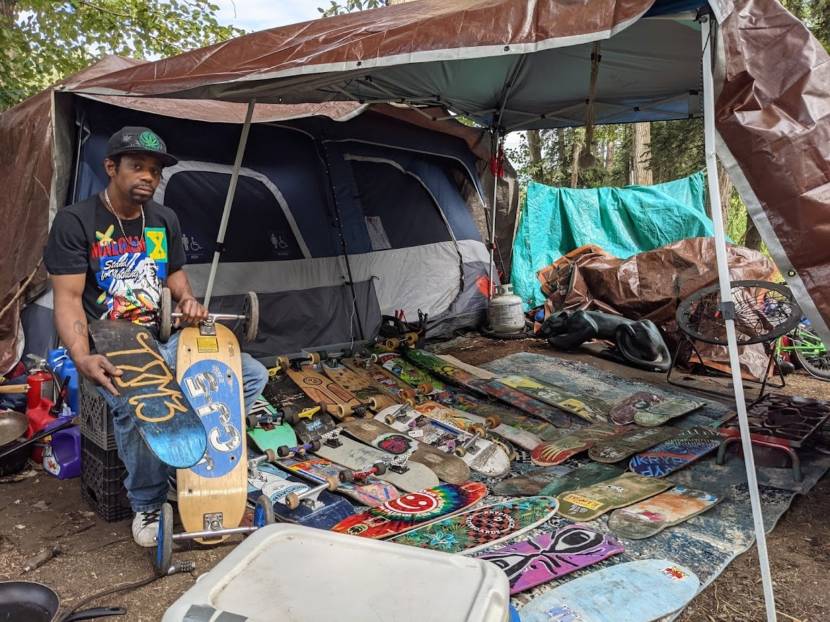
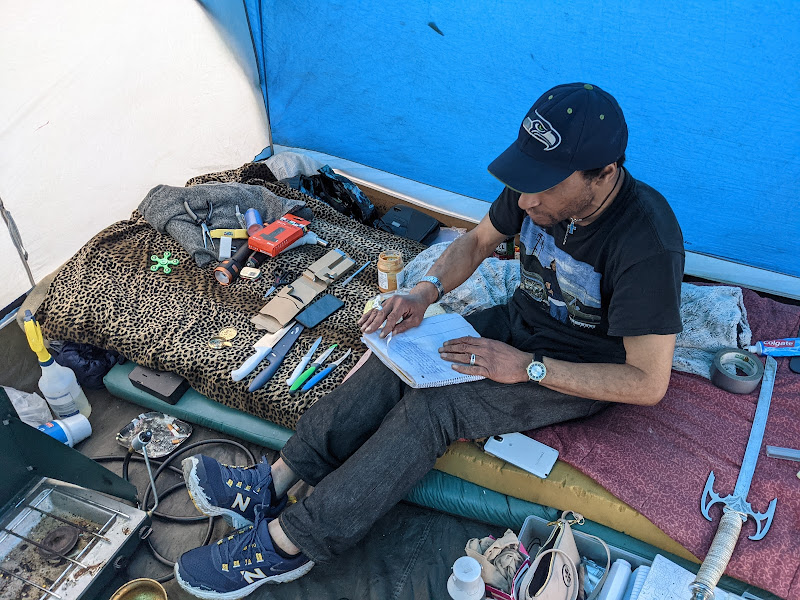
Cesar Carberry shows off his skateboards at his tent at the city snow dump in Anchorage’s Mountain View neighborhood in August, 2021. Carberry sands the decks and paints designs on the bottoms — sometimes with the help of fellow campers — and resells them for $40 for skateboards, or $50 for longboards. (Lex Treinen/Alaska Public Media)

In a grove of birch and cottonwood trees between Anchorage’s Mountain View neighborhood and the Glenn Highway on a recent day, camp resident Cesar Carberry’s calloused fingers rubbed down the bottom of a skateboard deck with a hand sander.

It takes about an hour to get the old paint off before he draws and paints an original design on the bottom. He screws in the trucks and attaches the wheels and sells them for $40 a piece. He calls his business A-1 Neva Boards.

“You’re never bored when, you know, when you’re on a skateboard. You always got something to do,” he said. “And it kept me out of a lot of trouble.”

Carberry doesn’t have a permanent place to stay. A1 Neva Boards is one of the reasons he doesn’t want to stay in a shelter, where the size of his personal belongings are limited to what he can fit in a plastic tote.

But in this large camp, the dozens of other campers have dozens of other reasons for not wanting to be in a congregate shelter, from claustrophobia, to fear of catching COVID-19. Some want to be in neighborhoods close to their families and others just love the open air.

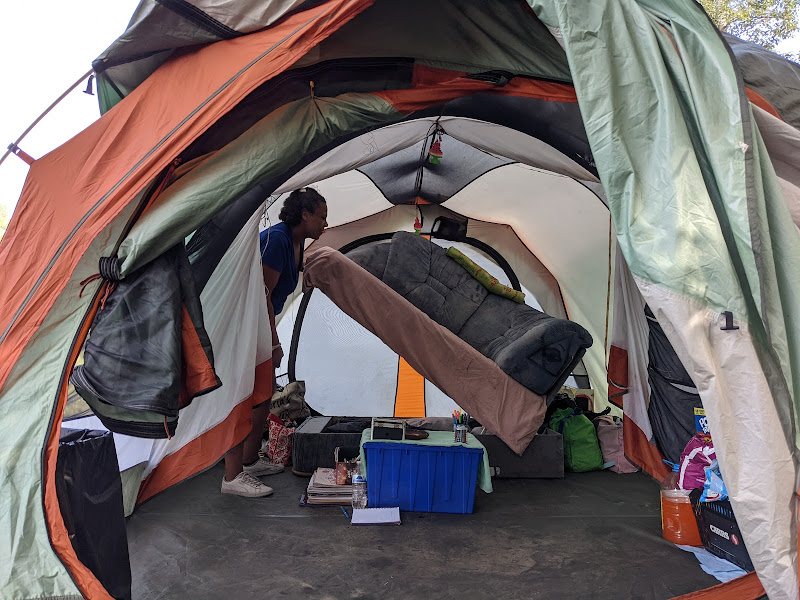
A camp in Anchorage’s Mountain View neighborhood in August, 2021. The area is used as a snow dump in the winter. The city estimated 51 camp sites in the area. (Lex Treinen/Alaska Public Media)

Scattered around Carberry’s spacious tent are buckets filled with spare skateboard parts, tools and a full-size ceramic statue of a panther. There’s no trash other than some scrap metal, and his two dozen skateboards are lined up neatly in a tarp-covered awning outside his tent. But this isn’t how he wants his 8-year-old son, who lives elsewhere, to see him.

“He’ll ask me, ‘You’re going back to the tent?’ And I’m like, ‘that’s not what I want.’ That’s not what I want. I want ‘you going back to your shop. Are you going back to your house?’” he said.

Carberry’s tent, and dozens of others in the area, were slated to be removed. During the first week of August, the city came to the lot — which the city uses as a snow dump in the winter — and posted white paper signs on the trees. The signs gave the legally required notice to the dozens of campers they’re required to leave within 10 days. The city calls it ‘abatement,’ though many campers refer to it as “eviction.”

Soon city employees planned to haul out hundreds of pounds of junk and trash from the abandoned sites. The abatement process costs the city hundreds of thousands of dollars each year, and it forces campers to spend hours packing up and moving their belongings to new campsites every few months or years.

“It’s just it’s … it’s getting old,” Carberry said.

The city says it has abated about 180 camps so far this year and hauled out 261 tons of trash, according to the city’s parks department. There’s no good estimate for how many campers are in the city at one time. Each year, on a dark night in January, city workers try to count every tent, but it’s likely there are many more campers in the summer when the weather is milder.

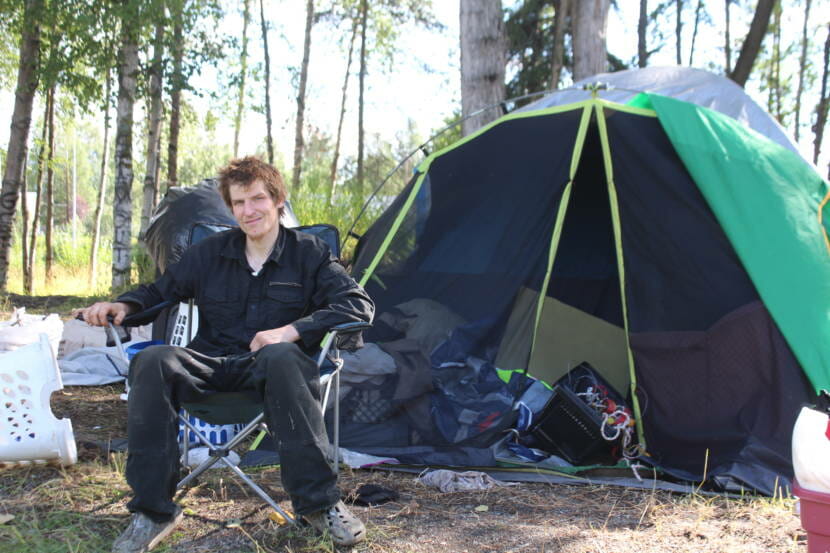
In a nearby tent, 28-year-old Devon Felton had already started to pack his things up for the move. He’s pencil thin and his jeans sag below his waist. The Vancouver, Wash. native pulled out a camp chair and sat down for an interview.

“I moved down here because of some family struggles and I’ve moved away from here three, four times and something about Alaska just keeps bringing me back. I love music, dancing and cooking,” he said.

Devon Felton at his campsite in Anchorage’s Mountain View neighborhood in August, 2021. Felton says he’s struggled to find employment and the abatement notice added insult. “It’s almost indescribable,” he said about having to move his things to a new campsite again. (Lex Treinen/Alaska Public Media)

He competes in rap battles, and melting down wires to make jewelry. But his talents don’t pay much. He’s looking for consistent work as a landscaper, but he hasn’t had luck lately.

“It’s kind of a stigma when you tell someone that’s hiring that you’re homeless. They — I don’t know how to describe it — they look at you differently,” he said.

He said shelter just isn’t for him. He found a group here that he trusts. They look out for one another, even if they’re forced to move to a new spot every few months.

“It’s more like a community like a family out here than at the shelter,” he said.

A lot of the campers here say that the community is a big part of why they stay outside instead of in a shelter.

Some campers recently proposed the city find a large, sanctioned campsite where they can offer limited services, like trash and bathrooms, to residents. Camper Allen Lavont Jefferson wrote the proposal as part of the Homeless Resource Advisory Council.

“As a solution-oriented community, we would do all the cleaning, bag up all the trash, take it and put it in a designated area where we could meet and greet other people who are having the same problem,” he said.

Allen Lavont Jefferson talks about his plans for volunteer work. Jefferson, who grew up helping his mother’s beauty salon in Fairview, says he likes the Mountain View area because it’s close to the assisted living facility where his mother lives. (Lex Treinen/Alaska Public Media)

The idea hasn’t caught traction among policy makers, who want people in shelters where they have easier access to services like mental health care and housing support that will help them get out of homelessness.

But campers like Elshanikwa Durfee say there are disadvantages to shelters too.

“I’m an adult, I don’t think I should have an 11 o’clock curfew to be inside of the building.  Because this person is drunk, or this person has mental health issues, I’m supposed to just kind of be quiet and let them react or behave however they’d like to?? I’m not really good with getting along with people,” she said.

Elshanikwa Durfee at her tent in Anchorage’s Mountain View neighborhood in August, 2021. She says she’s been living in tents since she graduated high school ten years ago but dreams of owning her own log cabin in the woods away from others. (Lex Treinen/Alaska Public Media)

She said at the Mountain View snow dump, she can hide away in her tent if she starts to feel overwhelmed by crowds. And, she said, pointing to the leaves fluttering above her tent, it’s a beautiful way of living.

“In the fall, all these trees change all different colors around here and it’s just quiet enough to where at night, that highway sounds like an ocean,” she said.

She hoped, last week, to enjoy it for a few more days before moving on to a new campsite.

Sitka Assembly removes landslide section from city code

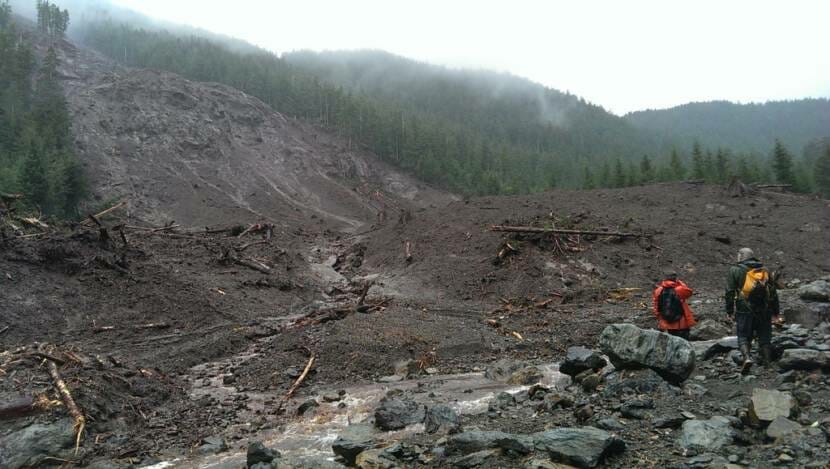
A 2014 landslide about ten miles from Sita caused no structural damage but wiped out hundreds of thousands of dollars of watershed restoration projects in the Starrigavan Valley. (USFS photo)

The Sitka Assembly has unanimously agreed to remove language about landslide management from city code.

After the deadly landslides in 2015, which killed three people, destroyed one home and seriously damaged two other properties, the assembly commissioned landslide mapping to assess risk throughout Sitka, and adopted a new section of city code with restricted development in areas with “moderate” or “high” landslide risk.

City administrator John Leach said that information is now being used by insurance companies and lenders, causing unanticipated challenges for some homeowners.

“The difficulty with this is we had an area that was already developed. And suddenly, all these homes were placed in this restricted land slide area, and they had no choice. And now, they’re kind of boxed out from refinancing, they’re boxed out from insurance, when really nothing has changed for them over the years,” he said.

At Tuesday’s meeting, assembly member Thor Christianson was in favor of removing the landslide language but voiced some skepticism at it being the solution for the insurance and financing problems.

“It will be interesting to see if this really removes the loan lending issue,” he said. “I have a sneaking suspicion this ordinance is being used as an excuse,” he said.

Leach agreed.

“The intent is to not be a barrier to lending and insurance,” he said. “But this is a little bit of a litmus test to see if we were the barrier.”

One member of the public asked if the landslide legislation would be replaced with something else. Assembly member Crystal Duncan was similarly concerned

“And I’m glad we were able to find a solution, but it kind of plays on what came up as a concern is that we’re rescinding that entire section, which in itself is sending a message, whether we intend to or not,” she said.

Leach said they wouldn’t be removing preventative landslide regulations from the city’s purview. He wants studies to continue and said he’s working on how landslide risk mapping will be further incorporated into Sitka’s building code in the future.

Federal eviction moratorium extended for nearly all of Alaska

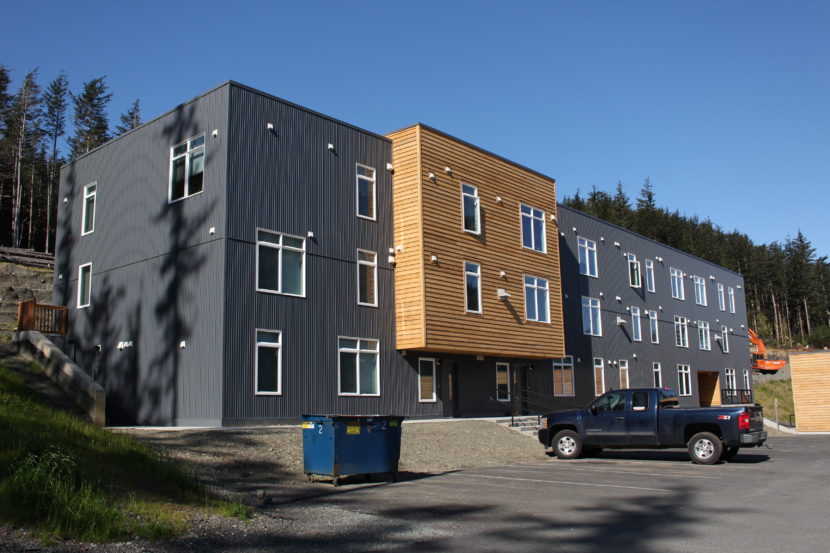
The Terraces at Lawson Creek are a recently completed affordable housing complex on Douglas. (Photo by Elizabeth Jenkins/KTOO)
The Terraces at Lawson Creek is an affordable housing complex on Douglas. (Elizabeth Jenkins/KTOO)

The Centers for Disease Control and Prevention issued a two-month extension on the federal eviction moratorium, which had expired at the end of July. With some limitations, this means tenants who aren’t able to pay their rent cannot be evicted through Oct. 3.

The new moratorium only applies to areas experiencing “substantial” or “high” levels of COVID-19 transmission. That’s nearly all of Alaska right now.

Daniel Coons, fair housing project director at Alaska Legal Services, said that while the extension is good news, it’s important to recognize that the moratorium will still end at some point.

“(The extension) is going to be a real relief for tenants, but people should absolutely keep taking advantage of any rental assistance opportunities that are out there because eventually landlords are gonna have to get paid,” Coons said.

The Alaska Housing Finance Corporation is the primary organization responsible for distributing state and tribal rental relief money, as well as money allocated for the Municipality of Anchorage.

AHFC’s last round of rental assistance applications closed in March, but CEO Bryan Butcher said he expects another round of applications to open in the next month or so. AHFC still has a waitlist to work through as well.

Butcher said Alaska has been faster at distributing rental assistance than nearly every other state. But he’s encouraging everyone to be patient as funds are sent out.

“We’ve communicated out to the landlords, the court system, and everybody we can that even if they are in a circumstance that the funds haven’t been sent out yet, if they’ve been approved, those funds are imminent,” he said.

Alaskans eligible for the relief money can be granted up to 12 months of rent payments, with the aid money paid directly to their landlords. Eligibility is based on income — renters with incomes no more than 80% of the area median income may qualify.

Since the pandemic started, Butcher said, AHFC has distributed $88 million to over 18,000 Alaska households.

Site notifications
Update notification options
Subscribe to notifications