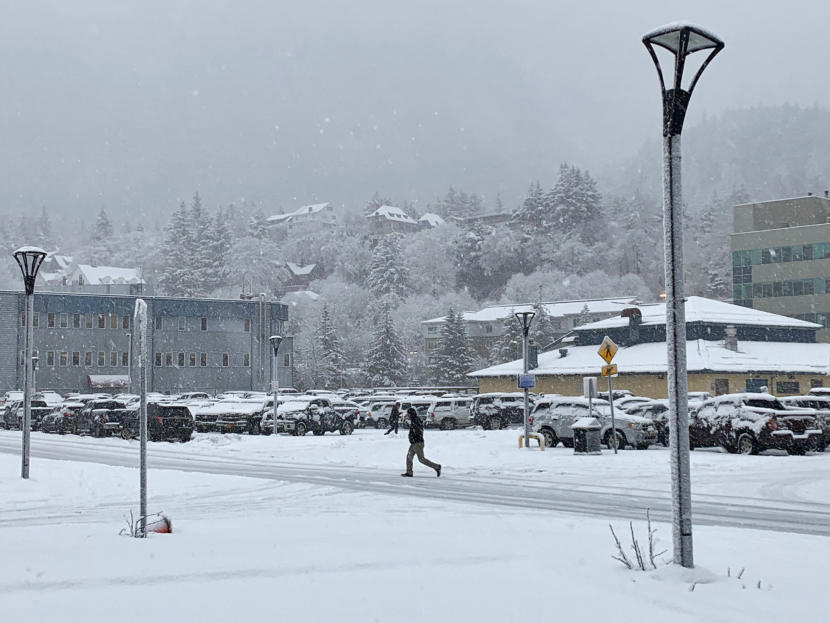
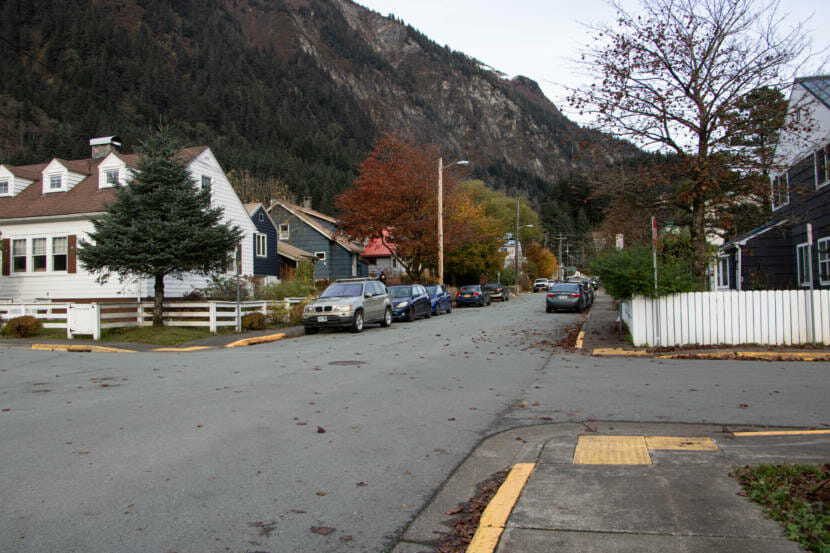
A man crosses Willoughby Avenue on Jan. 30, 2019 in Juneau, Alaska. (Photo by Rashah McChesney/KTOO)
A Juneau resident has started a new clothing drive to help people experiencing homelessness.
Alexis Ross Miller recently read a story in the paper by a woman named Laura Rorem about her daughter’s experience with homelessness.
“I, you know, was just motivated by Laura’s words as a mother,” Miller said. “And it’s just so sad to me that her daughter is not just one unique individual. There’s millions of stories like that.”
Miller started making calls to shelter providers around town to organize a clothing drive. It’s the first clothing drive she has organized. The Glory Hall, St. Vincent de Paul and Resurrection Lutheran Church are all participating.
Miller is hoping to hold the clothing drive through Dec. 15.
“But, you know, I tell people that you can donate all year long,” Miller said.
Winter items that the shelters need include coats, hats, snowsuits, scarves and gloves. Before donating, Miller asks people to wash or dry-clean any used items before donating, if possible. New items are also wanted.
People can bring winter items to The Glory Hall, located at 8715 Teal St. behind Nugget Mall, to St. Vincent de Paul next door or to the Resurrection Lutheran Church, located close to the Federal building at 740 W. 10th St.
Editor’s note: A previous version of this story included information about donating to Shéiyi X̱aat Hít. That information was removed at the request of the shelter supervisor because there is limited capacity for donations.
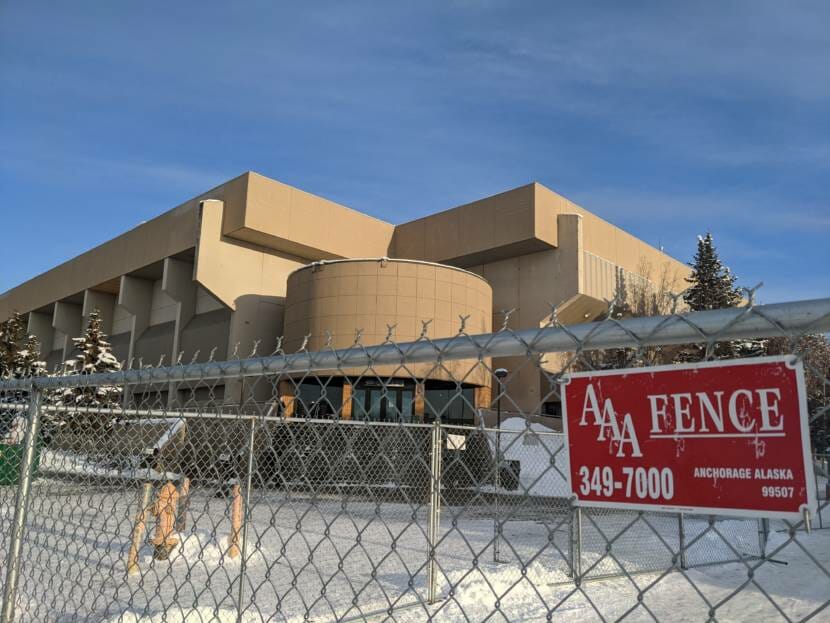
A chain link fence was set up on part of the perimeter of the Sullivan Arena on Nov. 17, 2021 (Lex Treinen/Alaska Public Media)
Anchorage Mayor Dave Bronson’s administration has seen a half dozen or so resignations or firings over the past several weeks among officials working on the city’s response to homelessness.
That comes at a time when temperatures have dropped below zero degrees in some parts of town and advocates have raised concerns about overcrowding in the city’s largest shelter at the Sullivan Arena.
Alaska Public Media’s Lex Treinen has been following the city’s recent efforts on homelessness.
Listen here:
This transcript has been edited for clarity and additional information has been added.
Casey Grove: Remind us where we’re at with the city’s response to homelessness right now?
Lex Treinen: The city has a big housing shortage right now, and during the pandemic, a lot of energy has been focused on making sure people have a roof over their heads. The Sullivan Arena, the massive emergency shelter in Midtown, has been sleeping hundreds of people each night since the pandemic began. That’s still sort of the center of the city’s efforts right now, even as it works on a plan to move people out of the shelter.
Casey Grove: How have things been going at the Sullivan? Have there been any big changes under the new operator?
Lex Treinen: From what I can tell, none of the changes have been giant. In general people say there’s less of a militaristic feel under the new operator — that’s the private company 99 Plus 1. Staff there say they’re going for a more humane approach and treating people like adults.
Not everyone thinks that’s a good thing, I’ve heard complaints from clients who say they feel less secure because of lax rules and fewer security guards.
But it’s been really hard to get information about what is happening. Part of that is the sheer number of people working on homelessness leaving, which has disrupted the normal flow of information.
There are also policy changes that have made getting information more difficult. Reporters aren’t allowed to talk to clients inside the shelter any more. It’s been harder to arrange tours of the arena, and managers were banned from speaking to reporters without permission.
Casey Grove: Should we be concerned about the conditions in the Sullivan?
Lex Treinen: I have been able to talk to a few officials and guests of the shelter, and they say while things aren’t great, they’re adequate. Recent cold weather has pushed the shelter to over capacity, so the sheer number of people in there is a challenge. A couple days in the last week there were over 500 people sleeping there, and the shelter was set up for a maximum of 420. They’re not turning people away though, especially in this cold weather.
The operator said it’s hiring more staff and working on tightening staff training requirements. They’re also trying to get the toilets operational again — the entire population there has been relying on Porta Potties for a couple of months now. Clients say it hasn’t been great, as you can imagine.
There are some things going on outside the shelter that have raised some eyebrows.
Casey Grove: Like what? What do you mean?
Lex Treinen: Just yesterday workers set up a chain link fence around part of the perimeter of the Sullivan. Shelter operators told me they weren’t told that it was going up, though a city spokesperson said the operator was told. A spokesperson wrote in an email that clients and neighbors requested the fence for security.
There was also a warming tent that finally went up earlier this week, but so far it doesn’t have a heater or a floor. An official said it should be ready to use by Friday so that people who come in after curfew, or those who don’t want to be in the Sullivan, have a place to go. Some sources told me the tent was supposed to go up a month ago, and it’s not clear why there was such a big delay.
The Sullivan has still been letting people inside, even though they’re already over capacity. But advocates told me they’re worried that campers might stay outside if they don’t know they’re allowed into the building after curfew. A spokesperson said that it’s working with providers to let homeless people know that they’re welcome in the Sullivan.
Casey Grove: Who’s supposed to be in charge of this? It seems like there’s a communication breakdown going on in the city?
Lex Treinen: I think the recent staff losses are really a big piece of this story. There’s been about a half dozen city officials involved with homelessness who’ve been fired or stepped down recently. Several told me they left after raising concerns about what’s going on with homelessness. All the job vacancies make it really hard to know where to direct questions.
Yesterday, we learned of a new hire who’s set to take charge of the city’s response to homelessness, so hopefully that will clear up some of the communication issues.
There’s also still a working group made up of Assembly members and administration officials working out a way to move people out of the Sullivan into smaller shelters, but the recent resignations have slowed those talks down. Assembly members on the group say they’re still making progress, but they also have to rebuild trust with the new members. All that just slows down the city’s progress towards its goal of getting people out of shelters and into housing.
Casey Grove: Who’s the new hire?
Lex Treinen: His name is Dave D’Amato. He’s worked at a few housing nonprofits over the past decade, like United Way and the Anchorage Coalition to End Homelessness. Robert McNeily, a spokesperson for the health department, said D’Amato will lead a new division focused on housing and homelessness that will be created next year.
A few people in that nonprofit world said they have concerns about D’Amato’s views on homelessness. D’Amato and the city declined an interview request, but he testified to the Assembly last year against a plan that is really similar to one that the administration and the Assembly have tentatively agreed to. That plan is to move people out of the Sullivan Arena into smaller shelters dispersed around town. So far Assembly members working on that plan say they’re withholding judgement about D’Amato, but I think it’s something to watch in the coming weeks.
Natasha Aġnaŋuluuraq Gamache is a 40-year-old mother of four. In September, her landlord told her he was raising her rent.
“I thought, ‘Crap, I’m gonna have to move,’” she said.
She said the increase was a few hundred bucks, and her federal housing assistance limited what she could afford. Anything over her voucher, and she’d be paying out of pocket. With a fixed income from federal disability benefits, there wasn’t much she could do. And when she tried to find a new place, she said, she realized her options were limited.
“You go on Facebook marketplace, try and find a place that meets that housing payment standard where you’re paying all your rent and your utilities at $1,850 a month for a three bedroom in Anchorage,” she said. “You can find them, but you’re gonna run into some issues.”
Data suggests that Gamache’s experience is becoming more common. Vacancy rates across the state declined sharply during the pandemic, according to a state report from September.
Rob Kreiger, an economist who wrote the report, said the drop in vacancy rates could be because fewer people are moving from place to place due to an eviction moratorium that was in effect until September.
“Normally, you’d have people constantly coming and going and moving from one place to the next and you have more units becoming available than normal,” he said. “But I think in the case of the pandemic, you had a lot less people moving around.”
The Alaska Housing Finance Corporation also gave out nearly $175 million in federal rental relief since the pandemic started, though the program required that applicants show they were impacted by the pandemic. The corporation says it’s helped keep 57,000 people housed.
But for people who have lost housing, the low vacancy rate means there are few options.
“If there’s not that much available, it’s gonna be that much harder to find a place,” said Kreiger.
Gamache said she and her family bounced around AirBnBs, relying on donated money for a few weeks before settling into a shelter. This week, they finally moved into housing thanks to a tribal voucher. She said she had to give up her federal voucher to participate in the tribal program.
Before moving into housing, Gamache and her family spent weeks at Safe Harbor, a family shelter run by RuralCAP. Shelter providers say the housing market means that their efforts to move people into permanent housing are slowing down.
At a Wednesday Anchorage Assembly committee meeting, Terria Ware, an administrator at the Anchorage Coalition to End Homelessness, testified that vacancy rates are likely to force clients to stay in shelters longer than in previous months despite a massive rehousing effort.
“If you’re someone on Social Security or disability benefits, you’re getting about $1,100 a month. If your apartment is $950, and you still have to pay electric, how can you afford that unit?,” she said in a phone interview on Wednesday.
That means the city’s shelters, which are already over capacity, could keep filling up. Ware said the only solution is the slowest and most difficult one.
“If we want to truly solve homelessness in Anchorage we need more units,” she said. “We need more affordable units.”
There is some good news, she said: During the pandemic, the state was able to keep some renters in their homes thanks to quick disbursement of federal rental relief money. But not all renters qualified. Gamache said she didn’t apply for the money because her rent increase wasn’t directly tied to the pandemic.
The federal eviction moratorium kept tenants from getting kicked out until September, when it was struck down by a federal court.
“We all expected an eviction tsunami when the moratorium ended, and it hasn’t really happened,” said Helen Renfrew, who studies evictions for the Anchorage Coalition to End Homelessness.
She said avoiding a surge of evictions is a good thing, but there’s a dark side to it.
“The reason that eviction filings didn’t explode is because evictions have been occurring this whole time. They never stopped,” she said. “We had eviction filings every single week, all across the state throughout the entire moratorium.”
Renfrew said there’s not good data on it, but she suspects it’s because landlords and tenants weren’t aware of the protections.
Gamache said all of the uncertainty in the rental market exhausted her family, which has had to move six times in the last five years. After researching costs of rentals and mortgages, she decided the only way she could find housing security was to buy a house.
Her 14-year-old daughter set up a GoFundMe to raise money for a down payment on a house. So far she’s raised more than $13,000.
“It’s hard on me because I just want to be a kid,” Denali Gamache wrote on the fundraiser page. “I don’t want to feel unsafe in a shelter where people fight and get drunk and beat on doors all night.”
For Natasha Gamache, it’s a bittersweet feeling. She’s thankful for the support but also said it’s a sad statement on the state’s priorities.
“I felt I had so much shame and guilt. But at the same time, I’m so very grateful. Because, sadly, that is where we’re at,” said Gamache. “This is where we’re at.”
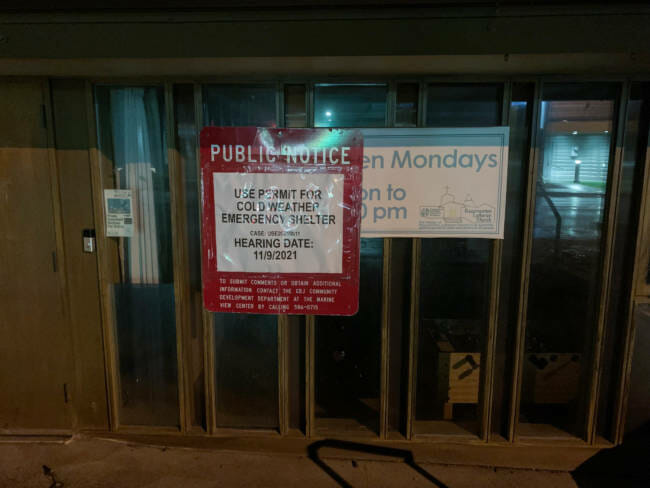
A sign with the dates of the next City and Borough of Juneau’s planning commission meeting hangs at the Resurrection Lutheran Church on Oct. 27, 2021 in Juneau, Alaska. At the commission’s Nov. 9, 2021 meeting, commissioners voted to approve the RLC’s conditional use permit to hold a cold weather shelter for the winter of 2021-2022. (Lyndsey Brollini/KTOO)
Juneau’s cold weather emergency shelter will be at the Resurrection Lutheran Church near downtown this winter. The city’s planning commission voted on Nov. 9 to approve the church’s conditional use permit to hold the shelter with some conditions.
The cold weather emergency use shelter was created in 2017 and has been run by a few organizations around town since. St. Vincent de Paul had run it since the end of 2019. Last month, the nonprofit pulled out of its contract with the City and Borough of Juneau to provide the shelter.
That is when the Resurrection Lutheran Church stepped in. Employees at the church have experience working with the unhoused population in Juneau. Without another viable option and with such short notice, Karen Lawfer and others at the church felt obligated to step up.
“We knew that it was going to get cold and we knew that people needed a place to go,” Lawfer said. “And as such, we have been working nonstop to get this process going so that those who are less fortunate than we will be able to have a place to stay and a meal.”
People living in the neighborhood surrounding the church said during the planning commission meeting that they have concerns. Most were related to safety around the neighborhood — for children going to school, people using the night drop at First National Bank, business owners and for residents in the Flats neighborhood.
Alicia Bishop called in as a representative of the Harborview Elementary Site Council, which includes parents and teachers at the school. She opposed the shelter location on behalf of the council and asked the city to find a different spot.
“Our biggest concern is the overlap of students with those exiting the shelter in the mornings, and especially at congregation points such as where school and public bus stops coincide,” Bishop said.
Naomi Davidson was conflicted about the proposal. She felt like the proposal was rushed but she also does not want unhoused people to be left out in the cold.
“I’m not against it. I’m against the way that this came about so quickly, with very little participation, and planning to, to create a whole plan to provide whole services for all of the participants and all of the partners,” Davidson said.
Some people suggested having more of a police presence in the neighborhood but Davidson doesn’t think that is the answer and doesn’t want to criminalize people experiencing homelessness.
Other people called in to offer their support. One of them was Doniece Gott. She said that people are building up a lot of fear for a problem that doesn’t exist.
“We need to model for our children and we should model compassion and love and respect for our fellow human beings instead of treating them poorly and othering them,” Gott said.
Jerrick Hope-Lang, an Indigenous homeowner in the Flats, also called into the meeting to support the shelter. He said that the concerns people are voicing really come with the territory of being downtown.
“And with the recent loss of some Native people in our community, I just think it’s really important that we not forget that there needs to be a secondary option, especially with the loss of shelter in the downtown area,” Hope-Lang said.
To address people’s comments, the planning commission put nine conditions on the permit. All the conditions were passed.
Three of those conditions were suggested by the city’s planner, Allison Eddins. Those conditions are:
Smoke detectors must be installed in the sleeping area and in bathrooms;
An alarm must be installed at the emergency exit near the sleeping area;
If new lights outside the church are installed, a light plan must be given to the community development department;
Six conditions were suggested by the planning commission:
Security cameras outside the building must be installed and operational before opening the shelter;
The shelter must operate no earlier than 9 p.m. and close 6:30 a.m. the next day;
The shelter can operate Nov. 1 – May 1;
When the shelter is operating, there must be two staff present at all times;
The permit will expire May 2022;
The facility will provide a contact number for people in the neighborhood that will be answered during the shelter’s operating hours
In the meeting, commissioner Nathaniel Dye said that this is the fastest moving conditional use permit he has ever seen and that the process felt rushed. That is why he wanted the expiration of the permit as a condition of approving it.
These permits don’t usually have an expiration date and some commissioners were concerned about setting a precedent for future permits.
“The precedent is relieved for me from the fact that there is an emergency situation for … It’s a life safety issue at this point,” Dye said.
Now that the church has its permit approved, it can start housing people when the weather gets below freezing. It is forecasted to be below freezing at night for most of next week.
To contact the church about the warming shelter, you can send an email or call 808-782-5795.
A previous version of this story mistakenly referred to Karen Lawfer as Karen Laughlin.
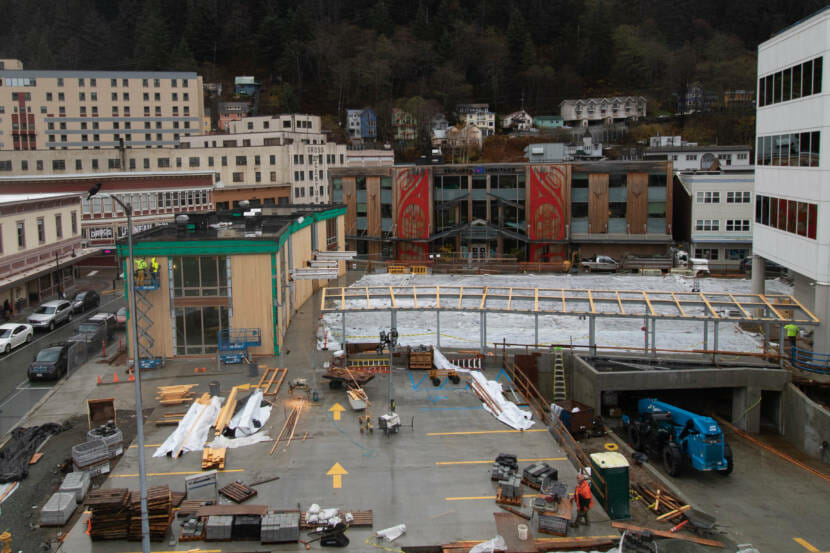
The Sealaska Heritage Institute’s Arts Campus is under construction in downtown Juneau. Sealaska Heritage Institute was one of the local nonprofits that received part of a $2 million donation from Norwegian Cruise Line Holdings. It got $100,000 for the arts campus project. (Lyndsey Brollini/KTOO)
This summer, Norwegian’s initial offer went to the City and Borough of Juneau government. The company said there were no strings attached, but most Juneau Assembly members didn’t like how that would look. Norwegian wants to build a new, downtown cruise ship dock and needs the city’s cooperation to do it.
So instead, Norwegian sent the money out to a bunch of nonprofits in the community. Company officials did not respond to requests for comment. But the organizations on the receiving end did. They were grateful. And, like the original offer to the city, they say there were no strings attached.
Here’s where the money went.
The Juneau Community Foundation got half of it, $1 million. The foundation broke that up into 14 grants to local social service organizations. Among other things, it’s going to help restock the Southeast Alaska Food Bank and fix up housing for people in crisis or experiencing homelessness.
Fireweed blooms around a sign marking a lot where the Teal Street Center will be built in Juneau on July 20, 2021. It’s intended to house social service agencies near the new Glory Hall emergency shelter and soup kitchen in the background so its patrons can connect to services easily. (Photo by Jeremy Hsieh/KTOO)
Executive Director Amy Skilbred said the foundation prioritized organizations that serve basic needs: food, shelter and mental and physical health.
“They’re the ones that get the stuff done in our community,” she said.
Specifically:
$500,000 for construction of the Teal Street Center. A groundbreaking ceremony is scheduled for Nov. 2.
$150,000 to The Glory Hall emergency shelter and soup kitchen for operations.
$60,000 to the Tlingit & Haida Regional Housing Authority for repairs to the youth shelter Shéiyi X̱aat Hít, or Spruce Root House.
$60,000 to AWARE for building new apartments.
$50,000 to St. Vincent de Paul to repair its housing.
$45,000 to JAMHI Health & Wellness for workforce development and retention.
$30,000 to Capital City Fire & Rescue’s community health program for a vehicle.
$25,000 to Bartlett Regional Hospital’s Community Navigator program for a vehicle.
$25,000 to the Southeast Alaska Food Bank for food.
$8,000 to Juneau Housing First for maintenance and repairs.
Finally, the foundation is keeping $5,000 for administrative overhead.
Two of the foundation’s intended recipients are city government entities: Bartlett Regional Hospital and Capital City Fire/Rescue. In both cases, the money is intended to buy vehicles for programs each one runs that try to reach vulnerable community members physically where they are before unaddressed needs become emergencies.
The hospital’s grant manager said hospital administrators can usually sign off on grants like this without action from its board or the Juneau Assembly. The city’s finance director said the Assembly will likely need to take action to accept the fire department’s grant. So it’s possible the optics issue may come back up.
After those Juneau Community Foundation grants, there’s another million dollars of Norwegian’s donations to account for. The Greater Juneau Chamber of Commerce and Juneau Economic Development Council got $800,000 for local business relief. Board members of the two organizations are working on the particulars of how that will be spent.
The last three donations go toward improving places cruise ship visitors are likely to visit.
Sealaska Heritage Institute got $100,000 for its downtown arts campus project. Chief Operating Officer Lee Kadinger said the main facility will be mostly finished by the beginning of December.
“They’ve just been a great partner in the community and have been wonderful in ensuring their clients come visit Sealaska Heritage,” Kadinger said. “So it’s been a great mutual relationship working with them.”
Other elements, like a covered, outdoor performance area, were delayed because of fundraising concerns amid the pandemic.
Norwegian’s donation “helps complete the bigger vision that we initially had,” Kadinger said.
The Catholic cathedral on Fifth Street downtown is getting $50,000. Father Patrick Casey said it’s going into a campaign to renovate the building to make it wheelchair accessible. Casey also explained that some cruise ship passengers seek out Mass services while they’re in town. The church gives free rides from the docks to its services.
Finally, $50,000 is also going to the New JACC partnership, which wants to replace the Juneau Arts and Culture Center. The current facility was originally a National Guard armory.
Juneau was one of six Alaska port communities that Norwegian Cruise Line Holdings’ ships visit that it donated money to earlier this year. The company committed $10 million total. The other communities were Hoonah, Ketchikan, Sitka, Skagway and Seward.
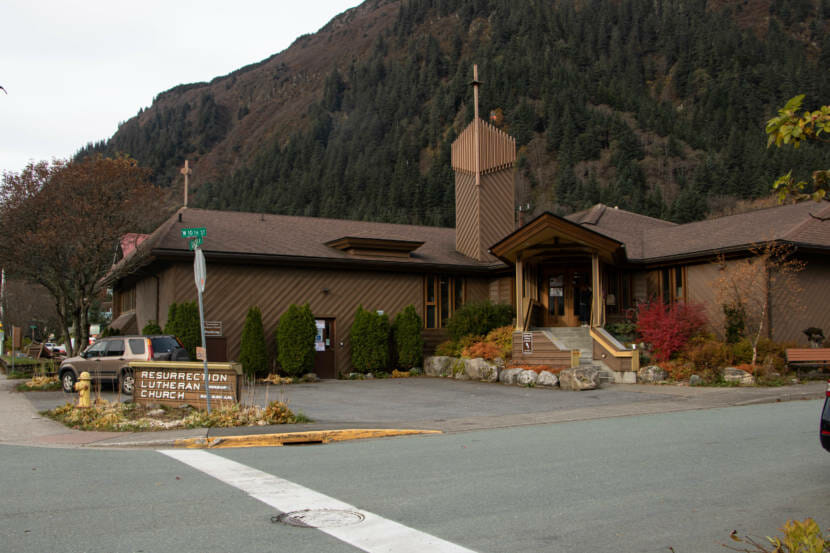
The Resurrection Lutheran Church on the corner of W. 10th St. and Glacier Avenue aims to be Juneau’s cold weather emergency shelter for the upcoming 2021-2022 winter. (Lyndsey Brollini/KTOO)
A church in a neighborhood near downtown Juneau has offered to be the location of this year’s cold weather emergency shelter.
Resurrection Lutheran Church submitted its proposal on Oct. 15 after a local nonprofit, St. Vincent de Paul Society of Juneau, pulled out of its contract to operate the shelter.
The shelter is scheduled to be open Nov. 15 through April 15 on nights when the temperature drops below 32 degrees.
Finding space for the warming shelter has been an ongoing problem. The shelter has changed locations four times since 2017. The shelter’s operator changed a handful of times in recent years as well.
St. Vincent de Paul Society of Juneau took it over from the city in 2019 and operated the shelter at the Juneau Arts and Culture Center from March 2020 through July 2021. But the JACC is no longer available as a shelter space.
Scott Ciambor, the city’s chief housing officer, said that after looking at options for shelter locations and considering the staffing involved, St. Vincent de Paul Society of Juneau decided it couldn’t operate the shelter this winter. The faith-based nonprofit only notified Ciambor about pulling out of the contract earlier this month.
Ciambor said he’s grateful for the nonprofit’s flexibility in providing shelter to those in need during the pandemic. But the change has left the city needing to find a new location fast, before the Nov. 15 deadline.
“We’re really just scrambling to make sure that something is available,” Ciambor said.
The Resurrection Lutheran Church says it has the space to have 28 socially distanced beds, and church staff have experience working with unhoused people through its food pantry. Pastor Karen Perkins and her husband also helped operate the cold weather shelter when it was run out of the old public safety building on Whittier Street.
The church is located in the Flats neighborhood, near the federal building in downtown Juneau.
The Flats neighborhood is located by the federal building in downtown Juneau. (Lyndsey Brollini/KTOO)
Last year, some residents of the Flats pushed back against a proposal to have a permanent cold weather shelter in their neighborhood. They did not want people who use emergency shelters to be in a neighborhood with lots of kids and schools nearby.
Perkins knows these are sentiments that may come up as the public comments on the proposal.
“A lot of people have an image of homeless people and risks that come with their presence that grow out of anecdotes of ‘I saw this happen’ or ‘I know that happened,’” Perkins said. “And so the idea of a shelter comes with, I think, some anxiety that isn’t really born out statistically.”
The church already operates a food pantry in the area, which provides food for some of the same people who would use the emergency shelter. And Perkins says Flats residents have been very supportive of the food pantry.
“Neighbors who live in the area, when they’re heading to Costco, will say, ‘What does the food pantry need?’” Perkins said.
Perkins thinks there are a lot of people who want to give and who want to help. But when it comes to people staying around longer to be sheltered, she thinks there could be some resistance.
The church plans to address safety concerns in a variety of ways — having experienced staff, having extra cameras and lights around the building, providing buses to transport people away from the church when the shelter closes, asking police to drive around the area, cleaning up trash and working with other shelters to make sure the church is only being used as a last resort.
Perkins hopes that talking with the community — outlining the church’s experience serving the unhoused population and educating people about how they’ll operate the shelter — will help ease any anxiety people might have.
Providing this shelter feels like an obligation to Perkins. She says that, as part of her faith, she was taught to love and care for her neighbors.
“Fundamentally, a loving neighbor means giving them shelter so they can survive the night,” Perkins said.
Perkins encourages empathy for people experiencing homelessness. She hopes that if anyone she loves were ever unhoused, people would see past their circumstances and acknowledge them as a person.
“People don’t choose to be homeless or choose to be in crisis or choose to be dependent,” Perkins said. “For many people, it’s a crushing way to exist. And being acknowledged as human beings is one of the most vital parts of surviving.”
The church is proposing to take over the contract that St. Vincent de Paul Society of Juneau had with the city, which would end in 2023. The church states in its proposal that it does not have any plans to be in the shelter business long-term.
Last year, the city looked into buying a building to use as a long-term cold weather emergency shelter, but the Assembly rejected all the proposals.
Ciambor said the city isn’t looking into any long-term emergency shelters at the moment. Right now, he’s focused on getting a shelter up quickly for this winter. And there aren’t any concrete backup plans if the Resurrection Lutheran Church doesn’t work out.
The church’s proposal should be up for public comment in a future city planning commission meeting before Nov. 15. The date is undecided right now.
The Resurrection Lutheran Church is holding a hybrid in-person and Zoom meeting on Oct. 27 at 7 p.m. to hear feedback about the proposal and answer any questions.
Close
Update notification options
Subscribe to notifications
Subscribe
Get notifications about news related to the topics you care about. You can unsubscribe anytime.