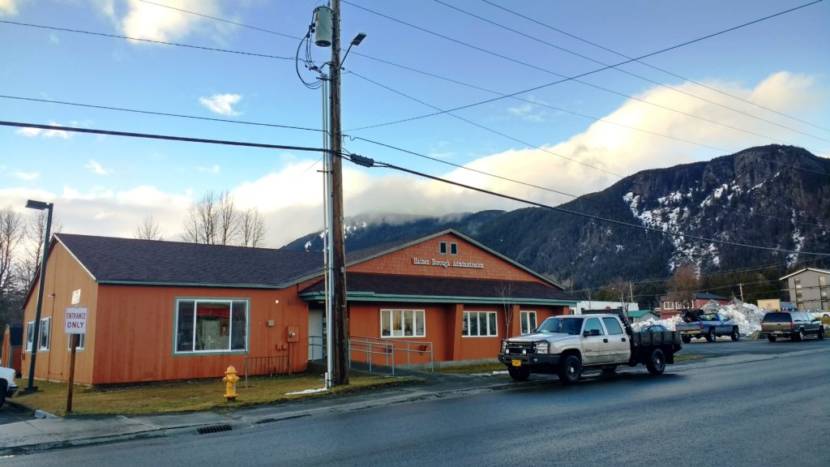
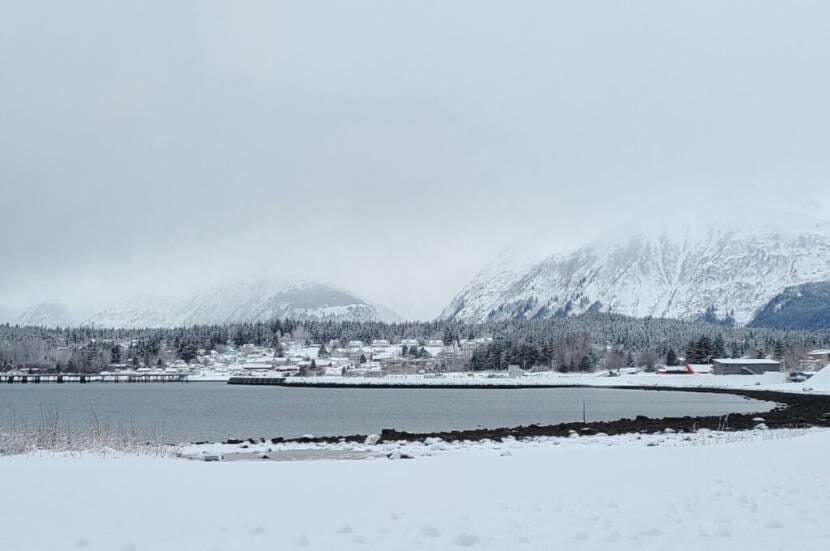
The Haines Borough Administration building. (Photo by Emily Files/KHNS)
The Haines Assembly has voted to restrict non-traditional dwellings like yurts and container homes on lots smaller than a half acre. They would be allowed in residential zones on properties of a half acre or more.
It’s a water-downed version of the total ban in the townsite that was recommended by the planning commission.
Assemblymember Gabe Thomas told KHNS that the idea came from looking at parcel maps.
“I was looking at going wow, there’s a lot of land out here — two, three acre lots, five acre lots,” Thomas said. “But it was all included in single family zoning areas, and it made no sense to me to say, Hey, why can’t they build out there?”
The original proposal would have completely banned new yurts and container homes to outside the townsite – rural residential and rural mixed use. The new version allows them in the single family residential zone, which includes neighborhoods like Highland, Skyline and Cathedral View.
For smaller properties of less than half an acre, or the waterfront zone, residents would have to apply for a conditional use permit to be approved by the planning commission.
That means property owners would have to fill out an application, pay a $150 fee and send notices out to all neighbors within 500 yards. Neighbors would have a chance to weigh in on the proposal, and it would be approved or denied by the planning commission.
If the planning commission denies the permit, residents would be able to appeal to the Haines assembly.
But not everyone was on board with the plan. Haines Assemblymember Tyler Huling opposed restricting non-traditional housing. She says yurts are often a more affordable housing option for people starting out in Haines.
“This is just a bad PR move for Haines,” Huling said. “It’s a bad look. From my perspective, and I understand that other people see it really differently. But as a young person who’s trying to build a life in this community, it’s just like, not an appealing prospect to have any sort of personal lifestyle choices limited in this way, that are singled out and not really applied to other forms.”
The Assembly passed the measure 4-2. with Assemblymember Catie Kirby also cast a no vote.
Proponents of the measure had argued that non-traditional housing could hurt property values. That was the reasoning that led planning commissioners to make their recommendation.
Haines resident Nick Schlosstein, who lived in a yurt for five years while he and his partner developed their business, says he’s not sure what has been accomplished in a community that already struggles with affordable housing.
“I am still unclear as to what problem that it’s solving,” Schlosstein said. “There’s a lot of properties in town that are under that size. And so it sounds like it’s more of a way just to limit it without saying that.”
Existing container homes and fabric-covered structures like yurts are grandfathered in, but the measure goes into effect immediately.
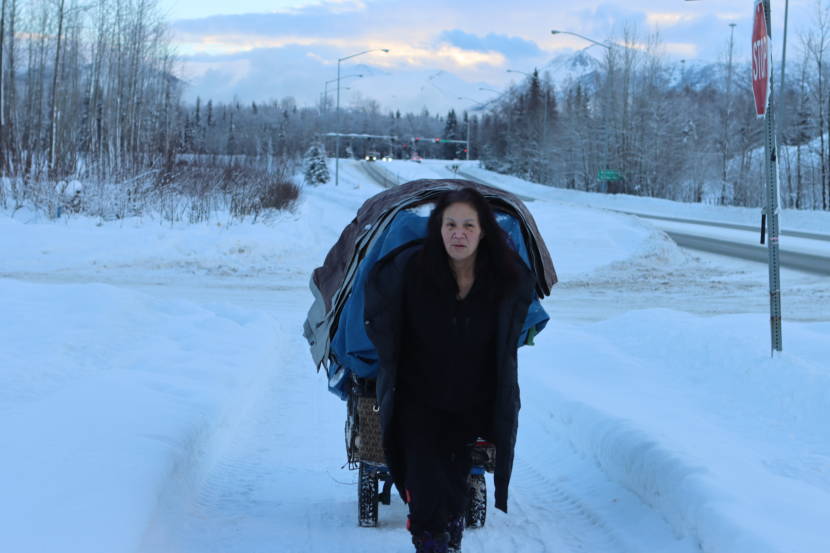
Lucille Williams pulls a cart filled with her belongings on a bike path along Mt. View Drive in January, 2022. Williams says it’s the third time she’s had to clear her camp this winter due to the city’s new abatement program. (Photo by Adam Nicely/Alaska Public Media)
It’s a relatively balmy 25 degrees as Lucille Williams drags a cart down a bike path in Anchorage’s Mountain View neighborhood.
The temperatures have turned the snow into mush in some spots, leaving Williams out of breath. On top of the cart is a repurposed dog kennel filled with pots and pans, blankets, tarps, and other items.
“What we have is kind of what we really own, which is barely anything,” she said, stopping for a breath.
Williams, 46, said her body hurts from living in the streets and shivering through Anchorage’s winter temperatures. She has a bruise under each eye – she doesn’t say why.
She’s exhausted, but needs to get to her next campsite – about a quarter mile away in another city park – before city workers come and clear out her current home. As part of the city’s abatement program, workers from the parks department stapled a paper notice on a tree near her old camp warning her she had ten days to move.
The program has existed for years in the summer, but starting in late December, for the first time Anchorage started removing homeless camps on public property during the winter months. The Anchorage Parks and Recreation Department says it’s cleared more than 50 camps since Dec. 22.
Policy makers say it will pressure campers into shelter or housing, where they’ll be safer and have more direct access to services.
“Winter abatement is — should be that gentle nudge, to get people to some type of situation where they can get help, they can get assistance,” said Midtown Assembly member Felix Rivera.
He supported allocating about $650,000 from the city’s alcohol tax revenues towards clearing camps.
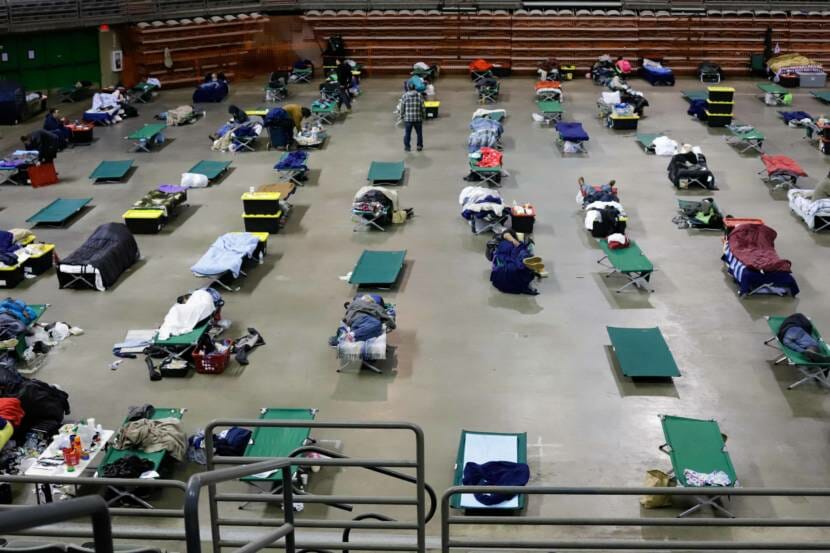
Rows of portable cots and plastic totes fill the floor space of the Sullivan Arena shelter in Anchorage on Nov. 1, 2021. (Photo by Jeff Chen/Alaska Public Media)
But advocates are raising concerns about the city’s approach and they say the city is failing to provide viable alternatives to camping.
“We just don’t have units available,” said Jessica Parks, who oversees housing for RurAL CAP, one of the nonprofits that does direct outreach to campers. “And if we do have units available, they’re not always the appropriate types of units.”
Williams said she doesn’t plan on moving to shelter, despite the outreach from RurAL CAP and over 100 open beds at the Sullivan Arena, the city’s main shelter. She’s been in it before, but prefers the open air.
“There’s a lot of issues (in shelter), a lot of people stealing and they only give you so much that you can bring,” she said. “And then there’s the whole COVID thing.”
Some campers are drug users or have PTS, which can makes it hard to live in a shelter alongside more than 400 people. Others are banned from returning to the Sullivan and other shelters.
In late December, the city raised the capacity at the Sullivan by about 100 people. It’s unclear what changes the operator made to accommodate the extra people. The city hasn’t followed up on a request to tour the facility and to speak with the city’s main homelessness coordinator, Dave D’Amato, which Alaska Public Media made on Jan. 10.
Residents have long complained about cold temperatures at night in the arena, and broken-down bathrooms, which have forced residents to use porta potties since last summer.
The current living situation at the Sullivan isn’t desirable for many people without permanent homes, advocates say.
“Gosh, sharing a bathroom is really hard with two teenage kids, and you can just amplify that issue when you’re housing … 510 people at the Sullivan Arena,” said Owen Hutchinson, a spokesperson for the Anchorage Coalition to End Homelessness, which coordinates outreach for the city’s abatement program.
That means that many residents who don’t want to be in shelter are just moving from one illegal camp site to another.
“It’s a shell game,” said Parks, from RurAL CAP, “You’re just clearing one camp out, and they’re just moving and setting up a camp somewhere else.”
Outreach workers sometimes help campers move, part of a process of establishing rapport with campers in hopes that some day they’ll be ready to look for housing. Jerry Staten is one of the workers.
Each weekday he travels around town on a predetermined route of known campsites. He brings cigarettes, sandwiches and blankets and knows many campers by their first names.
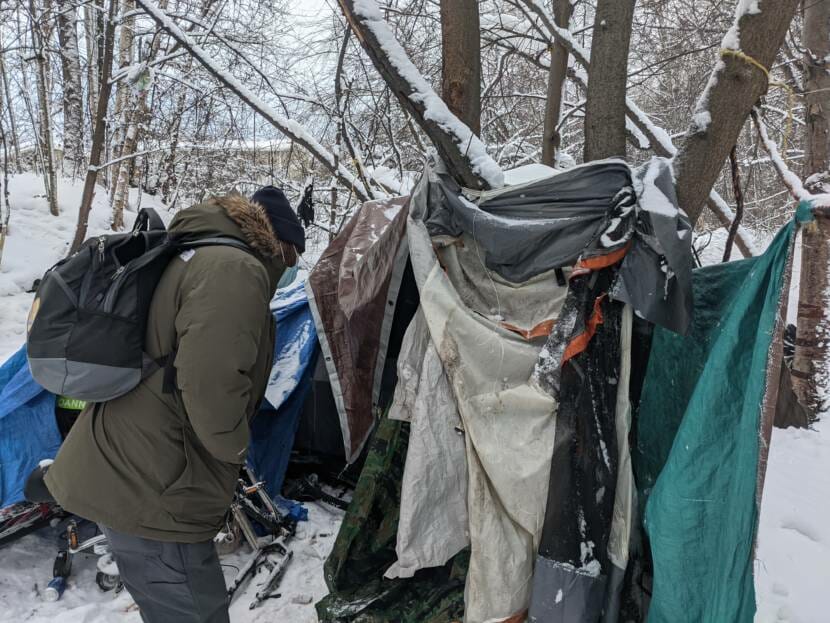
Jerry Staten, an outreach worker for RurAL CAP, approaches a camp slated for removal near Chester Creek. Staten carries sandwiches, cigarettes and extra clothes in his backpack that he offers to campers. “Maybe today, they’re not ready to get housed, but tomorrow, they’re ready,” he said. “The gift is to be there at the right time when people are ready to come up out of the tent.” (Photo by Lex Treinen/Alaska Public Media)
Often, he’s joined by other social workers who help campers sign up for Medicaid or food stamps. If campers are interested, Staten says he’ll help them get clean clothes and even set up a job interview. He’ll also sign them up for coordinated entry, a waiting list for housing that prioritizes the most vulnerable campers coordinated by the Anchorage Coalition to End Homelessness.
But getting on the coordinated entry list isn’t a guarantee that campers will be housed in the near future because of the housing shortage and nuances of eligibility.
“If you go out there and say, ‘Hey, sign up, if you talk to me and I’ll get your housed,’ — That’s a promise that you can’t make,” Staten said.
In some ways, the problems are the same ones the city has had for years. The difference, advocates say, is that during the winter months, campers face significant risks of frostbite each time they’re forced to move.
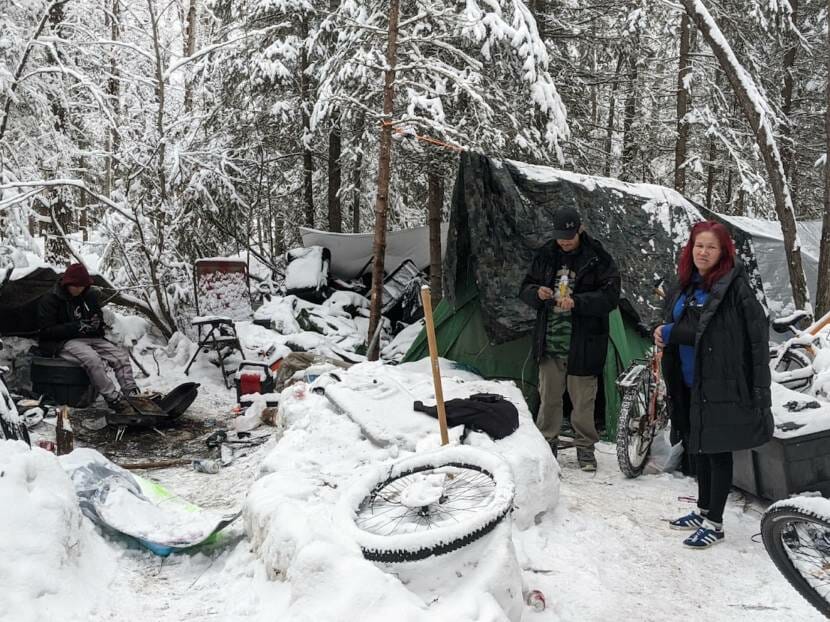
Campers often spend weeks in the fall winterizing their camps by building platforms from wood pallets, draping tarps over their tents and installing foam insulation on the walls and floors.
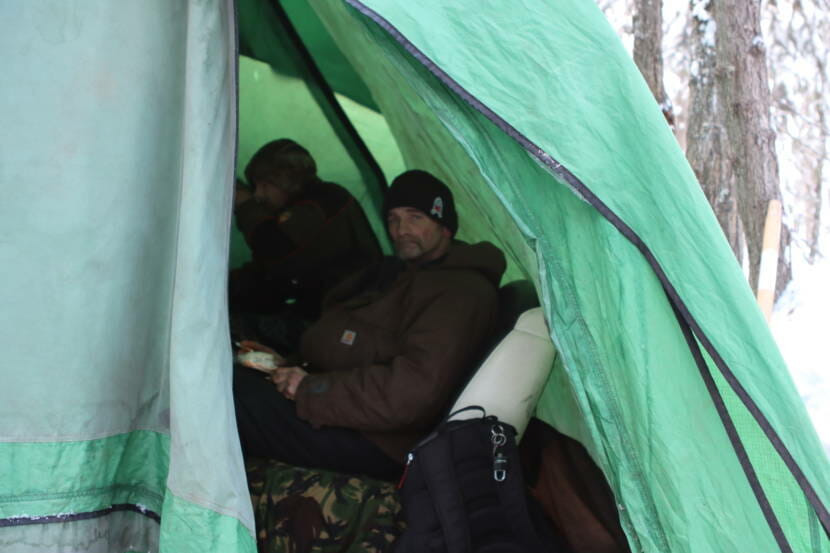
Brian Vaughn, who camps with the same group as Lucille Williams in Mountain View, recently had his camp removed.
One morning last week, he found himself shivering in a bare-floored tent in a park in Mountain View. It’s nearly the exact spot where he had a tent in the fall before it was removed in September. Vaughn appealed because there wasn’t enough space at the Sullivan for all the campers at the time, and he thinks the city won’t bother him now that he’s moved back during his appeal.
Brian Vaughn, a camper in Anchorage’s Mountain View, whose camp was recently removed, has appealed the removal because the city didn’t have enough shelter space at the time. (Photo by Adam Nicely/Alaska Public Media)
He’s lost supplies during the last removal, including tents. The zipper on the current tent door is ripped, and several other fellow campers are bundled up next to him.
“It’s hard because we normally were supposed to have a few months ago been getting set up for the winter doing the improvements for the cold weather,” he said. “Now we’re up on the move again, sitting here on a plate of ice.”
Within a few days, the camp is filled with supplies draped over with tarps for insulation. Campers insist that their possessions are legally acquired, though sometimes Parks and Rec staff throw away items they deem as junk.
“We kept telling them ‘This stuff’s not garbage, stop taking it,’” Vaughn said. “And they laugh at us about it.”
Parks and Rec say they do their best to make removals as easy and safe as possible for campers by working closely with campers and coordinating around the weather.
“If it’s raining, for instance, and we can look at the forecast and see that tomorrow is better if it’s snowing, or if it’s just freezing cold,” said Mike Braniff, who coordinates camp removals for Parks and Rec. “The one thing we don’t want to do is jeopardize the safety of the campers to stick to a timeline. So we’re certainly adaptive.”
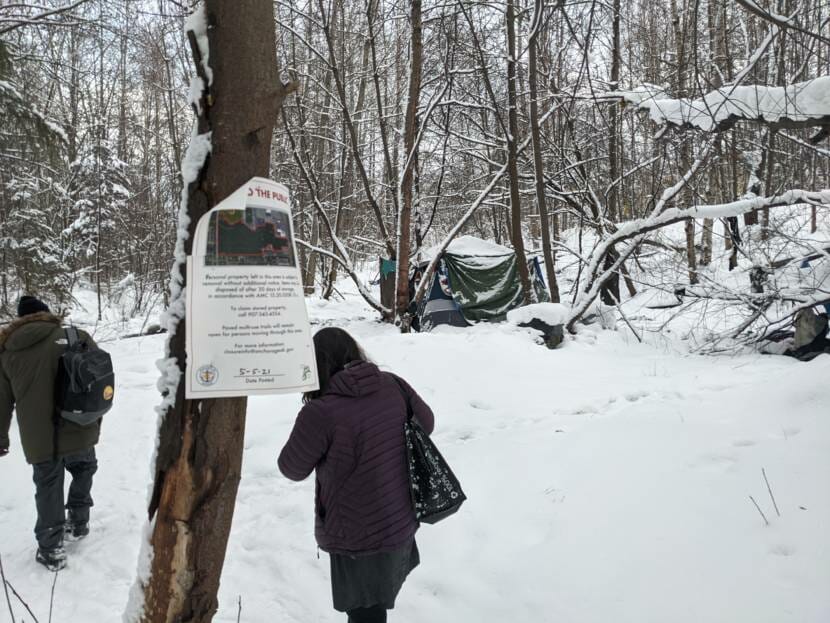
Jerry Staten, an outreach worker for RurAL CAP, and a social worker from Providence Alaska approach a tent slated for removal. An abatement notice was posted in the area in May, 2021, which means the camp is illegal and can be cleared at any time. (Photo by Lex Treinen/Alaska Public Media)
Braniff said that decisions about when and where to remove camps are often made for public safety reasons — both for the campers and neighbors. Camps can pose fire risks in some areas, and Braniff says camping in school routes has been an issue.
“Whether it’s right next to a highway or – gosh, there’s been a number of situations with structures that have been unsafe,” he said. “We’re addressing it for that reason as well.”
Some advocates and Assembly members have raised concerns about confusing communication from the city about clearing camps, which has made it unnecessarily hard for campers.
The city didn’t announce publicly that it had started removing camps in winter until an Assembly Housing committee on Wednesday, where city manager Amy Demboski said it was happening “on a limited basis” in certain neighborhoods, with a priority on public safety.
She said that follow up questions from the Assembly needed to be submitted in writing.
Lucille Williams and fellow campers at her new campsite a few days after the city removed their old camp. They hauled most of their possessions by hand about a quarter mile away to a new campsite, but some items are left behind, forgotten or stolen each time they move, Williams says. (Photo by Lex Treinen/Alaska Public Media)
Advocates said the city never stopped posting abatement notices at campsites when the Sullivan was above capacity, something that Braniff with Parks and Rec denied. RurAL CAP, Covenant House, and the Anchorage Coalition to End Homelessness say that notices were posted around campsites in November and December, even though camps were never cleared.
Parks, with RurAL CAP, said that affected the relationship that outreach workers had with campers.
“When we can’t even give them some certainty over the information that we have it really does undermine some of that trust,” she said.
For people like Williams, camping is worth it, even with the added risk of having her camp cleared. It’s what she’s used to and she doesn’t have to worry about anybody except for those in her group.
“This became like our comfort place, like we’ve been okay out here,” she said. “It’s just us – we don’t bother nobody.”
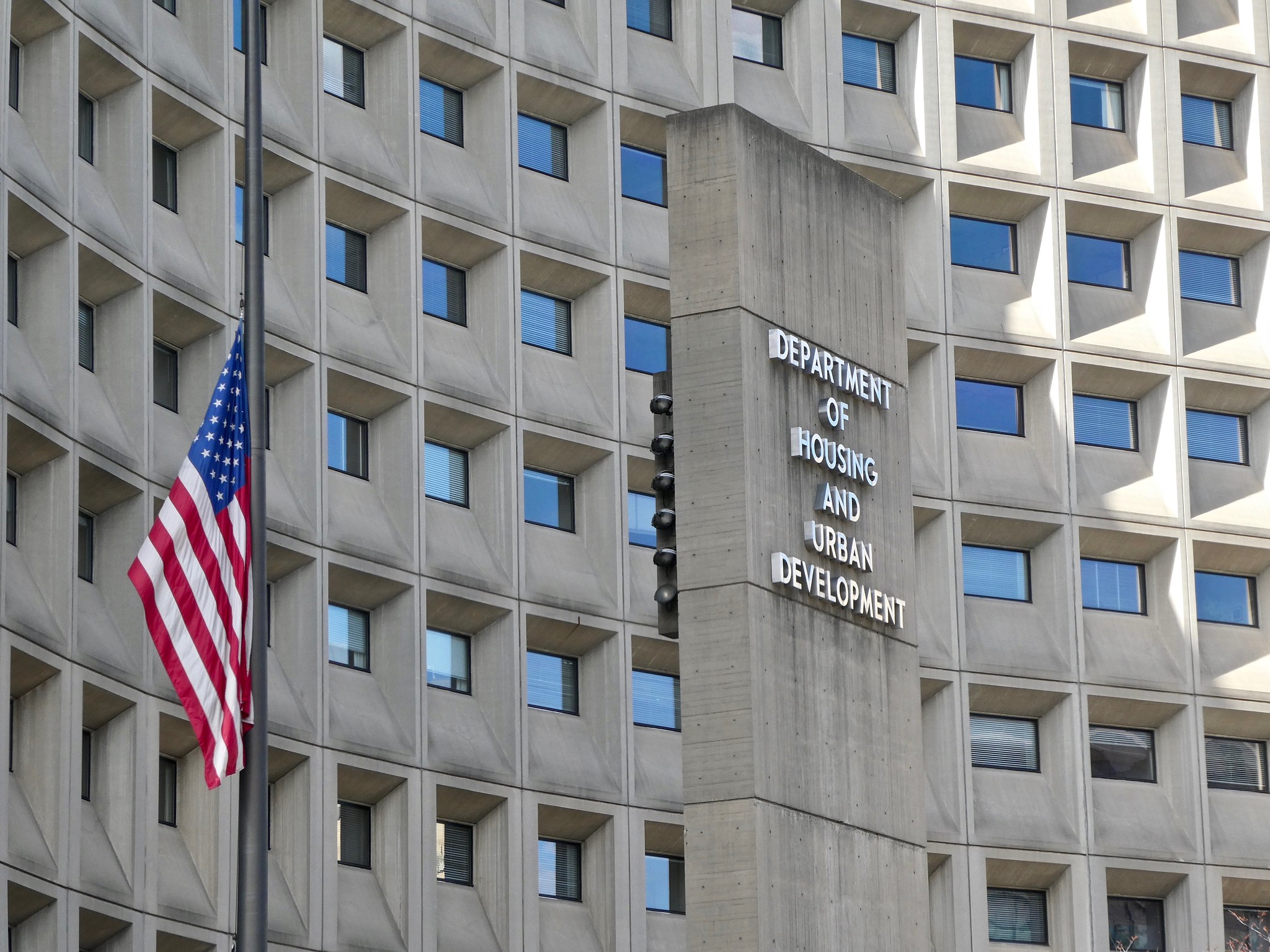
The headquarters of the federal Department of Housing and Urban Development pictured here on Feb. 18, 2018, is located in Washington, D.C. (Creative Commons photo by F Delventhal)
A pair of organizations based in Juneau are getting $4 million in federal housing grants to make homes safer.
The U.S. Department of Housing and Urban Development is giving $2 million each to the Tlingit and Haida Regional Housing Authority and to the nonprofit Alaska Heat Smart.
They applied for their grants separately, but have complementary programs targeting a lot of the same households, so they’re working together.
“We’re both looking at remediating lower income family homes and making them both healthier and safer to those folks who live in them,” said Andy Romanoff, executive director of Alaska Heat Smart. It’s the first time it’s received one of HUD’s Healthy Homes grants.
Alaska Heat Smart serves households in Juneau and focuses on heating and energy efficiency improvements to make them greener and cheaper to keep warm. That also fits HUD’s goals with the grant. Warm, dry homes are safer and healthier than cold, humid ones, especially when it comes to respiratory illnesses.
Jackie Kus.een Pata is the CEO of the housing authority, which has received Healthy Homes grants several times before. She said the housing authority’s Healthy Homes program covers lots of communities in Southeast Alaska, but is specifically for tribal citizens. It tends to cover more general repairs, like plumbing, addressing mold, fixing roofs and replacing floors.
“We’ve heard from our participants time and time again that just the simple act of removing the carpet out of the home, what a difference it made to the number of colds that they’ve had, anybody who had asthma, their respiratory condition,” Pata said. “And they were surprised how much better they felt and they didn’t even realize how bad it was affecting them until that was taken out.”
Pata and Romanoff are putting together a single application for their two programs. Eligible households must earn less than 80% of the area median income. They think they’ll be ready to start taking Healthy Homes applications in about two months.
Haines is experiencing a shortage of available and affordable housing in both winter and summer seasons (Photo by Corinne Smith/KHNS)
The Haines Borough Assembly is looking for ways to ease the community’s housing crunch. On Tuesday, they introduced a tax incentive for developers of subdivisions. But they also furthered a proposal to restrict unconventional structures such as yurts and container homes, which are favored by some as a less-expensive housing alternative in the community.
The new ordinance would incentivize building subdivisions for single-family homes by amending borough code so that when developers subdivide land, they wouldn’t have to pay property taxes until the new homes are built and sold — or for up to five years.
Borough manager Annette Kreitzer said at the housing working group meeting last week that the new measure would mirror state law.
“When you have someone putting in a subdivision, and they pay for the sidewalks and the water and the sewer and the other amenities for that, it’s a lot of investment,” Kreitzer said. “The statute recognizes that that’s a lot of upfront cost. And so to encourage developers to subdivide, the state passed this law in 2012.”
The working group was formed last month to address a shortage of available and affordable housing. It’s made up of the borough planner, manager, mayor, clerk, and members of the planning commission, and community non-profits.
The tax exemption would only qualify for residential developments, not commercial or industrial projects.
The plan would require developers to pay borough taxes on the entire bulk property but not on the improved sites for up to five years. The working group also discussed lobbying the state legislature to change the law to allow for a longer tax exemption.
Haines Borough Planner Dave Long told the working group a greater incentive would be a tax deferral up to 10 years.
“And I did talk to two property developers and both of them thought five years is not long enough,” Long said. “Maybe seven or 10 years is more reasonable.”
Long said the proposal is aimed at lifting a portion of the tax burden from developers, but there are additional challenges to developing new housing in Haines — such as labor, expertise, and cost of materials.
Rob Goldberg, a member of the planning commission, cautioned the working group that the incentive may not actually create more subdivision development.
“Looking back on all these years, and how many long plats (i.e. lots of four or more) have come to the planning commission over the last 20 years, it hasn’t been very many,” Goldberg said. “We can put these incentives in place, but it doesn’t really guarantee that anyone’s going to put in a subdivision.”
The assembly will hold a first public hearing on the ordinance on Feb. 8 and a second on Feb. 22.
Meanwhile, the assembly held a second hearing on a proposal to restrict yurts and container homes to areas outside the townsite. The issue has been the subject of heated debate over the last year, with proponents claiming that alternative housing structures like yurts harm property values.
Opponents say it would restrict affordable housing options for Haines residents.
Joe Aultman-Moore was among those who spoke out against the proposal on Tuesday. He said he was displaced from a dry cabin on Beach Road during last December’s deadly landslide, and he and other residents have struggled to find permanent housing.
“I believe I speak for a lot of people my age in this town in my situation is: we want to build,” Aultman-Moore said. “We don’t want to live in subsidized housing, we’re not looking for tax breaks for developers. We don’t want more landlords. And we don’t want to be worried that if we take another job, we might make too much money and lose our housing. We want to build. But what we can afford to build generally are cabins, tiny houses, yurts and container houses.”
Assemblymember Caitie Kirby brought up splitting the ordinance into two parts — one to define yurts and container homes in borough code, and the second to define where they would be allowed.
She also asked to define structure “creep” which was cited by the planning committee as a concern around alternative housing structures like yurts.
“I’m not really sure what creep means,” Kirby said. “And if it’s a definable term that can be used to say, objectively, oh, this person’s property is showing signs of creep, you need to do something about it. How we, as the borough are supposed to manage that. And if the zoning choices are based on a term that isn’t really something that can be objectively defined, I’m a little worried that we might end up with murky code in the future.”
The assembly is scheduled to hold a public hearing and possible vote on the ordinance at its Feb. 8 meeting.
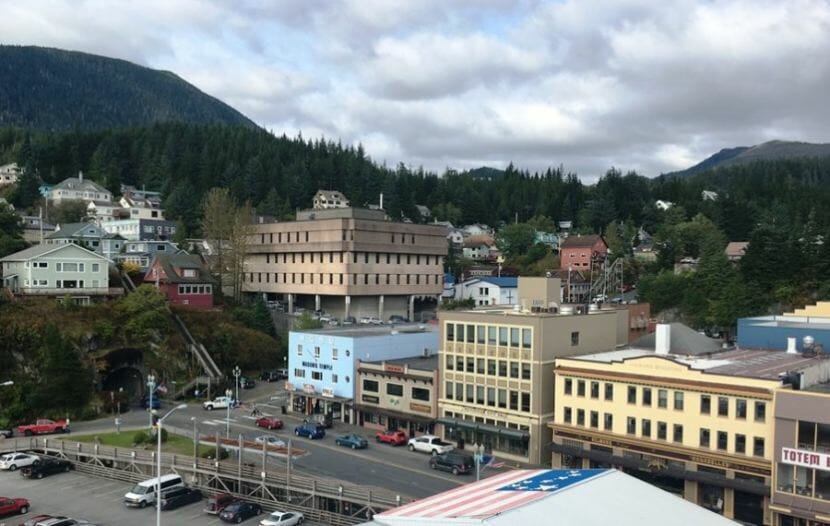
A view of downtown Ketchikan from the cruise ship Veendam. (Photo by Leila Kheiry/KRBD)
Ketchikan officials are cracking down on camping in some public parking lots inside city limits. Heightened penalties for illegal camping are set to take effect next month. That’s after the City Council passed a measure that also allows officials to clear encampments.
City officials cited complaints from downtown residents about noise, theft and drug use at an Edmonds Street parking lot just a block away from Ketchikan’s police station as the impetus for a measure that strengthens an existing ban on overnight camping in city-owned parking lots.
At a meeting last October, Silvia Greuter said she called police to report drug activity and other nuisances in the lot.
“We have homeless people living in the parking lot. We have drug interactions going on in broad daylight,” she said at the time.
Gruder recalled the police officer suggested their hands were tied.
“I said, ‘What’s left? What can I do?’ And he said, ‘You can go down to City Hall and get an ordinance put in place,’” she said.
And that’s what happened on Thursday evening.
Ryan McHale was the lone voice opposing the new measure. The Ketchikan resident said the City Council should instead expand funding for organizations that support the community’s unhoused people.
“Strengthening the city’s ban on camping and city on parking lots is the wrong approach. Forced removal, possible destruction of personal property and increased fines do not resolve the underlying conditions that create the need for camping in the first place and serve only to take away resources for those already living on the edge,” he said.
He asked the council to reduce the fine by two-thirds, which would max out to $100, and strike portions of the measure that would allow the city to confiscate tents, bedding, medications and food with 72 hours’ notice. They’d be held by the city for up to three months.
But the ordinance passed as written. Supporters included Council Member Riley Gass. He said that organizations like the Park Avenue Temporary Home and First City Homeless Services provide plenty of beds for people in need of shelter to sleep.
“I think the community has gone far enough to provide somewhere for people to go who don’t have a place to go. If that weren’t the case, I wouldn’t be in support of this. But quite frankly, if someone is homeless, it doesn’t mean they have a right to do these negative things in public areas.
Each day of illegal camping could incur an infraction — a minor offense like a traffic ticket — which would come with a fine of up to $300.
Council Member Lallette Kistler said she hoped judges would stop short of imposing the maximum fine. But she still supported the measure which passed unanimously.
It’s slated to take effect on Feb 19.
Mayor Dave Kiffer and Council Member Janalee Gage were absent from the meeting.
Coastal Villages Region Fund constructing a tiny home in Eek in 2018. (Coastal Villages Region Fund photo)
A surge of new housing is coming to the Yukon-Kuskokwim Delta. Most of those new units are slated to be of the trendy, tiny home variety. But with households in the Yukon-Kuskokwim Delta generally much larger than the national average, some tribes are questioning whether tiny homes are a good fit for their communities.
The U.S. Department of Housing and Urban Development recently announced almost $7 million in funding for Aniak, Atmautluak, Napaimute, Newtok, Quinhagak, Toksook Bay, and Tununak to begin construction on 25 new homes this year. The funding stems from federal coronavirus relief funding, which has brought a huge influx of money into Alaska for tribes to build homes.
“An explosion is a good term for how much that has increased,” said Greg Stuckey, administrator for the Alaska Office of Native American Programs of HUD.
Because these grants are tied to coronavirus relief funding, tribes must use the homes as isolation or quarantine units, at least at first.
“And then, you know, later, when COVID is eventually over, that you can use those to lower overcrowding in your communities, because that is a major issue in rural Alaska,” Stuckey said.
About 40% of homes in the Y-K Delta are either overcrowded or severely overcrowded. According to a statewide housing assessment, over 2,400 homes need to be built to fix that.
Nearly all of the homes that will be built in the Y-K Delta using these HUD grants will be tiny homes. They will be smaller than 500 square feet, with the kitchen, bed, and living space all in the same room. There will be a separate bathroom, but no separate bedrooms.
Tiny homes have been all the rage in recent years, often billed as an answer to affordable housing. But are they a good fit for a region where households are, on average, 50-80% larger than the national average?
The Yukon-Kuskokwim Delta has experimented with tiny homes before. The non-profit organization, Coastal Villages Region Fund, built one in Eek in 2018. The organization says that it would not do it again.
“We found that people need more space than a tiny home with the number of people in the family,” said Oscar Evon, Regional Affairs Director at CVRF.
Evon said that there were other issues with tiny homes, such as how banks wouldn’t finance mortgages for them. CVRF had originally planned for homeowners to purchase tiny homes through mortgages, which would have opened another pathway to homeownership in Y-K Delta villages. Most are currently built and paid for by the regional housing authority or through grants. After pivoting away from tiny homes, CVRF now builds more traditional three- to four-bedroom homes, which Evon says banks finance mortgages for and fit families’ needs better.
“A bigger home gives a family more space to raise their families and sometimes even their extended families,” Evon said.
Some of the tribes that recently received a HUD grant to build tiny homes have come to the same conclusion. Toksook Bay was awarded $1,035,000 to build five tiny homes, but Tribal Administrator Robert Pitka Sr. said that Toksook Bay would rather build bigger homes.
“We would choose two-bedroom home instead of tiny home,” Pitka Sr. said.
However, Toksook Bay submitted a grant application and received funds to build tiny homes. Pitka Sr. said that he thought the grant was specifically for tiny homes.
“The ICDBG [Indian Community Development Block] grant already had wording in there where it’s for tiny homes,” Pitka Sr. said.
HUD’s ICDBG grant requirements suggest building tiny homes as one way to use grant funds, which may have been enough to convince tribes to include tiny homes in their grant application. Tununak, which also received a grant to build tiny homes, also said it would prefer to build homes with bedrooms.
Stuckey said that HUD does not require applicants to build tiny homes or any particular type of housing and did not favor applications that included tiny homes. For example, Newtok received the same grant award to build three three-bedroom homes.
“It’s self determination. The tribes decide, the tribes are going to tell me what they’re going to build,” Stuckey said.
If tribes like Toksook Bay decide that they would rather build larger homes, they will be able to do so. HUD spokesperson Vanessa Krueger said that tribes can submit an amendment to their grant application.
In Toksook Bay, Pitka Sr. said that the new homes, whether they’re tiny or not, will make a big difference to the families currently living in old, unsuitable homes.
“They’re moldy. They’re cold. They’re rotten. They don’t have water and sewer system. Some are even tinier than tiny homes. And at least a brand new tiny house would make it 100% better,” Pitka Sr. said.
Pitka Sr. said that those families could move into their new homes later this year.
Close
Update notification options
Subscribe to notifications
Subscribe
Get notifications about news related to the topics you care about. You can unsubscribe anytime.