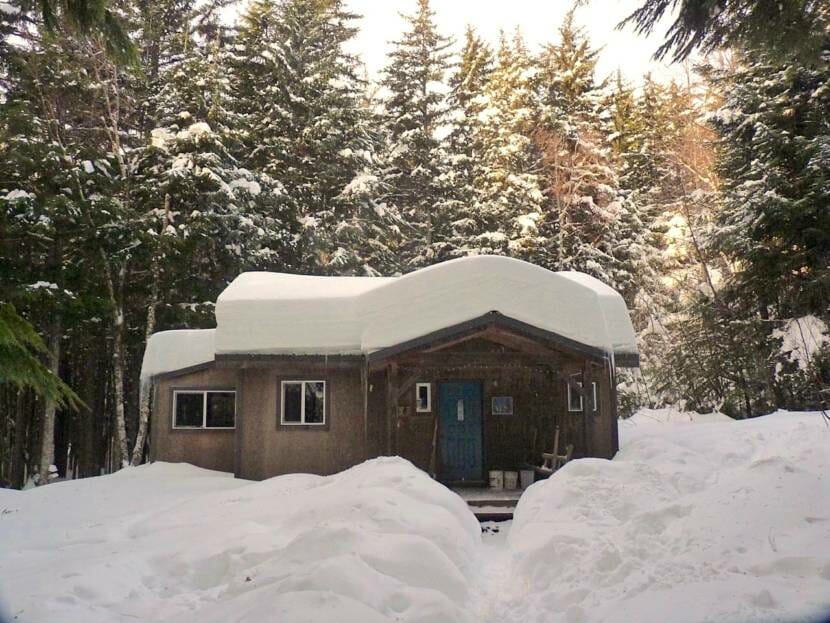
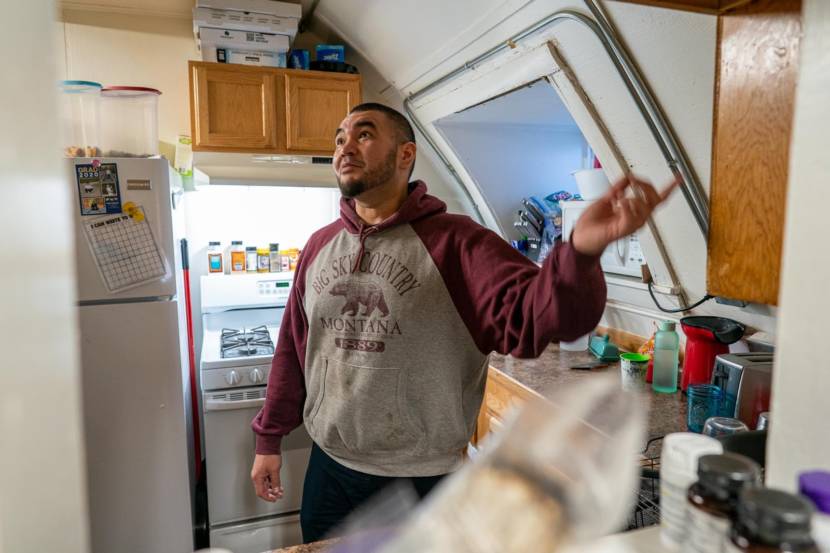
Cabin with heavy roof snow. (Courtesy of Kathleen M.K. Menke)
One of the forgotten dangers of living in Alaska is a roof full of snow. It might make for a cozy cabin photo, but the chance of a roof collapse — or being caught in an avalanche of roof snow — is real.
Haines is reporting nearly four feet of snow at multiple locations. And with high winds expected throughout the week, drifting snow can cause greater depths.
Erik Stevens from the Haines Avalanche Center says addressing your snowy roof while it’s cold can prevent problems later on when it warms up.
“I definitely recommend people be cautious. But it’s also a good idea to get that snow off your roof,” he said. “If it’s piling up, then it’s not shedding naturally. I’d hate for the next storm to come in real heavy and wet it could double the load pretty easily.”
Stevens says the Haines Avalanche Center measured the ground snow load over the weekend and found the snow weighs 57 pounds per square foot.
“I’ve heard of yurts collapsing pretty frequently here in Haines. I’ve seen garages and boat sheds collapse pretty frequently. I don’t think I’ve heard so much about residential homes collapsing. But every now and then, there’s a flat-roofed business that might collapse,” he said.
In Skagway, fire department officials warn that heat from inside the house can cause the snow closest to the roof to melt, which can later freeze. That can be a problem for firefighters when there’s a chimney fire.
Firefighter Engineer Zak Overmyer says they don’t wear cleats on their boots to get a good grip on icy roofs because that’s dangerous when climbing ladders. He also says that time spent shoveling snow instead of fighting the fire can lead to more damage, and heavy snow loads can cause collapses.
“If the house itself does get involved in a fire, having that extra load on the roof and extra weight will make those trusses and ceilings and stuff fail a lot quicker,” Overmyer said.
Another potential danger from excessive snow on roofs is a roof-snow avalanche. Last January, a Haines man was buried while collecting firewood out by Mosquito Lake. As the Chilkat Valley News reported, a former heli-ski guide was grabbing a couple of logs for his wood stove at night when the roof-snow gave way and buried him.
He managed to use his cell phone to alert neighbors, who helped rescue him after about 45 minutes.
But Stevens says shoveling a roof can also cause a slide — slides can happen anytime if the roof has a steep pitch.
“Metal roofs are particularly slick underneath. And they tend to slide when it warms up. When it’s cold they’re not likely to slide, but they could,” he said. “If your roof is around 30 degrees or steeper, I do not recommend getting on top of it or under it at all, because it could shed really at any time.”
He says snow drifts piling up on one section of the roof can also create problems and suggests having a structural engineer inspect your roof if you are unsure if it can handle the winter’s snow load.
In addition to the nearly four feet of snow in Haines, Dyea is reporting two feet and the William Moore Bridge on the Klondike Highway is reporting three feet. In town, Skagway is reporting 16 inches.
Skagway officials suggest hiring a local contractor to help with snow removal if necessary.
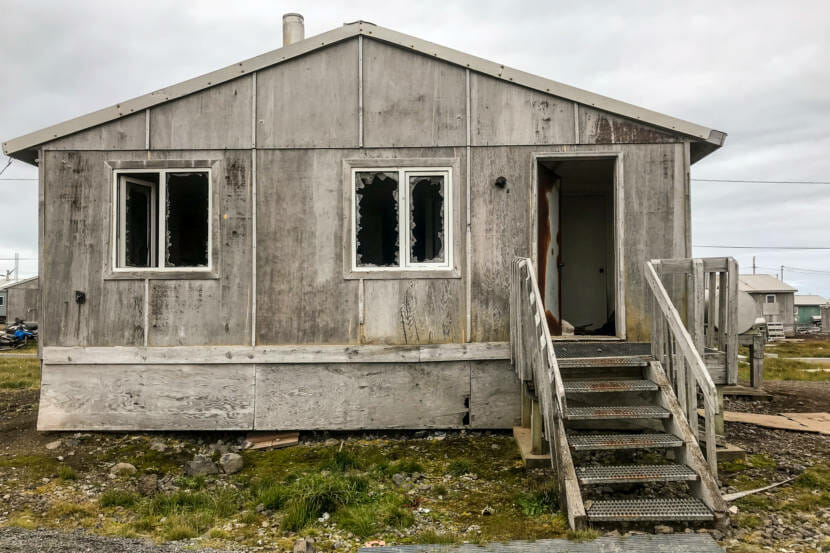
Several older homes in Savoonga have been run down by frequent winter storms and many years without maintenance. (Photo by Emily Hofstaedter/KNOM)
The COVID-19 pandemic has made it difficult to build homes in Western Alaska. But it’s also provided opportunities for more funding to alleviate some housing issues that exist in the region.
More than a third of residents in the Bering Strait region are living in overcrowded conditions according to the Alaska Housing Finance Corporation.
The former CEO of Bering Straits Regional Housing Authority, Chris Kolerok, gave public testimony on housing conditions in the region three years ago. Kolerok spoke during an Indian Affairs Senate Hearing held in Savoonga, the first of its kind hosted in Western Alaska.
“In the Bering Straits outside of Nome, the overcrowding rate is 37% — 19% of that are homes being classified as severely overcrowded,” he said in 2018. “And during community meetings, we have been confronted with the heartbreaking stories of 21 people sharing a small three-bedroom home.”
That same year, Savoonga received six new houses. Since then, there have been no new homes built in the community. Prior to the completion of those six new homes, Savoonga hadn’t seen new houses built locally in over 10 years.
Those rates are based on the Alaska Housing Finance Corporation’s latest housing assessment from 2018.
Jolene Lyon inherited these challenges as she took over as president and CEO of Bering Straits Regional housing authority in 2020. Although the housing authority has traditionally served tribal members of the Bering Strait by building houses, during the pandemic they were able to offer other assistance.
“Some communities chose to buy side-by-sides or ATVs,” Lyon said. “Others chose to get washers and dryers, some wanted more PPE, some wanted freezers because at the same time there was a concern that there would be meat shortages.”
Each community gets a certain amount of funding from the U.S. Department of Housing and Urban Development based on the population of the tribe. The housing authority then pools all the allocated money together which comes to between $1.4 million to $1.8 million each year for the entire Bering Strait region.
Staffing turnover, logistical issues and the wrench thrown into the plan by COVID-19 all delayed the construction of new homes that were slated for this year. Lyon says the upside of waiting though, is that the housing authority received additional funds from COVID-related grants and can afford to build more homes in 2022.
She had money left over from the regular allotment from the federal government and decided to stretch that with approval from the housing authority’s board of directors.
“I presented a revised Indian Housing plan to take that remaining funding and apply it towards new construction for Shaktoolik. So now we have two homes we can build. Thus comes along, we get the American Rescue Plan [funding], and I can take another $1.5 million from that and now I’m building four homes in Shaktoolik instead of the one we were actually going to do,” she said.
Shaktoolik, Diomede and Wales are all set to receive new homes in 2022. On top of that, King Island tribal members received two new modular homes constructed in Nome last year.
But a couple of single-family homes every 10 years or so is not enough to tackle the issue of overcrowding which is at 14% in Nome, and 37% in the Bering Strait region, according to the latest numbers from AHFC.
Sophia Katchatag, tribal coordinator for the Native Village of Shaktoolik, says four new homes next year will only make a small dent in a sizable issue for her community.
“It’s a blessing to know we are getting four new homes this coming summer, but there’s still a need out there. There’s still multiple families living in homes,” she said.
According to Katchatag, the last time Shaktoolik had new homes built in the community was from 2005 to 2006.
Going forward into 2022, Lyon says the housing authority will focus on building more homes across the region, with some extra funding courtesy of the American Rescue Plan Act.
“We can build stick-build [houses]. We can build sit-paneled homes, with those big, large panels. We can do modular or if they’re small, we can do tiny homes, we can have those shipped in,” she said.
Each option comes with its own set of pros and cons. Some cost more to ship than others but some are more suitable for the Arctic conditions that exist in Western Alaska.
According to Lyon, the housing authority could build up to a total of 10 new homes next year for three different communities instead of the usual three new homes.
And in early December, the federal housing and urban development department announced an additional $52 million in Indian Community Block Grants. Some of those funds will pay for a temporary shelter in Solomon, five tiny homes in Aniak and water holding tanks for Wales.
Correction: An earlier version of this story misspelled Jolene Lyon’s last name. It is Lyon, not Lyons.
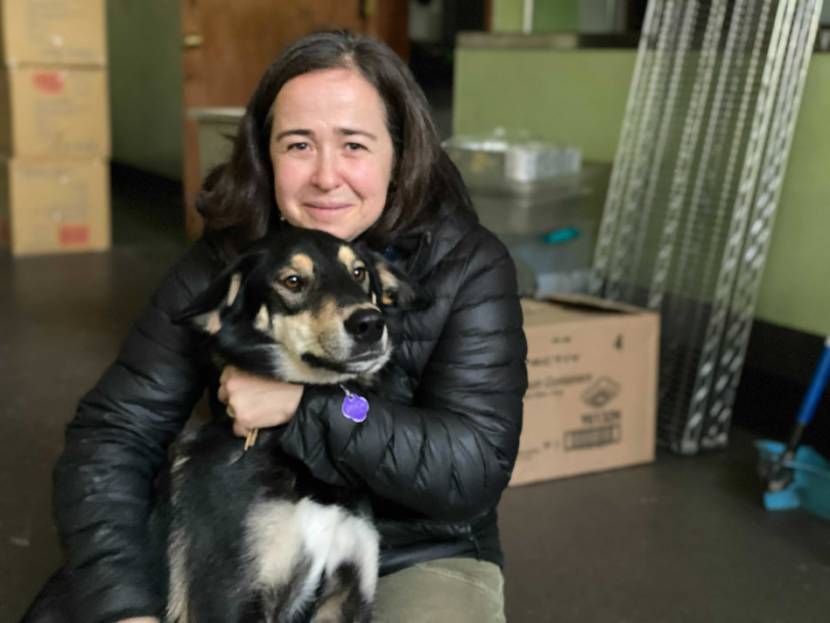
Mariya Lovishchuk with her dog at 247 Franklin Street in December, 2021. (Claire Stremple/KTOO)
Outdated hazard maps and city code are stalling an affordable housing project in downtown Juneau. The city is grappling with its need for affordable housing and how it interprets its own code.
The blue building at 247 South Franklin Street once housed dozens of people each night as The Glory Hall, Juneau’s emergency shelter and soup kitchen.
Director Mariya Lovishchuk tries a few keys before the door springs open. Glory Hall moved to a more spacious location this summer, and the downtown property that the Glory Hall non-profit still owns is almost empty.
Lovishchuk walks through the commercial kitchen into a high-ceilinged dining area that once served up to a hundred meals a day. She heads up to the second and third floor, where she’s proposing to convert dorm spaces into apartments.
Lovishchuk says the city sorely needs affordable housing downtown, but Juneau’s development department won’t green-light her plans.
According to city paperwork that’s because the Glory Hall’s building is in a severe avalanche hazard zone. City code says existing properties in those zones cannot increase density through new construction.
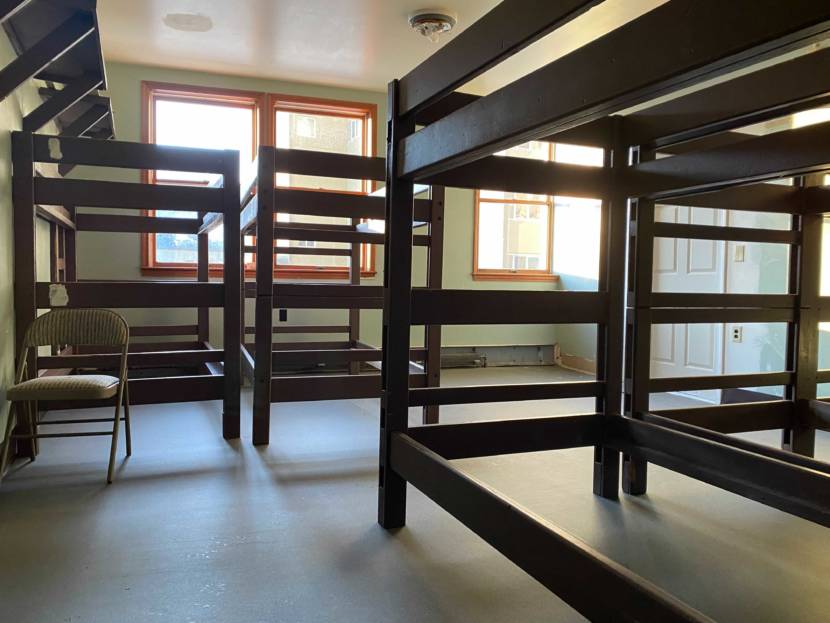
A dormitory room at 247 Franklin Street that The Glory Hall would like to turn into an apartment. December 2021. (Claire Stremple/KTOO)
Lovishchuk argues her plan actually reduces the number of people who might sleep there. The room she’s standing in is full of bunk beds. It once housed a dozen people. As an apartment only one or two people would live there.
“Overall, we are neither increasing the density of the people who are sleeping here, or the spaces inside the building. So I’m really hopeful that this is all gonna work out,” she said.
Lovishchuk’s plan will add some walls to the inside of the building, but instead of sleeping 50 people as a shelter, the apartments will sleep 7-14 people.
“The rub is in their reading of the code,” said City Manager Rorie Watt.
“They’re reading this as a conversion of building. In the planning world, they’re converting the use.”
He says the development department sees the new construction as a conversion of use — from a shelter to apartments — and they say that’s prohibited by code.
“For somebody not steeped in land use code or not regularly in it … you’d be like, ‘well, that doesn’t really make sense.’ And it’s like, well, it might not make sense. But that’s still what they think the code means,” Watt said.
Lovishchuk appealed the city’s decision to the planning commission, which voted unanimously to hear her appeal at a future meeting that hasn’t been scheduled yet.
Officials from the department wouldn’t speak on the matter while it is in an appeal process.
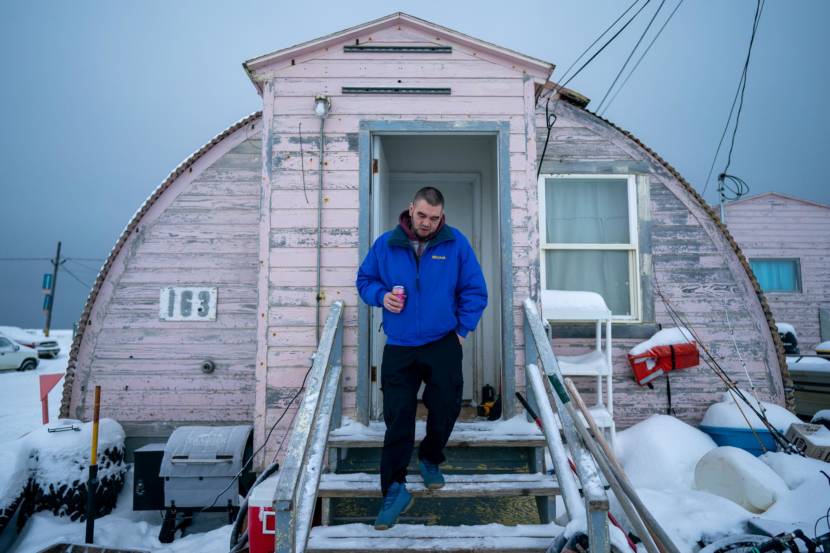
Justin Mitchak Gatten steps out of his home in NARL, a neighborhood on the outskirts of Utqiagvik, Alaska on Nov. 3, 2021. NARL, which stands for the Naval Arctic Research Laboratory, was a research facility established in the 1940s by the federal government and is now owned by the Ukpeagvik Iñupiat Corporation. (Loren Holmes/ADN)
Justin Mitchak Gatten’s Iñupiat ancestors were the original residents of Alaska’s North Slope thousands of years ago, and they once claimed millions of acres of land.
But today, Gatten can’t even find a lot to build a home in the region’s largest community, Utqiagvik. Instead, Gatten, 37, rents an aging quonset hut outside of town. He lives with his wife and four children.
The home is cozy but comes with inconveniences familiar to rural residents across Alaska: A delivery truck must replenish Gatten’s water supply as often as twice a day, and he has to warn his kids away from the septic tank, which sometimes overflows.
The North Slope’s Indigenous people lost most of their ancestral lands long ago, in a landmark settlement with the U.S. government that turns 50 years old this month, the Alaska Native Claims Settlement Act.
But after its passage, the act did transfer 340 square miles in Utqiaġvik’s vicinity to a newly created, locally owned corporation, Ukpeagvik Iñupiat Corp.
Homes in the Browerville neighborhood of Utqiagvik on Nov. 1, 2021. (Loren Holmes/ADN)
In a region long gripped by a housing crisis, where multiple generations often cram into the same home, many younger Utqiagvik residents like Gatten see the corporation’s largely unoccupied land as part of the solution.
That’s because UIC is owned by more than 3,000 Indigenous Alaskans who trace their heritage to the North Slope.
But for now, the owners with the loudest voices are those born before the settlement’s cutoff: Dec. 18, 1971. Those people each received 100 shares in UIC.
Gatten’s generation, and anyone else younger than 50, was left out. The result, he and others say, has denied them a full voice in the elections that set UIC’s leadership and direction, and a stake in their ancestral lands — until or unless they inherit stock from a relative.
UIC has made its original shareholders eligible to receive homesite lots from the corporation. But Gatten, who owns just 10 shares inherited from his mother, doesn’t qualify, and neither do his peers.
While Gatten has inherited two lots from grandparents, both are cut off from roads. And, he said, when he tried to exchange one with UIC for a more accessible lot, the only ones available were next to Utqiagvik’s sewage lagoon.
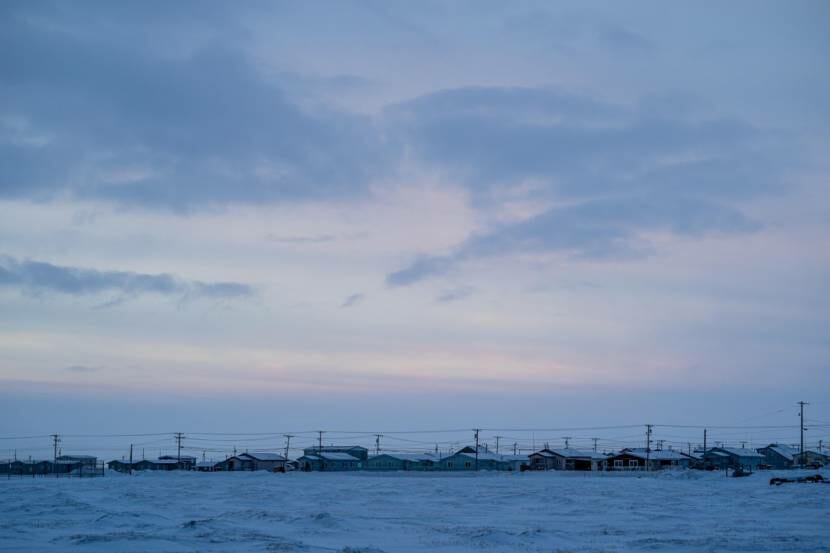
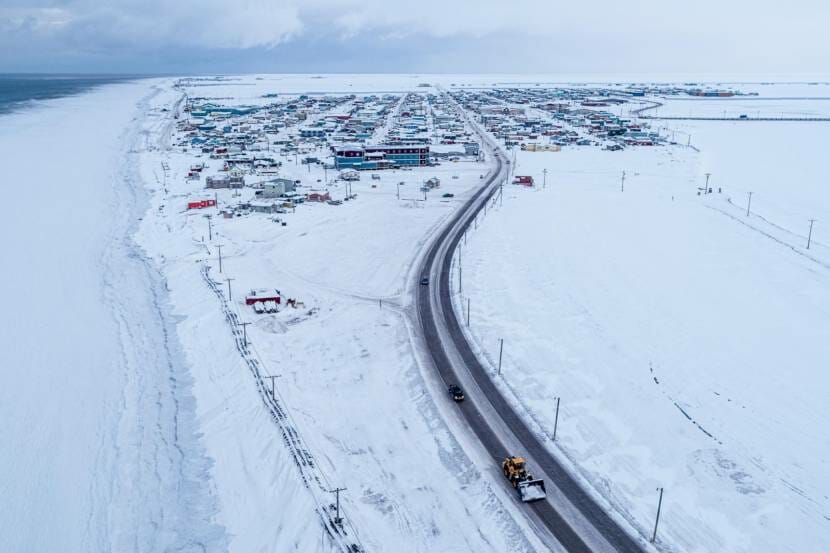
Utqiagvik, Alaska, photographed on Nov. 1, 2021. (Loren Holmes/ADN)
Alaska Native corporations have the power, if they choose to exercise it, to issue new shares to “descendants” born after ANCSA’s cutoff date.
But only about a dozen of the roughly 200 regional and village corporations statewide have done so. The indecision reflects high stakes that are both cultural and financial, as some Native corporations pay out substantial dividends that could diminish if more shares are issued.
UIC, which paid dividends of some $2,000 this year, has been studying the problem for years. But it has not yet issued new shares, with its board citing the complexity of the issue.
The same dilemma is playing out across the state, with dozens of Native-owned corporations contending with the same dynamics as their original shareholders, and descendants, grow older. And in many cases, the conflict has pitted community members and even family members against each other.
“What good is land if you’re not going to develop it?” Gatten said. “It seems quite selfish to me, for them to hold lands with road access, and we have to live in subpar conditions like this.”
UIC leaders didn’t respond to repeated interview requests.
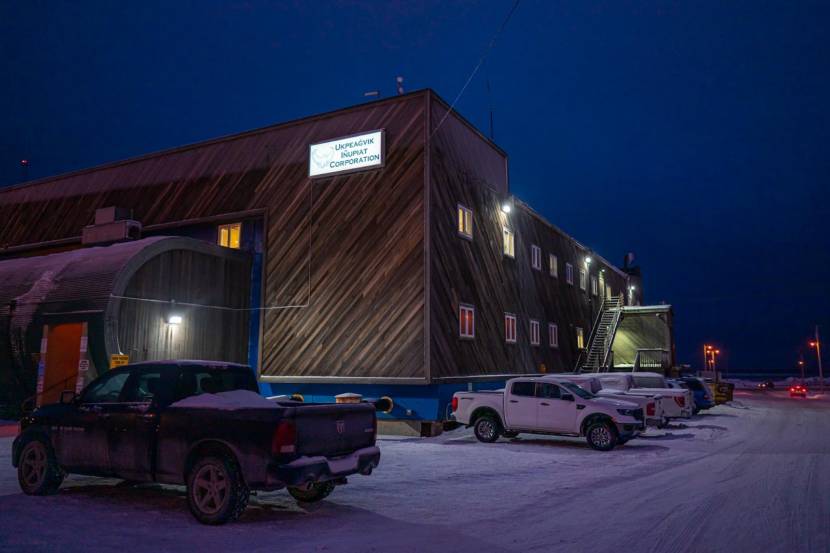
The Ukpeaġvik Iñupiat Corporation building, photographed on Nov. 3, 2021 in Utqiagvik. (Loren Holmes/ADN)
But in newsletters, the corporation says it’s formed a board committee to explore options for issuing new shares to descendants in response to a successful 2017 shareholder ballot proposal that recommended such a step.
“The board of directors continues to explore this complex and significant step in the evolution of UIC,” Delbert Rexford, the corporation’s chief executive, wrote in a newsletter last year. “However, because descendant enrollment involves many aspects beyond land rights alone, and because the ballot proposal did not address what other rights should or might be included if a new class of stock were issued, these questions still need to be asked and answered.”
Shares and identity
Some Alaska Native leaders say that issuing shares to descendants is an obvious choice to help preserve Native corporations’ Indigenous character and distinguish them from traditional capitalist businesses.
In the early decades after ANCSA’s passage, many Native shareholders looked to their corporations for profits and dividends, and leaders prioritized expansion and growth.
But now, Native leaders say that their younger shareholders place higher value on their culture and see the corporations as a potential source of Indigenous identity and belonging, with responsibilities that extend beyond the fiduciary.
Josiah Patkotak, Utqiagvik’s state representative, drives home after work at the Arctic Slope Regional Corporation on Nov. 2, 2021 in Utqiagvik. Patkotak is a descendant and former Ukpeagvik Iñupiat Corporation board member who has inherited a handful of shares. (Loren Holmes/ADN)
“I think it needs to happen, for that continuation of community feeling,” said Josiah Patkotak, Utqiagvik’s state representative — a descendant and former UIC board member who has inherited a handful of shares. “There needs to be some kind of identity and purpose and meaning.”
Many corporations, though not all, have tried to blunt the divide between shareholders and descendants by making descendants eligible for non-cash benefits like corporate jobs and scholarships.
But economics and politics quickly complicate the discussion about the shares themselves.
One of the biggest obstacles is the potential for “dilution,” or devaluing stock owned by existing shareholders.
It’s a math problem: If there’s a finite amount of profits that a corporation can pay out as a dividend, more shares make those dividends smaller on a per-share basis. Existing shareholders have to approve the issuance of any new shares — meaning that they have to vote against their own economic interest.
There’s also the question of power. Some shareholders, and well-compensated board members, could find themselves in the minority if descendants were granted equal voting power.
The monetary impact is less significant at UIC, where the corporation’s yearly dividends to original shareholders have exceeded $1,000 only twice in the past six years, according to annual reports filed with state regulators.
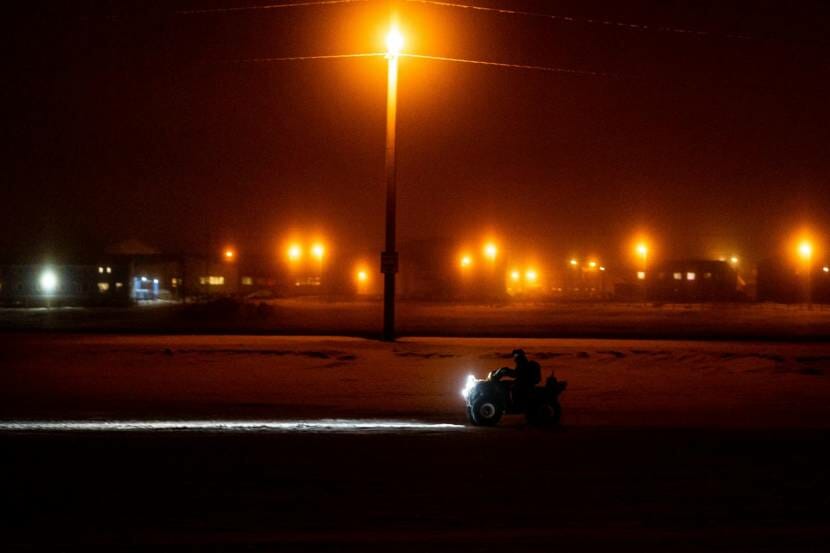
A person drives a four-wheeler across a frozen lake on Nov. 2, 2021 in Utqiagvik. (Loren Holmes/ADN)
But certain other corporations pay much more, and issuing new stock could cause problems for original, older shareholders. Some of them might depend on dividends to cover their expenses, particularly in areas of rural Alaska that lack high-paying jobs and strong cash economies.
“For dividends to go down, it’s just a scary thing, because you have your budget established,” said Hallie Bissett, executive director of the Alaska Native Village Corporation Association.
Another important dynamic cited by those opposed to enrolling descendants is that original shareholders, in some cases, sacrificed early dividends so that their corporations could reinvest profits in new businesses that only paid dividends later.
Afognak Native Corp., whose shareholders have roots in the Kodiak region, has a huge government contracting business, and those with 100 shares now receive yearly dividends of some $20,000.
But Gerad Godfrey, an Afognak shareholder and former board member, said the contracting business was enabled by original shareholders who decided not to pay out their earnings from early timber harvests — unlike shareholders in a different Native village corporation not far away.
“They’ve got cousins that have a brand new outboard, a down payment on a boat, a brand new four-wheeler across the way there,” Godfrey said. “They sacrificed to get us where we are today.”
Gerad Godfrey at his home on Monday, Nov. 29, 2021 in Eagle River. Godfrey was born in 1972, a year too late to qualify as an original Afognak shareholder, and he grew up watching three of his older siblings receive dividends of thousands of dollars before he inherited some of his grandmother’s shares. (Loren Holmes/ADN)
Godfrey was born in 1972, a year too late to qualify as an original shareholder, and he grew up watching three of his older siblings receive dividends of thousands of dollars before he inherited some of his grandmother’s shares.
In an interview, Godfrey said he remembered returning home from a school event to find his father, who was campaigning for a Native corporation board seat, stuffing envelopes in the kitchen. His father asked him for help, but at that point, Godfrey said, he was feeling “a little resentful.”
“He says, ‘Don’t you want your dad to be elected to your Native corporation?’” Godfrey said. “I said, ‘It’s not my Native corporation. It’s Glenn Jr.’s, it’s Valery’s, it’s Jenna’s, it’s yours. So, I’ll take a pass.’ And I went downstairs and turned on the TV.”
Nonetheless, Godfrey has resisted giving shares to his high school-age children and still opposes issuing new shares to descendants, largely because of the potential for dilution. Descendants will still be able to inherit shares, Godfrey said, and growing up without them, he added, made him appreciate it more when he could finally participate — he’s now served on Native corporation boards and worked for them as an employee.
“I may have been more immersed and involved in Alaska Native corporation activities and engagement because I knew what it was to be without,” he said.
Mitigating dilution
Advocates for issuing new shares, meanwhile, say there are ways to mitigate the dilution problem, and that the focus on it risks distracting from the benefits of bringing younger people into the Native corporations.
“The one big reason not to do it is because it’s going to dilute the stock. And that’s just a very Western, normal corporation way of thinking — and we’re not regular, Western, normal corporations. We’re Native corporations,” said Joe Nelson, board chair of the Southeast Alaska-based Sealaska Corp. “By definition, we should be thinking about the long term, and making decisions that are in the best interests of the next generations.”
When Sealaska Corp. voted to enroll descendants, in 2007, it also approved issuing an extra 100 non-voting shares to elders, said Nelson, who was working as an attorney for the corporation at the time.
The idea was to protect those original shareholders against the effects of diluting their original stock, he added.
Other corporations have also reduced dilution by issuing fewer than 100 shares to descendants. And they can delay its effects by adjusting the timing of when shares are issued.
Sealaska doesn’t allow descendants to enroll until they turn 18, while Interior-based Doyon Ltd. issues 30 shares to descendants when they’re born, then 70 more when they turn 18. Kuukpik Corp., which is tied to the village of Nuiqsut on the North Slope, recently issued 50 shares to descendants and will issue five more every year for the next decade.
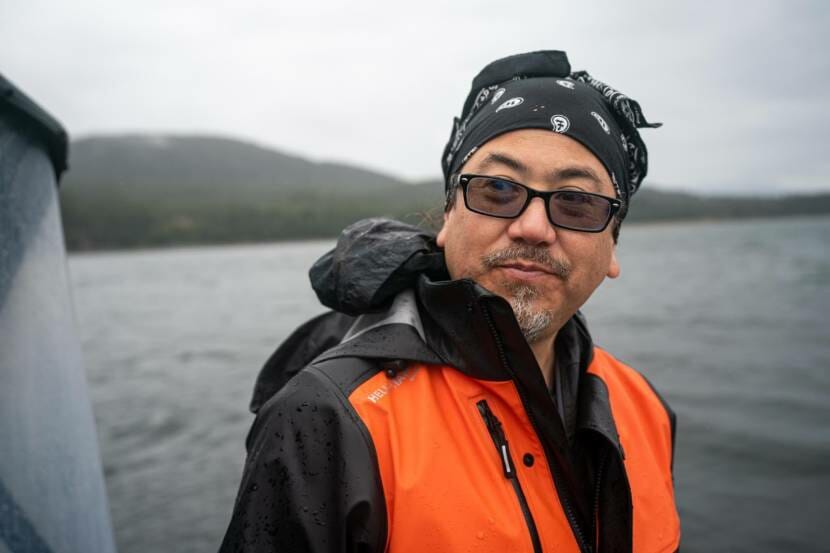
Sealaska Board Chair Joe Nelson stands on his boat in Saginaw Channel on Sept. 14, 2021 near Juneau. (Loren Holmes/ADN)
Some corporations, meanwhile, limit how many descendants can receive stock by maintaining a requirement in the original settlement legislation that shareholders be one-fourth Alaska Native.
Corporations have “levers that can be pulled” to address concerns around dilution, said Nathan McCowan, chair of the board of the Alaska Native Village Corporation Association.
One thing that many pro-enrollment corporate leaders say makes dilution less of a problem: Descendants of original shareholders tend to be less focused on dividends and monetary benefits and more interested in a source of identity.
Bissett, the Native village corporation association’s executive director, has inherited just three shares in Cook Inlet Region Inc., and she said sometimes her quarterly dividends amount to just $20.
But owning those shares, she added, has allowed her to win a seat on CIRI’s board and help shape the corporation’s future.
“It is not about the money for me,” she said. “You hear people talk about when they received their shares, and the first time they were able to attend annual meetings for the company — to have a share in taking care of these ancestral lands that were given to us to manage, forever. And that’s just an incredible feeling.”
‘Conquer and divide’
Supporters of enrolling new shareholders say it’s increasingly urgent for Native corporations to address the divide between elders and descendants, since the sooner descendants can become involved with corporate affairs, the more ready they’ll be to take leadership roles as original shareholders age out of them.
Half of Alaska’s 12 larger, regional Native corporations have already issued new shares; others are studying the question. But only a half dozen or so of the more than 150 village corporations, which tend to be smaller, have done so, according to industry leaders.
The relatively small fraction of village corporations to issue new shares is likely a reflection of how technical and expensive the process can be, McCowan said. Shareholder surveys and meetings are involved; consultants, actuaries and attorneys must be hired.
It took six years of debate and discussion before Kuukpik issued its new shares, said Isaac Nukapigak, a board member and former corporate president.
Native corporations’ generational divide was baked into the original 1971 settlement by Congress, which failed to create a mechanism to enroll new shareholders. That decision has since caused so many internal conflicts that some Natives suspect Congress was trying to provoke them.
“That was their intent,” said Gatten. “Conquer and divide.”
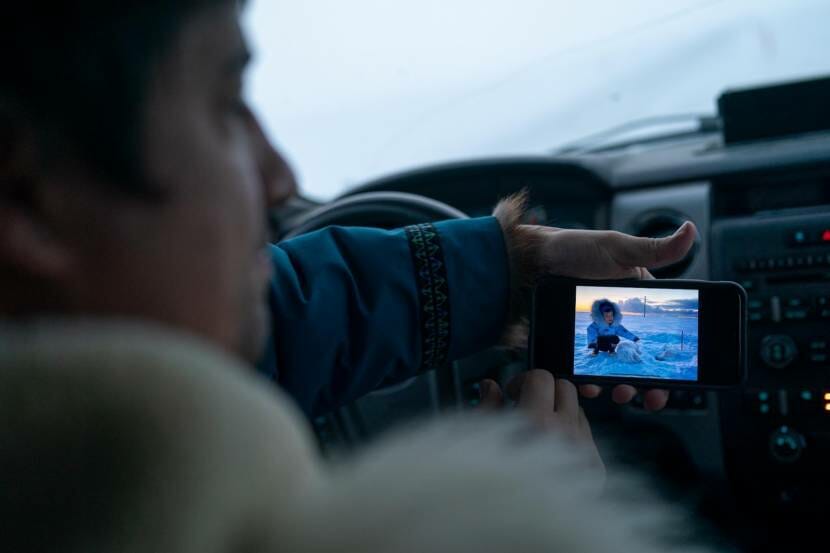
Qaiyaan Harcharek holds his phone, displaying a recent photo of his son with a fox, in Utqiagvik on Nov. 2, 2021. (Loren Holmes/ADN)
But today, there’s also broad agreement across the Native corporation world that a statewide, congressional fix to the problem isn’t viable, given the widely varying circumstances at each corporation and, at some, the outright opposition to descendant enrollment.
One suggestion from McCowan: Congress could budget money to support smaller corporations going through the enrollment process, which might otherwise lack the cash to hire the relevant experts.
“We’re byproducts of the public policy process in the United States, governed, like treaties are, by the laws of Congress,” he said. “If there’s a problem that Congress created then, by and large, it’s a problem that Congress has the responsibility to solve.”
But Native groups have not launched any kind of coordinated lobbying effort to push that idea, and no action from Alaska’s congressional delegation appears to be imminent — though U.S. Sen. Lisa Murkowski, whose congressional office was the only one to respond to a question about descendant enrollment, said she’s open to discussion with corporations about how to solve the problem.
“Whatever it is they choose to do, our role here in Congress should be to facilitate the promise of ANCSA, and be responsive to the fact that the world’s changed a little bit in 50 years here,” she said. “If we need to review, we should do that.”
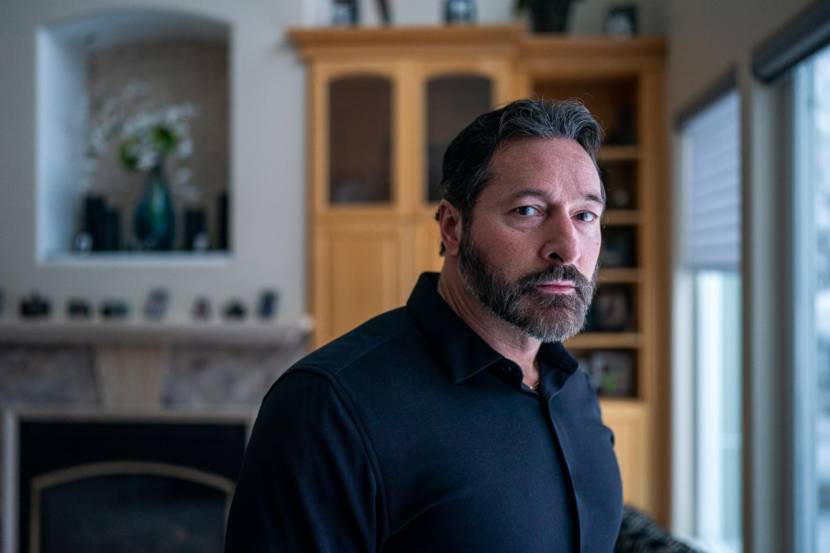
Justin Mitchak Gatten stands in his kitchen in NARL, a neighborhood on the outskirts of Utqiagvik, Alaska on Nov. 3, 2021. NARL, which stands for the Naval Arctic Research Laboratory, was a research facility established in the 1940s by the federal government and is now owned by the Ukpeagvik Iñupiat Corporation. (Loren Holmes/ADN)
In the meantime, Gatten, in Utqiagvik, remains in his quonset hut, as his wife nudges him to try for another land exchange with UIC that wouldn’t put his new house next to the town’s sewage lagoon.
He said he understands that issuing new shares can risk diluting dividends for original shareholders, and that his ancestors made sacrifices and grew up without many of the modern comforts that corporations have helped bring to the North Slope.
But as a parent to his own children, Gatten said, he remains confounded by original shareholders who aren’t eager to share in their corporate wealth with their descendants.
“We’re grateful. I’ll shake every single one of those people’s hands that’s still alive, saying thank you. But do you deserve a dollar amount? I don’t think that’s fair,” he said. “I think everyone should get a piece of the pie.”
This story is part of a reporting collaboration between Alaska Public Media, Indian Country Today and the Anchorage Daily News on the 50th anniversary of the Alaska Native Claims Settlement Act. Funding for the ANCSA project was provided by the Alaska Center for Excellence in Journalism.
Mariya Lovischuck is the director The Glory Hall in Juneau. (Photo by Danny Peterson/KTOO)
Juneau’s Mariya Lovishchuk was awarded a sabbatical next year in recognition of her long history of community service. The Rasmuson Foundation will support her organization, The Glory Hall, so Lovishchuk can take three to six months to recharge after more than a decade of long hours.
Lovischuk said running a 70-person emergency shelter means she’s on-call all the time, and something is always happening.
“In 11 years, I have not had a single day of boredom,” she said.
Lovischuk says she plans to spend time outside, including a kayak trip around Prince William Sound and mushroom hunting on her property in Haines. She has plans for a trip to Chicago with her child.
She said she knows her team at Glory Hall will be fine without her for a little while. The rules of the sabbatical state that she can have no contact with work for the whole time.
And as for being selected?
“Definitely feeling like a little bit of impostor syndrome. Like, you know, super, super honored. But also just kind of like wow, like it’s really hard to believe that,” she said.
Lovischuk said she’s proud of all Glory Hall’s partnerships in Juneau, but the Juneau Housing First project feels special — it’s 64 units of housing for people who are chronically unhoused in Juneau.
“Every time I walk into this building, they just, they feel really good about what they’ve been able to accomplish,” she said.
Lovischuk plans to start her sabbatical next spring in mid-May or mid-June. She will take about five months off.
Correction: A previous version of this story misspelled Mariya Lovishchuk’s last name and misstated the number of units in Juneau’s Housing First facility. It is 64. And Lovishchuk has only one child.
Anchorage Mayor Dave Bronson (left) and Anchorage’s new homelessness coordinator Dave D’Amato speak with reporters inside the warming tent outside the Sullivan Arena shelter the morning of Nov. 19, 2021. (Jeff Chen/Alaska Public Media)
Anchorage’s new homelessness coordinator, Dave D’Amato, has been on the job for two weeks, but the city hasn’t answered questions about his experience or his vision for tackling one of the mayor’s most urgent priorities.
The former health care lobbyist will lead a new division overseeing housing and homelessness in the Anchorage Health Department, according to a department spokesperson. That comes after the previous division manager was fired.
D’Amato, 53, is controversial in homeless advocacy circles because he has argued on social media and public testimony for using private security guards to keep homeless people from camping in public places. He’s also argued for increasing prosecution of minor crimes like trespassing. That’s a move advocates say would shift more homeless people into jails, burden the court system and leave people with criminal records, making it harder for them to obtain permanent housing.
D’Amato has was also a staunch critic of the Anchorage Assembly’s efforts to purchase several buildings last year to use as homeless shelters and a substance abuse treatment center. A similar plan was recently proposed by a working group of Assembly members and representatives from Mayor Dave Bronson’s administration.
Members of that group say progress on purchasing new buildings for shelter has continued even as D’Amato has taken over a seat on the group. Chris Constant, one of the group members, declined to comment directly about D’Amato but emphasized that new members should focus on listening rather than talking.
“You’re new to the table; we’ve spent 800 hours working on it. It would be wise to get a basic understanding of where we are,” said Constant.
D’Amato’s also been active in the conservative Save Anchorage Facebook group. Among his posts, first reported by liberal blog The Blue Alaskan, one calls for holding homeless people “responsible for some progress” to be eligible for public services. In another, he says that donating to nonprofits that provide services to homeless people is, “the worst possible thing to do with your money and for the community” because it perpetuates homelessness. He also used a profanity referencing an Assembly member’s weight in a post about the mask mandate.
D’Amato declined to answer questions for this story. City officials would not release his resume until Alaska Public Media filed a Freedom of Information Act request.
The resume says his previous experience in homelessness comes several years ago from work for United Way of Anchorage, where he worked in 2016 until 2017, leading a pay for success project which focused on reducing homeless peoples’ use of emergency services by providing them housing. He also was interim director for the Anchorage Coalition to End Homelessness for about six months in 2017.
D’Amato’s resume also says he worked as a consultant for D’Amato Consulting since 2005. There is no website or business license for the company, according to state records.
In 2010, he made Anchorage headlines for incurring a nearly $200,000 fine for wetland permit violations on his hillside property. In 2018 he appeared in Juneau headlines for his involvement in a property dispute as a power of attorney for one of the owners. The property, the Bergmann Hotel, had become a hotspot for crime, and was the frequent site of police calls before it was vacated, leaving tenants homeless.
D’Amato has appeared in official city meetings on housing and homelessness since he took the job and made a brief appearance for the media at the opening of a warming tent outside the Sullivan Arena, the city’s main shelter late last month. Advocates had criticized the city for being slow in setting up the warming tent, which opened days into a cold snap that gripped Anchorage.
At that event, D’Amato hinted at plans to change the Sullivan but didn’t elaborate.
“You’re going to see a lot of good stuff happening in the next few weeks, so we’ll continue to work that and keep your eyes peeled,” he said.
D’Amato has recently taken credit for work in reducing homelessness and crime in Juneau, including during his testimony in front of the Anchorage Assembly last year.
“Homeless people had taken over a neighborhood,” he said, “and it was overrun with crime addicts, homeless folks, this sort of thing. We went down there, myself, and another group of sort of committed folks. And what we did is in two years, two and a half years, we took the crime in that neighborhood … we got rid of it. We did some spectacular stuff down there.”
D’Amato’s resume does not list any work experience related to homelessness in Juneau. He recently applied for city funds to help with a renovation project on the Bergmann that would help convert it into worker housing, but that application was denied by a Juneau housing committee, which cited an incomplete application.
D’Amato’s job as the a division manager for the city’s health department doesn’t require Assembly confirmation.
Close
Update notification options
Subscribe to notifications
Subscribe
Get notifications about news related to the topics you care about. You can unsubscribe anytime.