Housing

Juneau homeless served with trespass notices

Juneau Empire reporter interviews a Juneau police officer Tuesday, August 22, 2017, at an encampment on Alaska Mental Health Trust property off Egan Drive. Juneau police served a notice of trespass to the encampment. The notice gave the encampment two weeks to leave the property. (Photo by Tripp J Crouse/KTOO)
Juneau Empire reporter Alex McCarthy interviews Juneau Police Officer Ken Colon on Tuesday at an encampment on Alaska Mental Health Trust property off Egan Drive. Juneau police served notices of trespass to the campers. The notice gave them two weeks to leave the property. (Photo by Tripp J Crouse/KTOO)

Residents in a homeless camp on the edge of downtown Juneau have been served with a formal trespassing notice by the landowner, the Alaska Mental Health Trust Authority.

Juneau Police Department officers and social care agencies walked through Tuesday afternoon delivering formal trespass notices. The encampment off Egan Drive mushroomed in recent months after police began enforcing park closures downtown.

Police Officer Ken Colon said the notices explain that people need to be off the property by Sept. 5 or face prosecution. They also include names, addresses and phone numbers of local social service agencies that could help.

This land is part of the Alaska Mental Health Trust. The trust’s land office is negotiating the sale of at least one of the parcels for redevelopment and wants to clear both parcels of vegetation.

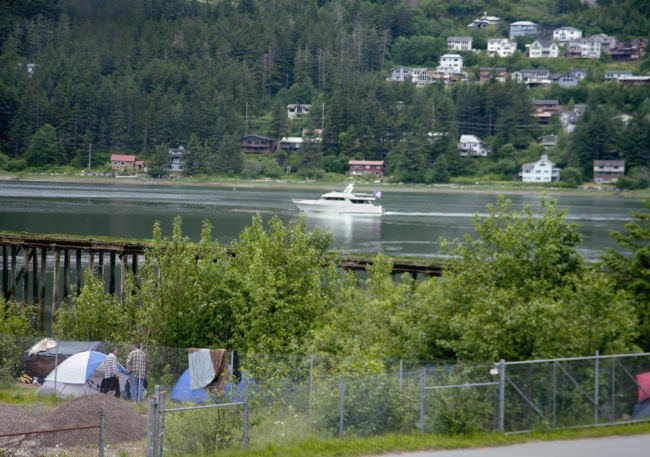
Closest to the road are a collection of tarps rigged up to keep a cooking and sleeping area out of the rain.

“When we got here it was pretty rough,” said resident Tapia Church, 45. “Then a couple of us got together and were like, ‘Hey man, we can’t have this stuff here. Pick up your garbage and throw it in the trash.’ Simple stuff.”
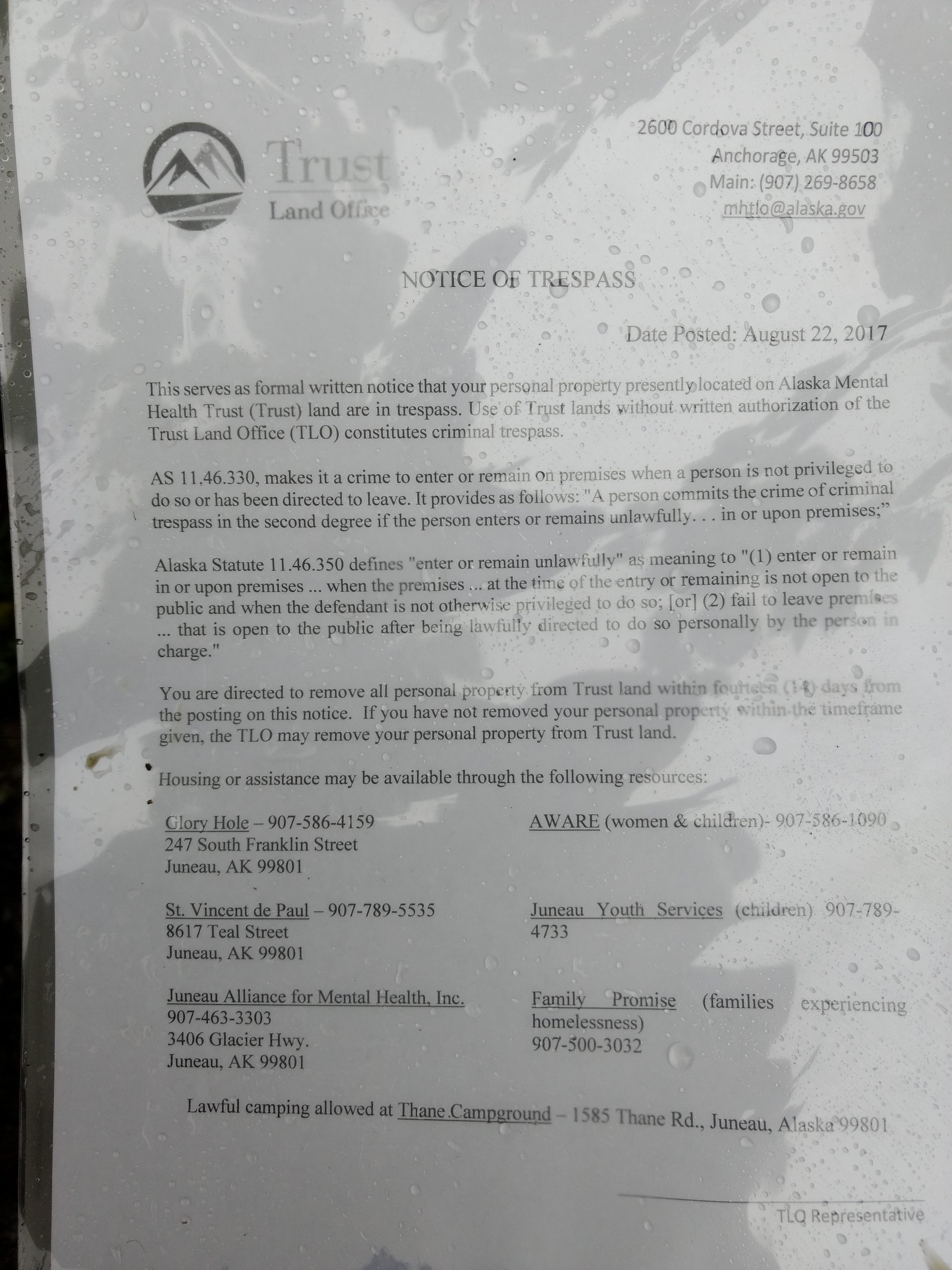
About a dozen residents in a homeless camp on the former sub-port property were served with this notice of trespass on Tuesday. (Photo by Jacob Resneck/KTOO)

He’s been here for about two months but admits the site isn’t perfect. He said further back in the bushes, there’s hard drinking, hard drugs and occasional bouts of violence.

“A lot of it just had to do with drinking, really,” he said. “Drinking and fighting that was about it.”

Juneau is grappling with a homeless crisis. It’s complex. Housing costs, mental illness and substance abuse, compound it.

This week the city applied to the Alaska Mental Health Trust Authority to fund a coordinator for homeless services. The request is for about $100,000 annually for three years.

The trust authority’s chief operating officer, Steve Williams, stood by as police officers talked to camp residents. He said the agency’s board will consider the city’s grant request.

“I haven’t looked at the grant application,” Williams said, “but I’m sure it’s to try and help pull together the resources here in the community to try and do a concerted effort on outreach and, you know, developing solution for homelessness.”

The city is considering extending operation of the seasonal Thane campground. It usually shuts down in October but may stay open longer this year.

The campground hasn’t been popular with Juneau’s homeless.

“There’s two reasons: number one it’s quite a walk from town and number two it’s not continuously open,” said camper Nick Beers, 30.

Where these people will go isn’t clear. Many don’t know themselves. But residents said they’re resigned to the fact that they’ll have to move on.

“We just wanted something, a nice little spot, a little hunker down for four or five of us,” Church said, “A little community, that’s what we did here.”

Shelter beds are scarce and social agencies say resources are thinly stretched.

The Juneau Housing First apartments are slated to open next month – that will offer shelter to 32 of the most vulnerable homeless residents. But a survey this year counted at least 215 homeless people in the community.
Alaska Mental Health Trust Authority moves to clear Juneau homeless camp

Campers gather near a small group of tents about noon Thursday, June 8, 2017, near the 300 block of Egan Drive in Juneau. (Photo by Tripp J Crouse/KTOO)

Residents in a homeless encampment in Juneau are facing a new deadline to vacate a downtown property.

The Alaska Mental Health Trust Authority has notified the city that it wants its property cleared of trespassers in two weeks.

About a dozen campsites sprang up this summer at the former sub-port property off Egan Drive. The Trust Authority says property needs to be cleared of trespassers by September 5.

“We have a growing number of complaints about impacts of the homeless camp and it’s not just on the mental health trust property right there, it has expanded,” Wyn Menefee, deputy director of the Trust Land Office, said Friday. “But we also are trying to help these people transition to a different location.”

The Trust Land Office manages land owned by the Alaska Mental Health Trust.

The Trust Authority has reached out to the city and social care agencies about relocating people in advance of the deadline.

“We have been working up to this transition,” Menefee said. “But we’re trying to do it in a way that it gives the people that are residing at the homeless camp the ability to move in a dignified fashion over to something else.”

The city estimates about a dozen people have been living on the 2-acre parcel. The Trust Authority is in talks to sell an adjacent parcel and wants the area cleaned up.

“We recognize that folks are camped out there and our goal would be to connect them in with other services available in the community,” Deputy City Manager Mila Cosgrove said Friday.

Cosgrove added the city is considering extending operation of the city-run campground south of downtown that normally closes in mid-October due to avalanche danger.

“We still have space available in the Thane Campground,” she said. “In terms of a like-environment, that also exists.”

Social care agencies have said the lack of transport to the Thane Campground, which lies 2-miles down an unlit road, makes it unsuitable for homeless people suffering from disabilities.

The Glory Hole, Juneau
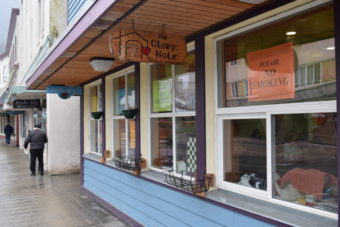
The Glory Hole, Juneau’s emergency homeless shelter and soup kitchen. An unseasonably cool summer has caused the shelter to operate over capacity this summer. (Photo by Casey Kelly/KTOO)

Shelter space is also at a premium.

The Glory Hole, a downtown shelter and soup kitchen, has been running above capacity. The shelter counted 46 people overnight Thursday in the 40-bed facility.

“It’s not unusual in the winter for us to sleep, you know, over capacity,” Executive Director Mariya Lovishchuk said. “Definitely it’s very unusual this time of year. It definitely creates a pretty stressful atmosphere.”

Clearing the camp will likely increase pressure on the shelter.

“We would certainly not turn anybody due to lack of space, but it will be pretty hard to house more people,” Lovishchuk said.

Earlier this year the Juneau Assembly passed an ordinance prohibiting camping on private property in the downtown core.

After some homeless people moved onto public property including Marine Park, Juneau police officers began enforcing park hours.

There may be some relief to Juneau’s homelessness crisis.

The 32-bed Housing First apartment complex, which is designed to house Juneau’s most vulnerable homeless residents, is due to open next month.

At Least 3 Killed, 12 Injured In High-Rise Fire In Honolulu

At least three people are dead and 12 injured after a large fire broke out in a high-rise condominium in Hawaii on Friday.

More than 100 firefighters responded to the five-alarm fire in the 36-story Marco Polo apartment complex in Honolulu.

A dozen people were treated for smoke inhalation and at least two were hospitalized, Hawaii Public Radio’s Bill Dorman reports.

The fire started around 2:15 p.m. on the building’s 26th floor, according to Hawaii’s KHON2, and spread to at least two floors above it before fire officials said it had been contained a little more than four hours later. Rescuers found the three bodies on the 26th floor.

“This lady’s voice, I’m not kidding you. I’m trembling. She’s like ‘help me, help me,’ and I couldn’t see her because the smoke was so dark,” resident Teresa Sommerville told the station.

Video on social media shows thick black smoke pouring from the middle of the building.

During a news conference, Fire Chief Manuel Neves confirmed that the building did not have a sprinkler system. The building was built in 1971, according to The Associated Press, before sprinklers were required in construction. The building has more than 500 apartment units.

“Without a doubt, if there were sprinklers in this apartment, the fire would be contained to the unit of origin,” the fire chief told reporters. He said the fire department only evacuated people in units near the fire.

About 50 residents later gathered at a nearby shelter, the AP reports.

The cause of the fire is under investigation.

The massive fire in London’s Grenfell Tower, which killed at least 79 people last month, highlighted the danger of fires in high-rise apartment buildings. Authorities in the U.K. later evacuated hundreds of apartments over fears of building material flammability.

Copyright 2017 NPR. To see more, visit http://www.npr.org/.

Healthy housing market shows Ketchikan’s resilience

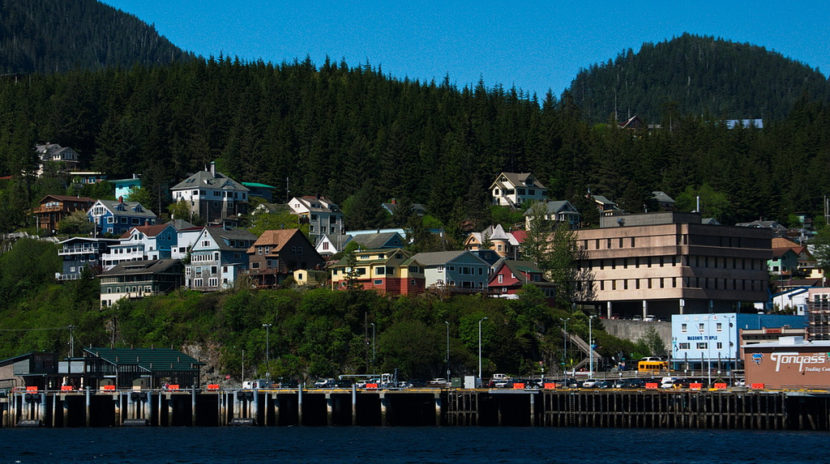
The Ketchikan skyline. Creative Commons Photo by Dave Bezaire)
The Ketchikan skyline. (Creative Commons photo by Dave Bezaire)

Like many industries in the city, the story of Ketchikan’s housing market is closely tied to the shutdown of Ketchikan Pulp Company in 1997.

Gateway City Realty broker Bill Bolling said the local market is quite healthy now. He said the robust local economy is in part due to the closing of the mill.

“If there was any silver lining in the loss of our mill, it was the diversification of our economy,” he said.

Ketchikan’s economy suffered in the years following the shuttering of the mill. The Great Recession affected Ketchikan just like it did the rest of the country. But the city bounced back, and so did the housing market.

“And then somewhere around 2012, 2013, things seemed to change for us, so far as activity and the number of sales, and prices started rising again,” Bolling said.

Bolling said real estate companies have seen Ketchikan become more of a seller’s market in recent years.

“There’s not a lot of product out there for people to look at or buy,” he said. “And so, it’s a macroeconomic love affair. There’s a lot of demand and not as much supply.”

Mary Wanzer, a broker for Coastal Real Estate Group, agreed.

“We’re seeing homes going on the market and selling within two or three days and getting multiple offers,” she said.

The average price of a single-family home in Ketchikan in 2016 was about $320,000. This is more than the national average price, which in June 2016 sat just above $290,000. Here’s Wanzer again.

“It stayed the same for quite a while, but I’d say definitely in the last three years, the average home price has increased,” she said. “Probably five to 10 percent in the last year would be my guess, without actually looking at all the data.”

She said companies are seeing more people coming to Ketchikan and building new houses.

“What we are seeing are [sic] more new construction,” Wanzer said. “So we’re seeing build-outs in areas like Emerald Forest, Ravenwood, White Rock. So we’re getting new construction, so more of a housing development that we haven’t seen in the past.”

Bolling attributes the market’s strength to the people of Ketchikan.

“Ketchikan has really been, kinda, this little engine that could,” he said. “And people here are tough. I mean, I think I’ve seen more businesses opened up since the mill shut down in Ketchikan than I remember ever opening up before. So, I think people have a good spirit here, and they have a can-do attitude, and they’re willing to put their money where their mouth is.”

Wanzer added that people of all kinds come to live in Ketchikan – people with the Coast Guard, the Forest Service and the hospital, especially. And they all need a place to live.

Juneau’s Housing First opening delayed until September

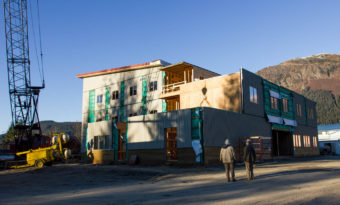
The Housing First Project under construction on November 17, 2016. (Photo by David Purdy/KTOO)
The Housing First Project under construction on Nov. 17, 2016. (Photo by David Purdy/KTOO)

The opening date for the Juneau’s Housing First project has been pushed back again.

Originally slated to open in early summer, the complex of 32 efficiency apartments and a downstairs clinic is now scheduled to open in mid-September. Its goal is to provide 32 homeless people with permanent housing with access to on-site medical care.

Housing First’s project manager Mariya Lovishchuk explained the delay was over finishing the Lemon Creek facility’s parking lot.

“It’s a paving issue,” she said Friday. “We just have to have enough time to finish paving the parking lot. That’s the last remaining item – is the parking lot paving.”

The $8.2 million project has received funding from a number of sources including about $2.7 million from the City and Borough of Juneau. Lovishchuk said national studies show that providing subsidized housing is worth it to communities in the long run.

“Projects like this do end up saving money in emergency service utilization,” Lovishchuk said, “and they also really improve the quality of life in the community for both the tenants of the facilities as well as for the general public.”

The housing project also has a new name: Alder Manor. A total of 32 homeless residents are being selected for accommodation based on a vulnerability survey – those chronically homeless and most likely to literally die in the streets.

The first eight residents are expected to move in on Sept. 15.

Proposed high-rise complex in downtown Juneau irks community members

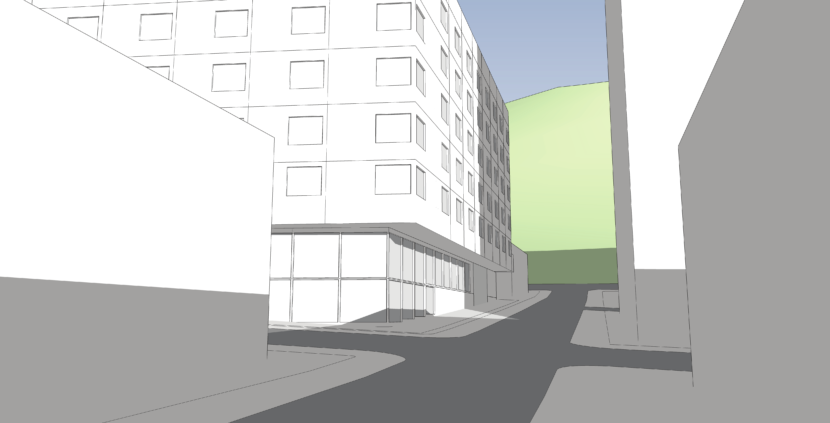
Eagle Rock Ventures LLC of Seattle has proposed a six-story apartment complex to be built at the city-owned North Franklin Street parking lot. (Rendering courtesy Eagle Rock Ventures LLC)

The design and density of a high-rise apartment building proposed in downtown Juneau drew a lot of public concern at Monday’s Juneau Assembly meeting.

The Juneau Assembly voted in November to authorize the sale of the the city’s North Franklin Street parking lot to Seattle-based Eagle Rock Ventures LLC for $530,000. The developer had proposed turning the 23 parking places into an affordable housing complex.

But a pre-application submitted this spring has alarmed some community members. Andrew Heist was one who criticized the sketches.

“The most recent design calls for 130 single-occupant residencies, with shared kitchens on each floor,” Heist said. “Basically, a high-density boarding house right in the core downtown business district.”

He called on the city manager not to close the sale, which the original agreement envisioned would be completed by the end of this month.

City Manager Rorie Watt told the Assembly that the sketch is only a rough concept and not a formal application.

“The developer has no interest in executing the sale,” Watt said. “But what they are interested in is extending that date for a period of nine months and the purchase and sale agreement provides for that extension. And I think that’s in everybody’s best interest.”

The original purchase had been controversial over the development’s lack of parking. The developers would pay a fee in lieu of parking, but critics said it would be inadequate to offset its impacts to the neighborhood.

Site notifications
Update notification options
Subscribe to notifications