Housing

Juneau’s Housing First prepares to open its doors

Juneau’s Housing First project is opening its doors this week to the first eight residents. The $8.3 million Lemon Creek complex will soon  house 32 of the community’s most vulnerable residents.

The 32 apartments in the Housing First building are basic, almost institutional with low, single beds. But then there are the little touches that show how much community support has gone into the project.

The Gold Street Quilters donated 32 handmade quilts with the names of each resident embroidered inside.
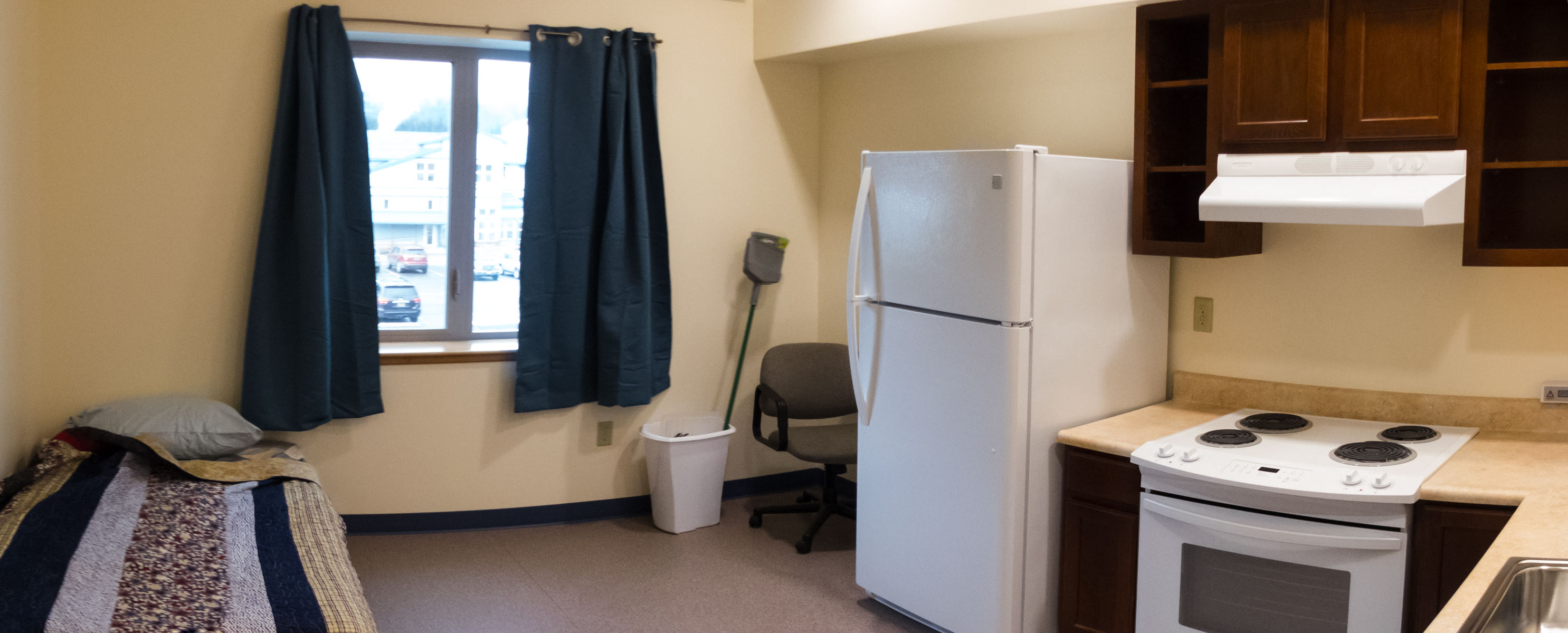
An efficiency apartment with a small bed with a quilt on it, a window,, a full sized refrigerator, and a small kitchenette area
Each apartment in the Juneau Housing First building has its own bathroom and kitchenette. (Photo by David Purdy/KTOO)

“Every unit gets a quilt and every quilt says who it’s for and their name and they’re all pretty awesome,” Mariya Lovishchuk said as she led a tour. She runs the Glory Hole downtown shelter and soup kitchen and has been project’s manager.

Similar facilities already exist in Anchorage and Fairbanks. It starts as no-strings housing for homeless people.

“The idea is just having housing, nice housing, in itself is a stabilizing force in people’s lives,” Lovishchuk said. “And what we know from other projects is that even though people don’t have to participate in services, they participate a lot more than when they have to do it as a condition of something.”
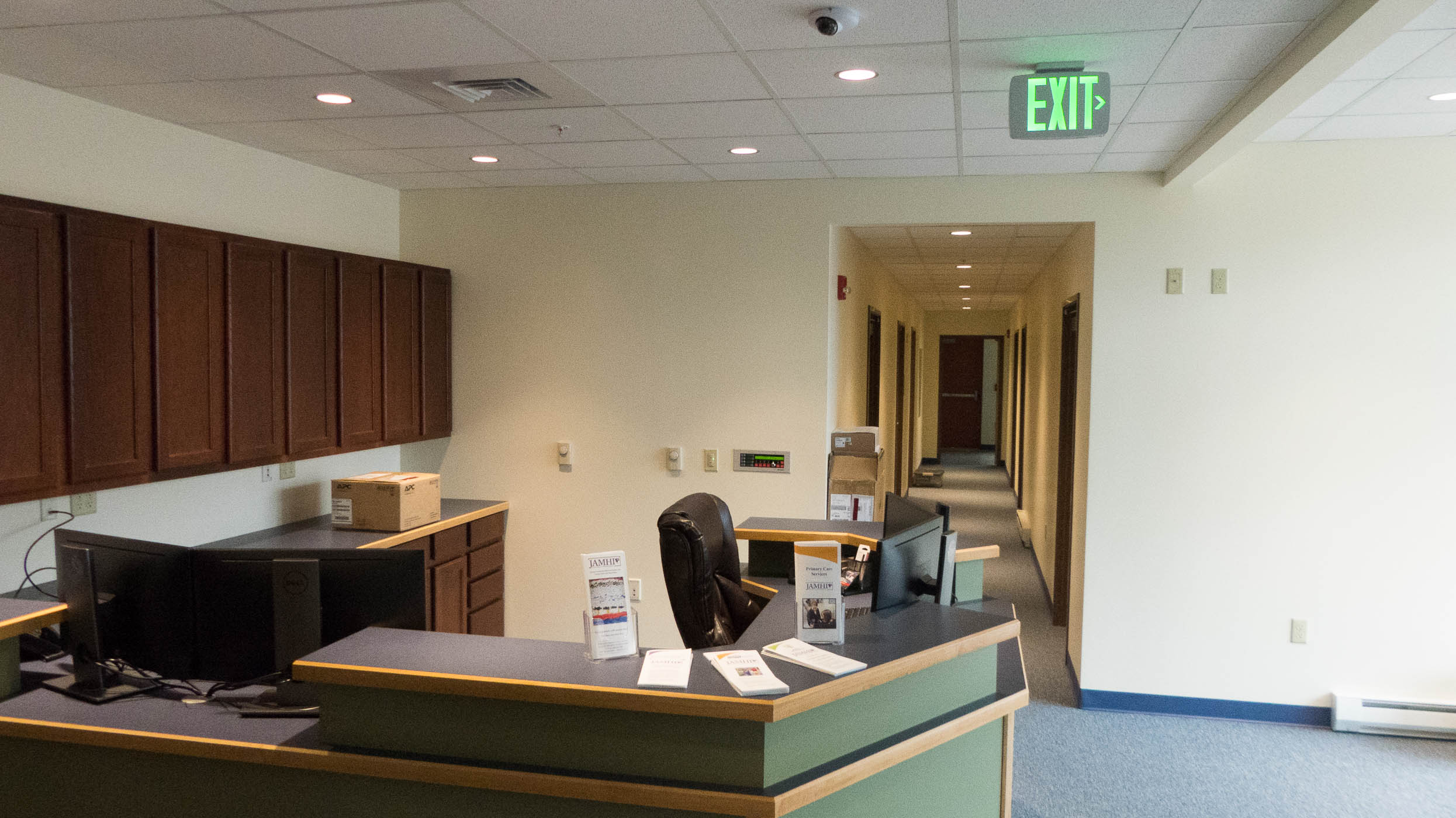
A reception desk with a hallway behind it with doors opening off it
The reception desk of the community clinic (Photo by David Purdy/KTOO)

Essential services from medical care to counseling are available. There’s also a clinic downstairs to be completed. A physician’s assistant will be on site for urgent care. Mental health services will also be offered.

The Juneau Assembly has provided $2.7 million in public money to help finance the project. Other donors followed. Businesses provided in-kind services and materials.

Tenants pay rent on a sliding scale.

“You pay 30 percent of your income to rent and it gets reassessed every month by the landlord,” she explained. “So if your income is zero then your rent is zero. But if your income is $1,100 a month then you pay 30 percent of that.”

And, the thinking goes, as people become settled, productivity increases.
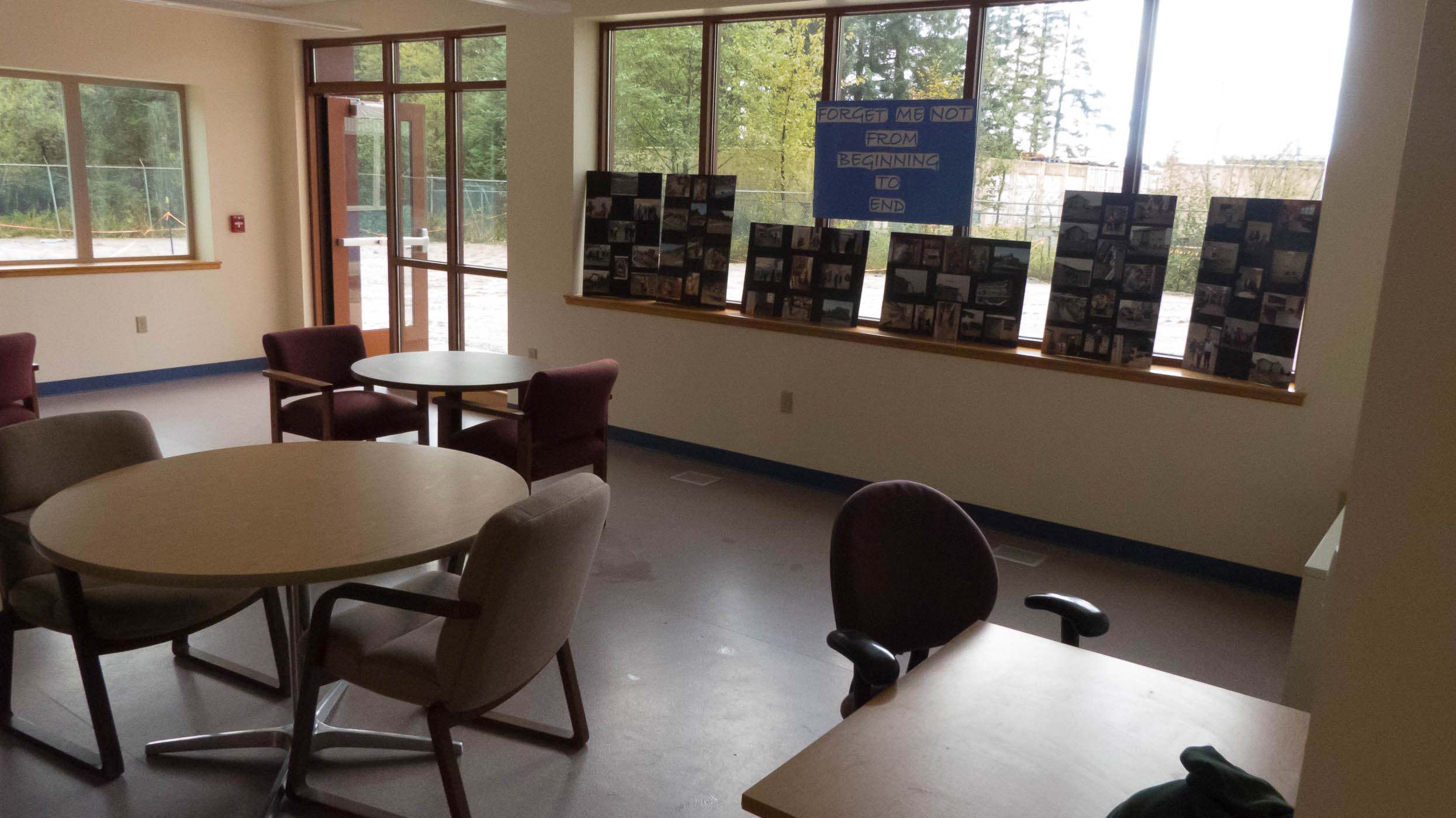
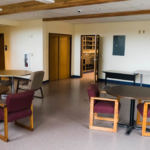
Tables and chairs in the common room with windows looking out into the parking lot
Common area in the Juneau Housing First building (Photo by David Purdy/KTOO)

“And actually in the idea is that in this project is that people come in with very little income initially but once they stabilize they do bring more income in, their income increases,” she said.

So will it work?

“We want to do an evaluation of the program and demonstrate of benefits of Housing First in Juneau,” said Jeanette Lacey, Bartlett Regional Hospital’s lead social worker and a Housing First board member. Lacey will also be working with researchers from University of Alaska Fairbanks which will be using this as a case study.

“The Housing First program in Juneau has obviously learned from the lessons of other programs throughout the nation and so what we’ve tried to do with our program is to take what’s been working and try to redesign some things that maybe didn’t go as well,” Lacey said. “So we want to just evaluate the process that we have here and also have something to give back to the community to demonstrate what we’re seeing as outcomes of the project.”

Dacia Davis is the newly hired program director who will oversee the complex’s eight staffers. She brings with her 14 years of experience in social work.

“I see it as a learning experience and we’re going to grow a lot this year,” Davis said. “And just every day kind of adjust and be flexible and meet the needs of the program and the tenants.”

The first 10 residents are set to move in in the next week. Organizers hope it’ll be quiet affair and under the radar as people settle in. Batches of 10 residents will move in every 10-14 days until all 32 apartments are filled.
HUD sends money to Alaska communities, including ‘Middle Spenard’

The U.S. Department of Housing and Urban Development has announced $7 million in grants to 14 Alaska tribal organizations, much of it for housing.

Image courtesy from HUD.gov

Many of the grants will fund village construction, from Chignik Lagoon to Chistochina.

HUD also selected one Anchorage grantee. Cook Inlet Tribal Council and Cook Inlet Housing Authority are due to receive $600,000 to rehabilitate a commercial building in Midtown.

The plan is to add 20 apartments to the second floor of 3400 Spenard Road, Housing Authority spokeswoman Sezy Gerow-Hanson said. But she said the HUD grant is just the first piece of a complicated funding package.

“The building is old and needs new mechanical systems,” Gerow-Hanson said. “There’s a lot of work that needs to be done and we’re not sure whether that’s going to pencil out to be the smartest use of the money.”

Gerow-Hanson said the demand for affordable housing in the area is high, and she said the project would help revitalize a section of the road her organization calls “Middle Spenard,” between Benson and Minnesota boulevards.

“There are a lot of mom-and-pop businesses along the roadway,” Gerow-Hanson said. “We feel if you start to add that housing component, it adds to the neighborhood, it adds to the vibrancy.”

All 14 Alaska grants were awarded competitively.

The $7 million total is a slight dip from prior years and comes on top of the roughly $95 million in Indian Housing Block Grants that’s distributed annually in Alaska.

Juneau’s Housing First ribbon cutting postponed

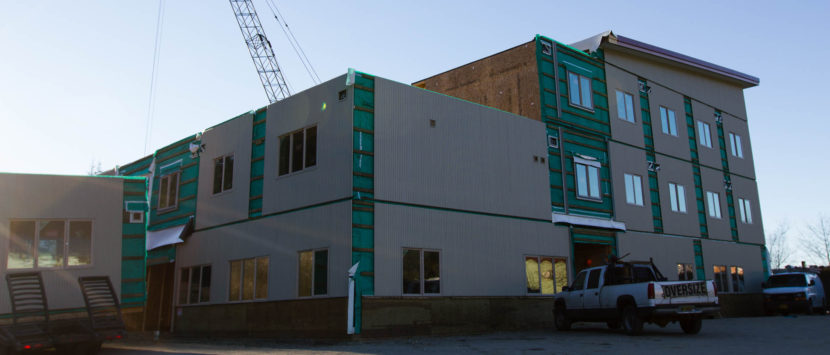
The Housing First Project under construction on November 17, 2016. (Photo by David Purdy/KTOO)

Juneau’s Housing First grand opening – slated for this week – has been delayed again.

The housing complex designed for Juneau’s most vulnerable residents was originally scheduled to open in May.

Project officials didn’t immediately offer an explanation for the delay, though it was confirmed that this week’s ribbon cutting had been pushed back for at least a week.

Building code officials are continuing on-site inspections at the Lemon Creek complex, according to City Housing Officer Scott Ciambor.

“The Housing First collaborative is still working on final details as far as we know which includes applying and getting the certificate-of-occupancy through the Community Development Department,” Ciambor said Monday. “I’m pretty sure they’re working on that as we speak.”

The City and Borough of Juneau has contributed about $2.7 million toward the 32-unit apartment complex. It will also include a community clinic operated by Juneau Alliance for Mental Health Inc. or JAMHI.

It’s at least the third time the opening has been postponed for the $8.2 million project.

Editor’s note: Scott Ciambor’s spouse is a CoastAlaska employee. 

Ketchikan council OKs funds for a fall-spring ‘warming center’

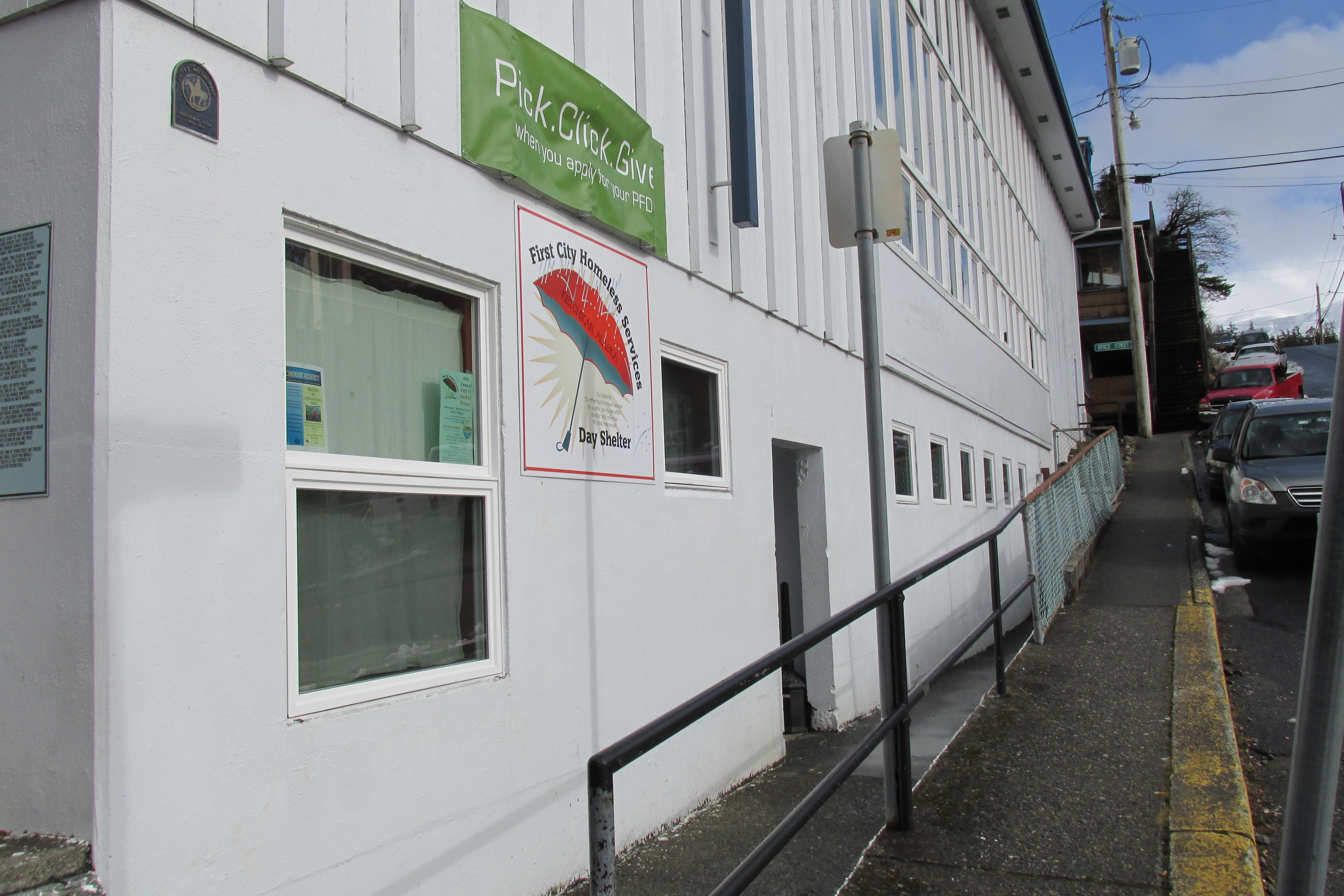
The entrance to the First City Homeless Services Day Shelter is seen this spring. The organization is working with the Salvation Army to open a separate night shelter. (File photo by KRBD)

The Ketchikan City Council agreed Thursday to fund a seasonal warming center for homeless residents at a cost of $80,000.

The program is a partnership between First City Homeless Services and the Salvation Army.

The organizations worked together last winter, too, to provide a warming center at the Salvation Army building on Stedman Street.

But, that facility doesn’t meet code requirements for people to sleep there, and Salvation Army Lt. Sam Fowler told the council that his group doesn’t have the funding to pay for it a second year.

The Rev. Evelyn Erbele of First City Homeless Services told the council that a safe place where people can sleep off inebriation following alcohol or drug use will save the city money in the long run. It will cut back on unnecessary work by police and emergency services personnel.

There was some concern from council members about the city fully funding the program.

Agnes Moran, who is working with the group on setting up the warming center, said they are applying for funding through the federal Department of Housing and Urban Development, and the Alaska Mental Health Trust; and they plan to apply for funding through PeaceHealth, which runs the local hospital.

Moran said because of when the plan came together, it didn’t work out to get applications in for this year. They hope to open a warming center at the start of October, and run it through the end of March.

Most of the funding will go toward salaries. The rest is for rent and supplies.

Erbele said they are negotiating to rent a downtown location.

The motion to fully fund the warming center this year passed unanimously.

Also Thursday, the council approved two loan applications to the state for new water and wastewater pipes on Schoenbar Road.

The council also agreed to meet in special session Sept. 14 to vote on a plan to dredge sediment from a washout on Carlanna Creek. The sediment is causing navigational issues in the Tongass Narrows.

Editor’s note: KTOO’s building sits on land leased from the Alaska Mental Health Trust Authority. KTOO has also applied for and received occasional grants for special reporting projects from the authority.

Juneau police clear downtown homeless camp

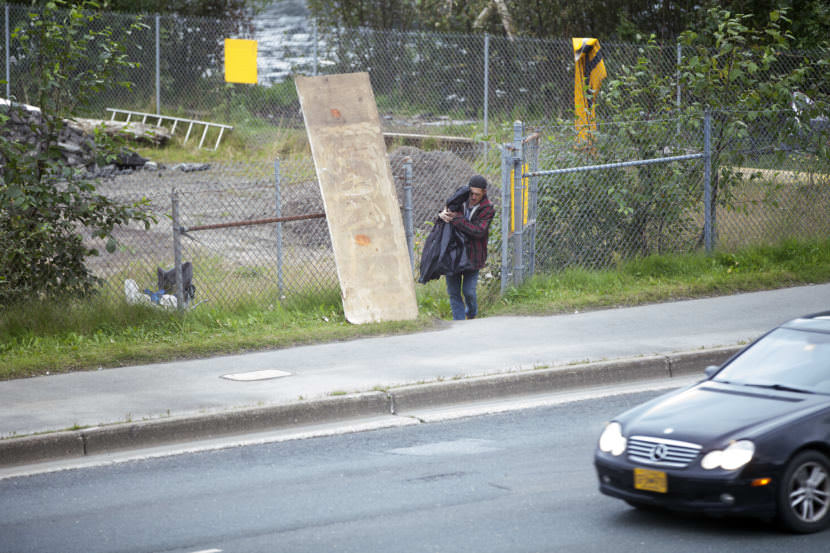
A man hauls belongings from a homeless encampment off Egan Drive on Wednesday in Juneau. The property is owned by the Alaska Mental Health Trust. (Photo by Rashah McChesney/Alaska’s Energy Desk)

Authorities cleared a downtown homeless encampment without incident this week. This comes as the City and Borough of Juneau looks to develop its strategy for tackling its homeless crisis.

Tents began sprouting up this summer on the former subport property off Egan Drive that’s owned by the Alaska Mental Health Trust. The Trust Land Office posted a trespassing notice two weeks ago and Tuesday was the deadline to vacate.

Police reported clearing the remaining people from the homeless encampment without incident.

“I think it went very smoothly,” said Wyn Menefee, acting executive director of the Trust Land Office. “We were very pleased to see that we had cooperation from all the campers that had been on the property. Most of them had already moved off and as of about 10 a.m. we had just two remaining camp groups that were in the process of packing and by noon they were off the property.”

His office last month closed on the sale of an adjacent parcel for $1.3 million to Juneau Hydropower. The energy startup has plans for a district heating and cooling plant.

Social care agencies were also on the ground during Tuesday’s sweep by police. The nonprofit Polaris House donated a van and driver to help people move their belongings, A case worker from the Juneau Alliance for Mental Health, Inc. also assisted.

This comes as a city task force is working to craft a strategy to tackle the community’s homelessness crisis – Juneau’s homeless population is the third largest in the state.

Some ideas are short-term: a sanctioned winter campground and a warming station for when temperatures drop below freezing.

Polaris House’s Executive Director Bruce Van Dusen said campgrounds, whether sanctioned or not, are not a long-term solution.

“Providing camping space for persons that are homeless is not a way to end homelessness,” Van Dusen said. “If we continue to provide supports and services that allow people to stay homeless then we’re going to continue to have a homeless problem.”

Nonetheless, City Housing Officer Scott Ciambor said several city-owned sites are still under consideration by the city’s task force.

“They didn’t necessarily settle on the idea that they liked the idea of a winter campground anyway but they just wanted to talk about it some more,” Ciambor said.

Additionally, the task force is looking at similar models to Juneau Housing First, a 32-unit apartment complex, slated to open next week. That will house some of the community’s most vulnerable homeless residents.

Initiatives like these, ones that help provide a roof over one’s head, are finding favor on the task force, he said.

“What they were more enthusiastic about was getting more details on the Juneau Coalition on Housing and Homelessness proposals,” Ciambor said, “so I’m getting some additional details on each of those.”

Those proposals include rental assistance for people unable to keep up with payments. Another model is scattered site housing which would be city-subsidized rentals scattered throughout the community. All of these proposals would cost money. The scattered site housing program could cost about $12,000 per unit, per year.

The city has also applied to the board of the Alaska Mental Health Trust Authority to fund a full-time coordinator for homeless services for the next three years. That request is being considered at the authority’s board meeting this week.

As for the displaced, a few have ended up at the Glory Hole downtown shelter and soup kitchen, though none wanted to comment.

Editor’s note: Scott Ciambor’s spouse is a CoastAlaska employee.

KTOO’s building sits on land leased from the Alaska Mental Health Trust Authority. KTOO has also applied for and received occasional grants for special reporting projects from the authority.

Spokane’s ‘tough love’: City uses rocks to deter homeless camping

The city of Spokane is spending $150,000 to place boulders under an overpass in hopes of detering the homeless population from camping there. (Photo by Emily Schwing/Northwest News Network)

As Seattle and Portland struggle with how to accommodate homeless residents, Spokane is catching flack for it’s “tough-love” approach to homeless camping.

Under an overpass for Interstate 90 in Spokane, four lanes of traffic pass by as a giant piece of machinery moves truckloads of basalt rock. The boulders are meant to deter camping by Spokane’s homeless population.

The city is hoping that instead of camping under the overpass, they will instead take advantage of city resources, like homeless shelters.

But not everyone agrees that’s likely.

“No they’re not,” said Jesse Westby, who works for the landscaping company. “They’re going to continue doing what they are doing.”

Westby used to live under the very same overpass.

“Our opinion is it’s inhumane,” he said. “But it’s our job. It’s what we do.”

The crew has moved at least 35 truckloads of football-sized boulders in the last week. The city says it has spent $120,000 this summer to clean up after its transient population.

The boulder project has a $150,000 price tag.

Site notifications
Update notification options
Subscribe to notifications