Housing

‘Grenfell Changes Everything’: Hundreds Of Homes Evacuated Over Safety Fears

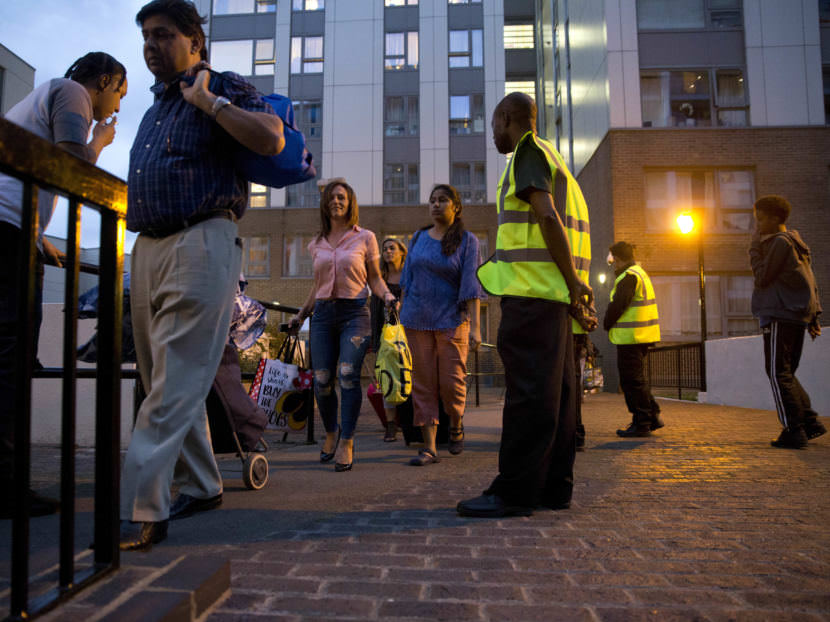
Officials evacuate residents of the Chalcots Estate, in London's Camden borough on Friday evening. Camden's local council decided to evacuate the hundreds of households due to safety concerns following the devastating fire that killed 79 people in Grenfell Tower.
Officials evacuate residents of the Chalcots Estate, in London’s Camden borough on Friday evening. Camden’s local council decided to evacuate the hundreds of households due to safety concerns following the devastating fire that killed 79 people in Grenfell Tower. Alastair Grant/AP

Authorities in London evacuated roughly 650 apartments in a high-rise complex overnight, citing fears that the complex bore many of the safety issues that Grenfell Tower did. Councilmembers for the London borough of Camden say it was the stark memory of the Grenfell blaze, which killed at least 79 people earlier this month, that spurred them to act.

“I know it’s difficult, but Grenfell changes everything,” Camden Council chief Georgia Gould told reporters outside a complex of buildings known as Chalcots Estate on Friday. “I just don’t believe we can take any risk with our residents’ safety, and I have to put them first.”

Tests earlier this week on the Chalcots Estate, a cluster of high-rise apartment buildings, had revealed four of the estate’s towers used exterior cladding and insulation similar to the materials used in Grenfell.

“Whilst we are clear that our cladding design and insulation significantly differs to that at Grenfell Tower, the external cladding panels did not satisfy our independent laboratory testing or the high standards we set for contractors,” Gould said in a statement Thursday, adding that the council had decided to “immediately begin preparing to remove these external cladding panels.”

Added to the cladding, the London Fire Brigade “also identified concerns relating to services that have been run through compartment walls leading to possible breaches in the buildings ability to stop fire spreading,” Dan Daly, assistant commissioner for fire safety, said in a statement after the evacuation.

“There were also concerns that some fire doors in the building are not working as they should,” Daly continued, “meaning that in the event of a fire it could spread to other parts of the building.”

“I said to fire services, ‘Is there anything I can do to make this block safe tonight?’ I offered to pay for fire services to be stationed outside those blocks just so we could have a couple of days to get the works done,” Gould told BBC Radio 4, according to The Guardian. “But the message was [that there was] nothing to do to make blocks safe that night.”

So, as NPR’s Frank Langfitt reports, “The council booked some hotel rooms and encouraged people to stay with family. About 100 air mattresses were provided on the floor of a local leisure center.”

Some of the residents saw the move as a “complete overreaction,” however. That’s the assessment of resident Edward Strange, who, according to The Associated Press, told British broadcaster Sky News they should have been given a choice.

“If we wanted to leave, we should have the choice to leave. But being told that we have to leave is just ridiculous. It’s our home.”

Frank notes that officials estimate it will take three to four weeks to make the buildings safe.

“Having to evacuate people from their homes is always going to be distressing for those residents, especially when we have to do it at such short notice,” Gould said in a statement after the evacuation. “I know some residents are angry and upset, but I want to be very clear that Camden Council acted to protect them.”

Copyright 2017 NPR. To see more, visit http://www.npr.org/.

Bed bugs getting the heat treatment at downtown building

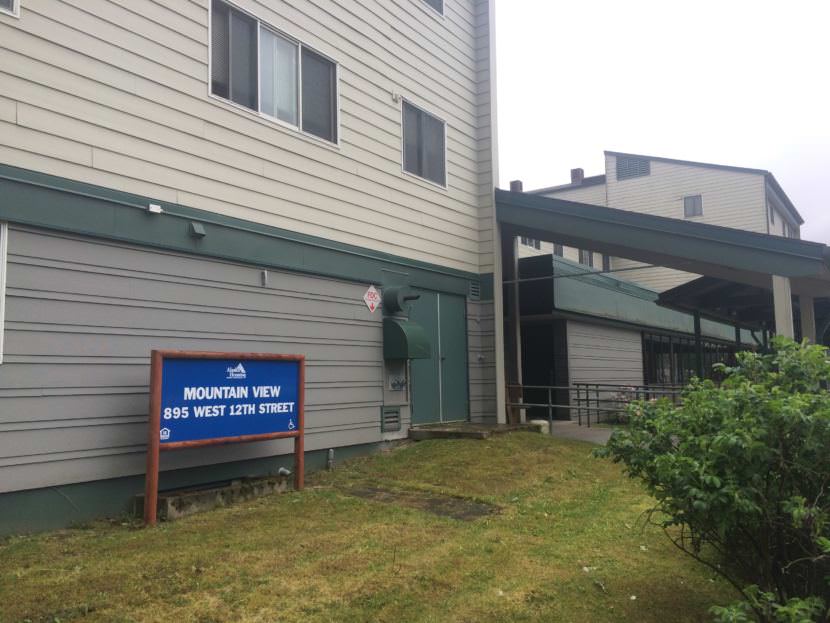
Mountain View Apartments on West 12th Street in downtown Juneau.
Mountain View Apartments on West 12th Street in downtown Juneau. (Photo by Matt Miller/KTOO)

Over a third of the units in a downtown Juneau apartment building are being treated for bed bugs.

Managers of the Mountain View Apartments on West 12th Street noticed the pests in some units earlier this month.

“In 2008, we had a similar kind of outbreak,” said Corry Isabell, the Juneau Family Investment Center manager with the Alaska Housing Finance Corporation, which operates the apartment building. “It doesn’t happen overnight. It’s a build up.”

Canvas strap of old box spring covering that is housing adults, skin castings, feces, and eggs.
This example image shows a canvas strap of old box spring covering that is housing adults, skin castings, feces and eggs. (Photo courtesy of Dr. Louis Sorkin)

Isabell said there’s a good amount of changeover in the clientele at Mountain View.

“We probably turn 20 units a year,” she said. “So, a third new clients every year, and keeping everybody educated, aware of the situation, acting aggressively on what they bring into their homes is always a challenge.”

Isabell said they hired a Seattle pest control company and their K-9 unit sniffed out the common areas and all 270 residential units in their Juneau facilities.

Isabell said bed bugs were found in 25 of the 62 units for fixed- or low-income clients at Mountain View Apartments.

The pests were also found in five other units in other of the corporation’s buildings.

“They’re all over,” said Mariah Jerman, an environmental program specialist focusing on pesticides in the Department of Environmental Conservation’s Division of Environmental Health. “We’re a very transient state. They travel all over the place.”

Jerman said bed bugs are non-discriminatory.

“They are called the hitchhiker bug because they will latch onto anybody if the opportunity is right, and they can follow us anywhere,” she said. “It doesn’t have anything to do with economic class, cleanliness. Although, it can be harder to eradicate if the environment is very cluttered.”

This example image depicts a view from above of an adult, Cimex lectularius bed bug. Adult bed bugs are on average 5 mm long and have an oval-shaped and flattened body. (Photo courtesy of CDC/ CDC-DPDx; Blaine Mathison)

Bed bugs need blood — usually human blood — to grow and advance through each of the half-dozen stages in their life cycle, culminating with the final egg-laying stage.

At that point, they’re about the size of an apple seed.

Jerman said bed bugs can be found hitchhiking on clothing and furniture.

“Often times, if they come from an infested location, they might end up say on the street with a free sign,” Jerman said. “That free sign, people like — ‘oh, hey, free couch’ — they’ll take it home and there will be eggs inside of it. Then, they just spread that way. That’s how apartment buildings will often get them, used furnishings that have them inside.”

Furniture can be vacuumed, heat treated or wiped down with a solution, but Jerman advises against blowing or splashing off the eggs.

Clothes can be treated by placing into a dryer at high heat for 40 minutes.

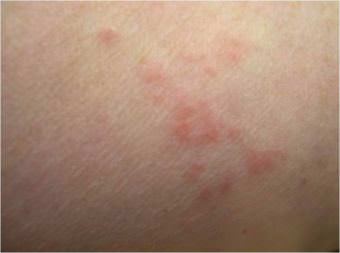
A person's arm with bed bug bites
A person’s arm with bed bug bites (Photo courtesy of Harold Harlan, AFPMB)

Bed bugs can leave itchy bite marks on human skin, but that’s about it. Unlike mosquitos, they are not known to transmit any diseases. Still, Jerman warns against excessively scratching any bites to avoid infection.

In addition to cautions about bringing home second-hand furniture, Isabell said they’re also encouraging Mountain View Apartments’ residents to police themselves and question guests who may be sneaking into the building.

Isabell said they’re starting the month-long process of heat-treating units at the building. False walls with plastic sheeting will be used to seal off hallway sections. Portable heaters will increase the temperature to 140 degrees to kill the bugs and their eggs.

Before heat treatments, maintenance staff will seal off any cracks or openings in rooms to prevent the bugs’ escape.

“Some people are not going to be prepared when they are supposed to be treated,” Isabell said. “Other people are going to be prepared early. And so the schedule will flex. The goal will be to have it all done by the end of July.”

Residents cannot remain in their rooms during the nine-hour heat treatment. They can wait in the building’s common room that is free from bed bugs, but which has been recently closed to the public to prevent the spread of any potential infestation.

You can find more information about bed bugs at the Alaska Department of Environmental Conservation and the U.S. Environmental Protection Agency.

Sitka considers code changes in landslide zones

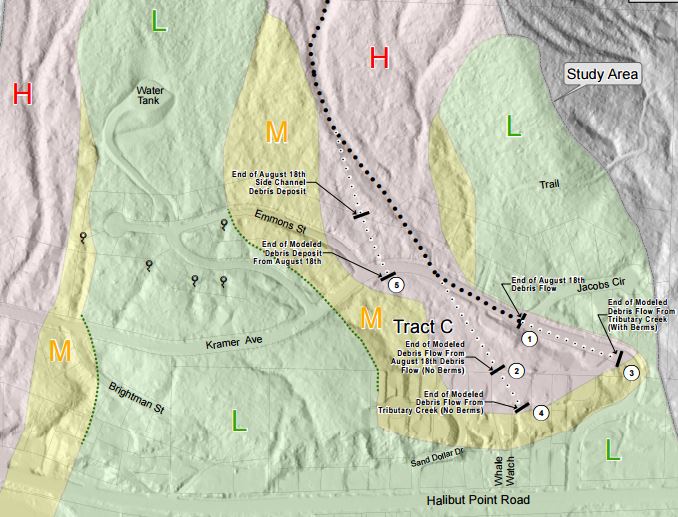
If the critical areas ordinance passes on June 27th, it would change development rules for South Kramer Avenue. An outside firm mapped the area for landslide risk in the aftermath of the August 18, 2015 landslides. (Map from Shannon & Wilson South Kramer report)

The state is currently mapping the potential risk for landslides in Sitka.

This time next year, the Sitka Assembly will be presented with a community-wide map.

Whether they adopt the maps or not, city staff wanted to be prepared for how the information could affect property development.

They presented their critical areas ordinance (Ord 2017-14) to the Sitka Assembly on June 13.

This is a policy rooted in tragedy.

“We all remember August 18th, 2015. Over 65 landslides hit Baranof Island that day,” Sitka Community Affairs Director Maegan Bosak said at the start of her presentation. “We had extremely heavy rainfall in the morning and a shift of wind patterns that left our community reeling over the tragic loss of life and damage to property.”

Future development in Sitka is now a fraught enterprise, particularly in the South Kramer and Gary Paxton Industrial Park areas.

This leaves the city in a tough position and in writing the critical areas ordinance, staff looked to other places with hazardous land, Bosak said.

“We’ve compared other municipalities, specifically Juneau – they have both a hazard, landslide, and avalanche area – Seattle, and Snohomish County,” Bosak said. “We’ve included outside counsel in drafting and review. And really struggled with this ordinance all personally. It’s really the argument of what is the role of government. Where do we step in? And what is that demand for public safety or the need to develop?”

The city currently cannot issue permits in landslide areas unless the homeowner pays for a geotechnical evaluation and any necessary mitigation.

Under this new critical areas ordinance, the homeowner can waive that requirement.

That person would sign a covenant with the city that would be tied to the deed of the land, “stating that essentially that they know and accept the risks and are protecting the municipality from financial liability,” Bosak explained.

Subdivisions and high occupancy buildings would not qualify for this waiver option. Future homeowners could cancel that covenant at any time.

The Assembly had mixed opinions on how this, with some wondering how designating land as “risky” could change its value, development, and financing. Would a bank be reluctant to loan money for a house on the Benchlands?

Planning Director Michael Scarcelli said that is beyond the city’s control and the market for supplemental insurance is growing. Homes in Juneau have been able to access “difference in conditions” insurance, or DIC, that is designed to cover catastrophes the broader insurance market won’t touch.

Scarcelli pointed out that an ordinance like this may be inevitable, as the federal government pushes for GIS mapping. FEMA recently published drafts of a multi-hazard map for Sitka, which the Assembly will review next year.

“Those private (insurance) markets – whether the Sitka Assembly would adopt those (flood) maps – might use those for those risk actuary analysis,” Scarcelli said.

Some on the Assembly were ill at ease with continued hazard mapping in Sitka, with Steven Eisenbeisz worrying about homeowners who suddenly find themselves in a high risk area. As for the critical areas ordinance, he said, “it scares me.”

“It seems like the city is just trying to wash its hands of any responsibility here. We’re just trying to step back and say, ‘Yeah no, let’s not be a part of this.’ But there’s still something in here that’s unsettling to me,” Eisenbeisz said.

Kevin Knox reasoned that landowners have their hands tied as is, under current rules, and saw the ordinance as a move in the right direction. “There are landowners right now that are hamstrung. They can’t do anything,” Knox said.

Mayor Matthew Hunter went so far as to say that this ordinance gives rights back to property owners. “If I owned a lot that was in a risky area and I wanted to use it, I’d say, ‘I own this property but why can’t I use it? I’ll sign a waiver that says I recognize this is dangerous, but just let me do what I want to do.’”

That may come to pass if the Assembly gives the critical areas ordinance final approval at their next meeting on June 27th. They passed the ordinance on first reading 5-2 Tuesday night, with Eisenbeisz and Aaron Bean voting no.

Juneau city manager: ‘People genuinely don’t have somewhere to go’

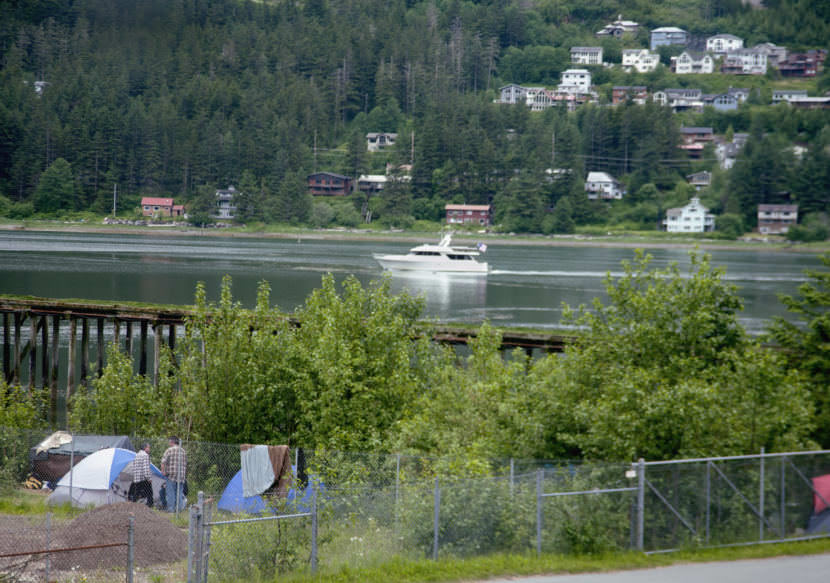
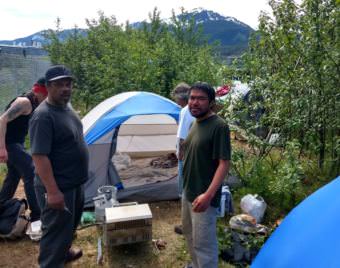
Campers gather near a small group of tents about noon Thursday, June 8, 2017, near the 300 block of Egan Drive in Juneau. (Photo by Tripp J Crouse/KTOO)
Campers gather near a small group of tents about noon Thursday near the 300 block of Egan Drive in Juneau. (Photo by Tripp J Crouse/KTOO)

A tent village has sprang up near the abandoned subport in recent weeks. Juneau continues to struggle with a housing and homelessness crisis that’s culminated in a new community on the edge of downtown.

In the encampment, there’s steak grilling on a propane stove. Tents began appearing in this wooded area about three weeks ago.

“I set up mine and then I woke up and there were three or four next to me. They followed, it just kind of came in waves,” said Kevin Howard, 44.

He looks around and sees community among the cluster of tents.

“Everybody here looks after each other and nobody does nothing to nobody. … (We) make sure everybody’s OK in the morning. Need something to eat? Need some water? We look after each other here.”

Juneau has been wrestling with a rising homeless population. Responding to complaints from downtown merchants, the Juneau Assembly passed an ordinance this winter banning camping on private property in the downtown core.

After it took effect in April, many homeless moved onto public property namely, Marine Park where cruise ships dock. Then in May, the city directed police to ticket anyone in the park after hours.

Kevin Howard and his friend David Waits recall officers telling homeless people in the park, “You guys get your s— out of here or otherwise it’s going in the trash,” Howard recalled.

“Somebody got a ticket, too,” Waits said. “We were like, ‘Aw, dude you can come down here and hang with us. We got our, you know, set up.’”

Howard added: “They threw everybody out of the doorways and threw everybody out of the park and now we’re all down here.”

Lorenzo Jefferson, left, and Kevin Howard grill steak on a propane stove in an encampment near the former subport off Egan Drive on June 6, 2017. (Photo by Jacob Resneck/KTOO)

Critics of the anti-camping ordinance had warned that a crackdown would just move the problem around.

“What happened is what we’ve seen happen in other communities that have similar ordinances is they’re displacing homeless individuals,” said Brian Wilson, executive director of the Alaska Coalition on Housing and Homelessness. “If we displace these individuals again, I’m not really sure where they’re going to go.”

The city of Juneau is coming around to this reality. City Manager Rorie Watt said a new Assembly-appointed task force is looking for a new strategy.

“People genuinely don’t have somewhere to go,” Watt said. “So if people got trespassed repeatedly they would be moving around. And if a situation is quiet and not causing issues that likely could be better than a lot of alternatives if those people got moved along.”

Juneau police won’t move on the camp without a trespassing complaint from the landowner. In this case that’s the Alaska Mental Health Trust Authority.

Wyn Menefee, deputy director of the trust’s land office, said the waterfront acreage is in the process of being sold to private developers. But for now there’s no plan to try and move the camp.

“If it were to get into a situation where it started in hindering the ability to make revenue off of the trust, we may have to do something further about it,” Menefee said. “But right now it hasn’t stopped us from doing what we intend to do with the parcel.”

About half of Juneau’s homeless population report suffering from mental illness. That’s according to a spring survey conducted by social workers who canvassed the community.

Brian Wilson said of the 96 unsheltered people that social workers interviewed, 45 people self-reported mental health issues or concerns.

“That’s typically an under-reported number as well,” Wilson said.

The irony of the mentally ill trespassing on Mental Health Trust Authority land is not lost on the organization.

“We’re actively engaged in the community on a number of different levels and probably target this population in one way or the other,” said Steve Williams, the authority’s chief of operations.

One of the projects the trust is helping fund is the 32-unit Juneau Housing First slated to open this summer.

“The folks that we’re seeing down at the camp are candidates for Housing First interventions,” Brian Wilson said, “but at the current state of our capacity, we don’t have that here locally. We need a lot more units.”

The city and the trust authority have received at least one complaint from the public concerned about health and sanitation. That will inevitably be an issue if the camp remains here long term.

David Waits said there’s a sense of pride about making the best out of what little you have.

“It doesn’t matter how much money you make or how much you have or anything else,” Waits said. “We’re all common people. I’m a Lakota Sioux Indian and we believe everybody’s related. Nobody’s higher or lower than the next person.”

So with few options available for Juneau’s homeless population, it appears a cluster of tents on the edge of town has become the status quo.

Editor’s note: KTOO’s building sits on land leased from the Alaska Mental Health Trust Authority. KTOO has also applied for and received occasional grants for special reporting projects from the authority.

Juneau mulls relaxing zoning rules for historic houses

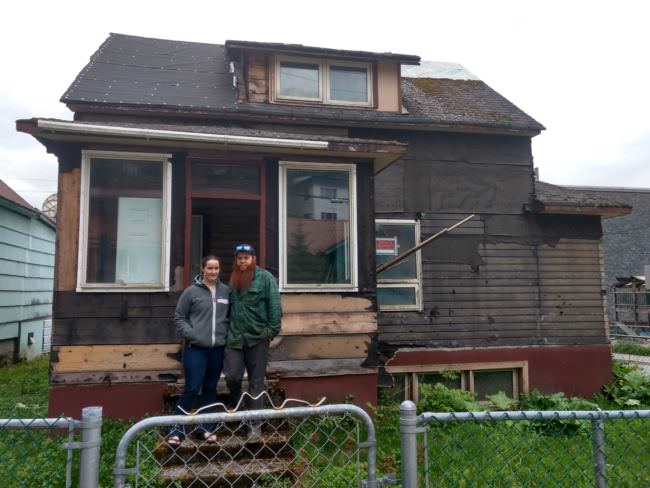
Erica and Don Andrew Roguska stand in front of the 103-year-old Juneau house on West 12th Street they bought in August 2016 to restore. (Photo by Jacob Resneck/KTOO)

The historic neighborhoods of Juneau and Douglas were built more than a century ago long before the city adopted zoning rules.

That’s led to all kinds of complications for homeowners trying to rebuild on these historic lots.

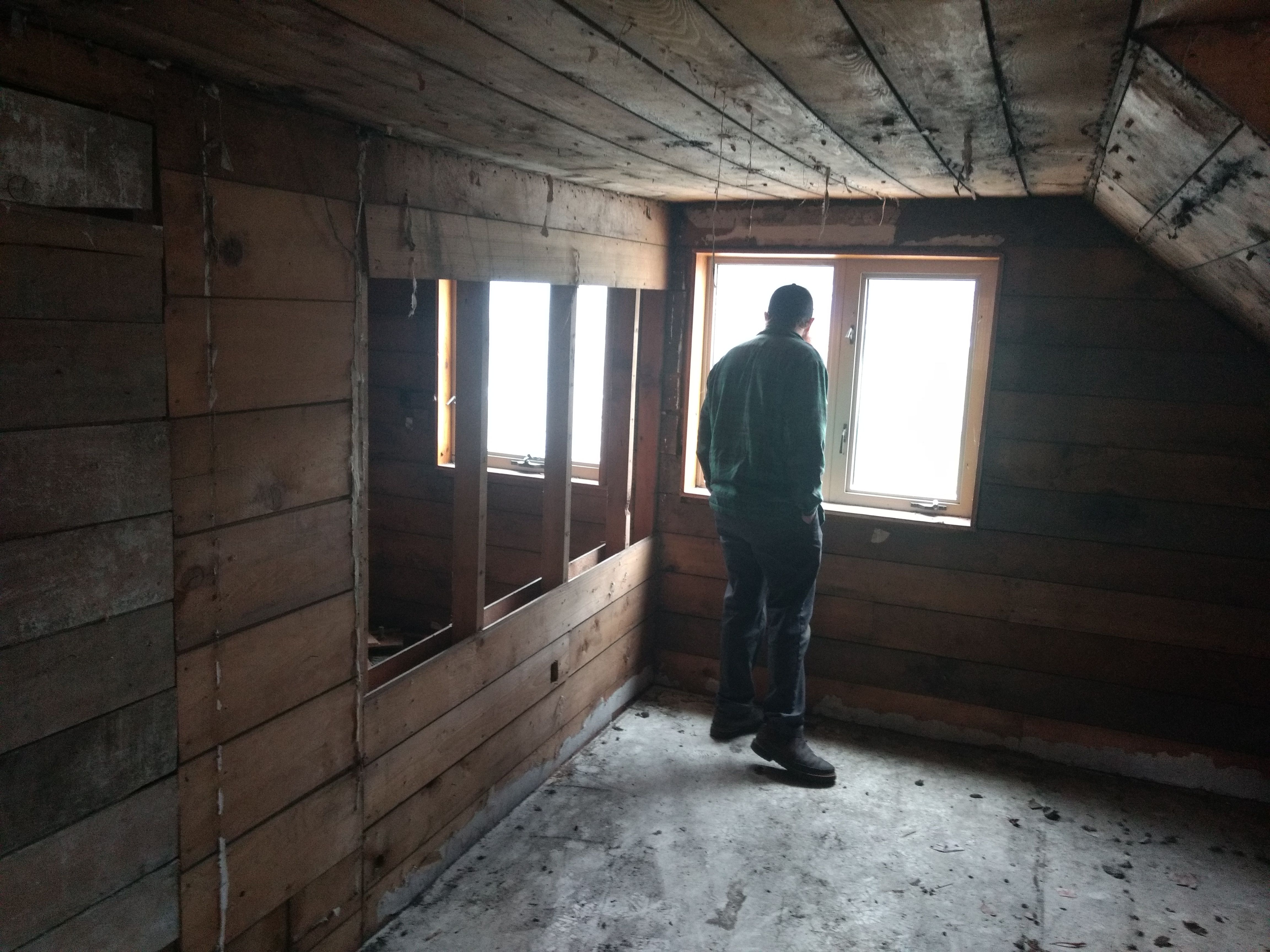
A two-story house built in 1914 sits vacant in the Flats neighborhood of downtown Juneau. A previous owner began tearing it apart to remodel it, but gave up in the middle of the job. So from the outside its exposed timbers and boarded up windows don’t make it much to look at.

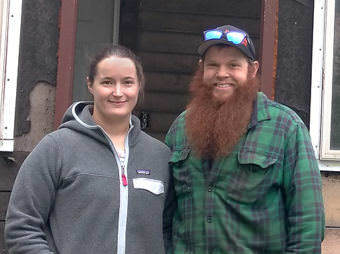
Erica and Don Andrew Roguska. (Photo by Jacob Resneck/KTOO)

Erica and Don Andrew Roguska bought this fixer-upper last summer for themselves and their two young children.

“Our plans were to keep as much of the house as we could and rebuild it,” Erica Roguska said.

The house has character and the couple wanted it preserved.

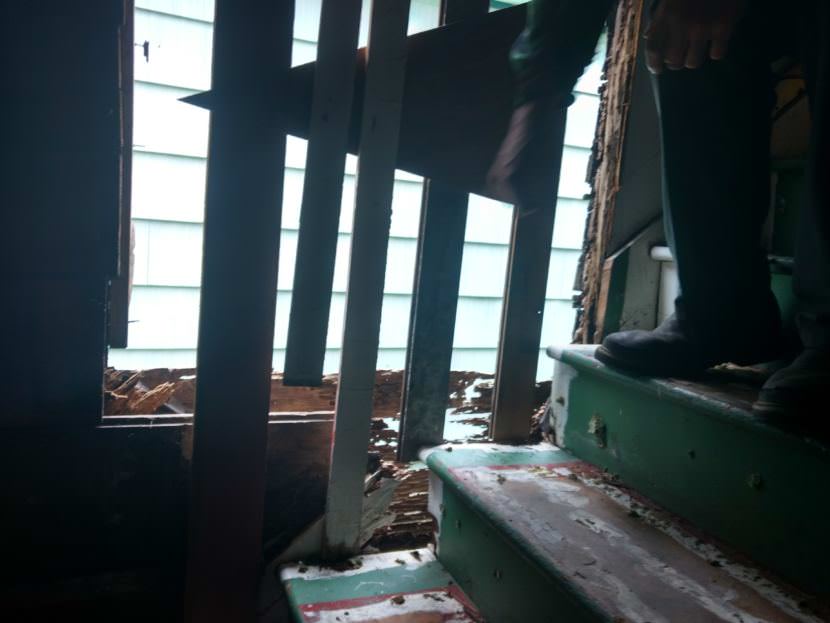
“But then we ran into troubles with the foundation crumbling and being cracked and so it just kind of snowballed into tearing the house down and rebuilding it,” she said.

The house’s zoning issues are complex.

It’s bounded by two streets and an alley on three sides. That leaves little room to legally build because of modern setback requirements.

The couple’s solution was building a new house on a smaller footprint, but even that would need permission from the city.

Substantial rot and insect damage in the walls combined with a failing foundation led Don Andrew Roguska to decide to tear down the house and rebuild. (Photo by Jacob Resneck/KTOO)

They were denied.

“It’s pretty disheartening to come up against so many roadblocks, when we’re just trying to rebuild a home in a neighborhood so that we don’t have this derelict building here,” Don Andrew Roguska said.

Even members of the Planning Commission, who voted to deny the Roguskas, admit it was a tough decision.

“The particular variance that was denied highlighted the quantity of problems that exist with the current zoning,” said Nathaniel Dye, member of the Planning Commission. “The commission found that we needed to find a different way to move forward because variances are, in essence, permission to break the law.”

He’s sympathetic to what they’re trying to do — the problem is with the city’s zoning, not their plans.

“If you look at what they would be allowed to build without a variance — it would not fit the character or feel of the neighborhood and no one would like it,” Dye said.

This story isn’t unique. Planners see it all the time.

“The downtown historic neighborhoods of Juneau and Douglas were predominately built by miners and fishermen long before today’s zoning was put into place — we didn’t have setbacks. We didn’t have lot sizes,” City Senior Planner Jill Maclean said. “For people to do any renovations or expansion of their building or new residential development, they now are required to meet the current zoning which doesn’t reflect the character of the neighborhoods.”

The city’s planners have come up with a workaround, which would give the Planning Commission greater discretion to bend the rules and be more flexible in historic neighborhoods.

It won’t be a free-for-all. And it’ll only be for houses in areas defined as historic neighborhoods.

“Projects will have to meet the height requirements,” Maclean said. “They’ll still have to meet the use requirements and this doesn’t also address density.”

Don Andrew Roguska looks out from an upstairs window of an historic Juneau house he bought in 2016 to restore. Zoning regulations have prevented him from rebuilding in the same style. (Photo by Jacob Resneck/KTOO)

Would this help out the Roguskas struggling with their fixer-upper in the Flats?

Probably not. Even if the city changes the rules it’ll likely be too little, too late for this couple.

Instead the couple is working on a plan that’ll keep them from having to revisit the Planning Commission.

It just won’t be as pretty.

“Now we’re looking at ways to build the house that will not require special consideration,” she said. “We’ll shrink the house, make it more box-like. Not what the neighborhood wants.”

The city’s initiative is technically called Alternative Development Overlay Districts, or ADOD. It would run for a limited time – the idea that it’d be a temporary fix while the city tweaks its zoning rules.

The Juneau Assembly is slated to weigh the plan next month.

Juneau Assembly forms task force on homelessness

Facing criticism to its handling of the community’s growing homelessness population, the Juneau Assembly has formed a task force on homelessness.

Juneau has the third largest homeless population in the state – after Anchorage and Fairbanks.

After fielding complaints from merchants, the Assembly banned sleeping overnight on private property in the downtown core. But many campers have since moved into downtown parks.

I don’t find myself being able to tell you that we are organized to proactively make decisions,” City Manager Rorie Watt told the Assembly on Monday. “I think we need to figure out how not to be in react mode.

He pointed to a Monday letter from the Juneau Coalition on Housing and Homelessness that questioned the city’s wisdom of ordering police to crackdown on sleepers in the city’s Marine Park. The coalition’s letter closed with an appeal to work closer with the city.

Assembly member Maria Gladziszewski agreed that the status quo isn’t working.

“We are, exactly as the manager said, doing something and then people get mad and then we do something else and then other people get mad,” she said.

The committee moved unanimously to form a three-member taskforce with Gladziszewski and fellow Assembly members Norton Gregory and Debbie White.

The task force will work with the city manager, housing officer and members of the Juneau Coalition on Housing and Homelessness and report back its findings at a future meeting.

Site notifications
Update notification options
Subscribe to notifications