Housing

Juneau’s homeless population prefers Marine Park over Thane campground

Lorraine Paul, 42, wakes up the morning of May 17, 2017, in Marine Park, Juneau. The city wants to begin enforcing the park’s posted hours of midnight to 7 a.m.

Juneau’s controversial anti-camping ordinance has been in effect for more than a month. The result has been more people are sleeping in downtown’s Marine Park.  Now the city is looking to empty the park of overnight campers.

It’s just after 8 a.m. on Juneau’s downtown waterfront. The Emerald Princess cruise ship empties of tourists as people sprawled out on the soft grass begin to stir inside their sleeping bags.

Lorraine Paul is one of those early risers. The 42-year-old and others often sleep in Marine Park though police sometimes try to move them on.

“Some of us sleep in the booth over here and have to be out by 5:30 a.m. to be respectful,” she said. “We get up to try and come over here and lay down and then here comes JPD and they’re like: ‘You need to get up and pick your stuff up.'”

The reason she chooses to sleep out in the open, in a public park, is security. There are aggressive drug addicts around who can be threatening.

“I hate to say this but because some of these people do meth, you know. I feel like they ruin it for us,” she said. “It’s really hard to find somewhere to sleep. I mean, I’m an alcoholic. Some of us try to stick together — how do I say it — pack off to ourselves.”

Juneau has one of the largest homeless populations in Alaska. A statewide survey in January found the capital city had 215 homeless people — 59 of them unsheltered.

Earlier this year the Assembly passed a controversial ordinance banning sleeping on private property in the downtown core.

Juneau Police Lt. David Campbell says officers have been able to coax people away from storefronts without serious conflict.

“Since the initiation of the ordinance, no citations have been issued,” Campbell said. “Which means that people are basically moving on if requested to and it hasn’t gotten to the level were the officers feel like they have to write a citation.”

Federal judges have ruled cities can’t pass laws that criminalize homelessness. That’s why the city’s recent ordinance is limited to private property. Many people moved to public property, like Marine Park, where Campbell says police were instructed to be more lenient about restricted hours.

“With the new camping ordinance and the directions to the officers we were told not to enforce that in Marine Park,” he said.

But soon the city will try to make Marine Park off-limits after midnight.

“We think that making sure that the park remains open as a park and not as a camping areas is best for everyone,” Deputy City Manager Mila Cosgrove said.

She says the decision was made Tuesday at a meeting of city department heads. The logic is to close the downtown parks to drive people toward alternatives, such as the seasonal campground near Thane.

“The thought was people would naturally migrate up to Thane as the weather got a little bit warmer, which it certainly has, and that hasn’t been happening. We want people to know that that’s a designated option for them.”

Unidentified sleepers sprawl out in Marine Park on May 17, 2017. (Photo by Jacob Resneck/KTOO)

Complaints in recent weeks about rowdy behavior in Marine Park is what led the city to take action.

“At times people don’t feel safe transiting through that area and that’s just not acceptable — everyone has the right to feel safe in their community,” she said.

The Tuesday afternoon directive to clear Marine Park after hours hadn’t filtered down to the police lieutenant on Wednesday morning.

But Campbell says it could be done.

“When we encounter someone it gives us the ability to legally justify contact with them to identify them and see who they are and then ask them to go out of the park,” Campbell said. “Because it’s after hours and if they refuse then to issue them a citation.”

Back in Marine Park, this is not welcome news to Lorraine Paul.

“Now that I hear that we can’t be sleeping out here — it sucks,” Paul said. “Wish they’d have somewhere for us to camp.”

What about Thane campground? She says it’s 2-miles from downtown on an unlit road. Not safe for a single woman.

“You hear a lot of stories. For example, if I walked out there myself — I’m told there’s guys out that way that camp that would hurt you and rape you,” she said. “It’s kind of hard because I’ve been on the streets off-and-on all my life.”

It’s unclear whether the city would be able penalize anyone caught in the park after hours, because there’s a typo in the city’s code that likely would need amending before a court could impose the $25 fine.

Can’t pay your student loans? The government may come after your house

Graduate cap weight pulls a student down a mountain.
James Yang for NPR

On Adriene McNally’s 49th birthday in January, she heard a knock on the door of her modest row-home in Northeast Philadelphia.

She was being served.

“They actually paid someone to come out and serve me papers on a Saturday afternoon,” she says.

The papers were from a government lawsuit that represents something more than just an unwelcome birthday gift — it’s an example of a program the federal government has brought to 19 cities around the country including Brooklyn, Detroit, Miami and Philadelphia: suing to recover unpaid student loans, like the ones McNally owes.

Every day, 3,000 people default on their federal student loans — and those lack of payments amount to an unpaid bill of $137 billion for the federal government. For decades, the government has tried to get borrowers to pay up by hiring debt collection agencies to call and send letters. But now the government is trying this new lawsuit strategy.

McNally filed for bankruptcy in 2006 and cleared out all her creditors — except for student loans, which are nearly impossible to get rid of in bankruptcy. As she and many others have found out, it’s not easy escaping federal student loan debt.

“Your whole body heats up with frustration,” McNally says. “I’m so frustrated over all this. It’s been so many years that they’ve been sending me mail and threatening me on the phone.”

In the last two years, more than 3,300 student loan borrowers have been sued after defaulting, according to the Department of Justice. In nearly every one of those suits, the borrower loses and the government wins.

What does the government win? A lien on the borrower’s assets — meaning that the debt is now attached to his or her most valuable belongings, like a home.

Jennifer Schultz, an attorney with Community Legal Services of Philadelphia, says that a lien traps a person, like house-handcuffs.

“I describe a lien as a kind of marker on the house,” Schultz says. “Any time a person tries to do a transaction involving their house — a new mortgage, a refinance, or if they try to sell it — they’re going to be expected to clear up any debt that’s attached to that house.”

The government has long been able to garnish wages, take income tax returns and divert Social Security and disability benefits. But targeting property is a way of applying even more pressure to get former students to pay up.

“It’s to try to awaken the avoider from their slumber,” says Drew Salaman, a debt-collection attorney in Philadelphia.

Salaman doesn’t work with student loans, but he’s familiar with debt avoidance. He says some of the borrowers are playing “catch me if you can.” These lawsuits ensure that people take responsibility for their debts.

“After all,” he says, “if we don’t have systems in place to recover debts, how can credit be extended?”

The end result of these suits — the liens — can be seriously threatening to borrowers. For many it’s a matter of housing preservation, says Joanna Darcus, an attorney on the student loan team at the National Consumer Law Center.

“For folks already living on the margins financially, the fear of losing that house can be palatable,” Darcus says.

Once a lien is in place, the government can force the sale of a former student’s home. That’s “exceedingly rare,” officials say, but it does sometimes happen.

The federal lawsuit program is expected to keep expanding, and with more than 8 million people currently behind on their federal student loans, it doesn’t look like the private firms will run out of work any time soon.

Copyright 2017 WHYY, Inc.. To see more, visit WHYY, Inc..

Juneau Assembly kicks in another $1.2 million for Housing First

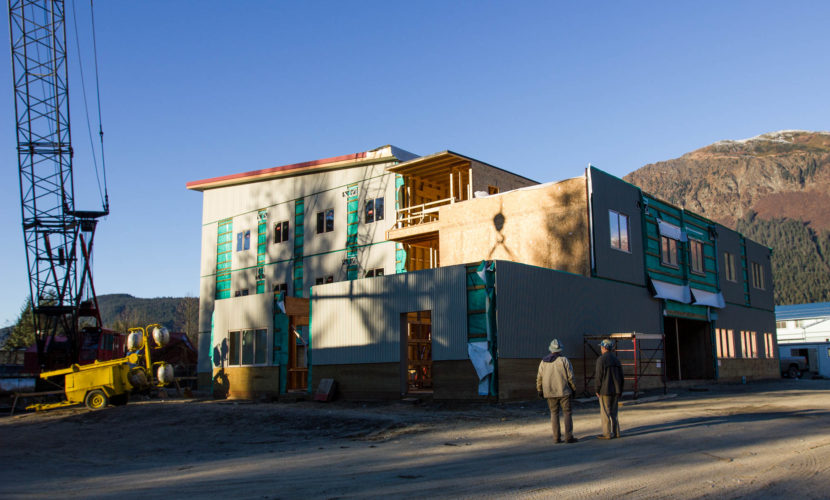
The Housing First Project under construction on November 17, 2016. (Photo by David Purdy/KTOO)
The Housing First Project under construction on November. (Photo by David Purdy/KTOO)

The City and Borough of Juneau has come to the aid of the Juneau Housing First Project with another $1.2 million.

Housing First is designed to serve Juneau’s most vulnerable residents, many of them homeless. But grants and other fundraising have been leaner than projected for the 32-unit complex and clinic under construction.

Housing First was originally slated to open in May. But when the project lost Front Street Community Health Center as its partner to run the onsite clinic, that pushed things back. Now a new partner’s been found: the Juneau Alliance for Mental Health, Inc.

“You know we’re just responding to the needs of the community, the program,” Doug Harris of JAMHI said. “And we’ve been fully invested in the Housing First project since its initial planning stages.”

The Juneau Assembly unanimously approved the increased funding without discussion Monday evening.

“We’re really excited to start moving people in,” Housing First’s Project Manager Mariya Lovishchuk said. “This feels like a huge, huge step.”

The Housing First complex is now slated to open in July and gives preference to what case workers identify as the community’s most vulnerable residents.

Concern for seniors as pioneer homes caught in budget battle

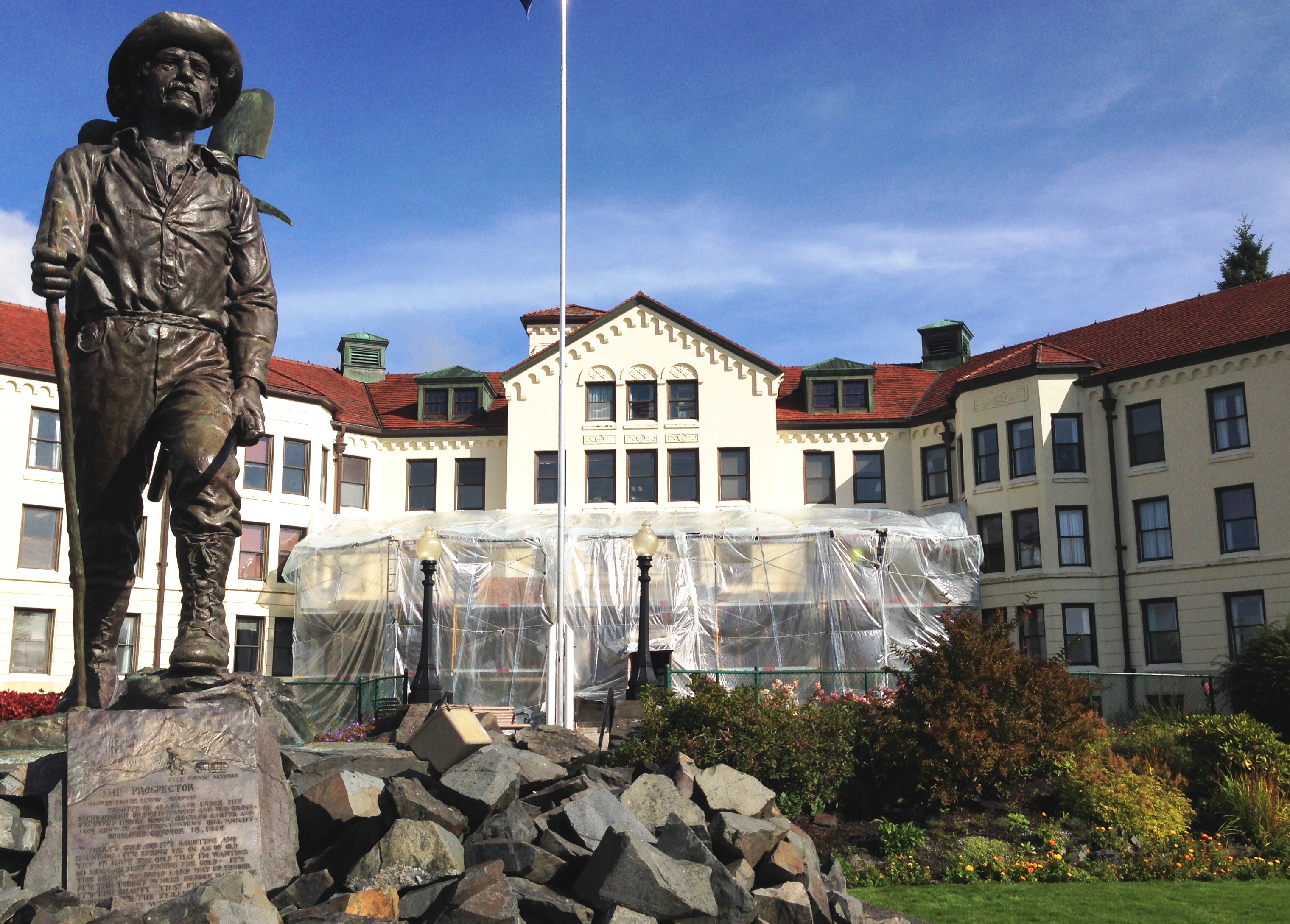
"The Prospector" statue stands in front of the Sitka Pioneers Home entrance, which was under repair Sept. 20, 2016. The homes reduced admissions as budgets were cut. (Photo by Ed Schoenfeld/CoastAlaska News)
“The Prospector” statue stands in front of the Sitka Pioneer Home entrance, which was under repair Sept. 20, 2016. The homes reduced admissions as budgets were cut. (Photo by Ed Schoenfeld/CoastAlaska News)

Residents and staff at the Palmer and Juneau Pioneer Homes, the state-run senior-care facilities, have been put on notice that a budget battle in the Alaska legislature is threatening to displace them.

The budget is far from complete, and some legislators say the governor and state officials are passing blame for the cuts and resorting to scaring the elderly to get their way.

The state said that blame lies squarely with legislators.

Meantime, the fight over Alaska’s budget is literally bringing people like Kim Kiefer to tears. Kiefer is worried about her mother, Marilyn, a Pioneer Home resident in Juneau.

“Those people love my mother, just like I do,” Kiefer said of the Pioneer Home staff, choking up. “I’m frustrated, I feel like it’s a game that’s being played right now between the Senate and the House, the blame game.”

Marilyn and other seniors at the Pioneer Homes in Juneau and Palmer are at the center of a struggle over cuts needed to balance the state budget, with the Senate, House and governor all involved.

State senators recently approved their version of the budget, including a roughly 10 percent cut to the health department’s funds to operate the Pioneer Homes.

Health officials, in turn, notified staff in Palmer and Juneau and word of the proposed cuts made it to residents and their family members, like Kim Kiefer and her mom.

And all that left Kiefer to wonder: “OK, do I need to start right now trying to look for a place for my mom that’s safe?”

It’s a question that Republican state Sen. Shelley Hughes, who represents the greater Palmer area, said Alaska’s elderly population should not have to be asking.

Hughes said it is the strategy of Gov. Bill Walker’s administration to cause a stir among constituents to pressure legislators — particularly Republicans from the Matanuska-Susitna area — to vote in support of a state income tax.

The administration has discretionary funds to make up the difference and that the warning to the Pioneer Homes was way too early in the budgeting process, Hughes said.

“Using our frail and elderly as a political football is, I can’t even think of the right adjective.” Hughes said. “It is just incomprehensible. It is despicable.”

Department of Health and Social Services Commissioner Valerie Davidson did not care for that characterization.

“I like to think that when we’re talking about elders in our state, that we never refer to them in those derogatory terms,” Davidson said of the “political football” comment.

Davidson disputed the claim that notifying the dozens of Pioneer Homes staff and residents of a possible late-summer closure amounted to “fear-mongering.” The residents and their families are already following the budget process closely, Davidson said.

The Senate made the cuts, and its own documentation shows the cuts were made directly to the Pioneer Homes, Davidson said, providing a copy to Alaska Public Media.

As for discretionary funds, Davidson said those are for unexpected expenses.

The money is not intended to bridge a gap created by legislators’ cuts, She said.

“It appears to me that the Senate’s intent was clear,” Davidson said. “It wasn’t the governor’s cut.”

Hughes and other members of the Mat-Su delegation maintain the state has the flexibility with those funds to further reduce spending and still take care of Alaska’s elderly Pioneer Home residents.

In the meantime, the budget process continues as legislators try to reconcile different versions from the House and Senate.

Thane Campground reopens as Juneau’s downtown sleeping ban takes effect

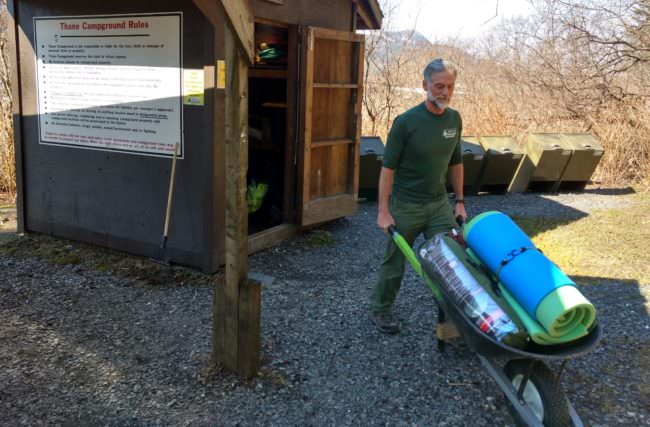
CBJ Park Ranger Dale Gosnell hauls donated camping supplies at the city-run Thane Campground on April 13, 2017. (Photo by Jacob Resneck/KTOO)

Juneau’s controversial ordinance prohibiting sleeping on private property downtown goes into effect April 15. The anti-camping initiative coincides with the reopening of the seasonal Thane Campground.

Spring has sprung at the Thane Campground and rangers from the City and Borough of Juneau are unloading donated camping gear.

“People have been extremely generous and they’ve donated lots of camping gear,” CBJ Park Ranger Dale Gosnell said.

This campground had traditionally been used by seasonal workers looking for low-cost housing.

With a new anti-camping ordinance coming into effect downtown, a number of homeless people are expected.

Juneau Assembly passed an ordinance that prohibits people from sleeping on private property in the downtown core.

The vote was in response to complaints about homeless people sheltering in business alcoves and creating a nuisance.

Juneau police officers have been reminding downtown homeless people about the social services that are available.

When the ordinance takes effect, Lt. David Campbell said, education will turn to enforcement.

“If an officer discovers someone in violation of the camping ordinance or if somebody calls in, we will respond like any other violation,” Campbell said. “We’ll give someone an opportunity to leave but if we need to cite them, then we will basically treat it like any other violation.”

The anti-camping ordinance passed in February was designed to correspond with the reopening of the city-run Thane Campground.

Mariya Lovishchuk, director the downtown shelter The Glory Hole, argues that the campground isn’t an option for many of the people she sees every day.

“People who are really self-sufficient do great at the Thane Campground. It’s really impressive, the campground that they set up,” Lovishchuk said.  She notes that many homeless people aren’t physically able to safely walk 2 miles down an unlit road — and there’s no bus service. “It’s wonderful, it really provides people a way to independently live in the great outdoors, but it’s certainly not for old people and it’s certainly not for vulnerable people.”

Those struggling with addiction and mental illness probably won’t make it far from the few streets affected by the ordinance, said Mandy Cole, co-chair of the Juneau Coalition on Housing and Homelessness.

“There’s a lot of talk of just moving to places where they’re not going to get confronted by the police,” Cole said. “They all heard, we all heard during the ordinance hearings that CBJ isn’t going to be enforcing it necessarily on their properties so it may be CBJ doorways — I’m not sure.”

The reason people might move onto city property is the camping ordinance was narrowly crafted to only apply to private property.

“We cannot move people off of public property,” said Mila Cosgrove, deputy city manager. The city, she said, is doing its best to confront a complex problem. “On the whole we’re a compassionate community, we want to care for our friends and neighbors — all of them,” she said. “I think everybody’s looking for the way to do that the most effectively.”

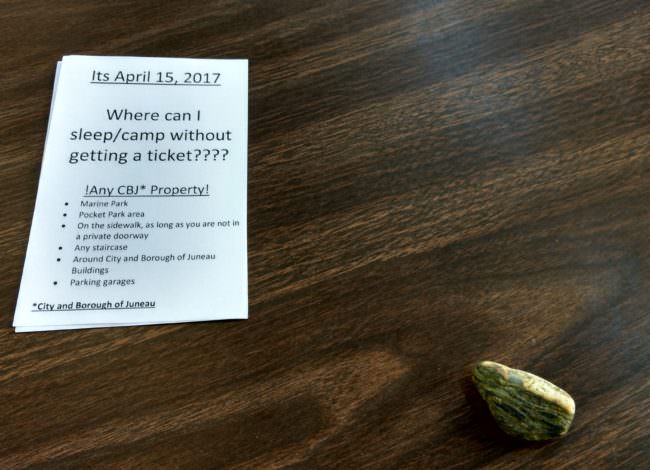
Leaflets like these have been left on tables on April 13, 2017, at the Glory Hole downtown shelter reminding patrons that the city’s anti-camping ordinance only covers private property. (Photo by Jacob Resneck/KTOO)

The ordinance is written in a way that the city isn’t able to push homeless people out of the downtown core completely.

But what about city parks?

‘They can sleep in parks that are open … some parks close and we prohibit any activity in those parks,” Cosgrove said. “There are plenty of other areas in the downtown core that are city property and if they choose to move from a private property to another area, say by the parking garage as an example, then that would be considered public property.”

Then there are property owners who opt out of the ordinance altogether.

The Glory Hole downtown shelter doesn’t allow people with alcohol on their breath to sleep overnight. But the shelter has decided it will allow people with nowhere else to go to sleep on the sidewalk outside.

“The Glory Hole is not going to participate in the camping ordinance out of respect of our patrons,” Lovishchuk said. “We will not condone the Juneau Police Department asking people to move and we have notified the police department of that.”

No one is sure what will happen until the city tries to enforce the ordinance.

There’s hope that able-bodied people will take advantage of the Thane Campground.

“We’re ready to go — we’ve cleaned up the campground,” Gosnell said as CBJ rangers put the finishing touches on the campground.

The city is also helping finance a 32-bed complex called Housing First that will house homeless people and allow drinking on site. But its opening has been pushed from mid-May to late July.

Pederson Hill housing initiative gets Juneau Assembly approval

Pederson Hill
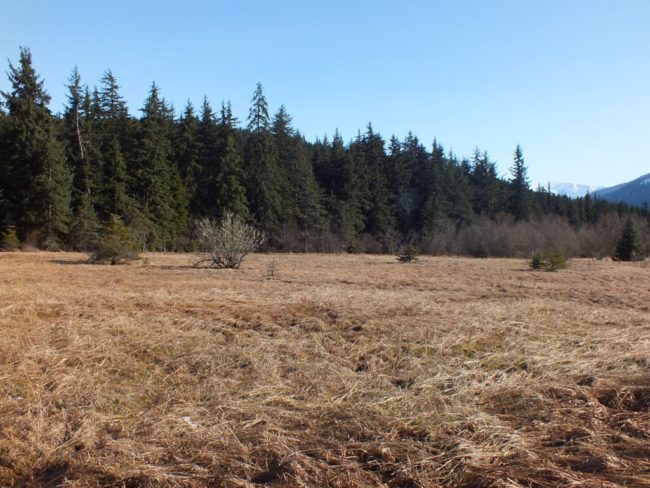
The Pederson Hill subdivision will be between the Mendenhall River and Auke Lake. (Photo by Casey Kelly/KTOO)

The 86-lot Pederson Hill subdivision has been greenlighted by a key committee of the Juneau Assembly. The city-planned project is designed to create more entry-level housing and received unanimous support Monday evening.

The City and Borough of Juneau’s Lands Manager Greg Chaney said the next step is contracting design work for the $8.8 million project less than a mile west of the Mendenhall River.

“The Assembly definitely made a strong statement that they want to make a difference with the housing shortage in Juneau — that was very clear,” he said in an interview. “And as staff we’re going to proceed and try to get this out in the most efficient and economical manner that we can.”

The Assembly decided to approve the 86-lot subdivision all at once rather than in phases. That has the advantage of not having to return to the Planning Commission which approved a preliminary plan in February. But it will require the city to dip into its treasury reserves for about $2 million before the first lots are sold to private developers that will build the actual houses.

Before all that happens, contractors will have to bid on developing the subdivision’s infrastructure, which will give the Assembly a second chance to review any financial risks.

“If the bids come in too high, the Assembly can decide it’s not going to proceed with the project,” Chaney said. “We can cancel the project, vacate the plat and we can put the plans on the shelf if they want to be used in the future.”

The project has been met with skepticism by those who question the city’s role in influencing the housing market. The next political question will be how many lots would be sold at a time. Chaney said that decision is for another day.

“The Assembly has to approve all land sales,” Chaney said, “so we’ll be going back to them and I assume it’s going to be a fairly interesting proposal with a blend of: some lots for contractors, some lots for potential partners, some lots for individual homebuilders and then some for contractors who want to get blocks of four or five in a row and that they would be able to develop those more efficiently.”

The timeline of the project is fluid. But design work is expected to be wrapped up in the fall with a target for breaking ground next year.

Site notifications
Update notification options
Subscribe to notifications