Retired neurosurgeon Ben Carson has been confirmed as the secretary of Housing and Urban Development, by a 58-41 Senate vote.
Six Democrats and one Independent joined with the Republicans to approve the nomination — mostly Democrats who are up for re-election next year and represent states that voted for President Trump, NPR’s Arnie Seipel reports.
“Sen. Elizabeth Warren of Massachusetts, who received blowback from liberals for voting for Carson in committee, voted against his nomination today,” Arnie says.
Carson was a controversial nominee to lead HUD because of his lack of experience in either housing or development — or government in general.
Before Trump announced his selection of Carson, an aide told the media that Carson wasn’t interested in joining the Cabinet because he “feels he has no government experience, he’s never run a federal agency.”
But the same aide, Armstrong Williams, later told NPR’s Rachel Martin that Carson was qualified to lead HUD because of “his life growing up in subsidized housing, growing up in poor communities.”
“He’s never been disconnected from these inner cities and these people who live these lives,” Williams said. “Dr. Carson may have aspired to become a world-renowned pediatric surgeon and a presidential candidate, but he’s never lost the human touch with people.”
While Carson’s nomination “raised some eyebrows,” NPR’s Pam Fessler reports, members of the Senate came around.
Carson “won easy approval in January from the Senate Banking Committee after he assured lawmakers that he supported some of HUD’s biggest programs, such as rental assistance for the poor, and that he would enforce the nation’s fair housing laws,” Pam says.
HUD has 8,000 employees and an annual budget of almost $50 billion, she says.
Pam has more on what to expect from Carson’s early days at the helm of the agency:
“One of his first challenges will be dealing with Trump administration plans to scale back domestic spending to help pay for a huge boost in the defense budget.
“Carson says he’ll go on a listening tour around the country to hear from those involved in housing and urban development to find out how the agency can best help them.
“Both he and President Trump have said they want to revitalize the nation’s urban areas, but have offered few specifics so far. Democrats say they’re worried Carson will cut HUD programs, such as rental assistance for the poor.”
Copyright 2017 NPR. To see more, visit http://www.npr.org/.
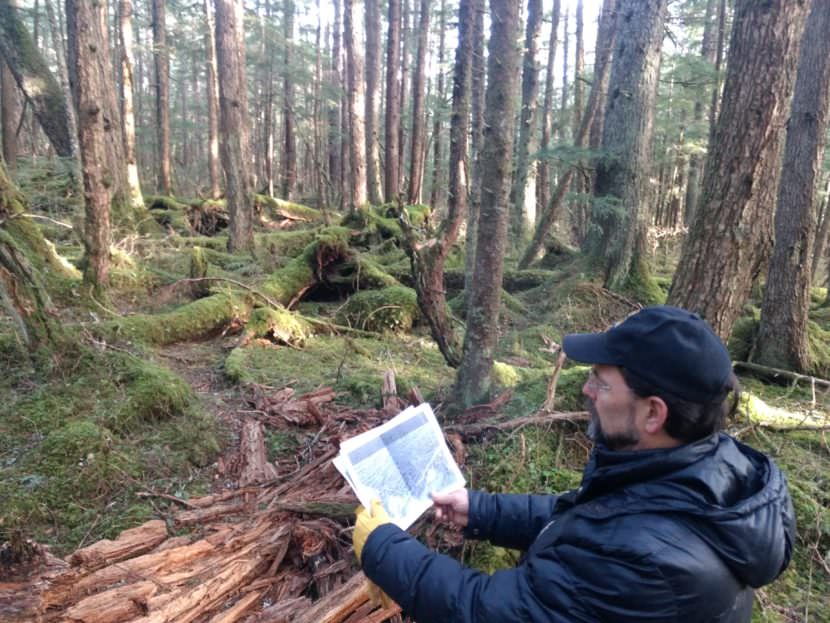
Greg Chaney, City and Borough of Juneau lands manager, consults the site plan for an 86-lot residential subdivision near Pederson Hill on Feb. 16, 2017. (Photo by Jacob Resneck/KTOO)
A unanimous Juneau Planning Commission approved the first phase of the Pederson Hill subdivision, clearing a major hurdle for the city’s housing initiative.
Commissioners heard testimony Tuesday night from the city’s Lands Manager Greg Chaney who made a pitch for 86 relatively small homes that could be entry-level housing for renters looking to buy.
“You could have a $250,000 starter home — nothing fancy,” Chaney said. “Compare that to living in an apartment and that’s what people will be considering with a mortgage payment here or a rent payment there.”
But the Planning Commission also heard pointed criticism.
“You guys, at some point when you went from infrastructure from roads and highways, airports, docks and harbors, water and sewer and you became housing developers for private sector,” said Jeremy Sidney, who owns a trucking company.
“You interjected yourselves into this market that was a really big mistake and you never should’ve done it,” he said. “And you shouldn’t do it now. I don’t believe it’s your place as a government.”
“Everybody’s always saying how we need to do something about affordable housing — this is something that we can do about it,” White said in an interview. “I have to say that I found it frustrating to find out that the same people that say they want affordable housing said, ‘Oh we want you to do this in a different way.’ And there’s no one way that is going to please everybody in Juneau.”
Now that the subdivision has been approved it will be up to the Juneau Assembly to decide how it will offload the lots.
Questions remain whether they will be put out to bid individually or in blocks.
Whether lots would be offered at fair market value or discounted to make them more affordable is another decision that’s still months away.
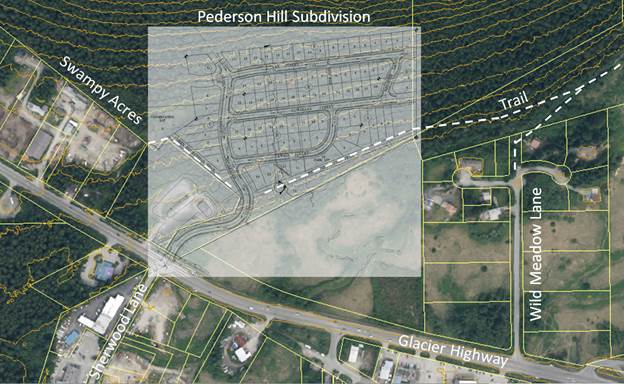
The proposed 86-lot Pederson Hill subdivision as envisioned by the City & Borough of Juneau. It goes before the Planning Commission on Tuesday, Feb. 28. (Courtesy City & Borough of Juneau)
A city-planned subdivision that aims to create dozens of buildable lots is set to go before the Juneau Planning Commission. City planners say the proposed Pederson Hill subdivision could help create relatively affordable housing for Juneau. Though some remain skeptical of the project.
About a half mile past the Brotherhood Bridge on Glacier Highway lies the entrance to what could be an 86-lot subdivision planned by the city.
“What our hope is is to make a compact neighborhood kind of in a traditional style similar to the areas of downtown Juneau or downtown Douglas,” said Greg Chaney, lands and resources manager for the City and Borough of Juneau.
Chaney sees potential here for scores of moderately priced homes. He said if the land were just sold outright there would be no guarantee that small lots would be carved out or developed at all. So what does the city have planned? Relatively small houses on dense lots: up to 10 houses per acre each not much more than 1,000 square feet. No garages and small backyards with the aim to make it affordable.
“Our magic number is $250,000 because the mortgage payment on a $250,000 home is about the same as a rental in Juneau right now,” Chaney said.
How the subdivision would be developed remains undecided. It would be up to the Juneau Assembly to determine whether shovel-ready lots would be sold off individually or in bulk to builders.
“The city is not building houses — we are only making land available. All construction will be done by the private sector,” Chaney said to allay the concerns of private developers. As one of the largest local landowners, the city and borough has to tread carefully when it offloads property onto the private sector. “Just because we build a project doesn’t mean we have to just dump them. We’ll hold onto the lots and disperse them as the land market dictates. So we’re not going to depress market.”
Still, some developers aren’t convinced and eye the project with suspicion. That’s because there is unease with the city being so closely involved with the economics of a housing project.
Earlier this month at a meeting of the Juneau Affordable Housing Commission, land developers that sit on the commission predicted pushback when it’s reviewed by the Assembly.
“There’s a bunch of players out there who pay a lot of property taxes and they got some influence on the Assembly,” said Wayne Coogan, a prominent developer. He made the remarks at a meeting Feb. 7 of the Juneau Affordable Housing Commission, which he vice chairs.
“I’m worried that if we don’t think about the political dimension of this project — that’ll come to the Assembly, they will meet head on the political dimension of it and then we will not have done our job,” Coogan said at the meeting.
He did not respond to requests for comment to clarify.
“The comment that I hear a lot is, ‘Oh you’ll be flooding the market,'” said Juneau’s Chief Housing Officer Scott Ciambor. (Ciambor is married to a Coast Alaska employee.)
“And I think historically we’ve always struggled with this type of housing product. We’ll continue to have difficulties developing single-family homes, and so anything we can do to get these units on the market is important,” he said.
But those in real estate are not so sure. Much of the criticism seems based on principle.
“A free market is not something that you control. You put it out there and it becomes what it becomes based on what the market demand is,” said Juneau real estate broker Marty McKeown. He has specialized in residential real estate for more than a decade.
“It’s a great idea that the city gets involved and helps out with the infrastructure and putting that in place,” McKeown said. “But to get involved with competing with the local developers in developing a neighborhood is not the right way to go.”
He echoes developers who have called for the city to sell off larger parcels to private developers.
“Developing the lots and just asking builders and selling off lots one at a time to each contractor is not the way to do that,” he said. “They should sell off a parcel and let the developers develop the lots.”
“The housing authority is very interested in a possible partnership with the city on the Pederson Hill subdivision,” interim CEO Joyce Niven said. “We’re supportive of the efforts of the city to meet the housing needs in Juneau, and in particular, to create affordable home ownership opportunities for moderate income, working families in Juneau.”
The Planning Commission will be asked to approve the plan on Tuesday. If it does, the Pederson Hill project gets its first hearing before the Juneau Assembly at a March 13 committee meeting.
Balancing free market principles against the currently high barrier to home ownership experienced by middle class families is something the Assembly will have to grapple with.
Correction: A disclosure statement in an earlier version of this story misstated for whom Scott Ciambor’s spouse works. Ciambor’s spouse works for Coast Alaska, not KTOO.
Jack Bennett of Homer harvests hemp in Oregon. (Photo by Maggie Hegarty and Nicholette Sutton)
Alaska became the third state to legalize recreational marijuana in 2015, but it’s not exactly ahead of the curve on hemp, which comes from the same plant.
Now, with growing pressure to diversify Alaska’s economy, lawmakers are talking about legalizing hemp for commercial purposes — something at least 30 other states have already done.
For the past year, home builder Jack Bennett of Homer, Alaska, has been working on a model home that he sees as a potential solution to affordable housing and energy in rural parts of the state.
He’s using building materials made from hemp.
“We acquired a facility for the year, imported the hemp insulation material and started to run experiments to build a brick for cold climate Alaska,” he said.
There’s just one problem: it’s illegal to grow hemp in Alaska, so Bennett imports his product from the Netherlands.
He’d like to source the product locally.
The 2014 federal Farm Bill allows states to grow and harvest hemp through pilot programs.
Sen. Shelley Hughes is sponsoring legislation that would establish such a program in Alaska.
“I think this is one more opportunity for farmers and Alaskans … and that it’s due time,” she said at the bill’s first hearing on Feb. 8.
But moving forward with the program is not as simple as waving a wand and making hemp legal. Lawmakers will have to decide on a regulatory framework that complies with federal regulations without stifling the industry before it even takes off.
Sen. Bill Wielechowski criticized the legislation at a Feb. 13 hearing.
“It’s uh, requiring that individual to register. It’s requiring that they list their global positioning coordinates where they’re going to be producing the hemp. They’ve gotta register every year. They’ve got to pay fees for applications and the fees have to cover the regulatory costs,” he said. “So, this is big government. I mean, this is extremely onerous.”
Don Hart, a farmer from the Mat-Su Valley, also is concerned about over-regulating the new industry.
“In order to benefit the farmers in the state of Alaska, it would be better to be able to remove it entirely from AS 17.38,” he said. “It allows anyone who does not want to see hemp growing in Alaska to be able to raise the issue by initiative or to propose their borough, administrative or municipality to be able to exclude it.”
The statute that Hart referred to, AS 17.38, lumps marijuana and hemp together under the same definition, allowing for local control over where the plant can be grown.
Alaska cultivated hemp until its ban in 1937 under the federal Marijuana Tax Act.
Bennett said the plant did well in Alaska, where it’s not always easy to grow things.
He’s committed to helping the industry grow.
“Alaska is, uh, it’s said to be in a fiscal crisis, but it’s a positive, it’s our opportunity. It’s our generation that gets to fix it. And hemp might not be the solution, but it’s a solution,” Bennett said. “Give them the freedom to farm, and let’s find out.”
The legislation will go to the Senate Judiciary Committee next, pending referral from Senate Resources.
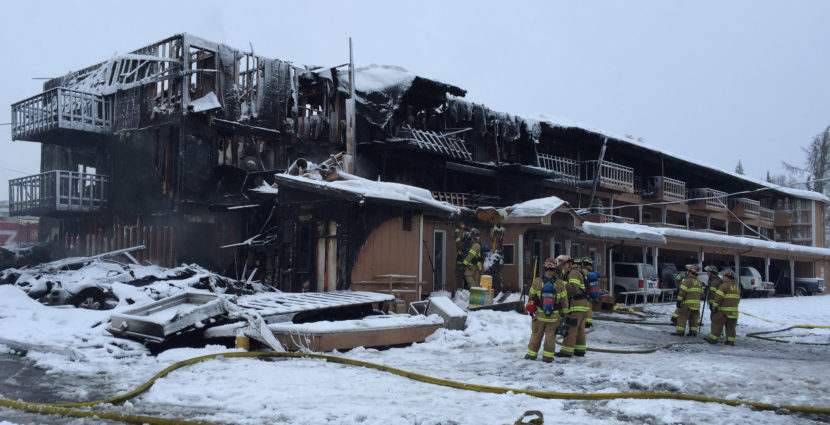
Firefighters put out the smoldering blaze at Royal Suites Lodge in midtown Anchorage on Feb. 15, 2017. (Photo by Anne Hillman/Alaska Public Media)
A midtown Anchorage apartment building caught fire early Wednesday morning, killing two people and injuring 16 others.
A portion of the three-story Royal Suite Lodge on Minnesota Drive in midtown has collapsed from the blaze, and the cause is currently unknown.
Late Wednesday morning, firefighters were still using chainsaws to cut away smoldering boards and spraying down portions of the building with water.
Royal Suite residents Tequila Parker-Hernandez and her husband, Juan, stood in the complex’s neighboring building, which was untouched. They lived in a first-floor apartment in the burned structure. They first heard an alarm about 2:30 in the morning, she said.
“We woke up. I opened the front door and down on the far end of the building, from the floor all the way up to the third floor was engulfed in flames. So we grabbed a couple things and went out to the parking lot,” Parker-Hernandez said. “And the fire just spread.”
The Anchorage Fire Department said 34 fire trucks and engines responded to the blaze.
Sixteen people were injured, including some who jumped out of third-story windows. At least four people were in critical condition.
Two others died, including Teuaililo G. Nua, 38.
Parker-Hernandez said they’re lucky because flames didn’t reach where they live, so they’ll just have to deal with water damage. She’s optimistic.
“You have to be, you know? Everything is inside your house. That’s everything,” Parker-Hernandez said, adding she feels horrible for others who lost even more.
Anchorage Fire Department Deputy Chief Jodi Hettrick said it may not actually be possible for people to retrieve their belongings.
By mid-afternoon, parts of the roof and some of the walls had collapsed, so it’s unclear which parts of building are structurally sound, if any.
“Damage at this end can definitely affect the stability at that end,” Hettrick said, pointing to the heavily burned area closer to Minnesota Drive, then to an area where fake plants still hung by the doors. “It may look like from the outside that it’s safe to go in and it’s just water damage, where there’s actual damage the flooring and the wall structure. And we just can’t put anybody in danger.”
As of midday, the building was not stable enough for fire investigators to enter and identify the cause of the fire. Hettrick said it’s hard to estimate when they will be able to go in, and they may have to pull down parts of the building with heavy equipment.
Some of the residents were taking shelter at the Spenard Rec Center on Wednesday morning, where the Red Cross had set up cots and was distributing food and some basic clothing.
Red Cross representative David Williams said the shelter will likely run for two to three days, and they’re helping residents connect with service providers to make longer-term plans.
“When people have gone through a loss like this, very often there is a sense of loss of control of their lives in general,” Williams said. “If they can start making decisions about where they’re moving on with their lives, then that’s helping them recover.”
Royal Suite resident Robert Thomas and his family said they want to find a new place as quickly as possible, but it may be hard to come up with the rent money.
He explained they had only been living in the apartment for two weeks.
Before that, he and his girlfriend had spent about two months living at Brother Francis Shelter.
“We lost everything, and we were saving and scrimping just to get in,” Thomas said. “Now two weeks later, we’re already out again. So we’re starting over completely from scratch.”
Thomas said when the fire alarm first went off, he didn’t think there was an actual fire because there had been a false alarm just last week.
“We were kinda taking our time then the manager came by and was banging on the door saying ‘This is not a drill. There really is a fire. Please get out, get out, get out!’” Thomas recalled.
They escaped the building and eventually took shelter in the Center Bowl.
Firefighters had broken open the door to get people out of the snow.
Many had run out of the apartments just in their pajamas and didn’t have shoes on.
Soon after People Mover Buses arrived at the scene to provide protection and eventually took people to the Rec Center.
The Hernandez’s stayed behind at the complex.
They plan to move into one of the empty units in the building where they’re taking shelter.
The night of the fire was their 10th wedding anniversary. It’s the first time they’ve celebrated it in Alaska; they moved up eight months ago from Puerto Rico.
Juan Hernandez said living in the state has always been a dream of his, and this fire is just a bump in the road.
“Not a regret in the world moving here, huh?” Tequila asked her husband.
“It’s part of living. You just gotta go on,” Juan said.
The 40-year-old building contained 30 units.
Its unknown how many people were present during the fire.
If you are trying to find someone who may have been impacted, call the Red Cross at 230-4472.
Homeless resident Catherine Duncan, far left, appeals to the Juneau Assembly not to pass a camping ordinance that would ban homeless from sleeping downtown on Feb. 13, 2017. (Photo by Jacob Resneck/KTOO)
A divided Juneau Assembly passed a controversial anti-camping ordinance Monday to ban homeless people from sleeping near downtown businesses.
In the end, the controversial ordinance passed by a single vote. It will allow police to cite anyone caught sleeping on private property in the downtown core between midnight and 7 a.m.
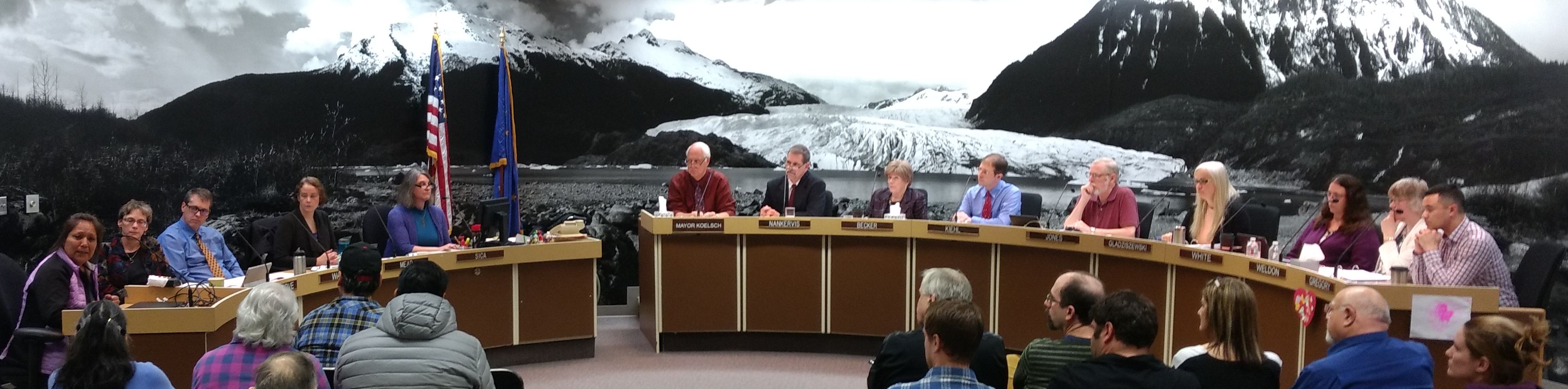
The ordinance passed in a 5-4 vote. Supporters were: Mayor Ken Koelsch, Jerry Nankervis, Debbie White, Mary Becker and Beth Weldon. Opposed were: Norton Gregory, Jesse Kiehl, Loren Jones and Maria Gladziszewski.
Many downtown merchants have complained of people using shuttered storefronts to shelter from the cold. Those concerns were heard by a majority of the Assembly.
“This isn’t about the people who sleep on the sidewalk. This isn’t about people in Marine Park,” Assembly member Debbie White said. “This is about people who have invested in our downtown community, who employ our neighbors.”
Assembly member Jerry Nankervis echoed that it was a matter of rights of business owners.
“We are trying to reinforce — at least in my mind — that I believe people have private property rights,” he said, “and just because you’re homeless doesn’t supersede somebody else’s private property rights.”
Juneau Police Chief Bryce Johnson said the ordinance would be a tool “which would give us the option of either writing a ticket or taking someone to jail for disorderly conduct.”
It takes effect in mid-April when the city-run Thane Campground reopens.
Opposition came from four Assembly members including Norton Gregory, who noted that many homeless people suffer from substance abuse and mental illness.
“Those are the discussions that I wish we were having tonight and we were talking about rather than passing an ordinance about pushing these people out of the downtown area,” Gregory said.
Assemblyman Jesse Kiehl disputed the police chief’s argument it would improve overall public safety.
“Are people better off now in doorways? You bet they are,” he said. “Because those abandoned mine buildings above Gastineau Avenue are scary places and there are no lights and (the Juneau Police Department) doesn’t drive by and check.”
Merchants who had complained that homeless people had harassed and intimidated their customers and employees were pleased with the vote.
“I personally think this will help and I hope it’s the beginning of a longer process to address all the issues of the homeless in downtown Juneau,” said Eric Forst, owner of the downtown Red Dog Saloon.
Homeless residents reacted with dismay.
“I’m scared of what’s going to happen,” Lisa Williams, 27, said after the vote. “I don’t know where I’m going to go and I’m afraid to go up to the woods. I have no idea what it’s going to mean for me.”
The ordinance began as an initiative by Juneau Mayor Ken Koelsch, who proposed it after fielding complaints from merchants in December.
“I asked for the no camping ordinance to be drafted and introduced for action,” he said in prepared remarks. “I accept full responsibility. It speaks to a core value of mine regarding respect of property of others.”
The ACLU of Alaska has cautioned the city that a blanket ban on homeless people downtown would be unconstitutional.
Courts have ruled homelessness can’t be criminalized when the homeless population exceeds shelter space available.
For that reason City Attorney Amy Mead said this ordinance was drafted narrowly to only apply to private property.
So what if the homeless campers move to a public place like Juneau’s Marine Park?
“My advice to (the Juneau Police Department) is that it would be potentially unconstitutional to enforce the camping ordinance against those people at that time,” the city attorney said in a brief interview.
The argument over this ordinance may be over.
But both sides here agree that the quandary over Juneau’s homeless problem continues.
Close
Update notification options
Subscribe to notifications
Subscribe
Get notifications about news related to the topics you care about. You can unsubscribe anytime.

9(MDEwMjQ0ODM1MDEzNDk4MTEzNjU3NTRhYg004))