Housing

Juneau Assembly considers downtown ‘camping’ ban

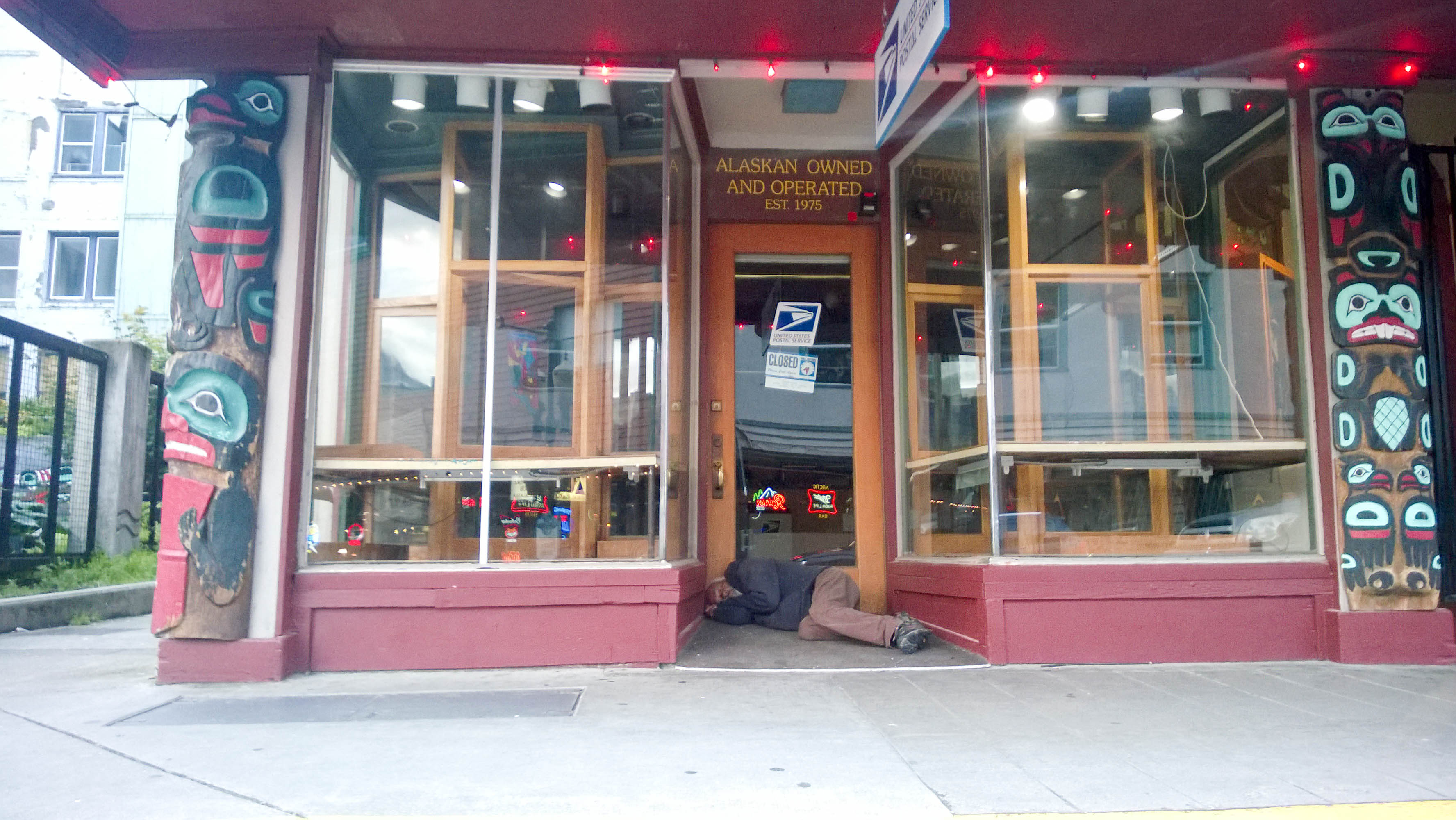
man sleeping downtown
A man sleeps in the doorway of a shop on South Franklin Street in July 2014. The location is now Kindred Post, which opened in September 2014. (Photo by Jeremy Hsieh/KTOO)

Juneau Assembly members asked pointed questions but didn’t indicate whether they would support amending Juneau’s camping ordinance to empower police officers to cite people sleeping in front of downtown businesses and move them on.

Police Chief Bryce Johnson told the Assembly on Monday night that current law only allows officers to move people sleeping on private property if the owner complains to police.

“We as a department have felt a little frustrated to provide a level of service because we haven’t felt that there is much we can do,” Johnson told the Assembly.

The proposed ordinance would make it an infraction to sleep on the street between midnight and 7 a.m. in the downtown waterfront between Fourth Street and the cruise ship terminal. The city attorney said a broader law likely could be struck down as unconstitutional.

Some downtown business owners have complained of makeshift camps in their alcoves, which are warmer and shielded from the wind. The police chief told the Assembly that a permissive atmosphere was preventing people from seeking long-term help. Juneau’s downtown homeless shelter screens for inebriation and doesn’t allow anyone inside with more than a 0.1 blood-alcohol level.

“I just think that enabling people to take that alcove right there in the business front and bypass all the services, we’re making it very easy for them to not take advantage of a very compassionate community that provides a lot of services to people,” Johnson said.

Much of the impetus comes from downtown business owners who say the problem has reached crisis proportions.

Juneau’s Downtown Business Association supports the ordinance as a necessity, said DBA chairwoman Jill Ramiel.

“Homelessness is an unfortunate issue but the DBA has one very small job, which is to protect our member businesses,” she said in an interview. “This camping ordinance would help them conduct business better, it would protect their employees and it would make all of downtown a more inviting place for our customers to come and spend money which is what is important to our membership.”
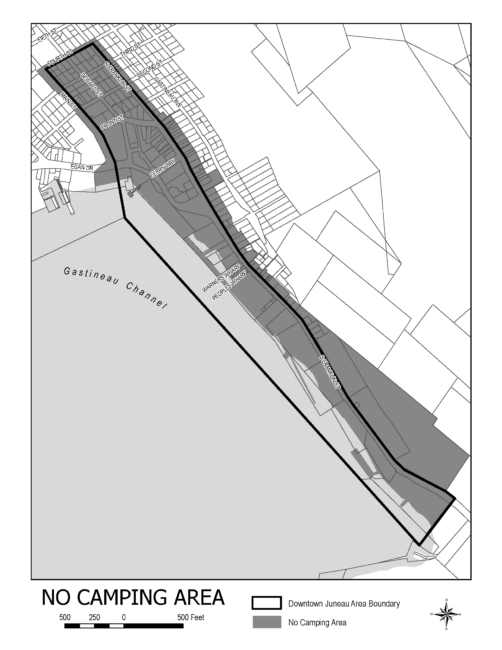
The ordinance as proposed would make it an infraction to sleep on the street between midnight and 7 a.m. in the downtown waterfront between Fourth Street and the cruise ship terminal. (Map courtesy of City and Borough of Juneau)

But advocates for the homeless disagree that an anti-camping ordinance is part of the solution to a wider problem.

Mandy Cole, chairwoman of the Juneau Coalition on Housing and Homelessness, told the Assembly that existing laws already criminalize vandalism, public intoxication and other nuisances that are drawing the bulk of complaints.

“Our public safety obligation is not to criminalize the behavior that is the very last refuge of somebody that doesn’t have any other options,” Cole said. “Adding tickets or adding fines to someone who is already at the end of their rope is, you know, it’s not something that is going to benefit any of us. We’re still going to have the essential problem.”

The overwhelming testimony Monday night was in opposition to the ordinance. Some of this came from the homeless community. One of those was Mary Bailey, who stays in the downtown shelter but said she herself had been forced to sleep outdoors.

“I ended up sleeping on the cement in a doorway and that’s very dangerous for a woman to be like that and scary,” she said. “I’m not a vandalous person, I’m not trying to mess up someone’s place. I’m just trying to survive.”

The ordinance is scheduled to go to a full vote on Jan. 23 after the Assembly holds a public hearing.

Editor’s note: This story has been expanded.

Ketchikan High School club donates pie proceeds to Pioneers

Every November, just before Thanksgiving, Ketchikan High School’s Rotary Interact club – the high school version of Rotary – organizes a pie auction. Money from the auction goes to the Ketchikan Pioneers Home, and usually the students are able to raise a couple thousand dollars.

This year, they raised the most money ever. In a special ceremony on Thursday, three graduating seniors from Interact handed over a check for Pioneers Home seniors.

Kayhi Rotary Interact members Angie Gomez, Alison Blair and McKenzie Harrison are ready to present a big check to the Ketchikan Pioneers Home. (Photo by Leila Kheiry)

Kayhi Interact co-presidents Angie Gomez and McKenzie Harrison, and past-president Alison Blair were all smiles as they presented a gift-wrapped big check – suitable for photos – to members of Ketchikan Pioneers Home’s resident council.

The residents, too, smiled as they unwrapped the early Christmas present. The big check – and the normal-sized official check – was for $3,375. Gomez said they raised that much because they had so many pies donated to the auction by Ketchikan’s generous bakers.

“I don’t even know how many pies we had – there was a lot,” she said. “We had more than we’ve ever had this year, which was great.”

The money will go into the resident council’s activities fund. Pioneers Home activities director Hilary Koch said that helps pay for all kinds of things that aren’t funded through the ever-shrinking state budget: Holiday decorations, for example, and bingo prizes.

“All kinds of supplies,” she said. “Newspaper and coffee supplies – a newspaper subscription. Cat food – we do have a cat, we have two birds, we have probably seven fish – nail polish and spa supplies,” and arts and craft supplies, even furniture.

Koch said the pie sale and the annual Pioneers Home garage sale are two big sources for that fund, along with individual donations from people in the community.

After the brief ceremony, Gomez, Harrison and Blair gave a few more details on the pie auction. They said Marna Cessnun’s pies raised the most money, as they do most years.

“I think it went $200 – almost $300,” Gomez said of the most expensive pie. “That was a cherry pie or an apple pie? (She made both) Her pies both went for a lot, but that cherry (or) apple pie – we don’t know – it definitely went for the highest.”

Harrison said Dick Miller’s pies also went for more than $200 apiece. Those also were classic cherry and apple. In fact, there were a lot of apple pies, and they sold well. But, she said, “We also had some rhubarb pies, cherry, pecan.”

Pioneers Home residents with the big check, representing the proceeds of this year’s Rotary Interact pie sale. (Photo by Leila Kheiry)

“Lots of apple, though,” Gomez said.

“There was a freezer one – a s’mores pie,” Harrison added.

Gomez said, “We had some cheesecakes too.”

“Another surprising seller, you could call her and ask her to make a certain type of pie, so it was an empty pie dish,” Harrison said. “That was a good seller. It ended up being an apple, though.”

Getting hungry? Let’s talk about something else, then. Like TAFCOM. That’s a non-profit organization in Tanzania. Here’s Gomez, explaining how Kayhi’s Interact helps that group: “There’s different groups in TAFCOM – there’s the education one and we mostly fundraise for the education: Schools and supplies and whatever they need for their schools.”

To do that, Gomez said, women in the Tanzanian villages make various items, such as scarves and bags. Interact sells those items here in Ketchikan, and then sends that money to TAFCOM for specific projects.

“We just recently sent them $1,500 because they need to furnish a school that they haven’t furnished yet, so that’s going to desks and school supplies and whatever else they need,” she said.

Blair said helping others is part of why she has enjoyed her four years with Interact.

“I like giving back to both the community I’ve grown up in and also our global projects we do, especially in Tanzania,” she said. “It’s just an amazing feeling you get when you help others.”

Gomez said she especially enjoys the various opportunities for community interaction.

“The activities that we do – the pie auction is one of my favorites – the Winter Arts Faire just gets you in the feeling for the holidays, TAFCOM is an amazing organization,” she said. “Just being able to say what we do and how it affects people; it’s really just great.”

Harrison said she feels blessed to be able to help others, and she appreciates the ongoing community support of Interact’s efforts.

“I would like to thank everyone who donates money, time and pies, also with buying the items,” she said. “I know sometimes it’s kinda the same items every year but people still tend to support us and we’re very grateful for our community’s help.”

This is the last year of Interact for the three seniors, which made the pie auction’s success somewhat bittersweet.

There is a college version of Rotary called Rotaract, which they say they might try to organize if their colleges of choice don’t have one already.

Juneau Assembly adopts housing plan, but excludes it from comp plan

Coogan Construction's 24-unit Island Hills apartment complex in West Juneau as it neared completion in February 2014. (Photo by Casey Kelly/KTOO)
Coogan Construction’s 24-unit Island Hills apartment complex in West Juneau as it neared completion in February 2014. (Photo by Casey Kelly/KTOO)

The Juneau Assembly has adopted its long anticipated housing action plan, albeit in a squishier form than originally intended.

The assembly adopted the plan in a 7-1 vote on Monday with a resolution crafted specifically to exclude it from the city’s comprehensive plan. Planning commissioners and professional staff use the comp plan to guide recommendations and decisions on land use in Juneau.

The 68-page housing plan contains findings about the local housing market, policy ideas and action recommendations with an overall goal to make homes more affordable in Juneau.

Assembly member Jesse Kiehl spoke to his vote.

“Even if it’s not quite how I wanted it, I think it’s time to get moving toward implementation,” Kiehl said.

Loren Jones was the dissenting vote. He said he was unhappy that it’s being left out of the comp plan.

The assembly threw out an ordinance to fold it into the comp plan at a meeting last month, amid debate from the prevailing side that included misinformation and hyperbolic statements.

Debbie White was the harshest critic last month. She’d suggested city staffers were obstructionists when it came to homebuilding. Monday, she had a markedly different tone. She said she’d had a four-and-a-half hour meeting with the city’s chief housing officer to talk about the plan and as a result, she ticked off several specific pieces of the plan she wanted to revise in committee.

“I just felt that it needs to be fleshed out a little bit more, and I feel that the housing director and I did make some forward motion on it, and definitely, still working on it,” White said.

Her motion to kick it back to committee failed in a 4-4 vote.

Assembly member Mary Becker was absent. She’d made the motion last month that excluded the housing action plan from the comprehensive plan.

Successes and shortcomings in Anchorage’s homelessness strategy

As the year comes to a close, Anchorage officials are taking stock of the city’s problems with homelessness.

Several assertive measures to connect people with housing and social services are succeeding, but the coordinated effort is showcasing just how much work is left to do.

A Wednesday meeting of the Assembly’s committee on homelessness put on display the measurable gains being made by city programs, and also where critical gaps remain.

Assembly members were briefed on a number of programs implemented over the last year, which included a lot of good news.

Dozens of people have been moved into housing since this summer.

Coordination among city services and non-profits has created a list of 250 vulnerable adults, including their names and needs based on comprehensive assessments.

A number of experimental programs are showing positive results.

One is a work-van program run by a company called Alaska WorkSource.

This fall, staff picked up individuals living or panhandling on the street and brought them to work sites.

Reporting by the Alaska Dispatch News recently uncovered questionable practices handling a no-bid contract from the city worth $75,000.

WorkSource’s Executive Director Darryl Waters took issue with the claims during remarks at Wednesday’s meeting, and stressing that what matters more is the half-dozen people who have gotten sober and found employment in the four months since the program launched.

“That’s how we roll, we don’t do a lot of technical stuff, we get right to the matter: ‘how do we help you?’” Waters said.

Five of the people who have gone through the program joined Waters in the audience.

The committee’s chair, South Anchorage Assembly member Bill Evans, is pleased with AlaskaSource’s results, which he held up as a compassionate and cost-effective way of getting people off the streets.

“But that doesn’t give us a pass,” Evans said. “Even (though) we’re working for a good end we’re still subject to public scrutiny because we’re using tax-payer dollars, so we have to be willing to take that level of scrutiny or criticism.”

Addressing Waters’s objections to the reporting about his venture, Evans offered his own diplomatic interpretation: “If anything the criticism seems to be directed mostly towards the city, the Assembly, whoever granted the contract on a no-bid basis, and whether we rushed into that or not.”

Much of what the committee heard was that some of the city’s efforts to gather data on the extent of Anchorage’s homeless problem and deal with it comprehensively are working too well, in that they’re giving stretched employees and services more work than they can handle.

One example is homeless camps: a systematic approach to locate, log and clean up camps has nearly tripled the amount of material hauled to the city’s dump over last year.

So far, 138 tons of debris have been removed, according to the city’s Parks and Recreation Director John Rodda. The demands placed on staff from the aggressive new approach were, Rodda said, not physically possible.

The increased focus has exposed other over-burdened services as well.

Alison Kear, the executive director of Covenant House, told Assembly members that not only are overnight shelters unable to house everyone in need amid an ongoing cold snap, but it’s often non-profit employees who are picking up the slack.

“We’re asking organizations to function over-capacity, and we’re calling it a ‘municipal cold weather plan,’” Kear said. “The organizations are funding the back-bone of this, and it needs to change.”

Kear also spoke of critical missing gaps in the city’s social safety net and ability to get people stable on the way into housing.

Chief among them is a shortage of detox beds and substance abuse resources.

To make the point, Kear put a tan grocery bag on the conference table.

Inside, she explained, were the cremated ashes of a 23-year-old who died of a heroin overdose Dec. 3. The young man was Tucker Sauder, son of Lisa Sauder, the executive director of Bean’s Cafe, a local soup kitchen.

“That young man had myself and Lisa, who I feel like is a pretty relentless person. I could not get that kid treatment,” Kear said. “I think there’s something wrong when we continue to fund the pickup of people and we don’t fund what we do after we pick them up.”

The homelessness committee’s next meeting will be in January.

Housing First project organizers seek $100,000 from Juneau community

The Housing First Project under construction on November 17, 2016. (Photo by David Purdy/KTOO)

The Juneau community is being asked to come up with $100,000 in donations toward the $7.3 million Housing First project under construction in the Lemon Creek area.

Mariya Lovishchuk heads the Glory Hole, downtown’s emergency shelter. The shelter is managing the new project to provide permanent housing and support services for 32 of the most vulnerable people in Juneau’s homeless community.

“They will have medical attention. They will have mental health care assistance if they want it,” Lovischuk said. “And yes, definitely, they will be permanently housed. It won’t be a shelter like the Glory Hole.”

She said the 32 people who’ll be housed have been homeless for an average of 9-and-a-half years. The facility is slated to open in late spring.

“We have walls and we have rough framing done for rooms. We have the majority of the roof done, which is great, because it’s definitely snowing outside,” Lovishchuk said.

Amy Skilbred heads the Juneau Community Foundation, one of many nonprofits helping out. She’s working on raising the money for the community’s portion of the project.

Skilbred said the Benito and Frances C. Gaguine Foundation helped out with a $45,000 matching grant.

“It’s great to have that so that we can spur on community donations to help meet the cost of the — the sort of the final cost for this project,” Skilbred said.

Skilbred hopes to hit the $100,000 goal in January, ahead of the May opening. As of Tuesday, they’re about 3.5 percent of the way there.

Skilbred and Lovishchuk were speaking as guests on “A Juneau Afternoon” last week.

The Juneau Community Foundation is taking donations for the project directly, and through the crowdsourcing site YouCaring.com. You can find out more about the project at JuneauCF.org.

Winter has a different meaning for Juneau’s homeless

It’s cold in Juneau. Earlier this month, the city saw one its heaviest snowfalls in at least a couple of years and, according to the National Weather Service, temperatures ranged between the teens and the mid-20s.

Karli Phillips was sleeping outside.

“Oh my gosh, so that storm, we were actually sleeping way under a dock and it just got drenched,” Phillips said. “This is like 3, 4 o’clock in the morning. We’re soaking wet, shivering and everything (was) just gushing water.”

Phillips is homeless and she regularly comes to the Glory Hole, one of Juneau’s few homeless shelters, for food and to get warm. She said that night she didn’t even go to sleep.

“So, I ended up just shivering in a doorway under some sheets I found,” she said. “I feel bad because I think I took them from somebody but, I didn’t sleep that night because I was afraid I would die.”

Winter months are an especially dangerous time for Juneau’s homeless population.

Rose Lawhorne said if you’re sleeping outside on a night like Phillips just described, dying isn’t far-fetched.

“Weather and temperatures down around zero or in the teens like we’ve had them, or with lots of snow, or wind … even damp clothes really contributes to life-threatening hypothermia,” Lawhorne explained.

She is a nurse and supervisor in the Emergency Department at Bartlett Regional Hospital.

She said during winter, homeless people can get hit hard.

“More affected, colder, more illness during the winter months,” Lawhorne said.  “We’ll start seeing them multiple times in a day, hungry and cold just looking for a way to get out – out of the elements.”

Rose Lawhorne is an RN and supervisor in the Bartlett Regional Hospital Emergency Department.
Rose Lawhorne is an registered nurse and supervisor in the Bartlett Regional Hospital Emergency Department. (Photo by Quinton Chandler/KTOO)

Lawhorne doesn’t know how many people come into the ER for exposure because those cases aren’t always captured in the hospital’s records.

“But what I can tell you is we get many patients every day who are brought to us by either Rainforest Recovery,” she said. “They walk in themselves, they’re brought by friends or family who are concerned, or JPD brings them to us and that is multiple times per day,”

Lawhorne said the range in conditions is huge. Some people are just cold and hungry and some are literally freezing to death.

At the Glory Hole, Executive Director Mariya Lovishchuk said the shelter has 40 beds for overnighters and during the winter they’re usually over capacity.

“We don’t turn anybody away for the lack of beds,” she said. “So last night we had 46 people sleeping here, so if we don’t have beds we put people on the floor.”

Glory Hole executive director Mariya Lovishchuk is the president of the newly formed Front Street Health Center board of directors. (Photo by Lisa Phu/KTOO)
Glory Hole Executive Director Mariya Lovishchuk in November 2013. (Photo by Lisa Phu/KTOO)

Lovishchuk said they give breathalyzer tests every night so people who have a blood alcohol level over 0.1 aren’t allowed in that night. People can also be suspended for longer periods.

“When people commit violent offenses or exhibit behavior that is really frightening toward other patrons or staff, they do get suspended from here,” Lovishchuk said. “I think we have two or three people who cannot get any services here.”

She said the Glory Hole is the only short-term shelter that takes men, women and children in Juneau, so unless suspended people and people who choose not to sleep in the dorms have somewhere else to go, they’ll end up outside. Phillips chooses not to sleep in the shelter.

“I actually haven’t gotten sick from sleeping outside. I’ve gotten sick from sleeping in here,” Phillips said.

She claimed the dorms’ air quality is poor and they get overcrowded.

“People don’t regularly bathe or wash themselves,” she said.

Another person said they didn’t sleep in the shelter because they kept getting into fights and being outside was easier even though it’s clearly dangerous. Phillips and others said when they’re outside, they have to wear a lot of layers and sleep under multiple blankets, sleeping bags and comforters – anything to stay warm.

Recently there was a rumor that a homeless man died sleeping on the street. An officer in the Juneau Police Department has said it’s just a rumor. Lovishchuk said she spent three hours trying to confirm it and now also thinks it’s just a rumor, but she said it definitely could happen.

Site notifications
Update notification options
Subscribe to notifications