Organizers of the Juneau Project Homeless Connect outreach event held last month have released numbers and related data on who attended. Most were in their 40s and identified as Alaska Native.
In the data released Friday, 238 people were counted, including 50 people living in a place federal housing authorities says are not meant for habitation.
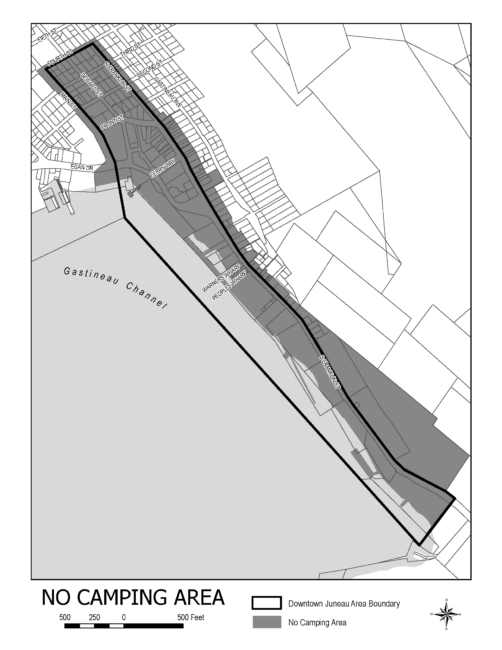
The Juneau Assembly is slated to debate an anti-camping ordinance on Monday that would ban people from camping in the downtown core. Merchants say it’s necessary to prevent homeless people from sleeping on private property and so employees feel safe.
The Alaska Coalition on Housing and Homelessness opposes the ordinance. Executive Director Brian Wilson says the latest numbers run counter to the perception that the homeless population downtown has become younger.
“There’s a narrative going around that this is a new phenomenon in Juneau,” Wilson said. “But overall if you look at the numbers, it’s primarily individuals who have been experiencing homelessness for more than a year. … Two-thirds identify as Alaska Natives and are over 43 years old on average.”
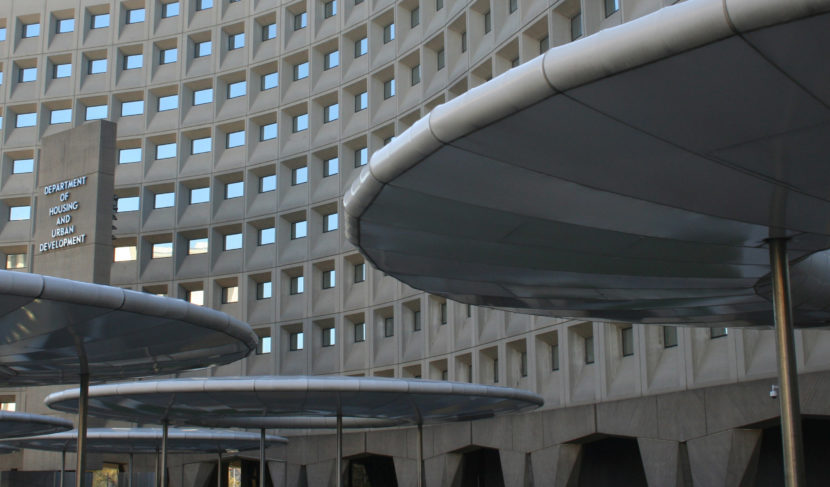
The headquarters of the U.S. Department of Housing and Urban Development in Washington in December 2006.(Creative Commons photo by David)
An ordinance to ban the homeless from camping in the downtown core continues to generate controversy. Now there’s questions over whether a ban could affect the community’s access to federal housing dollars.
There’s been a lot of outcry over a proposed ordinance that would ban homeless people from camping in Juneau’s downtown core. Proponents say it’s a public safety issue. Opponents say a camping ban would just move the problem around.
“The board made the decision that we were in support of the ordinance and I personally feel that was the right decision, not everybody on the DBA feels that way,” said Eric Forst, owner and manager of the Red Dog Saloon who penned the DBA’s letter of support for the ordinance.
He said it’s a complex problem and one that needs a lot of work.
“On either side of the issue we all feel that this not the silver bullet,” Forst said. “This is a step — there’s a lot more that needs to be done.”
He’s operated downtown businesses for about 20 years. There have always been homeless people around but that in the last 18 months or so it’s changed.
“(There’s) a younger, meaner more aggressive element that does not want to be helped — and that’s what this is targeted at,” he said.
In recent weeks a number of social care organization have testified that a camping ban wouldn’t solve anything and would waste police resources.
Homeless residents have also weighed in. Mary Bailey, 46, has recently been staying at the Glory Hole downtown shelter though she said she’s had to sleep by downtown storefronts.
“I mean, that’s the only thing that can protect us from the weather so I mean what’s going to happen?” Bailey said. “I mean, we need something what about a tent city? And if that law goes through, why don’t they put a tent city first?”
The city is working behind the scenes to identify a year-round campground. But that takes time. Rezoning would be at least several months away. City staff has proposed delaying any camping ban until mid-April when the city-run Thane campground reopens. It’s in an avalanche zone, so it closes down for the fall and winter.
Juneau Mayor Ken Koelsch, ordinance’s main proponent, said pushing the effective date to April 15 as a compromise. He’d like it to take effect earlier.
“We need to deal with our homeless problem,” Koelsch said. “We need to deal with our safety problem and we need to deal with both of them right now. And that’s the perspective I’m taking on it.”
“In Juneau we have two programs that are operated by St. Vincent de Paul to a total of $130,000 that has over 30 permanent supportive housing units in place,” said coalition Executive Director Brian Wilson.
Those funds come from the federal department of Housing and Urban Development, or HUD. In addition to these two resources, the new 32-bed Housing First shelter slated to open in May will likely be applying for federal funds to further expand. These federal dollars will likely be crucial, Wilson said, and when it comes to HUD reviewing grant applications in Washington. It’s a numbers game.
“The higher your score the more funding that you receive. The lower your score, you’re at jeopardy of losing funds,” Wilson said.
But could a camping ban really imperil federal funding? HUD, as a rule, doesn’t get involved in policy debates. But HUD officials would talk freely about what approaches to tackling homelessness they encourage — and discourage.
“Most of the evidence shows and most experts would agree that homelessness is not a crime, homelessness is a condition,” said HUD spokesman Lee Jones in Seattle. Congress has appropriated $1.9 billion nationwide for grants to communities dealing with homelessness. Typically 300 to 400 communities — both public agencies and private nonprofits — vie for a slice of the funds each year.
“It’s extremely competitive. $1.9 billion sounds like a lot of money, (but) we do have a fairly considerable homeless problem across the United States, in virtually every community large, small and in between,” Jones said.
How these communities — in HUD jargon they’re called Continuum of Care Programs — decide to deal with homelessness is definitely a factor, Jones said, when ranking funding requests.
“If the continuum has made efforts to essentially address homelessness as a condition rather than a crime they can score two extra points out of the 200 ideally they would need for a perfect application score,” he said.
Juneau Mayor Ken Koelsch
This is an issue some Assembly members want answered before the ordinance goes to a vote next week and city staff are working on trying to get answers.
“I think in order to make that policy decision the Assembly needs to understand that impact,” City Manager Rorie Watt said.
As for Mayor Ken Koelsch, he’s said he’s talked to the city’s DC lobbyist and congressional staffers for clarification but hopes to get the ordinance passed regardless.
“That would disturb me greatly to find out that a city that tries to help its citizens deal with trespassers on private property would suddenly not be received in the same light and that we would definitely follow up on,” the mayor said.
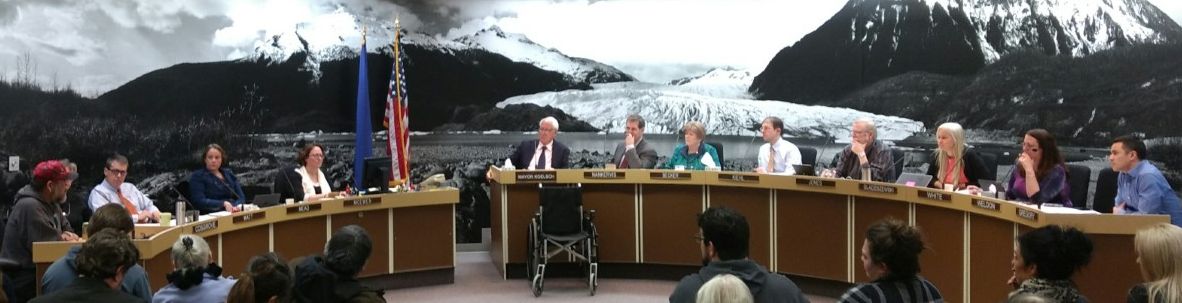
The Juneau Assembly likely won’t take further oral testimony, but with a vote scheduled for Monday, a crowded house is expected.
Juneau homeless resident Everett Johnson, far left, testifies about sleeping on the streets before the Juneau Assembly on Monday. (Photo by Jacob Resneck/KTOO)
That’s following more than 90 minutes of testimony from dozens of residents including merchants, social workers and homeless people.
They all agreed on one thing: Juneau has a serious homeless problem.
But speakers had radically different viewpoints.
Douglas resident Greg Capito told the Juneau Assembly on Monday night that tensions are rising between increasingly desperate people sheltering downtown, and that employees and patrons are increasingly afraid.
“In the last three years, downtown Juneau has changed and, ladies and gentlemen, not for the better,” Capito said. “There’s fear in the eyes of everybody. When you look in somebody’s eyes and see fear you never forget it.”
Other speakers also testified that they were feeling increasingly unsafe downtown, especially after dark.
But 27-year-old homeless Juneau resident Lisa Williams said that if the proposed ordinance is passed, she doesn’t know what she’d do.
“We have nowhere to go. And we’re already homeless,” she said. “If we had money to pay for something we would pay for it. You guys are trying to give us tickets or whatever — but if we’re homeless how are we going to pay for it? We don’t have anything, we don’t have a home. We’re staying in cubbyholes and everyone is saying they’re scared but — we’re harmless.”
Daryl Miller, owner of a downtown commercial printing business, said he likes the idea of more shelter capacity and an emergency warming station. But he’s reached the breaking point with people sleeping downtown.
“I’m tired of babysitting and cleaning up on a daily basis,” Miller testified. “So much so that I will be moving my business in the next three months from its current location, and one of the main reasons is because of the daily cleanup.”
Another longtime homeless resident, Everett Johnson, said elected officials don’t know what it’s like to be destitute and challenged them to put themselves in his place.
For people like him it’s a matter of daily survival, he said.
“You want to get us off downtown? OK — build us another shelter. Don’t make it difficult. We’re already having a hard time,” Johnson said, his voice trembling with emotion. “As I look at every one of you you guys got a bed, a warm place. Not me, not me. As a matter of fact, I brought my bed with me and that’s my sleeping bag.”
The Juneau Assembly concluded the ordinance’s public hearing and is scheduled to revisit the issue at its Feb. 13 meeting.
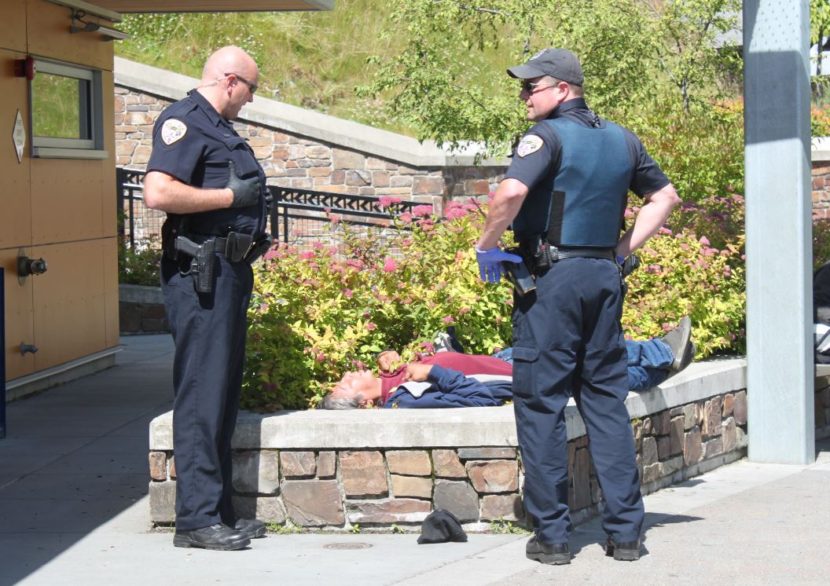
Two Juneau Police Department officers check on a man on Telephone Hill in downtown Juneau in July 2014. A proposed ordinance would empower the police to arrest and charge anyone in the downtown core that refused to move. (Photo by Lisa Phu/KTOO)
The American Civil Liberties Union of Alaska has warned that Juneau’s proposed anti-camping ordinance, drafted to deal with homeless people sleeping downtown, could violate a person’s constitutional rights.
The ordinance would empower police to cite homeless people sleeping in the downtown core in the early morning hours. Failure to obey orders to move would allow police to press criminal charges.
But the ACLU of Alaska says the ordinance may not survive a legal challenge.
“Los Angeles tried to do something similar and when the U.S. Court of Appeals for the Ninth Circuit struck it down, the court said that if a city doesn’t have enough shelter space for everyone and there’s nowhere for our homeless neighbors to go, it violates the Eighth Amendment to punish them for sleeping outside,” Tara Rich said in a statement. She’s the ACLU of Alaska’s legal director.
“What today’s proposed ordinance would do would be essentially criminalize the fact of sleeping, which is a fundamental, biological need for people that literally have nowhere else to go,” ACLU of Alaska Executive Director Joshua Decker said in an interview Monday. “It’s our hope that the Juneau Assembly will heed our constitutional concerns and rather than passing an unconstitutional law that does nothing to solve the problem of homelessness, it will instead refocus its efforts in making sure that everyone who needs shelter has it.“
The mayor introduced the ordinance after hearing complaints from merchants that the numbers sleeping in front of doorways was hurting commerce in Juneau’s historic downtown.
Opposition to the proposed ordinance comes from four regional Alaska Native groups as well as social work agencies that provide emergency shelter and services to the homeless.
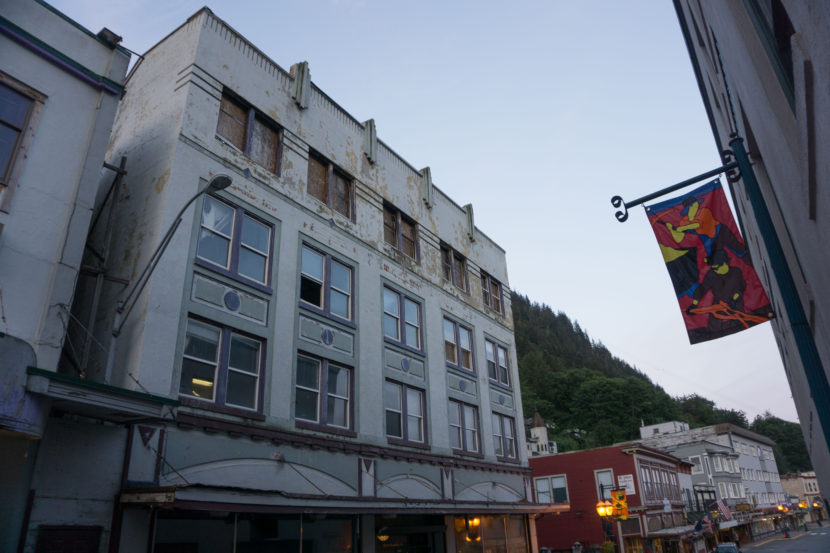
The former Gastineau Apartments on July 21, 2015. The City and Borough of Juneau spent about $1.4 million to have it torn down in February 2016. (Photo by Jeremy Hsieh/KTOO)
It’s been nearly a year since the City and Borough of Juneau demolished the Gastineau Apartments. Now the city is taking the owners to court to recoup some of the $1.4 million spent tearing it down. The apartment building caught fire in 2012, was neglected for years then caught fire again in 2015. The city condemned and demolished it.
The land is vacant while a lawsuit is pending against owners Camilla and James Barrett, who missed several deadlines to repair the property or demolish it themselves.
City Attorney Amy Mead said Wednesday that the Barretts should be held personally liable for repaying the city.
“The cost of the demolition far exceeds the current value of the property,” she said in an interview. “So in order for the CBJ to recover the funds that were spent in abating the public nuisance it would have to look outside the property.”
At issue before Juneau Superior Court Judge Philip Pallenberg is the legal concept of “piercing the corporate veil.” It would allow legal action against the Barretts, who controlled Gastineau Apartments LLC.
Defense Attorney Robert Spitzfaden had argued that the Barretts should remain shielded from liability. But the judge noted that the defendants had allowed their limited liability corporation to be dissolved after missing filing deadlines with the state.
“It’s clear that the Barretts were not always clear to observe the formal legal requirements of their LLC,” Judge Pallenberg said from the bench.
The judge rejected the defense’s motion for summary judgment. The lawsuit is headed for trial scheduled for June.
In a letter to the Juneau Assembly, the leaders say removing campers from downtown district can be done in “a humane and compassionate” way by establishing a campsite elsewhere.
The letter of opposition was signed by Rosita Worl of Sealaska Heritage Institute, Richard Peterson of the Central Council of Tlingit and Haida Indian Tribes of Alaska, Anthony Mallott of Sealaska Corp., and Charles Clement of SEARHC.
Close
Update notification options
Subscribe to notifications
Subscribe
Get notifications about news related to the topics you care about. You can unsubscribe anytime.

 The
The