Housing

What does recidivism mean anyway?

Ideally, when someone gets out of prison, they don’t go back.

In reality, nearly two out of every three offenders in Alaska go back inside within three years.

Some call this the revolving door. The technical term is recidivism.
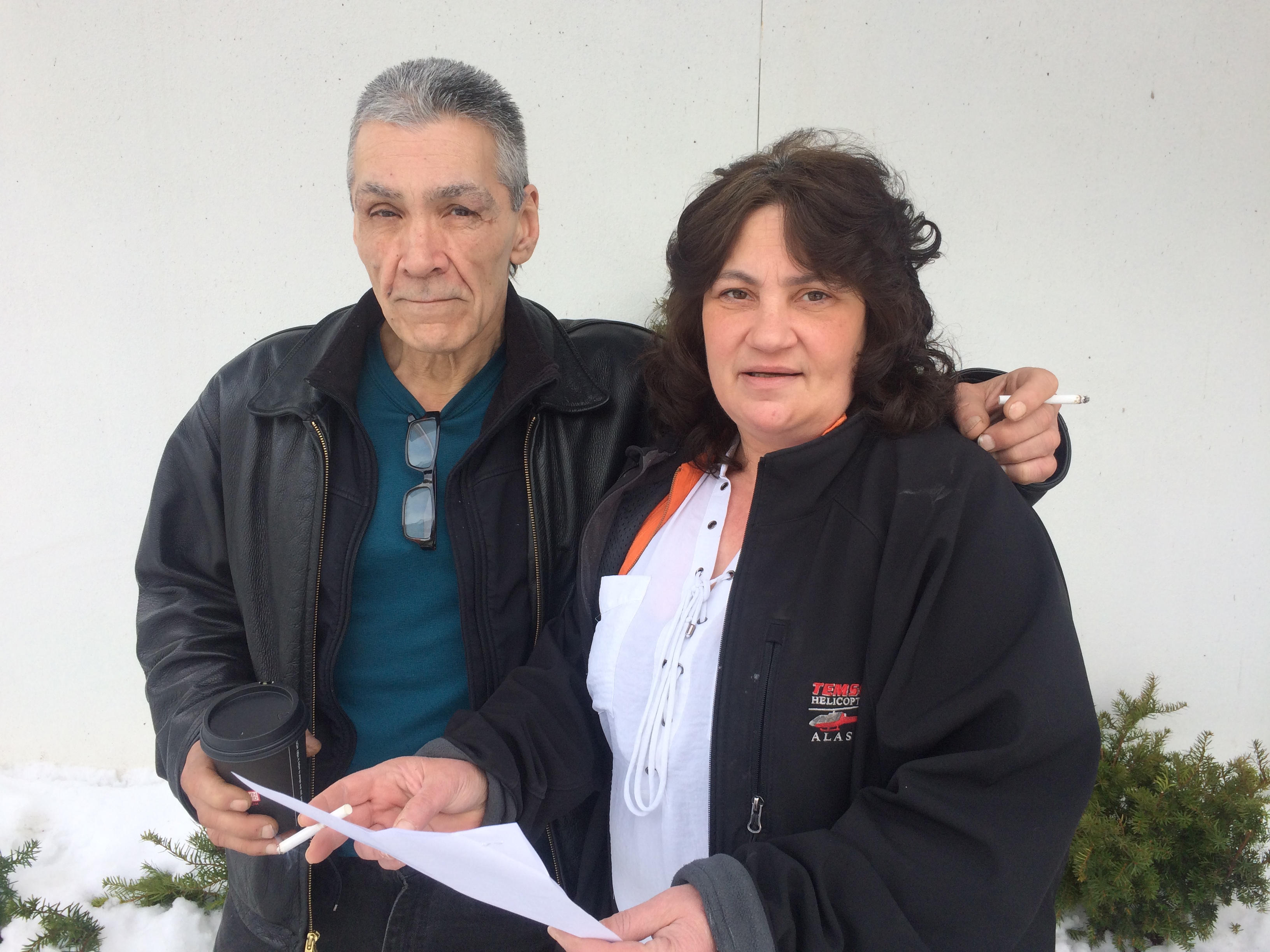
Elasonga Milligrock and Dani Cashen visit outside KTOO. Cashen says felons can be stigmatized by the community. (Photo by Scott Burton/KTOO)

I’ve been through Alaska’s revolving door myself, and hope to bridge the gap between convicts, ex-cons and the communities they’re trying to re-enter.

The Alaska Judicial Council defines a case of recidivism as when an offender is re-arrested, has a new court case filed or is remanded to custody for new charges or for probation/parole violations.

Listen to the story here:

For 25 years, I found just about all of the ways in and out of prison — more times than I care to count. Ironically, I’d never heard the word recidivism. I found I was not alone, so I hit the streets and asked about it.

After asking three random people, not one knew what the word recidivism meant.

At a Juneau Reentry Coalition gathering, it was better understood.

The coalition is a group of people and organizations dedicated to reducing recidivism, among other justice reforms.

I met Logan Henkins, a carpenter and ex-convict, who got it.

Logan Henkins and his girlfriend, LauraLee Peters. (Photo by Elasonga Milligrock/KTOO)

“Recidivism to me is the percentage of people that go into prison and continue to go back after they’re released because of not changing,” Henkins said.

The part about not changing was right on the money for me.

Eventually, I decided to change my ways, got treatment for my alcohol and drug abuse, and now I am staying out of jail.

But, that personal change, was only part of the equation.

When a person gets out of jail, the process is called re-entry — they’re re-entering society.

And I’ll tell you what, it isn’t easy.

It can be like starting a life in a foreign land where the people don’t want you there.

“I am a felon, yes, and I am a recovering addict after five years,” said Dani Cashen, who’s starting a house cleaning business. “I’m still a felon and it still tracks me and haunts me and follows me wherever I go.”

That stigma is something all felons and ex-convicts experience.

Unlike me, with my tattoos, you might not know Cashen had been to prison – unless you’re an employer.

By law, she has to check the felon box on things like job applications.

And then there’s the rest of life’s challenges, like getting housing and keeping up with the conditions of your release.

I’ve been on parole for three years. I check in with my parole officer downtown once a month, can’t leave town unless approved, can’t go into bars, and, I take random drug tests at my PO meetings. I have to obey all state and federal laws.

If I miss or fail any stipulations, it’s back to prison.

If that isn’t hard enough, imagine adding on mental health issues, which might go undiagnosed and untreated in prison.

Bruce Van Dusen is the executive director at Polaris House, an organization dedicated to supporting people with mental illness. (Photo by Elasonga Milligrock/KTOO)

“In general, the story is around the whole country is that the prisons have become the mental health providers,” said Bruce Van Dusen, who is an ex-convict and executive director of Polaris House, an organization dedicated to supporting people with mental illness.

It’s also part of the re-entry coalition trying to stop the revolving door.

“Because they have so many people who are incarcerated who have schizophrenia, or depression, or bipolar,” Van Dusen said.

Thankfully, people like Van Dusen are helping.

And then there’s Ramona Wigg who is a volunteer advocate for people going through reentry. Despite the many challenges, Wigg says she has seen attitudes around reentry shift for the better.

Despite the many challenges, Wigg said she has seen attitudes around re-entry shift for the better.

“It’s just now coming out in the public, so now it’s popular I guess. But it’s important and it should have been popular years ago,” Wigg said. “Think of all the lives we could have saved.”

Confronting and sharing these experiences, including my own, are just a few steps toward understanding and reducing recidivism as a community.

In my next story, I’ll profile a few people staying out of trouble and try to identify why.

This story is part of an ongoing project on re-entry and recidivism. 360 North is also producing a television documentary on the topic slated for June.

KTOO’s project focusing on recidivism is funded, in part, by a grant from the Alaska Mental Health Trust Authority.

Correction: In a previous version of this story Ramona Wigg was misidentified as a mother of a person going through the revolving door. She is a volunteer advocate for people going through reentry. 

Short on volunteers, Salvation Army’s ‘warming center’ winds down

red kettle (Photo courtesy of Salvation Army)
(Photo courtesy of Salvation Army)

A shortage of volunteers means Tuesday is likely the last night the Salvation Army operates its downtown warming station.

The emergency center opened Friday inside the Salvation Army’s downtown church following the city’s condemnation of the historic Bergmann Hotel.

Scores of tenants were displaced in freezing temperatures with 24 hours’ notice after the city ordered the evacuation of the residential hotel over numerous health and safety code violations in the 104-year-old building.

A total of 14 people spent the night in the Salvation Army shelter on Monday, which was originally slated to be the fourth and final night in the Salvation Army’s pilot program.

But the charity’s Lt. Lance Walters says extreme weather conditions and space shortages in Juneau’s downtown shelter caused them to extend the program.

“We decided to do one more day just to give people an opportunity to do more search for housing,” Walters said, “as well as some of those people that are unable to go into the Glory Hole to be able to get out of this weather that we’re experiencing.”

A shortage of volunteers has meant the warming center will likely not reopen this week until the Salvation Army finds people willing to help supervise the shelter overnight.

“We’re dependent on volunteers because my wife and I are currently finding that we just can’t not have sleep,” he said, “and we have to be there because we don’t have approved volunteers.”

The Salvation Army hopes to reopen the warming station soon from 11 p.m. to 6 a.m. on nights with dangerously low temperatures.

To volunteer, call the Salvation Army in Juneau at 586-2136.

‘We’re just out’: Bergmann tenants turn to Salvation Army

Closing the Bergmann Hotel left some of its tenants homeless and now they’re wondering what they’ll do next.

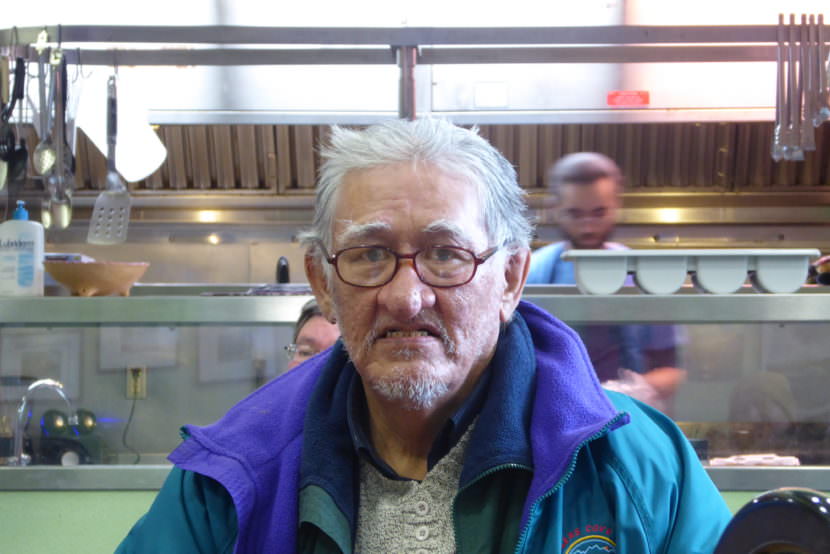
The Glory Hole soup kitchen is the only short-term shelter open to men, women and children in Juneau. It’s the perfect place for Charlie Joseph to stay warm and wait out the day.

Charlie Joseph at the Glory Hole on Saturday.
Charlie Joseph at the Glory Hole on Saturday. (Photo by Quinton Chandler/KTOO)

Joseph was at a barbecue the night police and other officials came to close the Bergmann Hotel. So when he went home, he was surprised he couldn’t get in.

“And I went down there and I seen the plyboards on all the windows and when I went to the front, everything was plyboarded off so I didn’t know what was going on,” he said.

The historic building has suffered from years of neglect and mistreatment. Juneau officials condemned it because the building isn’t safe but for Joseph and other Juneau residents, it was home.

The Salvation Army church opened a temporary warming station downtown specifically for the Bergmann residents, but Joseph didn’t know that until the next morning.

He says he just walked the streets all night. He didn’t get any of his things, including his medicine for hypertension and post-traumatic stress disorder before being evicted.

Juneau officials posted a sheet of paper condemning the Bergmann on Thursday. The paper had orders for all the tenants to be out in 24 hours. They also sent a letter to the owners and the property manager listing 15 ways the building violated city code.

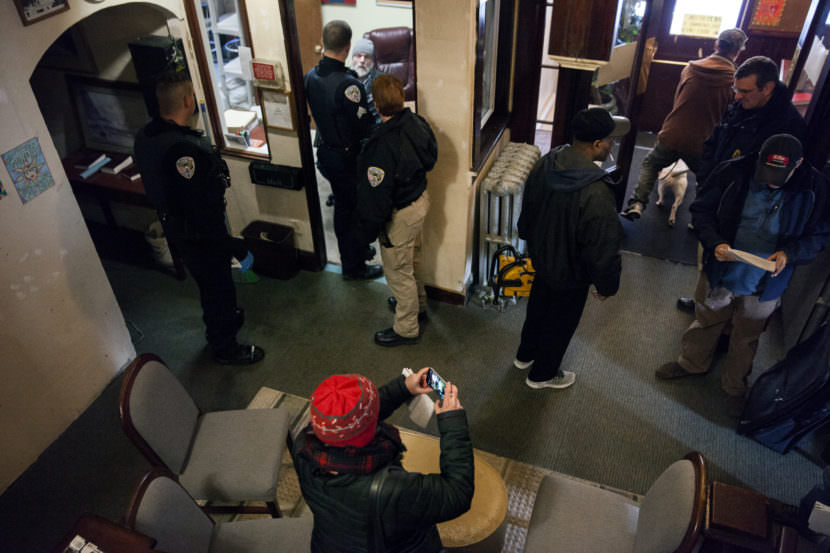
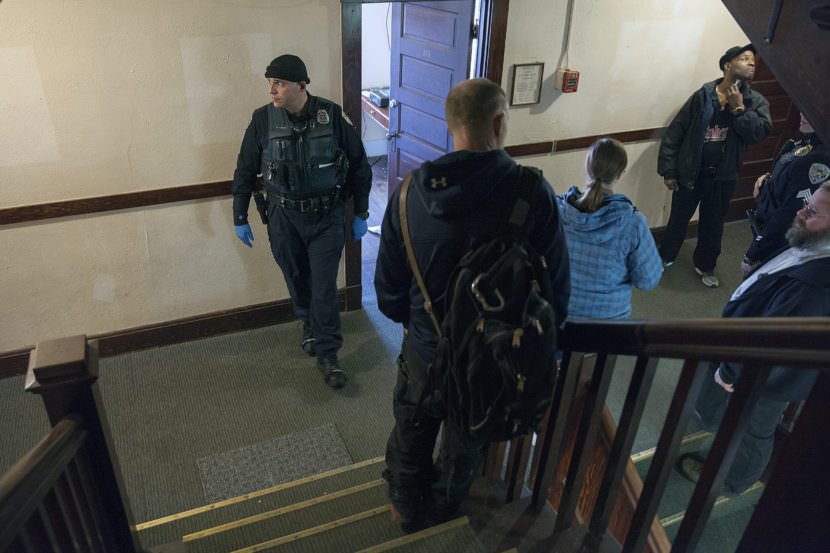
Police, aid workers, journalists and tenants of the Bergmann Hotel gather in the lobby as the building is cleared and boarded up on Friday, March 10, 2017 in Juneau, Alaska.
Police, aid workers, journalists and tenants of the Bergmann Hotel gather in the lobby as the building is cleared and boarded up on Friday, March 10, 2017, in Juneau. (Photo by Rashah McChesney/Alaska’s Energy Desk)

When police cleared the building Friday, they promised Bergmann residents that city officials would let them recover their belongings left in the building.

Joseph says no one told him about the pending closure but he had heard rumors about what might happen.

“Everybody was telling us that that’s what they were going to do, but I didn’t get no paper (and) nobody came and talked to me about it, so everything was up in the air,” Joseph said.

He plans to spend his next night indoors in the warming station in the Salvation Army church’s lower level.

There are seven people sleeping here tonight and four are Bergmann tenants. The night before about 15 people came for soup and seven spent the night. The Bergmann property manager said the hotel averaged 30 residents per month.

Chris Clark is playing cribbage with two friends. He says he found out the Bergmann was being closed two hours before he had to leave.

“There were four fire marshals standing out on the lawn and I asked them what they were doing there and they said, ‘We’re condemning the place,’” Clark recalled. “He said, ‘You need to go up and you need to start packing your stuff because you’re out.’ I paid $750 and they’re not giving me that money back. We’re just out.”

Chris Clark plays card and board games with friends at the warming station inside the Salvation Army church on Saturday night. (Photo by Quinton Chandler/KTOO)

Clark says losing his home has made everything harder.

“I’m not only homeless. I’m homeless with AIDS and I have no clothing, no medication, no anything. I have nothing.”

A Salvation Army volunteer brings Clark tissue so he can wipe away tears. He also has a bad back and is on disability.

“You know, I was really proud of being able to pay for my own home and now it’s gone and so is my money. So yeah, I’m a little upset,” he said.

Clark says he and his friends spent the day at the bus stop where they went to keep warm. He’s thankful for the Salvation Army.

Lt. Lance Walters, middle right, watches a card game at the warming station in the Salvation Army church on Saturday.
Lt. Lance Walters, middle right, watches a card game at the warming station in the Salvation Army church on Saturday. (Photo by Quinton Chandler/KTOO)

Lt. Lance Walters with the Salvation Army says this warming station is on a trial run.

“We’re going to be open from 7 in the evening to 7 in the morning and we’re going to go till Tuesday morning,” Walters said.

Whether they open again depends on how many people volunteer to help.

Walters says the station is a second chance for people who can’t sleep in the Glory Hole. The shelter won’t take people with a blood alcohol level over 0.1.

Walters says the Salvation Army won’t turn away people who are drunk unless they cause too much trouble.

The City and Borough of Juneau’s letter to the Bergmann’s owners gave them a chance to fix the building and open it to tenants in the future.

When each of the 15 violations are fixed, the letter says to contact the CBJ for an inspection.

Alaska Energy Desk’s Rashah McChesney contributed to this story. 

Tenants displaced after Juneau’s historic Bergmann Hotel condemned by city

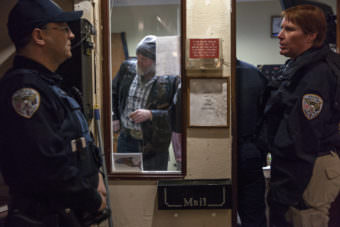
Juneau police and community members look on as residents of the Bergmann Hotel hurriedly packed their belongings and left their rooms on Friday March 10, 2017 in Juneau, Alaska. The building has been condemned and residents were given 24-hours to leave. (Photo by Rashah McChesney/Alaska's Energy Desk)
Juneau police and community members look on as residents of the Bergmann Hotel hurriedly packed their belongings and left their rooms Friday in Juneau. The building has been condemned and residents were given 24-hours to leave. (Photo by Rashah McChesney/Alaska’s Energy Desk)

The historic Bergmann Hotel used as a tenement has been condemned by the City and Borough of Juneau over health and safety hazards.

Tenants were coming to terms Friday with the city’s condemnation order.

Code violations have been ongoing for years, but few tenants realized this was really the end.

I read that sign and walked right past it just like most every other tenants did, probably most of them didn’t even read it — a few of them can’t,” said Dave Lane, a carpenter who works as a handyman in exchange for lodging.

The Bergmann Hotel was built in 1913. It’s been listed on the National Register of Historic Places since 1977.

The city says the owners had been on notice since October.

There’s significant health and safety issues at the Bergmann including an inoperable sprinkler system for fire, inconsistent heating, no hot water, sewage issues and improper roofing,” Deputy City Manager Mila Cosgrove said, “All of those issues pose significant risks to the people who are tenants there.”

About 50 people live in the building. Most pay about $600 a month. Tenants do much of the repair and upkeep themselves to keep the heat on and water flowing.

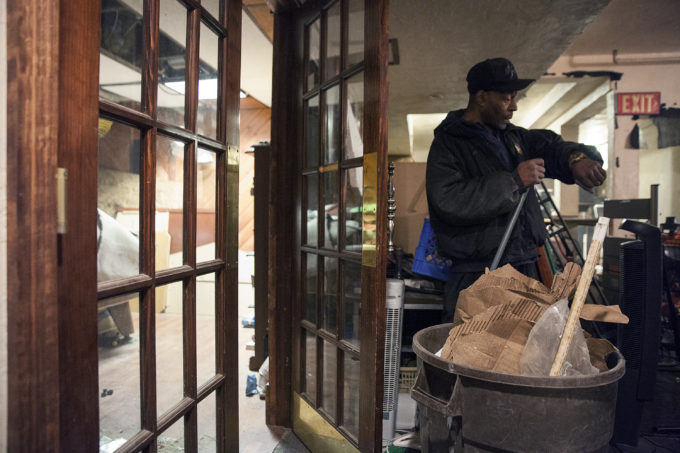
James Cole, 49, said he was caught off guard as he worked to clear out the basement.

“The whole point of it is I just gave them $600 yesterday for rent and the guy — he wouldn’t give me my money back,” Cole said. “I told him, ‘Dude. I just gave you $600 just yesterday.’ Now if I don’t get my $600 back — I’m going to take him to court. I want my money back if I can’t stay here.”

The city said it’s working with social service agencies to help displaced tenants with nowhere to go. As many as 30 spaces have been available at its downtown church.

“We’ll be open every night for them until Tuesday from 7 p.m. to 7 a.m. so they can sleep,” said Lt. Dana Walters of the Salvation Army. “We have cots, we have blankets. People are allowed to bring like one bag with them but then they have to take it. We unfortunately don’t have room for people to store things.”
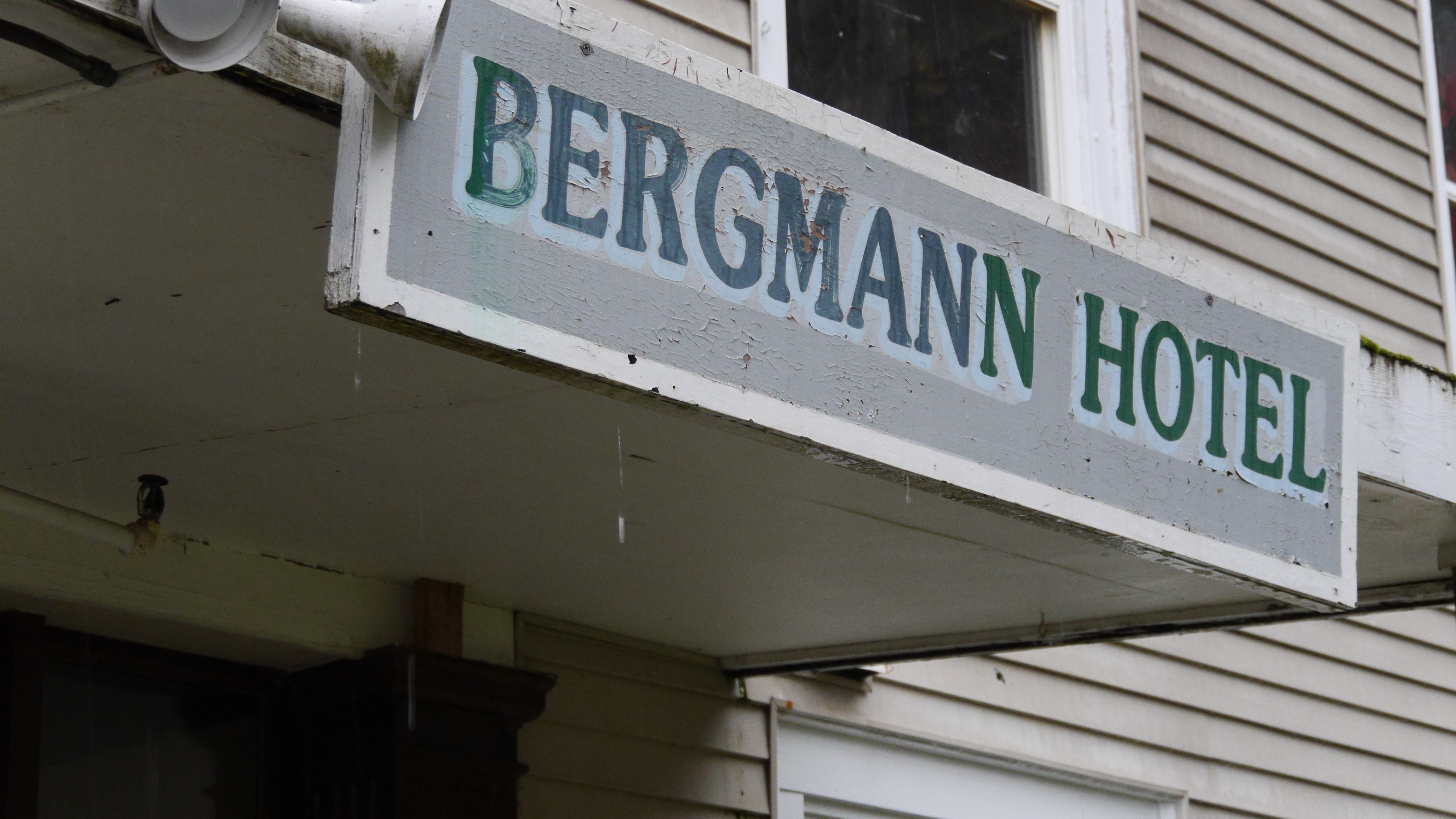
The hotel property is controlled by Camilla Barrett who owns it through a limited liability corporation.

Juneau police officers confer as they take Chuck Cotten, property manager at the Bergmann Hotel, into custody. Cotten was responsible for removing residents from their rooms before Friday in Juneau. The building has been condemned. (Photo by Rashah McChesney/Alaska’s Energy Desk)

Barrett also is a defendant named in a lawsuit brought by the city in its attempt to recover the cost of demolishing the Gastineau Apartments, a fire-ravaged downtown property owned by a limited liability corporation controlled by the Barrett family.

Dave Lane said he’s worked for about three years to try to keep the building habitable.

But there’s been little investment from the Barretts, he said.

“Right now they don’t get a lot out of it so they don’t want to put a lot into it,” Lane said. “They’re not looking into the fact that, ‘Okay — if we put some money into this’ Because I mean, look at this place … it wouldn’t really take that much to put this into — have it a really nice building.”

Efforts to reach Camilla Barrett – whose legal name is listed as Kathleen Barrett — and her attorney that represented her in the city’s lawsuit over the Gastineau Apartments were unsuccessful.

Many of the residents suffer from mental illness and substance abuse.

“We do support safety and things like that. We don’t want to see our mental health consumers housed in a dilapidated situation,”said Gregory Fitch, executive director of the Mental Health Consumer Action Network in Juneau. “But considering the cold — I think we could’ve waited a week.”

The National Weather Service forecasts temperatures to dip into the 20s over the weekend.

Juneau struggles with homelessness and a lack of affordable housing. It remains unclear what options many of these tenants will have after the city boards up the Third Street property.


CBJ: Bergmann Hotel shutdown and evictions imminent due to health and safety problems

Sign above the Bergmann Hotel's front door.
Sign above the Bergmann Hotel’s front door. (Photo by Quinton Chandler/KTOO)

Update | 10:48 a.m. Friday

Deputy City Manager Mila Cosgrove says the problems at the Third Street property are serious.

“There’s significant health and safety issues at the Bergmann including an inoperable sprinkler system for fire, inconsistent heating, no hot water, sewage issues and improper roofing,” she said. “All of those issues pose significant risks to the people who are tenants there.”

Bergmann Hotel owners have until 4 p.m. today to address the violations or the city is ordering its tenants out.

~ Jacob Resneck, KTOO

Original story | 10 p.m. Thursday

The owner of downtown Juneau’s historic Bergmann Hotel has until midday Friday to address various code violations dealing with health and safety issues — or else the city is ordering its tenants out.

City Manager Rorie Watt said in a written statement that the order was issued Thursday afternoon. He said it came after months of inspections, walkthroughs, and communication with the owner, including fire and building code violation notices dating back to October.

He said the owner was given “ample time to become compliant to little effect.”

Problems highlighted by the city include an inoperable sprinkler system, inadequate heating, no hot water, sewage issues and improper roofing.

The Bergmann Hotel was built in 1913 as housing for miners. It’s been on the National Register of Historic Places since 1977.

If the building must be cleared, Watt said the city is working with The Salvation Army and social service agencies to connect displaced tenants with housing and other assistance.

The building is controlled by Camilla Barrett who owns it through Breffni Place Properties LLC. State corporate records indicate Barrett lives in Edmonds, Washington, and that the limited liability corporation was incorporated in September.

Barrett is also a defendant named in a lawsuit brought by the city  in its attempt to recover the cost of demolishing the Gastineau Apartments, another derelict downtown property owned by an LLC controlled by the Barrett family.

Those apartments became uninhabitable after a fire in 2012. They deteriorated for years until the city demolished them in 2016.

Camilla Barrett – whose legal name is listed as Kathleen Barrett — could not be immediately reached for comment.

Juneau weighs winter campground for downtown homeless

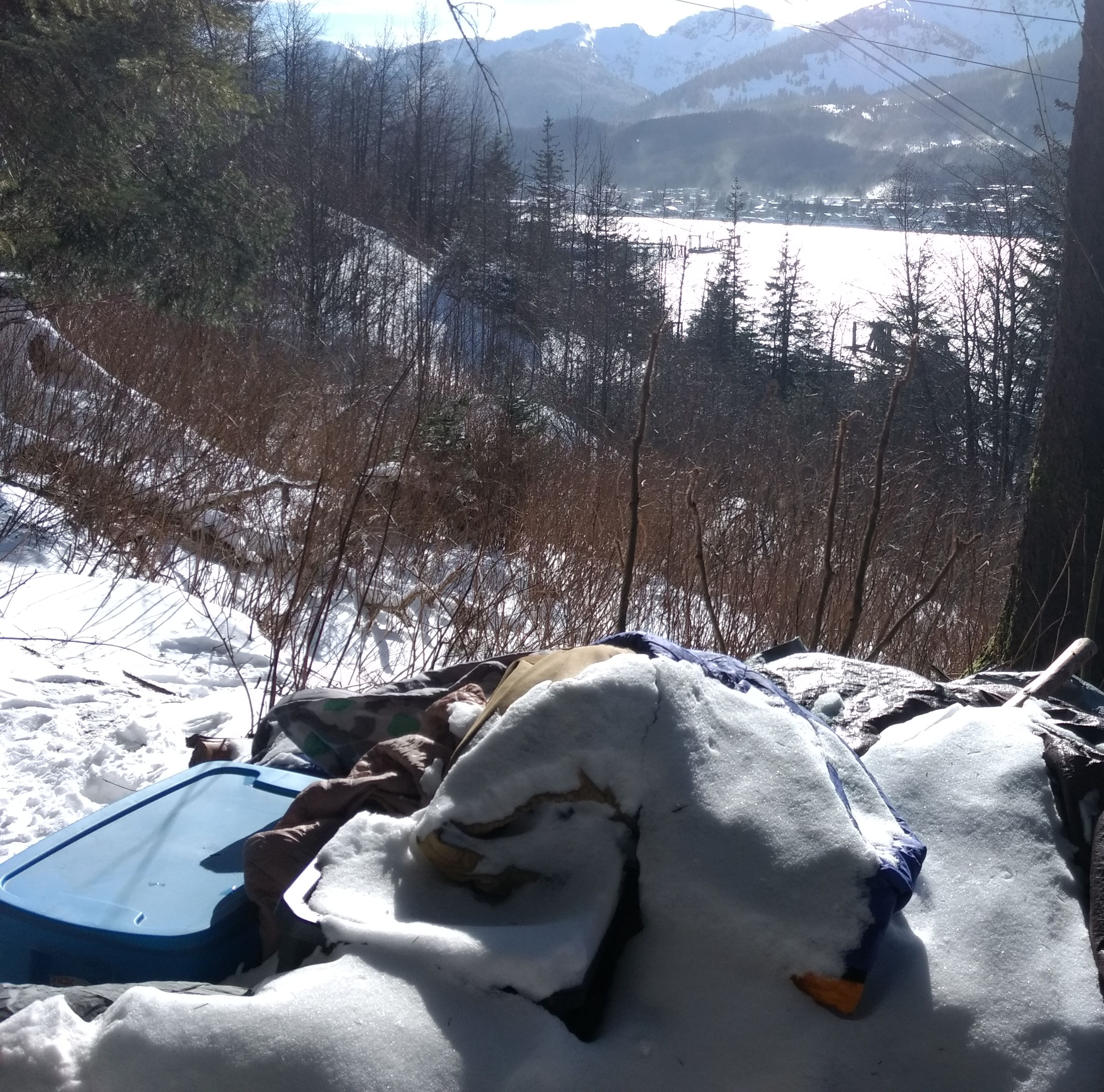
Snow collects on abandoned belongings at a campsite above downtown Juneau on March 3, 2017. AJT Mining Properties evicted its occupants in February. Homeless people have few legal camping options in the winter. (Photo Jacob Resneck/KTOO)
Snow collects on abandoned belongings at a campsite above downtown Juneau on March 3, 2017. AJT Mining Properties evicted its occupants in February. Homeless people have few legal camping options in the winter. (Photo by Jacob Resneck/KTOO)

Next month Juneau’s downtown camping ban goes into effect. Supporters of the ban said it would only be one part of the community’s homeless strategy. Much of the land above Juneau’s downtown is owned by Alaska Electric Light and Power’s sister company, AJT Mining Properties. And in all seasons homeless people erect makeshift camps in the woods on those lands.

Employees of AJT Mining Properties are constantly evicting the people it finds camping on these lands. People often ask where they are supposed to go?

“Many times it’s kind of hard — I personally don’t know what their other options are,” said Alec Mesdag, lands manager for AELP and its affiliated properties. “This campsite was tagged a number of weeks ago,” he said, pointing to a former campsite behind a thicket of elderberries. A mound of gear in totes, backpacks and a collapsed tent still remains.

“We offered a period of time for them to remove their campsite and move along, find somewhere else to go — not that I necessarily know where that other place to go really is.”

After April 15 they will be barred from camping downtown on private property. Mesdag said that AELP has offered the use of about an acre below the former AJ Mill to the city as a winter camping site.

“If we had this time of year a campground that we could direct people to, I think that would make it easier for us to say, ‘Well, you can’t camp here, but you can go over to this other managed campground,'” he reasoned.

The city already runs a summertime campground on AELP land off Thane Road. It’s used as a cheap housing alternative. But it’s also in an avalanche zone, so the city closes it down in the winter.

This proposed winter site isn’t perfect either. It’s an uphill walk from the end of Gastineau Avenue and there can be heavy snow in the winter. AELP is willing to turn it over to the city on a year-to-year arrangement. Mesdag says talks have been ongoing with city staff since December.

AJT Mining Properties, a sister company of Alaska Electric Light and Power, owns this clearing above downtown Juneau, photographed March 3, 2017. The utility has offered the land as a possible site for a winter campground. (Photo Jacob Resneck/KTOO)

“There’s actually an old fire ring sitting out here,” Mesdag said. “It’s been used as a campsite before and we’ve been up here with a number of folks from the city to look at how useful this would be, which parts of this area would be best for setting the actual tent sites, and what type of services we could bring up here.”

The city hasn’t decided whether it’s willing to manage a winter campground.

“The question of whether a winter campground is a good idea hasn’t been thoroughly vetted,” said City Manager Rorie Watt. “When I look around the country other places are actually trying to shut down homeless campgrounds.”

That discussion is slated for a Juneau Assembly committee meeting on March 20.

“There will be a cost to it and there will certainly be some philosophical decisions that have to be made in order to do that,” Watt said. “We’ve got other issues as well in terms of zoning and where you could legally put a campground and some other mechanical questions — but I think the big question for the Assembly is: What is the city’s role?”

Homeless advocates say just doing nothing isn’t an option.

“There will be people who pick up their blanket and move three streets over or to the Marine Park structure,” said Mandy Cole, co-chair of the Juneau Coalition on Housing and Homelessness. “And so it’s not ending homelessness in any way — it’s moving it away from that kind of one visible area.”

She notes that the new camping ordinance is not enforceable on public property. That means campers could move from downtown sidewalks and into city parks.

So if the city doesn’t want campers in parks it will need to create alternatives — a winter campground could be one of those options.

“There are people who live on the street who are looking for a kind of space of their own but not necessarily ready or willing to live in an apartment or participate in a program,” she said. “They want a space that’s theirs. Literally doorway-sized space that they can keep their belongings and themselves safe — for those individuals a campground seems totally reasonable.”

The Glory Hole downtown shelter continues to operate at about capacity. Not everyone can pass the required Breathalyzer test to sleep there overnight and some continue to shelter in alcoves.

On a recent morning 57-year-old Wolf Johnson was gathering up his bedding on South Franklin Street. He says he can’t understand how downtown buildings sit vacant while people like him sleep out in the cold. He says he’s looking forward to the 32-bed Housing First shelter that will open in May. But he complains the Assembly’s camping ordinance ultimately put private property rights over human welfare.

“They say April 15 is coming around,” Johnson said. “Well, we all as homeless, we look after each other. These business people are more worried about their property. Me? I’m homeless and all I worry about is where I’m going to sleep.”

There have also been talks between the city and Salvation Army over operating a warming station when temperatures dip dangerously low. That will also be up to the Juneau Assembly to consider later this month.

Site notifications
Update notification options
Subscribe to notifications