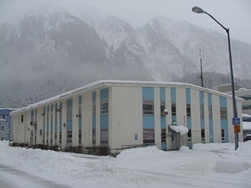
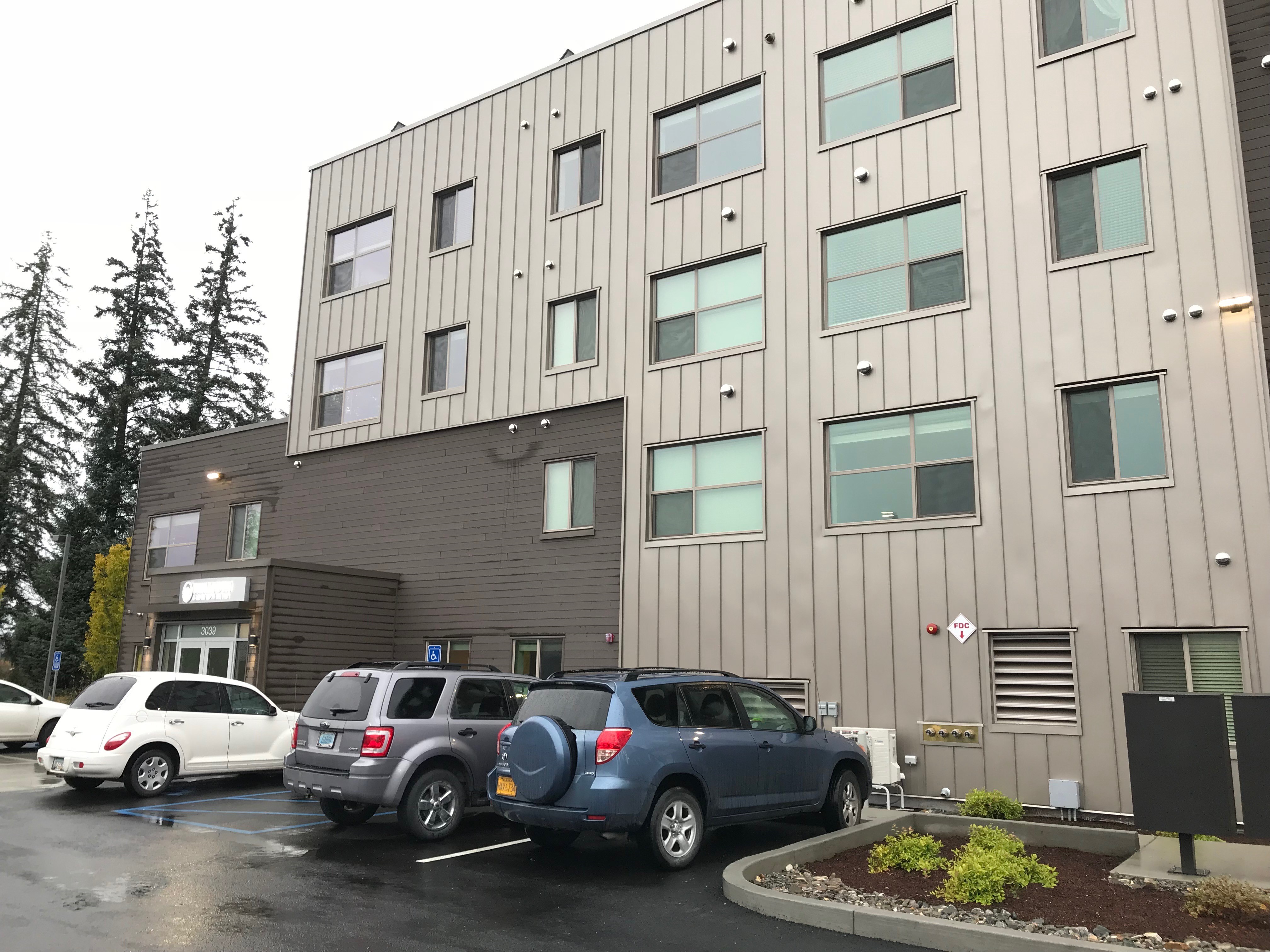
Trillium Landing is a age-restricted housing complex in Juneau that opened in September 2017. (Photo by Julia Caulfield/KTOO)
Juneau’s population continues to grow older: seniors were only 6 percent of the population in 1980, and they are now more than a quarter the population.
Housing is short for older residents. A new apartment complex that opened in September has added nearly a third more independent living units to Juneau’s capacity.
Sitting near the mouth of the Mendenhall River, Trillium Landing is a new apartment complex — including a gym, common area and solar panels on the roof — for people 55 and older.
The 49-unit building has a mix of studio, one-bedroom and two-bedroom apartments. Some are rented at market value.
Trillium gets a federal tax break for renting many of them as affordable housing.
Barbara Oudekerk sits in her apartment at Trillium Landing. The 78-year-old moved into the housing facility after waiting a year for it to open. (Photo by Julia Caulfield/KTOO)
Barbara Oudekerk moved in at the end of September. She said Trillium’s affordability was a major selling point.
“It was so hard to find a place to rent, and a place that would fit my budget … and being a Social Security person you can’t afford a big nice place, but this is just more than I could imagine.”
The 78-year-old moved to Juneau from Haines a year ago to be closer to family after her husband passed away.
She couldn’t find housing at first.
“I waited a whole year for this to come open, and it’s more than I could ever imagine. When I walked in and got to see it for the first time, all clean, and perfect,” she said. “There’s not a thing I would change. … I can’t be more grateful.”
Rain Coast Data director Meilani Schijvens said this isn’t surprising
“The interesting thing about Juneau is if you go back and you look at the 1890 census, the number one thing they talk about there is the lack of housing in this community,” Schijvens said. “You can kind of go and read any document talking about the community of Juneau from the 1890s to now, and housing has always been an issue.”
Schijvens adds that with 50- and 60-year-olds creating the largest age demographic in Juneau, housing that accommodates an aging population is going to become more important.
The apartment complex is only for older people who live independently.
Trillium manager Paula Lindsay has had to turn away people looking for assisted living.
Senior Citizen Support Services is planning to build an assisted living facility near Trillium Landing. They hope to have it completed in early 2019.
Once open, it will be Juneau’s first private assisted living facility.
Laura Cameron displays some of the donuts from her new shop, Dipper Donut in Spenard. (Photo by Anne Hillman/Alaska Public Media)
Cook Inlet Housing has developments across Anchorage, including a new 33-unit building in Spenard.
It’s an area of town better known for funky artists and a colorful past than for state-of-the-art modern housing.
The development doesn’t do much for solving the city’s need for 900 new dwellings per year, but it does help solve a different problem – the deterioration of a community.
“So this was Papa Joe’s – PJ’s – um, shall we say, gentleman’s club?” Tyler Robinson said, pointing to a new development on Deadman’s Curve near the corner of Spenard Road and 36th Avenue in Anchorage.
Robinson is the director of development, planning, and finance for Cook Inlet Housing, a non-profit that builds affordable and mixed-income housing, bought the land at auction from the US Marshals about five years ago.
Robinson said it’s an area with a lot of history – the parcel across the street was a strip club, too. But Spenard also is a place that evokes pride.
A few lots away sits an old post office building. It was converted to offices and shops years ago, but people remember.
“They’ll remember when they had a post office box at P.O. Box Spenard, Alaska,” he said. “And they came and got their mail right here.”
Cook Inlet Housing’s new development at 3600 Spenard Road in Anchorage. (Photo by Anne Hillman/Alaska Public Media)
Robinson said Cook Inlet is trying to make Spenard about more than its past — they want to help give it a bright future.
Over 10 years, Cook Inlet Housing bought up enough parcels at the intersection of 36th Avenue and Spenard to build the new orange and grey, window-filled apartment complex that has retail space on the ground floor.
They also reclaimed a contaminated lot across the street and plan to eventually add another 100 or so housing units to the area.
But their goal isn’t just to be landlords,Robinson said. “Primarily we use housing to develop community.”
Cook Inlet is trying to jump-start Spenard.
“We felt that if we could sort of get things going in the area, then other investment would follow,” he said.
And it has. Up the street from the shiny new apartment complex, Laura Cameron stood in a half-finished bakery.
Dipper Donuts is only partly open for business but they’ve started baking some batches for delivery.
Opening a box of donuts, she pointed out the pale brown speckled old-fashioned cake donut with salted brown butter glaze and the bright purple blueberry option.
She said they have other flavors coming soon, like a rhubarb jelly-filled confection. She tasted it once.
“It was brilliant,” she recalled. “It changed my whole outlook on the jelly-filled donut. I didn’t know they could not be gross.”
The kitchen behind her was already tidy.
Fryers were empty, garbage pails full of flour and sugar were neatly stored beneath metal tables.
The baking crew was gone by mid-morning, having worked through the night in a neighborhood with the aforementioned storied past.
Spenard has a reputation for not being safe, though the city’s crime map puts it on par with many other areas of town.
Cameron admitted crime is a bit of a concern.
“We’ve taken a few steps to get a little bit of training (for staff members). We’ve talked through ‘what if,’” she said.
They have also installed more cameras and are working with neighboring businesses to keep an eye out for things that seem off.
But despite that, Cameron said they specifically chose Spenard for their new craft bakery.
Partly because it’s a good location for delivering donuts and coffee all over town. And partly because its filled with potential, and organizations are investing in the area to improve it.
“The big investment in the road improvements was the first thing I looked at, and then quickly after that, it was ‘Oh yeah, Cook Inlet and Church of Love (community art space) are on to something. They’re investing as well.’ A couple different investments in the community that we could benefit from.”
She said the new developments will bring residents and shoppers to her door.
Tom McGrath owns part of the building that houses Dipper Donuts. He started buying property in the area 30 years ago because he saw the potential even then.
“When we bought those lots back in the ’80s we thought this area is ripe for development,” he said.
He joined a task force to get rid of the massage parlors and sex workers.
Twenty-five years ago, he started pushing for a road redesign that’s just now being built.
“We don’t do things real fast here,” he said.
McGrath is retired now and has sold some of his lots for the new developments.
The new housing is strengthening the neighborhood and bringing in opportunities for new entrepreneurs, he said.
“It only took 30 years but it’s happening. It’s a good thing.”
Sometimes housing isn’t just a solution for stabilizing a family. It also stabilizes a community.
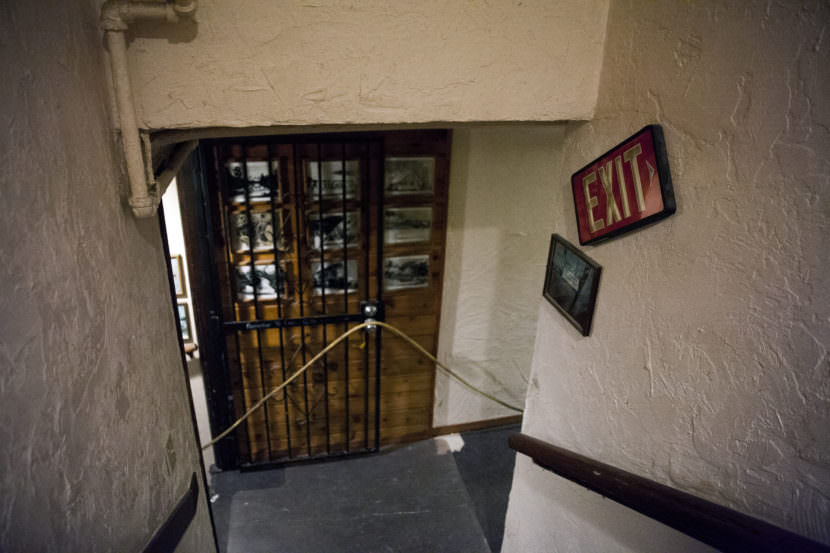
An extension cord runs along a hallways in the basement of the Bergmann Hotel on Friday, March 10, 2017, in Juneau, Alaska. (Photo by Rashah McChesney/Alaska’s Energy Desk)
City code enforcement officers documented widespread problems with the plumbing and heating system as well as fire code violations that led to the 46-room hotel being boarded up.
The property is owned by Kathleen Barrett through a limited liability corporation called Breffni Place Properties.
“The closure presented us with an opportunity to have the building vacant and do some necessary repairs,” David D’Amato, the LLC’s representative, told KTOO on Monday. “Once the repairs were done, it seemed to make very little sense to open it up to the broader, low-income community that didn’t really allow us to get much of the work done that we wanted to get done. We’re going to fix it up to the extend that it’d be attractive to a buyer and let it go.”
The intersection of the Sockeye run and the Chinook run. (Creative Commons photo by Ingrid Taylar/Flickr)
Concern over poor king salmon runs across the state drew a panel of fisheries experts together at a recent meeting in Anchorage.
The event focused mainly on a better understanding of the science behind population declines.
Panelists addressed the elements that play into ocean survivability, like fishing, predation and warming waters.
National conservation nonprofit, Trout Unlimited, hosted the panel.
Austin Williams, the group’s legal and policy director in Alaska, said there are still a lot of gaps in knowledge.
There’s a real need for continued research to address some of the reasons king runs are weaker, Williams said.
“It’s an issue not just confined to Cook Inlet or the Anchorage area,” Williams said. “The Southeast Alaska chinook runs have decreased dramatically and were entirely shut down this year and then some of the runs in Western Alaska have also been declining at alarming rates.”
Williams said the state has successfully managed its fisheries overall.
“We need to continue to do that and we need to continue to recognize that in the lean years when we don’t have as many fish returning as we’d like, we need to curtail back fishing and when we have years of abundance, we need to make sure that we go fishing and enjoy that,” Williams said.
There’s an overlay of politics and policy when managing the fisheries, Williams said, but the panel looked at the things people have more control over, like how ensure that the fisheries remain productive and sustainable.
Panel moderator Dave Atcheson called the event “a start.”
“We’re hoping that this will spawn a whole lot more action and maybe to have a whole full day symposium in the future and also to get groups like Trout Unlimited and other organizations to see what we might do to help support studies that might be needed and that sort of thing to keep our fisheries healthy,” said Atcheson, , a sport fisher and journalist.
Other speakers touched on the importance of freshwater habitat in conserving fish stocks and public involvement in protecting natural resources.
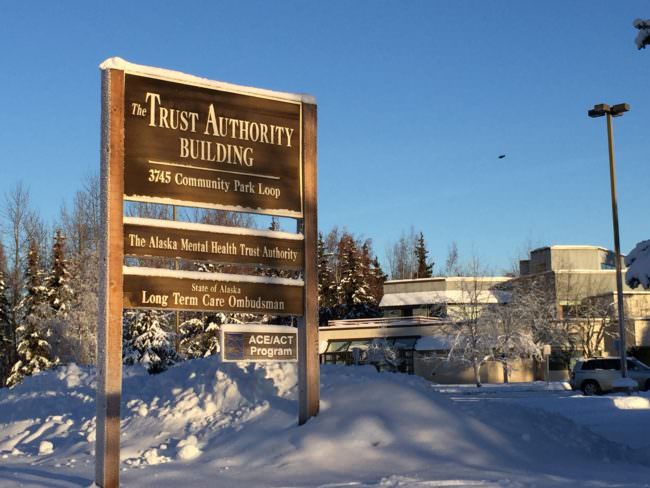
The Trust Authority Building in Anchorage houses their main offices. (File photo by Anne Hillman/Alaska Public Media)
Thanks to a $100,000 grant from the Alaska Mental Health Trust Authority, the City and Borough of Juneau will hire a coordinator for housing and homeless services.
Earlier this month, the Trust Land Office cleared a downtown waterfront lot that homeless campers had occupied. Most campers had left the property by the time police arrived to enforce a trespassing order.
The trust authority’s acting CEO Steve Williams said the trust’s board recognizes that many homeless people are also its beneficiaries with mental illness. The trust funds a similar position in Anchorage and Fairbanks.
“The trustees and the trust felt this was an important project given the homelessness issues that are happening not only down in Juneau but in other areas of the state,” Williams said. “And really trying to provide a resource to the city and borough to have a person on-point to help coordinate the local services so that we can get some better outcomes for the homeless population there in Juneau.”
Juneau’s housing officer requested the grant. The trust authority’s board approved it earlier this month. Williams said it envisions funding the position for three years.
“The second and third year the city will have to come back to the trust for the request, at which point they will review the request again,” he said. “It’s expected that the trustees would continue the funding for the second year and then the third.”
The Juneau Assembly is expected to formally accept the funds next month. The Assembly also is working towards establishing a warming center for mid-November when the seasonal city-run Thane Campground closes.
At this week’s meeting, city staff said $75,000, the bulk of which is drawn from the city’s tobacco tax, could be made available for a warming center to operate for about 100 days this winter.
City staff said time is short and that funding is scheduled to go to public hearing in the first week of November.
The city’s homelessness task force chaired by Assembly member Debbie White is still reviewing potential locations for a warming center. Its recommendations will be brought before the full Assembly.
Editor’s note: KTOO’s building sits on land leased from the Alaska Mental Health Trust Authority. KTOO has also applied for and received occasional grants for special reporting projects from the authority.
Close
Update notification options
Subscribe to notifications
Subscribe
Get notifications about news related to the topics you care about. You can unsubscribe anytime.