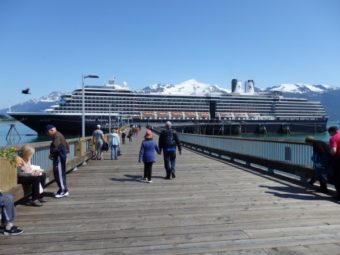
The Emerald Princess is moored at the S. Franklin Street Dock in Juneau in July. (Photo by Tripp J Crouse/KTOO)
Federal prosecutors in an Alaska cruise ship murder case said today they may consider pursuing the death penalty, and the Utah man accused of killing his wife pleaded notguilty.
Kenneth Manzanares, 39, of Santa Clara, Utah, appeared in federal court in Juneau wearing a yellow Lemon Creek Correctional Center jumpsuit.
He cried and wiped his eyes with tissues in the courtroom before the proceedings began.
Manzanares is charged with a single count of first-degree murder. His wife, Kristy Manzanares, also 39, died aboard the Emerald Princess cruise ship in July.
The alleged crime happened in territorial waters, so it’s being tried in federal court.
Anchorage-based U.S. Chief Magistrate Judge Deborah M. Smith read the charges to Kenneth Manzanares via teleconference.
The father of three began crying again, and Public Defender Jamie McGrady put her hand on his back to console him.
McGrady announced the not guilty plea.
Assistant U.S. Attorney Jack S. Schmidt requested time to decide whether to pursue the death penalty. Judge Smith gave him 60 days.
The prosecutor also requested time to review discovery, citing about 100 interviews to review, with many more expected.
Smith scheduled the next hearing for Sept. 22.
Manzanares is being held at Lemon Creek Correctional Center.
Kenneth Manzanares, 39, is charged with one count of first-degree murder in the death of his wife, Kristy Manzanares, also 39, aboard the Emerald Princess cruise ship in Southeast Alaska.
Kristy Manzanares was found dead aboard the ship last month after what the cruise line called a “domestic dispute.”
The Associated Press reported the couple were celebrating their wedding anniversary with family.
Kenneth Manzanares is being represented by federal public defenders F. Richard Curtner and Jamie McGrady.
If convicted, Manzanares could face life in prison or the death penalty, and a fine of up to $250,000.
This design rendering shows how the new Juneau Arts and Culture Center may appear from the Andrew P. Kashevaroff Building. (Courtesy Juneau Arts and Humanities Council)
Project coordinator Katharine Heumann said the decision came after hearing criticism of the proposal from Travel Juneau and members of the community.
“Different people contact you, you have these conversations, and you think you might have support,” she said. “And when you don’t, then you rethink your strategy.”
Travel Juneau expressed concern that the new facility would compete with nearby Centennial Hall for event rentals, and that the higher bed tax rate might discourage event planners from using Juneau as a destination.
After an Assembly committee meeting last week, the ordinance to create a ballot question to increase the bed tax from 7 percent to 9 percent was due for a public hearing and vote at the upcoming Juneau Assembly meeting on Monday. The city predicted the increase would raise $1.6 million over four years.
“We listened carefully to the concerns expressed by Travel Juneau and others in the community, and we want to be part of encouraging travel in Juneau. We believe our new facility will be a great draw to Juneau and we want the community to all be on board with that. So at this time, we’re exploring other avenues of partnering with the city.”
Heumann said the project will still go forward. She said cost estimates will be re-examined in the next few months before drawing up construction documents.
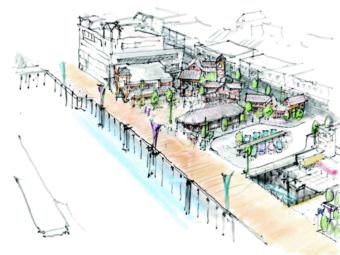
An architect’s rendering depicts the longhouse and other facilities to be built over the former Thane Ore House restaurant as a culture park. The Central Council of the Tlingit and Haida Indian Tribes of Alaska hopes to break ground on the $7 million project this year. (Courtesy CCTHITA)
A former attraction in Thane is slated to be burned to the ground. That’s because the former Thane Ore House property will be the site of a park for Tlingit and Haida culture. A controlled burn will be held to train firefighters.
“The Tlingit and Haida immersion park is a preservation of our culture,” said Annette Ulmer, an economic development officer with Central Council. The 3-acre site is actually two separate parcels. There’s a former restaurant owned by the city. And there’s a former Alaska Electric Light & Power Co. workshop. Ulmer describes the plan from a visitor’s perspective.
“You will enter into the first main building and it will have digital, virtual reality, a video that will explain about Elizabeth Peratrovich, the history of Tlingit-Haida people to give a true historical perspective.”
All of this will be built over the former Thane Ore House, a once-popular shoreside restaurant built in 1982. After the restaurant closed in 2012, the owners were evicted for not paying city sales tax. Ulmer said the tribe realized it had inherited a mess when it took over in March.
The former Thane Ore House restaurant in Juneau pictured on Aug. 8, 2017. The 35-year-old building is slated to be razed in a controlled burn to make way for redevelopment of the site. (Photo by Jacob Resneck/KTOO)
The structure was never built to code. Engineers found major structural problems. Black mold was in the timbers. And it looked like the former owners had simply walked away.
“Oh my gosh! We could not walk in there without respirators on,” she recalled. “When the city closed the doors they literally closed it and did not enter back into that building. So there was standing grease, there was food. It was just left in a real disarray.”
The original plan was for the building to be restored in the style of a traditional longhouse. Now the tribe says it will completely rebuild.
“There have been great memories for people who have come out here to the Thane Ore House when it was the restaurant,” Ulmer said. “But also look forward to the new opportunity you’re gonna see now.”
The property was originally built on state-owned tidelands that were later ceded to the city.
Port Director Carl Uchytil said it was quite a process for the city to take possession of the property.
“Docks and Harbors never really had the authority to enter the building until after the eviction process, and it takes awhile to make things happen,” Uchytil said.
The Docks and Harbor board decided last month to allow the tribe, which now holds a 35-year lease, to burn down the building.
This is a rare opportunity for Capital City Fire/Rescue. Officials said opportunities for controlled burns of structures are becoming increasingly difficult to find.
“It’s an excellent training training opportunity for all the brand new firefighters,” said Fire Chief Rich Etheridge. “Juneau’s growing up so much around everywhere that it’s hard to find a spot where we can burn a building that’s not going to endanger other buildings or put heavy pollutants in a neighborhood that’s going to affect other people – so it’s getting more and more difficult.”
The Thane Ore house was popular for its salmon bakes from the early 1980s up until its closure in 2012. After years of being boarded up the structure fell into disrepair as seen here on Aug. 8. (Photo by Jacob Resneck/KTOO)
The burn plan is still awaiting state permits. Once the building is cleared away, construction can begin to rebuild on the site. Public access on the beach will continue with five public parking spots.
The tribe said it hopes to create a new cultural destination for tourists in the summer and school children in the winter. The cultural park promises to be a prominent landmark from both the land and water.
“If you’ll notice when you come out to this property, there is only one way in and one way out for the cruise ships,” Ulmer said, “and they are pretty slow and this will be a beautiful scene that they will see, first thing.”
Under the lease terms, the tribe will begin paying annual rent of $8,600 for the property next year. It also agreed to pay a $1-per-visitor fee to the city. The tribe hopes to break ground before the end of the year.
Hotel customers in Juneau would pay 14 percent in taxes to the city under a proposal local officials are considering. And they’d help pay for a new and improved Juneau Arts and Culture Center.
According to data city staff collected, Juneau’s hotels would tie for third for the highest combined hotel tax and sales tax rate in the state. The local hotel tax is 7 percent and may increase to 9 percent. The existing 5 percent sales tax isn’t affected by the current proposal.
In committee Wednesday, the Juneau Assembly discussed and amended the proposal to increase hotel bed taxes. Assemblyman Loren Jones proposed the increase last month to raise $1.6 million for a new Juneau Arts and Culture Center.
“My intent is to raise the bed tax, it hasn’t been raised since the mid-’80s,” Jones said. “I wanted a portion of that 1.6 (million dollars) to go toward the JACC. They estimated this would raise about $400,000 a year, so that would be 4 years.”
If the full Juneau Assembly advances the proposal at its Aug. 21 meeting, voters will get the final say through a local ballot question in the October municipal election. As amended Wednesday, the extra 2 percent tax would be in effect from 2018 through 2021.
The travel industry has been concerned about the bed tax.
“Travel Juneau does appreciate the finance committee’s putting a four-year sunset on that ordinance,” said Travel Juneau CEO Liz Perry. “But we also maintain our position that this new facility, the new JACC, would compete with Centennial Hall and that the additional tax burden may discourage planners from selecting Juneau as a meeting destination.”
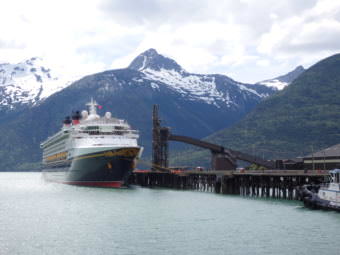
The Norwegian Pearl tied up at Skagway’s Broadway dock in July 2017. Two more cruise ships are moored at the railroad dock in the background. (Photo by Emily Files/KHNS)
Skagway leaders continue to work on a 15-year tidelands lease that would prolong a private company’s control of the waterfront.
Residents will get a chance to weigh in through a public vote.
But the Assembly is now talking about scheduling a special election later in the year, instead of rushing to meet deadlines for the Oct. 3 general election.
Over the last couple months, the Skagway Assembly met many times to discuss the White Pass and Yukon Route Railroad lease proposal. And the tone during public comment has generally become more positive.
“I think you’re making progress,” port commissioner Tim Bourcy said.
“I’m more comfortable than I’ve ever been,” Jan Wrentmore said.
But there are still concerns.
“I want you to be able to work on the lease issues without the feeling of having a ticking time bomb hanging over you,” Elaine Furbish said.
The ticking time bomb here is a floating dock.
Port consultants have urged the city to start permitting and design work on the dock as soon as possible in order to get it built by 2019. That’s when bigger cruise ships that need that infrastructure are due to arrive.
“If you feel rushed, don’t rush,” White Pass President John Finlayson said.
His company holds the key to a majority of the port under a lease that doesn’t end until 2023. In order to allow the city to access the ore dock and build the crucial floating addition, the company wants to extend its hold on Skagway tidelands to 2038, another 15 years.
At previous meetings, Finlayson said White Pass would not work on the floating dock without the new lease.
He indicated Wednesday that as long as a tidelands agreement is in progress, it might be possible to start laying the groundwork for the floating dock.
“Possibly there’s a way to initiate the project, jointly initiate it, with the caveat that the town will vote for a lease,” Finlayson said.
After these comments, the Assembly went into executive session with the borough attorney for an hour and a half. When they came out, they seemed to agree on one thing.
“The timeframe to get this on an October ballot is just not realistic,” Tim Cochran said.
The Assembly discussed holding a special election, possibly in November.
In the meantime, the city’s negotiating team will continue to meet with White Pass leaders, and the Assembly will continue to discuss updates at its meetings.
Changes made to the proposed contract terms recently include a boost in White Pass’ contribution to contamination cleanup at the ore dock. That’s another component tied to the 15-year lease. The railroad would now pay $2.75 million, instead of $2.5 million. The city wants to cap its contribution at $1.5 million.
Another amendment would give the city a more active role in cruise ship scheduling, even though the lease maintains White Pass’ status as cruise terminal operator.
The agreement would require regular meetings between the city and railroad to discuss cruise scheduling and operations.
Continuing White Pass’ control isn’t what everyone wants. But a couple Skagway leaders said without the agreement, the city’s place in the cruise market would be jeopardized.
And that’s a big risk.
“We have incurred an insane amount of debt,” port commissioner Bourcy said.
He referred to Skagway’s bond debt and the town’s reliance on cruise revenue to cover budget deficits.
“Your budgets as they are, are maxed out,” Bourcy said. “You guys are using cruise ship head tax money to pay the bills for this community.”
Bourcy and others disagree with a finding in port consultant Moffatt & Nichol’s reports.
Moffatt & Nichol said if Skagway misses out on the bigger ships that need that floating dock, its overall cruise income will still increase.
But Bourcy says that’s based on a flawed assumption that smaller ships will take the mega boats’ place. He said in order for Skagway to continue paying its bills, the lease with White Pass needs to move forward.
Close
Update notification options
Subscribe to notifications
Subscribe
Get notifications about news related to the topics you care about. You can unsubscribe anytime.