Tourism

Southeast economy down, with a few bright spots

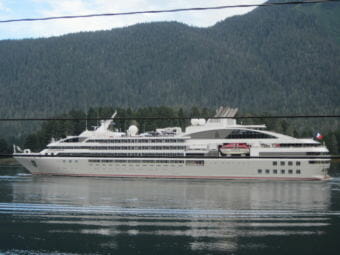
The cruise ship Noordam brought close to 2,000 passengers to Haines on Sept. 20, 2017. It and other ships carried more than 1 million passengers this summer, helping increase the region's tourism economy. (Ed Schoenfeld/CoastAlaska News)
The cruise ship Noordam brought close to 2,000 passengers to Haines on Sept. 20, 2017. It and other ships carried more than 1 million passengers this summer, helping increase the region’s tourism economy. (Ed Schoenfeld/CoastAlaska News)

The loss of state jobs is hitting Southeast Alaska hard.

Tourism has overtaken fishing as the region’s largest private industry. That’s the word from a new report released in September detailing the region’s economic booms and busts.

The region’s total wages and job numbers are down, according to Southeast Alaska by the Numbers, a report covering the 2016 calendar year.

Meilani Schijvens wrote the report for the Southeast Conference, an economic development organization. She presented her findings at its annual meeting in Haines.

The biggest hit is to government jobs.

She said about 30 percent of the region’s 45,000 jobs are in state and local government. Add to that more than a third of its $2.2 billion in wages.

What jobs do Southeast residents have? This pie chart splits up the sectors for 2016. (Graphic courtesy Rain Coast Data.)
What jobs do Southeast residents have? This pie chart splits up the sectors for 2016. (Graphic courtesy Rain Coast Data)

“A lot of people say, ‘Well, people, you know, are retiring,’ or ‘They’ve left their job and it’s not being replaced.’ It doesn’t matter if the actual individual leaving the job isn’t impacted,” she said. “It ends up being a huge hit to our economy.”

Schijvens said Southeast lost 250 state jobs last year and three-quarters that many so far this year.

That’s a total of 750 lost jobs over three or so years, a nearly 15 percent drop.

“The loss of 750 state jobs is equivalent in terms of wages to a large mine being shut down in Southeast Alaska. It’s actually slightly bigger,” she said. “It’s more wages than if we shut down one of our mines in Southeast Alaska. So it is an enormous economic hit.”

Mining jobs, by the way, are up, but only slightly.

Southeast tourism continued to grow in 2016.

The number of jobs went up 5 percent, providing nearly a quarter of the region’s business earnings.

“Our visitor industry, in terms of wages, is now our most important private sector industry for the first time ever,” she said.

Tourism’s relative economic standing rose, in part, because the region’s seafood industry declined.

Schijvens said fisheries jobs dropped by more than 10 percent, and earnings went down by almost twice that amount. The fisheries business is cyclical, so one or two years may not predict a longer trend.

The report shows hits to businesses on land and sea.

“In 2016, shore-based seafood facilities processed 30 percent fewer pounds of seafood than in 2015. And Southeast Alaska state fisheries tax revenue fell by more than 50 percent. These losses are also directly affecting our communities,” she said.

Schijvens said Southeast lost residents in 2016, as it did the previous year. About 650 people moved away.

“Juneau really bore the brunt of those losses. If you look at Juneau, they had their third largest population decline in the history of that community, because they’re really ground zero for state jobs and state wages,” she said.

The biggest population increases were in several small Prince of Wales Island cities, which ranged from 10 percent to 30 percent growth. Gustavus, Skagway, Tenakee, Klukwan and Wrangell also picked up new residents.

Schijvens made some future projections too.

She expects continued decline in government and construction jobs, tied to the lower price and quantity of oil.

Local stores, those not targeting tourists, also will lose some ground, as will timber.

But it’s not all bad.

“We do expect our visitor industry to continue to expand tremendously. We expect our health care (sector) to continue to grow, we expect our mining industry to continue their positive trends. We expect seafood to be a lot better moving forward than it was in 2016. And we expect our maritime industrial jobs to continue to expand as well,” she said.

And how do the region’s industries view the future?

A survey included in the report shows about half of business owners and managers expect things to be the same. A third say it will be better. And the rest say it will be worse.

Ketchikan remains an attractive cruise ship destination

The Borda family disembarks from the Norwegian Jewel on Monday, Sept. 25th. Candy Borda is Ketchikan’s 1 millionth cruise visitor for 2017. (Photo by Leila Kheiry/KRBD )
The Borda family disembarks from the Norwegian Jewel on Monday, Sept. 25th. Candy Borda is Ketchikan’s 1 millionth cruise visitor for 2017. (Photo by Leila Kheiry/KRBD)

The future remains bright for the cruise industry in Alaska, a cruise line association president said Monday during a shared during a luncheon.

Cruise Lines International Association Alaska president John Binkley delivered the optimistic news to the Ketchikan Visitors Bureau and Greater Ketchikan Chamber of Commerce.

Binkley said September 25, 2017, was an historic day as Ketchikan welcomed its 1 millionth passenger for the season.

He then spoke about the economic impacts of the cruise industry to Southeast as a whole, to Ketchikan specifically, and around the globe.

He cited data from a 2016 McDowell Group survey looking at current and projected numbers.

For Southeast, Binkley says total visitor spending in the 2014-2015 season was $1.17 billion. There were a total of 11,200 jobs associated with the cruise industry, and payroll in Southeast amounted to $436 million.

He said this is new money brought into communities.

“No different than mineral extraction or oil development where we send our crude oil outside,” he said. “Money is brought back into the state. It’s the same way with visitors who come up with new money from outside our communities, outside our state, and bring new economic vitality to our state and communities.”

For Ketchikan, Binkley said 96 percent of visitors coming into the First City arrive by cruise ship.

On average, each passenger spends about $160, amounting to more than $1 million each cruise ship day.

“If you’re on Front Street stuck behind a motor coach or waiting for crossing guards to let you through, just think about the million and a quarter dollars,” he said. “That’s $12,500 $100 bills falling out of everybody’s pockets, flying out the windows of those motor coaches, so keep your head down and look for those $100 bills on the sidewalk and see if you can pick up a few of those.”

Binkley said adding the amount of money the cruise lines and crew members spend in Ketchikan amounts to $188 million per season.

Statewide, Binkley says a total of 1,060,000 passengers are expected this year, an all-time record high for cruise ship visitors in Alaska.

Binkley said though cruise ships aren’t seen in Interior communities, they also receive economic benefits from the cruise ship industry.

“But we see about 225,000 cruise ship visitors that get off the ships in Seward or Whittier, go through Anchorage, usually by rail or motor coach up to Denali National Park, and then on to Fairbanks in the Interior.”

Binkley said there are several reasons why there has been growth in the Alaska cruise industry.

They include successful marketing, tax and regulatory stability, and Alaska’s attractiveness.

John Binkley of Cruise Line International Association Alaska speaks at a luncheon with Ketchikan Visitors Bureau and Chamber of Commerce. (Photo by KRBD)

Also, he says recent expansion of the Panama Canal allows more ships to come to Alaska.

“With the new canal, they can bring bigger ships from the Caribbean, in the winter time, right through the canal, into the Pacific and up to Alaska for the summer time,” he said. “That makes a difference as well, getting the larger ships that they can position in two profitable markets in different times of the year.”

Political stability in the country also benefitted Alaska, he said.

In addition, Binkley said the cruise industry is strong globally, especially in the Asian market. Ketchikan holds about 4 percent of the global market, and that percentage is expected to increase.

The demand for Alaska will remain high, Binkley said, and 2018 will surpass 2017 as a record year.

Larger ships, with greater capacity, will be coming to the state over the next two years. Binkley says communities need to be ready to embrace that growth, and have the infrastructure necessary to accommodate it.

“Ketchikan really has been one of the leaders in looking forward to what is going to be needed – planning, making sure they are setting aside the money to be able to fund the infrastructure to meet the demand of the industry. And that really has allowed Ketchikan to grow and have that capacity here to meet demand.”

Binkley said new cruise lines will be visiting Alaska in the coming years.

Windstar Cruises has sailings planned for next season, and Viking, Azamara and Cunard will arrive in 2019.

Can Juneau handle 1.5 million cruise ship visitors? Docks and Harbors says it’s time to plan

A pair of Panamax cruise ships docked in downtown Juneau on Aug. 30, 2017. The floating berths have eliminated the need for yellow security fencing and opened up a wide promenade for pedestrians. (Photo by Jacob Resneck/KTOO)

Juneau could see 1.5 million cruise ship passengers per season in the next decade, according to a recent study commissioned by the city’s Docks and Harbors.

In order to plan for the influx, Docks and Harbors is crafting a plan for the downtown waterfront.

Juneau has invested millions in new floating berths to accommodate bigger cruise ships that tie up downtown.

The floating docks can accommodate four large ships at a time plus one anchored offshore. In real numbers, that’s 10,000 to 15,000 passengers and crew daily.

City Port Engineer Gary Gillette said it was necessary to move with the times.

“The city built these two new cruise berths at the direction of the industry,” Gillette said. “They basically said, ‘We’ve got bigger ships coming and the docks that you have can’t accommodate them.'”

There’s also more space created by the floating berths. Gone is the yellow security fencing.

The long, broad wooden seawalk is a pedestrian promenade once again.

Last year Juneau broke the million passenger mark for the first time since 2009, when the Great Recession hit the cruise industry hard. And the numbers are expected to keep rising.

Gillette said forward thinking is needed for the promenade and the vendors that serve it.

“Rather than just say the first guy comes along, ‘OK, you go over here.’ And the next guy comes along, ‘Well, we’ll put you over here.’ And then in five or 10 years we go, ‘Oh god, why did we do that with no plan?” he said. “Now we’ve got a mess. How do we figure that out?'”

Docks and Harbors commissioned Rain Coast Data to make some projections on visitor numbers.

“The number that the cruise ship industry often have touted to use as a projected growth number is 2 percent, and so if you take that 2 percent growth figure and you march it forward, we’re going to see a 1.5 million cruise ship passengers in Juneau in 15 years,” said Meilani Schijvens, the research firm’s director.

Schijvens data shows visitor numbers are climbing at twice that rate.

“Mirroring what has happened over the past 15 years and moving that forward, we’re going to have 1.5 million cruise ship passengers in Juneau in 10 years,” she said.

Either way, a half-million more cruise ship visitors would have an impact downtown.

“We’ve got all those people disembarking in the downtown Juneau area. They’re moving through the stores, they’re moving through the community,” Schijvens said. “We want that to be a really positive experience for them, we want it to be a positive experience for the locals.”

Docks and Harbors is working on an urban design plan.

Consultants working on the plan said the newly opened up waterfront isn’t just for people off the ships – it’s for everyone.

Consultants Chris Mertl, foreground, and Dick Somerville sketch concepts during an open studio held by Docks and Harbors on Sept. 7. (Photo by Jacob Resneck/KTOO)

“We’re seeing a lot of locals are coming down and spending time down here just because there’s plenty of open space,” said lead consultant Chris Mertl, a landscape architect. “There’s artwork, there’s vendors and it’s really becoming an area of activity, it’s no longer congested. We’re looking at opportunities of how can we carry this success down the length of the seawalk, down towards Marine Park.”

Strong visitor numbers are good for the economy. But there are also broader questions about the downtown’s capacity.

“How many cruise ship passengers can our community handle and not constantly impact our quality of life,” asked Juneau resident Sue Schrader at a recent workshop hosted by Docks and Harbors. “We’re up to over a million. What are we going do? When are we going to start talking about this? I think the time is now.”

There hasn’t been a study on the downtown’s upper limit for cruise ship visitors, nor is Docks and Harbors asking that question specifically.

But Rob Steedle head of the city’s Community Development Department, said it’s something worth pondering.

“How many more vans can we put on our streets before the experience of the visitors is greatly diminished, before the experience of residents is greatly diminished? How many more destinations would need to be developed for all those visitors?” Steedle said. “That’s the question I think we should be asking ourselves is: ‘How many people can this community absorb?'”

Cruise ships bring more than 90 percent of tourists to Juneau.

Overall, visitors paid nearly a fifth of the local sales tax last year. And the marine passenger fee also funds much of the city’s dockside infrastructure and services.

But there are always unintended consequences.

“Tourism has been hugely beneficial for Juneau in terms of sales tax revenue, certainly, and in terms of employment,” Steedle said. “But is the quality of life going to diminish? And I think so far, I think the answer of the community is coming up with is: ‘No, it’s not.’ But at a million and a half? Will we have too many? We’ll see in another 10 to 15 years.”

Docks and Harbors’ urban design plan is limited to the immediate waterfront between Marine Park and Taku Smokeries.

But the planning exercise is a chance to delve into larger issues facing downtown in the long run.

Initial design concepts for waterfront planning will be presented to the Docks and Harbors board at 5 p.m. Thursday, Sept. 28, in the Assembly chambers.

Ferry Taku sold, will become floating hotel

The Alaska Marine Highway System ferry Taku is in storage at Ketchikan's Ward Cove. The former Ketchikan Pulp Co. mill site, including ferry headquarters, is in the background. (Photo by Leila Kheiry/KRBD)
The Alaska Marine Highway System ferry Taku is in storage at Ketchikan’s Ward Cove. It’s been sold to a Portland company that wants to turn it into a hotel. (Photo by Leila Kheiry/KRBD)

The Alaska ferry Taku’s next life will be as a floating hotel.

Portland-based KeyMar LLC made the winning bid of $300,000 for the 54-year-old ship.

Marine Highway System General Manager Capt. John Falvey said KeyMar beat out two other bidders, who wanted to scrap the ship.

“Their plan is to do some renovation on the Taku and turn it into a destination hotel and waterfront activities center,” he said.

The competing companies offered $50,000 each. The bidding deadline was Sept. 15.

The ferry Taku's solarium and upper back deck was, at times, home to a tent city. (Photo by Lonnie Walters/Alaska Department of Transportation)
The ferry Taku’s solarium and upper back deck were, at times, home to a tent city. The ferry has been tied up since 2015. (Photo by Lonnie Walters/Alaska Department of Transportation)

The Taku is tied up at Ketchikan’s Ward Cove. Falvey said it will be towed to Portland after the sale goes through and the new owner takes possession. That date has not been set.

Falvey said the ferry system has removed the Taku’s art and safety gear.

“Half a million dollars’ worth of equipment is being distributed to active ships in the fleet as needed, as we speak. Some of the equipment will be used for the two Alaska Class ferries,” he said.

Those new, smaller ships are being built at the Ketchikan Shipyard.

State officials have been trying to sell the Taku since spring of this year. It was first priced at $1.5 million, then at $700,000.

The latest minimum price was not made public. Falvey said it was $350,000, more than the winning bid, but close enough.

The Taku was built in 1963. It was tied up in 2015 as the ferry system looked for ways to balance its budget.

The ship can carry about 350 passengers and 50 vehicles. It has 40 staterooms, a cafeteria, observation lounges and a covered solarium.

Falvey has run the ferry system since 2004, overseeing the Taku and other ships in the fleet.

He said selling the Taku is a little bittersweet.

“It’s sad, but I’m very happy it’s going to live on as a destination hotel,” he said. “That makes me happy.”

The fast ferry Chenega also is in storage. But Falvey said there are no immediate plans to sell it.

At Katmai’s Brooks Camp, tourists and bears mingle mostly carefree

Bears barely seem to notice the 40 people watching them from the Brooks Falls platform. (Photo by KDLG)

Stepping off a float plane onto the beach at Brooks Camp can be disorienting.

“Where are the falls? Where are all these bears? Do we just walk there now?” one wonders.

The answers to these questions – and plenty of others – are answered at a brief orientation film shown to nearly every visitor before they make the short hike up to Brooks Falls, one of Alaska’s most iconic outdoor spots.

“Brooks belongs first of all to the bears and other wildlife. As visitors we need to let them be wild, and watch out for our safety,” the authoritative, almost ominous voice narrating the enjoyably dated video explains.

The video, which is available in English, Japanese and other languages common to the hundreds of visitors who will pass through each day in July, then covers the ground rules.

“Keep 50 yards away from any bear, and 100 yards away from a sow with cubs.” Stay alert at all times, and make noise with your group. Give the bear the right-of-way, and don’t make eye contact. Keep children close, gear in hand, and leave all food and scraps back in the designated cache behind the electric fence,” the narrator said.

“Overall, we’ve had very few incidents here at Brooks Camp, and I think that is largely attributable to the fact that we have very strict food control, and we’re able to educate every single visitor that comes through here reasonably well,” said ranger Michael Saxton, the lead wildlife technician at Brooks.

Katmai National Park & Preserve rangers estimated they had 40 individual bears at Brooks in July, not including cubs, being observed by 300 to 400 visitors each day.

Some humans camp overnight, some fish the river, but most step off the plane and head for a few hours at the viewing platforms.

Dating to 1950, Saxton said National Park Service has only recorded three “incidents” of bears tangling with people around Brooks, and none were fatal.

  • In 1966, a fisherman cooked his catch at his campsite and woke up to a bear dragging him away before another person scared the bear off.
  • In 1991, a ranger walking down the old trail — improved with a new boardwalk in 2000 — got too close to a sow and cubs and was charged. She wrapped herself around a tree while the sow roughed her up, and afterwards it was discovered she had a bite mark on her arm.
  • Saxton said the third is a “story” that no one has been able to verify actually happened, but supposedly involved a family who knew to step into the woods if bears came down the trail. When a bear happened along, mom is said to have jumped one way, dad jumped the other, and junior, left in the middle, was barreled over by the bear and sustained scrapes and bruises.

Brooks has a lodge, a restaurant with cold beer on tap, campsites, and a number of other facilities that seem a bit out of place in the middle of southwest Alaska’s wilderness.

Rangers know these comforts can put visitors in a less defensive mode than perhaps they we ought to be, so there is a large contingent of staff to keep an eye on things.

During the summer peak, About a dozen interpretative rangers, five bear management technicians, 10 law enforcement and maintenance staff, plus a handful of volunteers are on hand at Brooks, according to Cathy Bell, Katmai’s chief of interpretation.

One of those rangers is Tandi Stephens, who directed our small, ad hoc group to a mound of grass not far past the lodge.

“I’ll just bring you up here. Right now we have some bears right off the trail, so we’re just sort of holding here,” Stephens explained in hushed voice.

Another ranger approached with an update, and a third, nearer to the bridge, called information to Stephens on the radio.

“Copy, you have a bear at the upriver end of the marsh, near Big Island, and then bears are now at the river between Corner and Point,” the ranger said as the group waited.

“This is where we earn our bear pins, and this a trust. You trust me and I trust you, so we’ll go as a group, that’s always safer, and please listen,” Stephens explained to the visitors, none of whom appeared alarmed.

She asked this reporter to spit his gum out in a trash can behind an electric fence a few hundred yards away, but swallowing it was faster.

Katmai’s rangers keep a close watch on the bear activity near the bridge, intending not to leave people stuck mid-river or, worse, on the bridge with a bear.

The traffic delays can last a few minutes to an hour or more, and it’s all up to the bears who barely seem to notice the humans.

Nearby, fly fishermen wade the river mouth, and visitors question among themselves whether they’ll be shouted at for wading across should the delay go on too long.

On the other side of the lovely Brooks River and up the trail, visitors reach the first of two viewing platforms.

“If you’ve just arrived and are hoping to add your name to the wait list, we have our little pager system here. I’ll write down the name of your party, the number of people with you and when there’s space available that pager will buzz continuously,” ranger Rebecca Nourot explained to one group after the next.

She politely smiled off the “can we get some appetizers while we wait” for the umpteenth time of the day as she handed out the pagers, which are the same as those used in chain restaurants.

National Park Service has determined that only 40 people should be on the Falls Platform at once, and there is a one hour time limit there.

The lower Riffles Platform provided ample bear-eating-salmon viewing while groups waited their turn.

When the buzzer beckons, visitors are asked to ignore bear cubs rolling in the soft grass below as they are hurried across an elevated boardwalk between two “Jurassic Park-sized doors.

Cathy Snyder from North Carolina was among the 40 mesmerized visitors on the Falls Platform, each a little starstruck to stand so near to a few of Brooks’ biggest internet stars.

The hefty bruins moved little from their earned spots in the “Jacuzzi,” grabbing sockeye as they passed underneath or leaped over the falls.

“It’s my first time out, it’s been great, and the bears have been hungry,” Snyder said gleefully.

Being near to the bears, mainly while walking the trails, did not frighten her. Nor did she mind the presence or directions of the rangers, or getting held up for a while at the bridge while two cubs played in the water.

The experience felt balanced and well-managed, she said.

“Lots of fun, and they’ve done very well,” Snyder said. “They’ve kept a good eye on it, and I’m not worried about my safety at all.”

Of course, as National Park Service wildlife biologist Leslie Skora points out, nature plays a big, obvious role in keeping bears and humans apart, too.

“The tremendous salmon resource helps everybody seem to get along a little better,” Skora said.

The number of bears at Brooks Falls has been growing, as have the number of people coming to see them each year.

The rules have changed a few times, as has the infrastructure and the number of onsite rangers.

It may be too tightly supervised now for the liking of some, as a few King Salmon-based lodges have grumbled lately, but ranger Saxton said it’s part of the Brooks Camp trade-off.

“When you have this many people and this many bears, we don’t like to use the word ‘safe’ out here, you can’t promise anything,” Saxton said. “But we do the best that we can, and part of that is having a slightly more controlled environment.”

Cruise ship cancellation a ‘significant loss’ to Unalaska businesses

The decision to dock Celebrity Millennium in Sitka may have cost Unalaska businesses about $100,000, the visitors bureau estimates. (Photo by Berett Wilber/KUCB)
The decision to dock the cruise ship Celebrity Millennium in Sitka may have cost Unalaska businesses about $100,000, the visitors bureau estimates. (Photo by Berett Wilber/KUCB)

A 2,000-passenger cruise ship was supposed to dock in Unalaska today, instead it decided to go to Sitka.

Although Unalaska is known as America’s top fishing port, tourism — in particular the cruise ship industry — is a growing source of revenue especially for small businesses and non-profits.

Locals say they’ve been left scrambling, trying to figure out how they will make up tens of thousands of dollars in lost revenue from the Celebrity Millennium’s canceled visit.

“It’s a big loss for that ship to not come here. It’s about $20,000 to $30,000 of lost revenue for us,” said Virginia Hatfield, executive director of the Museum of the Aleutians. “It’s important. This is what we use to put up exhibits, to buy merchandise for the store, and to pay salaries and health benefits for our staff.”

She estimates the money from the ships visit could have been used to create four or five small exhibits or one nicer traveling exhibit.

Hatfield doesn’t think it’s possible for the museum to make up the loss. It’s too significant.

“We already have what we hope to make from them built into our budget, so it’s just a loss,” she said.

The Museum of the Aleutians isn’t the only organization that was counting on increased traffic from the cruise ship.

Unalaska Port of Dutch Harbor Convention and Visitors Bureau executive director Carlin Enlow estimates that the Celebrity Millennium would have distributed $100,000 across museums, restaurants, and stores.

“It’s not going to happen and that’s a bummer,” Enlow said. “The biggest thing that I hopes come out of it is that people realize what these business and organizations do for these cruise ships and how (Unalaska comes) to rely on it.”

Even though the fishing industry is the bread and butter of Unalaska, Enlow says trans pacific sailings are increasing and with the Northwest Passage opening up to cruise ships, the city is likely to see even more boats in the future.

So what caused the cancellation of the Celebrity Millennium’s port call? A lack of available facilities.

“We did have some options that if they could delay for some hours, they could come in at that point,” said ports director Peggy McLaughlin. “I don’t think that worked with what they were trying to accomplish and ultimately they made a decision to change that port of call.”

With the city dock under construction, regular cargo operations, and requirements from the vessel, there was only so much McLaughlin could do. This incident raises a big question about Unalaska’s future.

“If the city believes that the cruise ship industry is something that we want to diversity towards, what is the infrastructure that the city is prepared to commit to that?” McLaughlin said.

With more cruise ships expected next year, McLaughlin thinks putting numbers to the revenue generated by the vessels and understanding the benefits the industry brings to local business and non-profits is important.

While Hatfield understands why the ship cancelled, she says cruise ship profits are vital to the museum and help fund services that grants won’t cover.

“The more we make from these cruise ships, the less we have to ask from the city to help us get by,” Hatfield said.

Three more cruise ships are scheduled to stop in Unalaska this fall. Enlow says she’s heard rumors that two of them may be considering cancelling their port calls, too. If that happens, she estimates that could be another $100,000 loss for small business and non-profits across the city.

Site notifications
Update notification options
Subscribe to notifications