Tourism

Eagle numbers soar near Haines, while visitors to annual festival decline

Photographers take pictures of eagles feeding on salmon in the Chilkat River. (Photo by Emily Files/KHNS)

Eagles flocked to the Chilkat River near Haines and Klukwan in great numbers this year.

But the number of human visitors coming to see them was way down.

According to American Bald Eagle Foundation Executive Director Cheryl McRoberts, 99 people registered for the weeklong event this year.  She says typically the festival sees more than 300 guests.

McRoberts attributes some of the decline in visitors to the limited restaurant options in Haines this time of year.

The early November gathering happens just after the summer tourism season winds down, and several restaurants have closed for the winter.

The festival centers around eagle viewing and photography on the Chilkat River, and also features events like natural history talks, a banquet and auction, and the release of rehabilitated eagles.

Despite low numbers, McRoberts said the foundation still made a profit, grossing more than $19,000. She said she’s grateful for the businesses that remained open during the event.

Alaska Airlines to discontinue flights to Cuba

Pilots waved flags in the cockpit before taking off on Alaska Airlines' inaugural flight to Havana, Cuba on January 5, 2017. (Photo courtesy Alaska Airlines)
Pilots waved flags in the cockpit before taking off on Alaska Airlines’ inaugural flight to Havana, Cuba on January 5, 2017. (Photo courtesy Alaska Airlines)

Seattle-based Alaska Airlines on Tuesday announced it will discontinue flights to Havana after the holidays.

Alaska joins a parade of other U.S. carriers who are trimming back flights to Cuba or dropping service entirely.

Alaska Vice President for Capacity Planning and Alliances John Kirby said in an interview that he first noticed weakening demand and then the Trump administration reversed President Barack Obama’s liberalization on Cuba travel visas.

“Looking at the precipitous drop-off in bookings coupled with the fact that 80 percent of our traffic can no longer take advantage of the people-to-people education option, we just felt there were better opportunities for us,” Kirby said.

Alaska Airlines launched service on a Seattle-Los Angeles-Havana route with much fanfare last January.

Alaska’s last flight to Havana will depart on January 22, 2018, meaning the service to Cuba lasted just over a year.

The U.S. Treasury Department last week reimposed Cuba travel rules that basically make Americans join expensive, tightly-regulated group tours or have a valid business exemption.

Alaska Airlines said passengers who have reservations for travel to Havana after January 22 will be booked on another airline or offered a full refund.

Spirit Airlines, Frontier and Silver Air also have pulled out of Cuba, leaving American, Delta, JetBlue and Southwest as the main U.S. carriers flying reduced schedules to the Caribbean island.

Kirby said the anticipated pent-up demand for travel to Cuba materialized in the early going.

Alaska’s planes to Havana flew 80 percent-90 percent full in the spring and early summer.

After July, the level of interest dropped precipitously.

“A severe hurricane season didn’t help,” Kirby added. “I think there was some evidence of confusion. It was difficult to figure out how to go.”

Kirby said the Boeing 737 now assigned to the Cuba route will be redeployed to bolster capacity between Seattle and Orange County, California.

Skagway Assembly continues work on MOU with White Pass and Yukon Route Railroad

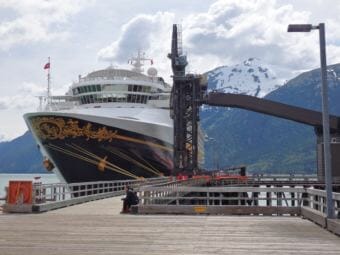
A cruise ship moored at Skagway’s ore dock. (Photo by Emily Files/KHNS)

The Skagway Assembly met for the second time this week to review a document that could provide a way forward on port improvements.

The group made some notable edits to a memorandum of understanding with White Pass and Yukon Route Railroad.

The agreement would make way for important waterfront improvements and a new 15-year tidelands lease with the private company.

Assemblyman Orion Hanson is one of the Assembly members who’s been negotiating with the railroad since discussions re-started earlier this year.

He suggested amending the memorandum to make White Pass responsible for the full cost of a new floating dock, instead of splitting it with the municipality.

“I’m looking for a solution to where we’re pushing forth the issue,” Hanson said. “Also this greatly speeds up the ability to get this dock done. Because White Pass can build this cheaper than we can. And they can probably get it permitted if not faster, than at least as fast without the red tape that we incur as a city.”

Hanson suggested the municipality contribute the $7.5 million that would have been spent on the floating dock to the roll-on, roll-off portion of the structure or other improvements to the ore dock basin.

The floating dock is needed to accommodate larger cruise ships in coming years.

The Assembly approved the amendment in a 5-1 vote.

White Pass official Tyler Rose said this is an option the company is entertaining right now.

But he said there needs to be more discussion.

Rose said White Pass is planning separate improvements for the railroad dock, to make room for bigger vessels in 2019.

He’s hopeful the Assembly will adopt the MOU and send it to the negotiating committee.

The Assembly accepted several changes recommended by the borough’s attorney that provide incentives for the railroad to complete cleanup and remediation of the ore basin.

The Assembly adopted a change that says a new lease will not happen if that cleanup doesn’t conclude by the end of the current agreement in 2023.

In the current draft of the MOU, the ore basin has to be removed from the Alaska Department of Environmental Conservation’s list of contaminated sites.

The changes to the MOU would also make way for liquidated damages if the cleanup isn’t completed, or in the event of future contamination.

Assemblyman Jay Burnham moved to make another amendment, looking ahead to the future of the other side of the port – the railroad dock.

“Seeing as how we’re kind of moving toward purchasing all – or acquiring – the tidelands, that’s a prime chunk of tidelands that we should look at acquiring in one way or another,” Burnham said.

Burnham suggested adding a section to the MOU that would give the municipality the right of first refusal to either purchase or acquire the railroad dock and tidelands under it, if White Pass is sold.

Hanson pushed back.

“I think that becomes a real imposition to the spirit of this MOU at that point because we are forcing them to sell something to us in the event that they make a business decision as part of an asset that then breaks up what they’ve been doing for over 120 years.”

The addition passed after Mayor Monica Carlson broke a tie vote in favor of the action.

Carlson favors the municipality controlling the port. Reading a statement at the start of the meeting, Carlson told the assembly there are other ways forward besides a new lease.

“White Pass is not our only option going forward,” Carlson said. “Going forward, we don’t know who will own White Pass and who we are negotiating with tonight. We can continue tonight or we can stop it now, tell White Pass we will work in partnership with them until 2023, at which time we will have control of our future. The port is the golden key that unlocks the future for Skagway.”

The Assembly voted to send the amended draft MOU back to the borough attorney to review. They’ll take it up again at the next regular Assembly meeting.

Chilkat River fall eagle forecast on the rise

Eagle photographers along the Chilkat River. (Photo courtesy John Hagen)

Raptors and bird enthusiasts alike flock to Haines for the Alaska Bald Eagle Festival, when the world’s highest concentration of eagles gathers on the Chilkat River.

Last year, the bird count spiked — and numbers are even higher this year.

It’s eagle season in Haines.

“This time of year is particularly special,” said Sidney Campbell, the Education and Outreach Coordinator at Haines’ American Bald Eagle Foundation. “The hydro-geology of the Chilkat is really unique. This river freezes a lot later than the other ones, so we have a really late run of salmon — and that’s what the eagles come for.”

The foundation capitalizes on the birds in its backyard: as the salmon attract eagles, the foundation welcomes visitors for the Annual Bald Eagle Festival.

Visiting photographers, birders and scientists gives Haines’ economy a bump between cruise and ski seasons.

But the event isn’t just aimed at outsiders, Campbell said.

“I think the biggest thing this year is that we really want this to be a community event,” Campbell said. “Almost every event during the festival is going to be free to Haines locals. And we’d really really like them to come in and meet with us and talk with us and see what we do.”

Opportunities include hearing scientist Rachel Wheat share her Ph.D. research on Chilkat Valley eagles, a film screening with the Takshanuk Watershed Council, Alaska Native dance and storytelling — and plain old-fashioned eagle watching, which could be particularly good this year.

Pam Randles spent a decade doing scientific eagle counts, and passed the torch to Chloe Goodson two years ago.

After years of decline, the women say birds counted on the Chilkat seem to be rising.

“For the previous four years, we were getting counts in the 700 to 900 level,” Randles said. “For (Chloe) to be getting over a thousand — 1,300, almost 1,400 — that’s a difference.”

That’s good news for visiting eagle observers.

Randles thinks it’s good for residents, too.

“The eagles directly reflect the salmon run,” Randles said.  “Salmon, as you probably know, in this area, is crucial to the economy.”

Randles said eagle counts can also illustrate environmental changes.

The Tsirku Delta on the Chilkat River attracts eagles because other rivers — other food sources — freeze over sooner.

Fewer eagles at the Tsirku could indicate less ice throughout the Chilkat Valley.

“If there is more open water and more access to food for the eagles, they’re going to take advantage of that instead of being crowded into the Tsirku fan area,” Randles said. “I think it’s an indicator of climate change.”

While two years of elevated eagle numbers don’t prove a lasting trend, Randles and Goodson will keep counting.

Their data reaches back to the late ’80s, and soon they hope to synthesize what three decades of eagle populations can illustrate about changes in the Chilkat Valley.

For Campbell and the foundation, that link between the birds and the environment motivates the Festival.

“Hands down, this is one of the most rich and valuable ecosystems left in North America,” Campbell said. “Our big action item is teaching people how to respect it and what we can do to make sure it stays as pristine as it currently is.”

This year, the festival will run Nov. 6-11. A schedule of events can be found here.

Cruise industry’s Juneau lawsuit could set wider precedent

Passengers walk a downtown Juneau dock where three cruise ships are tied up June 11, 2017. (Photo by Ed Schoenfeld/CoastAlaska News)

A federal lawsuit brought by the cruise ship industry against the City and Borough of Juneau says its passenger head tax is unconstitutional.

If the industry prevails it could impact the statewide passenger fee.

After a 18 months of litigation and at least $498,000 spent by the city in legal costs, the two sides are no closer to a resolution.

“We don’t dispute the collection of the fees. We don’t dispute those at all, it’s just the expenditures,” said John Binkley, president of Cruise Lines International Association Alaska, the industry group suing the city over how it spends the $8-per-passenger fee it collects.

He says the passenger and port development fees, are required by federal law to support cruise ship operations, not fund local vanity projects.

“And the city disagrees,” Binkley said. “They say it can be spent on things like the artificial island it built, the Whale Park, the airport or pretty much anything else it wants.”

The city argues that the industry reads the law too narrowly.

One example is seasonal crossing guards near the cruise docks; the city uses passenger fees to pay for them.

“We have a million people getting off the ships in the summer,” said City Attorney Amy Mead. “We think that crossing guards provide a service to the passengers because it enhances their safety and CLIA would disagree with that.”

But Binkley said his industry’s position is these fees are for port infrastructure – like a dock.

“Any of that money collected must be spent on a service to the ship because it’s a fee on the ship,” Binkley said.

(Actually, it’s a fee on the passenger that’s paid by the passenger. But that’s the gist of the dispute.)

A cruise ship is docked at Ketchikan’s downtown Berth 2. About 1 million cruise passengers visited Southeast in 2015. (Photo by Leila Kheiry/KRBD)
A cruise ship is docked at Ketchikan’s downtown Berth 2. (Photo by Leila Kheiry/KRBD)

In a filing last month, the cruise industry upped the ante. It asserts Juneau’s passenger fees are unconstitutional. It points to the Commerce Clause and Tonnage Clause, both of which give Congress the sole authority to regulate interstate commerce.

Mead said  that shows the industry is seeking a ruling with a wider precedent.

“If it were just a Juneau case, their motion would be tied to very specific expenditures and this case would all be about very specific expenditures,” she said. “That is not how CLIA has fashioned this lawsuit. They challenge the constitutionality of the fees.”

The cruise industry opposed past citizen-led referendums in Juneau and statewide that created the head taxes.

An industry lawsuit against the state’s head tax was settled in 2010 after the Legislature slashed the passenger fee by 25 percent.

That seemed to settle the issue, but state lawyers are still watching the Juneau case with interest.

Juneau’s local law closely mirrors the state’s law – so precedent matters.

By challenging the underlying constitutionality of a tax on cruise ship passengers, a victory by CLIA would establish a precedent,” Assistant Attorney General Chris Peloso said. “That could be useful in a future challenge against similar taxes levied by other municipalities, like Ketchikan, or a challenge against the state Commercial Passenger Vessel Excise Tax.”

In other words, it could open the flood gates to fresh challenges.

The cruise industry insists that’s not its aim. If the judge overturns Juneau’s passenger fees, Binkley said the industry would continue to pay the full amount to the state. And he says more funding might be available for other Southeast ports-of-call.

“The resources, we feel, are being not properly spent in Juneau, when they should be spent on port infrastructure in other, smaller communities,” Binkley said.

The Attorney General’s office hasn’t gotten involved.

But if the cruise industry’s lawsuit challenges the state’s passenger fee, Peloso said, the state would intervene.

Skagway Assembly frustrated by disagreements with White Pass on potential lease

Tourists in Skagway take pictures with a White Pass and Yukon Route Railroad train car. (Photo by Emily Files/KHNS)

Some Skagway leaders are growing frustrated with what they see as an unproductive back-and-forth with White Pass and Yukon Route Railroad.

What started as a hopeful process aimed at a new tidelands lease has now turned into something close to a stalemate.

At the latest Skagway Assembly meeting, members were unsure how to move forward.

The talk at Thursday’s meeting cast doubt on whether the city and railroad will be able to reach a tentative agreement at all.

“I’m kinda at a loss at this point,” outgoing Assembly member Spencer Morgan said. “What I see White Pass doing and what I see on paper coming back is really taking out a lot of the protections the municipality has asked for.”

In late September, the Assembly made changes to a working memorandum of understanding. The memorandum would make way for a new 15-year tidelands lease with White Pass. But then White Pass sent back its edits to the document, and the changes the railroad proposed were disheartening for the assembly.

White Pass crossed out a line about working with the city as joint cruise terminal operators.

The company added in a paragraph about easements that the Assembly wanted to outline in a separate contract. It also reinstated wording saying the city cannot unreasonably withhold a sale or transfer of the lease.

Those are just a few of the changes that bothered Assembly members.

“What White Pass responded with this time, it’s definitely regressing,” Assembly member Orion Hanson said. “I think we probably should just get what we’re very comfortable with …and the way that we want to see it done, and if White Pass doesn’t like that, then I guess there’s not an MOU.”

The major motivation behind all of this is a new floating dock.

Cruise industry leaders told Skagway it would fall behind if it doesn’t install a new dock for bigger ships by 2019.

But Skagway can’t just go ahead and build it.

White Pass controls the tidelands in question for another five years. The railroad said if it gets a new lease, then it will cooperate on the floating dock.

The city has been working on a request for proposals to start design work on the floating component. But manager Scott Hahn said the city shouldn’t advertise the proposals request until they know whether they even have access to the area.

“You don’t want to spend any more of your money on engineering that doesn’t yield results,” Hahn said. “I’m really concerned about going out to bid before having a fairly good idea of we can get in there.”

Hahn referred to the recent election results, and said they could move Skagway further away from a White Pass agreement.

Monica Carlson and David Brena, two lease opponents, were elected mayor and assembly member. Dan Henry won the Assembly second seat. He supported a previous lease proposal.

The Assembly decided to prepare the request for proposals so it’s ready to go to bid if the access situation becomes more clear.

Here’s another layer of the port conundrum: White Pass could be sold.

A June news release said the railroad’s parent company, ClubLink, is conducting a review of White Pass which may include selling the business.

White Pass operates primarily as an excursion for cruise visitors. And there’s been speculation about whether a cruise line might buy the railroad.

White Pass and ClubLink officials did not return requests for comment on this question.

Hahn addressed the concern at Thursday’s meeting.

“I do see situations, however extreme, if a cruise ship company bought the railroad company, and decided to play around with the schedules, to say, “Well, it’s just not profitable to have them operating on Thursdays and Mondays so we’re gonna shut those days down,”” Hahn said.

In light of the concern about a potential cruise line monopoly on the docks, the assembly is amending municipal code to try to ensure a fair marketplace.

The Assembly referred the code changes to the port commission.

As for the tidelands memorandum on which so many questions hinge, the Assembly did not decide on a next step.

Site notifications
Update notification options
Subscribe to notifications