Tourism

Walker budget proposes fix for spring ferry funding foul-up

The ferry Malaspina makes a rare appearance near downtown Sitka in 2010. A new report suggests a public corporation be formed to manage ferry operations. (Photo by Ed Schoenfeld/CoastAlaska News)
The ferry Malaspina makes a rare appearance near downtown Sitka in 2010. All marine highway vessels will have to shut down this spring if a budget gap isn’t filled. (Photo by Ed Schoenfeld/CoastAlaska News)

Gov. Bill Walker’s new budget fills a gap that could have shut the ferry system down for much of the spring. The spending plan, released Dec. 15, also funds the full Alaska Marine Highway schedule for the next fiscal year.

A complex provision in this fiscal year’s budget cut about a fifth of the marine highway’s funding.

If the money isn’t replaced, General Manager Capt. John Falvey said ships will stop sailing.

“We feel we can operate the ferry system until approximately the middle of April 2018. Then we would in essence have to shut the system down,” he said.

It wouldn’t start up again until the next budget year starts July 1. So all ferries would be tied up for about two and a half months.

But there’s a remedy in the Walker administration’s budget. It restores the funds – about $24 million. And that would allow the ferry system to continue serving its about 35 port communities — if it remains in the spending plan.

The fast ferry Fairweather docks at Juneau's Auke Bay Ferry Terminal in 2013. (Photo by Ed Schoenfeld/CoastAlaska News)
The fast ferry Fairweather docks at Juneau’s Auke Bay Ferry Terminal in 2013. (Photo by Ed Schoenfeld/CoastAlaska News)

“I would think the Legislature will support it,” said Sitka Republican Sen. Bert Stedman, who chairs his chamber’s transportation committee.

He said he expects opposition. But so far, House and Senate Finance Committee leaders haven’t disapproved.

“The co-chairs have been notified over a month ago by letter that this was coming and if they didn’t agree to it to let the administration know. As far as I know, there was no objections to it,” he said.

The Alaska Marine Highway System money is in what’s called the supplemental budget. It includes appropriations that fills gaps in this fiscal year, which ends June 30.

Funding for the fiscal year starting July 1 is listed in the operating budget. Walker’s version proposes a small drop in ferry system funding, less than 1 percent.

But Falvey said service will increase slightly, because some ships are cheaper to sail than others.

“We will run the Columbia a little less and the Malaspina a little bit more. Because of the ship configuration that we have this year, even with a little less money, we will be able to run a few more weeks of service,” he said.

Next year’s marine highway budget is just under $140 million.

Walker’s spending plan also includes money for a small, separate nonprofit Inter-Island Ferry Authority.

“It’s the thing that keeps us solvent,” said General Manager Dennis Watson.

It sails one route connecting Hollis on Prince of Wales Island and Ketchikan.

“We come within 15 to 20 percent of making our operating costs out of the fare box. So we fall a little bit short at the end of the year. And this helps. This makes up that,” he said.

The amount is $250,000, the same as has been requested in earlier years.

The governor’s budget lists his administration’s priorities. But the Legislature will make the final decisions. That means it could take months before either ferry system knows what it’s funding will be.

Juneau officials tee up more cash for cruise ship lawsuit defense

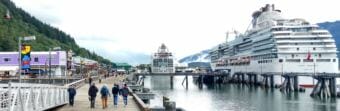
A pair of Panamax cruise ships docked in downtown Juneau on Aug. 30, 2017. The floating berths have eliminated the need for yellow security fencing and opened up a wide promenade for pedestrians. (Photo by Jacob Resneck/KTOO)

Juneau officials are preparing another $250,000 to cover the city’s legal defense against a cruise industry lawsuit.

If approved, it would bring the total commitment to $847,000 since the case began in 2016. On top of that, the head of the city’s finance department is recommending setting aside another $750,000 later.

Juneau Assemblyman Jesse Kiehl chairs the committee that heard the staff request for additional legal defense money on Wednesday.

“You know, it’s not a problem that we were looking for,” Kiehl said. “I think generally the Assembly feels pretty confident that the city’s use of those taxes is appropriate, so we’ll continue to defend the lawsuit. Because we use those monies to serve cruise ships and cruise passengers.”

The Cruise Lines International Association Alaska lawsuit has to do with the city’s collection of a cruise ship passenger tax, also known as the head tax, and how it’s spent. CLIAA thinks the city is spending it on projects and services beyond what federal law authorizes.

Correction: An earlier version of this story misstated when the case began. The lawsuit was filed in 2016, not 2015. 

Two really, really big cruise ships headed to Alaska

The Norwegian Bliss, shown in a promotional image, will begin sailing Alaska waters in about six months. It's one of two megaships slated to sail the Inside Passage. (Image courtesy Norwegian Cruise Line)
The Norwegian Bliss, shown in a promotional image, will begin sailing Alaska waters in about six months. It’s one of two megaships slated to sail the Inside Passage. (Image courtesy Norwegian Cruise Line)

Larger and fancier cruise ships will begin visiting Alaska ports starting this summer. The so-called “megaships” are part of a trend that’s sending more and more tourists to Alaska by sea.

If you think Alaska cruise ships are big, you ain’t seen nothing yet.

The 4,000-passenger Norwegian Bliss starts making port calls in June. The 5,000-passenger Ovation of the Seas shows up the following year.

Add 1,200 to 1,500 crew members and either will exceed the population of all but three Southeast cities.

“I believe people will notice the size difference in these ships, particularly the Ovation of the Seas,” said John Binkley, president of Cruise Lines International Association’s Alaska branch. “That is significantly bigger than the ships that people would normally be seeing throughout Alaska.”

The Bliss and Ovation will carry up to twice as many passengers as some ships already sailing here.

Chris Gray Faust is senior editor of Cruise Critic, an analysis and sales website owned by TripAdvisor, a popular travel-review app. She said Alaska is catching up with other cruise destinations.

“The large ships have been going to the Caribbean for several years. They’ve been over in Europe. They’ve been over in Asia and Australia,” she said.

So, why are they headed our way?

Gray Faust and Binkley said cruise lines are responding to several years of increased demand.

“It’s a somewhat exotic destination, yet it’s on U.S. soil,” Binkley said. “And it’s someplace that people feel comfortable and safe to visit.”

That was also the case after the 9/11 terror attacks.

The 5,000-passenger Ovation of the Seas begins its 26-mile conveyance to the North Sea March 11, 2016. It will begin sailing Alaska's Inside Passage beginning in 2019. (Photo courtesy Royal Caribbean International.)
The 5,000-passenger Ovation of the Seas begins its 26-mile conveyance to the North Sea March 11, 2016. It will begin sailing Alaska’s Inside Passage beginning in 2019. (Photo courtesy Royal Caribbean International)

Gray Faust said there’s also additional interest from overseas.

“Ovation of the Seas has been designed for an international passenger base. It’s been based in Asia and also Australia. And it already has some name recognition in those regions,” she said. “And by bringing it to Alaska, I think you’ll see more of those international passengers also come up.”

The Ovation is leaving its China and Australia routes due to a drop in demand.

The Norwegian Bliss is a new ship that adds to the overall number sailing Inside Passage waters. Binkley said the Ovation of the Seas will replace a smaller ship.

“We are gaining slightly on the number of ships, but most of the capacity increase, the increase in the number of passengers is because of the larger ships, rather than additional ships,” he said.

The Bliss will sail week-long round-trips out of Seattle, stopping in Ketchikan, Juneau and Skagway. It will also sail to Sawyer Glacier in Tracy Arm Fjord, south of the capital city.

The Ovation will be based in Seattle, too. Its Alaska itinerary hasn’t been posted yet. But it’s likely to follow a similar route.

Gray Faust said ships that large have added on-board attractions.

She points to the Norwegian Bliss, which advertises the largest go-kart race track on the seas. It also has a laser tag set that looks like it’s on the Death Star from “Star Wars.”

“One thing that’s very nice for passengers going to Alaska is they have a 20,000-square-foot observation lounge with 180-degree views,” she said. “Passengers in that lounge, they’ll really get the beauty of the landscape right there. They’ll be able to see it all as they come in.”

The Ovation of the Seas advertises skydiving and surf simulators, as well as robotic bartenders. But it’ll give the Bliss a run for its money in terms of scenery.

“They have what’s known as the North Star, which is a compartment that rises above the ship, like a traveling viewing compartment,” she said. “People should be able to get good views from that and certainly from the shore, people will notice that.”

The Bliss is owned by Norwegian Cruise Line. The Ovation is owned by Royal Caribbean International. Both sail other ships to Alaska.

Editor’s note: This report was updated to state that both cruise lines already sail the Inside Passage. The original version said only Norwegian sailed here.

Sullivan kills cruise tax, Murkowski adds tax help for Native corporations

The U.S. Capitol in Washington, D.C., on March 28, 2017.
The U.S. Capitol in Washington, D.C., on March 28, 2017. (Photo by Jeremy Hsieh/KTOO)

Alaska’s two U.S. senators not only helped Republicans pass their tax cuts early Saturday.

They made a pair of 11th-hour additions: one kills a new tax on the cruise industry, another helps Alaska Native corporations.

Sen. Dan Sullivan offered the cruise ship amendment. It erased a section of the bill that would have taxed foreign cruise lines for the time they spend in U.S. waters. The tax would have raised an estimated $70 million a year.

Cruise Lines International Association Alaska president John Binkley says the tax would have specifically hurt Alaska routes because they spend so much of their time in U.S. waters.

“We were concerned when we saw that come up in the Senate version,” Binkley said. “We contacted Sen. Sullivan, his office, and also Sen. Murkowski’s office.”

Sullivan’s spokesman says the senator already had noticed the tax in the bill and quickly moved to ditch it, to help Alaska communities that benefit from cruise ship visitors.

Sen. Lisa Murkowski added her own last-minute amendment that provides favorable tax treatment for Alaska Native corporations that put land or other assets into Alaska Native Settlement Trusts.

Congress created these trusts in 1988, in part to allow Native corporations to help “after borns” – Alaska Natives born after the 1971 settlement act — too late to be allotted shares in the corporations.

Old Harbor Native Corporation CEO Carl Marrs testified at a U.S. Senate hearing last month on the need to change tax law for settlement trusts.

He said, by law, a corporation’s duty is to its shareholders.

“We need a mechanism to be able to move assets over to take care of the whole (community), not just those born before 1971,” Marrs said.

Marrs said the tax changes would, among other things, allow a corporation to put pre-tax funds in a settlement trust. The trust would be taxed on the income, but the rate is much lower. Marrs described it as a way a community’s corporation can help its tribe.

“I think corporations are now realizing our job should be there supporting the tribal efforts, because those are the important programs to our indigenous people,” said Marrs, a former CEO of Cook Inlet Region Inc.

Friday night, the cruise-ship and Native corporation amendments appeared on a list of 30 changes Republicans had decided to make.

The list emerged while Democrats were on the Senate floor complaining they still had not seen the final language of the tax-cut bill.

Democratic Minority Leader Chuck Schumer groused that his side had to get the list from lobbyists.

“My Republican friends allowed lobbyists to see amendments, and likely the text of this bill, before their fellow U.S. senators,” Schumer said.

The tax bill, including a provision to open the Arctic National Wildlife Refuge to oil drilling, will be sent next to a conference committee with the House version so lawmakers can write the final bill.

Skagway Assembly overturns mayor’s veto of action on White Pass memorandum

A Disney cruise ship is tied up at Skagway’s ore dock. (Photo by Emily Files/KHNS)

memorandum of understanding between the Municipality of Skagway and White Pass and Yukon Route Railroad is moving forward.

The Assembly advanced the document at a special meeting Thursday, just over a week after a mayoral veto put on the brakes.

Last month, the assembly spent several meetings reviewing a draft memorandum of understanding with the railroad. The document would make way for a new, 15-year, tidelands lease with the private company and port improvements needed to accommodate larger cruise ships in coming years.

It also lays out conditions for the White Pass cleanup and remediation of the ore basin.

The group unanimously voted Nov. 21 to approve the draft memorandum, advancing it to a negotiating committee.

But the next day, Mayor Monica Carlson vetoed that action.

At a special meeting Nov. 30, Carlson said her veto it came down to two things.

First, information she recently received about the future of the Alaska Industrial Development Export Authority’s involvement on the waterfront.

AIDEA purchased the Skagway Ore Terminal nearly three decades ago. It subleases property from the city, through White Pass. Carlson said she recently met with AIDEA representatives, and learned the company isn’t planning to extend its lease past 2023.

“When I brought it up at the last meeting the only response that I heard was that’s between the lessee and their sub-lessee and they have an agreement,” Carlson said. “Not a word otherwise. But the reaction of the table it was of no concern. (If) the citizens of Skagway approve the lease, we would assume the AIDEA lease, its terminal and ship loader.”

Her concern was whether the municipality could assume responsibility for ore terminal cleanup if AIDEA leaves.

A description of the Skagway Ore Terminal project on AIDEA’s website says the lease expires in 2023 and it will not be renewed.

A representative from AIDEA recently said the future of the lease is unclear, and things could change in the future.

“I had no idea the negotiation committee had scheduled a Monday meeting with White Pass,” said Carlson, about her second reason for veto. “I was taken aback that I was not notified or told of the scheduled meeting. Had I known, I would have gone forward and scheduled an executive session and we would not be here tonight.”

Some Assembly members pushed back on this reasoning.

Orion Hanson, who is on the negotiating committee, said he thought he was clear about scheduling the meeting Carlson is referring to.

“I think this is a delay tactic,” Hanson said. “And I don’t know why. Because I really think, in the spirit of what we’re trying to do, you essentially just stalled negotiations.”

Steve Burnham Jr. said the Assembly is familiar with the situation around AIDEA’s lease, and doesn’t feel it has been ignored.

“I don’t feel like we didn’t care or didn’t know or were uninformed, I feel like we were,” Burnham said. “And had every possibility and chance to be.”

Dan Henry pointed out that the memorandum is not legally binding.

“You have absolutely nothing but conversation until the Assembly approves a legal crafted lease from the city attorney, which is then a final product,” Henry said. “And then, that has to go to the voters. To at any time deter any discussions on this matter, I think is a misstep.”

“I would like to be optimistic about this memorandum of understanding going forward,” said Tim Cochran, who also is on the negotiating committee with White Pass. “We are light-years beyond the 2015 MOU and lease. We’ve got a lot of protective language in there. Way over and beyond what we had before. I’d like to see White Pass agree to that stuff and go forward.”

Dave Brena and Jay Burnham were more understanding of the mayor’s veto.

Brena said focusing attention on the AIDEA sublease was a good idea.

“There were valid reasons to veto the progress of the MOU at least in a way that it would focus attention on an issue that seemed to be kind of skipped over to some degree,” said Brena. “And that is what exactly does happen to AIDEA in 2023.”

Jay Burnham said he didn’t have an opinion on whether the action was right or wrong.

“I do think that you had concerns about whether we fully understood the ramifications of the AIDEA lease,” said Burnham. “Aside from taking each one of us aside and talking to us, I can totally see why you’d want to get us all on the same page and have an executive session.”

The assembly met in executive session with the borough’s attorney to address potential legal issues related to the White Pass lease and subleases, before voting unanimously to overturn the mayor’s veto, moving the MOU forward.

New developments in the works for Juneau’s downtown waterfront

NorthWind Architects and Corvus Design created this concept art illustrating what part of Juneau's downtown waterfront could look like in 2019.
NorthWind Architects and Corvus Design created this concept art illustrating what part of Juneau’s downtown waterfront could look like in 2019. The concept is part of a Juneau Docks and Harbors master plan process underway.

More food trucks, retail, parking and an expanded USS Juneau Memorial are in the works for Juneau’s downtown waterfront.

Last week, the city released a design plan to develop the area from Marine Park to Taku Smokeries.

Gary Gillette, port engineer for Juneau Docks and Harbors, said the aim is to create a space both for visitors and locals.

“Our waterfront that we’ve been building up with the new cruise berths and stuff has been primarily focused towards serving the cruise industry,” Gillette said. “But we really hope that something will spark locals to get encouraged to come to the area in the off season, which in turn would spark some of those business owners to stay open in the winter.”

A large portion of the area for development is the Archipelago Lot, directly next to the public library. Docks and Harbors owns a portion of the land. But most of the lot is owned by Morris Communications, a Georgia based media company. They previously owned the Juneau Empire.

Gillette said they plan to work with the company to develop the area.

“We’ve been working with the private owner to make sure they get what they need and we get what we need and it all works together, so when it’s done it’ll all be one logical, cohesive plan, and cohesive area,” Gillette said.

Docks and Harbors is looking for community feedback on the design plan. You can see the plan on the Docks and Harbors website, and send feedback to Gary Gillette at gary.gillette@juneau.org.

The Docks and Harbors board is scheduled to vote on the design plan at 5 p.m. Nov. 30 in Assembly Chambers at City Hall.

Gillette said they hope to have the Archipelago Lot portion developed in 2019. Other portions will be developed as funds allow.

Site notifications
Update notification options
Subscribe to notifications