Tourism

New state Forest Service leader has Alaska experience

A timber sale sign is posted in the Tongass National Forest on Prince of Wales island. (KRBD file photo)
A timber sale sign is posted in the Tongass National Forest on Prince of Wales Island. The new Forest Service regional forester for Alaska, who takes over in April, was a district ranger on the island. (KRBD photo)

The U.S. Forest Service controls 22 million acres in Alaska, including most of Southeast. It’s overseen by a regional forester, whose staffers manage logging, mining, recreation and fish habitat.

The agency is getting a new top official in April. David Schmid will have to deal with a particularly controversial land management plan that’s under attack.

David Schmid

Schmid began his Forest Service career in Alaska. He and his wife moved here in the early 1980s for his first agency job, in Southcentral’s Chugach National Forest. Later, he worked in the Tongass in Southeast.

“Over the years I think we spent 23 years together in Alaska and just having an opportunity to come back and re-engage with folks and work on Alaska issues has just been a dream of mine,” he said.

He’s leaving his post as deputy regional forester for the agency’s Northern Region, based in Missoula, Montana.

He’ll take over the Juneau-based Alaska Region job from Regional Forester Beth Pendleton, who’s retiring after eight years in the position. She’s spent about 30 years in the Forest Service, two-thirds of it in Alaska.

Pendleton served as acting associate chief of the nationwide agency during the transition to the Trump administration. And recently, the agency’s chief stepped down amid allegations of sexual misconduct.

Despite shakeups at the top, she said there was no pressured to leave.

“My plans to retire were in 2018. So this is per my choice to retire at this time,” she said.

Beth Pendleton

Pendleton oversaw the Forest Service’s Alaska region during development of the most recent Tongass Land Management Plan. It’s been challenged in court and in Congress, largely because it begins the phase-out of old-growth logging.

She believes the plan will survive because it’s flexible and can absorb change.

“We’ve been really focusing on that transition to young-growth harvests and renewable energy. There is an adaptive management component that’s associated with the plan, where there’s room … to further amend the plan in the future if needed,” she said.

She said she’ll bring her replacement up to speed before she leaves the office.

Schmid hasn’t been part of this version of the Tongass planning battle. But he’s familiar with the issues from his days as district ranger for Thorne Bay, on Prince of Wales Island. Before the big mills closed, it was a center of Alaska’s timber industry.

He said he’s dealt with similar conflicts in his current job.

“I think I’ve had something like 75 or 80 objection resolution meetings here in Montana and Northern Idaho and North Dakota. And often times, mostly around tribal planning or large vegetation management, I would say it was almost identical to my experiences in Alaska with some very polarized issues,” he said.

A March 15 Forest Service press release announcing the transition said Schmid will be acting regional forester. But he said he’ll be here for the long haul.

The Forest Service has nine regional offices. Not a lot are overseen by women.

But Pendleton said she’s not unique.

“I would say in the last 10 to 15 years we’ve seen more women and minorities come into some of these leadership positions. And I have had nothing but support and encouragement as I have worked in the agency and as I have served here in Alaska,” she said.

A recent investigation showed a pattern of gender discrimination, bullying, sexual harassment and assault against women in fire crews and some other sections of the Forest Service.

Era Helicopters sells off Alaska tour operations

A TEMSCO helicopter sits on the Mendenhall Glacier in Juneau in 2009.
A TEMSCO helicopter sits on the Mendenhall Glacier in Juneau in 2009. (Creative Commons photo by Robert Raines)

One of the world’s largest helicopter firms recently sold its Alaska tour operations to Ketchikan-based firms.

Era Helicopters had operated flight tours from Juneau and Denali National Park. The Juneau operation will be taken over by NorthStar Trekking. The Denali flightseeing business will go to TEMSCO Helicopters.

Ketchikan businessman Bob Berto has ownership interests in both companies.

Era’s Global Accounts Manager Mandy Nelson confirmed the transactions closed Feb. 23.

Efforts to reach representatives at TEMSCO and NorthStar weren’t successful.

Residents speak out against possible hatchery in Baranof Warm Springs

There are a total of nine separate hot springs at Baranof Warm Springs with temperatures from luke warm to 120 degrees Fahrenheit. (Creative Commons photo by zug zwang/Flickr)

A proposed hatchery in a local tourist destination and fishing haven has some Sitkans and residents of up in arms.

Juneau businessman Dale Young has tried unsuccessfully twice before to win a hatchery permit in the bay, with similar public reaction.

Baranof Warm Springs is a quiet bay tucked away on the eastern side of Baranof Island.

It’s home to about 11 cabins, a field station for the Alaska Whale Foundation, and, most notably, sulfur hot springs that are a mecca for people around Southeast.

Jim Brennan has been coming to the warm springs since he was a kid.

“I think I was first there when I was either 5 or 6 years old,” Brennan says. “That’s where I learned to trout fish on Baranof Lake. As you can see by the color of my hair, that’s quite a few years.”

Brennan’s family has owned a cabin in Baranof Warm Springs since the 1950s.

He and other residents are concerned because their quiet bay could be the site of a new hatchery.

“It’ll completely distort and to my mind destroy the special quality of Baranof that is there that attracts so many visitors,” Brennan said.

Young put forth the proposal for the private, nonprofit hatchery, the Sustainable Salmon Institute, last November.

This is his third permit application in recent years.

Young owns property in Warm Springs on the north side of the bay.

The Alaska Department of Fish and Game identified the area as a prime location for a Chinook hatchery in the 1980s because of the large volume of water, but the project wasn’t pursued.

Young applied for a hatchery permit in 2011 and again in 2012, but his application was denied both times.

“It’s just untouched pristine old growth forest, and muskeg habitat. It’s just a remarkable place that’s really unlike anywhere else,” said Andy Szabo, director and research biologist with the Alaska Whale Foundation.

Szabo doesn’t know exactly how a hatchery would impact the ecosystem, but it would be substantial.

“No question it’s going to bring noise pollution. It’s going to bring a lot of people,” Szabo said. “We’re quite concerned about what it’s going to do to the number of predators, primarily grizzly bears that are going to come to the area. We have no idea what the cascading effects of that will be.”

Several thousand visit Baranof Warm Springs each year. And it’s an important area for scientific research in Southeast Alaska.

Szabo said it is precisely that pristine nature that makes it important to researchers.

“Setting up these monitoring stations in pristine environments allows us to create a baseline to see how ecosystems are supposed to be functioning.”

The new hatchery would be only 11 miles away from Hidden Falls, a hatchery built by the state in 1978 and now operated by the Northern Southeast Regional Aquaculture Association.

The hatchery is one of several in the area that has, in recent years, seen major problems with whale predation.

Association general general Steve Reifenstuhl said it’s really hurt the hatchery’s margins and a new hatchery would face big challenges starting out.

“It’s a grim situation,” Reifenstuhl said. “It’s a $2 million operational cost for that facility. We’re not returning that value to the common property fisheries. We’re scrambling hard to try and figure this out before we have to close the doors.”

Szabo said the idea of a second hatchery so close to one that’s already having  problems doesn’t make sense.

“One needs to only sit on our dock in May, you can literally watch humpback whales feeding on hatchery reared salmon at your feet,” Szabo said. “It’s pretty amazing to watch but again, the idea that someone would propose to establish another hatchery when the one 8 miles away seems to be suffering, seems very short sighted.”

Another concern? Bears.

Hatcheries attract a lot of them. Reifenstuhl said local cruise ship companies even stop in Hidden Falls now so tourists can catch a glimpse.

“It’d be like Jurassic Park but with bears,” Brennan said. He thinks bears in high numbers like in Port Armstrong and Hidden Falls could be a much bigger issue in a residential area like Warm Springs Bay.

“Both of those are pure hatchery bays,” he said. “Unlike Baranof Warm Springs where there’s, number one, a village with residents, and number two a lot of human traffic coming in on boats. And the potential for conflict is unimaginable, really.”

The movement of water also is key to making a hatchery run smoothly. Brennan said it would take too much.

“Twenty cubic feet per second that he would be drawing down. It would at times, based on stream flow records, it would draw the river down to levels that would threaten if not destroy the cutthroat trout habitat.”

Young who declined comment.

In 2012, when Young last sought a permit, he said if the facility was built it would be  the beginning of a valuable research and enhancement tool that will be able to be used far into the future.

Petersburg OKs cruise fee for 2019

The National Geographic ship Quest tied up to Petersburg’s drive down dock in 2017. (Photo by Nora Saks/KFSK)

Petersburg will start charging a $5-a-head fee for passengers on cruise ships in 2019.

Petersburg’s borough assembly gave final approval Monday to the new charge, despite a lawsuit over a similar fee in Juneau and concerns from the cruise ship industry.

Among Southeast communities, Petersburg will join Juneau and Ketchikan in charging a local fee on passengers, sometimes called a head tax.

Petersburg’s assembly has gone back and forth over what to call it because of concerns that the industry has sued Juneau over use of head tax money.

This month they agreed to change the name back to a marine passenger fee, instead of an infrastructure fee.

Eric Castro agreed to reverse course from the name change he suggested at the last meeting.

“After we received a letter from our attorney, she made a good point mentioning how the term infrastructure only refers to physical structures and that we shouldn’t probably limit the way we can spend money on so severely,” Castro said. “So for example we might be able to be able to use the marine passenger fee to be able to fund training of personnel, an activities director, any type of part time position and many things that aren’t a physical building.”

Cruise companies that stop in Petersburg, haven’t opposed the fee but have asked for changes.

Rick Erickson of the Cruise Line Agencies of Alaska wrote to the borough asking to table the ordinance and come up with a more narrowly focused fee for infrastructure that would aid cruise ships.

“The broad nature of the proposed ordinance to allow for funding of services to passengers and not just vessels is at the heart of the legal debate between Cruise Lines International Association of Alaska and the City and Borough of Juneau,” Erickson wrote.

Other companies have asked for a delay in implementation, because they’ve already priced their cruises for the next two years, or ways to encourage ships to start and end their trips here.

Assembly member Jeff Meucci proposed an amendment clarifying that ships starting and ending a cruise in Petersburg will only be charged once.

Kurt Wohlhueter wanted to consider an exemption for boats homeported here.

“We’re in a unique position right now where we could be the only community in Southeast that doesn’t charge a head tax for anybody who wants to homeport out of Petersburg and I think that’s something that we need to consider,” Wohlhueter said. “Because they’re gonna to bring that money in here, they’re gonna spend the night here, their ships are going to be moored here, we’re gonna make more money on those people then those that just do touch and gos. So instead of passing this amendment, you know we should consider, if they want to homeport here, not to charge them any head tax at all and then let main street benefit from the added income that they’re gonna spend here.”

Nevertheless, Meucci’s amendment passed with only Wohlhueter voting no.

Only smaller to mid-size ships stop in Petersburg, which doesn’t have a deep water port to accommodate the larger vessels.

Because of that, the community only sees a few thousand passengers a year. At best, the new fee is expected to raise about $30,000 a year, not the millions paid to larger communities in Southeast.

Assembly member Jeigh Stanton Gregor thought it would still pay for important improvements.

“That could be great money to invest let’s say new bathrooms, more subtle infrastructure over time that could also contribute to a ship wanting to homeport here, being able to invest that back into our infrastructure for that,” Stanton Gregor said. “I know it’s not a ton of money but, we’re so limited in exactly what we can use it for it’d be a good asset for the cruise industry as well.”

Use of the money will be determined by the assembly during the annual budget process, but the ordinance also includes a broad list of the types of expenditures it can go toward.

Those include capital improvements for ships or their passengers, land or building purchases to help the industry, along with passenger surveys, along with personnel and equipment needed as a result of cruise ship visits.

Mayor Mark Jensen didn’t want a lawsuit over Petersburg’s fee.

“I just am concerned about not generating enough money,” Jensen said. “I know it would add up but I’m just worried about any kind of litigation towards the city, so I will be voting no on this.”

Jensen and Wohlhueter were the only no votes and the amended fee passed on a 5-2 vote in third and final reading.

It takes effect in January 2019 and will be based on passenger manifests of ships docking in Petersburg’s harbors.

It also exempts ships with 20 or fewer passengers.

Can Southeast share the wealth of tourism growth?

Passengers walk a downtown Juneau dock where three cruise ships are tied up June 11, 2017. (Photo by Ed Schoenfeld/CoastAlaska News)
Passengers walk a downtown Juneau dock where three cruise ships are tied up June 11, 2017. A little more than 1 million people rode ships to Alaska that summer. By 2019, the number will be 19 percent higher. (Photo by Ed Schoenfeld/CoastAlaska News)

The number of cruise ship passengers visiting Alaska will jump almost 20 percent over the next two years.

Port cities need to plan for the infrastructure needed to support that many people.

One industry idea could change community control of the fees cruise ships pay.

Cruise lines are bringing more and more tourists to Alaska.

Passenger numbers topped a million for the first time in almost a decade last summer.

Cruise Lines International Association Alaska President John Binkley said they’ll continue to go up.

About 1.31 million passengers are expected to arrive in 2019, 19 percent more than last summer, according to projections Binkley released at the recent Southeast Conference Mid Session Summit.

“Sometimes there’s new ships that are coming into the market,” he said. “Sometimes there’s larger ships that are replacing smaller ships. And sometimes they’re adding to the shoulder seasons to have more voyages.”

Starting this summer, the larger ships will really be larger.

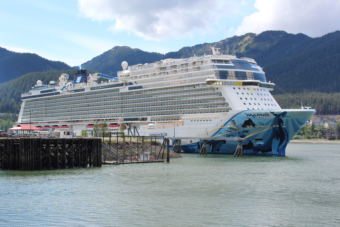
The Norwegian Bliss will carry up to 4,000 passengers, plus crew, starting this June.

The Ovation of the Seas will come in the following year, with as many as 5,000 passengers per sailing, double the capacity of some ships already traveling the region.

Binkley said the growth requires more infrastructure.

“It’s not just one community having the facilities to be able to handle that ship,” he said. “You have to have at least three ports to be able to have a ship like that be able to deploy to Alaska,” he said.

Only Ketchikan, Juneau and Skagway can handle such vessels.

They’re the biggest Southeast ports and they get the largest share of passenger fees.

Binkley said those total about $45 million a year, statewide. He said pooling that would allow other cities to boost their industries, too.

“We could be building a brand new dock each and every year in new communities around Southeast Alaska if we worked together and said … what’s the best way to take these dollars that we have and utilize them to grow the industry and have everybody in Southeast share and benefit from the industry,” he said.

It’s not a formal proposal, but the cruise association has already sued the capital city, challenging local control of how such funds are used.

Juneau City Manager Rorie Watt agrees more regional planning is needed.

But he takes a different approach.

He invited other community leaders to join the Southeast Cruise Port Association, which held its first meeting during the Mid Session Summit.

“I’m not under any illusion that we’re all going to cede local control of our communities to each other,” Watt said. “But I think we can get together on some very broad ideas.”

Those include improved communication and regional readiness for changes, such as quickly growing passenger numbers.

The industry’s share-the-wealth idea is of interest to Russell Dick, CEO of the Huna Totem Corp., which owns the Icy Strait Point attraction.

The renovated cannery and mile-long zip line completed its first dock two years ago, which brought more ships and visitors.

Dick said it’s looking toward construction of a second dock, which would support further growth.

“It’s all about tour capacity, having the infrastructure in place to handle the increase in ships and ship passengers,” he said. “And for us, that’s quite a bit. That’s a lot of people coming through.”

The cruise business is a significant part of Alaska’s visitor industry.

A cruise association report said ships, passengers and crew members spent about $1 billion during last summer’s season. And the passengers made up more than half of all visitors to the state.

Editor’s note: This report was updated to reflect cruise ships also brought a million passengers to Alaska in 2009.

New Anchorage airport manager looks to China for growth

Ted Stevens Anchorage International Airport general manager Jim Szczesniak stands in front of a photo of the airport, Feb. 20, 2018. He said he would like to see the airport build on its role in global cargo transport. (Photo by Andrew Kitchenman/KTOO)
Ted Stevens Anchorage International Airport general manager Jim Szczesniak stands in front of an aerial photo of the airport Monday in the Capitol. He said he would like to see the airport build on its role in global cargo transport. (Photo by Andrew Kitchenman/KTOO)

The new general manager for Ted Stevens Anchorage International Airport is looking to add more flights to China.

Jim Szczesniak started work Jan. 22 and discussed his plans during a recent visit to Juneau. He said the airport’s role in the economy is at the center of his work, which includes adding and maintaining services for the coming summer tourism season.

China is a particular focus.

“We’ve had some exciting meetings with (the) Chinese delegation lately, that’s included some potential talks of air service over there,” he said. “We’re going to continue to push that avenue to see if we can get some direct access to Asia.”

The Chinese officials included representatives from the Sichuan Province and from a Chinese airline.

Szczesniak also said he wants to build on Anchorage’s role as a global center for air cargo transport. For instance, he’d like to see the airport have facilities for keeping certain types of inventory on hand for fast shipping, such as pharmaceuticals or mining equipment parts that could be sent to Asia quickly.

“We want to take that air cargo power and essentially leverage that by developing some of the property on the airport to help with international trade,” he said.

He’s a former Chicago’s O’Hare International Airport executive who has worked mostly recently at a T-shirt company.

He said his experience with air cargo at O’Hare led to his interest in the Anchorage job.

Site notifications
Update notification options
Subscribe to notifications