University of Alaska President Jim Johnsen appears on an episode of Forum@360 in Juneau on April 3, 2018. (Photo by Rashah McChesney/Alaska’s Energy Desk)
The leader of Alaska’s public university system is resigning from his job.
The announcement from the University of Alaska’s board of regents follows blowback around President JimJohnsen’s unsuccessful effort to get a new job leading Wisconsin’s university system.
Sheri Buretta, the chair of the board, announced Johnsen’s resignation during an emergency meeting, following a 45-minute executive session.
“The decision regarding a change in leadership was mutual and was made after considerable reflection by the board,” she said.
Johnsen was selected as president of Alaska’s public university system in 2015. He led it through years of budget cuts imposed by state lawmakers as Alaska experienced a sharp decline in oil revenue.
Earlier this month, Johnsen had been named as the only finalist for the University of Wisconsin system’s presidency. But he withdrew from consideration following pushback from Wisconsin faculty and students.
This is a breaking news story and will be updated as new information becomes available.
In a press release Friday morning, Johnsen wrote “After deep reflection as to where I am called to lead a university system through these challenging times, it is clear to me and my family that it is in Alaska.”
Johnsen says he has notified the search committee chair.
A sign on the campus of the University of Alaska Anchorage. (Photo by Tegan Hanlon/Alaska Public Media)
The state’s public university system is eliminating dozens of degree and certificate programs from theater to chemistry to creative writing to close a budget gap driven by cuts to state funding and declining enrollment, and exacerbated by the coronavirus pandemic.
The University of Alaska Board of Regents on Friday approved cutting about 40 programs and reducing or merging several others. It’s part of an effort by the UA administration to scale-down the university system as revenue sources shrink.
Regent Karen Perdue said it’s the largest number of program reductions at UA in recent memory, and reflects the tough financial times the university system is in.
“The choices are difficult,” Perdue said in a statement. “Hard questions have been asked and refinements have been made.”
The academic cuts stem from a months-long review process. Students, faculty and community members have pushed to save some of the programs — arguing they have healthy enrollments and are unique to UA. Perdue said UA had to make difficult choices.
The program cuts will impact 30 faculty and staff. Also, almost 700 students are enrolled in the programs, according to UA. UA says those students will be able to complete their degree or certificate. That’s a requirement from accreditors.
Faculty say many more students take classes from the programs.
The programs eliminated include:
At the University of Alaska Anchorage: Bachelor’s degree programs in sociology, hospitality administration, theater and environment and society, plus master’s degree programs in early childhood special education and creative writing and literary arts.
At the University of Alaska Fairbanks: Bachelor’s degree programs in sociology, earth science and geography, plus master’s degree programs in biochemistry and space physics. The bachelor of arts in chemistry was also cut, but UAF still has a bachelor of science in chemistry. Some of the programs were previously suspended.
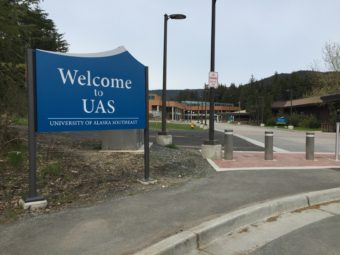
At the University of Alaska Southeast: A bachelor’s degree program in geography and environmental resources.
Regents also agreed on Friday to several other ways to cut spending including restructuring debt, suspending pay increases and furloughs. UA regents tasked administrators to further study a controversial proposal to merge UAS programs into the Fairbanks and Anchorage universities. The proposal has drawn widespread criticism.
Clarification: This story was updated to include that UAF still has a bachelor of science in chemistry.
There is a lot of opposition to the idea of the merger in Southeast Alaska. The city and borough of Juneau voted to publicly oppose it. In a special assembly meeting City Manager Rorie Watt said a merger would mean the loss of local leadership and it would make the university less appealing for students.
“I wouldn’t be in Juneau without the university, the attractiveness to it as prospective students,” assembly member Alicia Hughes-Skandijs said. “I can think of police, firefighters, business owners in our community that were all in my graduating class and so it’s a real magnet to bring folks to Juneau.”
After taking public testimony on the merger, city leaders in Ketchikan and university employees in Sitka — where UAS has satellite campuses — also objected.
This isn’t the first time the idea to merge UAS with another campus has come up.
Sage Logan is an accounting student at UAS in Juneau. He’s watched past efforts to bring up the merger. He says this time around it seems like the Board of Regents is willfully avoiding getting meaningful public comment from students and faculty.
“Just the way that they’re setting this up and continuing to propose it. Like, even through this pandemic, like, it feels like they’re taking advantage of the fact that we’re all separated,” he said.
There’s also clear opposition among some faculty at the university.
“I find it pretty outrageous,” said UAS sociology professor Lora Vess. “The loss of UAS would be such a loss to the state of Alaska and to the students of this region and to communities and to tribes to just have some of the regents seemingly tired of process want to push it through without actual consideration of what the role this university plays.”
As for cutting costs, Vess has one idea.
“What about those upper level administrative positions? Some of them have taken furloughs, which is a good important step. But, but perhaps it’s time to do a little bolder salary decreases as well,” she said.
“I would suggest that the UA system let the rural campuses lead and own distance education because our rural campuses need the distance education,” said Joe Nelson, Sealaska Corporation’s board chair.
Nelson and others also suggested that the university could be designated a tribal college.
“From a Native perspective, I’m just trying to picture around the board of regents table there and then the core, you know, decision makers,” he said. “I don’t see a lot of folks that are closely tied to our 10,000 years of history that we’ve had in Southeast Alaska.”
But as the public continues to explore alternative options to merging the campus, the University of Alaska system is facing significant financial problems. There have been deep cuts to state funding, enrollment is down and the coronavirus pandemic has added to that burden.
On Friday, The UA board of regents voted to cut over 40 programs, including completely eliminating sociology. That would make UA the only public university system in the nation without a sociology program.
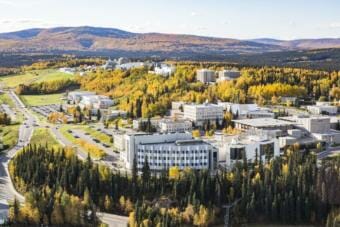
University of Alaska Southeast’s Juneau campus on Tuesday, Nov. 15, 2016. (Photo by Quinton Chandler/KTOO)
University of Alaska regents have put the brakes on a plan to merge University of Alaska Southeast programs in Juneau, Ketchikan and Sitka into either the Anchorage or Fairbanks operations.
The cost saving proposal has drawn major criticism since being introduced by President Jim Johnsen last week. University of Alaska spokesperson Robbie Graham says during a meeting Thursday regents voted to delay action, in favor of a motion by regent Dale Anderson of Juneau to instead conduct an in-depth analysis of merging UAS and University of Alaska Fairbanks programs, while “maintaining the unique identity and environment of each institution.”
Graham says the review, which will take place over the next 4 to 6 months, will involve input from a wide range of on and off campus stakeholders.
Regents also approved a budget for the upcoming new fiscal year, a spending plan which includes staff layoffs, and executive furloughs, suspends pay increases, and eliminates 50 academic programs.
Graham says the $832 million budget is $25 million less than the current year, the same amount state funding is being reduced, under a compact between regents and Governor Mike Dunleavy. The budget also includes $24 million in COVID-19 related costs, a hit Graham says is being covered with a draw from savings.
Graham says regents spent two hours of Thursday’s meeting in executive session to talk about the possible departure of President Jim Johnsen, who is the sole finalist to become president of the University of Wisconsin.
Regents meet again Friday, and Graham says one of the agenda items is the 50 academic programs slated for elimination. She says regents will be going over motions made by the academic and student affairs committee and could rescind some of the deletions.
The University of Alaska Southeast campus in Juneau, shown on July 25, 2019 (Photo by David Purdy/KTOO)
Leadership at Ketchikan’s University of Alaska Southeast campus on Monday asked the Ketchikan Gateway Borough to oppose a proposed campus merger.
Priscilla Schulte leads the Ketchikan UAS campus. She says the proposed cost-cutting move to merge UAS with University of Alaska campuses in Anchorage or Fairbanks won’t serve students in Southeast Alaska.
“There’s quite a few problems with merging UAS with UAA and UAF,” she said, “and my biggest concern is that the only way to do it is to make us go away.”
She says that’s because UAS’s total expenditures — including faculty and facility costs — account for about 7% of the total university budget.
Assembly members sympathized with Schulte. Felix Wong pointed to the economic value of the university campus in Ketchikan.
“If we lose the kind of skill set that comes out of the university system, who knows how much more money we lose as a regional community,” he said.
Assembly member David Landis noted that UAS is home to the statewide school of education attended by students across the state.
Member Sven Westergard pointed to the Ketchikan campus as a barrier against brain drain.
“For us to lose it, I think could be detrimental not only to our bottom line, but to our future — keeping kids here,” he said.
The assembly directed the borough manager to send a letter opposing the consolidation proposal.
Southeast Conference, a regional business development group, passed a resolution echoing the assembly’s concerns.
The University of Alaska Board of Regents will take public comment on the merger and other cost-cutting proposals from 4 p.m. to 6 p.m. Tuesday, June 2. Testimony can be provided by phone at (866) 726-0757.