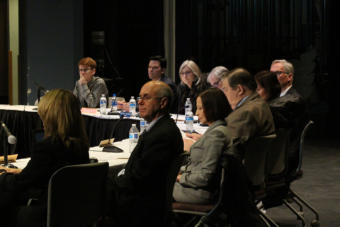
Pat Pitney, then director of the Office of Management and Budget, in a Senate Finance Committee meeting, Feb, 3, 2016. (Photo by Skip Gray/360 North)
For the second time this year, the Legislature must hire a new chief budget analyst.
Pat Pitney is leaving after serving less than six months as the director of the nonpartisan Division of Legislative Finance. She will begin work as the interim president of the University of Alaska on August 1st.
The Legislative Budget and Audit Committee is responsible for hiring Pitney’s replacement.
“We went through here it recently, six months ago, so it’s all still fresh in our heads,” said the committee’s chair Chris Tuck.
Tuck says he hopes the committee will fill the position by late August or early September. The position was advertised on the Alaska Workforce website on Wednesday.
“We want to make sure that we have good recruitment opportunities,” Tuck said. “I’m sure that people that have applied before are going to be applying again. And we may end up with some new people applying.”
The committee is scheduled to accept applications through August 17th.
The legislative finance director frequently testifies before the House and Senate finance committees on budget issues. The director is a high-profile nonpartisan voice as the state grapples with the budget gap.
“At the same time, we know that we have a university system right now that needs a lot of care. I don’t want to say it’s a sick patient, but it definitely needs some nursing, and I can’t think of a better person than Pat Pitney to help bring our university back to life,” he said.
Tuck says the committee has identified a candidate to serve as the temporary director until the position is filled, but he says he’s not in a position to identify the person until the decision is finalized.
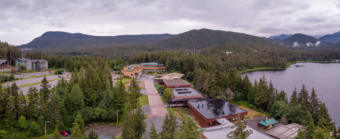
The University of Alaska Fairbanks campus. (University of Alaska photo)
The past week has been a roller coaster of emotions for international students across the country and in Alaska.
On Tuesday, the Trump administration rescinded its controversial plan issued just a week ago that would have required international college students to take in-person classes or leave the country entirely.
That plan from U.S. Immigration and Customs Enforcement drew immediate pushback last week. It sent shockwaves across universities that were in the middle of planning for fall classes during a pandemic — many expecting to rely on online classes to prevent the spread of COVID-19.
One master’s student at the University of Alaska Anchorage, who did not want to give her name for fear of drawing attention to her immigration status, said she found herself “weeping uncontrollably” at the thought that she might have to unexpectedly return to her home country of India.
“I live here. I rent an apartment, I have a year lease. I have a dog. This is my home,” she said.
Now, she is breathing a sigh of relief that there is no longer the threat of deportation if she can’t find in-person classes to take.
She said being an international student entails crossing many hurdles to come and stay in the country. She felt like her two-year graduate program was stable.
“You think, ‘Okay, for at least the next two years, I don’t need to jump through any hoops. This is pretty certain [and], if I keep my grades up, there’s no reason for someone to kick me out’,” she said. “So when you get news like that, it takes you back to all those times where you’re doing your GREs and your extra exams and doing all the extra things so that you can stay in the country. It was just so scary.”
She is just one of the 467 international students currently enrolled across the University of Alaska system. That’s about 2% of the entire UA student population. Across the country, international students make up about 5% of the nation’s post-secondary student population.
Last week’s guidance that would have forced international students to find in-person classes to take or leave the U.S. was met by eight federal lawsuits, which generated support from hundreds of colleges and universities across the country.
They argued that plans were already in the works for the upcoming semester, and for the government to change its course now would be arbitrary and devastating to the colleges, their students and local economies.
At the University of Alaska Fairbanks, Philip Wight, a professor of history and Arctic Northern Studies, said he and his colleagues hurried last week to come up with ways they could help UAF’s international students.
He offered to teach an in-person class, on top of his current course load, to any student who needed it in order to comply with last week’s order.
“I just felt compelled to do something, because I was just really struck by the cruelty and a lack of due process in this law,” he said.
Wight said Alaska has long attracted attention and interest from around the world, including countries in the circumpolar North like Norway and Russia. International students bring an unique perspective to his classroom, he said.
Paul Layer, UA’s vice president of Academics, Students and Research, said the public university system was prepared to sign petitions and encourage Alaska’s congressional delegation to oppose the guidance, which UA felt was unfair.
Now that the guidance has been rescinded, he said, it takes some of the pressure off of administrators, faculty and staff. They no longer have to reassess or change their plans for reopening campuses in the fall.
Right now, the UA system is operating under what is calls “Phase B.” That means most classes will be online during the upcoming semester that starts in late August. There will be some in-person classes when necessary, such as for labs or hands-on research.
Each phase is described in a system-wide reopening plan, and each university can decide which phase its campuses will operate in based on local coronavirus conditions.
However, things could change at any moment.
That’s one reason why Jean, another international student at UAA who’s studying aviation technology and math, said he’s skeptical about the government’s decision to rescind the destabilizing guidance.
Jean, who also didn’t want to share his full name because of fears about drawing attention to his immigration status, said when he heard about the guidance, his first thought was that he would have to pay $7,000 for a plane ticket back to his home country of Kazakhstan.
“Our government doesn’t want to help us most of the time, your government doesn’t want to help us either, UAA cannot help us. So it’s just very frustrating,” Jean said.
Even though the guidance has since been rescinded, Jean said, there’s nothing stopping the government from issuing a different set of rules again. He isn’t ready to breath that sigh of relief just yet.
Pat Pitney, director of the Office of Management & Budget, fields questions from reporters at a press conference called by Gov. Bill Walker, Feb. 5, 2015. (Photo by Skip Gray/360 North)
The University of Alaska system has a new interim president: Pat Pitney, the director of the state Legislative Finance Division.
UA regents announced Tuesday that Pitney will serve as interim president as they search for someone to permanently fill the position left vacant when Jim Johnsen abruptly resigned last month.
Regents selected Pitney from a group of five finalists. They unanimously appointed her to lead the UA system during a meeting broadcast online late Tuesday afternoon.
“We have a lot of work ahead of us,” Pitney said during the meeting. “I will hit the ground running and very much look forward to working with all of you and addressing the challenges we have ahead. But we also have tremendous opportunity.”
Pitney previously worked as a vice chancellor of the University of Alaska Fairbanks, and as the state budget director under former Gov. Bill Walker.
Pitney will take over as UA interim president on Aug. 1, weeks before the start of fall semester.
Pitney acknowledged that budget challenges await, but “there’s a very positive way forward,” she said.
In recent years, UA has struggled with a series of cuts to its state funding and declining enrollment. It was dealt another financial blow by costs and revenue loss tied to the coronavirus pandemic. The universities also continue to discuss what classes will look like this fall as the number of COVID-19 cases in Alaska continues to rise.
Pitney has agreed to serve as interim president for at least one year and up to 18 months, according to UA.
The prior UA president, Jim Johnsen, resigned in late June amid escalating calls for him to step down following his interviews for a job in Wisconsin where he made controversial comments about diversity and the PFD.
The University of Alaska Fairbanks campus. (University of Alaska photo)
The University of Alaska Regents on Friday named five finalists for the job of interim president at the state’s public university system. They include two current university chancellors and the director of the state’s Division of Legislative Finance.
The announcement comes about three weeks after Jim Johnsen suddenly resigned from his role as UA president amid blowback from his Wisconsin job search.
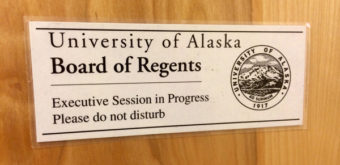
The regents say they expect to announce the interim president on Tuesday after interviews in executive session — meetings closed to the public.
An illustration of the greenhouse effect on the wall of Kevin Neyhard’s classroom. April 22, 2019. (Ravenna Koenig/ Alaska’s Energy Desk).
New research from the University of Alaska Anchorage shows this year’s class of teaching graduates in Alaska feels just as prepared to enter the classroom this fall as previous classes.
Many student teachers were training in classrooms when schools closed in March to help slow the spread of the coronavirus.
The state Department of Education & Early Development will offer new teachers emergency certificates despite having their student-teaching hours interrupted, but researchers were concerned the teachers would not feel prepared to teach.
Dayna DeFeo, the director of the Center for Alaska Education Policy Research at UAA and one of the authors of the research along with Trang C. Tran, said one reason why these new teachers feel prepared could be due to the way UA’s teaching programs are designed.
“Many of the University of Alaska teacher education programs require two semesters of clinical placements,” DeFeo said. “The majority of students are in K-12 schools getting clinical experience for two semesters before they graduate from the University of Alaska, and so if we’re looking at it that way they had done 75% of their in-person contact on site in schools before the coronavirus closures.”
This is encouraging news for first-year teachers educated in Alaska, DeFeo said, but it doesn’t provide any insight into whether teachers from other states feel similarly prepared.
The majority of Alaska’s new teachers come from outside of Alaska where teaching programs vary by institution, DeFeo said.
Alaska does not produce enough teachers to fill the nearly 1,000 positions hired across the state each year. This is further hampered by the School of Education at the University of Alaska Anchorage discontinuing its initial licensing program in 2019. According to DeFeo, this year’s graduating class of new teachers from UA was about 25 percent smaller than last year’s.
DeFeo said regardless of their preparedness, schools will need to support all teachers as they plan for hybrid, online, or physically distanced class environments.
“We’re not sure exactly what they’re going to be asked to do or what classrooms are going to look like in the fall,” DeFeo said. “We need to keep in mind that teachers are going to need support no matter what if they’re asked to teach and work in ways that are different than what they’ve been trained and prepared to do.”
The research also showed that compared to previous classes, this year’s teaching graduates were less likely to want to teach outside of Alaska, but were more interested in teaching in urban areas.
DeFeo said this suggests rural districts may have a more difficult time recruiting and hiring Alaska-prepared teachers.
The research also shows the majority of this year’s teaching graduates still planned to become educators despite the pandemic and some said the pandemic strengthened their desire to teach.
UAS Chancellor Rick Caulfield poses with incoming freshman Triston Chaney from Dillingham who is pursuing his undergraduate degree in Marine Biology this semester. (Photo by Annie Bartholomew/KTOO)
University of Alaska Southeast Chancellor Rick Caulfield retired on Tuesday.
Over the course of his five years leading the campus, he dealt with declining enrollment and repeated state budget cuts that left the entire university system struggling. His departure comes at a time when the campus is facing more uncertainty than ever.
“I know it’s not a great time,” Caulfield said. “I have thought about this a lot, and yet I’m very confident that our interim Chancellor Dr. Karen Carey will do a great job.”
When he announced his retirement last fall, Caulfield never could have imagined how his final semester would go.
And then, just a week before his retirement, university President Jim Johnsen announced his resignation.
“But this is just one more element of uncertainty amid budget cuts and the need to respond to a global pandemic,” Caulfield said.
Caulfield’s University of Alaska career started in 1977. He studied Alaska Native subsistence practices in Fairbanks.
After getting his Master’s in Education from UAF, he taught at the Bristol Bay Campus in Dillingham before leaving to pursue his Ph.D. in England and studying subsistence whaling in Greenland. He returned to become a professor at UAF, where he taught for 20 years before moving to Juneau to be the chief academic officer for UAS.
Looking back on his time on campus, Caulfield said he’s especially proud of the partnerships UAS has built with employers in the region.
“I’m not at all convinced that eliminating the separately accredited university that has served Southeast Alaska very well for over 33 years is the right way to solve the university system’s fiscal crisis,” Caulfield said.
Alternative cuts could be made by looking at redundant degree programs at UAA and UAF, he said, or by taking a hard look at the cost of university athletic programs.
Caulfield feels that it’s vital for decisions about education in Southeast Alaska to be made by the people who live there, not by administrators in Anchorage or Fairbanks.