University of Alaska

Alaska Native leaders offer alternatives to proposed university merger

Alaska Native organizations in Southeast are proposing alternatives to the University of Alaska’s Board of Regents’ controversial option to merge the University of Alaska Southeast with one of the other UA campuses.

Native leaders from Sealaska, Sealaska Heritage Institute and the Central Council of Tlingit & Haida sent a letter to select regents this week.

They’re asking for the option to establish University of Alaska Southeast as the administrative hub for rural community campuses. They say a more centralized campus in the region can increase overall enrollment.

It could also expand options for students and streamline program and course offerings. 

Sealaska Heritage Institute President Rosita Worl said the proposed merger would not result in the financial savings the university system is seeking.

Another option is to transfer UAS to a tribal college in the region.

Sealaska Board of Directors Chair Joe Nelson said the Southeast community deserves university leadership that is “committed to this native place.”

The board of regents are meeting to discuss options on Thursday and Friday.

They’re also holding public testimony by phone on Tuesday from 4 – 6 p.m. at 1-866-726-0757.

As the University of Alaska grapples with budget cuts, its leader may leave

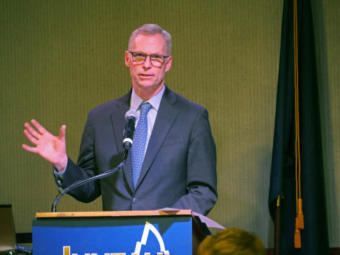
University of Alaska President Jim Johnsen delivers the State of the University Address at a Juneau Chamber of Commerce luncheon in Juneau on Feb. 16, 2017.
University of Alaska President Jim Johnsen delivers the State of the University Address at a Juneau Chamber of Commerce luncheon in Juneau on Feb. 16, 2017. (Photo by Skip Gray/360 North)

The head of Alaska’s public university system is potentially leaving the state to take over the helm of the University of Wisconsin System.

The UW system announced Tuesday that Johnsen was the sole finalist to become its president. Johnsen will go through multiple interviews next week for the job.

Johnsen’s possible departure from the University of Alaska system comes at a tumultuous time for UA. The university system is wrestling with another series of deep budget gaps driven by cuts to state funding, declining enrollment and the coronavirus pandemic.

In an email to UA students and employees on Tuesday, Johnsen wrote that he wasn’t looking for another job when he was nominated for the position in Wisconsin, “but the position aligns with my experience and skills as a university leader.”

“The opportunity to lead a larger university is an exciting prospect, and Madison is in very close proximity to our family,” Johnsen wrote.

Johnsen was named UA president in 2015. Under his leadership, he spearheaded efforts to consolidate the university system amid declining state funding. That effort was met with widespread pushback, and the UA Board of Regents tabled the idea last year after the governor walked back his budget veto. The governing body is expected to discuss a controversial option later this week to merge the University of Alaska Southeast into the system’s other universities.

The University of Wisconsin System is a constellation of 26 campuses. It’s one of the country’s largest systems of public higher education.

In its announcement Tuesday, the Wisconsin system said its presidential search committee unanimously agreed on Johnsen as its first choice as a finalist, describing him as a strong, qualified and collaborative leader. It also said the pandemic posed “unanticipated and unprecedented circumstances and obstacles” to the search.

“Several candidates removed their names from consideration near the end of the process, with some expressing concern over being named publicly as a finalist during the pandemic,” the announcement said.

Johnsen wrote that he will be in discussions next week with the Wisconsin committee and the university community, and expects the outcome of those talks by mid-June.

This story has been updated.


University regents consider controversial merger of UAS as solution to ‘immediate and significant financial headwinds’

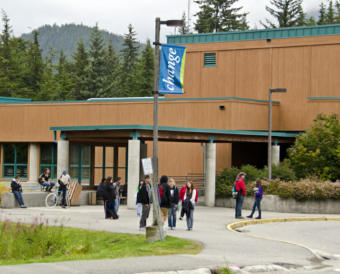
University of Alaska Southeast's Juneau campus on Tuesday, Nov. 15, 2016. (Photo by Quinton Chandler/KTOO)
University of Alaska Southeast’s Juneau campus on Tuesday, Nov. 15, 2016. (Photo by Quinton Chandler/KTOO)

The University of Alaska Board of Regents will meet next week to consider how to close a gaping budget hole driven by cuts to state funding, declining student enrollment and the coronavirus pandemic.

Options on the table include deploying savings to fill part of the gap, and deleting or reducing about 50 degree and certificate programs. Plus, there’s a controversial proposal to merge the University of Alaska Southeast into one, or both, of the system’s other two universities.

“The university is facing immediate and significant financial headwinds,” UA President Jim Johnsen said in a call with reporters Thursday.

For years, UA has grappled with reduced state funding and lost tuition dollars as enrollment declines. Then came the coronavirus pandemic. It cut into the finances of the already-strained university system.

Across the country, universities are wrestling with plunging revenues and rising expenses linked to the pandemic. The virus forced campuses to quickly move classes online. Events were canceled, and housing and dining fees returned. In some cases, universities helped pay for students to move home.

At UA, the coronavirus is projected to cause a nearly $25 million budget shortfall in the fiscal year that starts July 1, Johnsen said. He’s proposing that regents use one-time funds to fill it.

“These are funds that have been saved through belt-tightening over the last year,” he said.

Apart from the pandemic, UA was already preparing for a $25 million cut to its state funding in the upcoming fiscal year. It’s restructuring its debt, planning for furloughs, laying off staff, suspending pay increases and cutting administrative costs, Johnsen said. There’s also the proposal to reduce or eliminate the dozens of academic programs to save about $4.5 million.

Still, Johnsen said, that’s not enough to eliminate mounting budget issues.

UA is expecting another budget shortfall in the fiscal year that starts in July 2021. The budget gap could range from about $11 million to about $36 million, Johnsen said. The total depends, in part, on enrollment and what costs are eliminated this year.

That’s where the proposed merger comes in.

It’s the largest of the cost-cutting options for regents to consider next week.

“We’ve exhausted the little stuff,” Johnsen said. “We need to start looking at larger reductions.”

It would mean merging UAS into the University of Alaska Anchorage or the University of Alaska Fairbanks or both. UAS includes campuses in Juneau, Ketchikan and Sitka. It’s the smallest of the three universities. And, about about half of the credits from UAS are delivered online, Johnsen said.

“They’re already not on the campus every day, so they’ve made the transition,” he said.

Johnsen said a merger could potentially save $15 million or more. He said it would not mean closing campuses.

But the proposal faces opposition.

Heather Batchelder is a professor at UAS and the chair of the system-wide Faculty Alliance. She said faculty members were blindsided by the proposed merger, and the alliance does not support it.

“In order to meet the diverse needs of our state, we need to keep our university in our capital city,” she said.

Batchelder said talk of a merger has created another layer of instability for students and employees, some who are still reeling from last summer’s chaotic budget battle.

Facing an unprecedented, $135 million veto from Gov. Mike Dunleavy last year, regents considered consolidating the entire university system. The faculty alliance and others opposed the proposal, and it was later tabled after regents entered into a compact with Dunleavy, reducing the veto to a $70 million cut over three years.

Batchelder said it feels like “déjà vu” to confront another proposal to move away from a three-university system.

“There’s been so much uncertainty, and then the pandemic on top of that. So we are exhausted,” she said. “But we are not defeated. And we will not give up and we will never stop fighting for our three separately-accredited universities.”

Other cost-cutting options up for review next week include increasing coordination between programs across UA and consolidating general education requirements.

UA regents are taking public comment on the options by email at ua-bor@alaska.edu. Starting at 4 p.m. next Tuesday, June 2, people can also call in to provide comment. The regents will meet the following Thursday and Friday. They’re expected to approve a budget for the upcoming fiscal year, deciding whether to cut the academic programs and tap reserve funds to cover this year’s deficit. They’re also expected to weigh-in on the proposed merger.

Editor’s note: An earlier version of this story said that public comments would be taken by phone starting at 3 p.m. on June 2. The correct time is 4 p.m. The last paragraph of this story has been corrected.

Dunleavy talks about plans for the upcoming school year, announces early PFD payout

Updated at 7 p.m. — This story was written by Alaska Public Media’s Mayowa Aina. 

Gov. Mike Dunleavy said the state will pay Permanent Fund Dividends on July 1st, three months ahead of schedule. 

The announcement comes just hours after the Alaska Legislature approved the spending of more than a billion dollars in federal coronavirus relief aid. 

“We’re in extraordinary times,” Dunleavy said. “We need to make sure that people in Alaska have cash in their hands to help with this economy, I can’t think of a better time to do it than now.”

Dunleavy made the announcement at the end of a Wednesday press briefing that primarily focused on education and plans for reopening the state’s schools in the fall. 

University of Alaska President Jim Johnsen presented a framework for creating a fall plan. He said each of the system’s campuses will be able to adapt the framework to local conditions. 

Johnsen said that the framework is more conservative than other institutions in the state because campuses are at a high risk for transmission because of things like group housing, mass gatherings in lecture halls, extensive travel by students and teachers, and a younger population that is more likely to be asymptomatic. 

Johnsen said summer classes are currently underway and the university system is preparing for the fall semester.  

Education Commissioner Michael Johnson also presented a framework for developing a plan for the state’s K-12 schools. It includes a list of considerations and scenarios schools should think about when planning for the 2020-2021 school year. 

Johnson said the framework can be customized to each district’s needs. 

When asked how the state will ensure an equitable education across districts, Johnson said the flexibility of the framework will be key. 

“The best way to make sure that we have equitable educational services is to plan for it and that’s exactly what’s supposed to be happening right now,” he said.   

Johnson said there is not a set deadline yet for when district’s must submit plans for the fall but, should a district request a waiver to change its  school calendar, there must be a plan in place before the waiver can be granted. 

“What we want to make sure is that regardless of the situation next year, that teachers are teaching and students are learning. We want to pandemic-proof our school year, he said.”  

Original story – This preview was written by KTOO’s Rashah McChesney. 

Gov. Mike Dunleavy’s latest COVID-19 press conference is scheduled for 5 p.m. today.

He’ll be joined by Department of Education and Early Development Commissioner Michael Johnson and University of Alaska President Jim Johnsen. The three will discuss plans to reopen the state’s K-12 and higher education system later this year.

The University of Alaska system has a plan that can be found here

“It is not a linear path to reopening, in part because our universities were never closed,” Johnsen wrote in a letter to the UA Community on Wednesday. “In addition, it is very likely that we will move back and forth among the phases as the incidence of COVID-19 ebbs and flows in our state and communities.”

In partnership with the state health department, the state department of education is drafting a framework that will help schools decide whether and how to reopen schools. It includes a list of considerations and scenarios schools should think about when planning for the 2020-2021 school year.

Alaska Education Commissioner Michael Johnson discusses the new statewide virtual school on Wednesday, April 1, 2020, at a news conference with Gov. Mike Dunleavy. (Creative Commons photo by Office of Gov. Mike Dunleavy)

The governor has been holding these briefings almost daily since March 10.

Members of his administration have shared updates on the number of people in the state with confirmed cases, announced public health mandates, and explained the administration’s strategy and rationale.

They’ve imposed several public health mandates that have reshaped daily life across Alaska to combat the spread of the virus. Those mandates and other Alaska-specific COVID-19 resources and information are available at coronavirus.alaska.gov.

You can watch today’s press conference live on this post, the governor’s Facebook or Livestream pages, or on 360 North television.

UAF researchers use space-based radar to measure methane emissions in Arctic lakes

Ph.D. student Natalie Tyler stands next to a bubble survey transect in winter 2019. (Photo courtesy Melanie Engram/University of Alaska Fairbanks)

One of the many greenhouse gases that is contributing to global warming is methane. Methane is emitted a lot of ways, including from lakes across Alaska.

However, studies on how much methane flows up from those lakes into the atmosphere haven’t always been very accurate.

New research from the University of Alaska Fairbanks utilizing radar instruments positioned on satellites has led to a breakthrough in lake methane emission research. That research could help climate scientists better see how Alaska’s lakes contribute to the world’s methane emissions.

As permafrost under lakes begins to break down, it releases carbon, which is broken down by tiny microorganisms, which in turn, release methane.

“Sometimes you’ll sit on the edge of the lake and you can see a little pop,” said Melanie Engram, a researcher with the University of Alaska Fairbanks Water and Environmental Research Center. “And you might think ‘oh hey, it’s a fish.’ But it could also be a little methane bubble that’s coming out.”

Since methane is an odorless, colorless gas, it can be difficult to monitor how much is released by lakes. But not when they’re frozen.

“The ice forms around the bubbles; more bubbles are released and [ice] forms around the bubbles,” Engram said. “And the ice creates a time-lapse freeze frame, pardon the pun. It’s a freeze-frame historical record of the methane bubbling.”

To study these methane bubbles, Engram and other researchers use small bubble traps to make micro-measurements of methane and then scale them up to the full area. However, she says, those aren’t super accurate.

“The bubbling is very spatially erratic and it’s sporadic; you’ll see a big stream of bubbles and then it will shut off for a while,” Engram said.

Methane ebullition bubbles form in early winter lake ice in Interior Alaska. A yard stick is included for scale. (Photo courtesy Melanie Engram/University of Alaska Fairbanks)

Now, UAF researchers have begun to use what’s called a synthetic aperture radar, or SAR, to better map methane being released from lakes. Basically, a satellite sends a pulse down to a lake. A portion of that pulse bounces back to the satellite in what’s called a backscatter. Backscatters range in luminosity from kind of dim to very bright.

“The radar return was brighter in lakes that had more methane, and it was dimmer or lower in lakes that had less methane,” Engram said.

Engram and other researchers used SAR to map methane emissions from 48 lakes across five regions of Alaska, including the northern Seward Peninsula near Kotzebue, lakes near Atqasuk — south of Utqiagvik — and the Fairbanks area.

Of course, researchers still had to go out to the lakes that SAR was mapping to make sure it actually worked. To Engram’s delight, it did.

“It was really exciting for me to go out to a lake that was really bright in SAR, and to snowmachine out to it and dig down in the snow, and there were just bubbles everywhere in the ice,” Engram said. “I was excited. I said, ‘This is working! Yay, it works!’”

Engram says the success of using SAR to map out methane emissions in Arctic lakes means the system can monitor thousands of lakes across the state. And that’s not just exciting from a research perspective. Engram says that there isn’t a lot of global data on methane release from lakes, and use of the SAR can help create a baseline to track in the future. That will be useful to climate scientists tracking changes in the atmosphere.

“People measure methane in the atmosphere and they say how much comes from anthropogenic sources like oil fields and automobiles and agriculture and dairy cows,” Engram said. “They try to divide it up so we can see the different sources. And this will help [balance] the global methane budget.”

Studies show that methane is about 30 times stronger than carbon dioxide as a heat-trapping gas. And while methane is naturally emitted from these lakes, Engram says the amount is drastically dwarfed by the amount produced from those anthropogenic sources.

Engram’s research using SAR to track methane emissions in arctic lakes was the subject of a UAF research paper that was published this month in the scientific journal Nature Climate Change.

UAA honors spring graduates with online celebration, in lieu of an in-person ceremony

If University of Alaska Anchorage senior Alex Jorgensen had to pick one word to describe what it’s like to graduate during a global pandemic, he’d say “anticlimactic.”

“This is a big milestone in my life. I worked really hard for the past five years to earn this degree,” said Jorgensen, who’s graduating with his bachelor’s in political science.

“And now, it’s just, there’s no ending point,” he said. “It just slowly diffuses into the rest of the 60 years of my adult life. There’s no transition.”

Jorgensen is one of more than 1,000 students graduating from UAA this weekend. But the graduates won’t mark the milestone in the usual way. There won’t be caps or gowns. And walking across the stage to get a diploma? Not going to happen.

UAA has indefinitely postponed its in-person commencement ceremony as the coronavirus pandemic continues. For now, the university is opting for a more socially-distant way to celebrate the spring class of 2020: It’s launching a website on graduation day with video tributes and speeches.

Jorgensen and other upcoming graduates say they understand it’s what has to be done, and appreciate the online celebration. But, some say, it still kind of stings. They had looked forward to a big graduation day ceremony to cap off their years of work — to hug, high five and shake hands with their classmates and professors.

“It’s tough. Definitely tough,” said Virginia Groeschel, who’s graduating with her master’s degree in project management. “It’s emotional for sure. If I start talking too much, I might start crying.”

Like college students across Alaska, and the entire country, Groeschel’s on-campus life ended abruptly when the coronavirus took hold in March. UAA moved classes online, closed dorms and canceled events. Most students didn’t return to campus after spring break.

“It’s sad not to have those last moments,” said senior Clare Baldwin.

Baldwin is graduating with her bachelor’s degree in economics. She, Jorgensen and Groeschel were all selected to speak at the commencement ceremony.

But, instead of talking to a crowd of students, they recently pre-recorded their speeches to be posted online. Baldwin and Jorgensen spoke in front of a camera, in a largely empty room, at UAA.

Groeschel read her speech from a desk at home, during an online Zoom meeting with a university employee, as her husband and son stayed quiet in another room. She also defended her thesis on Zoom. Just a few months ago, Groeschel said, she and her classmates had expected these final weeks of college to look so different.

“We were talking about buying gowns, what sort of regalia we’re going to have,” she said. “I was going to have a party. I was inviting everybody.”

Nataliya Udovyk, who’s graduating with her bachelor’s in mechanical engineering, said there are many people from UAA she wishes she could thank in person.

“I still can call them, you know, and post stuff on Facebook,” she said. “But getting them all together to celebrate with me is something different, I think the virtual aspect of it, the virtual aspect of hugs and smiles… it doesn’t feel the same.”

Udovyk works for BP, and is transferring with the oil and gas company to Germany soon. She says she’ll celebrate her new degree in a video call with her department.

“Making the best out of the situation,” she said.

Other students say they plan to celebrate on calls with friends and family, or have tiny parties with those they live with. Veronica Smith, a business administration major, said she borrowed a friend’s old cap and gown so she can take photos.

“I’m gonna be wearing my cords and all that stuff, pretending like I had an actual ceremony,” she said.

University of Alaska Anchorage seniors Alex Jorgensen and Clare Baldwin recently recorded their commencement speech in front of a camera at UAA to be posted online for the virutal celebration on May 3. An in-person ceremony is postponed indefinitely due to the coronavirus. Jorgensen and Baldwin are also dating, and hunkering down together. (Photo courtesy Alex Jorgensen)

Willie Moody is stationed with the Air Force at Joint Base Elmendorf-Richardson. He’s graduating with a master’s degree in global supply chain management this weekend. He says he and his wife will eventually celebrate with a trip to Valdez.

“Although it might feel a little bit anticlimactic, you know, it will still be a moment where a lot of people will be celebrating in their own way,” he said. “And you’re going to see, I’m sure, a huge uptick in social media and people posting their, ‘Hey, I’m finally done!’”

Graduation ceremony aside, there’s another looming step ahead for many new graduates: The job search. Jorgensen said it’s tough with so many hiring freezes and layoffs.

“We’re graduating from college, this is the point in our lives we’re supposed to be, you know, establishing ourselves in the professional world and trying to find a new track for where we want to go in life,” he said.

“But yet, we’re trying to do this in a period of a pandemic, in a period where we’ve seen crazy high levels of unemployment.”


Site notifications
Update notification options
Subscribe to notifications