University of Alaska

UAF research vessel will be the first to leave port since the National Science Foundation halted sailings

(Photo courtesy Mark Teckenbrock/University of Alaska)

The University of Alaska operated research vessel Sikuliaq is headed out on a cruise on May 4 to collect water and plankton samples in the northern Gulf of Alaska, as part of a long running ecological survey.

According to the university, it’s the first time a National Science Foundation academic research ship is being allowed to leave port since the NSF halted sailings due to the coronavirus pandemic.  UAF College of Fisheries and Ocean Sciences Dean Brad Moran said the Sikuliaq cruise has been granted an exception for several reasons, including the sampling project’s longevity.

“It’s a point-to-point cruise out of Seward, Alaska, where Sikuliaq is home-ported. So it’s not going to go from Point A to Point B. And the cruise length was shortened to seven days, and it’ll never be more than one day’s steam back to land, should there be health concerns,” he said.

Moran says UAF also developed a detailed plan to minimize chances of COVID-19 cases among Sikuliaq crew and research team members.

“All of the scientific staff members, three of them, are home-quarantined here in Fairbanks,” he said. “There’s nobody from out-of-state going on this cruise. So we feel like we have a pretty robust plan.”

Moran said other NSF funded research cruises planned for this summer, hinge in part on the success of next week’s trip.

“We are certainly hopeful that we are able to host more science. And this plan has been shared with all the ship operators in the nation, so all eyes are on this cruise,” Moran said.

Moran said that the pandemic has thrown NSF-funded research projects into a state of flux, and that cancelled sailings have made the already complicated business of vessel scheduling even more challenging.

University of Alaska to furlough top leaders, including president, chancellors and deans

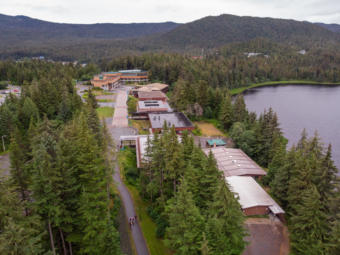
The University of Alaska Southeast campus in Juneau, shown on July 25, 2019. (Photo by David Purdy/KTOO)

The University of Alaska announced Wednesday that it will furlough all senior administrators across the system during the upcoming fiscal year, including the UA president, chancellors and deans.

It’s one of the ways the university system is slashing spending as it wrestles with a three-year, $70 million state funding cut, including a $25 million cut in the fiscal year that starts July 1. That’s on top of new costs and reduced revenues caused by the coronavirus pandemic.

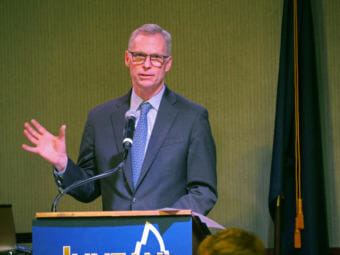
“I’m trying as hard as possible to minimize the impact of the budget reductions on our line faculty and staff across the university system,” said UA President Jim Johnsen.

UA says the furloughs, put in place by Johnsen, will impact 166 employees and are expected to save the university system $554,000.

The length of furloughs will be based on employees’ positions: Johnsen, university chancellors, provosts and chief officers will each lose a total of 10 days pay. Senior administrators, including faculty administrative leaders, will be furloughed eight days. Johnsen said the employee groups were selected because of their pay scale.

UA has also furloughed 120 lower-level employees whose jobs can’t be done from home during pandemic-related campus closures.

“Everybody is going to be contributing in one way or another to meeting these budget reduction requirements,” Johnsen said.

UA Faculty Alliance chair and UAA professor Maria Williams said the executive and administrative furloughs do not go far enough. She suggested a 10% salary reduction for those groups as a way to a avert broader cuts, including the deletion of academic programs.

“If we sunset these programs, we’re also cutting ourselves off at the knees, because we’re also going to lose future student tuition revenue,” Williams said.

But Johnsen is skeptical that salary reductions would have a large enough impact.

“The notion that if a few executives take some pay cuts we’re going to save the day is not realistic in this climate,” he said.

UA regents are expected to consider future cost-reduction measures at their meeting in June, including decisions on program cuts. UA last implemented executive furloughs in 2016.


Economists say more cash aid from the state makes sense, but it may not be as simple as another PFD

Sen. Bert Stedman, R-Sitka, walks onto the House floor before Gov. Mike Dunleavy’s State of the State address on Jan. 27 in Juneau. Stedman, co-chair of the Senate Finance Committee, says he wants to see what needs remain after federal coronavirus aid arrives in the state before committing it to another PFD. (Photo by Rashah McChesney/KTOO)

As Alaska lawmakers prepare to reconvene, some are pushing for an extra permanent fund dividend payment, which would come on top of the $1,000 that the Legislature already budgeted for dividends earlier this year.

Lawmakers are already planning to spend what they deem to be the maximum sustainable amount from the $62 billion fund, or about $3 billion, in the fiscal year that starts July 1. The cash will pay for dividends and government services.

Spending more than that risks reducing the fund’s overall value, leaving less money for future generations of Alaskans.

But some lawmakers, led by Gov. Mike Dunleavy, say the dire, once-in-generations nature of the coronavirus pandemic requires drastic measures in response. And a number of of Alaska economists agree — though they stress that extra spending from the Alaska Permanent Fund should done carefully, and that it comes with trade-offs.

Ralph Townsend, an economics professor and director of University of Alaska Anchorage’s Institute of Social and Economic Research, said he’s “deeply worried” about arguments against extra permanent fund spending on the basis that will leave less money available for Alaskans’ descendants.

“I would not hesitate to withdraw from my retirement account for expenses to help my brother get through cancer treatment, even if it means my children will have a smaller inheritance,” Townsend wrote in an email. “My kids have plenty of time to adjust to that smaller inheritance and they would agree with my choice. That is exactly our situation today.”

More than 60,000 workers, or about 19% of the state workforce, have active or pending claims for unemployment benefits. But the pandemic is also hitting Alaska’s budget by devastating the oil and tourism industries and depressing the overall value of the permanent Fund, which determines the amount available for government spending each year.

In an interview Monday, Dunleavy again called on lawmakers to approve additional spending from the permanent fund’s earnings reserve account, which he described as a rainy-day fund.

“If this is not raining, I don’t see how you could ever say something will rain,” Dunleavy said. “To put dollars into the hands of individual Alaskans so that they can pay for their bills, their food, their gas, I can’t think of a better approach at this stage in the game.”

But Dunleavy’s ideas face skepticism from some legislative leaders. Sen. Bert Stedman, R-Sitka, and co-chair of the Senate Finance Committee, said he wants to see what needs remain after federal aid arrives in the state. And he noted that lawmakers are getting dire forecasts about shortfalls in next year’s budget.

“I do recognize that there are resources in the permanent fund. But I have a serious concern about what’s coming at us next winter,” Stedman said. “We have crippling oil prices and revenue projections right now for the state, and I’m not so sure that the most difficult time upon us is here today.”

Economist Mouhcine Guettabi gives a presentation about Alaska’s economic outlook to the House Finance Committee, March 7, 2019. Guettabi is an associate professor of economics at the Institute of Social and Economic Research, University of Alaska Anchorage. (Photo by Skip Gray/KTOO)

Economists endorse more permanent fund spending

While a number of economists have pushed Alaska lawmakers to bring revenues in line with spending over the past few years, many now agree that setting aside normal fiscal discipline during the pandemic is justified.

Concerns about future generations and opportunity costs are valid, but those arguments assume the state’s economy will be okay through the current crisis without intervention from policymakers, said Mouhcine Guettabi, an associate professor of economics at ISER.

“I just don’t think that’s true,” Guettabi said. “You’re going to have to fight to get the economy going, or at least to make sure that it’s stable enough and be there to fight another day, or in a year or two years.”

Anchorage economics professor Matt Berman endorsed the idea of paying the already-budgeted dividend “as soon as feasible,” arguing that “now is when people need the cash.”

The question of a second PFD, however, prompted skepticism from economists. Several of them agreed that additional state aid from the permanent fund is merited — but they pointed out that the dividend is a blunt instrument, because it’s paid equally to all qualified residents regardless of income or status.

That means paying one during the pandemic would likely put cash in the hands of many people who don’t need it.

“The current suffering is not spread equally,” Roger Marks, an economist in Anchorage, wrote in an email. “The wealthier half of Alaskans that receive half the dividends do not need it. People who have not lost their jobs do not need it.”

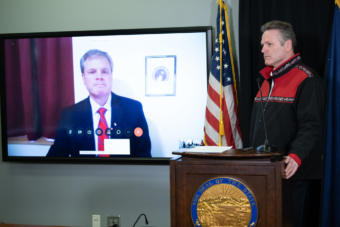
Gov. Mike Dunleavy speaks at a press conference in front of Wasilla Middle School in 2019. (Photo by Wesley Early/Alaska Public Media)

Tradeoffs between speed and efficiency

Dunleavy’s response to this argument is that Alaskans need extra cash now, and that setting up a more focused aid program would take time. “Every day we’re shaving off gross domestic product, and people are being laid off,” he said.

Several economists agreed that there’s a tradeoff between the speed at which policymakers move and how precisely they can focus aid programs.

The best policy right now would be targeted towards people who have lost jobs or had to close businesses — measures like loans, expanded unemployment insurance, food stamps and assistance payments, said Kevin Berry, an assistant economics professor at ISER.

Economists also said policymakers should try to coordinate state support with the array of federal aid programs passed by Congress. But, Berry said, targeting policy takes time and risks missing people.

“Something broad like a PFD is potentially more politically feasible,” Berry said. Shuttered businesses and people without much money in their savings accounts might not have time for lawmakers to negotiate a more focused package, he added.

A few economists expressed interest in the idea of making smaller payments, perhaps on a monthly basis, suggested by former U.S. Sen. Mark Begich and former Gov. Sean Parnell, who are leading Dunleavy’s economic recovery efforts.

Research suggests that smaller, regular payments — perhaps monthly — are more likely to be used for short-term goods like food and fuel, while a larger payment is more likely to be spent on durable goods like a car or big appliances, said Jonathan King, an Anchorage economist.

“If you’re worried about people’s quality of life during what is likely a medium-term event, smaller monthly payments makes more sense than a one-time larger, extra PFD,” King said in an email.

Institute of Social and Economic Research Director Gunnar Knapp
Gunnar Knapp, former director of ISER, delivers a presentation to the Houses Finance Committee, Feb. 25, 2016. (Photo by Skip Gray/KTOO)

Dividend spending leaves less for other programs

After the next fiscal year, even if lawmakers decide to pay no dividend at all, they’re still likely to face a budget deficit, which means that cash will be at a premium.

“We absolutely have no money to spare,” said Gunnar Knapp, a retired ISER economist.

If a larger PFD leaves less cash available for government services, cuts to education, the university system or public safety would “make economic development and growth in the long-run less likely,” said Berry.

A crash in tourism-related tax revenue is also likely to cause budget shortfalls for a number of Alaska’s cities and boroughs, which could need state assistance.

“There’s an argument to be made that helping these communities maintain core services during this unprecedented crisis, via a municipal stabilization fund, is a better use of money than an extra PFD,” said King.

An aid package could help preserve jobs and services, like education and health care, that could otherwise disappear or be left to the state, King added. Townsend said that the state and municipalities should also weigh the need for major investment in public health initiatives to help manage the pandemic over the next 18 months.

One other problem: There’s a finite amount of money available in the earnings reserve account, which is available for spending by a simple majority vote by the Legislature. If lawmakers spend too much, there might not be enough left for essential government programs.

“This account will be needed for public services,” said Marks. “Even without dividends it will be extremely stressed next year. Paying dividends will drain it more.” He and three other economists said taxes would be needed to help fill Alaska’s deficit.


UAS students and teachers cope with lack of physical community

The University of Alaska Southeast campus in Juneau, shown on July 25, 2019. (Photo by David Purdy/KTOO)

Last month, the University of Alaska Southeast closed down its physical campus, removing most students and transitioning to largely online learning.

But students and teachers say that transition has not been smooth.

Robin Gilcrest is a professor of architecture and construction technology. Normally her classes are a hybrid of physical and digital learning. Before the pandemic, she was teaching students how to use drafting software.

“I’ve been calling or texting them individually to make sure that they’re OK. But no, this is very traumatic and some of my students were working and now they’re not,” she said.

Now her classes are fully online. And, without that in-person interaction, she said some students aren’t as engaged as she hoped they’d be.

“They’re probably more worried about how they’re going to pay their rent than whether they get an assignment done,” said Gilcrest.

For many students, online learning just isn’t compatible with their classwork.

Sadie Inman’s focus is geography and the environment, as well as outdoor studies.

“A lot of the professors don’t know what to do,” she said. “Some of my classes have dropped assignments and other classes have made up more assignments. And so everything’s kind of just upside down.”

On top of the stress of classwork during the pandemic, housing is increasingly becoming an issue.

Inman is one of about 150 students who were living on campus before the pandemic. Only about 30 students are still there. They didn’t have safe places to go home to.

And while Inman was able to find housing through her work as a volunteer firefighter, options were limited for other students, like Sage Logan.

Logan left campus in a hurry when the university asked students living on campus to leave on March 17.

He’s now back home in Washington state, living in close quarters with his family, but he feels the impact of being removed from the community.

“People are close. You often refer to your professors by their first name,” he said. “It’s a very familiar kind of feeling. So kind of being removed from that environment feels like it kind of adds a little salt in the wound for this isolation.”

But — there are still ways for students to stay connected. Online meet-ups and art therapy sessions are held regularly through the university’s social media pages.

UAA study: To slow down COVID-19, Alaska will need strict interventions for months

A University of Alaska Anchorage study released Monday finds that the optimal mitigation strategy, applied over three months, was case isolation, home quarantine of household contacts, and social distancing of people over 70. (Graphic courtesy of University of Alaska Anchorage College of Health’s Division of Population Health Sciences)

A new academic study of the coronavirus’s likely impacts on Alaska is clear: To prevent thousands of deaths, strict interventions will be necessary for months.

recent paper by the University of Alaska Anchorage College of Health’s Division of Population Health Sciences predicts the effects of different containment strategies could have on hospitalizations and mortality. It gives figures for Anchorage and the Matanuska-Susitna Borough, as well as the state overall.

In no uncertain terms, the study’s authors recommend maintaining firm shelter-in-place measures, similar to what’s been recently enacted by the state to curtail widespread contagion and death.

“The social and economic effects of the measures which are needed to achieve this policy goal will be profound,” the study says.

Social distancing measures like school and university closures will significantly help reduce transmission.

“The more we do to slow down (COVID-19) transmission, the more lives we save,” said Dr. Tom Hennessy during a news conference Monday morning held by the Anchorage mayor’s office.

The study is based on two different data-based models of coronavirus spread. It’s meant to demonstrate to Alaska policymakers the potential outcomes from different approaches to dealing with the virus.

“What the university team has done is incredibly helpful,” said Anchorage Mayor Ethan Berkowitz during the news conference.

“If no action is taken,” the study says, “the model predicts that new cases will rapidly overwhelm Anchorage/MatSu’s medical capacity within weeks and will result in approximately 5,800 deaths in Anchorage. Anchorage/Mat-Su currently has just over 982 hospital beds, and in this scenario, we could need capacity to care for up to 7,400 hospitalizations at the peak of cases.”

The only scenario examined in which hospital capacity is not at some point overwhelmed is a lockdown similar to the one instituted in Wuhan, the city in China that was an early epicenter of the epidemic.

Moderate social distancing measures have the potential to push out the peak of hospitalizations in the Anchorage area by three-to-four weeks and reduce the volume of hospitalizations substantially. That would buy medical providers a little bit more time, but it would still overwhelm facilities by late April.

The shelter-in-place measures outlined by the study’s authors are similar to what most Alaskans are living with right now. Berkowitz has called it “hunkering in place.”

The good news under the academic model is that the strategy is effective while it’s in place, limiting the pace of hospitalizations and deaths.

“This scenario predicts very few cases while the response is in place,” the report says.

“We have done a lot to stop the virus,” Hennessy said of the state and municipality’s approach so far, adding that, as a result, the number of deaths from the disease could ultimately be much lower.

However, should the policies be lifted all at once, the volume of hospitalizations will climb rapidly, as if no measures had been enacted at all. It would, in effect, merely put off a surge in COVID-19 cases, buying time for health care providers. That could be mitigated by a phased approach to lifting restrictions on social movement, the study says.

The predictions for the state on the whole are not significantly different. With no containment measures, the authors caution, the number of virus cases will overwhelm the state’s hospital capacity in a matter of weeks, leading to “approximately 11,000 deaths.”

Idiosyncrasies in Alaska’s geography, the small population size of many communities and its unique health care system make it harder to model than larger metro areas. The relative isolation and early adoption of containment measures, however, may help limit the spread.

In effect, the study outlines different ways Alaskans can delay the worst impacts of the coronavirus and keep medical facilities from being dramatically overwhelmed, plus some of the tradeoffs the authors believe are necessary to facilitate that.

But, they concede, the measures are no silver bullet.

Asked how long he expects the city to maintain restrictions, Bekowitz said, “We are closer to the beginning than the end.”

Hennessy echoed that perspective.

“To avoid a rebound in transmission,” the UAA study concludes,  “these policies will need to be maintained until large stocks of vaccine are available to immunize the population — which could be 18 months or more.”


UA chancellors unveil proposals for cutting degree programs

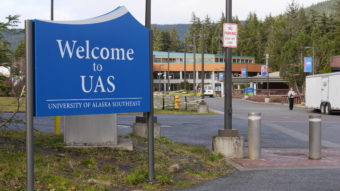
A sign on the campus of the University of Alaska Anchorage. (Photo by Tegan Hanlon/Alaska Public Media)

At the University of Alaska Anchorage, Chancellor Cathy Sandeen is recommending the university end 17 degree and certificate programs to cut spending, including a bachelor’s in theater and master’s in early childhood special education.

Sandeen released her proposal on Monday, March 23, as did the chancellors at the University of Alaska Fairbanks and University of Alaska Southeast.

It’s the latest step in a monthslong process across the University of Alaska system to close a budget gap driven by years of cuts to state funding and declining enrollment. UA’s governing board will ultimately decide in June what stays and what goes.

UA President Jim Johnsen said he knows it’s a painful process, made even more difficult by the coronavirus and its wide-spread impacts. But, he said, it’s necessary. The funding cuts aren’t going away. In fact, the university system’s budget situation may only get worse, he said.

“So lots of stress, lots of uncertainty. But what is certain is our state funding is going down,” Johnsen said. “And the COVID impact on us is serious. It is impacting us in terms of additional costs, which have to be borne in some way.”

Sandeen’s recommendations largely align with the prior proposals from Anchorage university leaders. At the University of Alaska Fairbanks, chemistry and sociology programs are on the chopping block, among others. And, in Southeast, the chancellor’s recommended cuts include a bachelor’s in geography and environmental resources.

There are other degree programs the chancellors are recommending be reduced, but not cut completely, while others, they say, should be enhanced. The chancellors are also looking for ways to save money within administrative services, and will provide recommendations for cuts to regents.

In the meantime, university leaders are also responding to the rapidly-developing coronavirus situation. They have largely shut down student life on campus. Most classes have been moved online. Most students have left their dorms.

Maria Williams is chair of the UA Faculty Alliance and a professor at UAA. She said it’s challenging to go through the degree program cuts while students and faculty are also adapting to the new coronavirus reality.

“I think clearly our public health crisis is taking all the oxygen out of the room,” she said.

She said faculty have concerns that they haven’t seen a cost-benefit analysis of the proposed degree eliminations.

“The other concern that faculty have is that if we’re really cutting academic programs, we’re cutting students, meaning we’re cutting student tuition dollars,” she said.

Also, Williams said, faculty think more cuts should come from UA statewide administration. But statewide officials counter the administration has already absorbed a large portion of the cuts over the years.

A UA spokeswoman said there wasn’t yet a total of how many jobs would be eliminated if the chancellors’ recommendations are approved.

Also, the coronavirus and its impacts may force the UA system to cut spending even further next year, according to Johnsen.

“We are working very hard to get our hands around what those extra costs are, and what impacts COVID may have on our revenues going forward,” Johnsen said.

Johnsen spoke Monday from his home office in Fairbanks where he is self-quarantining for two weeks after visiting his mother in California over spring break. In mid-March, UA announced that university faculty, staff and students returning from travel outside of Alaska have to stay home and watch for symptoms for 14 days.

Johnsen said UA’s spending has gone up as it responds to the coronavirus. Last week, UAA said it was helping buy students’ plane tickets to go home, if they couldn’t afford them, and refunding a portion of their dining and dorm fees.

The pandemic could also gouge the revenue side of UA’s budget, including reducing money for research, Johnsen said. UA is already bracing for a $25 million cut to state funding for the next fiscal year that begins July 1, and a $20 million cut in the following year.

Regents are taking public testimony in April and May, before making their decisions in June.

Site notifications
Update notification options
Subscribe to notifications