University of Alaska

Dramatic ocean changes are coming ‘a couple decades too early,’ scientists say

Sea ice floats in the Bering Strait off Cape Prince of Wales. (Photo courtesy of Gay Sheffield/University of Alaska Fairbanks)

Arctic Ocean temperatures are rising at rates faster than previously thought by the scientific community.

That’s the finding of a new study from the University of Alaska Fairbanks, which shows warming waters having an effect on everything from sea ice growth to marine ecosystems.

One researcher says now is a key time for studies on Arctic Ocean conditions, before the hotter temperatures become the new normal.

For UAF oceanography professor Seth Danielson, the record low sea ice and record high ocean temperatures of the last couple years came as a shock.

“It was a bit surprising, because we felt like it came a couple decades too early,” Danielson said.

Danielson is part of a team of researchers that authored a paper discussing the changes to Pacific Arctic ecosystems from warmer ocean temperatures. It lists several observations of the area, including weaker winter sea ice and an early melting period.

More open water conditions mean that there is likely to be an increase in vessel traffic through the region, which Danielson said could have an impact on subsistence. Low sea ice could also change migratory patterns.

“The time of the year that some hunting activities can take place may need to change,” Danielson said. “I think we’ve seen some indications of that already. And the species that people are hunting and fishing for may change as well.”

Katrin Iken, a professor at UAF’s College of Fisheries and Ocean Sciences, measures a brittle star. That data is part of an assessment of the seafloor community, which has shown signs of decreasing biomass in recent years. (Photo courtesy of Seth Danielson/University of Alaska Fairbanks)

Danielson said one of the findings of the paper is that new groundfish species, like Pacific cod, are showing up further north and have the potential to disrupt the native Arctic cod populations — and send ripples up the food chain.

“They’re a focal point through which energy flows to a lot of different components,” Danielson said. “For instance, they’re eaten by the seals. They’re eaten directly by people. The seals are eaten by people and polar bears.”

Danielson said that researchers expected that: As temperatures in the region got warmer, these effects could happen. He said research models show that the heat waves caused by global warming have become more prevalent in the wake of industrial advancement.

“You can be fairly confident in attributing these types of unusual events to human-induced causes,” Danielson said.

Danielson said that the rapid changes to Arctic marine ecosystems are happening in real time, as researchers are studying them. He said these changes likely aren’t going anywhere.

“It’s not gonna be too long before these extremely low-ice years that we’ve just had in the last couple years will be what we consider to be the norm,” Danielson said.

Historically, Danielson said there wasn’t a lot of scientific observation of Arctic waters four-to-five decades ago. He said the rapid warm changes to the environment mean now, more than ever, is the right time to keep tabs on Arctic waters.

“We’re at this interesting spot now, where we know things are changing incredibly rapidly, and now is the best chance for us to go out and make some additional observations,” Danielson said.

Danielson’s research was part of a coalition of scientists with the Arctic Integrated Ecosystem Research Program. The paper was published this month in the Nature Climate Change scientific journal.


‘None of us wants to do this’: UAA leaders recommend eliminating degree programs to shrink budget gap

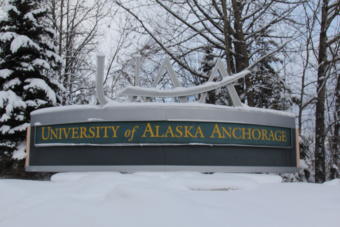
A sign on the campus of the University of Alaska Anchorage. (Photo by Tegan Hanlon/Alaska Public Media)

Leaders at the University of Alaska Anchorage are proposing to delete, suspend or revise more than two dozen programs to reduce spending and shrink budget gaps.

UAA published the proposed program eliminations on its website on Tuesday, Feb. 25. The nine programs recommended for deletion include the university’s bachelor’s degree in theater, master’s degree in anthropology and MFA in creative writing and literary arts.

“None of us wants to do this,” UAA Chancellor Cathy Sandeen said in an interview. “But this is the situation we’re in.”

Faced with three years of budget cuts, the University of Alaska Board of Regents tasked its universities last fall, including UAA, to begin fast-tracked program reviews. The task followed a tense, months-long state budget battle.

Sandeen said it’s still early in the review process: The university will take community feedback on the proposed eliminations, and then Sandeen will send her recommendations to the regents who are expected to make the final decisions in June.

This week, UAA is holding meetings with students and employees about the initial, proposed cuts, Sandeen said.

“It is quite dramatic for a university to cut academic programs at this scale,” she said. “So it really comes as a shock and people react with anxiety and sadness because what they know as UAA is definitely changing.”

When deciding what programs should go, university leaders weighed factors including enrollment and workforce demand, Sandeen said.

“If a program is eliminated, it doesn’t mean that it was a bad program. It’s just the situation we’re in right now. Because of these dramatic, extensive budget cuts, we need to go to this extreme,” she said.

Of the more than 100 degree and certificate programs reviewed, nine were recommended for deletion, 10 for suspension, 11 for revision and about 30 for continued review.

Sandeen said UAA expects to save about $4 million by slashing programs. It’s not an immediate savings. The university needs to give faculty notice of job cuts, and it needs to provide students already enrolled in programs with a path to a degree, she said.

It wasn’t immediately clear Tuesday how many jobs would be eliminated if the proposed cuts go through.

Sandeen said just because a degree program is cut doesn’t mean every related class would also disappear.

The release Tuesday of the proposed degree program cuts follows a turbulent year for the state’s public university system.

After a lengthy budget back-and-forth, the then-chairman of the UA regents and Gov. Mike Dunleavy signed a three-year agreement in August 2019 that included a $25 million budget cut for the university system in the current academic year followed by a $25 million cut next year and a $20 million cut the following year.

UAA also continues to grapple with a significant drop in student enrollment.

Despite the cuts, Sandeen said, the Anchorage university will continue to invest in the programs it keeps.

“Many, many of our programs will be preserved and will continue and will get strong so UAA will still be here,” Sandeen said. “It’s just we will be a different UAA going forward.”

This story has been updated.

UAA enrollment drops 10% after summer of tense budget battles

A sign on the campus of the University of Alaska Anchorage. (Photo by Tegan Hanlon/Alaska Public Media)

Leaders at the University of Alaska Anchorage are grappling with their largest drop in enrollment in years.

The number of students who signed up for UAA classes this past fall compared to the year before fell by about 1,500 students, or nearly 10%, according to preliminary data from the University of Alaska system.

The enrollment drop follows a tense state budget battle and accreditation issues for the Anchorage university, and it adds additional financial loss to a system that’s already cash-strapped and stressed.

“It’s significant for us,” said Bruce Schultz, UAA’s vice chancellor for student affairs. “It’s one of the largest declines we’ve seen in the last 10 years.”

While UAA, the University of Alaska Fairbanks and the University of Alaska Southeast have struggled for almost a decade with shrinking enrollments, along with colleges across the country, a one-year, 10% decline is “not typical by any means,” according to Robert Anderson, president of the State Higher Education Executive Officers Association.

He described it as “seismic.”

“I think it represents an uncertainty that students and their families feel regarding at what level Alaska will support higher education,” Anderson wrote in an email.

(Graphic by Hannah Lies/Alaska Public Media)

UAA Chancellor Cathy Sandeen said it became apparent this summer that fewer students would show up in the fall — defying projections.

“We keep a dashboard of our admission and enrollment data, and everything was green,” she said. “We were expecting a banner year for fall of 2019. And then in July, all those indicators turned red as fewer and fewer students were enrolling.”

She attributed the decline to a number of factors.

First, university regents voted in April to eliminate UAA’s teacher preparation programs after they lost accreditation.

Then came the summer’s state funding battle sparked by the governor cutting an unprecedented 41% of state funding for the UA system.

In response, university leaders warned they’d have to erase degree programs and shut down whole campuses.

In the middle of all of that, thousands of Alaska students also learned there was no money to pay for their college scholarships.

Talk about consolidating the UA system also gained new momentum.

It was a chaotic pileup of issues during a key time for UAA enrollment, Sandeen said.

“We had many, many questions from students,” she said. “And during portions of the summer, we didn’t have a lot of good answers for them. We tried to assure them that, ‘There still would be substantial programs offered in Anchorage. Hang in there with us.’ But, you know, some of them chose a wait-and-see approach.”

It’s also important to remember that many UAA students are older than the traditional college student, Sandeen said. They’re often working while they’re earning their degrees, and many are the first in their family to go to college.

A lot of them also wait until shortly before the semester starts to enroll in classes, Schultz said.

“It’s just the pattern,” he said. “Because they’re so dependent on financing and wanting to know how much time off they get from work and family obligations, they register in August. And because of the conversations and the negativity that was going through the community about the future of UAA and the statewide budget, our students didn’t register.”

Keon O’Brien is one of the university students who nervously watched the budget back-and-forth play out in the news this summer. He had just finished his freshman year at UAA, studying music.

“I honestly had no clue what I was going to do. I was working three jobs over the summer trying to save up for school,” he said. “I had plans for the fall. And that was sort of all turned on its head. I started looking at transfer options in June, July-ish.”

But, O’Brien said, he didn’t have enough time to transfer out of state.

So he’s still at UAA this year, and he said he notices fewer people on campus, whether in the dorms or in the student union.

O’Brien said he’s still weighing whether to stay at UAA another year, but he’s leaning toward leaving.

Even with the smaller state budget cut agreed to and scholarships going out, O’Brien said staying at UAA feels too risky. He worries about continued funding cuts decimating his program. Some of his friends are already gone.

“Which is really unfortunate because I love UAA. I love all the opportunities I’ve had here. I love the people here,” he said. “And so it’s sort of like, I don’t want to leave, but I sort of have to.”

According to a survey of UAA students who didn’t return this fall, the largest chunk who responded — about 38% — said they were taking a break from college.

“The biggest barrier we have is students deciding not to go to school at all,” Schultz said. “We don’t have students just flowing across state boundaries and among institutions.”

Nearly a quarter cited concerns about costs and financial aid, and 18% said they had transferred to another university.

To adjust to a smaller student body, UAA is offering fewer classes.

This fall, the university had 412 fewer course sections, about a 15% cut, Schultz said.

UAA also expects to be down at least $5.5 million in tuition and fees this year. That’s on top of its slice of the state funding cut: nearly $12.5 million.

Sandeen said UAA is currently reviewing its programs to inform where to cut spending. So are the other universities.

“Right now we’re still in somewhat of a period of uncertainty,” she said. “And I understand where people are coming from, but we’re working as hard as we can to turn this around so that we continue to help people fulfill their dreams.”

Sandeen said UAA also continues to “invest heavily” in recruiting new students and retaining those already enrolled.


Watch the latest legislative coverage from Gavel Alaska.

A new report sheds more light on how climate change is impacting Alaska Native villages

The Western Alaska village of Newtok in August 2016. Because of encroaching erosion, the village is in the process of relocating. (Photo by Eric Keto/Alaska’s Energy Desk)

Ten years ago, the Army Corps of Engineers released a report that detailed the impacts of erosion in Alaska Native communities.

Don Antrobus is the program manager for the Denali Commission’s Village Infrastructure Protection Program. He helped guide an updated report that documents three environmental threats facing the communities: erosion, thawing permafrost, and flooding.

Antrobus said those environmental threats are made worse by climate change.

“In order for communities to develop good solutions, they need to fully understand the site-specific threat,” Antrobus said.

The Army Corps and researchers at the University of Alaska Fairbanks conducted the research and wrote up the report at the behest of the Denali Commission. It took three years and $700,000.

Antrobus said that more specific information is needed to fully understand the threats.

“One of the approaches that we’re taking, to try to kind of paint a bull’s-eye around what those additional data collection needs are, is to not only say that you need additional information, but to identify these are the specific types of communities, specific vulnerability analyses that are necessary,” Antrobus said.

This report examines 187 communities, most of them in Western Alaska near or right on the coast or near a river. It ranks them according to how bad the threat is endangering their infrastructure.

The rankings are complex. The report separates the three threats and ranks each community under each threat. Then the report combines all three for each community and ranks the communities that are in the biggest trouble.

“There is a little bit of uncertainty based on that availability of data, so it shouldn’t be taken as hard and fast,” Antrobus said.

The top two most threatened communities are Shaktoolik and Shishmaref, both close to the Bering and Chukchi seas.

“We were looking at flooding, erosion, and permafrost degradation threats to community infrastructure. And so I think it’s natural that a lot of … the greatest flooding threats that we’re gonna see are gonna be along the coast,” Antrobus said.

These villages have endured catastrophic erosion and storms, and the dwindling sea ice means that there is less protection for the shoreline. The ocean is nibbling closer to communities, forcing some, like Shishmaref, to consider relocation.

Other communities sit right next to a riverbank, like Napakiak and Newtok in the Yukon-Kuskokwim Delta. Newtok is relocating entirely, while Napakiak wants to move its school.

Antrobus said that the report could help communities figure out their biggest threat. For some, erosion is the biggest. For others, it’s flooding. He said this report is just a one-time effort, but he hopes government agencies and villages can fill in the gaps in data, and apply for funding to do so.

University of Alaska Southeast chancellor to retire in 2020

UAS Chancellor Rick Caulfield in his office on July 10, 2019. (Photo by Zoe Grueskin/KTOO)
University of Alaska Southeast Chancellor Rick Caulfield in his office on July 10, 2019. (Photo by Zoe Grueskin/KTOO)

University of Alaska Southeast Chancellor Rick Caulfield will retire next June, after leading the university for five years.

The university announced the news Friday as Caulfield and other university officials met in Fairbanks for a University of Alaska Board of Regents meeting.

Caulfield took over as UAS chancellor in 2015, replacing John Pugh. His 35-year career with the university began at the University of Alaska Fairbanks Bristol Bay Campus, where he taught in the Department of Alaska Native Studies and Rural Development.

After teaching at UAF for about 20 years, Caulfield moved to Juneau in 2010 to become the campus provost.

As head of UAS, Caulfield supervised campuses in Juneau, Sitka and Ketchikan amid significant cuts in state funding. He also oversaw the creation of a new Alaska College of Education based in Juneau.

In a statement, UA President Jim Johnsen said a search committee made up of people from the university, UAS campuses and their surrounding communities will be formed to search for a replacement. Finalists will visit the campuses in the spring.

Community members will also have the opportunity to weigh in before Johnsen makes a final decision.

Caulfield’s replacement is expected to take over in July.

Research shows studded tires cost Alaska millions of dollars in road maintenance every year

A closeup shot of the treads on a tire.
Winter tires without studs are becoming more popular in Alaska, while some drivers choose to forgo winter tires altogether. (Photo by Abbey Collins/Alaska Public Media)

Winter tires without studs are increasingly popular in Alaska. But many drivers still roll with studs.

A new report finds that over the next 20 years, the road maintenance related to studded tire use will cost the state way more than what it takes in from fees drivers pay to use them.

When it comes to winter tires, Alaskans like Bryce Mecum have many different opinions.

Mecum, 34, was born and raised in Juneau. He’s on his third vehicle — a truck — and he’s moved away from winter tires altogether.

“I just opted not to go with switching out the studs. I just kept the summer tires on,” Mecum said. “And I just put 100 pounds of sandbags in the back. And that seemed to work really well. So I think I’ll probably stick to that for this next winter and just leave the studded tires under a tarp again.”

Meanwhile, Anchorage resident Carolyn Heyman said she relies on studded tires. Heyman lives in Anchorage’s Hillside neighborhood, where the steep streets can get really icy. She said when she first moved in, she didn’t have studs.

“For the most part, you know, 90% of the time, I could get around OK,” Heyman said. “But those really icy days, you did slide all over the place. Especially with kids. I have two girls, it just didn’t feel as safe. And there were a couple of times where I did slide into ditches.”

Heyman is not alone. A lot of drivers still use studs. But a household survey conducted by the University of Alaska found more people are going studless. The survey is part of research into the impacts from studded tire use in the state.

The research was requested by the state and conducted by the University of Alaska Anchorage College of Engineering.

Toby Schwoerer, with UAA’s Institute of Social and Economic Research, conducted the economic analysis.

Schoewer looked at state roads throughout Alaska, and how they are impacted by studded tire use. He compared the amount of money the state receives in revenue from studded tire fees to the costs of road repairs.

He found that the annual cost of road repairs related to studded tire use is expected to be $13.7 million over the next 20 years. According to the report, that’s 42 times the amount of money the state generates in fees collected in studded tire sales and stud installation.

“The highways that have the largest cost related to that is by far the highways — the Glenn Highway and the Seward Highway. Those receive the most traffic, and they’re repaved on a shorter interval over the years,” Schoewer said.

Schoewer said the research takes into account the fact that more people are switching to non-studded winter tires.

“So that really tells you there’s still a lot of cost. Even though people are switching over, not enough people are switching to non-studded winter tires,” he said.

The report makes several recommendations to the state for reducing costs, ranging from providing education about the safety of non-studded winter tires, to phasing out the allowed use of studs altogether.

Site notifications
Update notification options
Subscribe to notifications