University of Alaska

In the face of University of Alaska budget cuts, state lawmakers weigh next steps

Legislative Finance Director David Teal testifies before the House Finance Committee in February. On Monday, Teal told lawmakers in Anchorage that the Legislature could affect the University of Alaska budget by setting separate appropriations for different university campuses. (Photo by Skip Gray/360 North)

As the University of Alaska faces up to $70 million in cuts over three years, state lawmakers are trying to figure out what role they’ll play in shaping the university’s budget.

A group of state representatives and senators learned more about what they can do during a meeting they held in Anchorage on Monday.

David Teal, the Legislature’s top budget analyst, noted that the Legislature can steer money to different parts of the university. It can do that by separating the university budget into separate lines, known as appropriations.

“When the Legislature creates its appropriation structure and increases the number of appropriations, it often does it to limit movement of funding,” Teal said.

When the entire university budget has one appropriation, the university president and regents determine how the budget will be spread across campuses.

But there were two appropriations this year. The Legislature included a $25 million cut to the Fairbanks and Anchorage campuses, as well as to the central administration. And the University of Alaska Southeast in Juneau and 13 community campuses were given a separate appropriation with no cuts.

Fairbanks Democratic Rep. Adam Wool said having separate appropriations can increase lobbying of lawmakers.

“If next year, there are more than one — or three or four (appropriations) — that will really even more pit each campus against each other, vying for the same pie — who can get the bigger piece,” Wool said.

University officials are considering ways to make the cuts under an agreement between university regents and Gov. Mike Dunleavy.

New UAF climate report highlights rapidly changing Alaska ecosystems

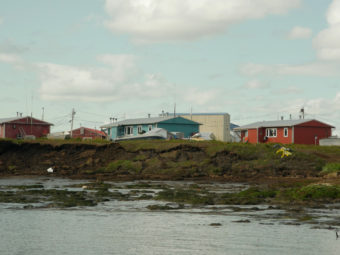
Bering Sea storms battered Port Heiden’s coast in October 2017. (Photo courtesy of Jaclyn Christensen)

Alaska has been breaking so many climate records over the last five years, it suggests the state has crossed a threshold into increasingly rapid ecosystem changes.

That’s according to a new report by Rick Thoman and John Walsh, scientists at the International Arctic Research Center at the University of Alaska Fairbanks.

“When you cross these thresholds, some of which we don’t know what they are until they happen, that you get these very rapid changes,” Thoman said in an interview on Wednesday.

The report highlights increasingly intense wildfires in the western U.S., rapidly declining sea ice and warming winter temperatures.

But there are more specific measures of climate change too. The year 2019 saw the earliest ice breakup on record on the Tanana River. Southeast Alaska’s rainforests have experienced multiyear drought. Tundra on the North Slope is greening, and widespread algal blooms have been showing up in warming coastal waters.

As the report points out, all of these have significant impacts on Alaska communities. Whole villages have been forced to migrate due to erosion. Subsistence resources have become more unreliable. And state agencies have been forced to adapt to new federal regulations.

Some of the climate records Alaska has broken over the last five years. (Graph by Rick Thoman/Alaska Center for Climate Assessment and Policy)

Thoman said the effects of climate change in northern latitudes are more apparent than in the Lower 48, a phenomenon called “Arctic amplification.”

“That is, very largely, the result of changes in sea ice,” he said. “Also, changes in snow cover on land over most of the high latitudes.”

It’s basically a worsening cycle. Shorter sea ice and snow seasons mean there’s less ice and snow to cool the air and the land, so the impacts of warming trends are more apparent. And Thoman said the extra water vapor in the air — a result of the warming atmosphere — acts like a greenhouse gas to trap in heat.

Even within Alaska, the effects of climate change are varied, Thoman said.

“In places like Southeast, especially southern Southeast, temperatures are responding much closer to what we’re seeing in Washington state, for instance, as opposed to on the North Slope, where the sea ice changes are so dominant. Temperatures are warming almost three times the rate that they are in southern Southeast,” he said.

Thoman and Walsh’s report also talks about how Alaska communities are responding to the changes. So far, many of the plans are mitigation strategies. But Thoman said that’s not really enough.

“Most of them are, ‘How do we protect our community when some bad weather event happens?’” he said. “But we are seeing more and more (communities) start to address the bigger issues, understanding that this is a global problem. It’s not going to be solved by one community not doing plastic bags at the store anymore.”

The climate report used published data from the National Oceanic and Atmospheric Administration and climate science researchers. Thoman said they’re hoping to make this report one in a series covering the impacts on communities and expectations for the future.

University of Alaska debt rating downgraded after years of cuts

Standard & Poor's
(Creative Commons photo by eflon)

Standard & Poor’s Global Ratings has lowered its debt rating for the University of Alaska system. They cited big cuts in state funding as an indicator of credit risk.

S&P Global Ratings report is the second time this year a rating agency has down-graded this measure, after Moody’s downgraded the UA system’s credit rating in July.

However, this week’s downgrade is only one notch in S&P’s rating system, from AA- to A+.

On their scale is AAA, AA, A, BBB, BB, B, CCC, CC, C and below that are junk bonds.

“In our rated universe, for higher education public institutions in the United States, A is the average rating, so it is above average,” said Mary Ellen Wriedt, S&P Global’s primary credit analyst in San Francisco. She wrote report on UA’s ability to pay back bonds. She said it is based on both strengths and weaknesses.

“The S&P Global Ratings criteria we have that dictate how we come to a rating looks at enrollment, matriculation, selectivity, graduation rates, tuition discounting, how much financial aid the university pays out,” she said.

In addition to the enterprise profile, S&P Global looked at the university system’s financial profile, including cuts every year from the state since the 2014 drop in oil prices. Especially this year’s $25 million cut. It’s what S&P Global calls “Negative net operating income.”

But Wreidt said there were a lot of indicators to keep UA’s rating in the A category.

“There are still tremendous strengths to the system despite enrollment declines and cuts to the state appropriation. Management also has been working very proactively to operate the system in a prudent fashion,” she said.

UA Chief Finance Officer Myron Dosch said the rating is a measure of creditworthiness, or of risk that UA will pay back what it borrows.

“The university would sell bonds to finance or pay for a new building, like the engineering building here in Fairbanks or the new power plant,” Dosch said.

Dosch said the downgrading from S&P global doesn’t affect any debt service payments the university is already making. About two-thirds of the new power plant and about a third of the new engineering building was financed by bonds.

And he said the university isn’t about to bond for any new construction in the near future.

“The university presently doesn’t have any new construction on the horizon. We have reduced state funding, that’s why it may not be the best time to borrow,” he said.

That means this downgrading will probably have no effect on university finances.

University of Alaska president: Budget cuts, possible consolidation won’t affect accreditation

The University of Alaska Southeast campus in Juneau, shown on July 25, 2019 (Photo by David Purdy/KTOO)

In the wake of a $25 million cut this year, and another $45 million cut anticipated the next two years, the University of Alaska is considering some campus consolidation.

UA President Jim Johnsen concluded the first day of presentations at the Southeast Conference in Sitka with a university update. Currently, the university consists of three accredited institutions and 16 campuses.

“We will remain an accredited university. Period. End of report,” Johnsen said. “So if anybody says that’s gonna threaten accreditation, no, we’re not going to do anything that would threaten our accreditation. It’s not negotiable. Even if we have increased consolidation, there will be people where the students are.”

Johnsen said a group of 13 teams would be looking into restructuring options of all of the academic programs, and they would present their findings to the university’s board of regents. But regardless of exactly what the institution looks like in the future, Johnsen said one thing was certain.

University of Alaska President Jim Johnsen appears on an episode of Forum@360 in Juneau on April 3, 2018.
University of Alaska President Jim Johnsen. (Photo by Rashah McChesney/Alaska’s Energy Desk)

“What’s certain is we will need to reduce our costs and programs and people will be cut. What’s certain is we’re going to go through a rational process for making those decisions,” said Johnsen. “What’s certain is that the students in those programs are going to be taught out, they’re going to be taken care of, and we have a record of accomplishing that.”

There’s been no consolidation of campuses in the system since 1988. Even without budget cuts, integration has been a recurring topic of discussion.

Johnsen said a recent survey of the university community was divided right down the middle when it came to campus integration.

“Fifty-fifty split between increased uniqueness and increased integration. Fifty-fifty split. You wouldn’t know that if you went to the regents meeting, because it was all 100% uniqueness.”

One quarter of the nearly 4,000 people surveyed were students. Johnsen said this demographic most favored more campus integration.

The annual meeting of the Southeast Conference runs through Friday in Sitka.

US-China trade dispute stalls timber sale negotiations in Haines

The Chilkat River as seen from Mount Ripinsky in summer of 2017. (Photo by Emily Files/KHNS)
The Chilkat River as seen from Mount Ripinsky, north of Haines, in summer of 2017. (Photo by Emily Files/KHNS)

Negotiations between the University of Alaska and a Chinese buyer ground to a halt last month as a result of an escalating trade war between the U.S. and China. The sale is on hold until there is a change in tariffs.

Morgan Howard from the University of Alaska Land Management office said the potential buyer is still interested in a timber contract. But not right now.

Tariffs on American timber headed to China have put the university’s negotiations on hold.

“The potential bidder for the timber sale does not see this time as a good time to engage with the tariffs being as high as they are,” said Howard. “So we’ll see what happens in the future, but we don’t see negotiations resuming until there is a change in the tariffs.”

The 13,426 acres is scattered throughout the Haines Borough. (Map courtesy of the University of Alaska)

The current tariff on spruce logs exported to China is 25%. Howard said they are still looking at infrastructure, permitting and potential markets for the spruce and hemlock on 13,000 acres of university land around Haines.

Conservation groups want to keep the forests standing. So the clash between the President Donald Trump’s administration and China is working in their favor.

“It’s amusing to say the least,” said Jessica Plachta, the director of Lynn Canal Conservation.

Plachta said she’s opposed to the sale because of logging’s ecological impact, especially to wildlife and subsistence resources. She said from an economic standpoint, the university could actually make more money trading their trees on the carbon market than cutting them down.

“The carbon credit market is turning out to be more reliable than global export for timber,” she said.

The university timber sale could make about $10 million over 10 years — if tariffs go down. A study put together by Takshanuk Watershed Council, another local conservation group, said a carbon sale of the university’s land could earn millions of dollars up front, followed by yearly earnings in the hundreds of thousands of dollars after that.

Those earnings would not be affected by tariffs. In fact, Plachta predicts the value will only go up as the need for carbon sequestration increases.

“If it was me, I would say, ‘Let’s see less effort, more money.’ Right?”

Carbon credits are something the university’s land management office is considering. Howard said they are still in the early stages of conversation on the subject, and it hasn’t been ruled out for the land near Haines. But he hasn’t given up hope that a regional timber industry could thrive.

“Initially, there was a vision for the Chilkat Valley that all of the landowners would work together in regard to harvesting timber,” he said. “If they all work together, then there could be a long-term timber industry put into place.”

That vision is on hold until trade conditions improve.

University of Alaska regents cancel financial exigency declaration

University of Alaska Board of Regents Chair John Davies (left) and UA President Jim Johnsen (right) at the board’s July 30, 2019, meeting. (Photo by Wesley Early/Alaska Public Media)

The University of Alaska Board of Regents has approved a motion to end financial exigency. The vote overturns a declaration that allowed for quickly eliminating academic programs and firing faculty, even those with tenure.

UA President Jim Johnsen, who recommended the new motion to the board, said that a recent change to university funding from the state was a big factor.

“The material circumstances that were on the ground when the board declared exigency are markedly different material circumstances that we face today,” Johnsen said.

The board of regents declared exigency in July when faced with $130 million in cuts from Gov. Mike Dunleavy’s line-item vetoes to the state operating budget. While cuts to administration and adjunct faculty have occurred this summer, Johnsen said no faculty had been laid off due to exigency.

The governor changed course last week when he signed an agreement with board Chair John Davies. This agreement outlined a three-year plan for cuts instead of one. It also reduced the total amount of cuts to $70 million.

Johnsen said he hopes the efforts to transition the University of Alaska from three separately accredited universities into one will allow for big savings.

“We’re working hard now on a plan that the board of regents directed us to prepare that they’ll be considering at their meeting Sept. 12 and 13. And that plan would involve substantial administrative cost reduction across the university system, and also reduction in the number of duplicative academic units across the university system.”

The vote was 10-0 in favor of canceling the financial exigency declaration. Regent Sheri Buretta was absent.

Site notifications
Update notification options
Subscribe to notifications