University of Alaska

University of Alaska Board of Regents votes to declare financial exigency

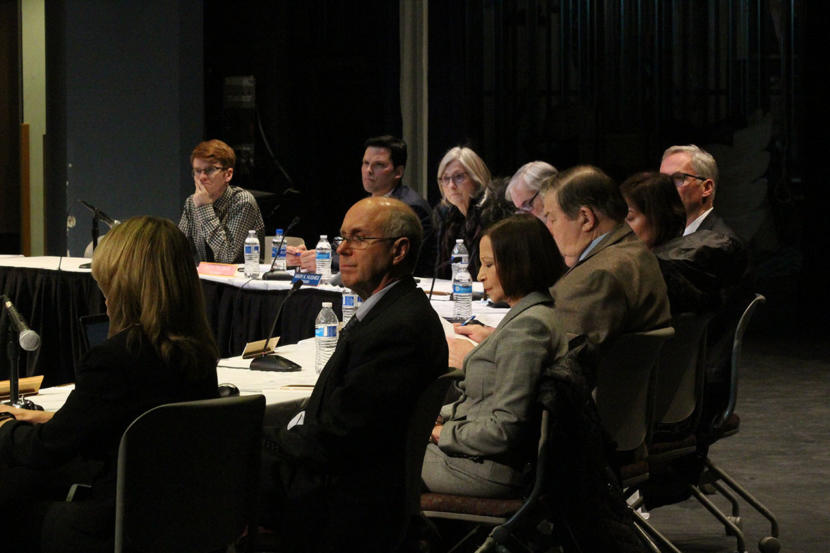
The University of Alaska’s Board of Regents, as well as officials from UAA, listen to public testimony from students affected by UAA’s loss of accreditation for its education department.
In this photo from February 2019, the University of Alaska’s Board of Regents, as well as officials from UAA, listen to public testimony from students affected by UAA’s loss of accreditation for its education department. (Photo by Wesley Early/Alaska Public Media)

The University of Alaska Board of Regents voted to declare financial exigency Monday, enabling immediate budget cuts, including expedited faculty layoffs. Regents approved the declaration at a meeting in Anchorage in response to an over 40% reduction in state funding.

Board Chair John Davies called it a sad day, saying it comes despite overwhelming public support for the university, as demonstrated during statewide public hearings last week: He said 86% of those who testified during those hearings spoke in support of reversing university cuts and other state funding vetoed by Gov. Mike Dunleavy.

“But on the other hand, we have as indicated a fiduciary responsibility to make sure that the institution survives. And I think unfortunately, we are right now grappling with survival,” Davies said.

Regents approved the exigency declaration 10-1. Regent Lisa Parker, the sole “no” vote, said it’s still not clear what specific actions the university will take.

“I don’t see through this declaration that we’re going to be able to be saving $11 million a month to reduce that burn rate. That’s not been identified,” Parker said.

The funding cut took effect July 1 and some regents expressed the urgency of addressing it quickly. Calling the reduction a political choice, chair Davies expressed slim hope that the Legislature might restore some of the money.

“If I have to bet on it right now, I don’t think it’s very likely,” Davies said.

The second portion of today’s regents meeting focused on how the university can actually cut costs. University President Jim Johnsen said exigency enables faster downsizing, and outlined three avenues.

“We can save the money closing campuses. And we can save the money by shrinking each one of the campuses within our current university structure. Or we can re-envision how we serve the state’s higher education needs,” Johnsen said.

Regents expressed interest in options two and three. Johnsen favored the single university model, in which all campuses work together to support core areas of study.

“So a college of engineering, education, management, business … through a common curriculum and calendar, course blocks, common bill, a common transcript, a common application,” Johnsen said.

Johnsen said courses would be taught in person and online, and the ratio of students to faculty would increase. University of Alaska Anchorage Chancellor Cathy Sandeen questioned how long it would take to make such a fundamental shift, and said individual campuses are already cutting costs.

“We are working diligently to move toward reduction. And I think that gives us time to analyze a major structural change. And I think it’s the quickest path forward to meeting these reductions,” Sandeen said.

The chancellors of the University of Alaska Southeast and the University of Alaska Fairbanks also expressed concerns about centralizing the system, but Johnsen stressed that the individual campus changes would have to be very dramatic to meet the cut. Regents asked Johnsen to bring more detailed analysis of options two and three to regents at the July 30 meeting.

This story has been updated. 

Juneau begins to feel budget veto impacts

Juneau resident Liz Lucas laughs with a friend during a rally against Gov. Mike Dunleavy’s vetoes from the state’s budget on Monday, July 8, in Juneau, Alaska. (Photo by Rashah McChesney/KTOO)

For months, city officials in Juneau and other communities across the state have warned that proposed cuts to the state budget would push the financial burden onto local taxpayers.

As the Alaska Legislature continues to grapple with the state’s budget, Juneau will be dealing with the direct and indirect impacts of Gov. Mike Dunleavy’s budget vetoes.

During a meeting last week, Juneau Assembly member Rob Edwardson echoed a point that was a common refrain during city budget meetings throughout the spring.

“This isn’t a cost cut, this is a cost shift,” Edwardson said. “These things, our citizens are going to end up paying for, where it was the state rightfully paying for it to begin with.”

Juneau Assembly member Rob Edwardson. (Photo by David Purdy/KTOO)

According to a city memo, immediate impacts for this fiscal year are estimated to be $5.2 million. The majority of that comes from the loss of $3.7 million in school bond debt reimbursement.

The Juneau Assembly will determine how to make up the difference at upcoming meetings. They may use savings to cover debt payments for now and increase property taxes later.

Bartlett Regional Hospital also expects to raise service fees in order to make up for a $1.5 million loss in Medicaid funding.

Those are things it’s easy to put an immediate price tag on.

As Assembly member Michelle Bonnet Hale pointed out, it’s harder to know how residents will feel the impact on an individual level.

“I’m very concerned by immediate impacts on people’s lives, like people losing their senior benefits with no warning,” Hale said.

Juneau Assembly candidates Michelle Bonnet Hale, left, and Carole Triem watch election returns on Tuesday, Oct. 2, 2018, at City Hall. (Photo by Mikko Wilson/KTOO)
Juneau Assembly members Michelle Bonnet Hale, left, and Carole Triem watch election returns on Tuesday, Oct. 2, 2018, at City Hall. (Photo by Mikko Wilson/KTOO)

Patrick Kearney is one of more than 300 seniors in Juneau who qualify for the state’s Senior Benefits Program. He had heard cuts were coming, but he thought he might be exempt — until his check didn’t arrive earlier this week.

While he didn’t rely on the income, he said he did budget for it.

“I had, like, $175 extra to spend. So now I’m going to have to be even more cautious,” Kearney said.

He said he mainly used the money for groceries and extra things, like occasional trips to the movies.

Now he’s waiting to see what happens.

“Part of me wants to (say), ‘OK, do I get ready to move out of Alaska?’ But where do I go?” Kearney said.

Other impacts that are hard to quantify just yet include the University of Alaska, which lost $134 million in state funding. That could endanger programs and research at the University of Alaska Southeast campus

Homeless and housing service providers and early childhood education also saw significant cuts, raising questions about how those programs will be affected locally.

On Monday, the Juneau Assembly will consider a resolution calling on the Alaska Legislature to restore vetoed funding to the state operating budget.

UAS accreditation renewed despite budget concerns

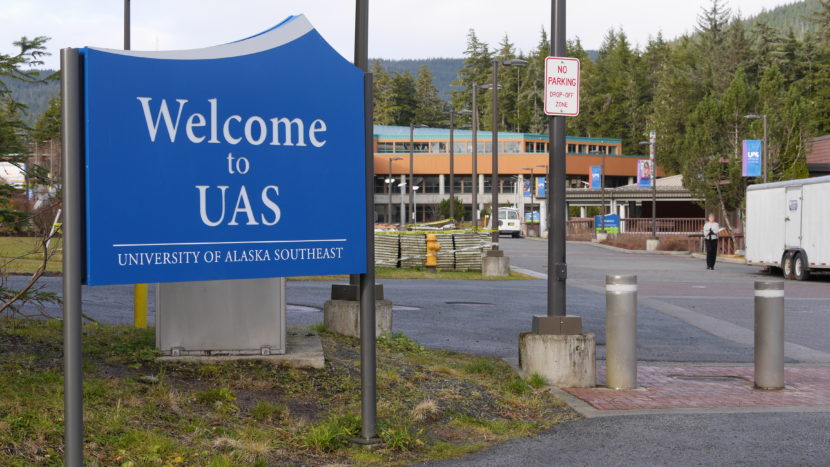
University of Alaska Southeast's Juneau campus on Tuesday, Nov. 15, 2016. (Photo by Quinton Chandler/KTOO)
University of Alaska Southeast’s Juneau campus on Tuesday, Nov. 15, 2016. (Photo by Quinton Chandler/KTOO)

The University of Alaska Southeast announced on Thursday its accreditation has been renewed by the Northwest Commission on Colleges and Universities.

The announcement comes despite a letter earlier this month to the Alaska Legislature from commission president Sonny Ramaswamy. In it, he expressed concern that cuts to the University of Alaska’s budget could jeopardize the institutions’ accreditation in the future.

The commission visited UAS in April to complete its evaluation process, which typically happens every seven years.

In the renewal letter, Ramaswamy commended UAS for its distance learning opportunities, the integration of its three distinct campuses and its inclusion of Alaska Native language and culture into curriculum and administration.

In a shorter list of recommendations for improvement, the commission expressed a need for greater stability in the UAS administrative team.

The University of Alaska Anchorage’s accreditation was renewed last year. And the University of Alaska Fairbanks recently began its reaccreditation process.

Could climate change research in Alaska be put on ice?

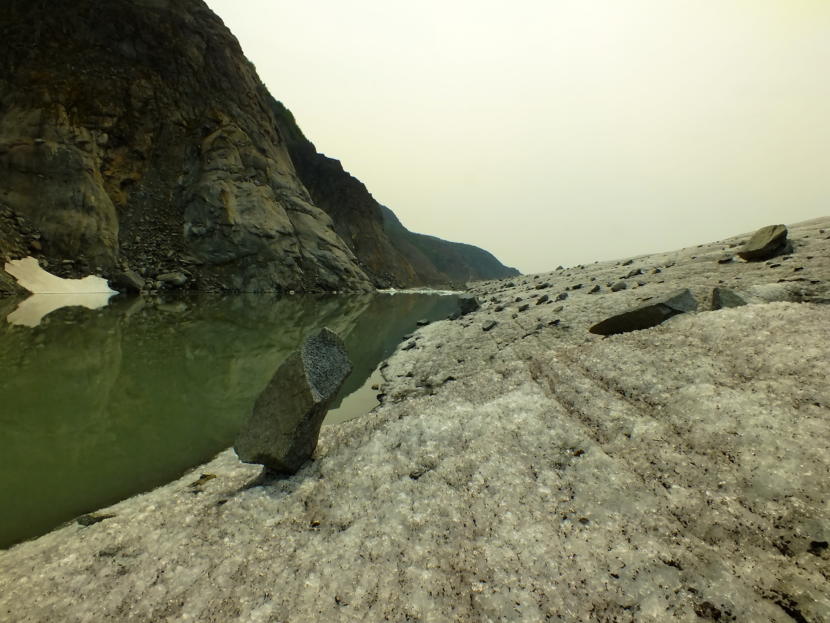
This dog-sized piece of granite rock, called a glacial erratic, stands naturally balanced on the edge of Mendenhall Glacier. The adjacent pool of water has spilled over from an ice dam that is holding back most of the water in Suicide Basin.
This dog-sized piece of granite rock, called a glacial erratic, stands naturally balanced on the edge of Mendenhall Glacier. The adjacent pool of water has spilled over from an ice dam that is holding back most of the water in Suicide Basin. (Photo by Matt Miller/KTOO)

Alaska is experiencing an unusually hot summer and researchers across the state are tracking the effects. The University of Alaska system is known as a leader in climate change research — studying melting permafrost to shrinking glaciers.

But there’s growing uncertainty about the future of such projects with steep cuts to state funding.

One faculty member in Juneau is hoping he doesn’t have to relocate.

Eran Hood is a professor at the University of Alaska Southeast. He’s training the next wave of environmental scientists, and he’s helping the capital city track potential climate disasters.

He researches avalanches and glacial flooding events, among other things. Hood says all of the money for those types of projects is generated by him and his collaborators.

“I’ve brought in more funding to the university then the university has paid me in salary over the years,” Hood said.

That helps pay for things like travel logistics, lab analysis and research assistance.

But for nine months, when class is in session, Hood’s salary comes from the university. And right now, there are some big unknowns about potential cuts to programs and if enough funding will be available.

Gov. Mike Dunleavy vetoed $130 million dollars in University funding. The Alaska Legislature has yet to decide if it will restore any of that cut. 

And Hood says that’s leaving a lot of researchers hanging in the balance. He thinks if the cuts are that deep a lot of faculty are going to leave the state.

“And when they leave the state that expertise goes with them,” Hood said.

And so could tens of millions of federal dollars for climate change research. That money isn’t necessarily tied to the university. Many of the projects belong to the faculty who applied for the federal grants.

So Hood says some expansive research projects — involving teams of people across the state — could unravel.

“We could leave a tremendous amount of federal research money on the table,” Hood said.

Earlier this week, university President Jim Johnsen addressed how the institution will weather these cuts and the potential loss of research funding.

He acknowledged eyes are on Alaska. The University of Alaska Fairbanks is known as a global leader in Arctic research, and climate change in the Arctic, Johnsen said, is an issue of national security.

Eran Hood, at the University of Alaska Southeast, says his work is also crucial for the state and the rest of the world.

Alaska glaciers are contributing to more sea level rise than any other mountain glaciers on Earth.

Despite these uncertain times, Hood says he isn’t ready to move his family.

“I still feel like I want to stay here,” Hood said. “I want to do research here. So I’m pretty committed to making that work.”

The University system is still trying to figure out if it will make a declaration, which would make it possible to more rapidly downsize and reduce staff.

In the meantime, Hood is spending his summer doing what he’s always done: Monitoring the changes in his backyard.

Editor’s note: This story has been updated to reflect the Alaska Legislature could choose to restore the University system funding. However, the deadline to override the Governor’s vetoes has passed. 

National financial services company downgrades University of Alaska’s credit rating

Moody’s Investors Service has downgraded the credit rating for the University of Alaska. The university’s previous rating of A1 has been dropped three notches to BAA1. The lower rating means it will be more expensive for the university to borrow money for various projects.

In a report from Moody’s, the group cited the 41% cut in state support for the university from Gov. Mike Dunleavy’s line-item vetoes, the state Legislature’s failure to override Dunleavy’s vetoes and the university’s board of regents putting off a vote of financial exigency as reasons for the multi-notch downgrade.

Diane Viacava is a higher education analyst with Moody’s. She says the university has unique challenges that make it difficult to offset the budget cuts.

“Given the uniqueness of Alaska and the University of Alaska’s market position and the student population base, it would be very difficult to grow, particularly within one year, the tuition revenues to be able to adequately offset that funding cut,” Viacava said.

press release from the University said that the downgrade now makes the University of Alaska the second-lowest rated flagship university in the country, ahead of only the University of Puerto Rico.

Susan Fitzgerald with Moody’s says that even though there has never been as drastic a drop in rating for a university in the past, the University of Alaska is still viewed as investment grade.

“We’re not anticipating that the university is going to default on its debt,” Fitzgerald said. “We are just highlighting that the credit risk is magnified as they adjust to very material budget reductions.”

The BAA1 rating is three levels above “non-investment grade.”

Viacava cited the university’s position as the state’s primary higher education hub as a reason for why it hasn’t reached that level. Additionally, the University of Alaska has $253 million in unrestricted monthly liquidity. That’s essentially cash or investments that the university could liquidate in under 30 days.

In a statement, university President Jim Johnsen said that declaring financial exigency won’t affect the recent downgrade, but could change the university’s outlook with Moody’s in the future.

Editor’s note: An earlier version of this story and a press release from the University of Alaska stated that the university’s BAA1 rating was two levels above “non-investment level” A representative from Moody’s said that it is three levels above.

This story has been updated. 

As University of Alaska faces uncertain financial future, officials focus on supporting current students

University of Alaska President Jim Johnsen continued his push for financial exigency for the university on Tuesday in an appearance on the radio program Talk of Alaska. The UA Board of Regents voted Monday to put off the vote to its next meeting.

University of Alaska President Jim Johnsen delivers the State of the University Address at a Juneau Chamber of Commerce luncheon in Juneau on Feb. 16, 2017.
University of Alaska President Jim Johnsen delivers the State of the University Address at a Juneau Chamber of Commerce luncheon in Juneau on Feb. 16, 2017. (Photo by Skip Gray/360 North)

In the face of an unprecedented cut from the state, University of Alaska staff, faculty and students have a high degree of uncertainty about their futures. President Johnsen says he hasn’t gotten much clarity so far from Gov. Mike Dunleavy about how to move forward either.

“He didn’t provide any details,” Johnsen said. “Only a commitment to meet with us and work on a solution to this challenge.”

One big question facing university officials is whether to declare financial exigency, which would allow a more expedited process for cutting programs and staff, even those with tenure.

Johnsen says that when the university planned for reductions at the state level, exigency was “definite” with a $60 million cut. Gov. Dunleavy’s budget vetoes cut $135 million from the university system — a cut of 41% of state funding. The university system has already cut $51 million over the last four years, resulting in more than 1,200 layoffs.

The budget shortfall has brought up concerns about whether or not the university can maintain its academic accreditation. The Northwest Commission on Colleges and Universities, the university’s accrediting body, sent a letter to the Legislature last week urging an override of the vetoes. Johnsen took a pregnant pause when asked about the potential loss of accreditation.

“I don’t believe it is going to happen. That is, if you will, the last straw,” Johnsen said.

The Anchorage campus was reaccredited last year, with distinction. Fairbanks has just begun its reaccreditation process and the Southeast campus is near the end of its review process.

Callers to the program brought up several proposals for saving money. One suggested that the university was spending a lot of money on buildings that weren’t maximizing their uses, such as the Alaska Airlines Center in Anchorage. Johnsen countered that the Legislature appropriates funds for university buildings, sometimes without a lot of input from university officials.

“It is legislators and others who are appropriating for those facilities for their own interests,” Johnsen said. “Often they meet the interests of the university and students in those communities. But it’s not all on us. And we’re doing our best with insufficient funds to even operate the facilities that we’ve been given.”

Another caller pointed to the high salaries for administrative staff within the University. Johnsen says that employees throughout the UA system haven’t had a pay raise in three years. He says UA system pay rates are below market value for the jobs. He added that he’s donated some of his own salary to a new scholarship fund designed to offset scholarships that haven’t been paid out to students due to legislative inaction.

While Johnsen expects university enrollment to drop in the face of economic uncertainty, he says the university has an obligation to teach-out students who are currently enrolled in programs.

“In order to maintain accreditation, which we strive to do whether or not we declare financial exigency, that teach-out obligation is there,” Johnsen said. “So students who are enrolled in a program who are majoring in engineering for example, we have a strong obligation to enable those students to complete their programs.”

As talks over program and campus closures continue, one caller asked Johnsen what the future of rural campuses looks like.

“I think we’re the University of Alaska, not just the University of the Big Cities. I think we’ve got to have a strong presence in rural Alaska,” Johnsen said. “What it looks like may be different going forward, but we’ve got to maintain a strong presence, particularly in hubs like Bethel and Nome and Dillingham, other communities.”

The Board of Regents is set to reconsider declaring financial exigency at its next meeting on July 30th.

Site notifications
Update notification options
Subscribe to notifications