University of Alaska

Cuts to universities could threaten Alaska’s unified library catalog

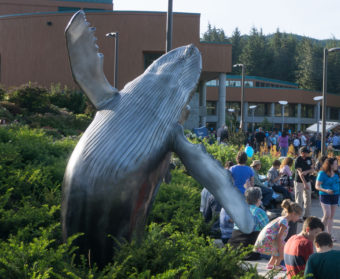
The Sitka Public Library is among the more than 80 local systems that share collections statewide.
The Sitka Public Library is among the more than 80 local systems that share collections statewide. (Photo by Bill Foster/KCAW)

Library workers across the state are concerned Gov. Mike Dunleavy’s cuts to Alaska’s university system could threaten a statewide library service that allows patrons to request more than 3 million titles from libraries across the state.

The governor’s line-item budget vetoes wouldn’t automatically doom the Alaska Library Catalog. But Juneau Public Libraries director Robert Barr — who pulls double-duty as board president for the Alaska Library Association — said that because the statewide catalog is largely dependent on the University of Alaska system, its days could be numbered.

“I have a hard time seeing UAA and UAF and UAS continuing to support that service with cuts of this magnitude,” he said Monday.

Barr explained how the Alaska Library Catalog works: “If you live in Juneau, and there’s an item that you want that’s not owned locally in Juneau, but it is in Fairbanks, we’ll get it for you and vice versa,” he said.

The materials are couriered on the road system. If the libraries aren’t in communities with roads, they go by mail. It’s a free service available to more than 90% of the state population. The network links 87 libraries run by municipalities, school districts and university campuses.

“It’s been a vision of libraries for a long time to figure out a way to create a statewide system to do something like this,” said university librarian Mike Robinson, who helped build the system at the University of Alaska Anchorage.

“But it was very hard to sit down on paper and plan it, you know, from scratch,” he told CoastAlaska. “Who was going to come up with the money? How are we going to do it? So it evolved organically over time, which is great, but it’s housed within the UAA infrastructure.”

Much of this infrastructure could soon face the chopping block: Dunleavy’s line-item budget veto eliminated $130 million from the university’s budget. University officials warn that will mean more than a thousand jobs lost unless the Legislature overrides the governor’s veto. That has Robinson and Barr worried about the three support staff that help run the catalog at UAA.

“Once the belt starts tightening, it could be easy to get in a hole where the whole system gets underfunded,” Robinson said.

As it stands, patrons in Talkeetna, for example, can request a book in Wasilla. But cuts to the universities could take Alaska’s public libraries back in time. Before the statewide catalog, Barr said, “You would instead only have access to a library catalog per your local community.”

The Alaska Legislature is slated to review this and 181 other line-item vetoes this week. It takes 45 votes to override a governor’s veto, and lawmakers have only until Friday to do so.

Constituents use Wasilla special session to lobby Alaska lawmakers on Dunleavy’s budget vetoes

Daphne Jackson of Palmer holds up a sign at a demonstration Monday outside Alaska Republican lawmakers’ special session meeting at Wasilla Middle School. (Photo by Nat Herz/Alaska Public Media)

Monday’s special session in Wasilla wasn’t just a meeting for Alaska’s Republican legislators.

It also gave road-system Alaskans a chance to offer their opinions about the huge dilemma facing lawmakers right now: whether to uphold Republican Gov. Mike Dunleavy’s major line-item budget vetoes, which would cut hundreds of millions in state spending on programs like its university system, cash payments to the elderly and early education.

Dozens of constituents turned out, first lining a stretch of the Parks Highway before walking to Wasilla Middle School, where they greeted lawmakers with dueling chants: “Save our state,” “Follow the law” and “Override!”

The demonstrators along the highway had gathered for an event in support of Dunleavy. One was Steven VinZant, 57, who held a “Save the PFD” sign. He said he supports the line-item vetoes because of what he sees as inefficiencies and high salaries in state government, including the University of Alaska system, which would lose $130 million if the vetoes are upheld.

Steven VinZant of Soldotna waves to drivers along the Parks Highway on Monday during a demonstration before Alaska Republican lawmakers’ special session at Wasilla Middle School. (Photo by Nat Herz/Alaska Public Media)

“There are some awful big beautiful buildings that cost an awful lot of money that could have been more utilitarian,” VinZant said, referring to university buildings. “We could have more books, more computers, if we didn’t have grandioso buildings for millions of dollars.”

Many of the demonstrators were from the Mat-Su, which is one of the most conservative areas of the state. But VinZant wasn’t. He drove 3 1/2 hours to Wasilla from his home in Soldotna, where he has worked as an adjunct professor at the state university system.

VinZant said he’s a little worried about what the steep budget veto to the university could mean for his students. But he also said he’s on their side in trying to stop lawmakers from reducing the permanent fund dividend, as they have done in the past few years.

“I’m fighting for the fact that $3,000 of your school money was stolen from you,” he said. “And they’re looking at stealing more.”

Others who lobbied lawmakers to override the vetoes met the opposing protesters outside Wasilla Middle School. The two groups squared off along a pathway into the school.

Some of the veto critics delivered their messages to lawmakers delicately. But Dave Musgrave of Palmer, a retired professor, sent his with a threat.

Dave Musgrave of Palmer yells in support of overriding Gov. Mike Dunleavy’s budget vetoes during a demonstration Monday before Alaska Republican lawmakers’ special session meeting at Wasilla Middle School. (Photo by Nat Herz/Alaska Public Media)

“Ten percent of my PFD will go to defeat any Mat-Su delegate who votes for the vetoes,” he said. “I know how hard those people at the university work. And the state is cutting off their nose to spite their face in this case.”

In spite of that, Musgrave said he’s been having respectful discussions about the vetoes with one of the Mat-Su’s senators, Republican Mike Shower of Wasilla.

“We have a reasonable conversation,” he said. But he added, “I’d like to see Mike move more towards our direction.”

University of Alaska president: Dunleavy budget vetoes ‘will impact everything we do’

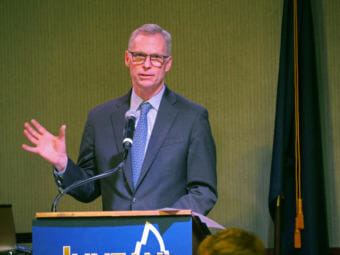
University of Alaska President Jim Johnsen delivers the State of the University Address at a Juneau Chamber of Commerce luncheon in Juneau on Feb. 16, 2017.
University of Alaska President Jim Johnsen delivers the State of the University address at a Juneau Chamber of Commerce luncheon in Juneau on Feb. 16, 2017. (Photo by Skip Gray/360 North)

Gov. Mike Dunleavy’s line-item budget vetoes, announced on Friday, include a roughly $130 million reduction in state support for the University of Alaska system. That’s in addition to a $5 million cut to UA already approved by state legislators. Combined, they reduce state support for the university by about $135 million, or about 40% from the previous year’s budget.

Dunleavy said on Friday he has faith that university leaders will be able to work through the loss.

“I believe they can turn the University of Alaska into, if not the finest university of the Arctic — in a few select areas, I don’t think they can be all things to all people. And I think that’s, generally speaking, the state of Alaska. We can’t continue to be all things for all people. We don’t have the money to do that,” Dunleavy said.

Speaking to the University of Alaska Board of Regents during a special budget meeting Friday, UA President Jim Johnsen underscored the severity of the cut.

”This budget will impact everything we do in every location where we operate,” Johnsen said. “Every student, every faculty member that we employ, every staff person that we employ.”

Dunleavy included a similar UA cut in his original proposed budget. Johnsen described the reduction as “devastating” and outside what university administrators had planned to accommodate.

”We were estimating a $30 million cut, a $40 million cut, a $50 million cut and a $60 million cut,” Johnsen said. “While severe, these were manageable. The cut is more than twice the most extreme cut that we anticipated.”

Johnsen said the cut means plans for an orderly downsizing plan cannot be followed, and he listed immediate actions being taken.

”A hiring freeze immediately effective, a travel freeze immediately effective, unnecessary contracts with vendors and contractors immediately effective,” Johnsen said. “We will be distributing a furlough notice to all our staff immediately.”

Johnsen said the university is also stepping up advocacy to encourage legislators to override the governor’s veto.

Escalating tariffs, lingering questions hamper University of Alaska timber sale in Haines

The University of Alaska announced a timber sale in the Haines area last year. That contract remains unsigned.

There are various factors slowing the 10-year timber sale the University of Alaska announced last March.

“There is no contract signed yet,” said Morgan Howard, the Liaison for the University of Alaska Land Management office. “The potential buyer is still estimating the overall volume and looking at the infrastructure that’s needed, such as log transfer facilities, also monitoring potential tariffs.”

This map shows 13,426 acres of land scattered throughout the Haines Borough that the University of Alaska owns and is negotiating a timber sale of.
This map shows 13,426 acres of land scattered throughout the Haines Borough that the University of Alaska owns and is negotiating a timber sale of. (Courtesy of the University of Alaska)

The Land Management office previously announced it would hire a local caretaker for the land, but Howard says that is on hold until a contract is signed.

This isn’t the first delay. In November of last year, Land Management cited a slowdown in negotiations.

This time, Howard says that timing and infrastructure are the issue. He says the university wants to time the harvest with adjacent landowners: the state and the Mental Health Trust. That way they could share resources.

“The vision was this could be a continuous long term employer in the Chilkat Valley. A small industry that could be viable if everybody worked together. So far it’s just us that’s moving forward,” Howard said.

And though the harvest would eventually require a log transfer facility in the Haines area, he says they could get started without one.

But the last big issue is one that the University really can’t control: the market. The tariffs that Howard says the university are monitoring are part of what’s been called a trade war between the U.S. and China. Tariffs are important here because Howard has said the timber from the Haines sale would go to China.

Rose Braden says the top U.S. markets are Canada, Mexico, China and Japan. She’s the executive Director of the Softwood export council in Portland, Oregon. She keeps tabs on the $950 million U.S. export market for softwoods—including the spruce, hemlock, and lodge pole pine that grow around Haines.

Last year, the Trump Administration placed a tariff on many Chinese imports. The Chinese government answered back with a 10 percent tariff on certain U.S. products, including timber.

Braden says the market for softwoods has been relatively stable for the last four or five years. But softwood exports to China?

“If you look at first quarter 2018 versus first quarter 2019 we had a 54 percent decline,” Braden said.

Fifty four percent is significant. And that’s a decline after the imposition of ten-percent tariffs. This month China increased the tariff to 25 percent.

Back at the Land Management office, Howard says he can’t predict what may happen with trade between now and the sale. And again, that cooling market is one of many factors.

He didn’t acknowledge any causality, but now the University is looking at what kind of money it could make by keeping trees in the ground. Last year they dismissed a suggestion from the community to consider selling carbon credits instead of harvesting timber. That’s a program where big polluters in California can offset their impact by buying credits, which represent real carbon sequestering things like trees. Sealaska made a multi-million dollar deal to do that last year.

“We’re working with everybody knowledgeable in Southeast in regards to carbon credit. There are a couple firms we’re talking to we’re talking to a couple of landowners that have already has sales,” Howard said.

He says participation in the program is still a few years out. It wouldn’t just be for the Haines area—it’s on the table for all university land. In the meantime, they’re still moving forward with the timber sale. But he says ten years is a long time, so some of the land in the Chilkat Valley could potentially be sold in the carbon credit program.

Capital budget, Power Cost Equalization, college scholarships are caught in PFD debate

Rep. Lance Pruitt, R-Anchorage, talks to reporters at a House Republican Minority press availability in his office at the Capitol in Juneau on March 14, 2019.
Rep. Lance Pruitt, R-Anchorage, talks to reporters at a House Republican minority press availability in his office at the Capitol in Juneau in March. Pruitt said Tuesday he anticipates there won’t be enough votes to draw from the Constitutional Budget Reserve unless the House amends the capital budget bill to fund full permanent fund dividends under a 1982 state law. (Photo by Skip Gray/360 North)

The state capital budget for the next year is caught in a dispute over the size of permanent fund dividends.

It also affects programs to pay for college grants and scholarships and to equalize power costs across the state.

The capital budget, Senate Bill 19, depends on at least six Republicans who aren’t in the House majority supporting the budget. That’s because it would draw $162.5 million from the Constitutional Budget Reserve, and drawing from that piggy bank requires support from three-quarters of the members of both chambers.

It doesn’t look like those votes will be there without dividends of roughly $3,000.

House Minority Leader Lance Pruitt, an Anchorage Republican, said his caucus supports amending the capital budget to pay full dividends under a 1982 state law. If that amendment isn’t successful, Pruitt anticipates there won’t be enough votes to draw from the Constitutional Budget Reserve.

“If the amendment for the dividend did not pass, then there would not be enough votes to have … the CBR language pass,” Pruitt said.

The capital budget debate could begin as soon as Wednesday. The budget would fund the reopening of Palmer Correctional Center and provide funding for new drug treatment facilities.

Rep. Tammie Wilson, R-North Pole, at a House minority press availability on Feb. 23, 2017. (Photo by Skip Gray/360 North)

North Pole Rep. Tammie Wilson said $10 million would go to grants to expand drug treatment throughout the state.

“We know that there’s pretty much not a part of the state that’s not affected by not having enough treatment beds,” said Wilson, a Republican in the House majority caucus.

The House Finance Committee advanced the budget Tuesday on an 8-3 vote.

If the entire House falls short of the 30 votes needed to draw from the Constitutional Budget Reserve, there would be no money in the budget for the Power Cost Equalization program for residents with high energy bills. And there would be no money for both Alaska Performance Scholarships and needs-based Alaska Education Grants. Both programs pay for Alaska students to attend postsecondary education.

The capital budget also would include more than $1 billion in federal funding. But the state must spend some of its own money to receive the federal dollars.


Watch the latest legislative coverage from Gavel Alaska.

University of Alaska task force looking at potential restructure of UA system

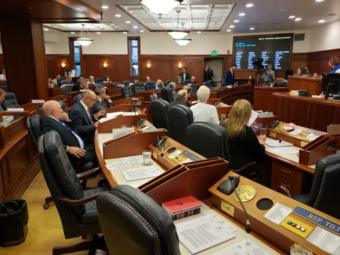
The University of Alaska’s Board of Regents, as well as officials from UAA, listen to public testimony from students affected by UAA’s loss of accreditation for its education department.
The University of Alaska Board of Regents, as well as representatives from the University of Alaska Anchorage, assemble for a meeting on the UAA education program, Feb. 12, 2019. (Photo by Wesley Early/Alaska Public Media)

A University of Alaska task force will look at options for restructuring the UA system. The Board of Regents voted last month to form the task force.

Regents chair John Davies has appointed 11 Alaskans to the group charged with considering at least four restructure options.

Davies said the “status quo” option would keep the three universities under one system.

“And then there’s a lead university model, where each university would specialize more than they do now,” Davies said. “And then there’s a single accreditation option where we could go to having all three universities combined under one administration. And then the fourth option would be three independent universities with separate administrations.”

Davies said the task force analysis will reflect anticipated state funding reductions and instruction from the Alaska Legislature to consider a single accreditation model.

”We want to take a look at that,” Davies said. “And of course, there’s always a trade-off issue: Are the savings worth the cost of the programs?”

Davies noted that the task force will able to draw on past and current downsizing and restructure analysis and initiatives, including UA 2040, a plan for improved online access.

”A single portal website that any student, anywhere in the state, can log in to and get information about all the programs that are available across the entire state, to break down some of the silos that exist now,” Davies said.

Davies underscores the importance of the task force’s work given the real effects of ongoing uncertainty about the university’s future.

”People are making choices to go elsewhere,” Davies said. “Students are deciding to go outside. And faculty are looking around to see if they have better options.”

The 11-member task force includes the following members:

  • Former UA Regent Jo Heckman
  • UA Regent Sheri Buretta
  • Alyeska Pipeline Service Company President Tom Barrett
  • Doyon Ltd. President and CEO Aaron Schutt
  • Former Northrim Bank board of directors chair Joe Beedle
  • Former Alaska state legislator Reggie Joule
  • Retired UA faculty members Terrence Cole of UAF, Cathy Connor of UAS and Gunnar Knapp of UAA
  • Former UA executive Wendy Redman
  • Former Student Regent Joey Sweet

The task force, which will hold public meetings around the state, has to get a final report to regents by November.

Site notifications
Update notification options
Subscribe to notifications