University of Alaska

Candidate Dunleavy said he had no plans to cut ferries, schools, university. Then Gov. Dunleavy proposed deep reductions.

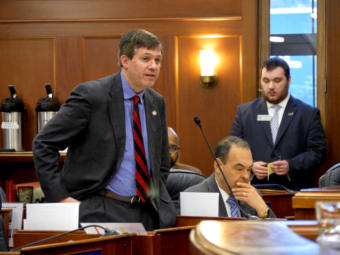
Mike Dunleavy talks to a group at a Juneau library in September, when he was still a candidate for governor. (Photo by Rashah McChesney/Alaska’s Energy Desk)

Shayne Thompson runs the store in the Tlingit village of Angoon, on Admiralty Island south of Juneau. There’s no road link to the mainland, so Thompson relies on the Alaska state ferry system to deliver his loads of fresh groceries, at least once a week.

That’s why Thompson voted for Republican Mike Dunleavy in last year’s gubernatorial election.

On the campaign trail, Dunleavy said “he was going to do everything he could to keep the ferry system intact,” said Thompson, 53.

The Alaska state ferry Malaspina off Sitka. Gov. Mike Dunleavy’s budget proposal would shut down the state ferry system Oct. 1. (Photo by Ed Schoenfeld/CoastAlaska News)

Two weeks before the election, Dunleavy told the Ketchikan Daily News that there was “no plan to hack, cut or destroy” the state ferry system. In another interview, with the city’s public radio station, he said: “I don’t envision at any time that there would not be a functional, robust ferry service in the Southeast, the panhandle of Alaska.”

In February, however, Dunleavy proposed a budget that would cut more than two-thirds of the state ferry budget and stop the system’s operations Oct. 1.

Now, Thompson said: “I feel like a fool, because of listening to somebody that was basically had a totally different agenda in mind when they were on the campaign trail.

Dunleavy’s plan would also make sharp reductions in government support for the state-run Pioneer Homes for elderly Alaskans, as well as to the University of Alaska system and to public schools – all of which, at various times during his gubernatorial campaign, Dunleavy said he did not plan to cut.

The reversals have left Dunleavy’s critics fuming. In interviews, they said the governor was able to make dubious claims about the budget on the campaign trail that were never debunked by a weakened mainstream media – which they said could have changed the outcome of the election.

“I think the campaign would have been different had he been more transparent about the costs of his proposals. And we didn’t have that conversation, so we can’t know how it would have come out,” said Anchorage Democratic Rep. Ivy Spohnholz. “I think Alaskans deserve transparency and disclosure in terms of what people want to achieve when they come into office.”

Dunleavy declined to be interviewed, but he has said that his evolving positions stem from falling projections of oil revenue.

A month before Election Day, oil prices were $85. They fell to $60 in the two months leading up to Dunleavy’s inauguration, costing the state $1.5 billion in projected revenue.

“We thought that we might be able to do this with reductions and efficiencies within certain areas of state government,” Dunleavy said last month on “Alaska Insight.” “When we got into office in December, we were hit with oil prices in the fifties and some said it was going to go further south.”

Dunleavy was also clear about his priorities during the campaign, said spokesman Matt Shuckerow: He opposed taxes and supported boosting the permanent fund dividend. And he wanted to make government more efficient, Shuckerow added.

“He was going to take a different direction, and that was addressing the structural deficit that we have,” Shuckerow said. “Most people we’ve heard from, there’s an understanding that the governor’s following through.”

As a candidate, when Dunleavy was asked by reporters and moderators whether he would cut specific state services, Shuckerow noted, he often left a caveat in his answers.

In an August debate on TV station KTVA, for example, Dunleavy was asked whether he’d cut several different programs. His answer for public education: “Not at this time.” Pioneer Homes and the university system? “No, for now.”

Dunleavy’s February budget proposes a 40% cut, or $134 million, in state support for the university system – some 17% of the system’s total budget, when federal and other revenues are included. Dunleavy’s administration is proposing to double the fees billed to some Pioneer Home residents, so that the state can reduce subsidies for the program. Per-student spending on public schools would fall by about one-fourth.

Meanwhile, Dunleavy pointed repeatedly on the campaign trail to at least $100 million – sometimes he said it was nearly $200 million – in spending that he said he could eliminate by getting rid of vacant positions in the state budget. Dunleavy, in an appearance on “Talk of Alaska,” said he was referring to a budgeting technique called the “vacancy factor.”

In fact, the vacancy factor is a multiplier that state agencies were already using to reduce spending, to account for employee turnover.

The Legislature’s nonpartisan budget analysts, in a presentation last year, said it’s a “myth” and “simply untrue,” that there are hundreds of millions of dollars in savings associated with the vacancy factor. And when Dunleavy released his budget in February, it did not include the savings from the vacancy factor that he referenced on the campaign trail.

Political blogger Dermot Cole has been highlighting that discrepancy, along with many of Dunleavy’s other campaign statements, since the governor unveiled his budget. In an interview, Cole described them as “impossible promises.”

“The Dunleavy campaign was more or less a fiscal fantasy from beginning to end that was able to exist because it wasn’t challenged by the press,” he said. “All of these assertions should have been treated with skepticism.”

Shuckerow said he hadn’t reviewed Dunleavy’s specific statements about the vacancy factor. But he said that the governor’s budget does reflect “significant changes to programs and operations.”

“This is all part of a broader conversation based on the information that we have about expenditures and revenues,” Shuckerow said.

Dunleavy’s political opponents have continually cited his shifting rhetoric in their criticism of his budget proposal – most recently, in a video released Monday that features labor leader Vince Beltrami.

“Dunleavy didn’t say he was going to devastate all the state services most Alaskans care about,” Beltrami said.

Anchorage Democratic Rep. Ivy Spohnholz. (Photo by Skip Gray/360 North)

But one Republican leader, Sen. Bert Stedman of Sitka, said he’s trying not to dwell on statements that were made months ago.

“I’m more concerned about putting an operating budget together in the Senate and working on the issues with the House than worried about particular political campaign promises,” said Stedman, co-chair of the Senate Finance Committee.

Even Spohnholz, the Democratic representative, acknowledged that her constituents are more focused on Dunleavy’s current proposals than on what the governor said during the campaign.

But she also argued that the governor’s lack of detail on the campaign trail means that he has less of a mandate for his budget now that he’s in office.

“What the governor campaigned on was a full dividend,” Spohnholz said. “He didn’t campaign on the cuts that he’s proposing.”

UA Board of Regents begins process to eliminate UAA education department

The University of Alaska’s Board of Regents, as well as officials from UAA, listen to public testimony from students affected by UAA’s loss of accreditation for its education department.
The University of Alaska’s Board of Regents, as well as officials from the University of Alaska Anchorage, listen to public testimony from students affected by UAA’s loss of accreditation for its education department, Feb. 12, 2019. (Photo by Wesley Early/Alaska Public Media)

The University of Alaska Board of Regents took the first step in phasing out the education department on the Anchorage campus. The regents voted Monday to eliminate seven initial licensure programs.

The recommendation came from UA President Jim Johnsen, who wants to eliminate the Anchorage campus education department following its loss of national accreditation for some of its programs in January from the Council for the Accreditation of Educator Preparation, or CAEP.

The seven initial licensure programs that lost accreditation are as follows:

  • B.A. Elementary Education
  • Elementary Education post-baccalaureate
  • M.A.T. Secondary Education
  • B.A. Early Childhood Education (pre-K to third grade)
  • Early Childhood post-baccalaureate (pre-K to third grade)
  • Special Education Graduate Certificate initial licensure
  • M.Ed. Early Childhood Special Education initial licensure

“I have recommended we not continue those programs, and that instead UAF and UAS, with continued coordination from the Alaska College of Education, provide their programs to students in Anchorage,” Johnsen said.

Both the University of Alaska Fairbanks and the University of Alaska Southeast have nationally-accredited education programs. Under Johnsen’s plan, education classes would be taught in-person and through online courses from UAF and UAS teachers.

The largest point of opposition to Johnsen’s plan came from Juneau-based Regent Dale Anderson. Anderson motioned to put off the vote until the board’s June meeting, in order to allow for more discussion. The motion failed by a vote of 4-6.

Anderson said that the process was done without collaboration between the board members on how to proceed. Anderson also accused Johnsen of consolidating most of the initial licensure program responsibility to the Fairbanks campus.

“Fairbanks has never accepted the fact that the school of education is in Juneau, and there’s uncostly bickering,” Anderson said. “And this turf war is totally wrong and needs to be stopped.”

Six of the seven programs would be moved to UAF’s education department. UAS currently houses the Alaska College of Education.

Board Chair John Davies of Fairbanks agreed that the process for what to do with UAA’s education department went by quickly, but he noted that the community requested an urgent response.

“One of the biggest concerns that we had, that we were hearing from the students, was that we weren’t acting fast enough,” Davies said. “And so that’s the reason why we’re having this meeting today and why we’re having it in this manner.”

In the end, the board voted 6-5 in favor of Johnsen’s recommendation, which would take effect Sept. 1 of this year. The next step of Johnsen’s recommendation is to eliminate the rest of UAA’s education department, effective July 2020.

The Alaska State Board of Education and Early Development requires that students graduate from a nationally-accredited education program to receive teaching licenses.

For one petroleum engineering student, oil prices change but the dream stays the same

Sydney Deering, president of the Society of Petroleum Engineers, stands in the student organization’s shared office at the University of Alaska Fairbanks. The Lego drill rig next to her was made by another student last year. March 25, 2019. (Photo by Ravenna Koenig/Alaska’s Energy Desk)

College graduation is just around the corner, and many students will be heading out into the working world to try to figure out what they want to do with the hours they’ll no longer be putting into school.

For one petroleum engineering student at the University of Alaska Fairbanks, that answer has been obvious since she was a kid — and hasn’t changed, even as oil prices have.

Sydney Deering has known that she wanted to work in the oil industry since she was about 9 years old.

“Coming from Alaska, the people that I saw as most successful were either a part of the petroleum industry or the medical industry,” Deering said. “And I couldn’t do blood.”

As a kid growing up in Eagle River, she was good at math and science, so engineering felt like a natural choice.

As she got older, she fell in love with petroleum engineering specifically — the field where people figure out how to extract oil from the ground. Deering said it’s more creatively satisfying for her than other types of engineering.

“You can build two identical machines. You cannot find two identical reservoirs, and so every question is new,” she said. “And to me, that’s exciting.”

But when she was finishing up high school, the booming oil industry that she hoped to go into started to take a dive. In 2016, when she was a freshman at the University of Alaska Fairbanks, oil prices plummeted to under $30 a barrel.

She said she heard about people in the industry getting laid off or getting job offers revoked. And her sophomore year, her petroleum engineering-specific classes seemed to shrink by about half, at least in part due to students reconsidering what their job prospects might be after college.

“A huge amount of people actually moved over to mechanical engineering,” she said.

But Deering didn’t. Petroleum engineering is a narrower field, and it’s one that Deering knew might have fewer jobs available when oil prices were low. But it’s her passion, and she wanted to stick with it.

Sydney Deering stands next to a whiteboard with the words "Society of Petroleum Engineers" written on it.
Sydney Deering stands next to a whiteboard with the words “Society of Petroleum Engineers” written on it. She leads her school’s chapter of the organization. (Photo by Ravenna Koenig/Alaska’s Energy Desk)

“I saw it as: I’m in a cyclic industry,” she said. “I’m coming in in the trough. Hopefully it’s only up from here.”

Oil prices have gone up since Deering started the program, though they’re still not back to what they were before the downturn.

But Abhijit Dandekar — the chair of the petroleum engineering department at UAF and Deering’s advisor — said that right now actually isn’t such a bad time to be looking for work. He said there’s less competition for jobs right now, because there are fewer people trying to go into the field than there were when the price of oil was through the roof.

“If you look at the number of jobs and number of potential job seekers, that ratio has become much more favorable now,” he said.

Even still, Deering has spent the past four years doing everything she can to make herself a competitive candidate. She’s president of her school’s chapter of the Society of Petroleum Engineers, and she’s active in the community outside UAF as well. She participates in all kinds of STEM- and resource-related outreach events for young kids and high school students. When we spoke, she told me about an event on her calendar a few weeks out.

“I’m going out to North Pole High School and teaching a couple classes for their engineering department on petroleum engineering,” she said.

She’s also done three internships with oil companies — two of them with ConocoPhillips, which allowed her to build a relationship with the company while she was still a student.

She sees that as a big factor in why she has a job lined up for after she graduates. She’ll be working as a petroleum engineer for ConocoPhillips here in Alaska.

I asked Deering about what she sees as the future of the oil industry — beyond this year and further out on the horizon.

As Deering said, it’s always been a cyclic industry. But increasingly, there’s pressure to move away from oil and gas and toward renewable energy. Does that make her worry about her long-term job security?

Her short answer is no.

“While we are transitioning to renewables, we have to face the fact that it’s not going to transition as quickly as most people realize,” she said. “You can’t cut off cold turkey. There is going to be a time that we will continue to be dependent on oil.”

She also points to the many products that are petroleum-based — things like plastic, polyester shirts, rubber bands — that she doesn’t see disappearing anytime soon.

Deering’s graduation is just a month away. She showed me some plans for the graduation cap she’ll be wearing when she takes her diploma.

She paints in her free time, and she’s sketched out a painting she’s going to do on the square top of her cap. It’s the silhouette of an oil rig against a sunset.

Sydney Deering’s graduation cap, which she painted herself. (Photo courtesy Sydney Deering)

UA president recommends closing UAA education program amid accreditation loss

University of Alaska President Jim Johnsen appears on an episode of Forum@360 in Juneau on April 3, 2018.
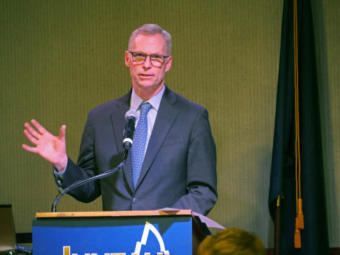
University of Alaska President Jim Johnsen appears on an episode of Forum@360 in Juneau on April 3, 2018. (Photo by Rashah McChesney/Alaska’s Energy Desk)

The University of Alaska president announced Monday night that he’s recommending that the University of Alaska Anchorage close its School of Education, after losing national accreditation in January.

UA President Jim Johnsen plans to make his recommendation to the UA Board of Regents on April 8 to close UAA’s School of Education by July 2020. His plan would discontinue the seven initial licensure programs for UAA’s education department, effective Sept. 1 this year.

On Jan. 11, UAA was informed that its education department lost the national accreditation for its initial licensure programs from the Council for the Accreditation of Educator Preparation, or CAEP. In its review, CAEP found that UAA failed four of the five categories in which it was assessed.

Representatives from UAA and the university system as a whole said that the main reason for accreditation loss was a lack of data on the progress of students in the education department.

“What came out of the evaluation was that UAA was not demonstrating that,” said Paul Layer, UA vice president for academics, students and research. “That is not to say that students weren’t meeting those standards, but the program did not demonstrate to the satisfaction of the accreditor that we were meeting those objectives.”

Under Johnsen’s recommendation, UAA education classes would be discontinued on Sept. 1, and Anchorage students would have to take education courses with instructors from the University of Alaska Fairbanks or University of Alaska Southeast, both of which have accredited education departments.

Layer said this would be offered in a mix of online courses and teachers from UAS and UAF traveling to teach in Anchorage. He said UAA’s current nursing program is an example of how the three different colleges can coordinate in such a way.

“Those students who are based in Fairbanks are taking UAF general ed and biology classes, but they are students in the UAA nursing program, and their degree will be from UAA for their nursing program, even though they may never set foot in Anchorage,” Layer said.

Layer said that there is only one degree program at UAA that won’t be offered in the same way: the bachelor’s degree in early childhood education.

“UAF will offer a program that will lead to the same certification for teachers when they graduate, but it will have a different title and a slightly different emphasis,” Layer said.

Some UAA education courses are still accredited. After students in those programs finish, the entire UAA School of Education would close July 1, 2020.

The decision of whether or not to allow UAA to pursue re-accreditation of its education department is up to the UA Board of Regents.

In a statement, UAA Chancellor Cathy Sandeen said she has “complete confidence the school’s faculty would successfully achieve accreditation based on the significant progress they have made toward compliance with CAEP standards.” But in his recommendation, Johnsen is against the idea of reapplying.

Layer said that since losing accreditation, UAA’s education department, under Interim Director Claudia Dybdahl, has created a quality assurance program they lacked in the first accreditation review.

“Should the board decide to permit UAA to move forward with accreditation, which is not the president’s recommendation, they have begun to collect the data necessary to make a strong case, should they try to seek re-accreditation,” Layer said.

The UA Board of Regents meets on April 8, and is set to vote on Johnsen’s recommendation. In her statement, Sandeen said she’ll abide by the decision to close UAA’s School of Education, should regents make that call.

This story has been updated.

Alaska lawmakers weigh becoming only state to not fund medical education

Sen. Bert Stedman, R-Sitka, co-chairs a Legislative Budget and Audit Committee meeting in Juneau on Jan 14, 2019.
Sen. Bert Stedman, R-Sitka, co-chairs a Legislative Budget and Audit Committee meeting in Juneau in January. On Monday, Stedman asked WWAMI medical school program administrator Dr. Suzanne Allen if the program has sought funding from private sources. (Photo by Skip Gray/360 North)

As part of Gov. Mike Dunleavy’s budget cuts, Alaska would be the only state that doesn’t fund medical education. On Monday, lawmakers weighing the proposal heard from an administrator for the program that’s now in place about the benefits and costs to the state.

WWAMI is the name for the University of Washington-operated medical school program that serves students from Alaska and four other states: Washington, Wyoming, Montana and Idaho. Alaska students spend their first three semesters at University of Alaska Anchorage. Then they get clinical training around the five states.

Dr. Suzanne Allen oversees the program. She said serving the needs of Alaska and the other states is a program goal.

“When we look at the needs across the state — primary care and in rural areas — WWAMI has created our curriculum to really address those specific issues, to try to train the workforce that is needed for the state,” she said.

Allen said the money the state spends for the program is well spent. She said the state spends slightly less than $40,000 per year for each of the 80 Alaskans who get their M.D.s through WWAMI. Another $10,000 or so for each comes from the University of Alaska.

“I believe the WWAMI program is a very cost-effective program to help provide physicians for the state of Alaska,” she said. “So, if you look at the cost per student, if you look at what the cost is per Alaskan, it’s significantly less than what it is for other states. And we have a higher return rate here in the state of Alaska than if you look at other public medical schools.”

But it’s that return rate that Dunleavy’s administration has cited as a problem. Sixty-one percent of Alaskans who go to WWAMI return to Alaska. This is higher than the national average of 39 percent of public medical students who stay in the state where they attend school. But it’s lower than what state leaders would like to see.

Sitka Republican Sen. Bert Stedman told Allen during the Senate Finance Committee meeting on Monday that changes to Alaska’s WWAMI funding are likely.

“We’re facing budgetary constraints,” Stedman said. “So has there been any discussion within the WWAMI group to try to come up with some other mechanism or help from another entity — if it’s hospitals or what have you, some other group — to help with some of these costs, so we can continue the WWAMI program amongst our other demands on our treasury?”

Allen replied: “We have not currently had any other conversations with other groups about potential funding opportunities.”

Hazel Brogdon, a recent WWAMI graduate from Chugiak, plans to practice as a psychiatrist in Alaska once she completes a residency in Washington. She said receiving part of her training inside Alaska will help her prepare to practice here.

“I am from Alaska, and I enjoyed being able to do most of my training at home, and learn from people that I’m ultimately going to work with in the future,” she said. “And it’s a small group, and there’s a lot of camaraderie between everyone who trained up there, so overall it was a really positive experience.”

She opposes eliminating WWAMI funding.

“I think that could be detrimental to the state as a whole,” Brogdon said. “I know there is already a shortage of providers, and just having this grassroots program being taken away could, you know, potentially limit the amount of folks planning on returning back to Alaska.”

The House Finance subcommittee on education and early development didn’t adopt Dunleavy’s proposal. It decided to continue with $3.1 million in state funding for WWAMI.

The full House Finance Committee begins considering the budget this week.


Watch the latest legislative coverage from Gavel Alaska:

Are more Juneau high school graduates ready for college? It depends.

UAS campus
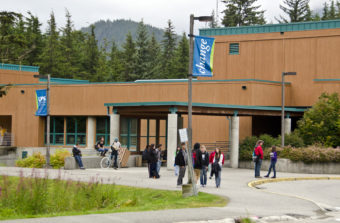
The University of Alaska Southeast’s Juneau campus. (Photo by Lisa Phu/KTOO)

Over the past five years, more students who graduate from Juneau high schools are ready for college. That’s according to the University of Alaska Southeast. But whether you see improvement depends on what you’re looking at.

Each year, a few dozen students graduating from Juneau high schools choose to stay in town for college. They enroll at the University of Alaska Southeast.

UAS Provost Karen Carey said those students haven’t always had an easy time when they get there. But recently, she said, things have been looking up.

“Their students are being much more successful now at the college level,” said Carey, “So we are very pleased about that.”

Carey said more and more Juneau high school graduates are arriving at UAS and across the University of Alaska ready for college. She shared the good news with the Juneau School District Board of Education in February and explained how it’s measured.

At UAS, “college ready” means you don’t have take any remedial courses below college level. Those are typically math and English courses that get students up to speed. Remedial courses don’t earn students any credit toward a degree — but they cost just as much as credit-earning courses.

“And so in some cases in the past we had students taking those courses two, three, four times and were paying for those courses out of pocket but weren’t getting any college credit at all,” said Carey.

In just the past five years, the number of Juneau graduates who had to take at least one course below college level when they reached the UA system has fallen dramatically: from over half to just 1 in 5.

Remedial course enrollment for JSD graduates in the UA system. (Data from UAS Office of Institutional Effectiveness)

UAS and the Juneau School District are calling it a win. But not everyone is convinced.

Herb Schroeder is vice provost for the Alaska Native Science and Engineering Program, or ANSEP, at the University of Alaska Anchorage. A couple years ago, he led a study that looked at college readiness of Alaska high school graduates over a ten-year period between 2006-2015.

The findings were not encouraging, especially for Juneau. Three-quarters of Juneau-Douglas High School graduates enrolled in at least one math or English course below college level during their first year in the UA system.

Schroeder questions the sunnier UAS report. That’s because while his study used national standards to define college-level coursework set by ACT — the education nonprofit best known for its standardized test widely used for college admissions — UAS sets its own bar. And that bar is lower than those national standards.

Schroeder is troubled that high schools and colleges in Alaska are making up their own definitions of college readiness. But Carey sees it differently. She said she won’t agree or disagree with the national standards.

“I think you have to know your individual students and what your population looks like,” she said.

And Carey said for UAS students, their definition of “college ready” makes sense.

It includes two courses that fall short of the national standards: one in math, one in English. Those courses don’t count toward general education requirements at UAS — they’re prerequisites for qualifying courses — but Carey said placing into them doesn’t necessarily mean extra semesters — and extra dollars — for students.

“Those courses can count toward electives or toward other things that the student might need in their program,” said Carey. “They get college-level credit.”

For an explanation of why more Juneau graduates are coming into college well-prepared, Carey points to changes the Juneau School District made five years ago. That’s when the high school graduation requirement was raised to three years of math and four years of English, and the district rolled out a more rigorous curriculum for both math and language arts.

Success in college is ultimately not about how you start, but how — and if — you finish. Juneau students have a higher four-year graduation rate from UA schools than the state average, but it’s still just 1 in 5 on average for all JSD graduates who entered the UA system in the last 10 years.

Four-year graduation rates for JSD graduates in the UA system. (Data from UAS Office of Institutional Effectiveness)

That too could change. The first class of Juneau high school students who had to clear that higher bar started college four years ago last fall. It remains to be seen just how many of them will walk across UA stages this spring, diploma in hand.

Remedial course enrollment vs. four-year graduation rates for JSD graduates in the UA system. (Data from UAS Office of Institutional Effectiveness)
Site notifications
Update notification options
Subscribe to notifications