University of Alaska

University of Alaska regents postpone vote on financial exigency

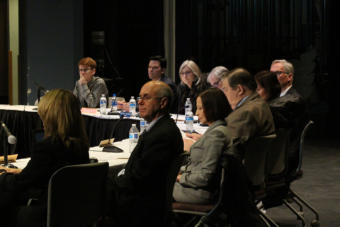
The University of Alaska Board of Regent has postponed voting on a declaration of financial exigency, a contractual tool that allows more expedited cost cutting, including laying off of tenured faculty.

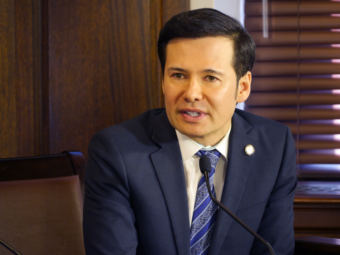
UA is facing over $135 million in reductions for state funding from the current year, including $130 million vetoed by Gov. Mike Dunleavy. Exigency would be a serious hit to the university’s reputation, and Regent Darroll Hargraves, a Dunleavy appointee, suggested there may be a way to ease into reduced state support.

”What we need is a glide path of, I would say, three years to make the cut,” Hargraves said.

UA president Jim Johnsen delivers his State of the University address at the University of Alaska Anchorage Lucy Cuddy Hall. (Photo by Wesley Early/Alaska Public Media)
UA president Jim Johnsen delivers his State of the University address in 2018. (Photo by Wesley Early/Alaska Public Media)

Regents voted to delay consideration of exigency until a July 30 meeting, when UA President Jim Johnsen will lay out specific cost reduction measures. The new fiscal year began July 1, and Johnsen emphasized that each day the university operates at status quo compounds the impact of any state funding cut.

”It just means that it will be a steeper reduction that will need to be achieved in-year,” Johnsen said.

Johnsen said he’s in regular communication with the governor’s office and state legislators, who last week failed to garner enough votes to overturn Gov. Dunleavy’s vetoes, which targeted the university as well as numerous other state programs. Override supporter Republican state Sen. Click Bishop of Fairbanks attended the regents meeting and offered a tearful apology, calling the university cut a travesty that sends the wrong message to young people.

”But I want you to know, I’m not done and we’re going to turn this around,” Bishop said.

Another override backer, Democratic Rep. Andy Josephson of Anchorage also spoke at the meeting. Josephson described the situation which has yielded the massive budget cuts as a political crisis, and said an alternate means of funding the university is in the works.

With no veto override, UAS chancellor expects layoffs at Southeast campuses

Bronze whale sculpture at UAS
A scale model of the humpback whale sculpture at the University of Alaska Southeast campus, Aug. 14, 2015. (Photo by Jeremy Hsieh/KTOO)

The vote to override Gov. Mike Dunleavy’s line-item vetoes fell short again Thursday in Juneau. With more than a third of legislators absent, there was little suspense, but University of Alaska Southeast student India Busby said that didn’t make the news any easier.

“I mean, I knew that it was going to fail, which I hate. I hate that. I feel in a way that my state is kind of falling apart,” Busby said. “You know, I was born and raised here in Alaska, and just watching everything that’s happening is really hurting me.”

Busby will start her senior year at UAS in Juneau this fall — if she returns at all. The 23-year-old creative writing and sociology student said her school’s uncertain future has her considering finishing college in the Lower 48.

Dunleavy has said the $130 million cut to the UA system would primarily impact the Fairbanks and Anchorage campuses. But UAS Chancellor Rick Caulfield said every campus relies on statewide UA services.

Rick Caulfield in his office on Monday, June 26, 2017.
Rick Caulfield in his office on Monday, June 26, 2017. (Photo by Quinton Chandler/KTOO)

“So it’s not reasonable to assume that UAS and the community campuses would not feel the impact of these reductions,” he said. “I think almost certainly we will.”

If the 41% cut to the overall UA budget stands, the UA Board of Regents will likely declare an official process to rapidly downsize. 

“Whether it’s consolidating programs, eliminating programs, campuses, what have you. So it is an unprecedented action if we go there,” Caulfield said.

Caulfield said that could happen as soon as Monday, July 15.

He said it’s very likely that will include significant layoffs of staff and faculty at the Juneau, Sitka and Ketchikan campuses.

For Busby in Juneau, that’s what worries her most.

“We’re a very small school, and a lot of the students are very close with their faculty and other staff members as well. And so the fact that these budget cuts are going to really affect them and, like, what’s going to happen with their job, it’s really upsetting, because these faculty members mean so much to us. It’s just devastating,” Busby said.

Adding to uncertainty for students, the Alaska Commission on Postsecondary Education notified 12,000 students — including Busby — this week that funds are not currently available for their grants and scholarships. Legislative action is needed to restore funding.

While Dunleavy’s budget vetoes survive override vote, Alaska’s Legislature remains divided

The Alaska Legislature meets to consider an override of Gov. Mike Dunleavy’s line-item budget vetoes. (Photo by Aidan Ling/Gavel Alaska)

The Alaska Legislature failed to override Gov. Mike Dunleavy’s state budget vetoes on Wednesday.

Without enough lawmakers present to reach the required 45 votes, the vote in Juneau fell eight votes short.

The floor debate in the Alaska State Capitol focused on the consequences of the $390 million in state funding Dunleavy vetoed. Anchorage Sen. Natasha von Imhof, a Republican, said Alaskans may have to make their permanent fund dividends last.

Anchorage Republican Sen. Natasha von Imhof speaks during Wednesday’s joint session of the Alaska Legislature.
Anchorage Republican Sen. Natasha von Imhof speaks during Wednesday’s joint session of the Alaska Legislature. (Gavel Alaska video still)

“You won’t have a job if you work at the university, or in construction, or in any of the number of nonprofits that serve homelessness shelters or abused women’s shelters,” she said of those affected by some of the vetoes. “You might not have access to dental coverage, or Head Start preschool for your kids, or assistance to pay for heating fuel, or any tuition money. Or even an actual university to attend, for that matter.”

In Juneau, all but one of the 14 Republican legislators — as well as all 22 Democrats and two independents — voted to override the vetoes. But 22 Republicans weren’t there, with many of them at the middle school in Wasilla, where Dunleavy called them into special session.

That meant there weren’t enough votes to override the vetoes. That’s because Alaska’s constitution requires 45 votes to override.

Bethel Democratic Sen. Lyman Hoffman made the motion to override.

“Thousands of people have contact my office: individuals, organizations, communities and villages,” Hoffman said. “And I stand here today to tell them that I’m going to represent them, and I’m going to vote for their interests and vote to override.”

Several legislators expressed concern about the effect of cuts to the university on the state’s future.

Anchorage Republican Rep. Jennifer Johnston quoted a 1986 speech by Gov. Wally Hickel.

“We used to say, ‘Let’s go.’ Now we say, ‘Give me.’ We used to say, ‘North to the Future.’ Now we ask, ‘Do we have a future?’” Johnston said.

Some lawmakers said Dunleavy is prioritizing having $3,000 permanent fund dividends this year. But Anchorage Democratic Sen. Bill Wielechowski said the vetoes didn’t touch one area that could balance the budget: the oil tax credits deducted by the major producers.

“These vetoes cut from the poor, the sick, our seniors, our kids — basically anyone who can’t afford to hire a lobbyist to come down here and lobby us. That’s who was cut,” Wielechowski said. “Who wasn’t cut? Some of the richest corporations in the history of the world.”

North Pole Republican Rep. Tammie Wilson was the only lawmaker present to vote against overriding all of the vetoes.

North Pole Republican Sen. Tammie Wilson speaks during Wednesday’s joint session of the Alaska Legislature.
North Pole Republican Rep. Tammie Wilson speaks during Wednesday’s joint session of the Alaska Legislature. (Gavel Alaska video still)

“Although I don’t support vetoing all of these items in total, I am 100% into compromise, working together with everyone, coming up with a plan that works best for Alaskans,” she said.

Wilson was in Wasilla on Monday. She was the only lawmaker who traveled from Wasilla to Juneau for today’s vote. Leaders of the legislators who stayed in Wasilla also have said they opposed overriding all 182 line-item vetoes with a single vote.

What happens next?

Friday is the deadline for a legislative vote to override the vetoes. No plans have been announced for another vote. Without more legislators coming to Juneau, any further override votes would likely be symbolic.

It appears there are two possible ways to get lawmakers in one place for the special session: a compromise or a court case. A potential location for a compromise could be Anchorage.

But a lawsuit filed by former North Pole Republican Rep. Al Vezey filed on Wednesday also could resolve the issue. The lawsuit contends the Juneau session isn’t legitimate. It won’t mean much for the overrides with time running out, but it may lead the courts to resolve where the proper location for the session is.

The lawmakers in Wasilla can’t take action because they don’t have a majority in either chamber to hold a meeting. Veto opponents protested there on Wednesday. Tegan Hanlon of the Anchorage Daily News shared videos from Wasilla Middle School on social media, with protesters chanting, “Forty-five to override!” The lawmakers in Wasilla left after a quick meeting.

While there won’t be a formal way to override the vetoes after Friday, there may be another path to restoring funding for some line items.

House Minority Leader Lance Pruitt has raised the possibility of funding individual items in a separate bill. And Soldotna Republican Sen. Peter Micciche wrote in a commentary posted on the website of the Kenai radio station KSRM that while he opposed an up-or-down vote on every veto, “there are also individual vetos I do not support (such as senior benefits, impacts on the disabled and seniors, a significant portion of the university reduction and others).”

Micciche has an excused absence from the Legislature to commercially fish, and he hasn’t shown up in either location.

It’s not clear how receptive Dunleavy would be to large-scale changes to the vetoes. If the Legislature passes more funding in another bill, it’s not clear if Dunleavy would veto it — and if he did, how the lawmakers aligned with him would respond.

Another area of uncertainty is the funding for items that were not in the line-item vetoes, like power cost equalization, medical education and college scholarships and grants.

They aren’t funded because the budget planned to draw on accounts that the Dunleavy administration may determine will be swept into the Constitutional Budget Reserve. The CBR is difficult to access, requiring three-quarters of both the Senate and House to agree. But it may be somewhat easier for the Legislature to build a consensus to fund these items than it would be to fund the items that were vetoed. If this were to happen, it would also have to be done in a separate bill.


Watch the latest legislative coverage from Gavel Alaska.

University of Alaska president: Campus closures, program elimination and layoffs on the table under Dunleavy vetoes

University of Alaska President Jim Johnsen appears on an episode of Forum@360 in Juneau on April 3, 2018.
University of Alaska President Jim Johnsen appears on an episode of Forum@360 in Juneau in April 2018. (Photo by Rashah McChesney/Alaska’s Energy Desk)

The University of Alaska stands to lose $134 million in state funding if Gov. Mike Dunleavy’s line-item vetoes are not overturned by legislators.

After the Legislature failed to override the vetoes this afternoon, university president Jim Johnsen said that the university’s Board of Regents will meet on Monday to discuss the option of financial exigency.

“Nobody — any employee of the University of Alaska — is safe in that sense. I’m certainly not, nor is anyone else, per se,” Johnsen said. “Financial exigency gives us the contractual ability to lay off tenured faculty and other in an expedited manner.”

Johnsen says layoffs would’ve been expected even under the $5 million dollar proposed cut from the Legislature. Johnsen anticipates about 2,000 layoffs under the governor’s vetoes. The university has already sent furlough notices to 2,500 staff and faculty.

In addition to layoffs, Johnsen says campus closures are a possibility, as well as closing and consolidating programs.

“We’re looking at programs, colleges and schools, where we have more than one of them,” Johnsen said. “So if we have two colleges of ‘fill in the blank,’ do we eliminate one of them and go with one? Those are all options on the table.”

Dunleavy’s vetoes have also raised concerns over campus academic accreditation. Earlier this week, the Northwest Commission on Colleges and Universities wrote a letter to the Legislature stating that the governor’s vetoes run the risk of diminishing the quality of education and jeopardizing the university’s chances of reaccreditation.

“It is a risk that we are going to do almost everything we can to avoid,” Johnsen said.

There is still a chance that lawmakers will reconvene in Juneau to vote on overriding the vetoes again. If the governor’s vetoes stand, the next step will be for the Board of Regents to vote on financial exigency next Monday.

Alaska university students notified that millions in scholarships and grants currently in limbo

Students gather outside at the University of Alaska Southeast on Tuesday, Sept. 4, 2012. (Photo by Heather Bryant/KTOO)

Notice went out to 12,000 Alaska students on Tuesday afternoon that money for their grants and scholarships isn’t currently available for the next school year.

But it’s not because the funds were vetoed from the budget. The Alaska Commission on Postsecondary Education wrote in the message that funds for the Alaska Performance Scholarship and Alaska Education Grant aren’t currently available and require legislative action to be restored.

The commission is a state corporation tasked with planning for higher education and administering financial aid programs.

Funding for a program that provides money for students from Alaska to attend the University of Washington School of Medicine is also unavailable.

At issue is nearly $350 million in Alaska’s Higher Education Investment Fund. Each year, funds from nearly every state program get swept into a constitutionally-mandated savings account. Typically lawmakers vote to put the money back into the programs it was designated for. But that process requires a supermajority of the Legislature — three-quarters of them — to vote to put the money back. This year, that didn’t happen.

It’s also unusual for the Higher Education Fund to be included in the funding sweep — historically, that hasn’t happened.

According to data from the University of Alaska, nearly 1 in 5 students gets a merit-based Alaska Performance Scholarship. Altogether, the performance scholarships and education funds support more than 5,000 students with more than $15 million in financial aid each year.

Alaska senators say time running out on funding for scholarships, medical education, Power Cost Equalization

Sen. Bill Wielechowski, D-Anchorage, speaks during a Senate floor session, March 13, 2019.
Sen. Bill Wielechowski, D-Anchorage, speaks during a Senate floor session on March 13. On Tuesday, Wielechowski said the Legislature should act to maintain funds that are being swept into the Constitutional Budget Reserve. This would maintain funding to make the cost for electrical power in rural Alaska equal to that in urban areas, as well as funds for college scholarships and grants and medical education. (Photo by Skip Gray/360 North)

State senators in Juneau raised alarm on Tuesday about the money swept from state budget accounts into a harder-to-access piggy bank: the Constitutional Budget Reserve.

Anchorage Democratic Sen. Bill Wielechowski was among those who said that if the Alaska Legislature doesn’t act soon, funds that pay for college scholarships, medical education and making rural power costs equal to those in urban areas will be gone.

“We can’t wait until August or September or October, because this is affecting Alaskans’ lives right now,” Wielechowski said on the Senate floor. “This will continue to affect Alaskans. Students are going back to school next month. Energy costs are going to skyrocket in the next couple of months for rural Alaskans. This is not something that we can delay.”

Wielechowski said the Legislature could discuss reversing the sweep of funds for these programs into the Constitutional Budget Reserve. But the Legislature would need to call itself into a special session. That’s because Gov. Mike Dunleavy has limited the focus of the current special session to paying permanent fund dividends in the amount under a nearly 40-year-old formula — roughly $3,000.

Dunleavy’s administration has said it is sweeping $2 billion from budget funds into the CBR. That’s much more than the $432 million swept last year.

David Teal, a nonpartisan budget analyst for the Legislature, said previous governors interpreted the amount that must be swept into the CBR more narrowly.

“Why would you want to sweep these funds?” Teal said. “That’s why I say not reversing the sweep is just throwing sand in the gears.”

Teal added that the Dunleavy administration “doesn’t seem to be shy about reinterpreting laws (and) policies.”

Teal also addressed one of Dunleavy’s line-item vetoes in his testimony to the Senate Finance Committee on Tuesday. Teal said it appeared that Dunleavy mistakenly vetoed $18.7 million more in Medicaid than the governor intended. Teal said Dunleavy apparently intended to reduce that amount in federal spending on Medicaid adult preventive dental services, but instead included it in the state cuts.


Watch the latest legislative coverage from Gavel Alaska.

Site notifications
Update notification options
Subscribe to notifications