University of Alaska

11th hour funding saves UAF-TMHS marine bio class

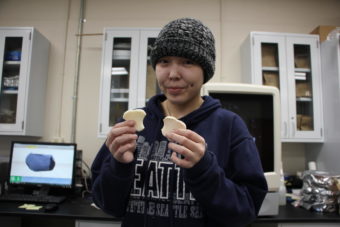
The class is shown part of the carcass of a baby orca they will harvest bones from.
Thursday in a lab at UAF’s Lena Point facility, the new DEMBONES class is shown part of the carcass of a baby orca that they will harvest bones from. (Photo by Quinton Chandler/KTOO)

Shannon Atkinson is in a lab showing a Thunder Mountain High School class part of the body of a baby orca, also known as a killer whale.

“This animal happened to be a neonate – meaning it was just born. Its teeth hadn’t even erupted,” she said.

Atkinson is a University of Alaska Fairbanks professor who works out of Juneau. Her specialty is marine mammals.

Thanks to the Juneau School District and a local donor, in a few weeks this class of mostly juniors and seniors will cut into two orcas and take out their bones.

“And ultimately create a museum-quality skeleton articulation,” Atkinson said.

About 50 students will take the college-level marine biology class — and the skeletons will be put on display in their school.

“We’re going to hang a skeleton in the high school. And we’ve got a bunch of them there already,” Atkinson explained. “So when we articulate something we’re basically putting those bones back together.”

Professor Shannon Atkinson introduces her new class to DEMBONES, Thursday at UAF's Lena Point facility.
Professor Shannon Atkinson introduced her new class to DEMBONES, Thursday. (Photo by Quinton Chandler/KTOO)

For the past seven years, Atkinson has taught a class called DEMBONES, an acronym for Distinctive Education in Motion Biodiversity of Nature and Environmental Stewardship.

It’s a college-level course for Thunder Mountain High’s marine biology class. The animals they use are usually found dead on the beach.

She said the class gives high school kids a unique opportunity to learn more about marine mammals.

“Everything from anatomy and physiology, ecology of the species, cultural uses of the animal, marine policy …,” Atkinson said.

This school year's DEMBONES class watches a video on Thursday of the articulation process made by a previous class.
This school year’s DEMBONES class watched a video of a previous class on Thursday. (Photo by Quinton Chandler/KTOO)

But earlier this year, she was afraid DEMBONES wouldn’t happen. After the state cut funding to the University of Alaska, UAF officials decided they couldn’t pay for the class.

“What is so wonderful is that between the Juneau School District and this community at large, they are so supportive of education that they have found the funding for us to be able to continue the class,” Atkinson said.

At its last meeting, the Juneau School Board voted to add $11,000 to its budget specifically for DEMBONES. Atkinson said the class is also getting new money from a local nonprofit. Most of the new funds will offset tuition and fees.

“My understanding at this point is the tuition for Spring Semester is $192 per credit and this is a two-credit class,” Atkinson said.

With fees, she said the class would cost about $400 per student and she said in the past, students have only paid about $50 of that tuition.

The program also usually gets grant money to take care of miscellaneous expenses.

“We also have costs associated with transporting carcasses, the chemicals that we use to clean them up, the time that it takes for technicians to help us prepare the skeleton,” Atkinson said.

Her past students have reconstructed harbor seals, a Cook Inlet beluga whale and a walrus.

Atkinson said the orca class will start in January and it will take about 13 weeks to put the skeletons together.

University of Alaska consolidates to single College of Education, UAS takes lead

University of Alaska Southeast's Juneau campus on Tuesday, Nov. 15, 2016. (Photo by Quinton Chandler/KTOO)
University of Alaska Southeast’s Juneau campus on Tuesday, Nov. 15, 2016. (Photo by Quinton Chandler/KTOO)

The University of Alaska is bringing its three colleges of education under one roof at the University of Alaska Southeast.

The University of Alaska’s Board of Regents voted unanimously Wednesday morning for UAS to lead the College of Education — though originally the regents planned to vote whether to give University of Alaska Fairbanks authority over the college.

City and Borough of Juneau Assembly member Jesse Kiehl said UAS is the obvious, best choice.

“Roughly as many teachers use University of Alaska Southeast programs as the other two universities put together and in some categories, even more than that,” Kiehl said.

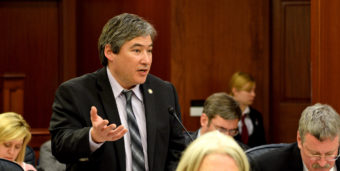
Jesse Kiehl
City and Borough of Juneau Assembly member Jesse Kiehl in May, 2013. (Photo by Casey Kelly/KTOO)

Kiehl, the Assembly’s liaison to a UAS campus advisory council, said UAS has already been leading the University of Alaska in innovative education programs and not being chosen would’ve have been devastating.

“That College of Education is nine-tenths of the graduate degrees that the University of Alaska Southeast offers. … Without a leadership role in one of the major missions of the university system statewide, UAS was in terrible danger,” Kiehl said.

The regents’ decision means the College of Education’s administrative services will be based at UAS but all three branches in Anchorage, Fairbanks and Southeast will still offer academic programs on their campuses and online.

UAS Chancellor Rick Caulfield said after a board meeting in September that the decision is part of a larger cost savings strategy called Strategic Pathways.

“Our hope is that in the end, we’re going to be a leaner university, we’re going to reduce costs, we have to, we know that,” he said. “But at the same time that we can continue to focus on quality in our academic programs.

For months the University of Alaska has been considering what its branches in Anchorage, Fairbanks and Southeast should specialize in.

Caulfield said UAS was uniquely qualified to lead the College of Education.

“UAS has long had a really robust array of teacher education training programs,” Caulfield said.

University of Alaska Southeast Chancellor Rick Caulfield in the Egan Lecture Hall on Tuesday, Sept. 13, 2016.
University of Alaska Southeast Chancellor Rick Caulfield listens to a presentation by President Jim Johnsen in the Egan Lecture Hall on Tuesday, Sept. 13, 2016. (Photo by Quinton Chandler/KTOO)

Kiehl said UAS is a key economic and cultural driver for Southeast Alaska.

Recently the City and Borough of Juneau and the Juneau Community Foundation decided to give the school’s College of Education a $1 million endowment.

The next academic programs Strategic Pathways teams are scheduled to evaluate for consolidation are social sciences, arts and humanities, physical sciences and mine training.

Caulfield said he is “grateful” to many Southeast residents and elected officials who voiced support for UAS to take this new leadership role.

He believes that support was largely why President Jim Johnsen eventually recommended the regents give the College of Education to UAS.

UAS Chancellor discusses issues and opportunities in Ketchikan

UAS Ketchikan Campus Director Priscuilla Schulte and UAS Chancellor Richard Caulfield.
UAS Ketchikan Campus Director Priscuilla Schulte and UAS Chancellor Richard Caulfield. (Photo courtesy KRBD News)

University of Alaska Southeast Chancellor Richard Caulfield was in Ketchikan this week, visiting with staff, faculty and students. Caulfield and UAS Ketchikan Campus Director Priscilla Schulte spoke about financial issues facing the university system, and opportunities for the Ketchikan campus.

Caulfield has been chancellor since May of 2015. He was in the First City on a regular visit to the UAS Ketchikan campus.

Caulfield says earlier this year, University of Alaska President Jim Johnsen implemented “Strategic Pathways,” an initiative to streamline the university system statewide, reduce the budget, and improve opportunities for students. Caulfield says all academic and administrative programs are under review.

“And already, the first phase of ‘Strategic Pathways’ has focused on our School of Management and its offerings in Southeast, and business programs elsewhere in the state, and also teacher education. And those are two prominent ones that are on the radar screen right now.”

Caulfield says two online degree programs will continue, but under a different school based out of Juneau. He says this will eliminate one dean position and streamline costs. The degrees are Bachelor of Administration and Masters of Public Administration.

Caulfield says the Board of Regents is meeting mid-December to consider a proposal to have a single college of education, and a single dean, across the state. He believes the board will approve that proposal.

“The question has been, ‘Which University – Fairbanks, Anchorage or Southeast – would take the lead for the state in teacher education?’ And the president’s put forward a recommendation that it be in Fairbanks, even as we would still have faculty in Anchorage and in Juneau serving Southeast Alaska.”

Ketchikan Campus Director Priscilla Schulte says many UAS Ketchikan students pursuing bachelor degrees want to go into teaching. She hopes whatever changes are made, students can easily move from their bachelor’s program into teacher education.

“And we want to make sure that it’s a very streamlined process, as it is now at UAS. They can go from our bachelor’s programs into the Master of Arts in Teaching. We have quite a few students who do that.”

Caulfield says a focus of “Strategic Pathways” is teacher education and retention. He says about 900 teachers are hired in Alaska each year, but only about one-third are educated at the University of Alaska.

“Two-thirds are imported from out of state. Inevitably that’s a good thing. We’ll get some new ideas and so forth. But the president has said, in his mind, it would be great, by 2025, if, say, 90 percent of the teachers teaching in Alaska schools were educated here in the state – people who know and love the state. They know our communities. They know our kids.”

Caulfield says he wants Southeast students to have continued access to quality teaching programs so that goal can be achieved.

Caulfield says maritime and fisheries programs will continue to be important fields. The School of Fisheries and Ocean Sciences is based in Fairbanks. He says there are plans to expand undergraduate fisheries education in Southeast.

“And my hope is that we’ll see a steady stream of Southeast Alaska students wanting to enroll in our Fisheries and Ocean Sciences program. They can start here in Ketchikan. They can get their basic courses here or in Sitka. Some of that they could do online. But they would, in the end, need to go to Juneau, probably, to finish up their degree.”

Caulfield says other opportunities for growth are in the marine trades. He says the university has had good working relationships with various employers, including Vigor Industrial and the Alaska Marine Highway, and he wants to see those relationships continue and expand.

UAS will be upgrading the regional maritime training center in Ketchikan next year. Schulte says there will be a remodel of the building on Stedman Street. She says the welding and diesel labs will be upgraded, along with facilities for the marine simulator.

“We’ve upgraded it with new software, new computers, but we need more space to put them. All of this will allow us to develop our simulator lab for marine transportation. (It will be) much more upgraded, and some of our existing welding facilities were build 20 to 30 years ago.”

She says the bids will go out in January, and work should start in May. Schulte says the facility upgrades will allow the university to do more in the marine trades.

Caulfield’s visit to Ketchikan was brief. He says he periodically visits each campus and looks forward to attending the next commencement ceremony.

SHI, UAS and IAIA partner to offer Northwest Coast art education

Haida artist Robert Davidson's metal panel "Greatest Echo" adorns the front of the Walter Soboleff Building. (Photo by Elizabeth Jenkins/KTOO)
The offices of the Sealaska Heritage Institute are in the Walter Soboleff Building in downtown Juneau. (Photo by Elizabeth Jenkins/KTOO)

Sealaska Heritage Institute has partnered with the Institute of American Indian Arts and the University of Alaska Southeast to provide enhanced and expanded Northwest Coast art programs and opportunities for Alaska students.

The three organizations signed a memorandum of agreement last Wednesday that will be used to design and implement a formal education plan.

“It’s part of a broader effort to really highlight Northwest Coast art, and to really make it something that’s attractive, that people want to come to Alaska to see,” said Rosita Worl, president of Sealaska Heritage Institute. “In order to do that, we need to make sure we have practicing artists.”

Worl said the initial focus will be for students to complete a two-year program at the University of Alaska Southeast in Northwest Coast arts. Then, those students could transfer to the Institute of American Indian Arts in Santa Fe for further study.

“And we want our students to have a good grounding in Northwest Coast art, but we also want them to be exposed to the broader creativity of art,” Worl said. “We want them to be able to work in different kinds of media – glass, tapestry – and IAIA does have programs where its students study in different countries.”

UAS hired Mique’l Dangeli in August to teach Northwest Coast art history. Worl said Dangeli, who is originally from Metlaktla, will be instrumental in expanding the program at the university.

“She’ll be recruiting others to teach other Northwest Coast arts. I understand her husband is going to be coming up and teaching a class as well. But really, at UAS, it is yet to be broadened.”

Worl said SHI currently provides Northwest Coast art education to elementary and secondary school students, but will expand that program. She said giving students the fundamentals at a young age will better prepare them for college courses.

“We’ve been trying to cultivate the arts already in our schools and in our communities, so I think they will have a cadre of students who are interested in Northwest Coast arts.”

Classes in Northwest Coast art are offered in Ketchikan through the Totem Heritage Center. UAS students can receive college credits for those courses. Worl said details are being worked out, but believes these classes will be included in the degree program.

AWARE increases presence at university campus

University of Alaska Southeast Campus on Tuesday, Nov. 15.
University of Alaska Southeast campus on Nov. 15. (Photo by Quinton Chandler/KTOO)

One out of every eight University of Alaska Southeast students said they experienced some form of sexual misconduct or sexual assault between 2015 and 2016. That’s according to the Alaska Justice Statistical Analysis Center at the University of Alaska Anchorage.

Lori Klein tracks reports of sexual discrimination for UAS as its Title IX coordinator.

“Dating violence, domestic violence, gender-based discrimination, sexual assault, sexual harassment, the whole gamut. This year so far, and with five months into the academic year, we’re at 17 reports,” Klein said.

She said there were 10 reports from students and employees last academic year. The reports are for all three campuses in Juneau, Ketchikan and Sitka.

Lori Klein is the UAS Title IX coordinator.
Lori Klein is the UAS Title IX coordinator. (Photo by Quinton Chandler/KTOO)

It’s Klein’s job to respond to those reports and to otherwise make sure the university complies with the federal law that prohibits sexual discrimination in any federally funded program or activity.

The University of Alaska Southeast wants to give its students and employees more options and information when they experience sexual discrimination. UAS is expanding two community partnerships in Juneau to better protect students and employees. To improve the university’s options for students and employees, Klein said they’re leaning on pre-existing partnerships with the Juneau Police Department and the advocacy group AWARE: Aiding Women in Abuse and Rape Emergencies.

“They serve us just like they serve anyone in the community and we engage with them on any number of issues,” Klein said. “But what we’ve done is we’ve formalized some of these partnerships.”

Mandy Cole is the deputy director of AWARE. Starting near the end of January, her group plans to give students access to an advocate for at least two hours a week inside the JPD substation on the UAS campus in Juneau.

“Maybe they were sexually assaulted,” Cole said. “Maybe they had an uncomfortable experience they’re not sure how to process and they want to talk to someone about it without triggering the response from the university.”

She said when someone talks to an AWARE advocate, everything is confidential.

Mandy Cole is the deputy director of AWARE.
Mandy Cole is the deputy director of AWARE. (Photo by Quinton Chandler/KTOO)

“A student can make a choice about what path she wants to start with. She may change her mind either way in either of the paths, but it gives her an opportunity to talk to someone who is just here to listen to what she’s thinking and what she’s feeling and figure out what’s the next best step for her,” Cole said.

Klein said, by law, students and staff can get that same confidentiality from university counselors and health care providers. She and Cole said AWARE will just give people one more option other than filing a report with the Title IX office, which may start a formal investigation.

UAS and JPD also have a new agreement to improve their coordination on cases of discrimination. Klein said that’s important because university employees and students who are victims of crime have rights under the law, and they have administrative rights granted through the university.

“Our opportunity with JPD is for me to provide some training to them about what those administrative rights are, for them to help me understand what (the) legal rights are, so that if a student comes and speaks with me, I can better explain what it would mean if they made a call to JPD,” Klein explained.

Klein said she is only required to tell police about crimes students and faculty report to her if it involves sexual assault and a minor. Otherwise, she said she gives the victim the option to call the police.

“In addition, should there be a report that comes to me and to them; we’ve put into this agreement just a higher level of collaboration with the two investigations running in a parallel manner,” Klein said.

A JPD spokesman said the police and the university have had a “robust” relationship for a long time and this new agreement is a logical next step.

Cole said she thinks UAS is thinking outside the box when it comes to sexual assault and other forms of sexual discrimination. She hopes by giving the university community a wealth of options, they are giving power back to the people they’re trying to help.

Correction: An earlier version of this story overstated how much time AWARE’s advocate plans to spend on the UAS campus. The advocate plans to be there at least two hours a week, not two hours a day. Additionally, parts of the story have been clarified regarding how Title IX reports are handled and which reports the university is obligated to inform law enforcement about.

University of Alaska takes sports off the budget chopping block

(Photo by Sparky Anderson)

The University of Alaska has decided not to cut six sports teams.

University President Jim Johnsen rescinded an earlier cost saving recommendation that men’s and women’s ski teams at the University of Alaska Fairbanks, and ski and indoor track programs at the University of Alaska Anchorage be eliminated.

Cutting the teams would have saved a projected $1.1 million, but would have dropped both Fairbanks and Anchorage campuses below the NCAA 10-team minimum.

Both schools had requested waivers from the 10-team requirement.

University President Jim Johnsen told the Board of Regents meeting Nov. 11 that the NCAA had informed the schools it declined to rule on their waiver requests.

”They said basically, ‘If you wanna go below 10 teams, go for it. Then ask for permission after the fact,’” Johnsen said. “In my view however, this approach contains way too much risk — financial risk, but more importantly, potential sanctions to both of our entire athletic programs.”

The university also will not pursue an alternative waiver-dependent proposal to merge Fairbanks and Anchorage campus athletic programs as a way to drop below the NCAA team minimum for each school.

Johnsen is no longer recommending cutting sports at all, he told regents.

“And I think that change of mind is supported by the impressive outpouring of support by the athletics community in general and by the Nordic ski community in particular,” Johnsen said.

Johnsen is instead recommending regents work with communities to increase private funding for sports programs.

Site notifications
Update notification options
Subscribe to notifications