University of Alaska students will see a 5 percent tuition hike next year.
For Alaska residents, that means lower division classes for the 2017-2018 school year will cost $202 per credit hour at all campuses except Kodiak and the Prince William Sound College, which will be slightly cheaper.
Upper division classes jump to $244 per credit hour, and graduate courses will ring in at $466 per credit.
Non-resident tuition increases to more than $513 per credit.
The Board of Regents approved the increase at its Nov. 10 meeting in Fairbanks.
The tuition rate goes into effect starting with the fall 2017 semester.
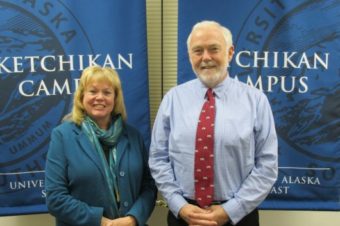
Former Ketchikan resident Cathy LeCompte has a new job. She’s been appointed as the director of Alaska Vocational Technical Center, or AVTEC, a state-operated post-secondary vocational school in Seward.
The news was announced Thursday by the Alaska Department of Labor and Workforce Development Commissioner.
LeCompte most recently worked as associate dean of academic affairs for the University of Alaska Anchorage’s Community and Technical College. Before that, she was campus director at UAS Ketchikan.
LeCompte will be the first woman to serve as director of AVTEC, which was founded in 1969.
According to the announcement, AVTEC offers training in maritime, culinary arts, industrial trades, welding, and information technology, among other fields.
Work continues on the UAF Engineering Building in Oct. 2016. (Photo via UAF Engineering Building Project Facebook Page)
Aging infrastructure throughout the University of Alaska is causing a $1 billion maintenance crunch, and campuses are trying to find ways to cope with a growing backlog of projects.
University Relations Vice President Michelle Rizk said the Board of Regents has been working for years to find ways to reduce the backlog of projects.
“As our buildings have been aging, you know the average age exceeds 30 years and we have over 400 facilities across the state of Alaska – as the buildings age, the need for emergency maintenance increases,” Rizk said. “So there’s roofs that are leaking and that need to be replaced, sewer systems, there’s a variety of issues out there.”
Traditionally, funding for deferred maintenance and projects to renew or re-purpose old buildings comes from the state legislature. If money is appropriated, then it’s often a drop in the bucket compared to the actual need.
According to John Faunce, the director of planning and construction for the Anchorage campus, about $10 million per year went to University of Alaska Anchorage.
“Our deferred maintenance grows at a rate of about $14 million per year,” Faunce said. “So we’ve got a backlog already of $240-250 million, and we continue to grow at $14 million a year.”
That’s just at University of Alaska Anchorage.
No deferred maintenance funds were allocated by the state for this fiscal year, but the University was able to funnel about $10 million from its operating budget into deferred maintenance – about $2.5 million of that went to the Anchorage campus.
Chris Turletes, the associate vice chancellor of Facilities and Campus Services at University of Alaska Anchorage, said that money helps, but it’s not enough.
“Kind of what we’ve been doing is keeping the roof from caving in and doing just-in-time work, systems that are broken or not operating efficiently, just keeping them running,” Turletes said. “And that’s what we’re doing a lot of. And eventually they break and you’ve got a problem.”
And those problems are not limited to UAA; the university system maintains buildings in Fairbanks, Juneau, and satellite campuses in many smaller communities across the state.
Michelle Rizk said the Board of Regents’ goal is to reduce the project backlog to a manageable level, but the exact path to doing so is not clear.
“Of course, one way to reduce the deferred maintenance of a building is actually to get rid of the building,” Rizk said. “And so we’re assessing is there some of our buildings over time should we sell them, should we lease them, to reduce our overall operating expense.”
And Rizk said the university will continue to seek funding from the state and other sources, but deferred maintenance can be a hard sell.
“A lot of people instead of fixing what you have, I mean, they wanna build a new facility, you know, so it’s hard to get donors and others excited about funding a roof replacement,” Rizk said.
In recent years, the university built the Alaska Airlines Center and a state-of-the-art engineering building on the Anchorage campus, and another engineering building on the Fairbanks campus remains partially complete.
The University of Alaska Board of Regents will address deferred maintenance and a variety of other capital and operating budget issues this week in Fairbanks.
It will be easier to register to vote, but not to take out college student loans, as Alaskans gave mixed verdicts on two ballot measures.
Voters passed Ballot Measure 1, that requires people who apply for Permanent Fund dividends to automatically be registered to vote. With all but a few precincts reporting, about 64 percent of voters supported the measure.
Ballot Measure 2 was defeated. It would have allowed the state to issue bonds to support college student loans. The goal of the measure was to lower the interest for student loans. But voters rejected the measure, with 56 percent voting against it.
In addition, all 33 judges on the ballot were retained by voters. An effort spearheaded by anti-abortion groups targeted Justices Joel Bolger and Peter Maassen, but they were retained.
Sen. Anna MacKinnon, R-Eagle River, on the floor of the Senate in March. She sponsored the ballot question to amend the state constitution to allow the state to issue bonds to lower college borrowing costs. (Photo by Skip Gray/360 North)
Alaskans are voting on whether to allow the state to issue debt to lower the interest students pay for college loans.
If voters amend the Alaska Constitution through Ballot Question No. 2, then more students also may be able to borrow to pay for college.
The Alaska Student Loan Corporation lends money to Alaskans to go to college. But the number of students who receive these loans has dropped steeply. That’s in part because fewer students can afford the interest on those loans, as well as the fact that fewer students qualified for loans after the state raised its credit standards.
While the corporation was started by the state, it has to pay more to bond holders than the state government does. That’s because the loan corporation’s bond rating isn’t as high as the state’s.
Sen. Anna MacKinnon, R-Eagle River, sponsored the ballot question that could eliminate the difference.
“My primary purpose is: How can we do something at no cost to the state of Alaska that would help students that are carrying an incredible amount of debt,” she said.
In April, corporation leaders projected the student loans could have an interest rate roughly 1 percent lower if the state issued bonds to back loans, instead of the corporation. That would save a student with the average amount of loans ($20,000) almost $1,200 over 10 years. The actual savings may be smaller, because the state’s credit rating has fallen since the estimates were made.
The state constitution limits state general obligation bonds to capital projects, veterans housing, and emergencies.
The amendment would allow the legislature to seek voter approval for bonds to back current and future student loans.
Former corporation executive Diane Barrans told legislators earlier this year the measure could also allow more students to borrow, because their credit scores wouldn’t have to be as high as they are now.
“We have about 40 percent of the applicants who do not qualify and are unable to get a co-signer,” Barrens said.
Not everyone supports the amendment.
Former state Revenue Commissioner Sterling Gallagher said college loans are too risky for the state to use its own bonds, since many students don’t pay off their loans.
“If we want to lower the credit ratings on student loans, let’s do it based on known cash flows, not on some grab of the state’s general credit,” Gallagher said.
MacKinnon countered that the state already faces the risk of paying off student loans in default, but students don’t benefit from the state’s higher bond rating.
“The risk that is there today is pretty much the same risk that would be there tomorrow if voters voted yes,” she said.
Only two lawmakers – Sitka Republican Sen. Bert Stedman and Wasilla Republican Rep. Lynn Gattis – voted against the legislation putting the question on the ballot.
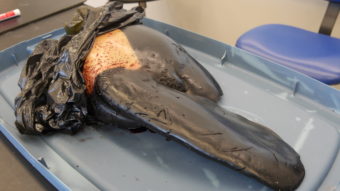
Researchers from the University of Alaska Fairbanks were at Kincaid Beach in Anchorage to finish recovering the skeleton of the humpback whale that washed up there in July. The team, led by Mammals Collection Manager Aren Gunderson, removed half the whale by hand in September then came back the next month with a helicopter for the remaining large bones. The massive specimen will become part of the largest marine mammal collection in North America housed at the University of Alaska Museum in Fairbanks.
Close
Update notification options
Subscribe to notifications
Subscribe
Get notifications about news related to the topics you care about. You can unsubscribe anytime.