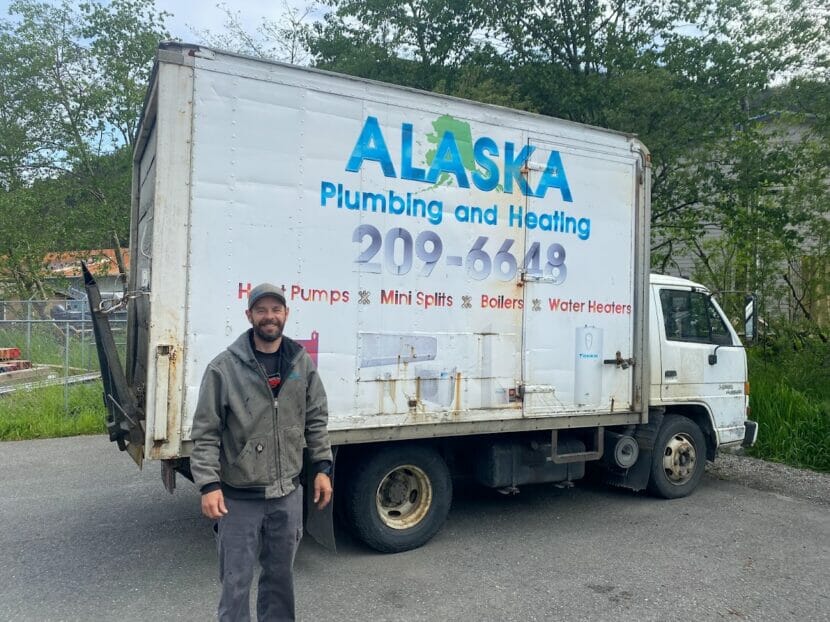
Sonny Ashby, owner of Alaska Plumbing and Heating, has been installing heat pumps in Juneau since 2012. He says demand for heat pumps has increased rapidly in recent years. (Photo by Anna Canny/KTOO)
Most people aren’t thinking about home heating in mid-June. But Andy Romanoff, executive director of Alaska Heat Smart, thinks more people should.
“You don’t want to wait until it gets cold and you think, ‘Oh, it’s cold, I should get a heat pump,’” Romanoff said. “Then you end up getting one in the spring because you had to wait all winter to get through the line.”
Swapping out oil-based heating systems for heat pumps is one of the best ways for homeowners to shrink their carbon footprints. And climate experts say nationwide demand for electric heat pumps is higher than ever. But in communities like Juneau, Ketchikan and Sitka, heat pump installers are struggling to keep up.
Homeowners swap fossil fuels for clean electricity
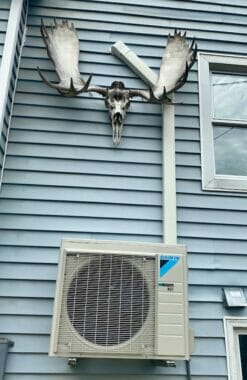
Phil Joy’s new Daikin heat pump was installed on his home in Juneau after a wait time of nearly six months. (Photo by Anna Canny/KTOO)
New financing opportunities and a growing community buzz have led more homeowners across Southeast Alaska to consider heat pumps.
Phil Joy is one of them. He started thinking about it when he moved to Juneau from Fairbanks in 2021. Then, in 2022, the Biden Administration introduced major rebates and tax incentives for homeowners purchasing heat pumps. That gave Joy the push he needed.
“When they passed the Inflation Reduction Act, I was like ‘Oh, maybe I can make this work financially,” Joy said.
National climate policy favors heat pumps because they’re an efficient electric alternative to heating systems that rely on fossil fuels. The fact that they run on electricity means they can be hooked up to renewable energy — which means they cut greenhouse gas emissions in places that have cheap hydropower like Juneau, Ketchikan and Sitka.
For Joy, ditching his oil furnace felt like a good way to take action.
“You know, I’m concerned about climate change,” Joy said. “And this was a way (to take action), especially with our electricity being almost 100% renewable.”
But it took Joy nearly six months to get a heat pump installed. And that wait time is typical.
An unsustainable pace
Sonny Ashby, owner of Alaska Plumbing and Heating, says that even with those long wait times, many installers are working at an unsustainable pace.
“Because they’re still doing all their normal demands. And then you add a whole new industry,” he said. “And that’s essentially what the heat pumps are.”
Heat pump installers are rarely dedicated to heat pumps alone. Most are plumbers, sheet metal specialists or refrigeration technicians, too. Having well-rounded employees makes a lot of sense for shops in small communities.
Gary Smith owns Schmolck Mechanical Contractors, with branches in Juneau, Sitka and Ketchikan. He said his employees have to juggle a wide variety of jobs from week to week.
“If the heat pump installation market is just trickling, you can’t justify having a guy doing nothing but that,” Smith said.
But now the market has stopped trickling, and both Ashby and Smith said heat pumps are a much bigger share of their workloads.
“There’s a lot of people putting in a heat pump, replacing a perfectly good heating system, just because they want that energy savings,” Smith said.
Nonprofits grow demand, installers wait for a tipping point
Nonprofits like Juneau-based Alaska Heat Smart and the Tlingit and Haida Regional Housing Authority have made a major push for heat pumps in Southeast Alaska, educating homeowners and helping them to secure funding.
“They want to see a much faster growth than what’s already organically happening,” Ashby said.
In Juneau, about a quarter of all households are already heated by renewable electricity, according to the 2018 Juneau Renewable Energy Strategy. But some local climate activists say Southeast Alaska needs to work to cut greenhouse gas emissions even faster, which would mean picking up the pace for heat pump installation.
Romanoff with Alaska Heat Smart has a list of close to 100 people hoping to get heat pumps. Getting through that list could take more than a year — and it’s just a fraction of the eligible households.
“We’re just not sure how to speed things up,” he said.
The obvious solution might be hiring more installers, but both Ashby and Smith said they’ve had trouble finding people. A workforce shortage for people in the skilled trades is a nationwide problem.
Introducing more local education and training programs for heat pump installers could help.
“But it’s a long-term solution to the problem, which is right here, right now,” Romanoff said.
Meanwhile, installers say they could pick up the pace by having one trained technician who is solely dedicated to heat pump installation.
“Our kind of plan moving forward is we need to get maybe a person in each town that installs heat pumps,” Smith said. “Their van is set up with heat pumps and we have the heat pump stocked.”
But before they make that transition, Smith and others say they’re waiting for a moment when demand for heat pumps reaches some sort of tipping point.
In the meantime, Romanoff says all he can do is ask people to be patient. He says managing expectations about long waits has become a big part of his job.
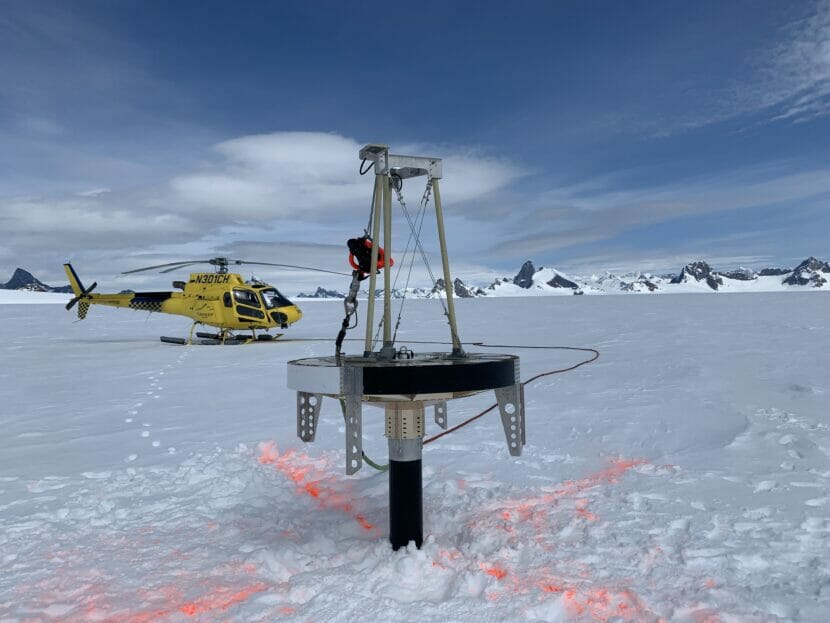
The “ice penetrator,” developed by researchers at MIT”s Haystack Observatory, was dropped from 5,000 feet above the Juneau Ice Field (Photo courtesy of Chester Ruszczyk, Jeff Hoffman, and Parker Steen of MIT)
Earlier this month, engineers from MIT teamed up with Coastal Helicopter and the Juneau Ice Research Program to pull off a high-stakes egg drop. It’s just like the ones you did in school, except the egg is a very fragile, very expensive seismometer. And the drop point is 5,000 feet above the Juneau Ice Field.
The dropping device looks like a six-foot lawn dart, and it’s called the “ice penetrator.” Eventually, they’ll be used to place seismometers in the ice sheets of Antarctica to help scientists understand climate change. But before that, MIT’s team will have to figure out if their design can keep the metaphorical egg from breaking.
Dr. Chester Ruszczyk leads the project, and he joined KTOO’s Anna Canny to talk about how it went.
Listen:
This interview has been edited for length and clarity.
Chet Rusczyk: It looks like a, basically, a six foot lawn dart with an antenna on top — a mast. The top part is much wider — it’s like a disc. It stays on the top because the mast has to be up above the ice and snow for communications. But the piece that holds the sensors and the batteries to provide power continues going into the ice shelf itself.
Really, the main thing is, it has to have enough speed so the two pieces can separate. But it also has with it the electronic cables to provide connection between your antennas and the actual receivers that need to get data to and from it.
Anna Canny: And the goal eventually will be to drop the ice penetrator from a helicopter to deposit seismometers in Antarctica to measure changing ice. Can you explain to me why that is such a difficult feat?
Chet Rusczyk: Because the seismometer is so sensitive. Usually they’re only meant to be dropped out of the back of a pickup truck. So when you tell them, yeah, we’re going to drop it from 5,000 feet above the ice shelf, they tend to freak out. So the goal of this was to get accelerometers inside the system, do a few drops. And then from the drops, we would be able to go to the seismometer people and say, this is what we expect that you have to survive.
Anna Canny: And the reason for putting accelerometers in there is to measure force, basically? Like the amount of force that these seismometers will eventually have to endure?
Chet Rusczyk: Correct.
Anna Canny: This prototype is sort of a dummy version. It doesn’t have those really fragile seismometers in it yet. But when it does, they’ll measure motion in the ice shelf in Antarctica. Why is that so important?
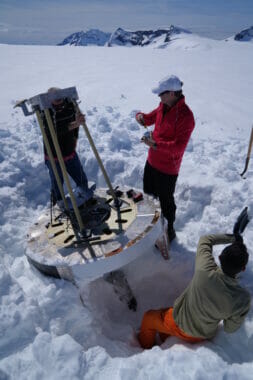
Dr. Chet Rusczyk retrieves the “ice penetrator” prototype after it’s inaugural drop (Photo courtesy of Chester Ruszczyk, Jeff Hoffman, and Parker Steen of MIT.)
Chet Rusczyk: Well, it’s climate change. Because if large chunks of the ice shelf break off, you get seawater rise, sea level rise. So part of this is really to look at, how do you predict this a little better? So think of the Ross Ice Shelf as suspended on a layer of water. So you’re gonna have impacts from the water underneath it, but you’re gonna have waves coming in at the front of it, and then you’re gonna have atmospheric conditions pushing down on it. So what the seismometer is really looking for is, how is the ice responding to all three of these different type of waves?
Anna Canny: Are there any other factors you’re considering, in terms of successfully deploying the ice penetrator?
Chet Rusczyk: So it really wants to go straight in. Because what happens is, with the seismometer, there’s a gyroscope that can only straighten it out if the tilt is so many degrees. So, um, there was a whole slew of things that could have gone wrong, but it actually worked out okay.
Anna Canny: And why is remote deployment so important? Why is the ability to be able to drop the sensors from a helicopter like this useful?
Chet Rusczyk: So one of the things is, a few of my colleagues have worked with people in the Arctic and Antarctica, and people’s lives — scientists’ lives — have been lost there. So this kind of mitigates that problem by removing that from the equation and making it a little bit simple. And they do have sensors out there that were manually placed. But it’s not enough. So being able to just throw a bunch out of the back of a helicopter or the back of a plane is a lot easier.
Anna Canny: Well, thanks for joining me, and it’s pretty exciting that Juneau got to play a little role in this really cool science.
Chet Rusczyk: Juneau was very important to us having success in Antarctica. So that was good.
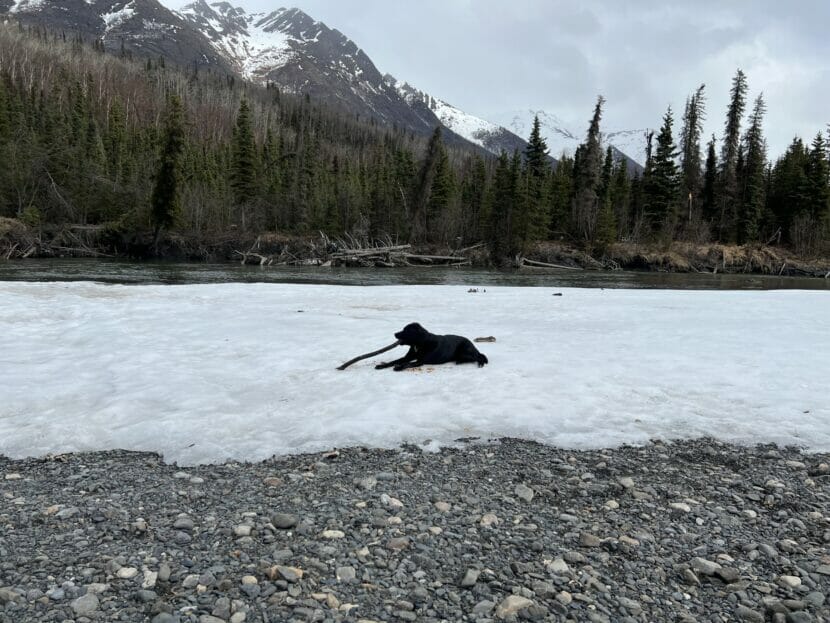
A dog named Theo, who is oblivious to the existential threat posed by climate warming, chews a stick near Eagle River, where snow lingered at the end of April. (Casey Grove/Alaska Public Media)
Well, if you’ve been grumbling about it feeling cooler than usual in Alaska this spring, you’re right.
Lingering snow and cloudy days resulted in temperatures about 3.5 degrees below average, statewide, from March through May.
National Weather Service climate researcher Brian Brettschneider — back for our Ask a Climatologist segment — says that ranged from about 1 degree below average in Juneau, to 2 or 3 degrees in Anchorage, and 4 or 5 degrees in Fairbanks.
And Brettschneider says April was a particularly chilly month statewide.
Listen:
Brian Brettschneider: It was the month where, normally, April is where we transition to spring. But April really was a continuation of winter. So statewide, it was either the fourth or fifth coldest April on record, about 10 degrees below normal. But in much of the central and western Interior, it was, you know, 14 to even like 18, 19 degrees below normal for the entire month, which is really remarkable. And even places like Nome set an all-time lowest temperature record for the month of April. A lot of records were set in (the) western part of the state.
Casey Grove: Interesting, yeah. So a lot of people were complaining about that, obviously. Maybe this is a dumb question, but is that just because of cloud cover, like it just happened to be cloudy, more of the time?
Brian Brettschneider: You know, spring is tough, because as we get the sun getting much higher in the sky, particularly from mid-April onward, the temperature can be highly dependent on if there’s still snow on the ground. So snow, in many ways, acts like a mirror, it reflects a lot of the solar energy back into space. So if there is snow in the ground, it’ll be cooler than the airmass would otherwise let it get to. So because we had a deep snowpack in many parts of the state, it becomes what’s called a “positive feedback cycle.” We get some below-normal weather, and then that prevents the snow from melting, and the fact that the snow didn’t melt means that it keeps the weather cooler than it would ordinarily be. So from an atmospheric point of view, we just had a big area of very persistent low pressure that was really stuck over the state and the Bering Sea area, and that just prevented any kind of any warm air from moving over the state.
Casey Grove: Gotcha. Well, so how does this spring compare to years past? I mean, some of those numbers sound pretty significant, but in the grand scheme of things, are they?
Brian Brettschneider: Yeah, so, you know, when we compare March, April, May 2023 versus other years, we’re going to look back and say, “Yeah, this was cooler than the normal for the current normal period,” which is 1991 to 2020. But historically, this would be actually pretty typical spring conditions. So we do have some recency bias to overcome. But we’ve certainly had some much colder springs in years past.
Casey Grove: Yeah, no kidding. I feel like we talk about this a lot, too, where what’s going on right now, or even this past spring, doesn’t really mean a whole lot, you know, in the long-term summer forecast. And I should say, I feel like we talk about that in regards to wildfires, too, because it doesn’t take a whole lot of hot, sunny, dry days to really ramp up that wildfire danger. So just to like, make that point.
Brian Brettschneider: And to follow up on that, as many people in, say, the Fairbanks area remember, 2004 was kind of the wildfire season of record. Well, May of 2004 was the wettest May that Fairbanks had. Anchorage people remember the hot summer of 2019 and that we were just choked in smoke basically that entire summer. May 2019 was the wettest May on record in Anchorage. So we can get lulled into thinking, “Oh, well, boy, it’s really wet and cool,” and kind of try to extrapolate that as to what the summer conditions will be, only to be completely wrong.
Casey Grove: So is that forecast for June to be warmer than normal, is that based on shifting into an El Niño pattern?
Brian Brettschneider: So there’s a couple of things that they look at when making these monthly and seasonal outlooks. And one is they do look at what are called “dynamic models.” That’s kind of, “Here’s the initial conditions, and where do we expect it to evolve over the next number of several weeks to several months.” So that’s one aspect. Another is they do look at trends, and trends and temperatures, and trends and, say, sea ice, and trends and ocean temperatures and how that would affect (the outlook). And then they also do look at El Niño or La Niña conditions. Typically in an El Niño summer, Alaska is a little bit warmer than normal. And particularly the western part of the state has a stronger signal for warmer-than-normal conditions. So all those things go into the pot when they generate a monthly and a seasonal outlook.
Casey Grove: OK, well Brian, now I want to play the part of the, you know, cranky Alaskan who felt like their spring was really, really cold and maybe, you know, just to understand that I’m just trying to play a character here. But doesn’t that mean, since it was, in some places, significantly colder than normal, doesn’t that mean that global warming is not actually happening?
Brian Brettschneider: Well, it can be tempting to look outside and, you know, while you have your jacket on and are maybe even looking at snowflakes falling in summer to say, “Well, what happened to global warming?” But we have to remember that we are, even though we’re a big state — the biggest, of course — we are a small part of the globe. And most of the globe is really on fire, in many cases literally, especially in Canada. And right now, all the buzz in the climate community is how the oceans are basically just on fire. How Antarctic sea ice is, even though they’re in 24 hours of darkness, is decreasing, day after day, not increasing. It’s really uncharted territory. So we’re a little area of cool nirvana compared to everyone else.
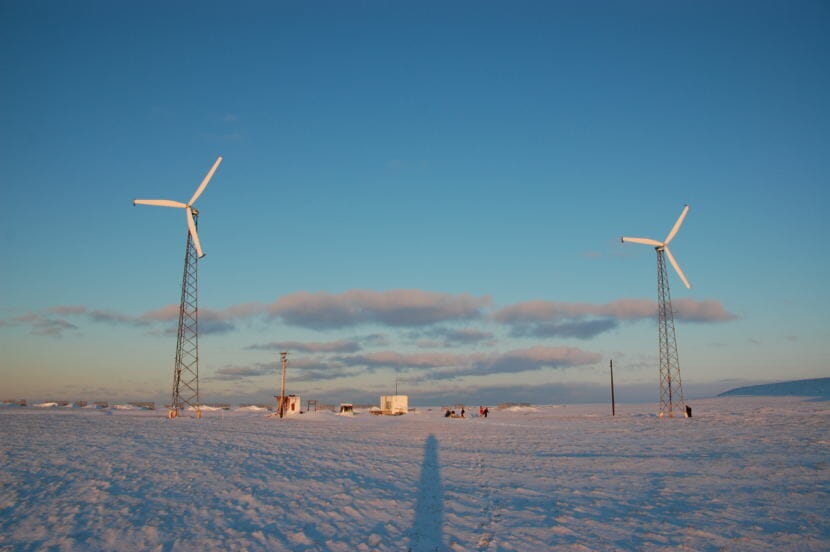
Wind turbines in Wales, Alaska. (Photo courtesy of Alaska Center for Energy and Power)
Standing in front of a crowd of energy experts and industry leaders in Anchorage last week, Gov. Mike Dunleavy outlined his vision for Alaska’s energy policy.
“When we talk about energy, for Alaska, it is going to be all-in,” Dunleavy told the audience at the Alaska Sustainable Energy Conference, which his administration helped organize.
Alaska is an oil and gas state, Dunleavy said, but it can no longer only be an oil and gas state. Going forward, he said, “it is going to be oil, it is going to be gas, it’s going to be wind, it’s going to be solar, it’s going to be geothermal, it’s going to be biomass, it’s going to be nukes.”
Alaska officials at the conference repeatedly made the case that the state should both increase fossil fuel production and boost renewables like wind and solar. But critics argue this vision ignores the devastating impacts of climate change.
Alaska has long faced an energy paradox. The state is a major oil producer, and oil taxes and royalties have for decades been a major revenue source, supporting state spending on everything from schools to roads. But most of that oil is shipped out of state. Meanwhile, rural communities in Alaska face some of the highest energy costs in the nation, often relying on expensive imported diesel and heating oil.
In an interview with Alaska Public Media, Dunleavy laid out his vision for how to address this dilemma. He argued that Alaska should double down on the production of fossil fuels as a revenue source, while building more renewable energy in-state to lower bills at home.
As part of that vision, Dunleavy and other Alaska officials used the conference to reiterate support for the Alaska LNG project: a proposed 800-mile natural gas pipeline from the North Slope to the Kenai Peninsula, which would potentially allow Alaska to export liquified natural gas to buyers in Asia.
“We want to be a player on the world stage in oil and gas, as well as coal, as well as biomass,” Dunleavy said in the interview. But, he added, “internally, we have to lower the cost of energy and make it stable. And that’s where you see a lot of the renewable concepts come into play.”
Dunleavy said for him, investing in renewables is not about lowering carbon emissions or combatting climate change, it’s about securing cheap energy for Alaskans that’s not tied to the volatile price of oil. The cost to operate renewable energy projects has dropped dramatically in recent years.
“From my perspective, if a diesel generator could be producing electricity at a very low cost consistently, we would consider that as well,” Dunleavy said.
But critics say this vision is short-sighted and fails to take climate change into account.
Phillip Wight, an energy historian at the University of Alaska, Fairbanks, said Alaska has pursued a similar approach for decades.
“Historically, Alaskans have not pursued renewable energy because of climate benefits. We have pursued renewable energy because it has reduced our reliance on diesel and other higher cost fossil fuels,” Wight said. “We’ve done it for economic reasons, not climate reasons.”
But Wight said today, as climate change accelerates, Alaska needs to consider more than just economic benefit.
Alaska faces growing impacts from climate change, from sea ice loss and thawing permafrost to species die-offs. Scientists say the world must slash carbon emissions, including from burning fossil fuels, nearly in half by the end of this decade to avoid the worst impacts of climate change. The state’s total contribution to the global oil and gas market is relatively small, but Wight argued that as long as Alaska continues to drill, it’s contributing to its own environmental problems.
“We’re still exacerbating a global problem, and a global problem where Alaska is warming four times faster than the rest of the planet,” Wight said. “We’re not escaping that problem. We’re on the front lines of the climate crisis.”
Proponents of fossil fuel production point out that there’s no clear alternative state revenue source that could replace oil production. But experts like Wight predict that as the world transitions away from fossil fuels, eventually Alaska will have to stop drilling. The International Energy Agency warned in 2021 that any new fossil fuel infrastructure would make it harder to meet global climate targets.
Meanwhile, some clean energy advocates say the state still isn’t doing enough to invest in renewables at home. Rachel Christensen with The Alaska Center, an Anchorage-based nonprofit, said she’d like to see the governor make renewable policy a bigger priority.
“What we’re seeing is just talk about the potential of solutions,” Christiansen said. “We need to see him actually taking action on putting those into place.”
Christiansen pointed to two proposals that were before the legislature this year: one would have required utilities to source a certain amount of their energy from renewable projects. The other would have created a “green bank” to help finance renewable projects in small communities.
Dunleavy supported both, but neither passed. In response to Christiansen’s criticisms, a Dunleavy spokesperson reiterated the governor’s goal to provide Alaskans with low-cost, reliable sources of energy.
Christensen said would also like to see the administration take climate change more seriously in its energy policy.
“It should be more than just an economic move,” Christiansen said. “Our people and industries are already feeling the effects of the climate crisis. And we can’t keep pushing these large scale extraction projects for export, just because it’s what we’ve always done.”
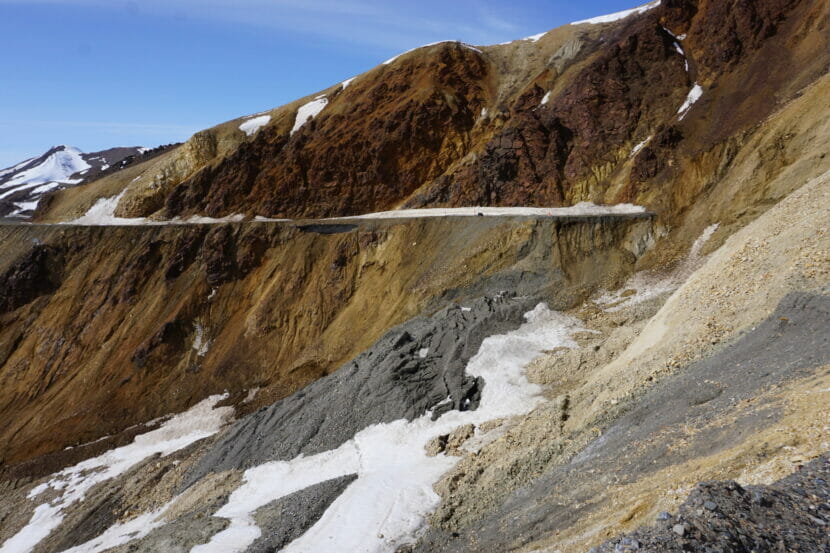
The landslide at Pretty Rocks, at about the halfway point of the Denali National Park road, is seen on May 5. The project to install a new bridge that will allow the road to reopen is challenging because of geologic and logistical complexities, which include ice-rich permafrost, a band of difficult clay and overall remoteness, The expected completion is now midsummer of 2026, pushed back from an earlier esimate of 2025. (Photo by Yereth Rosen/Alaska Beacon)
By midsummer in 2026, visitors will likely be traveling over a sophisticated new bridge that clears a geologic hazard that has become a poster child of climate change in Alaska.
Until then, the National Park Service and the tourism industry will be coping with three more years of shutdowns at about the halfway point of the sole park road to avoid ongoing landslides at a steep and perilous site called Pretty Rocks.
Where there used to be a curve at about mile 45 of the 92-mile road, a site known for its spectacular views of a valley called the Plains of Murie, a section of road is now gone, leaving a nearly sheer drop-off in its place. When the sun hits the rock face on the north side, as it did on the first Friday in May, clumps of dirt and rock tumble almost incessantly down the slope.
In August of 2021, the road was closed there; that section was still intact but deemed too dangerous for public travel. By then, the perils were obvious, said Dave Schirokauer, Denali’s science and resources team leader. He pointed to a site on the now-collapsed road section.“Right over there in the corner, we could see ice. Very, very ice-rich permafrost was at the surface and was very visible,” he said during a May 5 tour.
Pretty Rocks got this way in Hemingway-like fashion: gradually, and then suddenly.
The slope was moving slightly in the 1960s and likely for decades earlier, according to the park service. But prior to 2014, it was causing little trouble beyond some occasional small cracks in the road surface, according to park officials. As the climate continued to warm, slope movement that was measured in inches per year before 2014 increased to inches per month in 2017, inches per week the following year, inches per day in 2019 and, in 2021, 0.65 inches per hour, according to park officials. A collapse in August of 2021 forced the abrupt road closure and an early end to some Denali trips.
The project to reopen the road at Pretty Rocks, expected to cost about $100 million, is challenging. The site is remote and steep. The bridge has to be suitable for permafrost terrain, strong and secure enough to carry tour buses and withstand earthquakes, subtle enough in appearance to blend in with surroundings and constructed in a way that minimizes impacts to park visitors and wildlife.
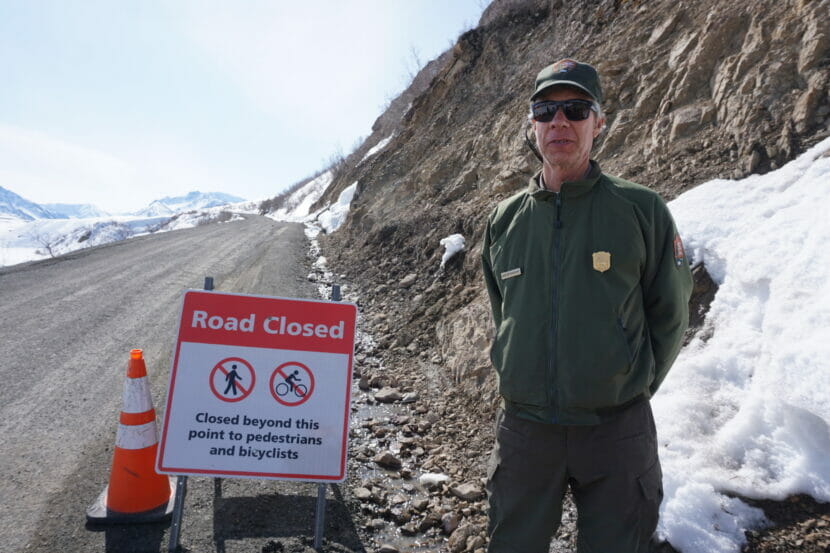
Dave Schirokauer, Denali National Park’s science and resources team leader, stands on May 5 at the East Fork turnaround site on the park’s road, at about mile 43 of the 92-mile route. Tour buses can go no further on the road because of the closure a couple of miles to the west at the dangerous Pretty Rocks landslide site. (Photo by Yereth Rosen/Alaska Beacon)
The design includes anchors to lodge vertically and at angles. It also includes 23 thermosyphons — devices that pull heat out of the ground — to preserve a pocket of ice-rich permafrost discovered 85 feet below the surface at the east end, said Steve Mandt, the park engineer coordinating the project.
Site geology pushes back road opening
The site’s geology makes any fix complex. There is permafrost overlain with a rock glacier, which is a frozen but thawing conglomeration of rock and ice. There is clay, which thaws at a lower temperature than that needed to melt ice. There is rainwater that infiltrates all that and, depending on the season, expands the ice or hastens the melt. “So you’ve got rock, you’ve got rain that freezes and you’ve got this major ice layer that’s moving,” Schirokauer said.
The clay has proved particularly problematic. A recent discovery that workers will have to remove 80,000 cubic yards of clay on the west side of the planned bridge site rather than the 30,000 previously estimated means a one-year delay in the project’s expected completion, said Denali spokesperson Sharon Stiteler.
The change from a 2025 road opening is a setback to the tourism industry.
“With the additional delay, obviously, that is disappointing,” said Jillian Simpson, president and chief executive officer of the Alaska Travel Industry Association. But the road is “a critical piece of infrastructure” and the industry understands “how important it is to get it right,” she said.
“Denali is the linchpin of tourism when it comes to exploring Alaska on land,” Simpson said.
As the bridge becomes reality, Denali will be busy with more than the usual tourist crowds.
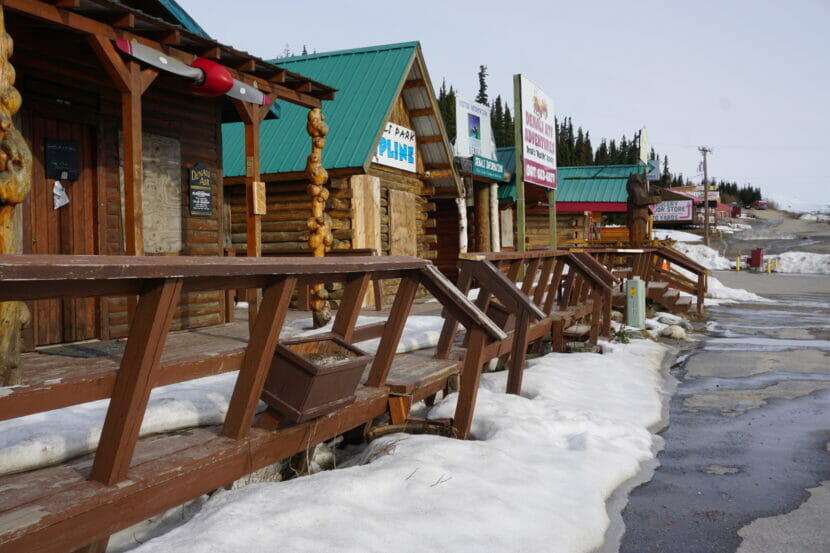
Tourist businesses lining the Parks Highway outside of the Denali National Park entrance, at a strip nicknamed “Glitter Gulch,” are seen on May 5. The shops, restaurants and tour companies, not yet open that day, depend on Denali crowds. Last year, with the second half of the road closed, there were more opportunities for some companies but challenges for others, like restaurants, which did not have the staffing to manage crowds. (Photo by Yereth Rosen/Alaska Beacon)
A camp at the park’s gravel site operated over the next summer seasons will serve 50 or more workers who will shuttle back and forth, their vehicles in some places alternating with the tour buses.
The approach to the Pretty Rocks site is so narrow that work trucks are to be backed in because there is not enough space for large vehicles to turn around. There will be some noise, like from pile driving, though the plan is to keep that to a minimum.
For tourists, this will be another year of stopping at the site called East Fork at the road’s 43-mile point, where there is a temporary ranger station in a yurt and enough space for buses to turn around.
“This is the new Eielson,” Schirokauer said, referring to the temporarily closed Eielson Visitors Center at the road’s 66-mile point, normally a popular stopping and turnaround site.
Last year, the first full year of the closure at Pretty Rocks, visitation bounded back from extreme lows resulting from the COVID-19 pandemic, though it was still only 88% of typical pre-2020 levels, according to an analysis by the Alaska Department of Labor and Workforce Development. Those who came to Denali were curious about the landslide, park staffers said. Many who rode the bus as far as they could, to the East Fork turnaround, walked the extra distance to see the site for themselves, Stiteler said.
This year, with Alaska on track for a record 1.6 million cruise passengers, the crowds are expected to be bigger. But Denali should be able to handle the increased traffic, even with half the road closed, said Brooke Merrell, the park’s superintendent.
“We feel like we got a good practice year last year to make sure we have it right,” she said. “We believe we’ll be able to accommodate it with the part of the road we have this year.”
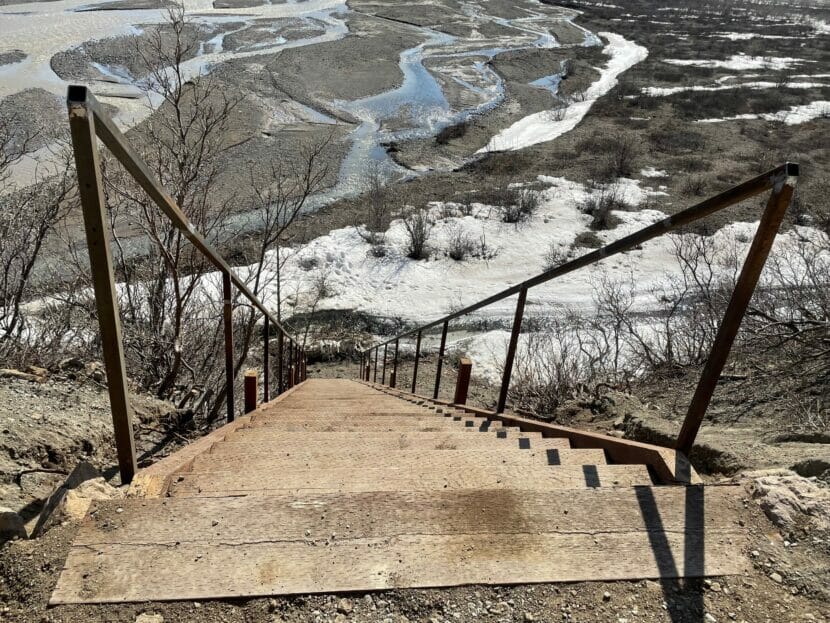
A temporary staircase at the East Fork turnaround area on the Denali National Park road, seen here in May of 2022, gives visitors access to the river plain below the roadbed and a route for exploring park territory beyond the Pretty Rocks closure area. (Photo provided by National Park Service)
It remains possible to travel around Pretty Rocks to the western half of the park.
There is temporary access provided by a steep stairway from the East Fork bus terminus to the river valley below. About 15% of the visitors who rode the shuttle bus that far last year chose to make that descent for brief walks or even more extensive hikes, according to park staff.
Backcountry users with the appropriate permits can keep going from there to explore the territory that is currently beyond park road access. Well-heeled travelers can, moreover, fly into Kantishna, the patch of private land at the end of the road, and stay at deluxe lodges where daily rates are well above $1,000.
How the construction affects Alaska tourism
The tourism industry has been adjusting to the new reality.
For local companies, last year was a “mixed bag,” with some operators able to take advantage of increased traffic resulting from the shorter bus trips but others struggling, said Vanessa Jusczak of the Denali Chamber of Commerce, based in Healy. Excursion companies had more business, but short-staffed restaurants were burdened by crowds appearing at what were normally low-volume times, she said by email.
In Anchorage this summer, Denali-bound tourists appear to be well aware of the road closure, said Jack Bonney, vice president of the Anchorage Convention and Visitors Bureau.
“It doesn’t seem to be affecting their choice about whether they go to Denali or not,” he said. While “the closure is in the back of people’s minds,” the park continues to be seen as an attractive destination, he said.
More than people are affected by the road closure. The park service is embarking on a study of bears to see how the lack of road traffic might be affecting them, Schirokauer said. The plan is to collar 18 to 20 animals, with half on the east of Pretty Rocks and the other half on the west side where the road is closed, he said.
Landslides increasing across the north
While Pretty Rocks is a dramatic and visible case because of its location and the inconvenience it is causing, thaw-induced landslides are increasing all over the north.
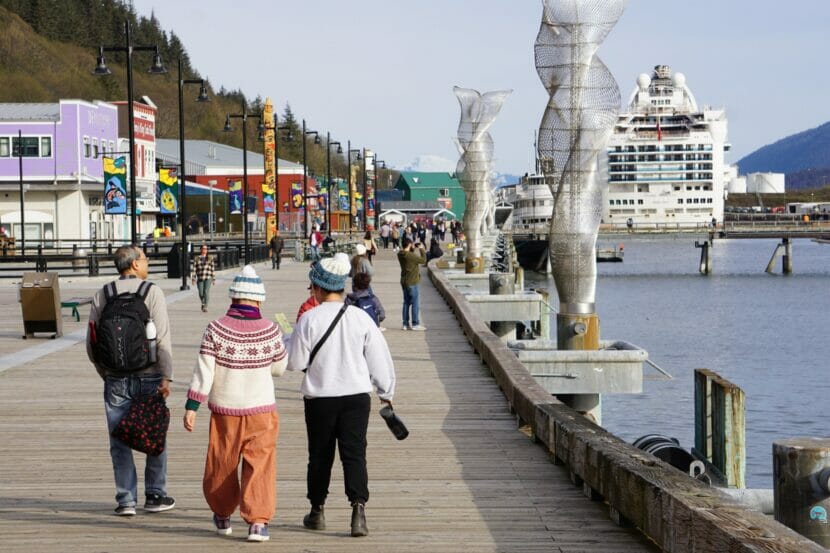
Cruise passengers stroll the waterfront in Juneau on May 9. Cruise visitation in Alaska is expected to hit a new record this year, and that in turn is expected to send more visitors to Denali, where half the road remains closed because of landslide dangers. (Photo by Yereth Rosen/Alaska Beacon)
Along other roads in Alaska, there are dangers in other national parks and sites outside of parks. Those include Slate Creek along the Parks Highway just outside Denali’s entrance, where permafrost thaw appears to be combining with extreme rainfall to create potential maintenance headaches and threats to a recently installed fiber-optic cable and other infrastructure, and the Dalton Highway, the sole land route to the North Slope oil fields, where thawing “frozen debris lobes” of ice, dirt, rock and vegetation are creeping downslope and forcing diversions and adjustments. East of Alaska, in Canada’s Northwest Territories, thaw-triggered landslides and slumps are eating away at the Dempster Highway.
Away from roads, big hazards come from thawing mountainsides, especially of coastal mountains, where dumped debris can cause localized tsunamis. One landslide hotspot is northern Southeast Alaska, where tall peaks rise dramatically from glacial fjords. There, and in neighboring parts of Canada; the pace of landslides is accelerated through combined glacial retreat and mountain permafrost thaw that destabilizes slopes. In 2015 in Taan Fjord, a coastal area of Wrangell-St. Elias National Park, the side of a mountain collapsed, sending rocks and debris into the water and triggering a local tsunami that reached over 630 feet, making it the fourth highest ever recorded. No people were affected by that, but the story was different in Greenland in 2017, when a massive landslide in a glaciated area caused a tsunami that killed four people.
In Denali, the Pretty Rocks bridge will not be the end of the work. The federal funding secured for the bridge is also intended to cover a second project phase to address another unstable site less than a mile to the east called Bear Cave.
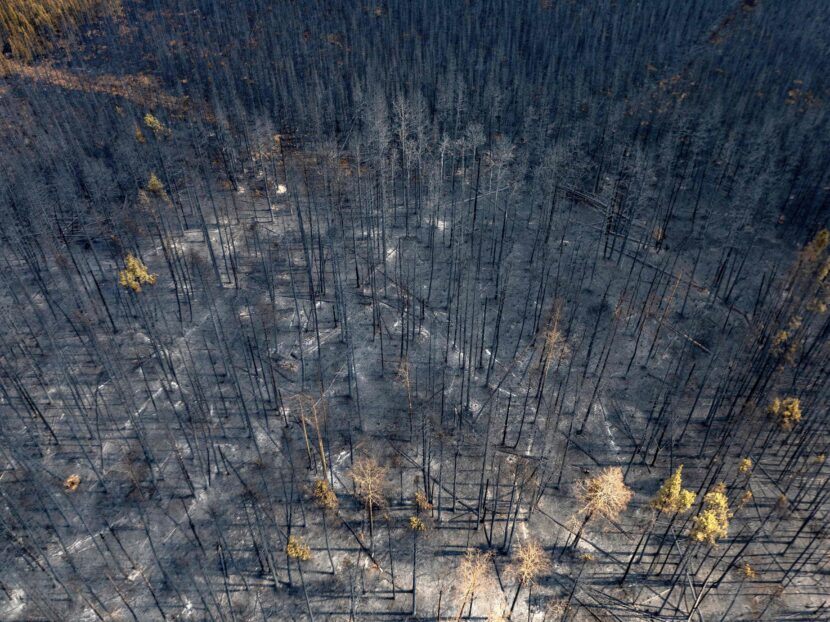
A burnt landscape caused by wildfires is pictured near Entrance, Wild Hay area, Alberta, Canada on May 10, 2023. Canada struggled on May 8, 2023, to control wildfires that have forced thousands to flee, halted oil production and razed towns, with the western province of Alberta calling for federal help. (MEGAN ALBU/AFP via Getty Images)
Copyright 2023 NPR. To see more, visit https://www.npr.org.
Transcript :
MARY LOUISE KELLY, HOST:
Early and record-breaking wildfires are burning across multiple Canadian provinces from the east coast to the west coast. They’ve forced more than 50,000 people to evacuate this month. Some fires have been so huge smoke has drifted as far south as Philadelphia. Emma Jacobs reports.
JANINE MUISE: I can see the smoke billowing in the sky.
EMMA JACOBS, BYLINE: Volunteer Janine Muise steps outside the rec center in rural Shelburne County, Nova Scotia, to speak on the phone.
MUISE: When we first came here, we could – you know, you could smell it. There’s been a lot of calls that have been dropped. I think there may be some towers down.
JACOBS: Many of the 5,000 evacuees in this area have been stopping at the Red Cross shelter here to register – some with children and many with pets. Most plan to stay with friends and family, but others will sleep on cots set up in the hockey rink.
MUISE: Anxiety is the main thing, around their home. I mean, people have worked for years to build what they have. And then, all of a sudden, it’s just gone.
JACOBS: This fire, known as the Barrington Lake fire, has grown quickly, becoming the largest in the history of the province. Another wildfire on the outskirts of Halifax has destroyed around 200 structures – mostly houses – and forced another 16,000 evacuations. It’s unknown when they will be allowed to return home.
DAVE STEEVES: This is a very dangerous situation.
JACOBS: Dave Steeves with Canada’s Department of Natural Resources and Renewables said dry, windy weather today would create treacherous conditions for firefighting.
STEEVES: It’s changing every moment with wind, with fuels, with the lay of the land, how the sun is heating the fuels. Everything is constantly evolving.
JACOBS: Nova Scotia Premier Tim Houston has banned all travel and activity in the woods and pleaded with people to stop any behavior that could ignite more fires.
TIM HOUSTON: For God’s sake, stop burning – stop flicking your cigarette butts out your car window. Just stop it. Our resources are stretched incredibly thin right now fighting existing fires.
JACOBS: Halifax Deputy Fire Chief Dave Meldrum said the wildfire had hopscotched through neighborhoods, destroying some homes while leaving others nearby untouched.
DAVE MELDRUM: It’s terrible to see. There’s – you know, these are people’s homes. This is a community.
JACOBS: But it’s not just been a bad spring for fires in Nova Scotia. The area burned this year in the western province of Alberta is about half the size of Massachusetts.
MIKE FLANNIGAN: And this is the highest amount of area burned for May.
JACOBS: Mike Flannigan studies wildfires. He’s a professor at Thompson Rivers University in British Columbia.
FLANNIGAN: Things are still burning actively in British Columbia, Alberta, Saskatchewan, Northwest Territories and now Ontario.
JACOBS: He says climate change is exacerbating conditions that make for bigger, more destructive fires – more hot, windy weather and more dry vegetation.
FLANNIGAN: The warmer we get, the longer our fire seasons are. And we’re seeing that pretty well across much of Canada. Fire season starts earlier in the spring, goes later in the fall.
JACOBS: And these wildfires can have impacts far outside the fire line. Heavy smoke led to health warnings in Nova Scotia this week. And plumes of smoke from wildfires in western Canada led to air quality alerts in U.S. states from Colorado to Montana and Minnesota.
For NPR News, I’m Emma Jacobs in Montreal. Transcript provided by NPR, Copyright NPR.
Close
Update notification options
Subscribe to notifications
Subscribe
Get notifications about news related to the topics you care about. You can unsubscribe anytime.

9(MDEwMjQ0ODM1MDEzNDk4MTEzNjU3NTRhYg004))