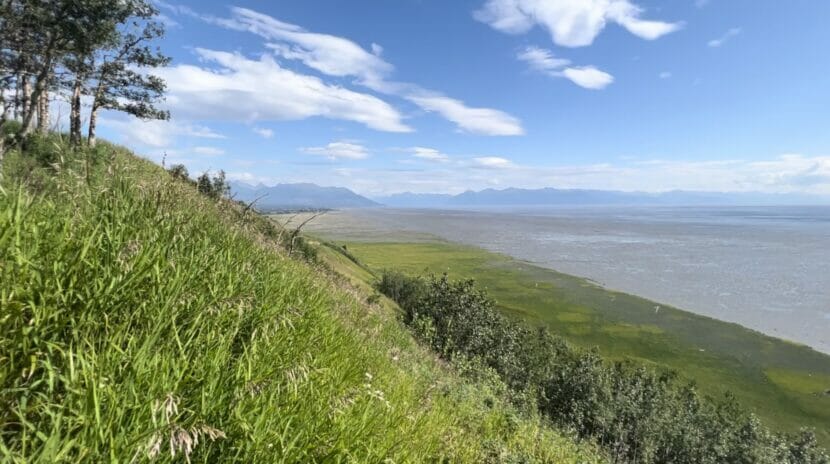
The Anchorage Coastal Wildlife Refuge, as seen from Kincaid Park. (Casey Grove/Alaska Public Media)
The global average temperature has hit record high marks recently, with some estimates that Earth is warmer now than it has been in hundreds of thousands of years.
National Weather Service climate researcher Brian Brettschneider, back for our Ask a Climatologist segment, says about a quarter of Alaska had its warmest July on record.
And while the state has been spared from even worse heat, like the 90-plus degrees seen in parts of South America, where it’s supposed to be the middle of winter right now, Brettschneider says Alaska could easily end up back in what he calls “the bullseye.”
Listen:
The following transcript has been lightly edited for clarity.
Brian Brettschneider: Well, we’ve seen that in the past. So 2016, at the time, was the warmest year on record. And Alaska really was in the bullseye of that. We really kind of shattered our record for the warmest year. But even that year, about 10 or 15% of the Earth experienced their single warmest year on record. So when we say, “Globally, it’s the warmest month or the warmest year,” that’s a global average. It can vary a lot from place to place. So July 2023, globally, shattered by a very wide margin the warmest July on record and the warmest any month on record.
Casey Grove: I think I read somewhere that the estimate is that it was the warmest in 120,000 years or something like that. Is that right?
Brian Brettschneider: Well, that’s a little bit speculative. We do have good ice core and proxy temperature records going back even several hundreds of thousands of years. And there’s a pretty reasonable chance that this year is the warmest it’s been at any point in the last several hundred thousand years. Certainly the last several thousand years, and again, potentially tens or even hundreds of thousands of years.
Casey Grove: Wow. Yeah. It’s just like these timescales that boggle the mind. I mean, it’s just too big for a human to comprehend. But I guess one thing we can wrap our heads around is it did seem like we had a pretty cool start to the summer here in Alaska, most of Alaska, and then it changed as things do, right? Can you can you tell me about that, and kind of where we are at here at this point in the summer?
Brian Brettschneider: Me being in Anchorage, I’ve heard a lot about how cool it’s been this summer. And in Anchorage proper, in the city itself, it has been the coolest start to the summer in 11 years. So not historically cool, but cool compared to the last decade or so. Now July, statewide, looks like it finished as the sixth warmest July on record statewide. So this notion that Alaska has had a cool summer is really very far from reality. Statewide, a very warm July. So places kind of from Fairbanks eastward and Fairbanks northward, many set records. Fairbanks had their second warmest July. Northway had their warmest July, by a wide margin. Eagle, I think, had their warmest or second warmest July. Up on the North Slope, Utqiaġvik had their warmest month on record. The other day, they had an average daily temperature of 66, their warmest day on record. And I think six of the 20 warmest days on record in Utqiaġvik have happened in the last month. In fact, in the last 30 days, it’s the first time they’ve ever had a 30-day average temperature above 50 degrees. Really exceptional, in some cases, unprecedented warmth in northern Alaska.
Casey Grove: So yeah, I mean, we’ve been talking about anticipating an El Niño pattern setting in. Are these high temperatures that we’re seeing, are those a results of an El Niño or, you know, any other phenomenon?
Brian Brettschneider: So there’s currently a moderately strong El Niño in the central Pacific Ocean, and that is liberating some warmth to the atmosphere that had been kind of sequestered down below in the previous couple of La Niña years. But really, what we’re seeing is that it’s really kind of everywhere. We are seeing, especially the north Atlantic Ocean, much warmer than normal sea surface temperatures, really from the equator or even south of the equator, all the way to the British Isles, you know, 50 degrees north. And so that’s completely disconnected from the Pacific Ocean. So El Niño is liberating some warmth, and that’s definitely a contributing factor, potentially even a significantly contributing factor to the record temperatures we had this month, but it’s not the complete story, and likely is only a modest part of the story.
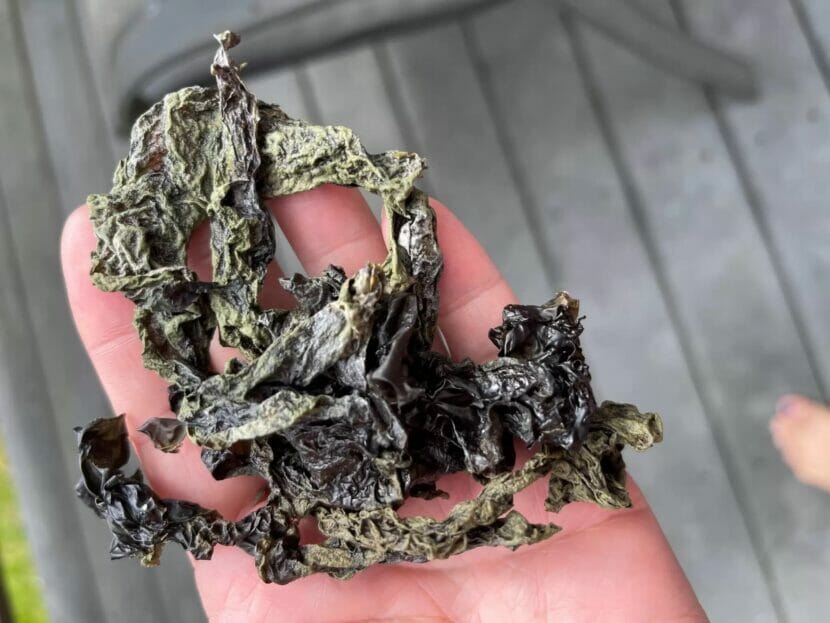
This dried, black seaweed has a light green color that traditional harvesters say isn’t normal and “tastes off.” (Photo courtesy of Irene Dundas)
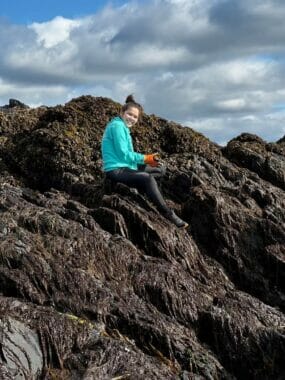
Irene Dundas has harvested black seaweed her whole life – near Kake when she was young and near Ketchikan as an adult. The harvest happens in May when the seaweed is exactly the right size. Dundas and family members travel by boat to specific large rocks far from shore. It must be low tide so they can pull the seaweed off the rocks.
“When you’re grabbing it in your handful, it looks like you’re grabbing a handful of long, thick black hair,” Dundas said.
Black seaweed is found in more treacherous areas. It needs nutrients that only come from lots of moving water.
Dundas harvests about 50 gallons to share with family and friends. Processing is lengthy, drying the seaweed into bite-sized pieces.
“It’s kind of crunchy like a piece of popcorn,” she said. “But the flavor is like the black seaweed that you put on sushi. It’s that exact flavor. So delicious.”
Dorian Dundas, Irene Dundas’ daughter, collects black seaweed. (Photo courtesy of Irene Dundas)
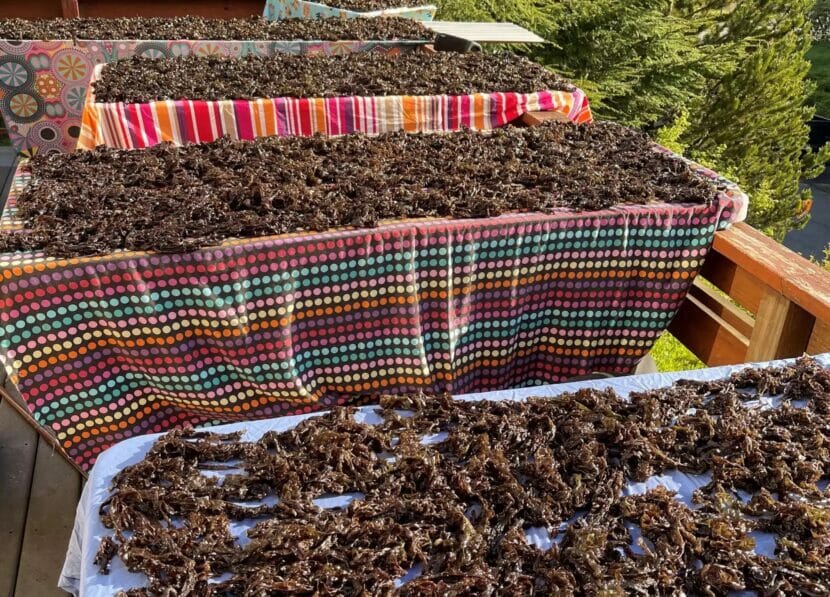
She transfers the wet seaweed in pillowcases and puts it outside on several large tables to dry. But in the years 2021 and 2022, she noticed something was wrong.
“The seaweed that I picked had a very distinct strong, strong smell,” Dundas said. “There was a discoloration, this light green color. I felt like it had a little bit more metallic taste to it.”
To get any good seaweed this year, she traveled for hours by boat near the Canadian border. Her past harvests, she threw away.
“I was alarmed and very, very, very upset,” said Dundas. “I had no clue what was going on.”
Keolani Booth has similarly concerns. He collects black seaweed on the outer waters near Metlakatla and southern Prince of Wales Island.
“This year, I hardly had anything of a harvest,” he said. “I usually give out quite a bit to our community members that can’t go out. And I was only able to get a minute amount and it was kind of heartbreaking because you know, some of these people depend on me to bring them some seaweed for the year.”
Booth says black seaweed could be like a canary in a coal mine – a warning of what could come from climate change.
“It’s a very hard seaweed to try to cultivate,” Booth said. “It’s very sensitive, which you know, you realize that in the open ocean, it’s a precursor to all the things that are stronger in the ocean.”
The Metlakatla tribe got a grant to start researching the problem two years ago. That research is ongoing. And last month, Dundas and Booth carried their concerns to a meeting in Juneau, hosted by the Sealaska Heritage Institute. Harvesters and scientists discussed what to do.
Jennifer Clark from Vancouver brought a Western science perspective. She works for a kelp company but studied the effects of climate change on seaweed for her Ph.D. In a post-doctoral project, she worked with Indigenous groups in central British Columbia about black seaweed disappearing there.
“In 2016, it’s almost completely missing from the intertidal shoreline,” she said.
Clark’s research linked the disappearance to an enormous hot water mass in the Northern Pacific known as The Blob. In 2014-2015, The Blob moved from the Gulf of Alaska down to California. It was followed by more heat from El Nino, which elevated seawater one to two degrees, enough to destroy the black seaweed.
“These heat waves are kind of unprecedented,” said Clark. “They just cause disruptions in life cycles and disturbances in the intertidal, which most of the seaweeds that you find are intertidal-subtidal, so they’re getting extreme changes in their habitat.”
She learned that black seaweed couldn’t survive past 64 degrees. As temperatures cooled in the years after The Blob and El Nino double whammy, BC’s seaweed started to come back. But not like before. Clark doesn’t know if Alaska’s black seaweed problem was also affected by The Blob – she says it would take more research. But she does know that black seaweed anywhere has challenges ahead if climate predictions come true.
“I think if it was persistent, like if we were to increase two degrees – 2050, I think that’s the projection is one and a half degrees – then maybe they won’t be so resilient, and they’ll just kind of exist as much as they can until they’re, they’re wiped out,” Clark said.
Wet black seaweed dries on tables outside. It will be ground into bite-sized pieces. Harvesters in Southeast Alaska collect it by the gallons. (Photo courtesy of Irene Dundas)
Rosita Worl is the president of Sealaska Heritage Institute. She says the seaweed is critical to many communities in and out of Alaska because it’s shared and traded.
“Black seaweed is really important to us as a food source, but also for its cultural components,” Worl said. “It’s like a glue that binds our community together through our widely sharing patterns. It also has spiritual dimensions. Black seaweed is distributed and consumed during our ceremonies.”
Sealaska Heritage Institute is creating a committee comprised of harvesters and scientists to start researching the problem. They’re also documenting the historical practices of the harvest and how it’s changed in recent years.
They hope the information will help them figure out if there’s any way to save black seaweed.
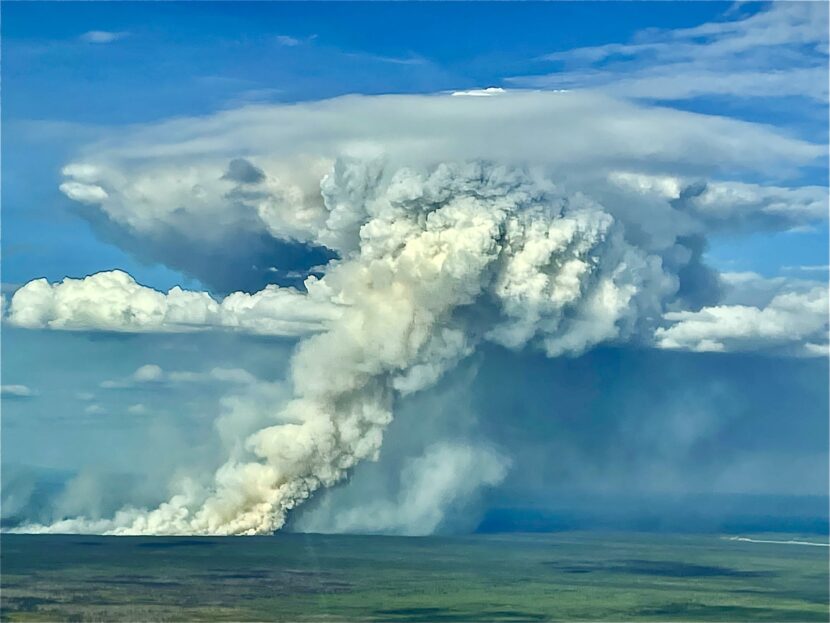
Lightning sparked wildfires across the state after a slow start to the fire season. There are now 140 active fires, including one that prompted an evacuation notice near Fairbanks.
“There’s fires distributed all over the place. All around us,” said Craig Eckert, a meteorologist with the National Weather Service Office in Fairbanks. “There’s too many to try and describe.”
This time of year usually marks the start of the rainy season for the Interior, which can slow wildfires. But that’s not happening this summer. Weekend forecasts call for highs near 90, and a chinook wind that could spread the fires and dense smoke even further.
“I can feel it in my throat,” Eckert said. “Even inside the building.”
July was hot across most of Alaska, with record-breaking temperatures in some communities.
Utqiaġvik had its hottest month on record. Fairbanks had its second hottest July. And Juneau’s heat lagged only behind July of 2018 and 2019 — two years that were part of a region-wide drought.
That all came during a month of scorching heat across the Lower 48 and much of the globe. Climate specialist Rick Thoman with the University of Alaska Fairbanks said climate change will continue to bring hotter summers.
“These kinds of very high temperatures are going to become more and more common,” Thoman said. “But it’s really unusual to have really warm weather this late in the season.”
Southeast Alaska flirts with drought
In Southeast, temperatures in the high 70s and low 80s this weekend could approach record highs, though they likely won’t surpass them for most communities. The region is also seeing very dry conditions.
“Across the board, everybody was below their normal precipitation,” said meteorologist Ben Linstid with the National Weather Service Office in Juneau.
Klawock and Yakutat each experienced their driest July on record, while Juneau and Ketchikan each recorded their fourth driest July.
Scientists are still struggling to define drought in an extremely wet region like the Tongass rainforest, but the U.S. drought monitor has flagged “abnormally dry” conditions for Southern portions of Southeast, from Baronoff Island to Petersburg and southward.
“So, not quite to the drought level, but it’s kind of like the alert of the possibility of drought,” Thoman said.
That’s with the exception of one community. Wrangell is now in a moderate drought due to a combination of the dry conditions and the city’s aging infrastructure — the city’s slow-sand filtration plant is slow to treat water supplies, which has limited water availability in dry summers.
Drenching rains out west
Meanwhile, a swath of the state from Anchorage and the Kenai Peninsula into the Southwest mainland saw cool temperatures. Anchorage, Kenai and Kodiak each clocked their coolest July since 2012. Across that region and up along the state’s western coast, it was also extremely wet, with some communities measuring as much as 200% more rainfall than normal.
The differences in the weather were largely determined by two opposing fronts. A low pressure system over the south Bering Sea brought consistent heavy storms from the Western Gulf of Alaska across Southwest Alaska, Southcentral and the Kenai Peninsula. Meanwhile, a high pressure system over the Yukon Territory and eastern Interior Alaska kept skies mostly clear with persistent warm temperatures.
Thoman said that the sustained heat — rather than a handful of hot days — is worrisome.
“One hot afternoon, it might be really hot, but it comes and goes,” Thoman said. “When it’s day after day, that’s when we really start to see the environmental impacts.”
In other words, long stretches of warm weather like this are what will drive major ecosystem changes across the state: things like warming oceans and streams, bigger fires that burn longer and melting permafrost.
In the Interior, the worst of the heat is expected to subside late next week. For Southeast, that reprieve may come sooner, with cooler temperatures forecast for early next week.
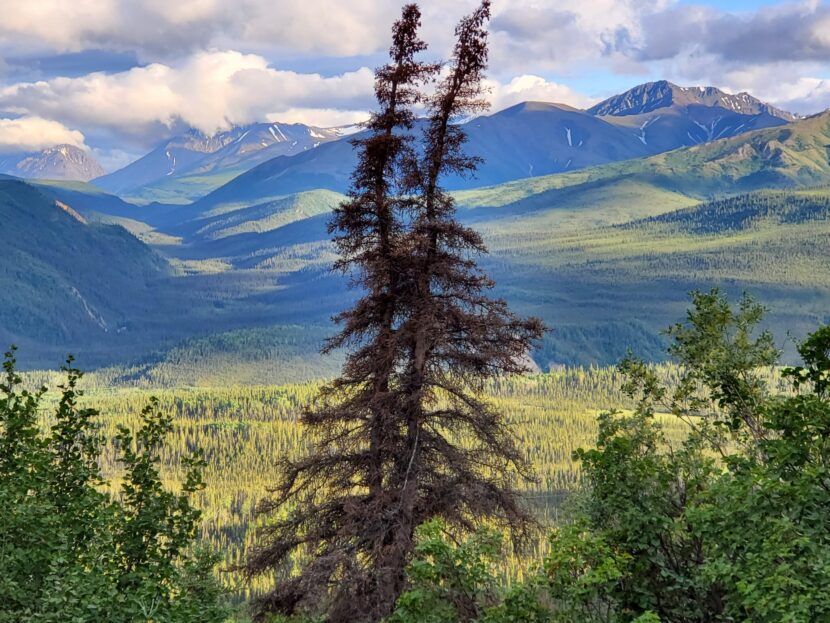
A spruce, with rust-red coloring that is the usual result of beetle infestation, is seen on July 7 on the Mount Healy Overlook Trail in the front country of Denali National Park and Preserve. The beetle infestation that hit the Manatuska-Susitna Borough hard starting in about 2016 has spread north and reached the national park. (Photo by Yereth Rosen/Alaska Beacon)
Along with the tourist crowds that are flocking to Denali National Park and Preserve is another arrival: Masses of beetles have burrowed into the park’s spruce trees and begun killing them off.
The aggressive infestation that took hold in the Matanuska-Susitna Borough north of Anchorage in 2016 has now spread north, covering hillsides in the communities outside the park with rust-red dead trees and reaching into park boundaries.
The ferocity and northward spread of that “epic” Mat-Su infestation surprised Glen Holt, a forester with the University of Alaska Fairbanks’ Cooperative Extension Service.
“I didn’t really see this coming. I thought we’d be good for another 50 years because of the previous outbreak in the ’80s and ’90s,” he said, referring to a massive infestation concentrated on the Kenai Peninsula that killed trees over about 3 million acres, according to the U.S. Forest Service.
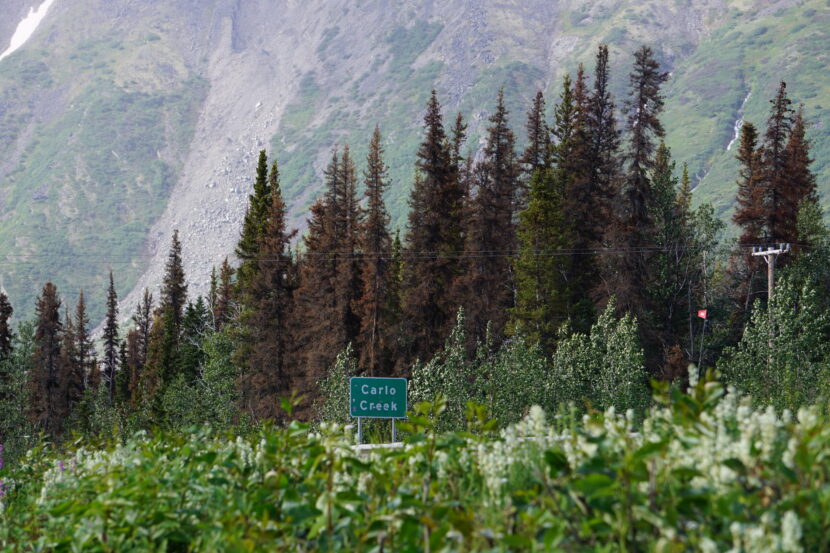
Beetle-killed spruce trees, their needles rust-red, are seen by the side of the road on July 8 at Carlo Creek, a community just outside the main Denali National Park and Preserve entrance. (Photo by Yereth Rosen/Alaska Beacon)
Spruce beetles are native to Alaska, and they can be found throughout the spruce, birch and aspen region known as the boreal forest, albeit in small numbers in the very far north. They bore through the bark of spruce trees, mostly white spruce, to eat and breed in the soft tissue underneath. Since that soft tissue is critical to the trees’ survival, the presence of beetles inevitably kills trees.
But while the beetles are considered to play a role in the boreal forest lifecycle, outbreaks in the modern era have been different than those in the past.
The 1990s epidemic killed trees in 40% more territory than was affected in all the Alaska infestations over the prior 70 years combined, according to scientists from the Forest Service, U.S. Fish and Wildlife Service and Alaska Department of Natural Resources. The infestation spreading into the Denali area is of a scope rarely observed that far north in the past, according to park scientists.
In the more populated and developed Southcentral Alaska regions where beetles have taken hold, residents regularly cut down infested trees on their properties and take precautions to prevent new infestations, including applications of insecticide. The state Division of Forestry and other agencies and organizations have offered numerous public-education opportunities to help residents avoid accumulations of flammable, beetle-killed timber and other pitfalls.
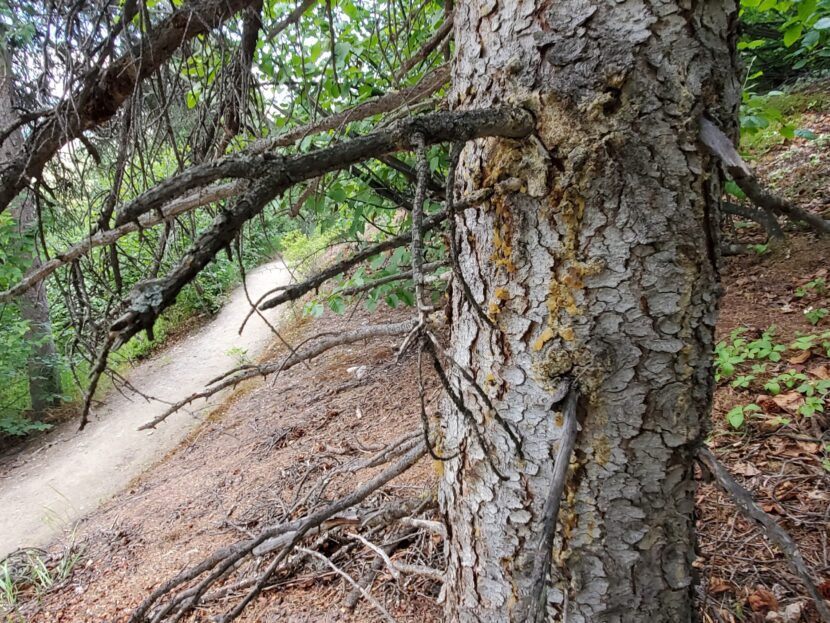
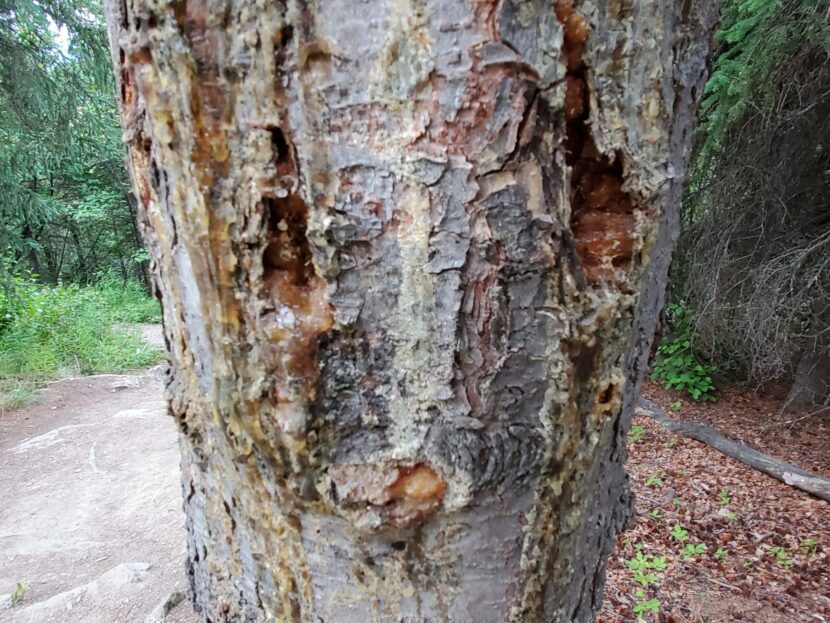
Beetle-bored holes and dried drippings of sap that was produced in defense are seen on July 7 on an infested tree along the Mount Healy Overlook Trail in the front country of Denali National Park and Preserve. (Photo by Yereth Rosen/Alaska Beacon)
In Denali, where the national park mission of preserving nature prevails, there is a different approach: Managers are not interfering with the beetles’ march northward.
“The Park Service is not really in the business of messing with the native processes. In fact you can say that’s what we’re trying to preserve,” said Sarah Stehn, a park fire ecologist.
Letting nature, and the beetles, take their course
Rather than try to hold back the wave, Denali scientists and managers intend to watch closely as it spreads over the next several years. The park has established a multitude of study plots throughout the park that will be monitored, and comparisons will be made with what has happened farther south, said Carl Roland, a Denali plant ecologist.
“We want to see not just the pattern of mortality but also how does the forest respond after the wave has broken? In the long term, decades out, what comes back? Is the nature of the forest that comes back the same or different?” Roland said.
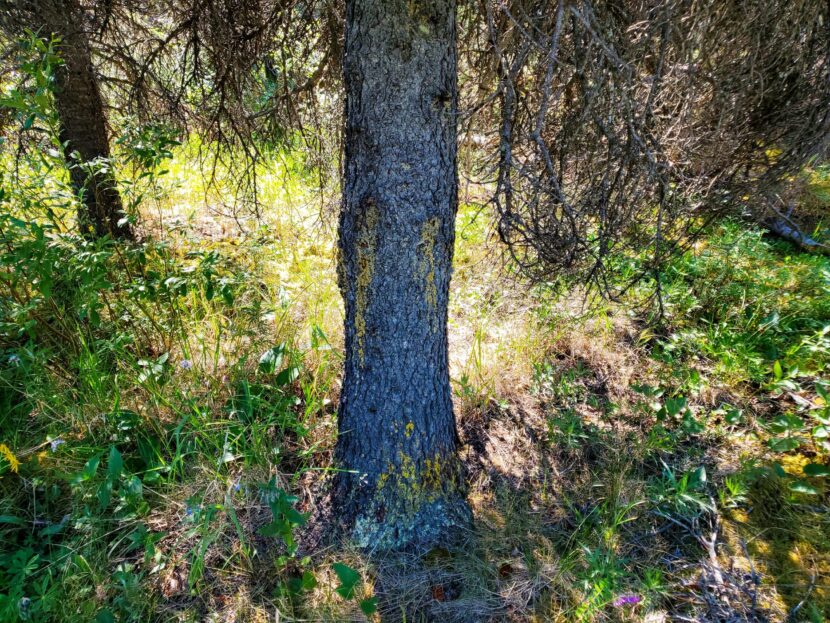
A spruce tree with boreholes and sap drippings that are signs of beetle infestations is seen on July 8 along the east end of the Savage Alpine Trail in Denali National Park. (Photo by Yereth Rosen/Alaska Beacon)
Another question is how far north the wave will reach. The nature of the forest on the north side of the Alaska Range, which bisects Denali National Park, could moderate the spread, Roland said. Trees on the south side of the range grow bigger and faster and therefore can harbor more beetles than the slower-growing northern trees, he said.
As to whether the northward beetle spread is a good or bad thing, park scientists are, to some degree, withholding judgment.
“Whether it’s objectively a problem depends on whether you’re a spruce beetle or not, I suppose,” Roland said.
It can also depend on what kind of boreal animal you are. For squirrels, which depend on spruce for their food, the infestations could mean trouble. For one type of beetle-eating bird, the American three-toed woodpecker, the infestations could mean a rich bounty. The park scientists plan to monitor squirrels and woodpeckers to see how each species fares over the coming years, said Roland.
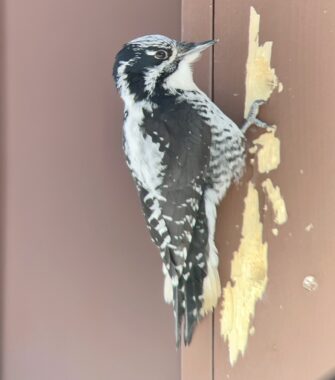
A female three-toed American woodpecker is seen in this undated photo. For these woodpeckers, which eat spruce beetles, the infestation into the Denali area offers an opportunity to feast. (Photo by Sharon Stiteler/National Park Service)
For people visiting the park and those living in the communities near it, the sweep of beetle infestations and dead trees can be concerning, Roland and Stehn said. Park rangers are gearing up to answer more visitor questions over the next few years as the infestation progresses.
“You know, people who live in the forest are pretty affected when it dies around them,” Roland said.
A more tangible concern for park managers are what Roland called “hazard trees” that are at risk of toppling over on heavily used areas like campsites. So far, at least one of those trees has been cut down, said Sharon Stiteler, the park’s public information officer.
Another looming issue is wildfire risk, particularly in the heavily used front country, where there are big crowds and important structures. Denali had been working on improving fire safety there, ensuring that there are routes in and out for visitors and firefighters if the need arises, and the beetles’ arrival does not change that, Stehn said.
Park officials are taking lessons from the high-profile fires that burned in beetle-infested areas in past years on the Kenai Peninsula and in the Matanuska-Susitna Borough, she said.
Warmer summers or less-cold winters?
Exactly why this latest infestation is spreading, not only north to Denali but also south in another wave on the peninsula, is a subject of continued study.
On the peninsula and elsewhere in Southcentral Alaska, past years’ explosions of spruce beetles have been linked to warming summers. With higher summer temperatures, beetles burrowing into trees were able to shorten their life cycles from two years to one, thus doubling their reproductive ability, according to research led by Ed Berg, a now-retired U.S. Fish and Wildlife Service ecologist who witnessed the 1990s infestation at close range from his base in the Kenai National Wildlife Refuge.
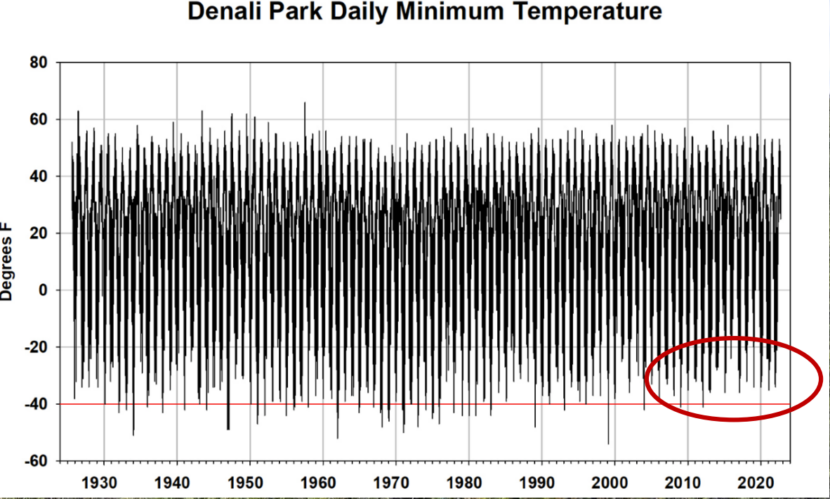
But in Denali and elsewhere in Interior Alaska, seasons are more extreme. The summer heat that seems extraordinary in the coastal Kenai Peninsula is common in the Interior regions of the state. Rather than summer changes, it appears that changes in winter are the key factor in the beetle expansion. Winters are no longer cold enough to kill off nesting larvae; long-term records at Denali’s headquarters show that frequency of ultra-cold winter days has diminished notably over past decades, a sign of climate change. There has been no minus-40-degree reading there since 2012, though such readings were once considered normal.
The record of temperatures at the Denali National Park and Preserve headquarters shows that minus-40 degree readings, once normal, have not occurred since 2012. (Graph by Ed Berg and provided by National Park Service)
Nonetheless, Roland said, the beetles’ northward creep in recent years over the broad, higher-elevation area known as Broad Pass was a bit of a surprise to him.
“I basically didn’t expect them to really come over Broad Pass so much. I thought it would slow down,” he said. “I thought it would be too cool up there in the summer, so I was wrong about that.”
Jason Moan, the forest health program manager for the Alaska Division of Forestry, has tracked the beetles for several years. He noted that their relationship to temperature and climate change is multifaceted, complex and sometimes hyper-localized.
Beetle-bored holes and dried drippings of sap that was produced in defense are seen on July 7 on an infested tree along the Mount Healy Overlook Trail in the front country of Denali National Park and Preserve. (Photo by Yereth Rosen/Alaska Beacon)
“Even in a single tree, you can have some that are developing in two years and some that are developing in one year,” he said. Differences can depend on which side of the tree the beetles have settled, he said.
Snow levels can play a role, with snow abundance insulating trees, holding in enough warmth to let beetles survive the winters, and snow scarcity leaving tree trunks exposed to cold air, potentially killing off overwintering beetles, he said. Availability of water can have an effect too, with drought-stricken trees struggling more, he said.
In general, the farther north habitats have enough cold winter temperatures to keep beetle populations low, Moan said. But the characteristics of the beetles now in Denali National Park, including their reproductive cycles and winter durability, have yet to be determined, he said.
Outside of park boundaries, natural resource managers, experts and property owners have been taking aggressive steps to respond to the latest spread.
Beetle-killed trees, their needles turned rust red, are seen on July 8 spread along the Broad Pass area south of the Denali National Park entrance. (Photo by Yereth Rosen/Alaska Beacon)
A key goal is protection from wildfires that can sweep in when infested trees are in their most flammable state – dead but with rust-red needles and resin still intact.
Human interventions encouraged, but they have practical limits
For decades, the Division of Forestry and other agencies have been urging property owners to establish precautionary “defensible space” by removing infested trees that are close to homes and buildings.
“The time to do that is not when you see a large cloud of smoke. The time to do that is before then,” Holt, the UAF Extension Service forester, said in a public workshop held in Palmer on July 19.
One state program that could help address the beetle kill attempt is the pending carbon-credit system to be created under a newly signed bill passed by the Alaska Legislature. The bill, a big priority for Gov. Mike Dunleavy, authorizes a system of carbon-trading credits for preservation of Alaska forest tracts. Through that program, there could be incentives to log infested areas and clear the way for healthier and potentially less burn-prone trees, some bill supporters said.
John Boyle, commissioner of the Department of Natural Resources, made that specific pitch last spring. Replacing dying or dead trees with new trees will result in more carbon absorption by the forests, Boyle said in a brief interview in the Capitol hallway immediately after the Alaska Senate approved the bill.
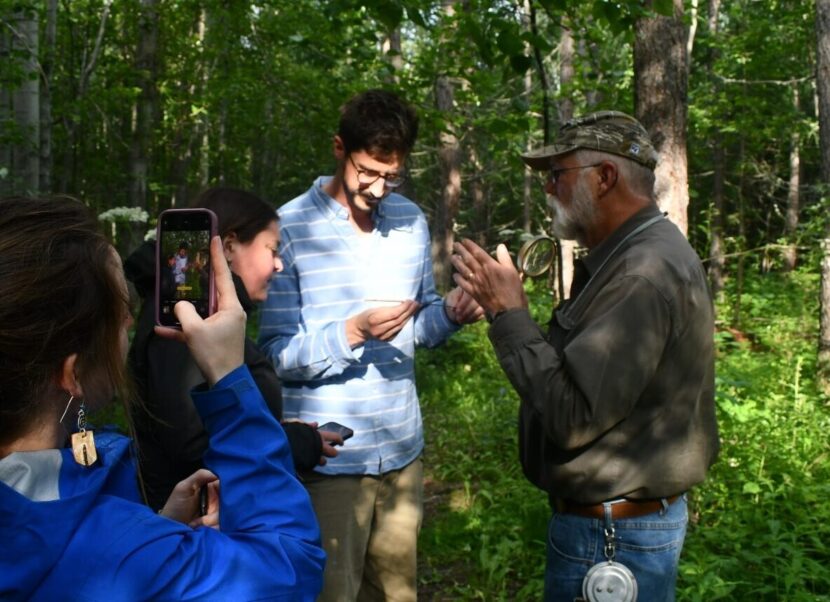
Glen Holt, a forester with the University of Alaska Fairbanks Cooperative Extension Service, guides a walk through a section of forest in Palmer on July 18. (Photo by Teigan Akagi/Alaska Beacon)
The beetles play a role in the forest ecosystem, but “to the extent that we can manage around that and keep it from laying waste to hundreds of thousands of additional acres of land, we’ll certainly take a hard look at that and see what we can do to be more proactive on that front,” Boyle said.
Outside of the carbon-credit program, which has yet to be set up, the department’s Division of Forestry is planning a series of timber sales that would sell off beetle-killed spruce wood from over 1,271 acres in the Matanuska-Susitna Borough. Key purposes of the planned sales, to run through 2026, include efforts to salvage economic benefits from the dead spruce “before it loses substantial value” and to reduce wildfire risks to nearby communities, according to the division analysis issued on July 14. It is possible that no one will submit competitive bids, leaving the option of selling directly, without any bidding, to any future interested parties, the division said in its public notice of the sales.
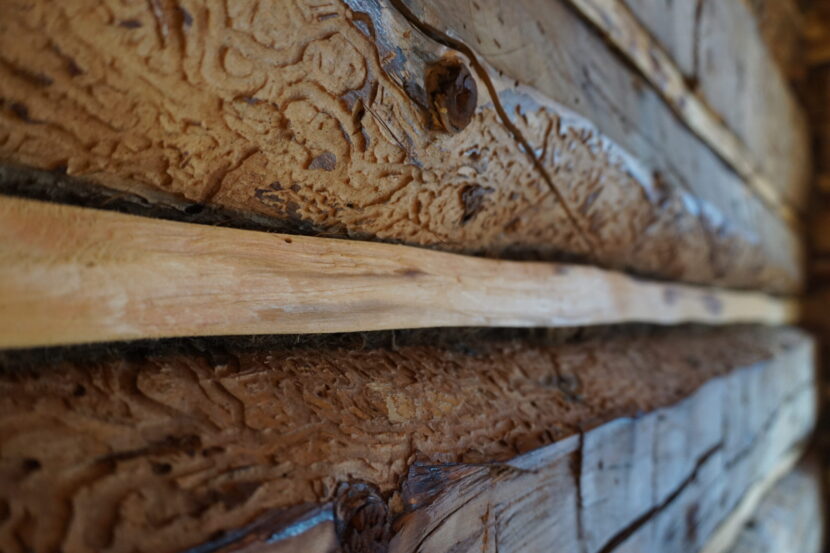
Even in Denali, where the strategy is heavy on science and research and extremely light on human action, there is evidence of past salvage of beetle-killed trees. A cabin built by in the 1920s by the park’s first superintendent, Harry Karstens, which has since been relocated to the park headquarters area, was constructed from infested wood, as is evidenced by the curling burrows dug by beetles beneath the bark a century ago.
The interior of a cabin built in the 1920s by Harry Karstens, the first superintendent of what was then known as Mount McKinley National Park, is seen on May 5. The wood used in the cabin, eventually relocated to the park headquarters, shows the grooves made by spruce beetles that burrowed beneath tree bark a century ago. (Photo by Yereth Rosen/Alaska Beacon)
No matter how hard and creatively people work, however, the beetles will continue to sweep through boreal Alaska, Holt said. Though Alaskans can clean up the fringes by removing some infested trees, there will be changes in the vast forest that human intervention cannot stop, he said.
“There’s a lot of spruce trees that nobody’s ever going to get to,” he said.
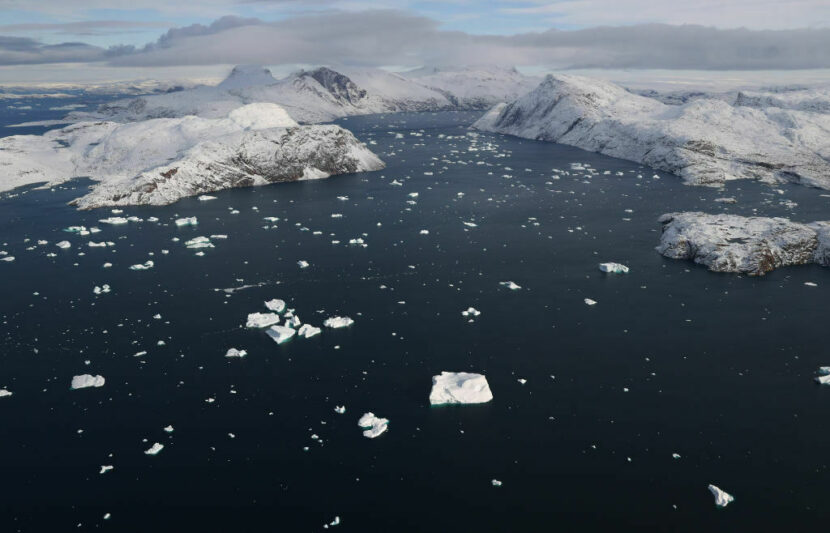
As the planet heats up, Greenland’s ice sheet is pouring more meltwater into the Atlantic. Scientists are tracking whether this could cause a collapse in a crucial ocean current. (Mario Tama/Getty Images)
Deep in the Atlantic Ocean, there’s a massive current the size of 8,000 Mississippi Rivers. Its role in the Earth’s climate is so powerful that it determines weather from the equator to Europe, crop production in Africa and sea level rise on the East Coast.
Scientists say there’s a risk this vital current could shut down as the climate gets hotter, a collapse that could have dire consequences worldwide.
Researchers have been trying to determine when the Atlantic might cross that tipping point. But answering that is no easy task.
Now, a new study finds the collapse of the current, which is known as the Atlantic meridional overturning circulation, or AMOC, could happen far sooner than scientists have previously thought, possibly within a few decades, as a result of human-caused global warming.
“It’s a worrisome result,” says Peter Ditlevsen, professor of climate physics at the University of Copenhagen in Denmark and an author of the study. “It calls for quite immediate actions. We need to reduce emissions. We need more brakes on the train.”
Other researchers caution that the timeline of such a collapse — or even whether the AMOC will collapse at all — remains unclear, given the sheer complexity of understanding an ocean system that stretches thousands of miles. Previous assessments have suggested a collapse is unlikely this century.
The new study adds to a growing body of research suggesting crucial tipping points in the climate system are incredibly hard to predict, and that humans are changing the fundamental processes of the Earth faster than we can understand them. Given the potential for catastrophic impacts, scientists say further research to understand the AMOC is more urgent than ever.
“The AMOC is a bedrock of our climate system,” says Nicholas Foukal, an assistant scientist at the Woods Hole Oceanographic Institution who was not involved in the study. “It redistributes heat globally and it’s something that we just take for granted.”
A conveyor belt for heat
When it comes to weather, Europe has a lot to thank the AMOC for. Cities like London and Paris are warmer than their counterparts at similar latitudes in North America.
“In Scandinavia, we have a sort of pleasant, mild climate,” Ditlevsen says. “And if you compare that with the U.S., we are at the latitude of Alaska, which is much colder than Scandinavia.”
Milder winters in Europe are largely thanks to an influx of heat from the AMOC. The current carries vast amounts of warm water from the equator, which travels north up the East Coast of the U.S. before crossing to Europe. That’s where the water cools off, releasing heat into the atmosphere.
The cold, salty water is denser and heavier, causing it to sink near Greenland. Like a massive ocean conveyor belt, the current then returns in the direction it came from, flowing south along the ocean floor.
Scientists know this conveyor belt has collapsed in the past. Around 12,000 years ago, temperatures around Greenland suddenly dropped by about 18 degrees Fahrenheit. That shift is attributed to a sudden shutdown of the AMOC — and demonstrates the potential impact of such a climate tipping point.
“A tipping point is a strong result to a small change,” Ditlevsen says. “It’s when you’re pushed over the cliff. When you reach the cliff, you drop.”
Looking for the tipping point
To determine how close that tipping point might be, Ditlevsen analyzed ocean temperature records near Greenland over the past 150 years and ran a statistical analysis to track the fluctuations in temperature. He and his co-author found increasing variability in temperatures, which they say is a sign the AMOC is weakening. Based on their analysis, they estimate the AMOC could collapse between 2025 and 2095. That’s decades earlier than other studies have found.
While researchers disagree on the timing of such a collapse, there is broad consensus on the potential consequences. A collapse in the AMOC could have ripple effects around the planet. Temperatures in Europe could fall, while heat in the tropics would rise, exacerbating climate change that’s already occurring.
Rainfall could decrease across the Sahel region of Africa, threatening crop production for millions of people. The summer monsoon could weaken across Asia and sea levels could rise even faster in the Eastern U.S. Scientists have already found that subtle shifts in Atlantic currents can have serious effects on marine life, like threatening endangered North Atlantic right whales.
“It’s going to affect agriculture,” Foukal says. “It’s going to affect disease, especially in the equatorial region. It’s going to affect mass migration.”
When is still a big question
Still, a midcentury collapse is at odds with what other research studies have found. A report from the Intergovernmental Panel on Climate Change found the AMOC is unlikely to collapse this century.
“Whether it will collapse is still a question,” Foukal says. “I think that there is still quite a bit of uncertainty.”
Foukal says this most recent study relies on temperature records from a small part of the system and doesn’t simulate what would happen to the entire current itself. He says it’s also crucial to understand the cause of a collapse to estimate the timing — something Ditlevsen’s study didn’t address.
The last time the AMOC shut down, the Earth was coming out of an ice age. Scientists believe a vast amount of fresh water from melting glaciers poured into the Atlantic, interfering with the conveyor belt. Fresh water is lighter than salt water and can inhibit the sinking motion that powers the entire current.
A similar thing could happen again, as humans continue to heat the atmosphere by burning fossil fuels. Ice in the Arctic and Greenland’s ice sheets are melting at an increasing pace, also adding fresh water to the Atlantic. But Foukal says researchers are still trying to determine whether that would be enough to cause a complete collapse.
What’s more likely, he says, is that the AMOC could weaken this century. That could still cause some of the same serious impacts as a collapse, though to a lesser extent. Some studies have shown a weakening is already happening, but other researchers say that given the normal fluctuations in the current, it will take more time to make that call.
Direct measurements of the Atlantic circulation have only been made since 2004. Given the depths and distances the AMOC covers, it’s challenging to keep tabs on it. But with the potential for such widespread impacts, scientific researchers say further research is more urgent than ever — as well as rapid action to limit how much the planet warms.
Copyright 2023 NPR. To see more, visit https://www.npr.org.
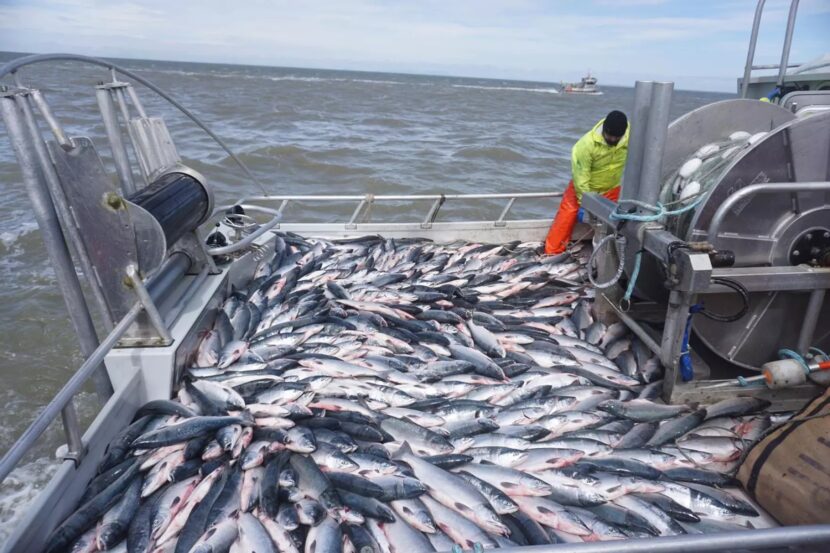
Salmon spread across the deck of a fishing vessel during last summer’s record season in Bristol Bay. (Hope McKenney/KUCB)
University of Washington ecologist Daniel Schindler is at the mouth of a salmon stream at Lake Nerka, in Southwest Alaska. It’s roiling with fish.
“They sort of pile up in balls of thousands of fish for a couple of weeks. I think that’s when they’re doing their final maturation,” he said of the sockeye mob. “They’re jostling with each other and splashing, occasionally jumping.”
Schindler is in his 27th year of field work, studying Bristol Bay sockeye. This year is on par with the sockeye abundance Bristol Bay has seen in the last decade, he said, which is far higher than the historical average.
The unlikely hero of this story of plenty: climate change.
“We tend to think of climate warming is bad news for wild animals,” he said. “But for sockeye, Bristol Bay warming has been good news.”
For other salmon, climate change is a villain.
Chinook — or king — salmon are in terrible decline all over the state, and especially dire on the Yukon River. Meanwhile, sockeye — or reds — are having another banner year in Bristol Bay, and everywhere. Scientists say they don’t know exactly why one salmon species is doing so well while the other is in crisis, but some clues are coming into sharper focus.
One key difference, Schindler said, is what kind of river habit each species needs.
Sockeye use lakes as their nurseries. Since the 1980s the water in those lakes has warmed significantly. The warmth stimulates plankton to reproduce more, and young sockeye eat plankton. Fifty years ago, Schindler said, a lot of sockeye spent two years in Lake Nerka before heading out to sea.
“And now they grow so fast that nearly all of them leave after a single year in freshwater, which is a reflection of the fact that the freshwater systems have become more productive,” he said.
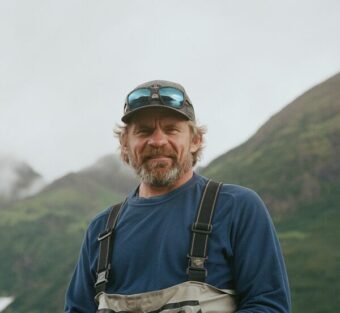
University of Washington professor Daniel Schindler is in his 27th summer of field work in the Bristol Bay watershed. (University of Washington)
The science is a little murkier about what happens in the ocean, but Schindler said northern parts of the coastal ocean have been especially good for Alaska sockeye. There’s apparently plenty for them to eat. and their predators seem to be elsewhere.
“So the Nushagak, the Igushik, even the Kuskokwim River, which never really had that many sockeye in it — all those populations have really exploded in the last decade,” he said.
The chinook aren’t so lucky. Changes in the ocean and the rivers have not been kind to kings, especially for those from Alaska’s longest river, the Yukon.
“It’s kind of this perfect storm of bad things happening for those particular chinook stocks,” said Katie Howard, a state fisheries scientist.
Her research shows Yukon chinook who spawn during a warm-water year produce fewer juveniles. The water temperatures in the Yukon sometimes get to 68 degrees now.
“When water temperatures get that high, they just kind of shut down,” she said. “They’re a cold-water fish. They can’t really tolerate those temperatures very well.”
Heat stress is just one factor. Big rainfall can wash eggs from the gravel where female chinooks deposit them. There’s a parasite that leaves Yukon chinook riddled with “pus pockets,” Howard said. And there’s evidence that female chinooks may not be getting enough thiamine from their ocean diet, causing developmental problems in their eggs.
All of these things may stem from climate change, and kings are particularly vulnerable.
“Kings tend to spawn in really big rivers. That’s where the big king populations are,” said Erik Shoen, a fisheries biologist at the University of Alaska Fairbanks. The Yukon, for instance, has all kinds of conditions along its 1,982 miles, but every fish that spawns there has to go through the lower river.
“So if that lower main stem is unfavorable,” he said, “or if the Bering Sea just went through a heatwave and they have to make it into the lower main stem with less gas in the tank than they need to swim 1,000 miles plus — they’re in trouble.”
By comparison, the sockeye population of Bristol Bay thrive in the ocean and have multiple shorter rivers to climb, with more cool spots to take refuge in.
The Kuskokwim, like the Yukon, is a big river enduring a multi-year crash of chinook. Chum salmon are also in crisis. But there are more sockeye returning to it than ever before.
Near the peak of the Kuskokwim run “there will be anywhere from 20,000 to 40,000 sockeye salmon passing the sonar in one day,” said Kevin Whitworth, executive director of the Kuskokwim River Inter-Tribal Fish Commission. “That’s a lot of protein.”
His organization is encouraging subsistence fishermen to take up dipnets to scoop up sockeye without hurting Kuskokwim chinook. The giant nets — sometimes 5 feet in diameter — are not a traditional tool for the region.
As part of the campaign, the fish commission posted a video on Facebook featuring testimonials from tribal elders.
“I wasn’t really expecting to get this much from dipping on the Kuskokwim,” said James Nicori, of Kwethluk. “Something new for me. And it works good.”
His brother-in-law, Martin Andrew, also from Kwethluk, said he overcame his skepticism by landing 20 sockeye.
Unfortunately, though, people on rivers like the Kuskokwim can’t just swap one salmon species for another. There still aren’t enough reds returning to replace the missing stocks on the Yukon and Kuskokwim.
And biologists say there never will be. The Kuskokwim and Yukon just don’t have enough suitable sockeye habitat to produce fish equal to the mass of salmon that used to return to them.
But with chinook too few to meet the need, sockeye are too plentiful to ignore.
Close
Update notification options
Subscribe to notifications
Subscribe
Get notifications about news related to the topics you care about. You can unsubscribe anytime.

9(MDEwMjQ0ODM1MDEzNDk4MTEzNjU3NTRhYg004))