Climate Change

New ‘berry booklets’ for Alaska pickers combine traditional knowledge and science

Cloudberries are the focus of a new booklet out this month that includes information on how climate change is impacting Alaska’s berries statewide. (Emily Schwing/KYUK)

A team of scientists at the University of Alaska Fairbanks just released its first “berry booklet.” It’s part of a larger project that digs into the future of Alaska’s wild berries as the climate warms.

Berries, regardless of species, are a huge part of rural Alaska’s subsistence lifestyle. They are often the only fresh, local fruit available in remote villages. Their value is not lost on the Alaska Climate Science Center’s tribal resilience liaison, Malinda Chase.

“Well, berries mean to me joy,” she said from her home in Fairbanks. Chase grew up between Anvik and Anchorage.

“To see your berry bucket get full, to know that this is part of our beautiful land. It’s food that is delicious, it’s something that we do as families, as communities, as good friends,” Chase said.

A warming climate means where and how people harvest berries is changing. And over the years, communities across Alaska have developed climate change adaptation and mitigation plans.

Two years ago Chase’s colleague, University of Alaska Fairbanks Research Association professor Katie Spellman, started reading them.

“Malinda told me, ‘You go read all the climate adaptation plans and start there, because that’s where the important research needs to be,’” Spellman said.

Among dozens of plans she read, Chase said that she only found two references to scientific research specific to berries.

“It made it really clear that the science on berries, which is a topic that Alaskans care a lot about, was not accessible,” Spellman said.

“Scientific papers are really hard to read if you’re not trained to read them,” said Christa Mulder, a plant ecologist at UAF. “They’re really dense. They’re full of difficult words, so what we decided to do is essentially a translation project.”

Mulder said that the team set out to learn everything they could about how climate change could affect the plants people care about.

Mulder, Spellman, and Chase held three listening sessions with berry pickers representing 50 communities. And this month, they’ve released the first in a series of six booklets. The aim is to blend scientific research with traditional knowledge and current observations on how climate change is altering where and how berries grow in Alaska. Chase said that it’s a good start.

“You know, we have so many beliefs and traditions around berries, and they’re so central to many of our family time together, our time on the land, and that is significant,” Chase said.

The first berry booklet, which is focused on cloudberries, was released earlier this month. Also known as akpiqs in Iñupiaq and atsalugpiaq in Yugtun, cloudberries are soft, round bright orange berries that grow on Alaska’s tundra. Many people also call them “salmonberries.”

Spellman said that they’re fascinating.

“It has male and female flowers, and so if the weather during pollination time is off, then it’s gonna really affect how many fruits, how many berries, are produced in that year,” Spellman said. “I just think it’s a really beautiful and fragile berry that really relies on those pollinators.”

Those pollinators can’t fly in colder temperatures, according to the cloudberry booklet. But a warmer climate may help pollinators.

Mulder said that the team worked hard to make sure to include the potential benefits of a changing climate. She said that the booklets include advice on how people who rely on berries can help them thrive.

“So very simple pruning, for example, of blueberries can give a gazillion blueberries on a single plant. And that’s not a solution for everything, of course, but if you have Elders who can’t go very far, having patches of forest where sort of cultivate, semi-cultivate, have a bit of a food forest could be a really good thing,” Mulder said.

Five other booklets are due out in the coming months. Those will focus on blueberries; lingonberries, also known as low-bush cranberries; crowberries, also known as blackberries; and red currants. They’ve already garnered so much interest that the team is looking at ways to combine all the booklets into one main resource.

Biden is unveiling the American Climate Corps, a program with echoes of the New Deal

President Biden promised to create the Climate Corps during his first week in office. It’s a program meant to appeal to young climate activists. (Jim Watson/AFP via Getty Images)

The White House on Wednesday unveiled a new climate jobs training program that it says could put 20,000 people to work in its first year on projects like restoring land, improving communities’ resilience to natural disasters and deploying clean energy.

The American Climate Corps is modeled after a program that put millions to work during the Great Depression. President Biden’s climate policy adviser Ali Zaidi told reporters that the program has broader goals beyond addressing the climate crisis.

“We’re opening up pathways to good-paying careers, lifetimes of being involved in the work of making our communities more fair, more sustainable, more resilient,” Zaidi said.

The program will pay participants, and most positions will not require previous experience. The administration is also proposing new regulations aimed at making it easier for participants to enter the federal public service after the program.

The announcement has been in the works for some time

Biden first called for the government to find a way to establish a “civilian climate corps” in an executive order during his first week in office. The president said that he hoped the corps would “mobilize the next generation of conservation and resilience workers and maximize the creation of accessible training opportunities and good jobs.”

The idea of a climate corps began with progressive environmental activist groups, including the youth-led Sunrise Movement.

“We need millions of people, especially young people, employed to do the essential work of averting climate catastrophe and building a fair and equitable new economy,” said Varshini Prakash, the group’s executive director, who has advised the White House on climate issues.

“I am thrilled to say that the White House has been responsive to our generation’s demand for a Climate Corps and that President Biden acknowledges that this is just the beginning of building the climate workforce of the future,” Prakash told reporters.

Climate activists hold a demonstration to urge President Biden to reject the Willow project on Nov. 17, 2022. (Jemal Countess/Getty Images for Sunrise AU)

Biden has been criticized by young climate activists

When he took office, Biden named tackling climate change as one of his top four priorities, and announced a goal of slashing U.S. greenhouse gas emissions to half of 2005 levels by the end of the decade.

His 2022 Inflation Reduction Act — some $369 billion in climate incentives and spending — is expected to get the country close to that goal.

But Biden has faced intense criticism from some factions of the environmental movement, particularly after he approved a large-scale drilling project known as Willow in northern Alaska. That decision directly contradicted a campaign pledge to bar all new drilling on federal lands, and polling showed a decline in his approval ratings on climate.

Since then, Biden been barred federal drilling on millions of acres of federal property, a measure aimed at wooing back the young, climate-conscious voters who played an important role in his electoral coalition.

The Climate Corps is more modest than some had hoped

Democratic lawmakers including Rep. Alexandria Ocasio-Cortez, D-N.Y., and Sen. Ed Markey, D-M.A., had pushed for more funding for the climate corps program, but that did not transpire, meaning the program is likely to be smaller in scope than early proposals.

It’s also much smaller than its predecessor: the Civilian Conservation Corps, a New Deal-era program that ran for ten years and employed millions restoring public lands and building infrastructure for the country’s national parks.

There is another key difference, too. While the Conservation Corps primarily employed young, white men, the White House says that the American Climate Corps is designed to attract participants from disadvantaged communities disproportionately impacted by the changing climate.

Copyright 2023 NPR. To see more, visit https://www.npr.org.

Juneau Assembly considers repealing hazard maps and development restrictions in place since 1980s

Residents examine the aftermath of a landslide on Gastineau Avenue in Juneau on Sept. 27, 2022. (Photo by Paige Sparks/KTOO)

The Juneau Assembly may repeal existing hazard maps and development restrictions that have been in place since the 1980s as the debate about how the city should address landslide and avalanche dangers in downtown Juneau continues. 

“Everybody seems to agree that those current maps are not as good as they should be,” said Deputy Mayor Maria Gladziszewski. “The question is — what responsibility does CBJ have to regulate development in those places that are hazards?”

The new proposal is a departure from previous attempts to adopt new, more precise hazard maps that would expand land use restrictions to more downtown homes. Instead, the proposal presented in Monday night’s committee of the whole meeting would abandon existing land use restrictions for hazard zones altogether. 

The committee will continue the discussion in their next meeting. But some members of the Assembly, including Michelle Hale, objected to the proposal, citing the need for more expert testimony to understand the complexity of avalanche and landslide zones. 

“It feels like we’re flailing around, trying to do something,” Hale said. “But we don’t understand this very well.”

Efforts to update hazard zones in downtown Juneau have stalled since the city commissioned new hazard maps — made with more advanced science — more than two years ago. The new maps, which designate more than twice as many properties in severe hazard zones than the existing maps, have caused widespread concern from both policymakers and homeowners.

The new maps are different because they treat landslide and avalanche zones separately. The old maps lump them together, even though they’re distinct hazards with different risk factors.

The severe avalanche areas are quite similar between the maps, and the committee’s proposal does leave room for reintroducing development restrictions on avalanche zones.

The bigger challenge is figuring out what to do about landslides. The new maps added or upgraded some neighborhoods to a severe hazard designation because of their landslide potential. That’s led many homeowners to oppose the adoption of the new maps and the accompanying ordinance, believing it might restrict their ability to get loans or insurance on their property in the future.

Gladziszewski, who authored the new proposal, said she has not formally consulted with lending agencies or insurance agents to corroborate those concerns.

Member Wade Bryson expressed his support for repealing existing development restrictions, saying that the city should leave it up to developers and property owners to avoid hazard zones.

“The concern that we’ll have a whole bunch of people building in hazard zones because we don’t have a hazard or an avalanche zone labeled, I think that would be mistaken thinking,” Bryson said. 

The proposal attempts to respond to public testimony by not adopting new landslide maps. 

But it would adopt the new avalanche maps — which are similar to the old ones — and enact an updated land use code for avalanche zones only. The details of that updated code have not yet been outlined. 

Some members of the committee expressed hesitation about ignoring landslide hazards.

“The public does not yet know how serious the risk of landslides are in Juneau,” said member Christine Woll. “And that they’re getting worse with climate change.”

According to the Juneau Climate Change Report, landslides are expected to increase as climate change brings more extreme rainstorms to Southeast Alaska.  

One of Juneau’s worst disasters was a 1936 landslide on South Franklin Street that killed 15 people.

The new proposal will be the basis for a draft land use ordinance, which will be discussed in a future committee of the whole meeting. 

Families affected by Juneau’s glacial outburst flood rebuild, or reassess completely, as recovery efforts drag on

Amy Ballard stands on the balcony of her condo, overlooking Mendenhall River. Ballard hasn’t felt safe in her unit since the glacial outburst flood on August 5, 2023 forced her to evacuate. (Photo by Anna Canny/KTOO)

The sound of the nearby Mendenhall River filled the room as Amy Ballard sat down in her condo for the first time since evacuating last month. 

Six weeks ago, Juneau’s record breaking glacial outburst flood threatened to send her home into the river, along with the rest of her condo building on Riverside Drive. But on the inside, Ballard’s unit still looked untouched and cozy. 

Amy Ballard’s twins on the day of the glacial outburst flood. (Photo courtesy of Amy Ballard)

There was a clutter of high chairs, baby books and a small pile of unfolded onesies in an armchair by the front hall. The wall was decorated with photos from her trips to Jamaica, Monaco and France over the years. But this condo had always been her home base. 

“I’ve loved this place,” Ballard said. “And I’m saying this in past tense. Because it feels weird now.”

Ballard can’t bring herself to sleep here. For her, and many who were affected by the flood, the fear feels fresh

And six weeks out, recovery is just beginning. Some homeowners are figuring out how to rebuild. Others, who don’t have a home to return to, are reassessing completely.

Ballard moved into her unit five years ago as a first-time homeowner.

“It was a big, big deal for me to own my own place,” Ballard said.

She had hoped the place would be home to her growing family. On the day of the flood, she celebrated her twins turning seven months old.

But later that night, she had just 15 minutes to grab the twins and some essentials as the enormous force of the water rapidly eroded the riverbank beneath part of her building. 

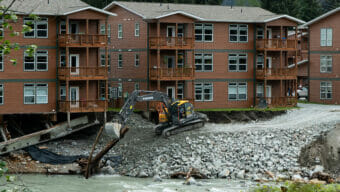
The building is still standing, but what used to be a huge backyard is now just a strip of grass — about five feet wide — with yellow caution tape propped up along the edge. 

The day after the flood, Ballard’s building and the neighboring building were condemned by the city. Her building was then quickly deemed safe again, after rock fill was installed to stabilize the riverbank. Though many of her neighbors have moved back in, Ballard has been hesitant.

The enormous force of the flooded Mendenhall River sloughed away the land under Amy Ballard’s condo building. The building has been deemed safe by the city, but Ballard is hesitant to move back in (Photo by Anna Canny/KTOO)

For now, she and the babies are keeping cramped quarters with her parents, who live in a condo across the parking lot. 

“Life feels transient and not settled,” Ballard said. “And I don’t think it’s gonna feel settled until I have a new place.”

But she’s in financial limbo. Like many of her neighbors, Ballard was denied a payout from her insurance company. State disaster assistance may provide some money, but she hasn’t heard any official word on her application since she submitted it last month. 

Meanwhile, she’s still paying a mortgage, property taxes and homeowner association dues for a home she no longer feels safe in. 

“I don’t have money to put down in another place,” Ballard said. “I mean, most people do not have money to just dump into fixing their places after a natural disaster.” 

Ballard, along with every member of the Riverside Condominiums Homeowners Association, is also on the hook for $20,000 to continue repairs on the still-condemned building and to armor the riverbank. The goal is to fortify the property against future glacial outburst flooding. 

Ballard said it won’t be enough to keep her there. When she bought her third floor unit, with a balcony overlooking the river, it felt too good to be true. But when the construction work is done, she hopes to sell it and move on. 

“There’s just too much trauma for me,” Ballard said. “I think my perception has changed. You can’t fight nature. Nature’s gonna win. Right?”

Rebuilding land by hand

All along the Mendenhall River, restoration work has begun.  A crew of river rafters cleared downed trees from the water below Ballard’s balcony. And on the opposite bank, a truck dumped massive boulders on the river’s edge.

Upstream, a long stretch of the riverbank in Joe Pagenkopf’s neighborhood is now lined with rip rap. On Pagenkopf’s River Road property, gravel and 150 dump trucks-worth of sand are piled up around the foundation of his house. 

Property owners have already installed tons of rock to fortify the bank along River Road, just downstream from Mendenhall River Bridge. (Photo by Anna Canny/KTOO)

Pagenkopf had just finished paying off the mortgage when the flood eroded away his back yard.

“We had all these plans to landscape. And I’m glad we didn’t,” Pagenkopf said. “We’re giving our lawnmower away. No more lawn to mow.”

As the water subsided, about a third of the house was left hanging off the bank. He and his wife considered it a total loss until a contractor told them it might be salvageable. They started the work right away.

Joe Pagenkopf, 64, spend about four hours a day packing sand to rebuild the land under his house. (Photo by Anna Canny/KTOO)

“I’m a task-oriented person. So I focused on the task,” Pagenkopf. “I don’t think I’ve taken more than about a 24-hour period off, working on the house. And it’s been mind-bogglingly hard.”

Contractors put in a new wall and a set of pilings, which stabilized the building enough for the Pagenkopfs to move back in. But the bank is only partially restored. It sits much lower than it used to, and their house is still suspended. 

So Pagenkopf has been rebuilding the land by hand. He crawls under the house each day with a small shovel. 

“This is my sandbox,” he said, while hunched over under the house in a space that’s less than four feet tall. One side is filled with a firm mound of sand that Pagenkopf just finished building.

“Bit by bit, I’m shoveling over there and packing it in and then just moving my way this way.”

For hours each day, Pagenkopf kneels under the house, shoveling sand, wetting it down and packing it tight to fill in the space. It’s grueling work for the 64 year old.

“It takes me a while to stand up straight,” he said. “I’m vaguely hominid when I come out.”

Even though he’s taking on much of the work himself, the cost for contractors and materials is staggering. Pagenkopf had to cash in on his retirement savings to foot the bill, which he estimates will come out to around $150,000.

The restoration is far from over. It’ll take at least two more weeks to finish the fill. And Pagenkopf said the real test will come with next year’s glacial outburst flood. 

“The one thing this jökulhlaup proved is that there is no complete,” he said. “There is no certainty.”

But for now, Pagenkopf said he’s grateful that he was able to save his home.

Joe Pagenkopf’s yard is filled with sand that he’s using to rebuild the land he lost in the glacial outburst flood on August 5, 2023. (Photo by Anna Canny/KTOO)

A waiting game

For Elizabeth Kent, there’s nothing left to save. Her home on Riverside Drive is the one that thousands saw collapsing into the river in a viral video.

Kent wasn’t home when the house went in. She’d been renting out the house, and those renters were out of town when it came down.

Meanwhile, Kent and her husband were thousands of miles away. She’s been working as a teacher in Nicaragua, on sabbatical from her teaching job in Juneau. Her coworkers saw the video on Nicaraguan news channels.

The flood destroyed the house and everything in it. For Kent, the days immediately after were chaotic and filled with grief. 

And it also was very hard to find, like, what you’re even supposed to do,” Kent said. 

Kent and her neighbors along the riverbank helped each other t0 figure out what numbers to call. Kent spent her free time calling her insurance company, her mortgage broker, the city and the state. Many of those calls left her frustrated. 

Elizabeth Kent’s garage still stands on the edge of the riverbank. She and her family lost nearly all of their possessions when their home collapsed into the Mendenhall River on August 5, 2023. (Photo courtesy of Elizabeth Kent)

“I think all of the different agencies I’ve called, probably like half of them, I ended up breaking down crying,” Kent said. “And once you’ve exhausted all the numbers, then you’re in a waiting game.”

Her insurance company has denied her claim, and her mortgage company has not given her any clear answers as she continues to make payments on a house that’s no longer standing. 

There’s also no clarity about how much assistance she’ll get from the state. Kent says several officials have told her to hold out for FEMA, but she says she’s not holding her breath for federal aid. FEMA is facing a funding shortage after devastating disasters like the deadly wildfire in Maui and Hurricane Idalia in Florida last month.

Kent’s been spending a lot of her time thinking about how people in those places will be able to recover.

“It does make me realize that, oh my gosh, all the disasters I’ve ever heard about — this is what happened to those people afterwards,” she said. 

For now, Kent is still in Nicaragua. She’s not yet sure when or how she’ll rebuild back in Juneau.

Four years into the Yukon salmon collapse, an Interior Alaska village wonders if it will ever fish again

An aerial view of Fort Yukon Alaska on Tuesday evening, August 29, 2023. (Matt Faubion/Alaska Public Media)

Without salmon, Gwichyaa Zhee is missing its heart.

“It’s just no good,” said Linda Englishoe, sitting on the sofa in her house not far from the Yukon River. Englishoe is an elder who has lived in the village for her entire life.

There are signs of fall in Englishoe’s house — a pan of apples and cinnamon on the stove, a tray of lowbush cranberries waiting to be processed. Fall usually also means the arrival of chum salmon on their journey upriver, but this year, the run is a fraction of the size it once was.

Without fish, Englishoe said, nothing in the village is the way it’s supposed to be. The smokehouses, normally full of salmon drying for the winter, are empty. Even the smell of town is different.

“It used to smell so good, smelling those fish,” Englishoe said. “Ooh, I used to just sit outside, smelling.”

A picture of the town Fort Yukon.
The town of Fort Yukon on Thursday, August 31, 2023. (Matt Faubion/Alaska Public Media)

Gwichyaa Zhee is the Gwich’in name for Fort Yukon. The village sits on the upper Yukon River 150 miles northeast of Fairbanks. It’s home to less than 500 mostly Gwich’in Athabascan people, many of whom are related and have deep ties to other communities all along the river and into Canada. Small homes, many with large moose antlers mounted above the door and snow machines or four-wheelers in the yard, sit on a sprawling grid of dirt roads and flat tundra. People here are used to sharing food with one another.

Life in Gwichyaa Zhee revolves around the Yukon River, which is wide and braided where it passes by town. Its silty waters barely make a sound winding through scalloped islands and sandbars. This river used to be full of fish and busy with families traveling back and forth from fish camp, Englishoe said.

“Everyone would visit each other along the river,” She remembered.

Now, the riverfront is quiet, except for a few hunters heading out to try for moose.

A boat next to a river with a sunset.
The Yukon river on Tuesday, August 29, 2023. (Matt Faubion/Alaska Public Media)

Englishoe is one of the 15,000 people living along the Yukon River who are feeling the effects of the salmon collapse, from the Bering Sea to the river’s headwaters in Canada.

The river’s once-strong king salmon run has been on a long, slow decline since the 1990s. Chum salmon runs have also been unpredictable. But in the last four years, both species’ runs abruptly crashed.

Researchers are still unsure exactly what is driving the collapse. Scientists say climate change probably plays a big role, raising the temperature of river water and potentially affecting the availability of prey species at sea. Many people along the river also blame bycatch from the Bering Sea trawler fleet and commercial salmon fishing along the Aleutian chain.

This year, the king salmon run was less than a fifth of its normal size. This summer, for the fourth year in a row, fisheries managers closed almost all king and chum fishing along the Yukon River in Alaska to try to ensure as many fish as possible make it to their spawning grounds.

That means, in Gwichyaa Zhee, there’s no salmon to eat, and no salmon to put away for the winter.

A man in a plaid jacket stands in the road.
Michael Peter outside his home in Fort Yukon morning. September 1, 2023. (Matt Faubion/Alaska Public Media)

Michael Peter worries about young people — his kids — losing a part of their identity.

Peter is second chief of Gwichyaa Zhee. He grew up learning to cut fish from his grandmother. Summers at fish camp connected him to his community, the river and his family from a young age. But now, he said, instead of spending the summer working together on the river, people are at home.

“A lot of our young people are kind of lost, because of not having our traditional foods and showing them our traditional values, and teaching them, going to fish camp,” Peter said.

For him, fish camp served as a “spiritual awakening,” Peter said. He worries younger generations are missing out on their opportunity to carry on the tradition.

The salmon collapse has also made daily life harder. Without fish, people have to rethink what they eat. Many families are hunting more, Peter said, but fueling up a boat to hunt for moose or shoot geese can cost $9 per gallon. Grocery shopping at the local AC store costs three times what it would in Anchorage.

Year-round work is limited in Gwichyaa Zhee, and Peter said, without fish it’s hard to make ends meet.

“A lot of people are migrating to the city,” he said.

For people in Gwichyaa Zhee, the salmon collapse is just one of a cascade of outside threats.

Recent floods destroyed fish camps up and down the river. Floods like that could become more common, as climate change drives more unpredictable spring river breakups and extreme weather. Peter also worries that oil development like the Willow project and proposed mining in the Brooks Range will threaten caribou herds his community relies on for subsistence. These projects do have support from some communities and Alaska Native leaders, even as Peter and others see them as threats.

“It seems like we’re being attacked all at one time, without any consideration for our future — our kids, our land, our animals, our air, our water, our climate,” Peter said. “The earth can only sustain so much.”

Peter and other residents want Alaska Native people to have more control over how the river and other resources are managed. Currently the U.S. Fish and Wildlife Service and Alaska Department of Fish & Game set limits on subsistence fishing when the runs don’t meet the escapement goals and quotas set out in a decades-old treaty with Canada.

Peter represents the Yukon Flats in the Yukon River Intertribal Fish Commission executive council which develops recommendations for fishery management. He and other Yukon residents are pushing to establish tribal co-management rights for Yukon River salmon. They’re looking at the Kuskokwim River where 33 federally-recognized tribes work in partnership with state and federal agencies to make management decisions, as a model.

“We shouldn’t have to struggle to survive, but we’re survivors, and we’re resilient,” Peter said. “We’ve been here, we’re not going nowhere, and this has always been our home. And who are the better managers of the land than the people themselves?”

Climate change exacerbates deadly floods worldwide

The city of Derna, Libya on Wednesday, Sept. 13, 2023. Floods from extreme rain killed thousands of people and washed entire neighborhoods into the sea. (Muhammad J. Elalwany/AP)

Catastrophic floods in eastern Libya killed at least 5,100 people, according to local authorities. The disaster comes after a string of deadly floods around the world this month, from China to Brazil to Greece. In every case, extremely heavy rain was to blame.

The enormous loss of life on multiple continents reinforces the profound danger posed by climate-driven rain storms, and the need for better warning systems and infrastructure to protect the most vulnerable populations.

Climate change makes heavy rain more common, even in arid places where the total amount of precipitation is small. That’s because a hotter atmosphere can hold more moisture. Everyday rainstorms, as well as bigger storms such as hurricanes, are increasingly dangerous as a result.

In Libya, a storm called Daniel swept in from the Mediterranean over the weekend and resulted in a jaw-dropping 16 inches of rain in just 24 hours, according to the World Meteorological Organization. That is far too much water for the ground to absorb, especially in an arid climate where the soil is dry and is less able to suck up water quickly.

The massive amount of rain caused widespread flash flooding, and overwhelmed at least one dam near the coastal city of Derna. That unleashed torrents of water powerful enough to sweep away entire neighborhoods.

While it was clear to global meteorologists that the storm was powerful and was headed for the Libyan coast, it’s not clear that residents of Derna were warned about the severity of the potential flooding. Libya is governed by two rival governments, and years of war means dams and other infrastructure haven’t been well-maintained.

Before it got to Libya, the storm called Daniel also devastated Greece and Turkey with enormous amounts of rain. Some parts of Greece received more than two feet of rain in a three hour period last week, according to local authorities. And in Hong Kong last week, a record-breaking 6 inches of rain fell in one day. That caused flash flooding in the dense, hilly city, carrying away cars and flooding underground rail stations.

In Brazil, flooding from a cyclone last week killed more than 20 people and left a swath of southern Brazil underwater.

Cities around the world are scrambling to upgrade their infrastructure to handle increasingly common deluges.

The disasters in the last two weeks also underscore the vulnerability to climate change of people who are not wealthy or who live in places that are at war. While extreme rain has caused floods around the world recently, the death toll is significantly higher in places where there isn’t money or political will to maintain infrastructure and adequate weather warning systems.

Copyright 2023 NPR. To see more, visit https://www.npr.org.

Site notifications
Update notification options
Subscribe to notifications