Oceans

Fish and Game says crab counts were low this season, fishermen totally disagree

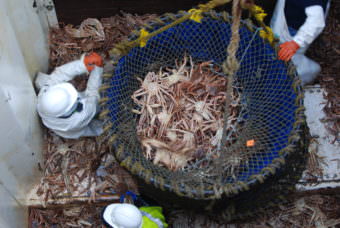
When Captain Daher Jorge and his crew fished for Opilios, they found a surprising number of Bairdi crab. (Laura Kraegel/KUCB)

The Bering Sea Bairdi (or Tanner) crab fishery stayed closed this year, for the first time in four years. State biologists decided there were too few crab to safely harvest. But fishermen are questioning that decision. They say there were plentiful Bairdi when they were fishing for other species.

At a Board of Fisheries meeting in Anchorage this week, commissioners will look into the possibility of opening the fishery even in low abundance years.

The crew of the Polar Sea stands at a metal table on the deck, sorting through a fresh pot of crab. They’re looking for Opilio (another snow crab related to Bairdi) keepers. Captain Daher Jorge rolls video on his iPhone and asks for a count.

Sorting opilio and bairdi crabs on the deck of the FV Polar Sea (Video courtesy Daher Jorge / Polar Sea captain).


“How many Opies?”

“200,” said a crew member.

“How many Bairdi?” Jorge said.

“100.”

“This is not like we’re faking it,” Jorge said. “This is just one video. It is reality. It’s right there. This is not going to lie.”

Those 100 Bairdi all go back in the ocean. Had the Bairdi season opened, Jorge would have been able to sell them.

“I mean, it’s a no-brainer,” Jorge said. “Instead of throwing over the side, why we can’t we put one species in one tank and a different species in the other tank?”

He says fishing both species would have reduced bycatch — saving fishermen time and money, and saving the crab population a lot of incidental deaths.

Opilio crab is offloaded from the Polar Sea. (Laura Kraegel/KUCB)

But their experience in the ocean didn’t match the predictions from the Alaska Department of Fish and Game. Management biologist Miranda Westphal said the annual crab survey in October showed low numbers across the board for all species — a trend she connected to warmer ocean waters.

“Everything’s just kind of below threshold,” Westphal said. “We’re not seeing a whole lot of recruitment right now. It’s sort of a theme this season.”

Managers reduced the quota for red king crab by 15 percent, cut the Opilio quota in half, and cancelled the Bairdi season entirely.

With crabbing season now wrapping up, Westphal didn’t want to comment on whether the quotas for Bairdi, or any other species, were appropriate.

But Dave Harris thinks the Department of Fish and Game made a mistake. He’s captain of the Arctic Mariner and has hauled pots in the Bering Sea for more than 40 years. In that time, he says he’s never seen the department get the quotas so wrong, and not just with Bairdi.

“You might see it in one fishery or the other,” Harris said. “But not all three fisheries. Something’s wrong with this picture. Something’s wrong with the model or surveys or something.”

Neither Jorge or Harris is able to attend the Board of Fisheries meetings in person. But they’ve shared their thoughts, videos, and pictures in the hopes of bridging the gap between what they’re seeing and what managers are documenting in their surveys.

The meeting agenda includes proposals that might open the fishery even when stocks are low or permit fishermen to keep some of the crab bycatch that’s thrown back when the fishery is closed.

Because the Board of Fisheries works on a region based schedule, the statewide King, Opilio, and Bairdi crab fisheries won’t be on the docket again until 2019.

Sea-to-table movement takes root with Alaska’s growing kelp industry

Photo courtesy of Matt Kern and Lia Heifetz
(Matt Kern harvests wild bull kelp. Photo courtesy of Matt Kern and Lia Heifetz.)

In February of last year, Governor Walker signed an administrative order to help jumpstart mariculture, or sea farming, in the state. One Juneau couple is whipping up a recipe to make local kelp an enticing business and snack. They’re part of a growing number of startups that see Alaska seaweed as a marketable food.

There’s an aquatic plant that’s become a big part of Matt Kern and Lia Heifetz’s relationship.

“It’s basically all we talk about it,” Heifetz said with a laugh. “Every day of the week. Every night of the week. Every weekend.”

Kern and Heifetz are dedicating so much of their time to seaweed because they’ve been laying the groundwork for a new business.

“Kelp Salsa,” Kern said. “It’s made from predominantly from bull kelp that we harvest from around Juneau.”

The Alaska Department of Fish and Game doesn’t have a formalized process for collecting wild kelp for commercial use — at least not yet. So, the couple forages under an experimental permit.

A lot of work and late nights goes into whipping up a batch of salsa.

Matt pops the lid off a small mason jar and opens a bag of corn chips.

“Today we have a green salsa verde,” Kern explains. “And another flavor called campfire that has roasted garlic and onions.”

Both jars of salsa contain lots of minced bull kelp. I scoop my chip into the campfire flavor. It’s tart from the seaweed and mildly spiced.

Photo co Wild Alaska Kelp Co.
(Kelp salsa at Juneau’s public market. Photo courtesy of Matt Kern and Lia Heifetz.)

The couple recently received a $40,000 Path to Prosperity grant, which is for Southeast entrepreneurs to help grow their business. Last year, they made about 2,000 jars of salsa, mostly cooked up in their home kitchen and sold at the local public market. But they want to eventually expand distribution beyond Juneau.

Having access to enough foraged seaweed for that expansion could be difficult, but a California-based startup might be able to help. Blue Evolution is looking at the prospect of seaweed farming in Alaska. Right now, the company grows the plant in Mexico, dries it and turns it into pasta.

“They were really interested in doing domestic production,” said Tamsen Peeples. She’s employed by Blue Evolution and works on the science of seaweed farming at the University of Alaska Southeast, as a marine biologist.

She says coastal states like Maine are already kelp farming, but developing it in Alaska has its advantages.

“Alaska has bountiful amounts of coastline obviously, clean water,” Peeples said. “As an Alaskan, I think it’s a great opportunity for individuals who otherwise in the winter are laying low between commercial fishing and tourism.”

But one thing Alaska doesn’t have is easy access to kelp seed. The department of fish and game says you can only farm with plants native to the region, and that’s where Peeples’ research comes in.

She’s been working on propagating seed from local kelp spores.

“In order for this industry to grow, we’re going to have to get a number of other hatcheries to come online,” Peeples said.

A new House bill could make it easier for more nonprofit hatcheries to receive state loans. Even though those wouldn’t apply to a company like Blue Evolution, Peeples thinks it’s a good thing.

So far, she has successfully incubated varieties like sugar and ribbon kelp. And those plants are growing in the waters of Kodiak and Ketchikan. Blue Evolution will buy the seaweed back in the spring.

As their kelp salsa business grows, Matt Kern and Lia Heifetz  say they’re also interested.

“We plan to be sourcing directly from farms in the future,” Heifetz said.

They say, for them, it’s not about building a seaweed snack empire.

“This wasn’t a huge day-to-day leap in our lives … to go from doing it on our home scale,” Kern said. “‘Because this is what we’d be doing with our time anyways.”

That means building their business sustainably, making thousands of jars of kelp salsa and sharing it with friends.

Warm air, sea-surface temperatures in February limited Arctic sea ice growth

It’s been a relatively cool and snowy winter here in the Interior, compared with the past couple of winters.

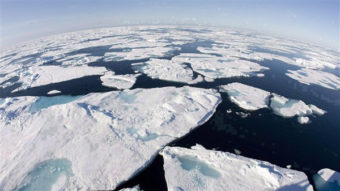
But climate experts say the Arctic has been warmer than average. They say that’s why it appears this year’s maximum Arctic sea ice cover, measured near the end of winter, is likely to set another record for the smallest maximum on record.

Arctic sea ice extent for February 2017 averaged 5.51 million square miles (14.28 million square kilometers), the lowest February extent in the 38-year satellite record. February 2017’s sea-ice extent is about 15,400 square miles 40,000 square kilometers) below February 2016’s, which set the previous lowest extent for the month, and 455,600 square miles (1.18 million square kilometers) below the February 1981-2010 long-term average. (NSIDC)

Spring equinox is a week away, which means the time is nigh for the National Snow and Ice Data Center’s annual declaration that Arctic sea ice cover has grown as much as it’s going to this winter.

“We’re at about the maximum sea ice extent you’ll see for the year. Usually the maximum happens around mid-March,” said Mark Serreze, a senior research scientist with the Snow and Ice Data Center.

Serreze said the formation of sea ice this past winter was once again sparse, due mainly to above-average air and sea-surface temperatures throughout the winter and again last month.

“We already had a record-low sea ice extent in February,” Serreze said. “We’re looking at a very, very low sea ice extent ending the freeze-up season, starting the melt season.”

This may seem contradictory to residents of the Interior after a week during which the mercury dropped to 30-, 40-, even 50-below overnight in many areas around the region. Serreze said this season was cooler than the previous two, which set consecutive records.

Overall, for the Arctic, it’s been a very, very warm winter, and you see that reflected in the very, very low sea ice levels that we have right now,” he said.

National Weather Service climate specialist Rick Thoman said it’s been a chilly winter for much of the Alaska.

“For Alaska as a whole, for the 2016-17 mid-winter – say, December-through-February period – Alaska as a whole was actually very close to the long-term normal,” Thoman said.

Except for some parts of the state. Thoman said it was a much milder winter north of the Brook Range, especially along the Arctic Ocean coast.

“As you would expect in Alaska, there (are) regional differences,” Thoman said. “The North Slope, in particular, was quite warm this winter – about the 12th warmest winter for the North Slope as a whole.”

Serreze said it’s been especially warm on the Atlantic side of the Arctic. And he expects that will be reflected in the sea ice maximum extent map the Snow and Ice Data Center will post in the next week or so.

Calls for Hilcorp to shut down leaking Cook Inlet gas line get louder

Chunks of ice float in Cook Inlet on Dec. 13, 2016 near Kenai, Alaska. (Photo by Rashah McChesney/Alaska’s Energy Desk)

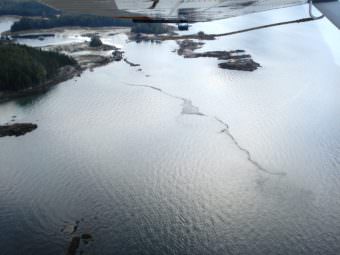
An ongoing natural gas leak in Cook Inlet is sparking a debate over pipeline safety. Hilcorp, the responsible company, says it can’t shut off the flow of gas through the pipeline without risking an oil spill. But a number of environmental groups disagree.

A recent letter from the federal agency overseeing the incident, the Pipeline and Hazardous Materials Safety Administration (PHMSA), revealed the leak began in late December. It’s currently estimated to be leaking between 203,000 and 225,000 cubic feet of gas per day, according to Alaska regulators. Dangerous ice conditions in Cook Inlet mean divers may not be able to start repairs for weeks.

Hilcorp — the biggest oil and gas producer in Cook Inlet — has repeatedly claimed shutting off the gas would be unsafe for workers and the environment. The pipeline carried crude oil until it was converted to gas in 2005. Hilcorp argues shutting off the gas could lead to an oil spill from the residual oil in the line.

Lois Epstein of the Wilderness Society called Hilcorp’s argument, “frankly bogus.”

Epstein, who has advised the federal government on pipeline safety, said there shouldn’t be much oil in the fuel line, explaining it would have been flushed out when it was converted to a gas.

Because Epstein doesn’t think there’s a big oil spill risk, her message to Hilcorp is this: “If you can’t repair it, you need to shut it down and wait until you can repair things safely.”

Epstein isn’t alone. Last week, several national environmental groups, including Greenpeace and the Natural Resources Defense Council, sent a letter to the federal government demanding it force Hilcorp to immediately shut down the pipeline. A local environmental group, Cook Inletkeeper, is lobbying state legislators to call for a shutdown.

But in a March safety order, PHMSA gave Hilcorp until May 1 to fix the line or shut it down. The agency agreed with Hilcorp that it would be too risky to shut down the gas line immediately.

Hilcorp responded to PHMSA’s letter in an emailed statement, saying, “ensuring the safety of our response personnel is our top priority as we proceed. We are pleased that PHMSA’s Proposed Safety Order acknowledges this, recognizing that immediate repair is not a viable option due to current conditions and concerns for the safety of personnel.”

But in the same letter, PHMSA also noted there’s a second pipeline nearby, “operating in an environment substantially similar” to the leaking gas line. That pipeline is carrying crude oil

Epstein argued if the crude oil pipeline was leaking instead, the federal government would be cracking down on Hilcorp.

“Hilcorp was, in fact, lucky that it was a gas line, because they are having this argument about whether they need to shut down or not,” Epstein said. “But if it was the oil line or if the breach were closer to the platform, I’m very confident that the state or federal governments would be shutting down this line.”

Both Hilcorp and the Pipeline and Hazardous Materials Safety Administration turned down interview requests.

The state Department of Environmental Conservation says it’s reviewing Hilcorp’s environmental monitoring plan and also can’t comment until that process is finished.

Commercial long-line seasons to open on time

Commercial longliners in Alaska can go fishing March 11 after all.

The National Marine Fisheries Service announced March 3 that the start date for halibut and black cod fishing will be March 11.

March 11 is the halibut fishing start date approved by the International Pacific Halibut Commission back in January. The National Marine Fisheries Service typically opens long-line fishing for black cod on the same day.

President Donald Trump issued an executive order in January requiring that for every one new regulation issued, at least two prior regulations be identified for elimination.

The start dates, catch share plan and other changes are all regulations that need to be published in the federal register.

As of late last month, the National Marine Fisheries Service was still unsure of the impact of the presidential order on the fisheries.

Fishermen in Alaska were questioning whether they’d be able to start fishing on that date.

However, the federal agency confirmed Friday that the season would be starting on the 11th for both halibut and black cod.

“The executive order really in the end didn’t end up delaying the opening of the season dates this year,” Rachel Baker said. She’s a fishery management specialist for the National Oceanic and Atmospheric Administration Fisheries’ Alaska Region. “We had to work a little more extensively with folks back in NMFS headquarters and up the chain in NOAA and the Department of Commerce just to really stress the importance of getting the halibut management measures through the regulatory process to allow the season to open on time.”

March 11 is a little earlier start date than other years. The season runs through November 7.

Baker said the actual regulations for commercial and charter fishing for halibut will be published in the Federal Register on Monday.

For the first year, long-line pot gear is allowed for commercial black cod in the Gulf of Alaska this year. Crews fishing for black cod with Individual Fishing Quota for halibut are required to keep those fish as well.

Low salmon projections cancel popular Southeast spring king derby

Last year's Spring King Salmon Derby in Juneau ran for all of May. This year's was cancelled due to poor salmon returns. (Image courtesy Spring King Salmon Derby)
Last year’s Spring King Salmon Derby in Juneau ran for all of May. This year’s was canceled because of projected poor salmon returns. (Image courtesy Spring King Salmon Derby)

A popular Southeast spring fishing derby won’t happen this year, because there aren’t enough fish.

David Turner Jr. won 2016's Spring King Salmon Derby with a 29.25-pound salmon. (Image courtesy Central Council of Tlingit and Haida Indian Tribes of Alaska)
David Turner Jr. won 2016’s Spring King Salmon Derby with a 29.25-pound salmon. (Image courtesy Central Council of Tlingit and Haida Indian Tribes of Alaska)

The Central Council of Tlingit and Haida Indian Tribes of Alaska has organized the Spring King Salmon Derby for two decades.

The Juneau-area contest has raised $475,000 for scholarships to more than 1,500 students.

But this year, the state Fish and Game Department announced it was shutting down the king salmon sport fishery in the area, because too few fish were expected to return to the Taku River, near derby grounds.

Central Council Higher Education Manager Laird Jones said it had no other choice.

“They closed the fishery from mid-April to mid-June. And the derby is typically the month of May. So, no hooks in the water for king salmon,” he said.

He said the council, a regional tribal government, considered moving the derby dates back, but decided it wouldn’t work.

Fish and Game officials aren’t sure why Taku River returns are down.

Juneau Area Management Biologist Daniel Teske said the problem is in the ocean, not the rivers where kings spawn and hatch.

“Something’s happening out there, whether it be less prey available or more predators and we are seeing it throughout a bunch of different systems here in Southeast,” he said.

The department on Monday also restricted chinook fishing near the Chilkat, Stikine and Unuk rivers:

  • Haines-Skagway area: The waters of Chilkat Inlet, north of Seduction Point, are closed April 15-July 15. In waters of Lynn Canal north of Sherman Rock the retention of king salmon is prohibited. Those caught must be released immediately and returned to the water unharmed from April 15-Dec. 31.
  • Ketchikan area: Fishing is closed April 1-Aug. 14 in Behm Canal and the contiguous bays enclosed to the north by a line from Point Lees to Elsie Point and a line from Elsie Point to the longitude of the outlet of Long Lake and to the south by a line from the western entrance of Bailey Bay to the northern tip of Hassler Island. In West Behm Canal, the bag and possession limit is one king salmon 28 inches or greater in length for all anglers.
  • Petersburg-Wrangell area: In the waters of District 8, for May 1-July 15, the bag and possession limit is one king salmon, 28 inches or greater in length for all anglers.

Teske said the low runs are part of a trend.

“We’ve been in a period of low productivity for the last several years and our projected return for 2017 is well below our escapement goal,” he said. “Therefore, we’ve had to implement some conservative regulations in order to limit harvest.”

The central council supports the closure in hopes of building back fish populations.

And Jones said Fish and Game provided plenty of notice.

“They called our specialists here … around the end of December … and kind of said, ‘Here’s what we’re thinking, statisticians are still crunching the numbers and it’s looking bad,’” he said.

The Golden North Salmon Derby has three official stations, Douglas, Auke Bay and Amalga Harbor. (Photo by Lisa Phu/KTOO)

Juneau has another large fishing contest, the Golden North Salmon Derby. It’s organized by the group Territorial Sportsmen.

Board member Matt Robus said it happens after Taku kings peak.

“A very large majority of the fish poundage caught in that August derby is coho,” he said. “There are a few king salmon and a few other individuals of other salmon species that are caught. But by and large the whole salmon derby at that time of year is focused and based on the silver salmon run.”

That derby also raises funds for scholarships. It’s brought in more than $1.7 million for more than 300 students since the program began in 1953. Its grants are larger than the central council’s, but go to fewer people.

Robus’ group understands how the council’s cancellation affects anglers and students, he said.

“We are very sympathetic with the spring derby situation and we don’t wish that situation on anybody,” he said. “It’s unfortunate, but obviously, conservation of those fish stocks is the first thing … and I think everybody agrees with that.”

That’s the situation now, but salmon returns change from year to year.

Central council’s Jones said his organization is concerned a closure could happen again in 2018.

“We’re hoping that taking some of these measures might be enough,” he said. “But if it happens again, we’ll have to cross that bridge and see how well our fundraising goes this year.”

The council still plans to help students with college costs, he said, and is considering other methods of raising the money.

Site notifications
Update notification options
Subscribe to notifications