Oceans

Proper packing becomes more important as mushers kick off from Fairbanks

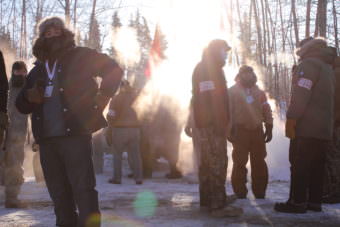
Fairbanks volunteers prepare for race start on banks of Chena River (Photo by Ben Matheson/KNOM)

Mushers are on the rivers heading out of Fairbanks right now, as the 45th Iditarod starts in earnest.

This is the second time in three races that the restart has been in Fairbanks. And a lot of the mushers have vivid memories of the 2015 race, so this year, they’re trying to pack accordingly.
It was chilly in Fairbanks, with overnight lows dipping toward 30 below. But by the time mushers were harnessing dogs and running through checklists the clear weather was easing toward a balmy zero degrees.

Though not running the race this year, four-time winner Lance Mackey was on hand, and said this year’s serious winter in the Interior may prove strong factor to content with.

“The wind has been blowing all winter,” Mackey said. “It snows when least expected. I’ve said many times – if these people haven’t tried their snowshoes on they’re gonna be hurtin’. ‘Cause I think this is the year you might need ‘em. Even to get off the trail to camp.”

Trailbreakers have been adding passing lanes to the early part of the route heading toward Tanana where the snows have been the heaviest.

The long stretches in the first leg of the race will require most mushers to stop for rest between checkpoints, a break to feed and rest the dogs.

All around the parking lot that’s been converted to a dog yard, mushers are attaching bails of straw to their sleds. Some on the baskets. Others, like veteran Pete Kaiser, were piling it into trailers hitched behind the sled.

“This just gives a little extra room for some of these long runs between checkpoints where we’re gonna be stopping on the trail and camping, and requires a little more gear,” Kaiser said.

What will not be hauled in a trailer this year is dogs.

A controversial rule change bars mushers from carrying dogs in trailers, throwing a wrench in many people’s strategies from year’s past, which involved regularly rotating animals through rest along runs.

Many people are experimenting with a workaround, most notably, returning champion Dallas Seavey.

“Without being able to carry dogs in trailers, we had to find a way to bridge that gap,” Seavey said. “We just made a bigger sled.”

Seavey is standing over what looks like the Batmobile of dog-sleds.

It’s almost totally black, and instead of an external frame with a bag suspended from supports, this looks more like a plastic shell. It’s about 10 percent bigger than a regular sled.

He had it custom built from Kevlar and carbon-fiber, and mounted to the runners behind where the musher stands is another heavy duty cube that could hold supplies or dogs.

According to the rules, as long as it’s safe and fixed to the structure of the primary sled, you can use it for an animal.

“There’s many sleds here that have the ability to carry just as many dogs as I do in the same way, they just don’t have hard sides,” Seavey said. “I like the hard sides because it helps protect the dogs, so that if there’s just a piece of fabric between them and the great big world it’s a little less than carbon fiber and Kevlar. I’ve got them in a little cocoon in there.”

Hundreds of people took buses from the Carlson center to view the event at Pike’s Landing.

Spectators lined the long shoot clapping as mushers rushed below celebratory arches, down onto the Cheena River, and on toward Nome.


You can follow Alaska Public Media’s Iditarod coverage here, or listen to the Iditapod podcast below:

Alaska Sea Grant program “hopeful but not confident” funding won’t be cut

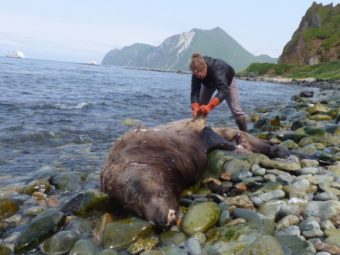
Melissa Good with UAF Alaska Sea Grant collects a sample from a Steller’s sea lion carcass by Unalaska’s Summer Bay. (Photo by John Ryan/KUCB)

The National Oceanic and Atmospheric Administration, or NOAA, received a surprise on Friday: The Trump administration is proposing deep cuts to the organization, which focuses on fisheries and climate science.

As reported in the Washington Post, NOAA could lose 26 percent of its overall budget. The Sea Grant program, with more than a dozen projects in Alaska, could be hit particularly hard.

Carol Kaynor is a communication specialist at Sea Grant. She’s worked there for about 25 years.

“This is the wildest ride I ever remember,” Kaynor said.

Last week, she found out the organization could lose all of its federal funding by scrolling through Facebook.

“Part of the reason I’ve worked here so long is that I believe in this program,” Kaynor said. “I think it’s an excellent program and I felt like it made a difference, and that’s a big thing.”

Sea Grant helps train villages to monitor coastal erosion, tracks the economic vitality of the seafood industry and studies the impact of climate change, among many, many other things. The organization supports research at 33 universities nationwide, including the University of Alaska Fairbanks.

Kaynor says Sea Grant plays a vital role nationally and in the state. So the news that the Trump Administration wanted to eliminate program was hard to swallow.

“I was thinking this is crazy. Sea Grant has such a huge return on investment,” Kaynor said. “Why would you cut a program that has a major return on investment when you’re trying to grow the economy? It doesn’t make sense.”

NOAA is administered by the U.S. Department of  Commerce. The Washington Post obtained a memo that said the new administration wants to “prioritize rebuilding the military.” It mentions the “trade offs and choices inherent in pursuing the goals.”

Paula Cullenberg, the Alaska director of Sea Grant, says she’s not sure why the program didn’t make the cut.

“I have no idea … Maybe this was an easy mark and it was something on a spreadsheet that looked available,” Cullenberg said. “As far as I know there wasn’t any in-depth analysis around that.”

Sea Grant has been in Alaska for about 47 years and Cullenberg says the program has been threatened before. She says the Reagan administration tried to nix the funding but Congress chose to reinstate it. This time around, she hopes it goes the same way.

“You know, it feels like a bit of a blow,” Cullenberg said. “A lack of confidence for sure or a lack of support by the administration. I can’t say I’m confident but I’m certainly hopeful.”

The next fiscal year starts in October. The White House and lawmakers will have the upcoming months to decide. Cullenberg is meeting with NOAA this week in Washington, D.C., to discuss a game plan.

National Park Service predicts the future of shipping in the Bering Sea

A map of Arctic shipping routes, including the Northern Sea Route over Russia.
A map of Arctic shipping routes, including the Northern Sea Route over Russia. (Public Domain photo courtesy the Arctic Council)

It’s no crystal ball, but it could show us the future of Arctic shipping. A new simulation created by the National Park Service and its partners maps out projected ship traffic in the Bering Sea for the year 2025. Tahzay Jones is a coastal ecologist with the National Park Service, and he helped this simulation come to life.

“There’s already projections about how much traffic is gonna increase,” said Jones, “and what we really wanted to get at was, what does that actually look like?”

In the simulation video, colorful dots representing vessels sail up and down the Alaskan coast.

“If you imagine, like, a train track or something, we create boat tracks that these little boats can go back and forth on,” said Jones.

Most dots are clustered around the Aleutian Islands. But it’s the Bering Strait region that will see the greatest increase in traffic in the next decade. Between two and eight percent of ships that currently pass through the Suez and Panama canals are expected to start using the Northwest Passage instead.

Overall, the simulation predicts that between 115 and 275 more ships will pass through the Bering Sea during the most active month of the 2025 season. And those numbers don’t include one category of vessel that the region may see a lot more of soon: cruise ships.

“We just haven’t had enough cruise ships in the area to understand all of their routes,” said Jones. “I mean, we had one that went through last year. And so, that’s the only track that we have for large cruise ships that would potentially be going through the Bering Strait, and that’s not enough to really base a model on.”

However, the model could be adapted in the future once cruise ship patterns are established. In the meantime, Tahzay Jones’ task is to determine how the simulation can be used to prepare people living on the Alaskan coast for an increase in traffic.

“It’s one thing to create a model,” he said, “and then it’s another thing to say, how does this model actually apply to community needs, to management planning needs, those kinds of things?”

Jones visited Nome this week to meet with Kawerak Inc. representatives and share the potential uses of his project. Those uses include predicting the location of oil spills, and determining which animal populations might be threatened by traffic or noise disturbances. He also asked the representatives for suggestions of species that may be especially at risk. This collaboration with communities is important to Jones because he says the undertaking started with them.

“This project itself was really conceived and developed not as an agency-derived thing, but more so, it was very specifically an issue that communities had been conveying to the Park Service, and the Park Service saying, ‘I think that there might be a way we can address this,’” he said.

Of course, the real impact of the Arctic shipping boom won’t be known for certain until 2025.

Unalaska teen: If you like sushi, you better take care of the environment

Cade Terada fishing in Unalaska. (Photo courtesy Cade Terada)

Across the state, there’s a cohort of young Alaskans raising awareness for the rapidly changing Arctic environment. Cade Terada is one of 22 Arctic Youth Ambassadors. Growing up in Unalaska, America’s largest fishing port, he was immersed in the seafood industry.

Terada looks like a young, hip politician. Hair gelled back, the 18-year-old sports a grey quarter zip and khaki’s with an earring and a tattoo peeking out from under his sleeve.

He graduated from high school early, back in December.

You might not guess the role fishing has played in his life. Terada’s father grew up in a small town in Northern Japan and the best way to make money was fishing.

“He had to drop out of school in the ninth grade because his family was quite poor at the time,” Terada said. “So, he’s been working in fishing ever since, which is approximately 40-plus years.”

What did he think of fishing as a child?

“I really enjoyed it,” Terada said. “I really enjoyed looking in the tide pools with all the hermit crabs. I thought it was really cool looking at fish. I don’t know what it was about it, but it was an exciting opportunity to see what was out there, what could we catch.”

From a young age, Cade Terada, left, was exposed to the fishing industry by his father. (Photo courtesy Cade Terada)

At what point did he realize Unalaska was pretty unique in the amount of resources it has?

“I kinda started realizing it back when I was beginning my high school career,” Terada said. “It didn’t really hit me that maybe 90 percent of my class has someone working in the fishing industry. My history teacher would always talk about how this town would be a ghost town if we didn’t have fisheries and that really got me thinking that everything is dependent on the fisheries where I’m from.”

Becoming an Arctic Youth Ambassador was a stretch for Terada. He didn’t really excel in high school.

“There’s a lot of other kids like me that have the mindset that if they have a low GPA they aren’t going to be able to do much,” Terada said. “I want to let people know if you have a low GPA that doesn’t mean anything … With this ambassador program I’ve had to opportunity to go to Greenland (and) Canada. I’ve met the prime minister of Canada, Justin Trudeau. I’ve met with countless government officials. That’s not something you’d expect from a kid with a 2.6 GPA.”

Terada has been passionate about protecting the environment for as long as he can remember. He got his start with Alaska Youth for Environmental Action. After a youth organizing summit, he was encouraged to apply to the Arctic Youth Ambassador program.

For Terada, convincing people to care about the environment is simple. He puts it in perspective.

“A lot of people I meet like sushi. And I come from the place that’s the number one fishing port in the nation, so if you like crab, if you like eating fish, you like eating any of this you better take care of the environment,” he said. “People are like ‘Wow, I really like my caviar and if I don’t care about the environment there’s going to be no more caviar or lobster.'”

At only 18, Terada feels like he’s already making a difference.

Next up is college where he’s planning to pursue degrees in political science and environmental studies. Then, he wants to return to Alaska to run for elected office.

After nearly two decades living in America’s largest fishing port, he thinks he’ll be able to bridge the gap between science and politics and continue to advocate for his community and the environment.

Ocean acidification in Southeast, tribal network seeks regional impact

Ocean acidification has been big news lately. Experts have spoken about the possible consequences for shellfish and the critters that eat them but, its actual impact in Southeast Alaska is not known.

Southeast Alaska Tribal Ocean Research, a network of 15 Southeast tribes, hopes to answer that question.

Wrangell and fourteen other tribes have participated in the Southeast Alaska Tribal Ocean Research program, collecting clams and cockles to test for paralytic shellfish poison.

The Sitka Tribe of Alaska heads the initiative, and now wants to get a baseline for ocean acidification in the region.

Sitka tribe Environmental Specialist Esther Kennedy said that monitoring ocean acidification in near-shore environments has been quite difficult until recently.

“Most of the research on OA to date has been in the open ocean,” Kennedy said.

These environments naturally have wide swings in ocean chemistry due to stream and river volume changes, storms and droughts, and proximity to the open ocean.

“I suspect Sitka is going to look a lot more like the Gulf of Alaska than it will look like Wrangell with its huge fresh water input from the Stikine,” Kennedy noted. “One of the things that will be really interesting is can we start to see say gradience and effects of ocean acidification as we move from the outer coast into the even more coastal environments.”

The project aims to get a baseline for Southeast waters.

Some data will be obtained through a buoy in Sitka Sound that will measure PH levels and dissolved carbon dioxide in the water, a slice of the many variables measured to indicate ocean acidification.

The buoy will help answer the main concern of the environmental issue: how difficult it is for organisms to form a shell?

“That plays into the second part of our ocean acidification project where we are now installing an instrument called a Burkolator in our lab,” Kennedy said.

A Burkolator is a machine that will be constantly taking measurements in one of Sitka’s harbors, but will also test samples sent in by 14 tribes across the region. The Wrangell Cooperative Association monitors phytoplankton and collects clam and cockle samples at two popular sites south of town — Shoemaker Bay Harbor and Pats Creek Landing.

Shellfish samples are sent to the lab in Sitka for testing, and the results are dispersed on the program’s website.

Chris Hatton, the association’s Indian Environmental General Assistance Program coordinator, said the tribe is excited to participate.

“Because we are already going to these locations every week and sometimes more than once a week, we’ll be able to grab a sample in a special brown jar. Then that jar will be stored for a bit and sent to Sitka where they can analyze it four different levels of acidification and other things in the water,” Hatton said. “It’ll be great to get a baseline because that’s what we don’t have yet.”

Hatton added she’s interested to see how Wrangell’s large freshwater influence plays out when it comes to ocean acidification and paralytic shellfish poisoning.

“With our PSP results, I think we are all realizing there is the chance and there are cockles and clams that are higher in PSP than what we recommend for consumption,” Hatton said. “Our fresh water maybe helps us, but it doesn’t keep us safe necessarily.”

Kennedy said with such environmental diversity in Southeast, she hopes to use the project’s data as a model for other parts of Alaska.

Data from the open ocean will be used to tease out the large variabilities of near-shore environments.

Kennedy noted measuring ocean acidification will also answer questions about the impacts of fewer shell-forming organisms.

“An indirect effect would then be less food for other creatures like crustaceans, which are also going to have shell-forming difficulties, but also salmon, marine mammals will have a more difficult time finding food,” Kennedy said.

Kennedy hopes to have the buoy up and running within a month and plans to start testing samples from around the region in September.

Ice in Cook Inlet likely to delay fix to Hilcorp gas leak for weeks

Still from footage taken by a helicopter of a gas leak in Cook Inlet, obtained by the environmental group Cook Inletkeeper. (Image courtesy Cook Inletkeeper)

Hilcorp recently informed state regulators that the company is unlikely to begin repairs on a gas leak in Cook Inlet until mid- to late March.

That’s according to a letter the Houston-based oil-and-gas company sent Feb. 20 to the Alaska Department of Environmental Conservation.

Alaska’s Energy Desk obtained the letter through a public records request.

“We all agreed that we would prefer to be able to either immediately repair the Pipeline, or, if unable to make repairs, to shut in the Pipeline if there were no adverse impacts of taking that action,” Hilcorp wrote. “Neither is possible at this time.”

Hilcorp added, “broken ice, exacerbated by high tidal flows and limited daylight” make it too dangerous to send divers to fix the leak at this time.

It’s estimated the fuel line is leaking at a rate of 210,000 to 310,000 cubic feet of natural gas per day.

The company also gave several reasons why it can’t simply shut off the gas.

Hilcorp said the fuel line used to carry crude oil, and shutting off the line could lead to an “unknown quantity” of oil escaping the line. The company added the fuel line powers its platforms, and shutting it off could endanger workers.

The letter was addressed to Alaska Department of Environmental Conservation’s Geoff Merrell, who is leading the state’s response to the leak.

He couldn’t say when the leak can be fixed, either.

“The bottom line is the pipeline will be repaired when it’s safe to repair the pipeline,” he said. “When that is, nobody knows.”

The line in question leaked twice before in 2014, when it was owned by a different company, according to Merrell. But those leaks happened in the summer, and repairs were made within a few days.

Merrell said safety concerns about fixing the leak in winter are legitimate, recalling a January 2009 incident in Cook Inlet when sea ice pushed a supply boat into an oil platform and sank.

But the letter also shows Hilcorp disputing the department’s assessment of the environmental risks associated with the leak.

For example, Hilcorp challenges the agency’s evidence that methane can harm aquatic species.

“Hilcorp has their opinion and their position, which is fine, they’re entitled to that,” Merrell said. “The department has access to environmental and science experts who are arriving at a position that is different than that of Hilcorp’s, and that’s fine too.”

Cook Inlet is home to a population of beluga whales, which are listed as endangered.

Hilcorp wrote in its letter to the state that the whales are likely to steer clear of the gas bubble stream coming from the leak. The company added, “belugas tend to avoid ice-covered areas.”

The National Oceanic and Atmospheric Administration said the opposite in a Feb. 24 letter it sent to the Pipeline and Hazardous Materials Safety Administration, the federal agency overseeing the incident.

“Cook Inlet belugas have shown a preference for ice cover,” the agency wrote in the letter.

NOAA added that the leak is taking place within preferred Cook Inlet beluga winter foraging areas.

In an emailed statement, Hilcorp spokeswoman Lori Nelson said the company is working with environmental consultants, who concluded “the potential impact to marine life is minimal.”

Nelson added the company is working closely with government agencies to respond to the incident.

The long time frame for fixing the leak is drawing criticism from local environmental groups.

“Basically Hilcorp is saying ‘we cannot respond to an event in Cook Inlet in the winter,'” said Bob Shavelson, advocacy director for Homer-based Cook Inletkeeper. “Our response to that is, ‘if you can’t address an event whether it’s a gas spill or an oil spill in Alaska in the winter, then you should go back to Texas, because you don’t have a right to do business here.'”

Earlier this month, Cook Inletkeeper announced it intends to sue Hilcorp over the leak, claiming it is violating of the federal Clean Water Act.

Site notifications
Update notification options
Subscribe to notifications