Oceans

Chukchi Sea polar bears are thriving but only in the short term

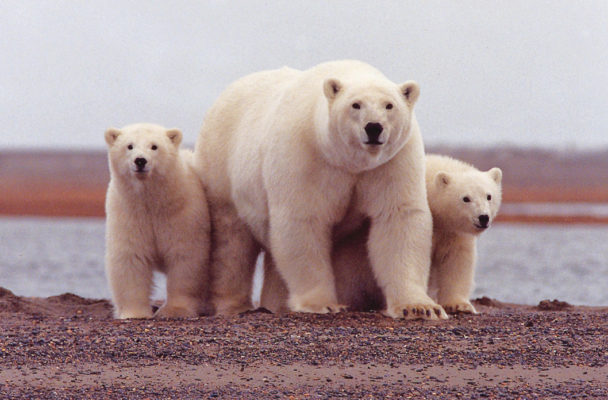
A polar bear keeps close to her young along the Beaufort Sea coast in Arctic National Wildlife Refuge.
A polar bear keeps close to her young along the Beaufort Sea coast in Arctic National Wildlife Refuge. (Public Domain photo by Susanne Miller/USFWS)

If there’s a poster child for Arctic animals affected by climate change, it’s the polar bear. But the data behind those famous furry faces tells a more complicated story.

Dr. Eric Regehr is a biologist with the U.S. Fish and Wildlife Service in Anchorage. He’s the lead author of a new study on the global conservation status of polar bears. Assessments of the conservation status of polar bears have been done before, but this is the first one that takes a databased, quantitative approach.

The study establishes a relationship between sea ice reduction and polar bear population numbers. The researchers then used that trend to predict how the world’s 26,000 polar bears will fare in the future.

“Putting together all available data, and making some informed projections on the basis of those data, do suggest that there is a high probability that the global population of polar bears could face reductions of up to one-third or greater in the next 35 to 40 years,” said Regehr.

However, not all polar bear numbers are suffering, at least in the short term. There are nineteen individual subpopulations of polar bears across the Arctic. Some of these subpopulations are stable, and a few are even growing.

One group that’s thriving is the Chukchi Sea subpopulation, which includes Western Alaska and the Russian coast across the water.

“The waters are shallow, they’re nutrient rich; there are a lot of seals, ringed seals and bearded seals, out there for the polar bears to eat,” said Regehr. “And so, other studies suggest that, despite the fact that the Chukchi Sea region has exhibited a loss of Arctic sea ice the bears in that region appear to be faring quite well, currently.”

But their neighbors to the East, the South Beaufort subpopulation, are declining in number.

“The continental shelf is much narrower, the region is less biologically productive,” said Regehr. “And scientific studies there suggest that the polar bears have been negatively affected by sea ice loss. So there is a lot of variation in their status across the Arctic.”

Despite this variation, Regehr says the decline in population numbers expected in the next few decades is likely to affect bears in all regions of the Arctic.

“Fundamentally, at the end of the day, polar bears require sea ice to do what basically makes them bears, which is killing and eating seals,” he said.

That means even healthy subpopulations, like the Chukchi Sea, bears face long-term threats.

“Just logically, there’s some point at which a polar bear in the Chukchi Sea may not have enough days of the year on sea ice catching seals to get the nutrition they need and be healthy,” he said.

Regehr doesn’t know when that time will come, but he’s already seeing the bears spend an extra month on land each year. And there’s evidence that the sea ice loss is affecting not just the polar bears in the Chukchi Sea, but those that hunt them. Regehr says polar bear harvest numbers in the region have been declining for the past few decades.

He hopes that as polar bears in the Arctic continue to be monitored, his team’s study will set a precedent for more quantitative assessments.

“Polar Code” a Step In The Right Direction?

Drift ice camp in the middle of the Arctic Ocean as seen from the deck of icebreaker Xue Long, July 2010.
Drift ice camp in the middle of the Arctic Ocean as seen from the deck of icebreaker Xue Long, July 2010. (Photo by Timo Palo via Wikimedia Commons)

At the beginning of 2017, the International Maritime Organization, or IMO, instituted a new set of regulations for ships traveling throughout Arctic waters. It’s called the Polar Code, and it builds upon 2009 guidelines to help ships operate safely in polar waters.

Kawerak’s marine advocate, Austin Ahmasuk, says the Polar Code is an improvement on the previous regulations for ships in the Arctic, but it still doesn’t change the nature of sailing through Arctic waters.

“The Polar Code, which took effect January 1, 2017, it doesn’t make the Arctic absolutely risk free,” emphasized Ahmasuk, “but it is a gigantic step forward to address the demands that are placed upon ships in polar waters, as well as addressing impacts and acknowledging that there have been coastal communities in the Arctic for a very long time.”

According to the IMO’s website, the goal of the Polar Code is to “provide for safe ship operation and the protection of the polar environment, by addressing risks present in polar waters.”

But of course, it can’t prevent all damaging situations from happening to ships traveling in icy Arctic waters. Just this week, according to an article in the Maritime Executive, two Russian carriers and icebreakers got stuck in three-foot-thick ice near the Chukotka Peninsula.

A missing feature of the Polar Code that Ahmasuk hopes will be addressed in the future is “how Arctic communities will be engaged in mitigating and addressing shipping plans, ship operations. You know, how will communities be engaged? That is something I am interested in,” he said.

Natasha Brown, who works for IMO, said via email that the Polar Code was developed by Member States of the IMO over the course of a few years with input from a range of non-governmental organizations (NGOs), shipping groups, and environmental groups. Brown did not specifically mention local Arctic communities being a part of the development process.

Even though the Polar Code took effect on January 1, not all of the ship-design requirements will be put into place this year. Some won’t be ready until 2018 after the first survey of ships is complete. When asked if the Polar Code is an indicator of more shipping traffic coming to the Bering Sea, Ahmasuk said:

“Oh, boy, well, that’s the million-dollar question, right? It does seem apparent that there is an interest to reduce shipping costs, which the Northern Sea route would obviously do for the global shipping market. It seems as though that interest is going to be maintained despite the new Polar Code,” stated Ahmasuk.

Regardless of how many ships come through the Bering Sea and other parts of Arctic waters, the Polar Code dictates that they be categorized based on how much ice they can sail through safely.

Brown says it’s up to the Member States to enforce the Polar Code regulations on their own domestic ships and any vessels docking in their ports.

Sitka to lose Coast Guard Cutter Maple this summer

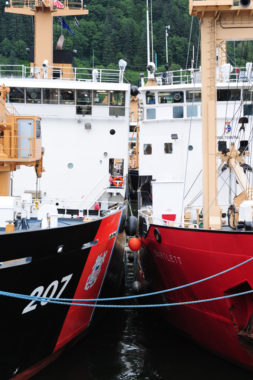
The Coast Guard Cutter Maple and the Canadian coast guard vessel Bartlett sit side-by-side at Coast Guard Station Juneau July 16, 2012. The two buoy tender crews, along with four other U.S. Coast Guard cutter crews, travelled to Juneau for the annual buoy tender roundup. U.S. Coast Guard photo by Petty Officer 3rd Class Grant DeVuyst.
The Coast Guard Cutter Maple and the Canadian coast guard vessel Bartlett sit side-by-side at Coast Guard Station Juneau July 16, 2012. (Photo by Coast Guard Petty Officer 3rd Class Grant DeVuyst)

Sitka’s docks will look a bit different this summer. The US Coast Guard Cutter Maple will sail south for maintenance and then be reassigned a new homeport in the spring, leaving Sitka without a large Coast Guard vessel for at least six months.

Lt. Commander Patrick Armstrong is the officer in charge of the Coast Guard cutter Maple.

“There’s been so many hours put on the engines and the generators and things just need to be rebuilt,” explained Armstrong. “Wiring and a lot of the engineering type stuff needs to be overhauled. So there’s nothing specifically wrong with the ship, it’s just a general mid-life maintenance.”

The Maple was commissioned in the mid-1990s. Armstrong says it’s among more than a dozen other cutters now in need of a tune up.

Once work on the Maple is done, the 225-foot vessel will have a new homeport in Atlantic Beach, North Carolina. Although the cutter will have a new home, Armstrong said its crew wouldn’t go with it.

“Here in Sitka, nothing will change in terms of the personnel or the transfers, only the ship itself,” Armstrong said. “In the end, it will be just a name change for the ship.”

That new name is the Kukui. The 225-foot cutter is currently homeported in Honolulu, Hawaii and has long ties to the state, getting its name from Hawaii’s state tree.

Like the Maple, it too was designed to service navigation buoys.

“It’s essentially the same thing, just a few minor engineering configurations on board, but it’s really the same class of ship,” Armstrong said.

Along with being in the same class, it was also commissioned around the same time, so the Kukui, too, will get midlife maintenance done in Baltimore before sailing on to Sitka.

But, Armstrong said, that won’t happen until 2018, meaning Sitka will be without a Coast Guard cutter for at least six months.

“Without having a ship we won’t be sailing and doing our normal ATON [aids to navigation] missions and search and rescue missions. Instead, our crew will be focusing on training and maintaining proficiency by doing temporary service on other units and also assisting local units.”

Armstrong said search and rescue efforts will be well covered in the area with the help of Air Station Sitka and Coast Guard Sector Juneau, but he does have some bad news for Halloween lovers in Sitka.

“This October unfortunately, because we don’t have a ship, we will have one year here without it, but we fully expect when we have Kukui back in 2018, we do plan to have a haunted ship again,” Armstrong reassured.

The Coast Guard cutter Maple will leave Sitka this summer, probably in July, Armstrong said and he expects the Kukui to sail into Sitka’s harbor in the spring of 2018.

First tsunami survival capsule deployed on Pacific Northwest coast

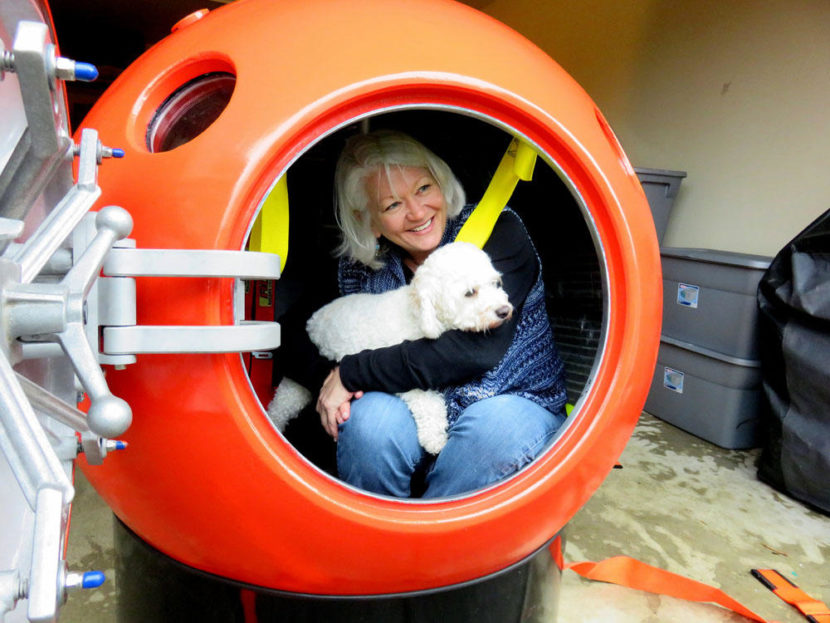
Jeanne Johnson of Ocean Park, Washington, is the first U.S. buyer of a tsunami pod sold by Mukilteo, Washington-based Survival Capsule LLC. (Photo by Tom Banse/Northwest News Network)

A new tsunami survival option has come to the Pacific Northwest coast.

It involves climbing into a spherical aluminum pod for what is sure to be the ride of your life.

The first U.S. buyer of this technology resides in Ocean Park, Washington.

Jeanne Johnson just recently moved from the Seattle area to what she calls her “dream home” at the beach, about midway up the sandy, flat Long Beach Peninsula.

“When I decided to move to the ocean into a tsunami zone I felt like I should prepare,” Johnson said.

Her tsunami evacuation options are not good.

She could make a run for it, but this Microsoft executive doubts she could reach the distant high ground in the short time between the end of the shaking of a great earthquake and incoming tsunami waves.

“People panic and I don’t want to be caught in the panic,” Johnson said.

A bit of internet research led her to a new option: a survival capsule — a bright orange, high-strength floating metal ball.

She has taken delivery and is now deciding whether to tether her capsule in her herb garden or keep it in the garage. In any case, Johnson wants her dog to join her if and when “the Big One” comes.

“My model is big enough for two people to be buckled in like a pilot’s seat,” Johnson said.

The aircraft-grade aluminum sphere is about 4 1/2 feet in diameter.

The sphere looks a little bit like an astronaut capsule, with a round marine door and two tiny portholes.

The survival capsule delivered to Johnson came equipped with twin air tanks inside in case the capsule is pinned underwater for a time or is surrounded by burning debris.

The aluminum shell of the capsule has a ceramic blanket interior lining to protect against the heat of fire on the outside.

A welded tubular framework inside braces the exterior shell.

There are drinking water bladders in the bottom of the capsule and a GPS locator beacon in the event the capsule goes adrift.

“I have friends who say, ‘Oh my God, wouldn’t it be claustrophobic? How can you stand it?’” Johnson said. “All I can think is, what’s my option? To drown? I would rather be in that ball for the ride of my life and maintain my life.”

Johnson is the first domestic customer of a startup called Survival Capsule, based near Seattle.

Company president Julian Sharpe said he got the idea for the product lying awake one night while weekending in Cannon Beach, Oregon.

“I thought, ‘Well, what happens now if a tsunami comes?’” Sharpe said.

The aerospace engineer had a brainstorm.

“I just thought it’s going to be a disaster because I’ve got four sleeping kids,” Sharpe said. “If it comes at night, the lights are going to be out. You don’t necessarily know where you’re going. You can’t see the wave, how far it is. So I thought it would be great if I could design something to throw the family in and ride it out. That’s where it all started.”

Sharpe’s company’s initial sales have been to Japanese customers — eight capsule kits so far.

He anticipates local governments in Japan could become a major customer base along with private sales along the U.S. West Coast, Gulf Coast and East Coast.

“The target customer is the person who lives on the ocean who cannot vertically or horizontally evacuate,” Sharpe said.

That’s potentially a lot of people as long as they’re willing to pay the price. Sharpe said the two-person survival capsule starts at $13,500. A four-person model lists for $17,500. Six, eight and 10-person models are for sale as well.

Sharpe said he aspires to bring the price down through economies of scale when orders increase.

“We hope that people will see the value of this product,” Sharpe said. “It’s not a gizmo or a toy. It’s a life insurance policy. It’s really designed to give people who live in coastal communities peace of mind.”

Sharpe and Johnson hope the government will eventually subsidize private purchases of the survival capsules as an extension of public spending on tsunami readiness projects such as the planned safe haven berm proposed for a field behind Long Beach Elementary School.

While the inspiration for the product was tsunami survival, Sharpe said his company’s capsules are now drawing additional interest from coastal residents worried about hurricanes.

“Rather than evacuate from hurricanes and be 200 miles away while the hurricane decides it wants to go in a different direction leaving their home vulnerable — or business vulnerable — to looting, they want to stay at home and have a tsunami capsule as a last line of defense,” Sharpe said.

Residents who swung by Long Beach City Hall earlier to look at plans for a different evacuation option had mixed reactions to the tsunami capsule idea.

Jane Bena shivered at the prospect of sheltering inside while being battered by tsunami debris.

“I would hate to be bounced around in that,” Bena said. “I’m too old. I’m 80 years old. I don’t know that I would care to survive a tsunami.”

The city of Long Beach, Washington, is using grant money to design an armored, man-made hill that could be used as a tsunami evacuation platform for at least 850 people.

Bena favored building this, but as you maybe can tell she’s fatalistic about her own chances.

Juneau’s downtown cruise terminal preparing for bigger boats

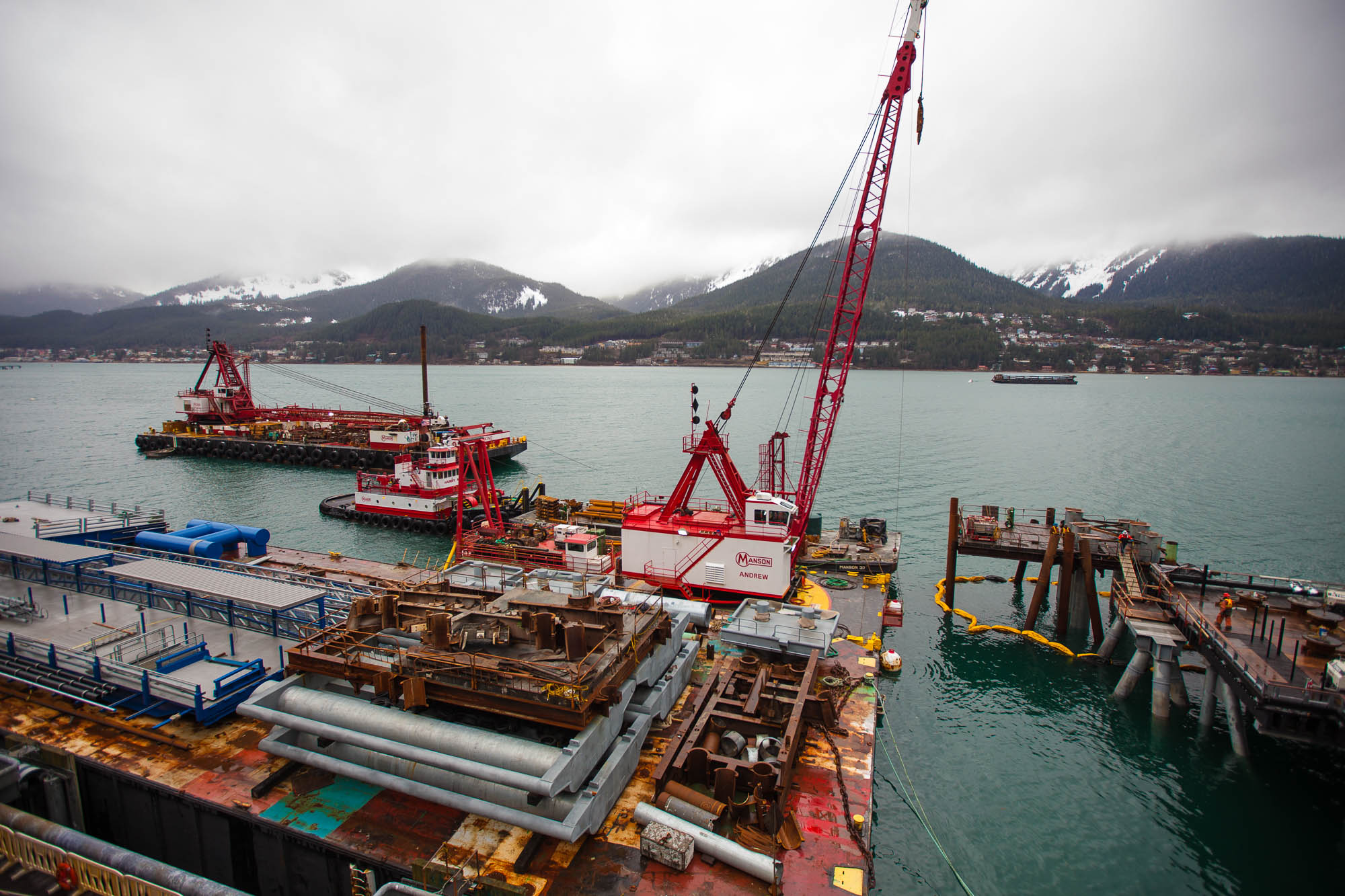
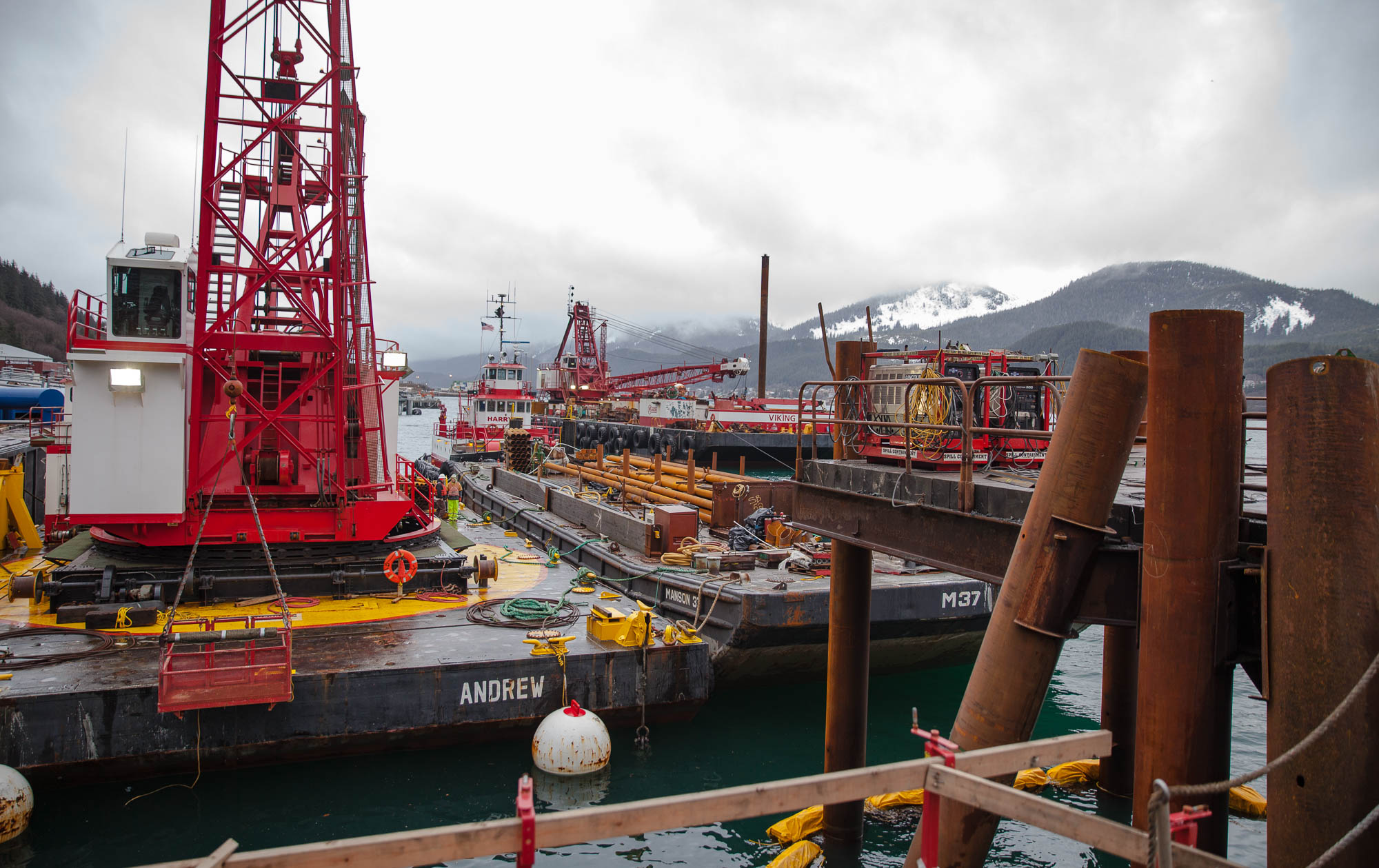
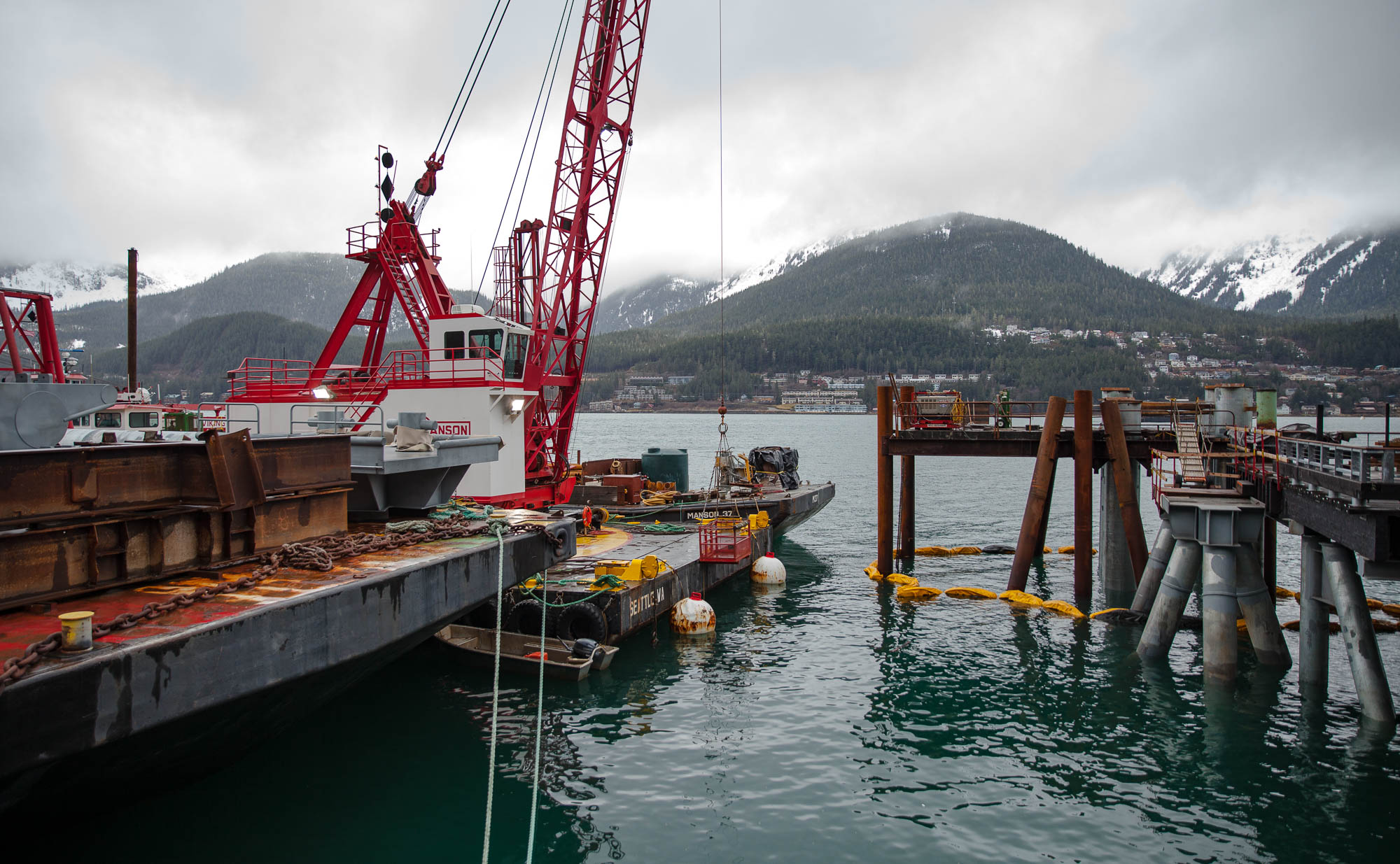
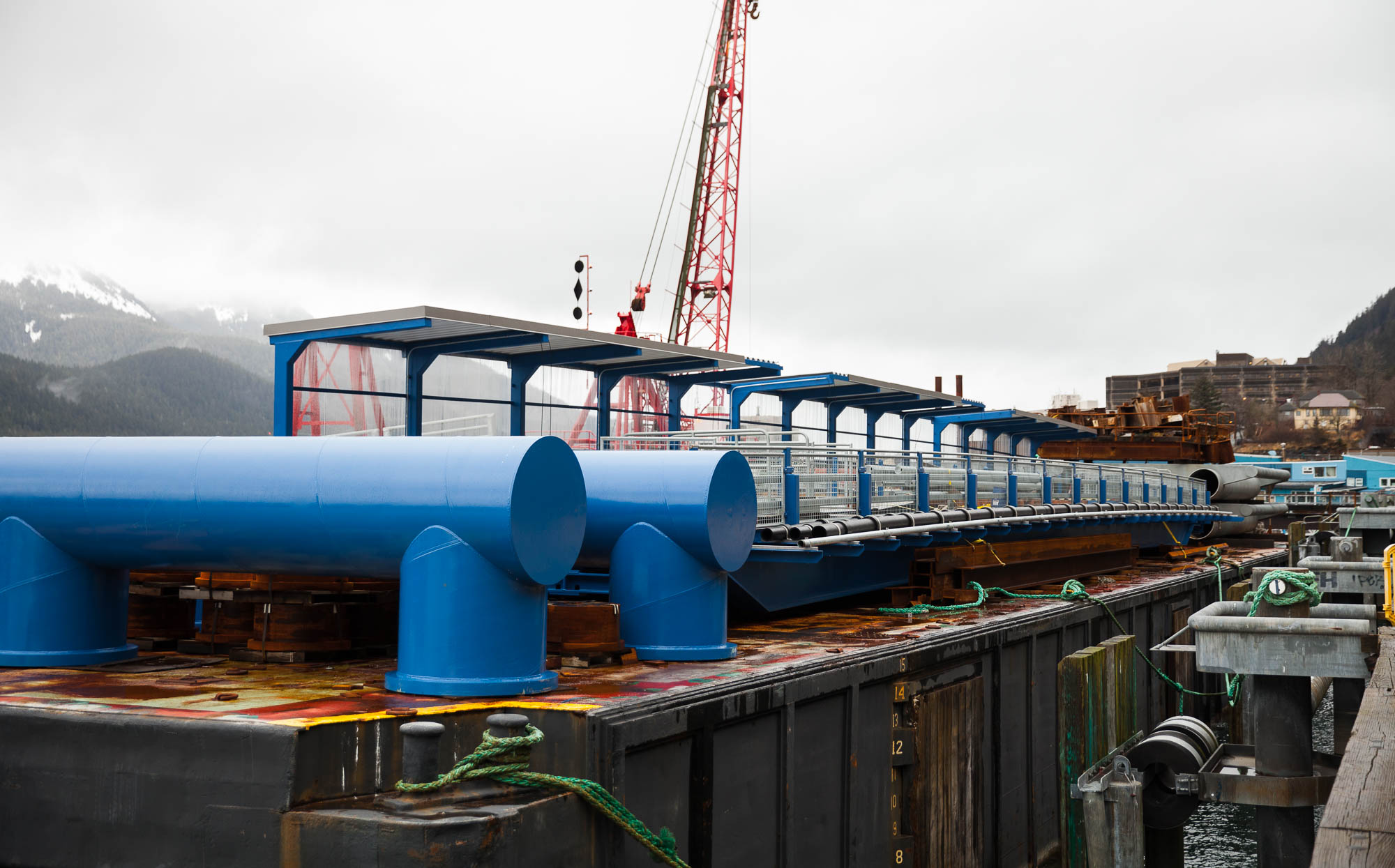
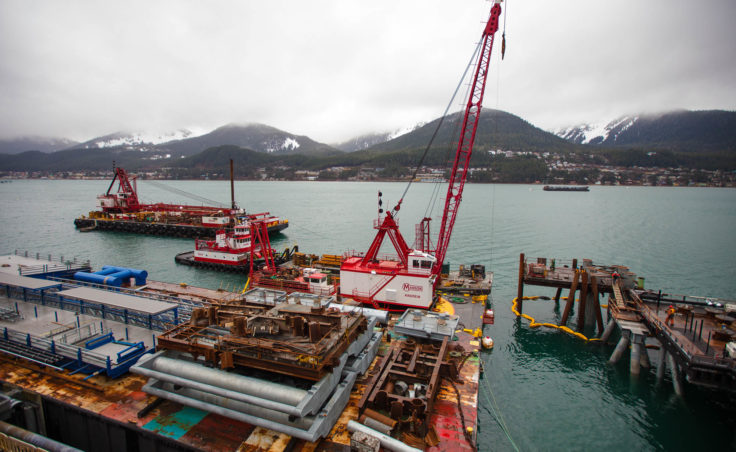
A $54 million project to add a pair of floating cruise ship berths to Juneau’s downtown waterfront is within months of completion.

The project will expand the port’s capacity to accommodate larger vessels. That’s because cruise ships in Alaska are getting bigger.

Juneau’s Docks and Harbors has been working to expand its terminal to keep up with industry requirements.

The city’s Deputy Port Engineer Erich Schaal said the downtown Alaska Steamship Dock was limited to tying up ships greater than about 800 feet. And the southern Cruise Terminal or CT dock, was not much longer.

“The original max length that we could receive at our southern CT dock was 960 feet and now we’ll be able to receive a 1,000-foot vessel and an 1,100-foot vessel at the same time,” he said.

Seattle-based Manson Construction is the lead contractor working to expand the cruise ship berths.

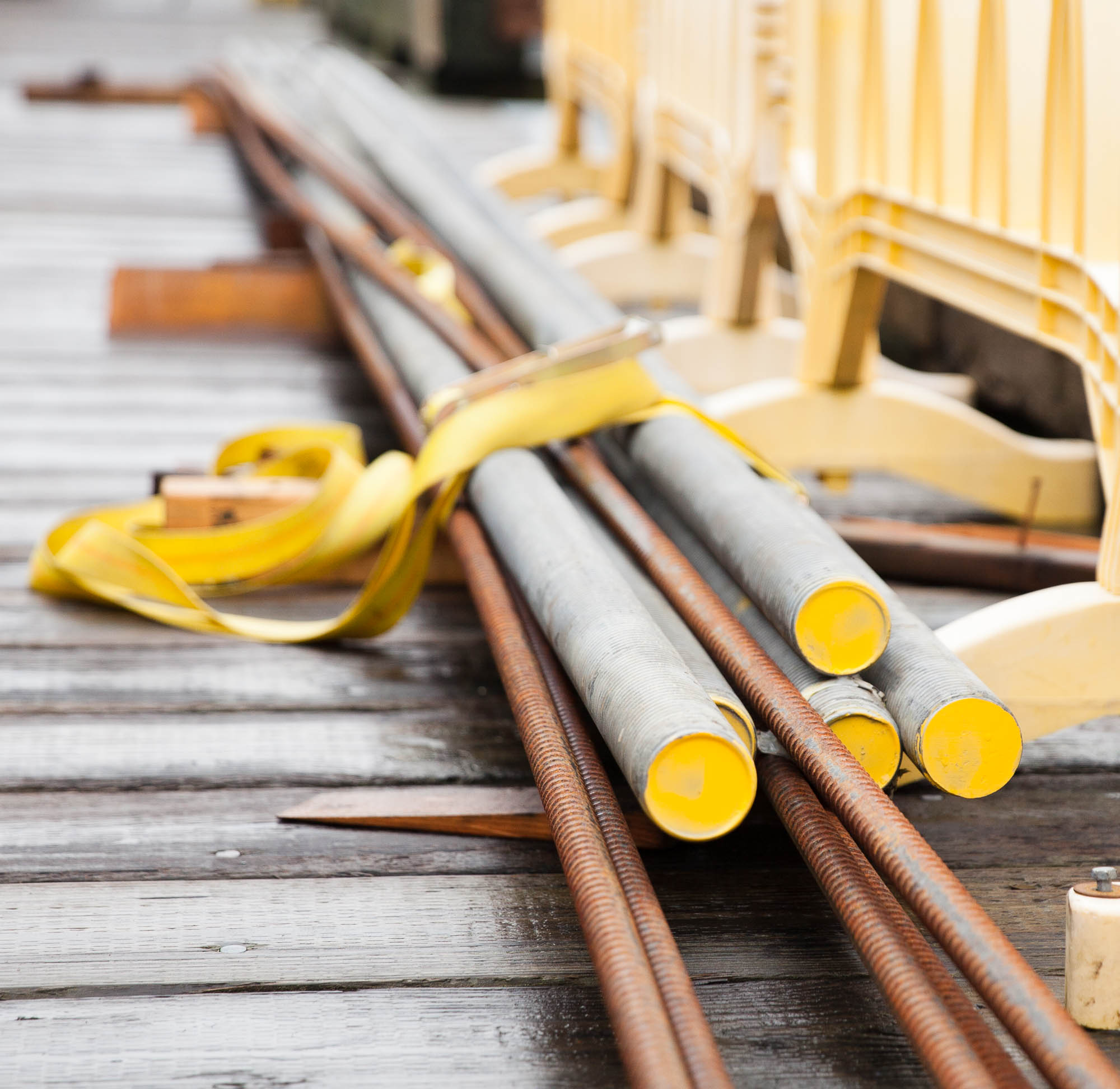
A 25-strong crew from the firm has been working double shifts drilling and driving piles in the daytime and welding in the evenings.

The final work should be wrapped up by May 7, project manager Monica Blanchard said.

Given all the activity on the water there’s not a lot of extra space for different ships to get in and out of the harbor.

Schaal said there was a lot of back and forth between different interests in settling on the final design.

Gastineau Channel has a busy summer season mixed with fishing boats, private yachts and cruise ships all competing for dock access in the summer.

This side of the dock is closer to shore than the south side and that’s because back in the design and we were working with stakeholders, especially the fishing fleet, they needed more access to the Taku Dock,” he said. “The original design was more parallel with the dock and there was going to be a kind of smaller area between the two.”

(Photo by David Purdy/KTOO)
Deputy Port Engineer Erich Schaal says the final design attempts to compromise between cruise ships and the commercial fishing fleet. Jan. 25, 2017. (Photo by David Purdy/KTOO)

The cruise ship industry says the new dock still isn’t as big as it should be.

We felt that the best design would be a new dock that handled two of the larger class ships,” said John Binkley, president of the Cruise Lines International Association Alaska, which represents companies sailing state waters. “The new class ships will be over 1,000-feet long. And we felt that it was wise to — in terms of an investment of this size — to have a dock that could handle two of those ships and leave the existing dock in place.”

Alaska is projected to receive larger vessels because bigger liners are now able to transit an expanded Panama Canal to arrive from the Carribean in the summertime, Binkley said, as well as a response to consumer demand.

“They like bigger ships, there’s more amenities, more variety of things to do on the ships and it’s also an economic reason,” he said. “The larger the ship just like with a bus or a car or an airplane, the more passengers you can get on, the better the economics are.”

The final project wasn’t without other local controversies.

For a quarter-decade the Blessing of the Fleet has been held at a dockside monument maintained by the Alaska Commercial Fishermen’s Memorial. The group challenged the city’s design in court  but its legal efforts were ultimately unsuccessful.

Memorial President Carl Brodersen said the court fights are over and now the board is focused on trying to find it a new home.

Until that time, the blessing ceremony is scheduled to go ahead in the midst of the expanded cruise ship terminal.

It is very hard for the two elements to co-exist and for both to function perfectly for their individual purposes. I mean we essentially do have an enormous wall of cruise ship in front of the memorial right now,” Brodersen said. “But the ceremony is over 25 years old — we can’t just stop doing it.”

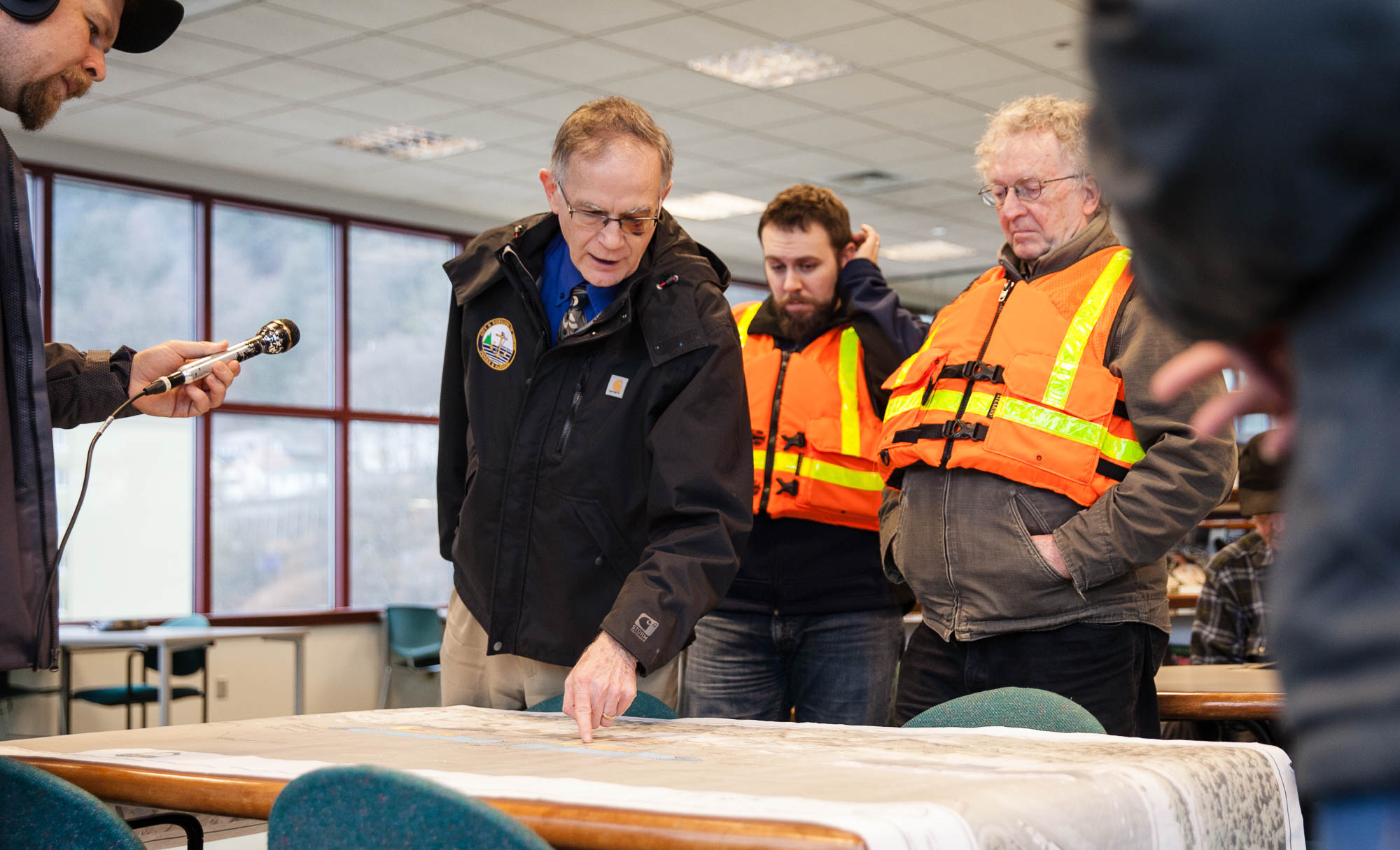
Standing next to the new floating berths under construction, Assembly member Jesse Kiehl attended a recent tour to see the progress.

He said the new cruise ship terminal will aid the local economy.

“I really like that we’re replacing this infrastructure for the next 50 years of this piece of Juneau’s economy,” Kiehl said. “Of course, the added benefit is that Juneau sales tax and property taxpayers aren’t footing this bill. This is coming from taxes that the industry and the passengers pay for the services that we provide.”

The first cruise ships are scheduled to arrive on May 1 in Juneau. They are the Nieuw Amsterdam and the Eurodam, both 935-foot-long, Signature-class vessels operated by Holland America Line.

Strong harvests, more oversight marked 2016 groundfish fisheries

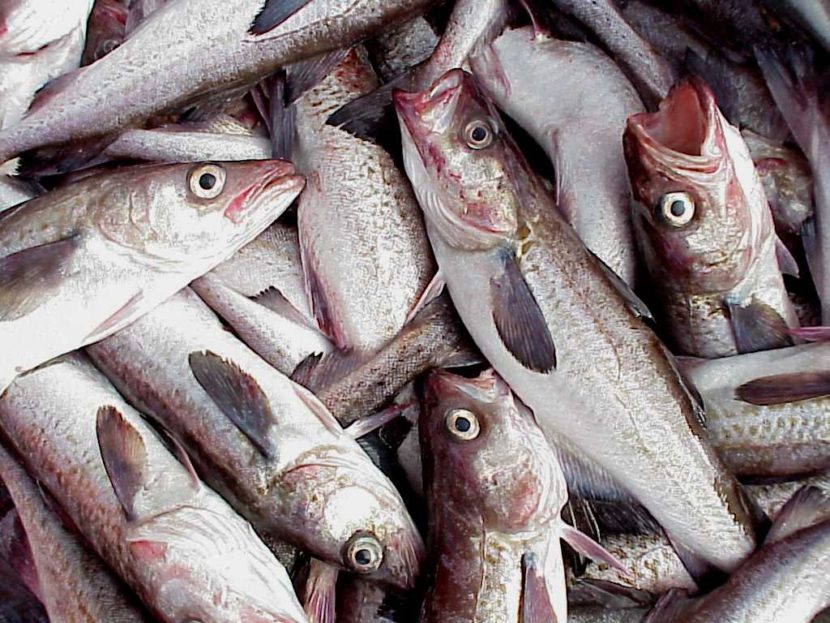
Alaska Pollock. (Photo courtesy of NOAA)

Last year was a good year overall for groundfish fisheries in the region.

With a few standout harvests and favorable proposals with the Board of Fisheries, managers are feeling optimistic heading into the new year.

The Alaska Department of Fish and Game oversees several groundfish fisheries within the Cook Inlet Management Area, which extends outside of Kachemak Bay to the north Gulf coast.

“These fisheries include Pacific cod, sablefish, a directed pelagic shelf rockfish fishery, lingcod, and a small commissioner’s permit Pollock fishery,” said Jan Rumble, Fish and Game area groundfish management biologist.

Pacific cod stood out in 2016 as it was open all year long for pot and jig gear in either a parallel or state waters fishery, Rumble said.

Despite the extended opening, the state waters fishery only reached 83 percent of its guideline harvest level, or GHL.

“The markets here in Homer are just really variable so sometimes it’s challenging for the pot fishermen to find markets that are stable,” she said.

In contrast, fishermen reached the GHL for the very first time in the directed pelagic shelf rockfish fishery.

“I think that this year’s salmon season was not very good, so we just had an increased amount of participation and people doing it who hadn’t done it before and trying it out,” she explained. “I really think it was because of other fisheries not performing as well. People need to pay their bills.”

Fishermen came within 800 pounds of the sablefish GHL last year with a total of six vessels and 35 landings. The GHL for that fishery varies with the acceptable biological catch, or ABC, for the Gulf of Alaska, which is based on the National Oceanic and Atmospheric Administration’s National Marine Fisheries Service stock assessment surveys. This year the GHL will go up by 6,000 pounds for a total of 54,000 pounds. The sablefish fishery will open July 15.

Portions of the sablefish and rockfish management plans were on the table at the Board of Fisheries meeting in Homer, which took place Nov. 30-Dec. 3, 2016.

One proposal more clearly defined how long fishermen have to turn in their logbooks after a landing. Another required prior notice of landing, meaning fishermen have to call ahead and let the department know they are coming in.

“Especially with the rockfish fisheries, which are long-lived species, it’s really critical for us to get samples from these rockfish and collect otoliths for age determination,” said Rumble. “Both those proposals were important for our management and we were really happy that those passed.”

Perhaps one of the biggest changes that came out of the meeting was to reduce the groundfish pot closure area. That should allow local Homer fishermen to have more areas to fish that are closer to town, Rumble noted.

The area was initially closed to protect Tanner crab stocks in Kachemak Bay.

“With our recent information that targets Tanner crab, this area of high Tanner crab abundance could be better defined, which is why we reduced the size of it,” she said.

Looking ahead to 2017, Rumble said she‘d be keeping her eye on the rockfish and sablefish fisheries. For Pacific cod, the focus will be on making sure fishermen once again have enough opportunity to reach the GHL. Above all, she said the priority would be once again monitoring stocks as well as they can with the tools they have.

Site notifications
Update notification options
Subscribe to notifications