Oceans

Asian tapeworm found in Alaska salmon off Kenai Peninsula coast

(Photo courtesy Jayde Ferguson)
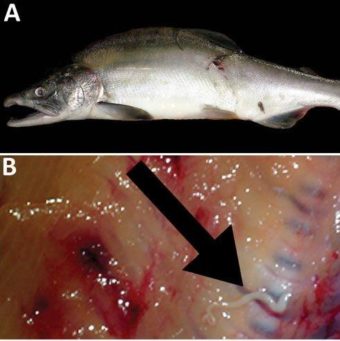
(Graphic by Jayde Ferguson/Alaska Department of Fish and Game)

Scientists recently announced they had found an Asian tapeworm species in pink salmon caught off the coast of the Kenai Peninsula.

In a recent study, a team of scientists identified a Japanese broad tapeworm larva in pink salmon caught in Resurrection Creek near Hope.

The study appears in the February issue of Emerging Infectious Diseases.
Humans can contract the tapeworm by eating raw or undercooked fish, but researchers say the risk is low.

For years, researchers have suspected the Japanese broad tapeworm was present on the Pacific Coast of North America.

With improved genetic techniques, they can now be sure.

The tapeworm larva, which was about 10 millimeters — or 0.39 inches — long, had burrowed deep into the fish’s muscle near the spinal cord.

Jayde Ferguson, a fish pathologist with the Alaska Department of Fish and Game and one of the study co-authors, said the Japanese species looks remarkably similar to another fish tapeworm already present in North America.

“There’s been growing evidence that it’s been here, it’s just the ability to differentiate it with the similar looking species has now improved with molecular testing,” said Ferguson.

Japanese broad tapeworm eggs were first found in wolf feces in British Columbia back in 2008.

This is the first time larvae in fish have been found in North America, but it’s likely this species has been present here for many years.

That’s why Ferguson says the name Japanese broad tapeworm is somewhat misleading.

“Pacific salmon are on both sides of the Pacific Ocean,” Ferguson said. “They’ve evolved on those sides for thousands and thousands of years as have their parasites.”

“There’s really no increased risk, no need to be alarmed.”

Since it was first identified in 1986, the tapeworm has been found in several salmon species, including sockeye, chum and pinks.

Tapeworm larvae in raw or undercooked fish can infect humans and other carnivores.

An estimated 2,000 people have contracted the tapeworm worldwide, mostly in northeast Asia.

The risk of contracting the parasite in Alaska, either from raw fish in a restaurant or at the store, is low. According to the Alaska Food Code, businesses must freeze all fish prior to serving to kill parasites.

To ensure the safety of personally caught fish, Ferguson said there are simple precautions to take.

“There are FDA guidelines on how to prepare your fish properly to basically avoid any risk of infection,” he said. “That would be freezing your fish in your standard household freezer for one week or cooking it to the standard recommended cooking temperature of 140 degrees Fahrenheit.”

For more information on common fish diseases and parasites in Alaska, consult the Alaska Department of Fish and Game’s illustrated handbook.

Alaska’s warming waters could slow coral growth, impacting fish

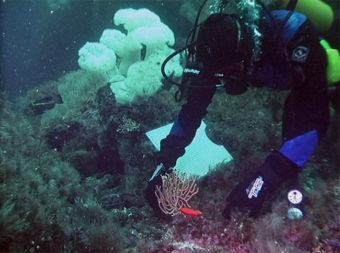
Bob Stone prepares to measure a tagged gorgonian coral colony Photo: Linc Freese, NOAA Fisheries
Bob Stone prepares to measure a tagged  coral colony. (Photo by Linc Freese/NOAA Fisheries)

The National Oceanic and Atmospheric Administration says warming ocean temperatures, due to climate change, could slow the growth of some Alaska coral. In a study released Thursday, scientists warned about the potential impact to fish, which take refuge in thickets of coral.

Bob Stone, a fisheries research biologist, dove in the waters of Southeast Alaska to photograph one group of sea fans, a type of coral. His team returned yearly for a period of five years, and they noticed it wasn’t growing as quickly as they anticipated.

“There is evidence from other studies around the world that show for some corals under warmer conditions, they do grow more slowly,” Stone said. “So it’s surprising to us but important because at least at the present moment our oceans are warming particularly in the Gulf of Alaska.”

Sea fans grow in the waters of British Columbia, spreading all the way to the Aleutian Chain. There are around 136 different types of coral in Alaska waters.

In the future, scientists think ocean acidification could threaten coral, too.

Menopause mystery: Why do female killer whales experience the change of life?

Orcas. (Creative Commons photo by Chis Michel)

Menopause is a mystery to evolutionary biologists, but new insights could come from a long-term study of killer whales.

In these whales, the explanation may lie in a combination of conflict and cooperation between older and younger females, according to a report published Thursday in the journal Current Biology.

Killer whales are one of only three species known to have menopause — the others are pilot whales and humans. Researchers have long wondered why it was that these few species evolved to have females that spend so much of their lives unable to have babies.

Killer whales start reproducing around age 15, but stop having calves in their 30s or 40s, even though they can live for around a century.

A team led by behavioral ecologist Darren Croft of the University of Exeter decided to search for answers with the help of an unusual long-term study of killer whales in the Pacific Northwest. There, since the 1970s, researchers have carefully collected information on the births and deaths of individual whales that live in family groups.

Contained within the data is an intriguing clue about why female whales may stop reproducing later in life.

When older females reproduce at the same time as their daughters, who live alongside them, the calves of the older mothers are nearly twice as likely to die in the first 15 years of life. But when older mothers had calves in the absence of a reproducing daughter, their calves did just fine.

“It’s not that older mothers are bad mothers, that they’re not able to raise their calves as younger mothers,” says Croft. “It’s that when they enter into this competition with their daughters, they lose out and their calves are more likely to die.”

The competition may center on access to food, says Croft, because there’s good reason to believe older females feel more pressure to share their precious fish with the others around them.

That’s because, in killer whales, females mate with males from other groups but then rejoin their families. That means when a new calf is born, its father is not around, and females start their lives in a situation where their relatedness to the group is rather low.

As a female grows older and starts having calves that stay with her, however, she develops more kinship ties to those around her. “It may be that older females are more likely to share, and younger females are less likely to share food,” says Croft. That would mean younger females would have more resources to lavish on their own calves.

It’s clear that in these whales, older females play an important role in the survival of not just their own calves, but all of the family members they live with. “If an old female dies, her son’s risk of dying in the year following her death is over eight times higher than if his mother was still alive,” says Croft, “and these are adult sons, these are not juveniles, these are 30-year-old, fully grown males.”

The idea that older females safeguard and enhance their genetic legacy by protecting and providing for their children and grandchildren has been an influential explanation for why menopause evolved. It’s known as the Grandmother hypothesis, and was developed by anthropologists who studied hunter-gatherer cultures.

But Croft thinks that alone isn’t enough to account for menopause, because other long-lived, social species, like elephants, have older females that help their group but continue to bear young until the end of life. “Just the fact that these old females can store information and share that with the group and increase their survival doesn’t explain why they stop reproducing,” says Croft.

Proponents of the Grandmother hypothesis, however, may not be so convinced that intrafamilial conflict plays an important role.

Anthropologist Kristen Hawkes, at the University of Utah, says the killer whales are fascinating, but that they’re hard to study. “They’re doing all kinds of stuff where you can’t see it, and even to get demographic data is just so tricky, because they’re all underwater and they’re long-lived,” she says.

She points to one recent study on food-sharing in killer whales that found older females share fish with their older adult sons, perhaps to maximize the males’ ability to sire more babies.

If that’s the case, she says, “it’s not the older females and younger females in competition, it’s the older females contributing to the enormous success of their sons, and then those baby whales are all born somewhere else. They’re not competing, because their moms are elsewhere.”

Copyright 2017 NPR. To see more, visit http://www.npr.org/.

Fukushima radiation yet, and unlikely, to affect Alaska seafood

Sockeye salmon delivered in Bristol Bay. (File photo by KDLG)

Alaskan seafood remains free of detectable Fukushima-related radiation, according to the Alaska Department of Environmental Conservation.

The department along with other state, federal and international agencies has been testing Alaskan seafood since 2013.

After the 2011 Fukushima nuclear disaster in Japan, food safety authorities, including the FDA, reported it would be highly unlikely that radiation would affect Pacific seafood in the U.S.

Marlena Brewer, the spokeswoman for the Department of Environmental Conservation, said there was still significant public concern in Alaska.

“Fishing is such a huge part of our lives here, so I think that there was this overwhelming concern,” Brewer said. “They wanted to see Alaska specific data.”

Food safety inspectors were already collecting samples around Alaska as a part of normal food safety operations.

In 2013, they began collecting additional samples to send to the FDA lab in Massachusetts to test for Fukushima-related radiation. Species tested include king, chum, sockeye and pink salmon; halibut; pollock; sable fish; herring; and Pacific cod.

In 2016, Alaska was selected as the first state test site for implementation of a field deployable gamma-ray analysis system to analyze fish for radionuclides. The system is housed in Anchorage.

The FDA continues to analyze the results, but now the samples are tested in-state.

“The idea is that, in the unfortunate event that there’s another incident like Fukushima, the FDA would be able to deploy these instruments to other states so that they could get the real-time monitoring data instead of kind of scrambling after the fact and trying to coordinate these sampling efforts like we have,” Brewer said.

Brewer said that they will continue to test Alaska seafood specifically for Fukushima-related radiation for at least one more year. None has been detected since testing began.

Warming oceans could boost dangerous toxin in your shellfish dinner

West Coast crab fishermen just ended an 11-day strike over a price dispute. But a more ominous and long-term threat to their livelihood may be on the horizon. A new study in the Proceedings of the National Academy of Sciences has found a link between warming ocean conditions and a dangerous neurotoxin that builds up in sea life: domoic acid.

Seafood lovers got a glimpse of that threat in 2015, when record high ocean temperatures and lingering toxic algae blooms raised the domoic acid in shellfish to unsafe levels, shutting down the West Coast Dungeness crab fishery from Alaska to Southern California for several months. Though less dramatic, the problem emerged again this season, when harvesting was again delayed for portions of the coasts.

Domoic acid is a toxin produced by Pseudo-nitzschia, a micro algae which can accumulate in species like Dungeness crab, clams, mussels and anchovy. It can be harmful to both humans and wildlife, including sea lions and birds. Remember the famous Alfred Hitchcock movie, The Birds? It was inspired by a real-life incident of California seabirds driven into a frenzy by the neurotoxin.

Although we’re starting to hear about domoic acid more often, it’s been on the radar of public health officials since a Canadian outbreak in 1987 killed three and sickened over 100. In mild cases, it can cause vomiting, diarrhea and abdominal cramps. Severe cases can cause trouble breathing, memory loss, and even coma or death.

In the case of Dungeness crabs, the food chain looks like this: The phytoplankton Pseudo-nitzschia produces the toxin domoic acid during an algae bloom. Zooplankton and filter feeders, like clams and mussels, then eat that phytoplankton. (Interestingly, not all shellfish react the same way. Mussels, for example, are able to rid themselves of the toxin within a few weeks, while domoic acid may linger in clams for several months, even up to a year.) Those delicious Dungeness crabs we like so much have a taste for clams, which is where domoic acid can be passed up the food chain to us humans.

Officials are able to test for unsafe levels, keeping tainted seafood out of restaurants and away from seafood counters, but scientists haven’t been able to predict when natural algae blooms may take a toxic turn — until now.

“The record of domoic acid is now 20 years long, allowing us to look at it from a different perspective than anyone has previously,” says Morgaine McKibben, a Ph.D. candidate at Oregon State University and lead author of the new study.

The researchers looked at long-term data collected from Oregon razor clams, copepods (zooplankton that drift with the currents and are studied to predict salmon runs), and recurring climate patterns known as the Pacific Decadal Oscillation and El Nino Southern Oscillation. And they were able to establish that domoic acid events, like those that have been impacting the West Coast Dungeness crab fishery, are strongly related to warm phases in the ocean.

“The most important takeaway from the study is that it’s telling us about changes in the food web based on long-term observations of changes in the oceans. It’s a very zoomed out view of how the food web responds to natural changes to ocean conditions. That’s very important when you talk about resource management,” says McKibben.

These types of long-term records are somewhat rare in oceanography, she says, because “it’s hard to find funding to keep consistent observations like this going.”

And a future with more frequent domoic acid events seems likely, says says Bill Peterson, a NOAA senior scientist and co-author of the study. “We’re having more and more of these warm ocean events and we’re going to have more domoic acid blooms each year. It might become a chronic problem,” he says.

That paints a troubling picture for crab fishermen like Bob Eder of Newport, Ore. While domoic acid might go away for a year or two as a problem, it “is something we’ll now be dealing with for a long time,” he says.

He also worries about how future domoic acid events could impact exports — critically important to boosting the overall price of whole crabs. While Americans typically eat only the meat from the crab, Chinese consumers also eat what’s known as the “butter” (or guts) of the crab, where domoic acid tends to be more concentrated.

Officials from the California Department of Public Health say they test year-round for toxic phytoplankton at more than 100 sampling sites along the entire California coastline, and that 2015 was the first year domoic acid was found in crab meat. Oregon and Washington have similar sampling strategies, and have collaborated with California on Dungeness crab testing over the last two years.

But Peterson thinks states vulnerable to domoic acid events should be doing even more testing.

“They should sample more often and over a wider … area,” says Peterson. “Crab harvests are a huge money maker on the West Coast. You can’t have people think they’re going to get sick from eating crabs. Pretty soon [states] are going to have to sample more often and more places to keep better tabs on what’s going on in the ocean.”

Patrick Kennelly, chief of the food safety section for the California Department of Public Health, says he’s confident the state’s monitoring program is strong and able to ramp up as needed. He notes that officials have already started testing Dungeness crab months before the season begins.

Copyright 2017 NPR. To see more, visit http://www.npr.org/.

Entangled humpback whale rescued off Prince of Wales Island

A group of local good Samaritans banded together this week to help a humpback whale that had become tangled in a barge anchor cable off Prince of Wales Island.

A tangled humpback whale was rescued by a group of Ketchikan good Samaritans this week. (Photo by Oscar Hopps)

Oscar Hopps, of Ketchikan-based Alaska Commercial Divers, said the whale was discovered by Olsen Marine crew members on Wednesday.

“Apparently, what had happened is the humpback whale had been feeding in the Nutkwa Inlet for some time – a lot of krill around there,” Hopps said. “He must have been bubble feeding when he came up and bit down on this inch-and-a-quarter cable that was going to a 7,000-pound anchor.”

The whale must have spun, Hopps said, because the cable wrapped around the top half of the marine mammal’s head. The cable then twisted up on itself, forming almost a noose.

Hopps estimated the whale had been tangled for a few days before it was discovered. A rescue effort was organized quickly by Rick Olsen, bringing together Olsen Marine, Alaska Commercial Divers and Seawind Aviation crews.

They initially thought someone would have to dive down to remove the cable from the anchor. Hopps said they were able to use the cable to slowly coax the whale to the surface, next to the dive boat.

“We were able to get hold of the cable from underneath the whale and cut it,” he said. “Then from a small boat, we were able to slowly unwind the cable from itself and then using a system of pulleys, just kind of slowly pulled the cable off the whale.”

Hopps said the whale suffered minor wounds — the cable luckily missed its eyes. It seemed pretty tired after the ordeal, though, and stuck around for a while, resting on the surface.

Hopps said the whale seemed to understand that the crews were there to help.

“He was a little temperamental when we first started pulling him up, but as soon as he started feeling that slack of the cable, he sat there quietly and let us take care of him,” he said. “I’m really glad we were able to.”

Hopps says it was a meaningful experience for the rescue crews, too.

“It was a once-in-a-lifetime experience, for sure,” he said.

National Oceanic and Atmospheric Administration officials are aware of the rescue, and have asked for photographs of the whale so they can identify it, Hopps said.

According to the NOAA Fisheries website, entanglements are one of the leading causes of whale deaths. The agency has even produced a podcast giving tips on how to disentangle a whale — along with warnings about the potential danger of getting close to such a large animal.

Site notifications
Update notification options
Subscribe to notifications