Oceans

Fishing rule aims to do for all marine mammals what it did for the dolphin

The vaquita is a small porpoise found only in the northern Gulf of California, in Mexico. Today, the species is critically endangered, with less than 60 animals left in the wild, thanks to fishing nets to catch fish and shrimp for sale in Mexico and America. The animal is an accidental victim of the fishing industry, as are many other marine mammals.

But a new rule that takes effect this week seeks to protect marine mammals from becoming bycatch. The rule requires foreign fisheries exporting seafood to the U.S. to ensure that they don’t hurt or kill marine mammals.

If U.S. authorities determine that a certain foreign fishery is harming these mammals, the fishery will be required to take stock of the marine mammal populations in places where they fish, and find ways to reduce their bycatch. That could involve not fishing in areas with high numbers of marine mammals. Fisheries will also have to report cases when they do end up hurting mammals. This is what American fisheries are already required to do under the Marine Mammal Protection Act.

Up to 90 percent of seafood eaten in the U.S. is imported, most of it shrimp, freshwater fish, tuna, and salmon. The goal of the new rule is to ensure that seafood coming into the country didn’t harm or kill marine mammals.

But can this new rule protect the vaquita?

Zak Smith, a senior attorney with the Marine Mammal Protection Project at the Natural Resources Defense Council, thinks so. The vaquita is kind of a poster child for what happens when you don’t have this law in place,” he says.

To understand the potential impact of the rule, Smith says, we should consider the laws that saved dolphins from tuna fisheries. For decades, dolphins – which swim with schools of tuna – were accidentally (and sometimes deliberately) killed by tuna fisheries. According to NOAA, over six million dolphins have been killed since the beginning of tuna fishery. Enacted in 1972, the MMPA required tuna fisheries to take measures to stop harming dolphins. Then, in the 1980s, the act was amended to ban the import of tuna from foreign fisheries that harmed dolphins. In 1990, the U.S. passed another legislation – the Dolphin Protection Consumer Information Act – that spelled out requirements for “dolphin-safe” labeling on all tuna sold in America.

Smith says these laws have helped reduce dolphin deaths. But the new rule goes even further, he says, because it applies to all kinds of seafood and all marine mammals, not just tuna and dolphins.

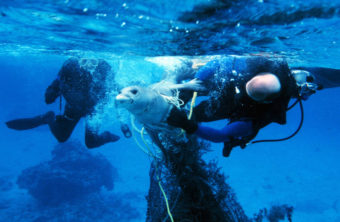
Divers release a seal from fishing gear. Getting entangled in active or abandoned fishing gear often leads to injury or death in marine mammals. (Photo by NOAA Marine Debris Program/Flickr)

As an American consumer, “I’ll know that anything I purchase in the U.S. met U.S. standards,” he says.

A 2014 analysis from the NRDC estimated that hundreds of thousands of marine mammals are injured or killed every year by fisheries around the world. The U.S. government’s independent Marine Mammal Commission says unintentional encounters with fishing gear represent “the greatest direct cause of marine mammal injury and death in the United States and around the world.”

So the new rule could help protect many marine mammals worldwide, says John Henderschedt, the director of the National Oceanic and Atmospheric Administration’s (NOAA) Fisheries Office of International Affairs. He says in some fisheries around the world, fishermen use nets that whales and dolphins easily get caught in. And some fishermen won’t take the time to make sure entangled marine mammals are released safely, he says.

He adds that for some fisheries, the new rule will make them take stock of their marine mammal populations, and think about how to protect those animals for the very first time.

The new rule is good for American fisheries too, says Ryan Steen, a lawyer representing the Hawaii Longline Association. “If U.S. fisheries are going to be subject to the standards that are set by the [Marine Mammal Protection Act], then I think it’s only fair that their foreign competitors would also be subject to the same standards if they’re delivering fish into U.S. markets,” he says. “It’s the fair thing to do and it’s the right thing to do.”

But implementing the new rule could be tricky, cautions Linda Fernandez, an environmental economist at Virginia Commonwealth University. For example, the World Trade Organization could object to any bans on imports from a seafood exporter, she says.

Fernandez says the push for dolphin-safe tuna holds a good lesson in this. In 1990, the U.S. banned tuna imports from Mexico because Mexican tuna fisheries didn’t meet American standards for protecting dolphins. The decision upset Mexico and it complained to the General Agreement on Tariffs and Trade (GATT), the predecessor of the World Trade organization. A GATT panel concluded that the U.S. was wrong to embargo Mexico imports simply because it didn’t like the way the tuna was harvested.

“In that case, the U.S. was unfairly treating trade partners based on how …they harvested the product,” Fernandez says.

What the U.S. could do without violating international trade agreements, was label tuna as either “dolphin-safe” or not.

It gave seafood exporters an incentive to get a “dolphin-safe” label, she says. Judging from this history, she says, the WTO will be fine with a labeling system (which the new rule doesn’t require), but it probably won’t be fine with an embargo, which could happen under the new rule.

Cost is also a big concern in implementing the rule, according to Lekelia Jenkins, a marine conservation expert at Arizona State University and a former NOAA employee. Jenkins says her number one concern is how much money NOAA will have to enforce it.

“We can write laws as much as we want,” she says. “It does not mean that there will be appropriations to fund those laws.

Rob Williams, a marine conservation fellow at the Pew Charitable Trusts, says the amount of resources that the U.S. invests will determine the effectiveness of the new rule. Some resources, he says, should be used to help other countries implement U.S. conservation measures. He says it took the U.S. 40 years to refine these measures. “We should be exporting those lessons learned so that other countries don’t have to take 40 years to learn,” he says. Otherwise, he says, “countries presumably will just find other markets for their seafood.”

Copyright 2017 NPR. To see more, visit http://www.npr.org/.

Juneau’s cruise ship head tax spending pitches due next week

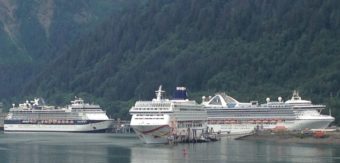
Three cruise ships dock in downtown Juneau on July 14, at the height of the tourist season (Photo by Ed Schoenfeld/ CoastAlaska News)
Three cruise ships dock in downtown Juneau on July 14, at the height of the tourist season. (Photo by Ed Schoenfeld/CoastAlaska News)

Proposals to spend Juneau’s cruise ship passenger fees are due next Monday, and so far, the city hasn’t received many pitches.

The city charges a $5 per passenger tax on large vessels that stop in Juneau. With about a million cruise ship passengers a year, it generates about $5 million. Under federal law, that money can only be spent on projects and programs that address both cruise ship passengers’ safety and accessibility.

Susan Phillips, an executive assistant to the city manager, said, as of Tuesday, the city has only received nine project proposals from five entities. The submissions period opened Dec. 2.

Typically, the city receives dozens of pitches for things like seasonal emergency services personnel, waterfront infrastructure improvements, crossing guards and more public restroom cleaning and maintenance.

Meanwhile, Cruise Lines International Association’s lawsuit alleging Juneau misspends that money is pending in federal court.

Neither the city attorney nor a representative of the cruise line association could be reached for comment, but Juneau Deputy City Manager Mila Cosgrove said the case is in the discovery phase.

Cosgrove said the looming lawsuit won’t affect the spending process this year.

“Business as usual. We’ll just move forward with using the same process we’ve always used, as you’re aware,” Cosgrove said. “It’s a public process where we ask people to submit, and then we go through — traditionally, we have met with industry representatives to discuss the proposals and hear their thoughts about them, and we will do the same thing this year.”

Juneau’s Marine Passenger Fee Proceeds Committee vets the initial list of spending proposals. Its recommendation go to the Juneau Assembly, which gets the final say on the projects that make the cut. The assembly discussion is expected in the spring for the budget year that begins in July.

Russian Military Plane, With 92 Aboard, Crashes Into Black Sea

A search and rescue team attends to the crash site of a Russian Defense Ministry plane after the Tupolev Tu-154, with 92 people on board, fell off of radar over the Black Sea early Sunday. Artur Lebedev/Artur Lebedev/TASS
A search and rescue team attends to the crash site of a Russian Defense Ministry plane after the Tupolev Tu-154, with 92 people on board, fell off of radar over the Black Sea early Sunday.
Artur Lebedev/Artur Lebedev/TASS

A Russian military plane carrying 92 passengers has crashed into the Black Sea, according to local media, citing the Russian Defense Ministry.

The ministry says 84 passengers and 8 crew members were on board, reports the Associated Press, and that emergency teams have been dispatched.

Russian state TV reports the Tu-154 passenger plane dropped off from radar about 20 minutes after taking off from Sochi’s Adler airport at 5:20 a.m. local time on Sunday.

The Defense Ministry says wreckage debris has been found about a mile off the Sochi coast. So far, rescuers have found one body and personal documents belonging to some of the passengers.

As NPR’s Lucian Kim tells our newscast from Moscow, the plane was reportedly carrying members of a military choir, the famed Alexandrov Ensemble, who were to perform in a holiday concert for Russian service members deployed in Syria.

Defense Ministry spokesperson Igor Konashenkov said soldiers and nine reporters were also on board the plane, notes the BBC.

A respected Russian charity doctor, Yelizaveta Glinka, was among the passengers, says the AP.

“Glinka, known as Doctor Liza in Russia, has won broad acclaim for charity work that included missions to the war zone in eastern Ukraine.

“Her foundation, Spravedlivaya Pomoshch, or Just Help, says she was accompanying a shipment of medicines for a hospital in Syria.”

There’s no indication of any known survivors.

The cause of the crash remains unknown, but Russian officials dismiss terrorism on the basis that the plane is military-operated.

Viktor Ozerov, head of the defense affairs committee at the upper house of Russian parliament, said, “I totally exclude” the notion of an attack leading to the crash, reports the AP, citing his remarks carried by state RIA Novosti news agency.

Lucian adds that Russian commercial airlines have been gradually phasing out the Soviet-designed three-engine aircraft for more modern models, but, as the AP notes, the military has continued to use them.

Copyright 2016 NPR. To see more, visit http://www.npr.org/.

Arctic Slope Regional Corp: Obama acts in our name, ignores our needs

The Arctic Slope Regional Corp. building in midtown Anchorage in September 2007.
The Arctic Slope Regional Corp. building in midtown Anchorage in September 2007. (Creative Commons photo by chuck t)

President Obama cited subsistence and the needs of Alaska Natives yesterday as part of the reason he decided to block future oil and gas lease sales in Arctic waters. Some Alaskan Natives welcome the resource protection. But the Arctic Slope Regional Corp. said the president didn’t consult with its members and is ignoring the real needs of the Inupiat people.

To see how offshore development would help the people of the region, ASRC Executive Vice President Tara Sweeney said to look at what happened when Shell was exploring in the Chukchi Sea.

Tara Sweeney is the executive vice president for external affairs of the Arctic Slope Regional Corp.
Tara Sweeney. (Photo courtesy Arctic Slope Regional Corp.)

“Our communities were working,” Sweeney said. “Our shareholders were marine mammal observers. We were providing services to the industry in Barrow, in Wainwright, out of Point Hope and in our communities. And absent any of those types of opportunities, people are looking for work.”

As requested by national environmental groups, Obama put the entire Chukchi Sea and nearly all of the Beaufort Sea in what’s known as a 12(a) withdrawal, making the areas unavailable for any future lease sale. Advocates of the move say the withdrawal can’t be undone by the next president.

Industry associations dispute that, and Alaska’s all-Republican congressional delegation said it’s already laying the groundwork to cancel the withdrawals.

Sweeney said the president is thwarting the needs of Arctic people to have things like toilets, running water and a healthy economy. It’s especially galling to her that the White House, according to Sweeney, made the withdrawals without discussing it with ASRC or other Native groups.

“It’s easy for someone in New York or Washington, D.C. — an E-NGO or a limousine liberal — to sit there and say ‘leave the oil in the ground’ when they have access to modern amenities that are considered luxuries in the U.S. Arctic,” Sweeney said.

A White House official said Native corporations and other stakeholders were consulted over several years, not directly for this decision, but when the Interior Department was considering the Arctic for its five-year offshore leasing plan.

A recent poll, sponsored by a pro-drilling lobby, found a large majority of Alaskans support Arctic offshore development. Among Native respondents, the pollsters found 72 percent in favor.

But that’s not everyone.

“I’m very, very grateful for everybody’s concern for all the Arctic, the Beaufort and Chukchi,” Ole Lake said. Lake works for the Alaska Wilderness League in Anchorage.

Ole Lake mans the Alaska Wilderness League table at the 2015 Alaska Federation of Natives convention.
Ole Lake mans the Alaska Wilderness League table at the 2015 Alaska Federation of Natives convention. (Photo courtesy Alaska Wilderness League)

Lake is originally from Hooper Bay. It’s well south of the North Slope, but he said Yupik and Cupik cultures like his depend on harvesting the creatures that pass by on their way to the Arctic, and he wants to protect that way of life.

“The coastal people have been witness to that magnificent migratory route for thousands and thousands of years and have grown with it,” Lake said.

Lake believes lots of Native people are probably happy the president decided to keep oil rigs out of Arctic waters, but they’re too busy with subsistence activities to make their views known.

Halibut catch for Southeast Alaska could drop for 2017

Halibut come in at Juneau's Taku Fisheries. (Photo courtesy NOAA Fisheries)
Halibut come in at Juneau’s Taku Fisheries. (Photo courtesy NOAA Fisheries)

Managers of halibut in the Pacific will be setting catch limits in January and could be considering a small decrease for commercial and guided sport fishing fleets in Southeast Alaska.

The International Pacific Halibut Commission held its interim meeting at the end of November and scientists presented the latest information on catches and stock estimates for the valuable bottom fish. The IPHC oversees commercial, sport and subsistence halibut catches in the U.S. and Canada from California to Alaska.

A quantitative scientist with the commission, Ian Stewart, said researchers are seeing a steady, slow increase in the halibut stock coast wide.

“It’s pretty consistent in what we’ve been predicting over the last four stock assessments,” Stewart said. “It’s not a huge increase but just a gradual build up of the spawning biomass. The real highlights for this year is we’re seeing some bycatch reductions and the harvest policy results are somewhat more variable across areas.”

Biomass is a word for the total weight of the flat fish estimated to live on the ocean floor coast-wide.

The commission does annual stock assessment fishing to come up with an estimate of halibut.

Stewart explained that this year IPHC staff changed the way they calculate the abundance of the fish and where those fish are located based on those surveys.

“And that’s improved our estimates but it has changed our perception of just exactly how the biomass is distributed around the stock,” he said. “And in part it’s led to our understanding that there’s a bit more biomass in the central part of the stock then we previously estimated and a bit less on the eastern side of the stock. But then superimposed on top of that are also some differences in what we’ve seen in the survey the last few years and this year in particular.”

Each year commissioners from the U.S. and Canada decide on overall catch limits for commercial and guided sport fleets, as well as the way that catch is divvied up between parts of the Alaska coast, British Columbia and the western U.S. Halibut commission staff at the interim meeting presented several alternatives for catch limits for 2017.

One would have an overall decrease in fishing coast-wide, with most of that decrease coming from area 2B in British Columbia. Area 2C Southeast Alaska and area 3A, the central Gulf would see small cuts to the commercial and guide sport fishing catch under that alternative.

Another option would continue the same level of fishing pressure that fleets have enjoyed in recent years.

That alternative would translate to catch increases for the upcoming year for the central Gulf and western parts of Alaska but a decrease for Southeast Alaska and British Columbia.

The commission will decide on catch limits, other proposed changes to management and season length at an annual meeting January 23rd-27th in Victoria, BC.

Alaska Volcano Observatory lowers Bogoslof volcano aviation alert

Update | 3:24 p.m. Wednesday

A volcano in the eastern Aleutians erupted suddenly Tuesday afternoon prompting the Alaska Volcano Observatory to issue its highest alert level for aviation.

The alert has since been downgraded.

Bogoslof volcano is on an uninhabited island 60 miles northwest of Unalaska.

Observatory scientist Michelle Coombs said several pilots reported seeing an ash cloud about 34,000 feet.

She said satellite data show a short-lived explosion occurred about 4 p.m., but the activity has since died down.

Coombs says the volcano seems to have erupted because it was “gassy.”

“It looked like it had a lot of gas in it — a lot of sulfur gas and probably water gas,” Coombs said. “(The eruption) might have been the opening event in possible the eruptive sequence.”

An eruptive sequence that might include new land forming.

“People have seen that the shape of the island has changed,” she said. “New little side islands have grown up and then are sometimes destroyed, by explosions or wave action and erosion.”

The area is very dynamic. Coombs said over the years the shape, height and number of islands have changed.

Since the 1700s, Bogoslof has erupted eight times and Coombs said it’s hard to know how long this eruption will last.

Eruptions are like personalities.

“Some volcanoes tend to erupt have a big explosive eruption and then go back to sleep,” she said. “A lot of volcanos have more longer-lasting, low-level activity.”

She said long eruptions — lasting weeks or months — are common in Alaska.

Because there is no-ground based monitoring equipment on Bogoslof volcano, the observatory cannot predict future eruptive activity. Instead, they are monitoring from afar — using satellite images and other data for indications of significant seismic activity.

If this eruption continues, then it could impact aviators, mariners and drop ash on nearby communities.

Prior to this, the last recorded eruption of Bogoslof was in 1992 and lasted nearly a month.


Original story | 8 a.m. Wednesday

Volcano in the eastern Aleutians erupted suddenly Tuesday

A volcano in the eastern Aleutians erupted suddenly Tuesday afternoon.

The Alaska Volcano Observatory says several pilots reported seeing an ash cloud about 34,000 feet above Bogoslof volcano.

Bogoslof volcano is on an uninhabited island 60 miles northwest of Unalaska.

The observatory says a short-lived explosion occurred at 4 p.m. Tuesday, but the activity has died down.

For now, the observatory and U.S. Geological Survey has raised the aviation code to “red” and the alert level to “warning.”

Because there is no-ground based monitoring equipment on Bogoslof volcano, the observatory cannot predict future eruptive activity. Instead, they will monitor from afar — using satellite images and other data for indications of significant seismic activity.

Prior to this, the last recorded eruption of Bogoslof was in 1992.

Site notifications
Update notification options
Subscribe to notifications