Oceans

Ask the Energy Desk: Are plastic bag bans better for the environment?

via GIPHY

Bans on plastic grocery bags have been cropping up across Alaska’s remote communities. Cordova’s ban went into effect last year.

But so far, the larger cities in the state have yet to adopt one.
Penny Gage, a resident of Anchorage, has a different kind of skeleton in her closet.

“I have a large collection of plastic bags at home, and I feel very bad,” Gage said. “I have gotten out of the habit of bringing my fabric bags to the store. And we use them for trash bags or other uses. I find myself using them for everything.”

Gage used to live in Washington, D.C. So, she’s no stranger to a ban on single-use plastic bags.

She said Anchorage has some recycling options for plastic bags.

Still, she wonders if nixing it from the checkout line altogether could be better for the environment?

“Yeah, I’m curious. Does it really help if we get rid of plastic bags?”

Around the state, the opinion on plastic bag bans — and its effectiveness — seems to differ just as much. 

Cordova's plastic bag ordinance is helping displace over a million plastic bags a year. (Photo courtosy of the Eyak Preservation Council)
Cordova’s plastic bag ordinance went into effect in October 2016. (Photo courtesy of the Eyak Preservation Council)

Homer’s City Council passed a plastic bag ban ordinance, only to have it overturned months later by a popular vote.

Fairbanks considered a tax on plastic bags, but there was community opposition.

“You have to decide in your community in your culture what’s the most important thing for you. In Cordova, it’s that we live and die by the ocean,” said Emily Stolarcyk, the program manager of the Eyak Preservation Council, an environmental advocacy nonprofit.

Cordova has a population of about 2,500.

Stolarcyk said in the past, the community was using over a million plastic bags a year. That’s particularly troubling when you consider the town’s main economic driver: commercial fishing, she said. She points to studies on microplastics winding up in seafood as a reason to be concerned.

So, Stolarcyk set out to change that.

Her organization gifted reusable bags to every household in Cordova.

Within a few years they had enough support to rally around a ban.

“It’s better when it takes a long time because it doesn’t shock people either when it happens,” Stolarcyk said. “People need time to get used to the idea of change.”

One thing that didn’t change, though, is that grocery stores in Cordova still give out bags. But now, it’s biodegradable one’s.

Cordova’s plastic bag ban is similar to one passed in Bethel about seven years ago.

But according to Bethel’s landfill manager, David Stovner, bags are still flying around.

“Well, at the landfill, we got a lot of wind here. We’ve got fences but that doesn’t stop ’em all,” Stovner said. “We’ve got brush piles that catch a lot of the debris. But still, there’s a lot of it that winds up on the tundra.”

Jennie Romer, a lawyer who’s worked on plastic bag laws in California and New York, said plastic bag bans work best when there’s a fee involved.

In other words, if you forgot your reusable bag, you pay 5 to 10 cents for a paper one.

A similar ordinance in New York City recently failed to receive enough support.

Still, Romer thinks those types of laws are better for the environment.

“An example of it not being better for the environment is the allowance of biodegradable plastic bags,” Romer said.

Biodegradable bags are typically made from plant-based material or cornstarch, rather than petroleum. But the rate at which the breakdown happens depends on the temperature and moisture in the air.

A grocery store manager in Bethel I spoke with said paper bags are too heavy to be affordably shipped to the city, which is off the road system.

Romer thought the fee component could help that pencil out.

But what about the bigger Alaska cities with plastic bag recycling? Romer said unless that bag is squeaky clean: 

“There aren’t really any successful curbside recycling programs for plastic bags. And so, there isn’t a way to get them to be made into other bags,” Romer said. “The majority of plastic bags end up in the landfill.”

But, getting back to the original question, I asked Mary Fisher, the director of Alaskans for Litter Prevention and Recycling, are plastic bag bans better for the environment?

“Probably … I guess plastic bags are not good for the environment, and neither is plastic anything or paper or aluminum cans or abandoned boats,” Fisher said. “You could ban everything, I guess, and it would be good for the environment. But us as humans, we’re not going to do that.”

I catch Penny Gage, our question-asker, up to speed.

“Yeah, this is not a black-and-white issue. That’s for sure,” Gage said.

Gage said now that she’s more aware of the issue, she plans to use her fabric bags more.

“I actually want to put a sticky note in my car to remind me,” Gage said.

For now, what Alaskans carry their groceries in is still a personal choice.

With the exception of a few small communities, most cities in the state don’t want to tell people how to bring their groceries home.

Questions raised over new tanker escort tugs for Prince William Sound

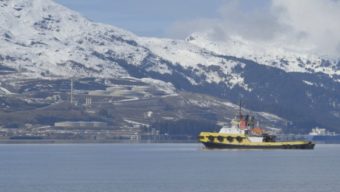
Crowley Marine Services currently holds the contract to provide oil tanker escorts and spill response and prevention in Prince William Sound. (Photo by Eric Keto/APRN)
Crowley Marine Services currently holds the contract to provide oil tanker escorts and spill response and prevention in Prince William Sound. (Photo by Eric Keto/Alaska’s Energy Desk)

A watchdog group is raising questions about whether new tugboats planned for Prince William Sound are up to the job of escorting oil tankers through the region.

The new tugs are part of a major transition taking place in the system set up to prevent oil spills after the Exxon Valdez.

Last year, Alyeska Pipeline Service Co., the operator of the trans-Alaska pipeline, surprised communities in Prince William Sound when it announced it would be parting ways with its longtime tugboat operator, Crowley Marine Services, and bringing in a new company: Louisiana-based Edison Chouest Offshore.

Alyeska said one reason for the switch is Edison Chouest’s commitment to build brand new vessels to replace the current, aging fleet. That fleet includes the tugboats that escort oil tankers to and from the pipeline terminal in Valdez and barges standing by in case of a major spill.

But now a report is raising questions about the design of those new boats.

Donna Schantz is the executive director of the Prince William Sound Regional Citizens’ Advisory Council , which commissioned the report. She said tugboats play a major role in preventing oil spills – and they have to be able to do that work in pretty rough conditions.

“They need to save a fully laden tanker in seas of up to 15 feet and winds of 45 knots,” Schantz said.

The citizens’ council was created by Congress to provide local oversight after the Exxon Valdez oil spill. Schantz says they’re closely watching the transition between operators.

“It’s the largest change-over of equipment and personnel that the system has seen since it was created after the 1989 Exxon Valdez oil spill,” she said. “So we just want to make sure the level of care is taken to make sure we don’t lose any of the safeguards that we worked so hard to put into place.

Alyeska’s choice of a new operator raised some eyebrows when it was announced last year.  Edison Chouest has operations around the world, but it’s perhaps best known in Alaska for the Aiviq tugboat, which was towing Shell’s Arctic drill rig, the Kulluk, when it grounded near Kodiak in 2012.

The citizens’ council hired Vancouver-based naval architect Robert Allan to review Edison Chouest’s plans for the new tugs (designed by the Dutch shipbuilder Damen). Allan’s firm raised concerns about several issues, including a bow shape he worries might slow the tugs down and collect water in high seas. In an interview, Allan called the designs “less than ideal” for what’s supposed to be a state-of-the-art new fleet.

“I don’t in any way, and certainly didn’t say in my report, that there’s anything about either of these designs that is any way unsafe,” Allan said. “It’s just a question of, could be better.”

 Allan also says the information he received didn’t include evidence that design testing was done to make sure the boats could handle rough conditions.

An Edison Chouest representative referred questions to Alyeska, which said it’s confident in the tug designs. Alyeska spokesperson Michelle Egan said the company takes Allan’s report seriously. But, she said, his firm only reviewed limited, preliminary plans, which — in some cases — have already changed.

“We’ve gone through the report. We have identified a number of areas where changes were already made in the design,” Egan said. “And then there are clearly places in the report where there is a professional difference of opinion between two different sets of marine architects.”

One of those differences of opinion is the bow shape, which Egan said hasn’t changed.

Egan said the new vessels come with new benefits, including more horsepower and updated winches for towing; and she said Alyeska will be sharing more information as the transition unfolds. Donna Schantz, of the citizens’ council, said that information can’t come soon enough. Edison Chouest is slated to take over the oil spill prevention and response contract in Prince William Sound in July 2018.

Correction: An earlier version of this story stated the new tugs would be built by the Dutch shipbuilder Damen. Damen designed the vessels; it is not building them. 

Pollution has worked its way down to the world’s deepest waters

Tiny, shrimp-like amphipods living in the Mariana Trench were contaminated at levels similar to those found in crabs living in waters fed by one of China's most polluted rivers. (Photo by Dr. Alan Jamieson/Newcastle University)
Tiny, shrimp-like amphipods living in the Mariana Trench were contaminated at levels similar to those found in crabs living in waters fed by one of China’s most polluted rivers. (Photo by Dr. Alan Jamieson/Newcastle University)

The Mariana Trench in the northern Pacific is the deepest part of the world’s oceans. You might think a place that remote would be untouched by human activity.

But the Mariana Trench is polluted.

At its deepest — about 7 miles down — the water in the trench is near freezing. The pressure would crush a human like a bug. Scientists have only recently explored it.

Among them is biologist Alan Jamieson of Newcastle University in England. His team dropped what they call a mechanical “lander” down into the trench. It had cameras and water samplers and some baited traps. They didn’t really know what they’d find.

When the lander surfaced, the traps contained amphipods — shrimp-like crustaceans. That wasn’t terribly surprising, as amphipods are known to live at great depths. But bringing them back from the Mariana Trench was a rarity, and Jamieson thought there might be something to learn from them. He took the creatures to an environmental scientist.

“So we just sort of turn up with this really weird looking animal,” he says, “and joking aside, he came back and said these are really badly contaminated.”

The amphipods were contaminated with PCBs — polychlorinated biphenyls — toxic chemicals used for decades in industry, as well as other industrial pollutants known as persistent organic pollutants.

“Every sample we had,” Jamieson says, “had contaminants in it at very high or extraordinarily high levels.”

How high? He compared the contamination level in his Mariana amphipods to crabs living in waters fed by one of China’s most polluted rivers, as well as amphipods from other parts of the world. “And what we were finding in the deepest place in the world were (levels) hugely higher, fifty times in some cases,” he says.

The team found the same thing in another deep sea trench in the Pacific–heavily contaminated amphipods.

Jamieson, who was at the University of Aberdeen in Scotland when he did the research, describes the results in the journal Nature Ecology & Evolution. He thinks the pollutants might get to the trenches by latching onto plastic that’s floating in the ocean. Fish and other marine animals absorb pollutants, as well. Eventually, the plastic and the dead animals fall to the bottom. Like dirt in your house, a lot of it will collect at the lowest points. It’s simply a matter of gravity, and the trenches are as deep as it gets.

“Once it gets deeper and deeper and deeper, there’s nowhere else for it to go, because there’s no mechanism to put it back to the surface again,” Jamieson explains.

PCBs were banned decades ago. But they’re still out there. Marine biologist Katherine Dafforn at the University of New South Wales in Australia says the discovery of such high levels in these trenches is “disturbing.”

“A lot of chemicals will have far-reaching impacts that we don’t necessarily know about,” Dafforn says.

And those impacts might be in places that people don’t pay much attention.

Jamieson says just because pollution is out of sight doesn’t mean it’s harmless. “We’ve got to remember, planet Earth is mostly deep sea,” he says, “and to think that it’s OK just to ignore it is a little bit irresponsible.”

Copyright 2017 NPR. To see more, visit http://www.npr.org/.

Skeleton of orca that died in the Nushagak River printed in 3-D

3-D printer at the UAF Bristol Bay campus.
3-D printer at the UAF Bristol Bay campus. (Photo courtesy KDLG)

A machine the size of a mini-fridge sits on the counter of a college science lab. Three half-constructed plastic models of fetal orca bones are visible through the glass front. The 3-D printer’s extruder moves across the models, adding plastic layer by layer. It whirs, hums, and beeps like a “Star Wars” droid.

In September of 2011, three killer whales puzzled biologists by traveling about 70 miles up the Nushagak River. Orca’s natural habitat is saltwater. Sometimes they swim up the freshwater river for salmon, but not that far. By October all three whales had died. That raised the question of what to do with the bodies, which led to an unusual science project. Bristol Bay area scientists, students, and educators have been working to make a plastic model of the fetal orca’s skeleton.

One orca was pulled ashore, and NOAA scientists performed a necropsy. When they discovered the whale was pregnant, they saved both her skeleton and the skeleton of the fetus. But preserving the fetus was complicated because its bones hadn’t ossified and fused together yet.

Kent Winship teaches construction and runs the fabrication laboratory at the University of Alaska Fairbanks Bristol Bay Campus. He has helped oversee work on the solution to that problem.

“It was basically a bag of bones with skin on it, just like a big trash bag full of partially formed cartilage, and not all the way meshed together bones,” says Winship. “This is all cartilage, so it’s going to decay. What they decided to do was 3-D scan them.”

So the Nushagak Orca Articulation Project was born. The Dillingham City School District, Bristol Bay Campus and Nunamta Aulukestai have worked in partnership to clean, categorize, scan, and print the fetal skeleton’s hundreds of bones.

Cheyenne Roehl holds both a fetal orca bone and a plastic model. She has worked at the UAF Bristol Bay Campus for two years, scanning and printing the majority of the orca's skeleton.
Cheyenne Roehl holds both a fetal orca bone and a plastic model. She has worked at the UAF Bristol Bay Campus for two years, scanning and printing the majority of the orca’s skeleton. (Photo by Avery Lill/KDLG)

The project brought high school student Cheyenne Roehl onboard two years ago to scan bones. She works in the campus lab three hours every weekday. A few other people have been involved in scanning over the years, but Winship says that Roehl has done the bulk of the work.

Her job is to create 3-D digital models of the bones in a computer aided drafting program.

“I get one of the bones, and I put it on the scanner,” she says, explaining her process. “We have to get multiple scans, and then align them together. And then we make sure that it looks like the bone, and then we get a finalized watertight model…I’m making it sound a lot more simple than it actually is.

It’s time-consuming work. If a bone has a lot of holes, protrusions, or facets, it can take numerous scans to capture all the angles. Each scan takes about 20 minutes.

Roehl pulls a piece of the orca’s skull from one of tall cabinets where bones are stored in jars and paper bags.

She holds it, turning it over and running her fingers along its different angles.

“I see a lot of holes and places that scanned very well to have a lot more detail for the scan because we use a laser, and if it’s slanted a little bit, the scanner won’t be able to pick up that data.”

When she has the scans, Roehl joins the images to form one 3-D model. Then she prints it and organizes it with the other printed bones.

The project reached an important milestone this week. Roehl finished scanning, and she’s about to finish printing the last of the roughly 300 whalebones.

Then it will be time for the jigsaw phase of this project. Project leaders with the university, school district, and Nunamta Aulukestai are developing plans to begin constructing the skeleton out of the model bones. They aim to involve students in this stage of the work as well. Fully assembled the killer whale fetus will be about 6-feet long.

Roehl reflects on the hundreds of hours she and other students have put in over the years. She says that it’s the idea of seeing this orca skeleton completed is what keeps up the momentum.

“It’s really exciting because you know that they’re going to be turned into a 3-D model skeleton, and that will be beautiful.”

Ketchikan Indian Community checking Ketchikan beaches and shellfish for toxins

Esther Kennedy of the Resource Protection Department collects water samples every week from Starrigavan.
Esther Kennedy of the Resource Protection Department collects water samples every week from Starrigavan. Along with six other tribes in Southeast, the group is working to create an early warning system to protect shellfish diggers from PSP. (Photo by Emily Kwong/KCAW)

Last summer, Ketchikan Indian Community began a phytoplankton and shellfish monitoring program in Ketchikan as part of the Southeast Alaska Tribal Toxins Program. KIC tests samples, and informs the public if dangerous levels of the toxin that causes paralytic shellfish poisoning are found in local clams and mussels.

Nicole Forbes is the environmental specialist at KIC in charge of collecting samples. She says it’s important for people to understand what paralytic shellfish poisoning is and how it is transmitted.

“Basically there are tiny, microscopic plants in the ocean called phytoplankton. Most of them are not harmful. In fact, they produce 50 percent of our oxygen. But there are a few harmful species and one of those is Alexandrium and it produces something called saxitoxin. When the shellfish filter-feed, it gets collected in the shellfish, and when people eat it, that’s what causes paralytic shellfish poisoning.”

PSP toxins cannot be cooked or cleaned out of shellfish, and freezing does not destroy the toxin. Consumption of the toxin can cause paralysis and death. Commercial shellfish is tested and considered safe. The Tribal Toxins Program targets recreational beaches.

Forbes says KIC is testing samples at popular beaches in the Ketchikan area so people will know if clams, mussels, and cockles are safe to harvest. Currently, testing is being done at Settlers Cove and Whipple Creek. Forbes says they plan to add Seaport Beach in Saxman soon. She says the program is in the beginning stages and they are working to identify other sample sites.

“We’re trying to figure out where most people harvest, so that we can get those results. The thing is you have to get results for each beach. Because you could go two or three miles down and it’s going to be completely different down there.”

Forbes says there are three steps to the collection process, which starts with weekly phytoplankton samples.

“Which involves me going out there with a phytoplankton net and wading in the water, and grabbing a sample. I bring that back to our local lab, and I put it under the microscope and look for those harmful phytoplankton species that I was talking about. If I see one, that’s the first warning sign that we need to get a shellfish sample out as soon as possible, because it’s possible that saxitoxin is in the shellfish.”

Forbes says suspect samples are sent to the Sitka Tribe of Alaska’s lab in Sitka. She says the turnaround time for testing is fairly quick.

“I send it out on Tuesday, gets there Wednesday, I get results Thursday or Friday.”

She says the third step of the process is filtration, which involves taking a water sample, filtering it, and then sending the filter to the lab, where phytoplankton species and quantities are identified, along with concentration of toxins.

Tony Gallegos, the cultural and natural resources director for KIC, says Alexandrium may be present, but not necessarily producing toxins.

“The scientific literature hasn’t come to clear conclusion on how you know whether they’re going to produce the toxins or not, what triggers that. That’s still unclear. We can see the algae, but we need to actually do an analysis of those algae to see if they actually have toxins in them.”

Forbes says phytoplankton aren’t as active in the winter because it is cold and dark, but she says no time of the year is safe to harvest without testing. She says they found high levels of toxins in butter clams at Whipple Creek this winter.

“Actually butter clams hold onto the toxins longer, and then during the winter the shellfish slow down their filter feeding, so they can actually hold on to those toxins for the whole winter.”

Forbes says she collects samples every two weeks, weather permitting, and if samples test positive, they are retested weekly. Results for all Southeast beaches being tested are posted in the data section of the Southeast Alaska Tribal Association Research website – www.seator.org. Information is also sent to local media.

KIC is interested in identifying other local sites for sampling.

If you have suggestions, you can contact Nicole Forbes at KIC. Forbes email is nforbes@kictribe.org.  The phone number is 228-9365.

Evidence suggests harmful algae blooms impact species from humans to whales

A beached fin whale in the upper Knik Arm on June 21, 2016. (Photo by Christopher Garner/JBER biologist)

There is growing evidence that harmful algae blooms have widespread health impacts on everything from humans to whales.

When fin whales were found floating dead in Alaska’s oceans and stranded on beaches last year, some researchers suspected that toxic algae blooms might have been responsible.

According to Nicholas Pyenson, a paleo-biologist and curator of the Smithsonian Natural History Museum’s fossil marine mammal collection, it would not be the first time such a thing may have occurred.

He points to a huge graveyard of 900-year-old fossilized whales recently discovered in Chile.

“Something else about this site, there’s not just whales there; there’s dolphins, early seals. That’s what we call a multi-species stranding event,” Pyenson said. “So this happened many times. Harmful algal blooms are the only explanation that really explains why we have the profile of death that we see at this site.”

Pyenson said that the red halo of iron they found around the bones is a telltale sign of toxic algae blooms.

“So we do have a candidate; a smoking gun. Could it have been domoic acid? Sure, but dinoflagellates red tide is, I think, probably the most likely explanation,” he said.

That’s the same red tide that closes clam beaches today when it occurs in Alaska, something that has been happening more frequently as a result of our warming seas.

It’s not just whales that are suffering.

Kathi Lefebvre with the National Oceanic and Atmospheric Administration’s Northwest Fisheries Science Center said that marine mammals, like sea lions, are being found with the beginnings of seizures from harmful algae blooms associated with red tide.

“You may or may not know, but on the central California coast we get dozens to hundreds of sea lions each year coming onto beaches, having seizures, and suffering from domoic acid poisoning,” Lefebvre said.

NOAA scientists found evidence of memory loss and excitability in the sea lions that did not die from that exposure. That led them to wonder if the same thing was happening to humans who consume things like razor clams.

“Pacific Northwest recreational and tribal communities subsistence harvest razor clams, which we know retain low levels of toxins below the regulatory limit for up to a year or more after the bloom,” Lefebvre said. “So that we know that populations are exposed to that.”

Lefebvre and her colleagues exposed laboratory mice to low levels of domoic acid and trained them to run through mazes. At first they saw no effects, but after six months the change was striking.

“Exposed mice simply did not learn,” Lefebvre said. “This big of an effect just completely shocked us. Doing chronic exposures is really risky, because a lot of times you don’t see something, so this was a pretty dramatic effect; way more than we had expected.”

More study is needed to understand the effects on humans, but Lefebre points out that existing standards are based on one-time high exposures that can cause seizures and permanent brain damage.

The good news is that the kind of effects showing up in laboratory mice from long-term low exposure can be reversible.

How does this relate to beached whales?

Even if the exposure to domoic acid wasn’t high enough to kill them, memory loss could have still made it tough to navigate.

Site notifications
Update notification options
Subscribe to notifications