Oceans

Satellite used to record sea ice data malfunctions

The graph above shows Arctic sea ice extent as of February 3, 2016, along with daily ice extent data for four previous years. (Image courtesy of the National Snow & Ice Data Center)

The satellite used to record sea ice data in the Arctic malfunctioned in April, and scientists are scrambling to calibrate a month of missing data.
In mid-March, the National Snow and Ice Data Center reported the lowest maximum sea ice extent in satellite history.

“It was a record low in our satellite record, which is quite consistent,” explained NSIDC lead scientist Ted Scambos. “We work on it a lot to make sure we can compare it, one year to the next.”

NSIDC first started recording sea ice data in 1978.

Julienne Stroeve is an NSIDC scientist who studies sea ice conditions in the Arctic. Stroeve said she and her fellow scientists noticed a glitch in their data in early April.

“We started getting false ice concentrations in parts of the Arctic where you wouldn’t have sea ice,” Stroeve explained, “so it was biasing our extent.”

“The good news is they’ve found another satellite in that same type of series,” confirmed Amy Holman with the National Oceanic and Atmospheric Administration. “They believe the data (are) compatible enough that we can continue the data record,” Holman said.

The satellite Holman is referring to has been recording sea ice data for a year now, which Julienne Stroeve said should be enough time to cross-calibrate. Consistency is key, Stroeve said.

“You want as long of a data record as possible to really see how much this change we’re seeing is due to natural climate variability, for example, or how much is due to anthropogenic warming.”

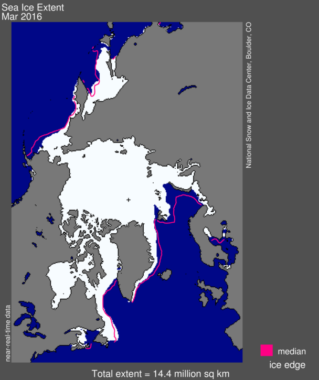
Arctic sea ice extent for March 2016 was 14.43 million square kilometers (5.57 million square miles). The magenta line shows the 1981 to 2010 median extent for that month. (image courtesy of the National Snow & Ice Data Center)

To help make that distinction, NSIDC captures an image of sea ice extent in the Arctic every day and posts daily updates online. The agency has since suspended the updates and removed all of April’s data from NSIDC’s archives.

While the malfunction was a bit of a shock, Stroeve said it was bound to happen.

“It wasn’t surprising that this happened because the satellite was pretty old,” Stroeve said, “so eventually the sensors do degrade and start giving bad data.”

The satellite that malfunctioned was launched 10 years ago. The one they’re relying on now was launched nine years ago. Stroeve said there is a backup to this backup, but that one is still on the ground.

“Congress took away the funds for the Air Force to launch it, which is very unfortunate,” Stroeve said. “Obviously, we’re hoping that pressure can be put on Congress to launch that other satellite.”

For now, Stroeve and her colleagues will continue cross-calibrating data, with the hopes that the one they’re using now will stay online until Congress approves funding for the next series of satellites.

A Hunk Of Planet Dissolves Before Our Eyes

It begins with a growl. Then there’s a crack — a slurpy, sucky, crunchy noise. A guy is on the phone, and his pal interrupts him and says, “It’s starting, Adam, I think. Adam? It’s starting …” The two are up on a bluff, overlooking a giant ice field. They are standing next to time-lapse cameras. What happens next is astonishing: An enormous frozen, icy hunk of our planet suddenly opens, splits into bits and then sinks right before our eyes into the sea. It happens so, so quickly. And the scale of it? That’s the part that shocked me. When they superimpose part of Manhattan Island onto the ice at the end of the clip, you think, “Uh oh.” This is a peek into something monstrous.


The video comes from photographer James Balog’s film, Chasing Ice. The two guys on the bluff at the beginning are part of Balog’s Extreme Ice Survey team, which maintains scores of time-lapse cameras overlooking glaciers in Greenland, Iceland, Alaska, Canada, the Rockies and the Himalayas. During daylight hours, they watch and record. Then they share what they see with scientists and National Geographic, and turn the footage into movies and TV shows.

Losing All The Ice In The World? Let Me Calculate …

What they’re seeing, of course, is ice disappearing from mountain tops, from ice fields, from the poles. Seeing it go this quickly in so many places, raises the obvious question: How long will it be before there isn’t any ice left? We’ve had such moments before in earth history; it’s certainly possible. We have lived in a gentle age where, every winter, one can take a trip to someplace white to see a snowy mountaintop, a distant glacier creeping down a slope, or an iceberg in the distance. Come summer, the whiteness retreats. It’s a lovely balance. But how long will that last?

When Henry Pollack (a professor emeritus of geophysics at the University of Michigan) was asked, he answered, “Losing all the ice in the world? I think sometime between a thousand and 10,000 years encompasses most probabilities.”

A thousand years is not a lot of time. As Craig Childs says in his book, Apocalyptic Planet, 10 centuries ago Europeans were busy building cathedrals. Chinese merchants were sending flotillas to trade with Africans. “I was thinking we had more time,” Craig says.

Konrad Steffen thinks Craig is right. A University of Colorado climatologist, Steffen figures (or figured, a couple of years ago) that Greenland might be iceless in 10,000 years, but Antarctica (being much bigger) will take a lot longer to turn bare.

But that’s an endpoint. It’s the middle passage that has so many scientists worried. Steffen tells Childs, “Greenland and Antarctica are very remote, and were considered to be big ice boxes that responded not very fast to climate change. We never developed a mechanism to observe them until we had satellites and lasers. Now we see some surfaces lowering up to 50 meters per year.” He repeated that number, to make sure Craig heard. “Fifty — five-zero — meters per year.” That’s a vertical drop of about 150 feet. In two years, that’s 300 feet. Then 450. Year after year — enormous piles of ice melting into the sea.

A lot of water. Coming our way.

Copyright 2016 NPR. To see more, visit http://www.npr.org/.

New Photos Show The Rapid Pace Of Great Barrier Reef Bleaching

Fish swim amid bleached coral near Lizard Island, Australia. CoralWatch
Fish swim amid bleached coral near Lizard Island, Australia.
CoralWatch

The massive bleaching hitting the Great Barrier Reef off the coast of Australia is likely that country’s “biggest ever environmental disaster,” says Dr. Justin Marshall, who has studied the reef for three decades.

Only 7 percent of the reef has escaped bleaching, according to researchers at the ARC Center of Excellence. Marshall, a professor at the University of Queensland, says the destructive phenomenon is happening in an area the size of Scotland.

“Before this mass bleaching started, we already were at the point of losing 50% of the coral cover on the Great Barrier Reef. This, I think, will probably take another 50% off what was left,” Marshall says.

Over the course of the last six months, Marshall and his colleagues with the citizen science project Coral Watch have documented the degradation of reef structures near Lizard Island, one of the worst-hit areas.

They photographed the same formations of coral multiple times, showing clearly the pace of the destruction.

“It was a beautiful, wonderful paradise of reef structure and animals, and it’s not there anymore. Or it is — but it’s a slime ball, it’s a gloomy place,” Marshall says.

In this series of photos, you can see first that the coral is healthy – then, bleached. Algae begin to grow on the coral, which later intensifies, eventually resulting in disintegration of the coral and the loss of a habitat.

Photo (1), taken in Dec. 2015 shows healthy coral near Lizard Island. The coral in photo (2) from March is bleached. In April, as shown in photo (3), algae begin to grow on the coral. Finally, in photo (4) from May, you can see heavy algal overgrowth. CoralWatch
Photo (1), taken in Dec. 2015 shows healthy coral near Lizard Island. The coral in photo (2) from March is bleached. In April, as shown in photo (3), algae begin to grow on the coral. Finally, in photo (4) from May, you can see heavy algal overgrowth.
CoralWatch

Bleaching is caused by warmer-than-usual water temperatures that stress the coral, as The Two-Way has explained:

Coral bleaching occurs when the living organisms that make up coral reefs expel the colorful, photosynthetic algae that normally live inside their bodies, and provide them with food. Those algae give coral reefs their color and disappear when the reefs are exposed to stressful climatic conditions, such as temperatures even a few degrees higher than normal.”

The phenomenon is linked to global climate change, says Marshall: “Mass coral bleachings have only been happening for 20 years, and they are irrevocably, totally, absolutely linked to man-induced climate change.”

The New York Times reports climate change has compounded “heat stress [to the reefs] from multiple weather events including the latest, severe El Niño.”

This series of images taken by Coral Watch shows a close-up of healthy coral’s progression through bleaching, and later covered with thick algae.

Photo (1) shows healthy coral. It's then seen bleached (2). Photo (3) shows dead coral with a film of algae, which grows thicker in photo (4). CoralWatch
Photo (1) shows healthy coral. It’s then seen bleached (2). Photo (3) shows dead coral with a film of algae, which grows thicker in photo (4).
CoralWatch

This is the ominous final photo in the series:

Bleached coral near Lizard Island showing heavy algal overgrowth. CoralWatch
Bleached coral near Lizard Island showing heavy algal overgrowth.
CoralWatch

Scientists are concerned about reefs worldwide. “We are currently experiencing the longest global coral bleaching event ever observed,” C. Mark Eakin, the Coral Reef Watch coordinator at the National Oceanic and Atmospheric Administration in Maryland, tells The New York Times. “We are going to lose a lot of the world’s reefs during this event.”

Now, Australia’s summer is ending and the water is cooling down. Marshall says some of the bleached coral is beginning to recover — but much of it is dying. He says that reefs in the area where these photos were taken could see 90 percent mortality.

Longer term recovery can happen over the course of years and even decades, should corals regrow and recolonize. Marshall compares it to “cutting down a forest and then regrowing trees.”

He adds: “I will probably never see the Great Barrier Reef in the state that it was in six months ago ever again.”

Copyright 2016 NPR. To see more, visit http://www.npr.org/.

Two marine mammal specialists conduct Kodiak’s first whale survey of 2016

A dead gray whale floating in the ocean. (Photo courtesy of Kate Wynne)

A mass die-off of at least 40 whales last summer caused the National Oceanic and Atmospheric Administration to declare an “unusual mortality event.” Many of those whales, the majority of which were fin or humpback whales, were spotted on or around the Kodiak Archipelago.

KMXT’s Kayla Desroches recently boarded a float plane with two marine mammal specialists who were conducting a whale survey along Kodiak’s east side. Bree Witteveen with the University of Alaska Fairbanks said they were retracing a flight they did in June 2015 as a response to the die-offs.

We spot a gray whale not long after we leave the city of Kodiak.

“A lot of the bones were poking out already,” said Witteveen. “So he’s been there for a while.”

She says it’s unclear how the whale died, but she can gather that it may be a calf due to its small size.

The researchers snap pictures and mark the location of the carcasses on a map using a tablet. Less than ten minutes later, we spot a second gray whale.

“We’ve got a floater,” Witteveen said.

It’s belly-up in the water.

“This floating whale will be a lot fresher than the one that we saw,” Witteveen said. “I mean, it’s possible that the first one we saw has been there for months even, but this one is within a few days.”

Witteveen explained how he could tell how long the whale was there.

“Partially the fact that it’s still floating, but it looks relatively intact still,” Witteven said. “Also doesn’t show evidence of a killer whale attack.”

Unlike the third and final whale.

We spot it in Ugak Bay on the way back to the city. The researchers think it’s a humpback whale that may have had a run-in with a killer whale and become a snack.

When it comes to less cut and dry cases than predator and prey situations, the cause of death can be hard to determine. Witteveen said they took samples from a carcass last summer and tested it for an indicator of radioactivity and a number of toxins that would be present in a harmful algal bloom.

“And all of those were negative,” said Witteveen. “Unfortunately, because the carcass was as old as it was by the time we got to it, a lot of those toxins could have degraded out of the tissue already.”

Witteveen says the ideal time to take a sample is 48 to 72 hours from death. That would require a quick turnaround and plenty of tip-offs from pilots, fishermen, and anyone else who scans the coastline on a regular basis.

Witteveen says that’s how we found two out of the three whales we flew over today. Our pilot, Scooter Mainero with Andrew Airways, is up for the task.

“Next time I see a fresh dead whale, I’ll call you guys and I’ll fuel the plane and we’ll go,” Mainero said.

Witteveen says this year they’ll have more funds to respond to calls like that in time thanks to the “unusual mortality event” declaration in August and a response plan to address the die-offs. The financial help will allow specialists to fly out soon after a carcass’s discovery and secure a sample.

Kate Wynne, another marine mammal specialist on the trip, said that the number of die-offs seems normal for this time of year, and the survey will be useful as a baseline.

PSP warning issued for Douglas Island beach

Outer Point
Grey Pendleton scans the shoreline along the Outer Point Trail during the Juneau Audubon Society’s 2013 Christmas Bird Count. (File photo by Casey Kelly/KTOO)

Juneau and Douglas residents are being warned to refrain from harvesting butter clams because of possible paralytic shellfish poisoning.

According to a community advisory issued by the Southeast Alaska Tribal Toxins or SEATT network and the University of Alaska Fairbanks School of Fisheries and Ocean Sciences, butter clam samples collected earlier this week from Outer Point on Douglas Island showed levels of biotoxin that were above the Food and Drug Administration’s regulatory limit.

Those results are from the new Sitka Tribe of Alaska Environmental Research Lab or STAERL that was created to test subsistence shellfish.

Elizabeth Tobin is post-doctoral researcher at UAF who is collaborating with STAERL to train tribes to monitor and also share information about any Juneau area observations through SEATT.

“At the moment, we don’t have a rigid monitoring program for the shellfish themselves,” Tobin said. “We’re doing weekly monitoring throughout Juneau for the algae that cause the toxins. So, if there’s any blooms of this toxic algae, we’re constantly monitoring for that. In terms of looking at the toxins within the shellfish, we’ll likely go out during the next low tide cycle when we can, access those shellfish and we’ll do another round of testing.”

Tobin said cockles and pinkneck or surf clams collected from Outer Point did not show elevated levels of biotoxin. But she still warns harvesters to be careful.

“Whether they are positive for the biotoxin or negative for the biotoxin at one beach, that isn’t exactly clear what the meaning is for even an adjacent beach next to it,” Tobin said. “So, really it is go at your own risk in terms of harvesting anywhere.”

You can find more information about shellfish monitoring throughout Southeast by going to Southeast Alaska Tribal Ocean Research website.

Mount Edgecumbe students to present original research on beluga and narwhal bioacoustics

SeaTech students on a Skype call with Josh Jones of Scripps Institution of Oceanography. (Photo by Brielle Schaeffer/KCAW)

Despite graduation, school is not over for some science students at Mount Edgecumbe High School in Sitka. The class, known as SeaTech, is headed to the Scripps Institution of Oceanography in San Diego to present their original research on beluga and narwhal bioacoustics.

You’ve probably never heard a beluga whistle or a narwhal click. Not many people have. But Michael Mahoney’s students are experts on the bioacoustics of these mammals, after spending hours logging recordings of their sounds from the Chukchi Sea and Northwest Passage.

“We’re trying to figure out if they’re happy if they’re sad, like, if there’s more fish around, to see if their clicks and their buzzes represent what’s going on in the ocean around them,” said Natalia Smith, a 17-year-old junior from Elfin Cove.

The SeaTech class is not your regular science lab. The students are actually contributing to the research at Scripps Institution of Oceanography at the University of California, San Diego.

“You’ll have people who come to your classroom who say, ‘If you go to school for a really long time you can be a scientist like me, too,’” Mahoney said. “Scripps and the Whale Acoustics Lab says, ‘Why don’t you guys be scientists with us right now.’”

Using Skype, SeaTech students connect with the oceanographer John Hildebrand and Josh Jones, a graduate student in biological oceanography at Scripps, to talk about how researchers analyze the acoustic data to study the marine mammals.

Jones says the diversity of students at Mount Edgecumbe, many who are from the villages near his study area, benefits the project. The students from subsistence communities have cultural ties to whales, having grown up around them or depending on them for food.

“That perspective, that sort of cultural and personal perspective on the animals really lends a lot to their insights on what might be going on in these otherwise numerical analytical processes,” he said.

And, Jones says, working with the SeaTech class is good for productivity.

“In a certain respect we work harder down here in our lab because we are trying to keep up with the students who are up there making steady progress on this research,” he said.

The Whale Acoustics Lab collects the sounds underwater with a high-frequency acoustic recording package, which is basically a computer and hydrophone anchored to the sea floor. The system can record underwater sound continuously for a year at a time.

Mahoney says the students go through the tape with a computer program to identify any patterns in sounds made by the whales at different times of year. The work looks to see effects of climate change and human activity on these animals.

“We can know when ice formation happens, we hear ice sounds,” he said. “Or lots of other environmental sounds. We can hear anthropogenic sounds, sounds that humans make so we can hear ships that pass over or any of those types of things.”

Jones says the Scripps/Mount Edgecumbe partnership has been going on for about 10 years. He started the program as an undergrad interested in science outreach and with roots in Sitka, having worked at the Baranof Wilderness Lodge.

As the program grew, several of Mahoney’s former SeaTech students have presented at other symposiums and even had their work published in scientific journals. A couple even chose to attend UCSD and got jobs at the Whale Acoustics Lab when they started.

In San Diego, SeaTech students will present their findings from the research they’ve been conducting during class, which is kind of a big deal.

Natalia is looking forward to the trip.

“It’s really cool,” she said. “I never thought it would be this big. I thought it was just we go into his class and we learn how to use these programs. I never thought we would get to go down to San Diego and talk to all these important people in science and learn more about these animals.”

The students will also spend time on some Scripps Institution research vessels and when the hard science is over, they’ll study the habitat of mice, talking dogs, and flying elephants during a visit to Disneyland.

Site notifications
Update notification options
Subscribe to notifications