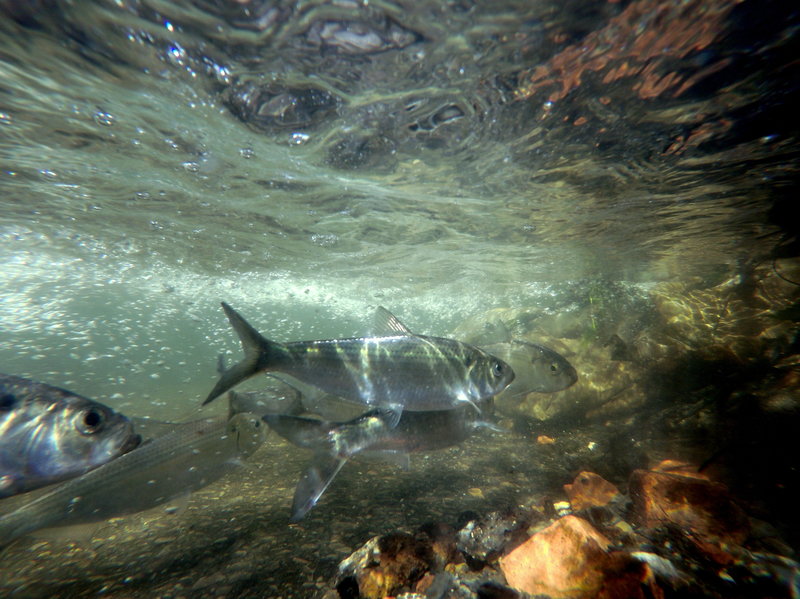
Herring swim up the Wynants Kill two weeks after an old industrial dam was removed to allow ocean-going fish access to the Hudson River tributary for spawning and habitat in Troy, N.Y. (Photo by Erica Capuana/AP)
Herring are spawning in a tributary to New York’s Hudson River for the first time in 85 years after a dam was removed from the tributary’s mouth.
The spawning in the Wynants Kill tributary is seen as an environmental success, as NPR’s Nathan Rott tells our Newscast unit. He says it was previously “closed off to fish by a 6-foot dam at the side of an old mill there.” Nate explains:
“With the removal of the dam earlier this month, river herring and other ocean-going fish are making their way up the tributary to spawn. Those fish spend the bulk of their life at sea, but need smaller tributaries off of rivers like the Hudson to spawn and reproduce.”
There are more than 1,500 dams affecting Hudson River tributaries and “there’s a wider push to remove ones that no longer serve their intended purpose,” Nate added.
“Every dam should have an existential crisis,” said John Waldman, a biology professor at Queens College, told The Associated Press. “These are artifacts of the Industrial Revolution that are persisting and doing harm.”
Riverkeeper, a watchdog organization aimed at protecting the Hudson River involved in the dam removal, describes Wynant’s Kill as a “historic spawning run.” They explain this is an effort to improve herring stocks which fallen for decades:
“Since the 1960s, river herring populations up and down the Atlantic Coast have significantly declined due to overharvest and the loss of spawning habitat. Federal and state biologists prioritize the restoration of this habitat as one of the best ways to encourage herring stocks to recover from current historic lows.”
And herring are an “integral part of the aquatic food chain,” as the Associated Press explains. “In the Atlantic, many species of fish, bird and mammal rely on herring as their primary food source,” according to the wire service.
“Environmental improvement efforts like the removal of the Wynants Kill dam are critically important to maintaining a healthy Hudson River ecosystem,” Mayor Patrick Madden said at a recent news conference, the Troy Record reports.
Riverkeeper’s boat captain John Lipscomb sees this as one part of a broader Hudson River recovery.
“The construction of the Wynants Kill barrier almost 100 years ago cut off a tributary that was owned by the herring and other species. Now it’s theirs again. That’s how the Hudson River will recover. That’s how the Hudson will be restored,” said Lipscomb.
You can see the herring in action in this video from Riverkeeper:
Other species such as the American eel, white sucker and yellow perch have also entered the tributary after the dam was removed, according to the Troy Record.
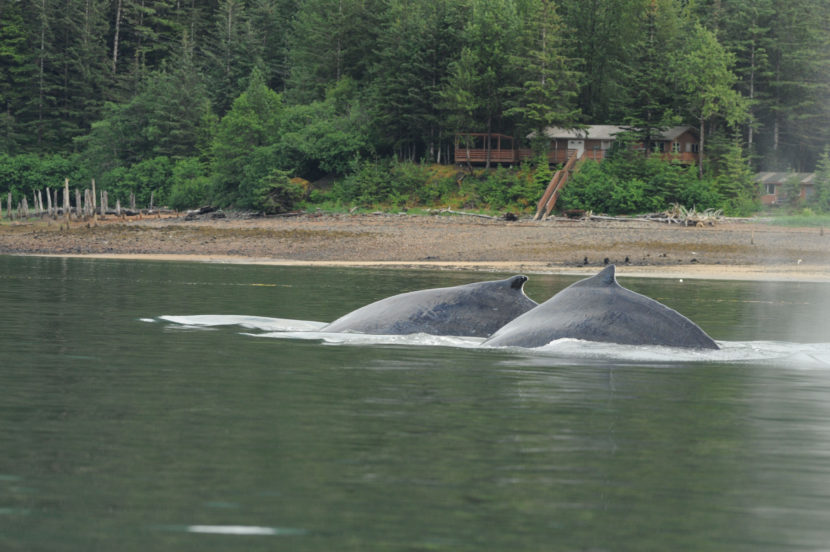
A second humpback has been swimming alongside the entangled humpback since at least June 4, when this photo was taken. The second whale may also be entangled in the anchor line, complicating the entanglement situation. (Public Domain photo by NOAA Fisheries)
Marine mammal stranding experts are again asking for the public’s help in locating a humpback whale caught in some anchor line in Southeast Alaska.
The whale was first sighted caught in line, anchor and two buoys last Wednesday, June 1st near Seymour Canal on Admiralty Island south of Juneau. A marine mammal stranding team tried to free the animal from the gear that day but was unsuccessful. They tried again on Saturday after the whale had traveled up Gastineau Channel near downtown Juneau. That day, the team was able to attach a satellite tracking buoy but couldn’t remove all the line from the humpback. The 40-foot-long adult has been followed by another adult humpback.
With the tracking buoy attached, both animals made their way over to Tenakee Springs and then to the waters near Kake on Wednesday. That’s where they were last seen.
National Oceanic and Atmospheric Administration spokesperson Julie Speegle said Thursday the satellite buoy is no longer attached. “It has become disconnected from the whale so we are no longer able to track this whale through their satellite tag.”
The last satellite tag location recorded was near Payne Island outside of Kake. The entangled humpback is now only trailing one orange buoy. Speegle said both animals may be caught in the anchor line now but responders are not sure about that.
“There is a second humpback that has been swimming alongside the entangled humpback since Saturday evening and it’s curious that it’s stuck around this long,” Speegle said. “We don’t know if he’s just a swimming buddy or if the second humpback may be entangled in the line also so, that’s something that our marine mammal responders will be trying to figure out.”
A third attempt to remove the gear could be made if weather cooperates and the whale is located in an area that is not too remote for a whale entanglement team to respond.
NOAA Fisheries is asking the public for reports on the position and direction. The marine mammal stranding network hotline number is 877-925-7773 or reports can be relayed through the Coast Guard on VHF channel 16.
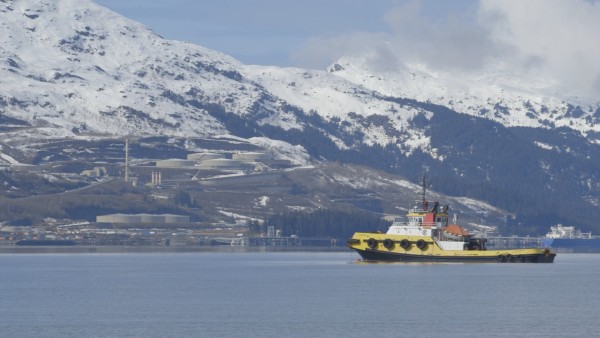
Crowley Marine Services currently holds the contract to provide oil tanker escorts and spill response and prevention in Prince William Sound. (Photo by Eric Keto/APRN)
Two unions representing workers on tugboats and barges in Prince William Sound are calling out the operator of the trans-Alaska pipeline.
They say the plan to bring in a Louisiana-based company to take over oil spill prevention and response in the Sound risks another spill, 27 years after the Exxon Valdez.
Speaking at a press conference Tuesday morning, Alan Cote, president of the Inlandboatment’s Union (IBU), called the public campaign “unprecedented.”
“I have never endeavored anything as big as this and as important as this in my career in the union,” he said.
Together, the IBU and another union, the International Organization of Masters, Mates and Pilots, represent about 230 people in Prince William Sound. That’s everyone from cooks to captains on the tugboats that escort tankers in and out of the Sound, and on the barges available 24-7 in case of a spill.
They work for Crowley Marine Services, which has held at least part of the contract since the response system was first put in place after the Exxon Valdez oil spill in 1989.
Earlier this spring, Crowley announced it was no longer in the running to renew its contract, raising concerns about the future of the program.
This week, the company that operates the trans-Alaska pipeline, Alyeska Pipeline Service Co., confirmed that it’s in final negotiations with a different company — Louisiana-based Edison Chouest Offshore — to take over.
The unions have launched a campaign to stop that contract, airing ads in Anchorage and Juneau that warn darkly of Louisiana workers coming for Alaska jobs.
And in part, it is a fight over jobs: Edison Chouest isn’t unionized. The current Crowley workforce is about half Alaska residents, and unions worry they’ll be replaced by Outsiders.
But Cote argues the fight is bigger than that. He points out that it was an Edison Chouest tugboat that was pulling Shell’s arctic drill rig, the Kulluk, when it grounded off Kodiak in 2012. And he warns that Alyeska, and the oil majors that own it, are trying to cut costs at the expense of Prince William Sound.
“I was there in 1989,” Cote said. “I saw what happened to Prince William Sound. It was devastating. I never want to see that again.”
Carl Jones worked as an engineer on Crowley tugboats for about 15 years. He said there’s no good reason to replace a system that’s working with newcomers who are unfamiliar with the weather, tides, and geography of a notoriously difficult place to operate.
“Everyone down there has years of training and experience,” he said. “To think that a company from outside could come in and replace 25 years of experience in one day, ten days or a hundred days — it can’t happen.”
Edison Chouest did not reply to an interview request in time for this story.
But Michelle Egan, a spokesperson for Alyeska, said the pipeline operator is confident the Louisiana company will meet its safety and environmental standards.
“Any company that works with us has to meet the expectations of the response plan in Prince William Sound, which are very rigorous, and they have to be demonstrated repeatedly through drills and exercises,” Egan said. “So there are many opportunities for us to identify if there are gaps and then help bridge those gaps. But we expect them to be an outstanding contractor.”
Egan said there’s no specific Alaska hire requirement in the contract. But Alyeska does require all contractors to employ 20 percent Alaska Native workers, and she expects Edison Chouest would hire locally, at least in part.
Alyeska expects to finalize the contract this summer. Edison Chouest would take over in July 2018.
A NOAA team watch as an entangled humpback surfaces Saturday in Gastineau Channel. (Public domain photo by NOAA Fisheries, Permit No. 18786)
The National Oceanic and Atmospheric Administration received a report of a humpback whale dragging an anchor line in the Seymour Canal near Admiralty Island on Wednesday. Saturday, the whale was spotted in Gastineau Channel. Monday morning, it was reported in the Tenakee Springs area.
The whale is still entangled and is dragging a couple of buoys. Julie Speegle with NOAA said whale entanglements have become fairly frequent because whale populations and the number of people on the water are increasing.
“Entanglements can cause a wide variety of problems for whales. (They) can inhibit their feeding, cause them to become fatigued because they’re dragging some extra gear along with their normal weight and sometimes even cause the whale to die,” Speegle said.
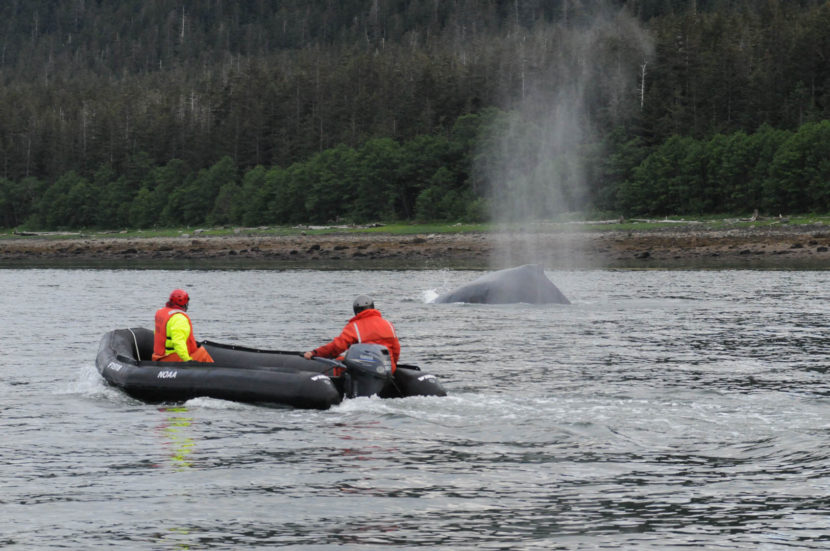
NOAA mobilized a team to try and remove the entangled line, Speegle said. They couldn’t remove it all and had to settle on attaching a green satellite buoy to the anchor line in order to track the whale.
A NOAA team tries to remove anchor line from entangled humpback whale. (Public domain photo by NOAA Fisheries, Permit No. 18786)
Speegle said they’ll keep trying to untangle the line but it’s complicated because there’s a second humpback traveling with the entangled whale and they’re not sure if that whale is tied up, too.
“Today the whale is in the Tenakee Springs area,” Speegle said Monday morning. “Members of our Alaska Marine Mammals Stranding Network are responding. Ocean and weather conditions are good. We’re going to attempt to get some underwater video so we can learn more about that entanglement to see what would be the best way to respond.”
Speegle said NOAA’s team is specially trained to deal with whale entanglements and they have the right tools to do the job. Members of the public are asked to stay away from the whales and not to try and help. Speegle said freeing the entangled whale will be extremely dangerous work.
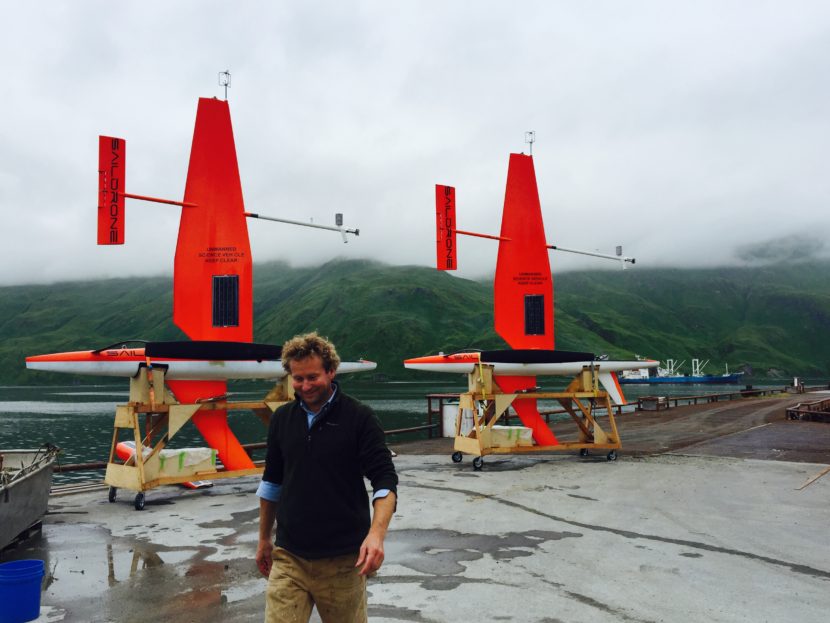
Saildrones Inc. CEO Richard Jenkins turns in Unalaska. (Photo by John Ryan/KUCB.)
Orange drones were launched in Dutch Harbor last summer to measure sea ice retreat. Now Saildrones are back in the Bering Sea with a new mission and new features.
One of them is to record North Pacific right whale calls to help track its migratory patterns. There are only 30 North Pacific right whales in U.S. waters. The other new feature will help determine how many fur seals and pollock live in parts of the Bering Sea.
The pollock fishery there is the largest in the U.S.
“Is it going to be a winner or a loser over the next decade in terms of the effects of warming, ocean acidification and loss of sea ice?” asks Douglas DeMaster, a science director at the National Oceanic and Atmospheric Administration Alaska Fisheries division.
DeMaster says scientists are concerned about the fur seals, which feed on pollock, and the diminishing stocks of pollock.
“It’s something the fishery needs to plan for and adapt to. And the only way to do that is with good information,” DeMaster said.
https://vimeo.com/167481038
In addition to testing the temperature, oxygen and salinity of the water, the Saildrone will also be using echo sounder technology. DeMaster calls it “a sophisticated fish finder.”
“It’s basically a ping, a sound impulse that’s sent through the water column and it’s reflected off of fish,” he said.
NOAA has used it on research vessels before but never on the Saildrone. Scientists will be able to sit from the comfort of their office or even in a coffee shop, as some of the data is collected in real time. In September, they’ll pluck the Saildrones out of the water when the season changes. They run off battery and solar power. It’ll take six months to a year before scientists can draw solid conclusions from the data.
Christopher Sabine, the director of NOAA’s pacific marine environmental lab, says pollock stocks have dropped before. The temperature of the Bering Sea warmed up in the early 2000s.
“Then it got cold again and the fish stocks came back,” Sabine said. “We’re now swinging back into a warm period again and we’re looking at potentially three years for this to manifest itself in the fisheries side of things.”
Since the Saildrone were launched two weeks ago, some startling information has already come back. Sabine says temps in the lower Bering Sea are about five degrees warmer than normal.
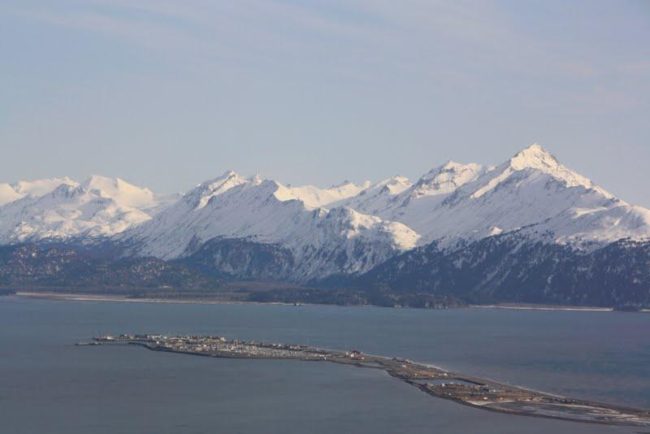
The Homer Spit on Kachemak Bay. (Photo courtesy of KBBI)
The environmental nonprofit Cook Inletkeeper sponsored a panel discussion to commemorate the 40th anniversary of the Kachemak Bay oil and gas lease buyback. The buyback prevented oil and gas development in the Bay and protected it as a critical habitat area.
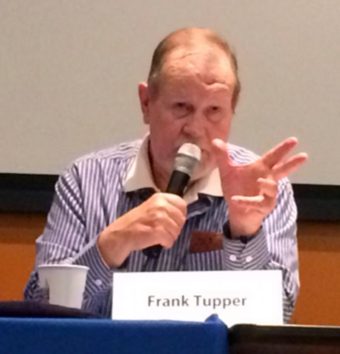
“It was a story. It was a David and Goliath; a little town in Homer at the end of the Sterling Highway, is under pressure from those big oil companies,” said Frank Tupper, who helped found the Kachemak Bay Defense Fund.
In one corner was David: a motley crew of commercial fisherman, Homer’s budding environmental movement — including Tupper — and other Homer residents desperate to protect Kachemak Bay. In the other were oil companies and the state of Alaska, which in December 1973 held a Lower Cook Inlet lease sale that opened up the bay to drilling and production activities.
What followed was a three-year battle fought in all three branches of state government and all aspects of the community. On May 25, Cook Inletkeeper sponsored a panel discussion to commemorate the 40th anniversary of these events.
“It was a local, human-scale fight over our human destiny with great characters and great arguments on all sides,” said Tom Kizzia, editor of the Homer News at the time,” said journalist, Tom Kizzia.
“Homer really changed as a consequence of what happened in that period. I think you can see a lot of what Homer became, was seeded and started to grow at that time,”
The seeds of environmentalism flourished from the fight, and the community became centered on tourism and fisheries, rather than oil and gas.
Loren Flagg was the commercial fisheries area biologist for Fish and Game when the lease sale was announced, and had all of two days to prepare comments.
“At that time the bay was producing 5 million pounds of shrimp a year, 2 million pounds of king crab, a half million pounds of tanner crab, and, of course, salmon, halibut. It was extremely, extreme(ly) valuable resources,” said Flagg.
But Gov. Bill Egan supported the sale, so it went ahead, much to the surprise of Homer residents. The sale had been announced through the usual governmental and industry channels, but not in a way that reached community members. Ken Moore fished crab, herring and salmon in the bay. He says fishermen felt like they didn’t have a say in the matter.
“No effort to find out if the people whose front yard it was all going to be in wanted it there. Or it didn’t seem that anybody really cared whether they did or not, it had happened already. And that just added insult to injury when you discovered what was going on,” said Moore.
Frank Tupper was making ends meet as a self-proclaimed hippie at the time, when a friend came by his trailer to tell him about the pending lease sale.
Frank Tupper was one of the founders of the Kachemak Bay Defense Fund. (Photo by Jenny Neyman/KBBI)
“Neither one of us could believe that that would be possible, that people were not that stupid, that they wouldn’t just do it just for the dollars. Naïve we were, but, still, that’s what we thought because of this beautiful, intrinsic area that we live in. So I think I said to Chuck, ‘Well, dammit, there’s two of us, let’s get going.’ From the citizen side of it that was the beginning of going out and just beating the streets and talking to people, ‘Do you know what’s coming, do you know what’s coming?’” said Tupper.
Such was the grass roots of the community campaign that eventually gained national attention. Activists established the Kachemak Bay Defense Fund, led by Tupper. They joined forces with the North Pacific Fishermen’s Association, led by Moore, to spread the word of the oil incursion into the bay and raise money for a legal battle.
A popular tactic was to hold shrimp and crab feeds, serving up information and donation forms along with the shellfish.
“I would hold up a quart of oil and I would say — after they were wiping their mouths with the butter and the garlic and everything — I said, ‘Now, which would you prefer in the bay?’” said Tupper.
The fund helped pay for legal challenges to the leases. The issue made it to the Supreme Court. Warren Matthews was an attorney for the plaintiffs. They brought three challenges: Failure to give notice — they lost on that one; failure to make a reasoned decision that the lease sale was in the best interest of the state; and failure to conduct a study of potential impacts to be shared with affected communities. The court found merit in those two claims, but not enough to reverse the sale.
“A majority of the court said, ‘Well, you’re right, but do we want to disturb all these other leases that have been made in the past?’ They answered, ‘No. Therefore, we’re not going apply this ground to you, either,’” said Matthews.
But political tides were changing. Republican Jay Hammond was elected governor in 1974, in part on his conservationist platform to protect fisheries.
Homer fishermen, environmentalists and others had been fighting to protect Kachemak Bay from development after the state of Alaska held a lease sale for oil and gas exploration.
“We were fighting for our homeland; we were fighting for the bay, the intrinsic beauty of the area. So it wasn’t just a bunch of people with an ‘ist’ at the end — conservationist, environmentalist, developmentalist. It was people. People from a little town that had a common goal, and we fought like hell,” said Frank Tupper, of the Kachemak Bay Defense Fund.
Tupper’s group raised money to bring a legal challenge to the leases. Though the Supreme Court agreed with some of their arguments, it offered no practical relief, not wanting to step on a slippery slope that could affect many other leases already issued.
That left the state’s lawmakers and administration to settle the issue. Gov. Hammond submitted a bill to the Legislature in 1976 calling for a one-year moratorium on oil drilling in the bay, in which time the state could negotiate with the oil companies to buy back the leases. After that year, the state could reacquire the leases through eminent domain. Going forward, Kachemak Bay would be protected as a critical habitat area.
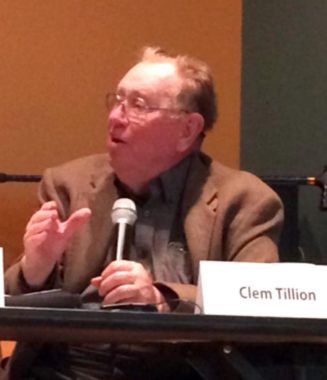
It was not an easy sell in the Legislature, with many Democrats still loyal to Gov. Bill Egan, who authorized the sale, or supportive of industry development in the state. Republican Legislator Clem Tillion, from Halibut Cove, was one of the main champions of the bill, both to protect fisheries and because the oil industry only paid 1 percent severance tax at the time. New legislation would impose taxes on the oil industry similar to what Texas required.
In his time in the Legislature, Clem Tillion helped pass a bill that protected Kachemak Bay from oil and gas drilling. (Photo by Jenny Neyman/KBBI)
“Why would I give up one fish for something that doesn’t pay me anything? Those are my grandchildren and great-grandchildren’s resources. But I’m certainly not going to give it away,” Tillion said.
Chancy Croft was a Democrat lawmaker, but on the same side of the issue.
“By ’75 you had a Republican governor and a Legislature that was overwhelmingly Democrat. And, so, the question was, ‘Were a group of Democrats going to say that the former Democrat governor of Alaska was wrong in what he did?’ It turned out a majority were willing to say that,” Croft said.
As the clock wound down in the 1976 legislative session, Tillion was short three votes to get Hammond’s bill passed. Ironically, the oil industry provided the extra push needed.
The jack-up rig George Ferris had been towed to Mud Bay, along the Homer Spit, for repairs after it was damaged at Cape Kasilof early that year. By August, rumors were flying that the rig’s iron legs were stuck in the mud. In May, Shell Oil attempted to move the rig, but the legs failed to retract and the rig got swamped by the tide, spilling diesel fuel into the bay. The oil boom meant to contain any possible spills was stuck on deck. Another boom brought in to contain the spill turned out to be already dirty and released its own sheen into the water.
Kizzia, editor of the Homer News at the time, covered the fiasco.
“To this day you can find plenty of quotes from industry officials about the care that they were going to take if drilling went ahead. And as soon as there was actual trouble all the promises evaporated,” said Kizzia.
Most anyone on the fence about protecting the bay was pushed over by the resulting outrage.
“One of the biologists with Chevron testified that it would not be possible to spill enough oil to do harm in Kachemak Bay,” said Loren Flagg, the commercial fisheries area biologist for Fish and Game at the time. “As the Legislature was getting ready to vote, the George Ferris. And that was enough for the Legislature to change their votes.”
Homer was indelibly changed by these events, and those involved learned lifelong lessons.
“Trust but verify. Don’t take everything you hear,” said Flagg.
“Don’t give away that which lasts forever for something that’s going to be here a short time,” said Tillion.
“The belief in people power, in self-advocacy, in the strength that you as an American citizen has,” said Tupper.
The panel discussion panel discussion to commemorate the 40th anniversary the Kachemak Bay oil and gas lease buyback took place on Wednesday, May 25 at Islands and Ocean Visitor Center in Homer. Cook Inletkeeper plans to make a full recording of the discussion available on its website, at inletkeeper.org.
Editor’s note: In 2014, Soldotna Sen. Peter Micciche sponsored legislation that removed the area around the deep-water dock on the Homer Spit from the critical habitat area, allowing drill rigs to dock at the Homer port. Cook Inletkeeper objected to the change, but there was overwhelming political support and the legislation passed.
Close
Update notification options
Subscribe to notifications
Subscribe
Get notifications about news related to the topics you care about. You can unsubscribe anytime.