Oceans

Researchers find new whale species in Western Alaska

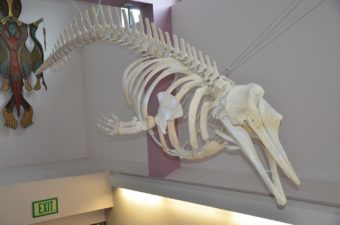
This skeleton hanging at Unalaska High School is the only full specimen for a new species of whale, long known but only recently identified. (Photo courtesy Unalaska School District)
This skeleton hanging at Unalaska High School is the only full specimen of a new species of whale, long known but only recently classified. (Photo courtesy Unalaska School District)

Researchers think they’ve found a new species of whale in Western Alaska. A new study published in Marine Mammal Science is identifying the find as a relative of the Baird’s beaked whale.
It doesn’t have an official name yet. Researchers aren’t quite that far along in the process of actually cataloging a new species. But it isn’t a brand new creature, either. In fact, Japanese whalers have long called it Katasu, or raven.

Philip Morin is a molecular geneticist with NOAA. His work on the genetic level was a key in making the discovery.

“This species, the new beaked whale, has probably been around for at least several million years,” he said.

This “new” type has actually been identified before, just incorrectly. Over the years, carcasses and skeletons have simply been pegged as juvenile or dwarf Baird’s beaked whales, but they are noticeably darker in color. A closer look at the genes led Morin and the rest of the team to conclude they were really looking at something altogether different.

“We looked at Baird’s beaked whale species samples from all across the North Pacific and the amount of difference, even between animals found in Japan versus northern Mexico, was very small. Compare that to the difference between the animals that we identified as this new species, it was an order of magnitude higher. They’re much more different from each other than animals within each species,” he said.

Morin’s work was important because typically, a new species is identified through a lot of taxonomy work. Lots of physical samples are brought in and studied, the differences noted and eventually we get a new species. But specimens of this type are rare. It took a lot of detective work to find what is out there.

Paul Wade is a research biologist for NOAA’s marine mammal laboratory. He’s spent years canvassing the Bering Sea for whales and he contributed to the pool of samples used for the genetic testing.

He says this latest discovery opens the door for a lot more questions, the first of which is where exactly these small, black beaked whales live.

“Kind of from Dutch Harbor to the west and north of the Aleutian Island chain is a deep water basin in the Bering Sea. Everything going over to where you are in Dillingham is very shallow water on the Bering Sea shelf and that’s not where you would find these whales,” he said.

“But once you get past the Pribilof Islands, the shelf edge breaks off there and goes into deep water. And so maybe this is a whale that’s primarily found in that deep ocean basin in the Bering Sea there,” he added.

Research on this project started a couple years ago when one of the whales washed up onshore at St. George in the Pribilofs in June of 2014.

French company promises Western Alaska high speed internet

The Ile de Brehat docked in Dutch Harbor. (Photo by Laura Kraegel/KUCB)

Western Alaska just got one step closer to high-speed internet.

That’s because, after years of planning and wrangling permits, Quintillion is finally ready to lay fiber optic cable from Prudhoe Bay to Nome. The telecom company has one vessel stationed in the Bering Sea and another close behind.

The Ile de Brehat has left its homeport in France, passed through the Panama Canal, and will soon arrive in Nome. That’s where the vessel will start laying a path of fiber optic cable below the sea floor — a path that will wind more than a thousand miles up to the North Slope.

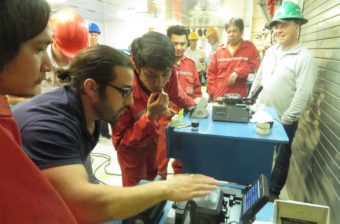
Right now, though, the ship is docked in Dutch Harbor, and a group of Quintillion’s executives and investors is climbing aboard.

“This is the cable ship Ile de Brehat,” said Captain Charles Souffre. “So first of all, welcome on board, all of you.”

Souffre is in charge of the nearly 500-foot-long vessel and its 70-member crew.

They run the ship on behalf of Alcatel Submarine Networks, the French company Quintillion hired to make and lay the cable system. They’ll start trenching outside of Nome any day now, and the operation will run 24 hours a day through September, relying on a careful configuration of multimillion-dollar equipment.

A section of fiber optic cable. (Photo by Laura Kraegel/KUCB)

As Souffre explained to the group, all of that time, money, and manpower really comes down to one thing: protecting thin filaments of glass.

“This is the fiber,” he said. “This one is only for deep water. And this cover is to send power inside the cable to monitor the integrity of the system.”

That’s crucial. The fiber optic system is supposed to last 25 years or longer, supporting a delicate process that allows phone and computer data to ride light waves across the glass fibers of the cable.

It has to work, and it has to be fast. So Souffre said his team will test the cable constantly as they install it by running an electrical current through the entire system and reading the signal from start to finish. If it’s not clear, they stop the ship and fix the problem.

But Souffre said there shouldn’t be too many problems. His crew will lay the cable along a carefully chosen route, developed over two seasons of marine surveys. There are underwater cameras on all the equipment — and cable detectors too, if visibility is poor in murky waters. The whole operation is run from countless monitors and control boards on the ship’s bridge.

“It’s like a big PlayStation,” he said.

But community leaders say that big PlayStation will have an even bigger impact on rural Alaska, where people are still dealing with internet at dial-up speed.

Reggie Joule is a former state legislator and mayor of the Northwest Arctic Borough, and now he’s Kotzebue’s liaison for the Quintillion project.

Looking around the ship at tanks full of fiber optic cable, Joule said high-speed internet is going to be “momentous,” especially for rural economies.

“If we have somebody who can make widgets in one of our communities, but has no outlet — the internet can get the skill of that individual and provide them with a market,” he said. “That changes the economy of places where there aren’t economies, potentially.”

Joule said fast internet will also help rural communities provide better healthcare and education through telemedicine and online learning services.

Unalaska City Manager Dave Martinson agreed.

“Having high-speed internet here will enhance our abilities to do our jobs across the board — whether you’re an educator, a doctor, or a shipping company,” said Martinson.

Reggie Joule looks over tanks of coiled fiber optic cable in the Ile de Brehat. (Photo by Laura Kraegel/KUCB)

But Unalaska isn’t getting fiber optic cable. At least, not yet.

Quintillion’s ships will pass through the port, and the company plans to store extra cable on the island in case of emergencies. But for right now, just six communities are getting fiber: Prudhoe Bay, Barrow, Wainwright, Point Hope, Kotzebue, and Nome.

That’s why Martinson made it a point to meet with Quintillion representatives during their visit to Unalaska.

“This was another opportunity to put our plight in front of them — our need for high-speed internet,” he said. “I think that ultimately, it’ll take us a while, but our odds are pretty good.”

Elizabeth Pierce is CEO of Quintillion. She said the company is already thinking about expansion, but she can’t make any promises yet.

“We are working very aggressively to determine what landings we’ll cover in phase two,” said Pierce. “It is our objective to add more Alaska landings, but it’s a little early to make any announcements.”

For now, the Ile de Brehat will start laying cable in Nome and move north. Its sister ship — the Ile de Sein — will begin in Prudhoe Bay and work south until they meet in the middle. The project is on schedule to deliver high-speed internet to western Alaska by early 2017.


Ferry breakdown strands passengers in Petersburg

Joe Yuhas and brothers Steve and Larry Banwart were stranded in Petersburg after the Columbia ferry broke down on Wednesday. (Photo/Abbey Collins)
Joe Yuhas and brothers Steve and Larry Banwart were stranded in Petersburg after the Columbia ferry broke down on Wednesday. (Photo by Abbey Collins/KFSK)

Nearly 200 passengers were stranded in Petersburg this week after a mechanical issue on one of Southeast Alaska’s main ferries caused it to stall there Wednesday morning. KFSK’s Abbey Collins met a few of those passengers before they left town late Thursday night.

Larry Banwart and his brother Steve were living the dream – riding their motorcycles up the Alcan from Phoenix.

“I had a three-week vacation, my brother came down to meet me,” says Banwart. “And we decided we were going to ride our bikes to Alaska.”

“It’s our bucket list,” says Steve Banwart.

They reached Alaska and boarded the Columbia ferry to head back down to Bellingham, Washington. That’s when they hit a snag.

“I called my boss this morning and told him I’m going to be a few days back to work,” says Banwart.

That’s because they were stuck in Petersburg after the ferry broke down Wednesday morning. Banwart says passengers have been told the best case scenario gets them to Bellingham, Washington Saturday evening.

“Best Case. Worst case we have no idea,” says Banwart. “Live here.”

Alaska Marine Highway System spokesman Jeremy Woodrow says a mechanical issue with the ship’s starboard engine required the ferry to remain moored. That issue has since been resolved and the boat sailed to Ketchikan late Thursday night. It’s expected to depart for Bellingham about 48 hours behind schedule.

The Columbia is one of Alaska’s main ferries, running routes between Skagway and Bellingham. It will now be running on a revised schedule through the end of the month. The ferry will then be dry docked in Ketchikan for a few days while an oil leak is repaired. It’s expected to be back up and running on August 3.

While waiting in Petersburg, passengers were provided free meals. As far as sleeping goes, Woodrow says people are given staterooms if they are available. But some, like the Banwart brothers, slept in tents – others wherever they could find a spot.

Steve Banwart says he doesn’t mind the camping or the delay.

“I don’t have a job so I have nowhere to go. Doesn’t matter to me if we get stuck here for another week,” says Banwart.

Joe Yuhas, a motorcyclist from Minnesota, says he’s not too concerned about getting home later than expected, but he did have to cancel all of his reservations for his road trip back.

“So based on whenever we land I’ll reschedule everything to get home,” says Yuhas. “All my hotels have been cancelled. I’m freewheeling it all the way home from here.”

There were a few alternatives for people – other ferries and some flights. But for those headed to Bellingham, the Columbia is only ferry option.

Yuhas and the Banwarts have their motorcycles on the ship, so they stayed on board until the engine started running.


The year Bristol Bay landed its 2 billionth salmon

James Shawcroft holds up what might have been the 2 billionth commercially caught salmon in Bristol Bay’s history at Coffee Point, July 6, 2016. (Photo by KDLG)

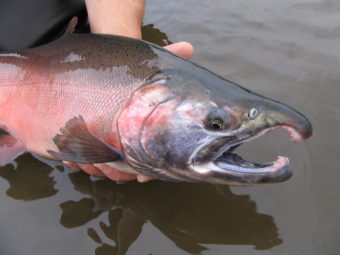
Bristol Bay is home to the largest sockeye salmon fishery in the world. Over 132 years of commercial effort, now more than 2 billion salmon have been harvested from the Bay’s waters. In fact, the 2 billionth salmon was landed sometime, by someone, on July 6, 2016.

It fell to Bob King, the longtime news director at KDLG and now avid fish historian, to announce this milestone in an essay he penned last fall.

“Since the canned salmon industry came to to Bristol bay in 1884, fishermen have landed 1.99 billion salmon, 93 percent of which were sockeye.” King wrote. “It took 95 years for Bristol Bay to produce its first billion salmon, the two billionth fish will come just 38 years after that.”

King had been quietly watching the numbers for years. After the Deptartment of Fish and Game issued the forecast for the 2016 salmon run to Bristol Bay, he knew this would be the year. Fish and Game confirmed King’s tally, and decided that the 10,033,455th salmon harvested this season would mark two billion. As the run took shape, it was clear that salmon would be landed on Wednesday, July 6, an appropriately cool and rainy day in Bristol Bay.

At Dillingham’s Kanakanak Beach, set netters were headed out for an opener.

“We caught it this morning, about two o’clock!” said Coffee Point set netter Corey Evans, with a common response. Evans also offered reflections on the fishery and the milestone shared by many too.

Alithia Belleque and her mother Johanna set net at Coffee Point near Dillingham, and caught Bristol Bay’s 2,000,000,000th salmon on July 6, 2016. (Photo by KDLG)
Alithia Belleque and her mother Johanna set net at Coffee Point near Dillingham, and caught Bristol Bay’s 2 billionth salmon on July 6, 2016, maybe. (Photo by KDLG)

“It’s impressive it’s gone on for this long and I think it says something about the management, that we can keep it going like this,” Evans said. “You see a lot of fisheries that have trouble through the years and this one seems to be going pretty strong. That’s pretty nice to see.”

I let Steve Becker, another Coffee Point set netter, know about the famous fish soon to be harvested.

“Really? I’m going to catch it,” he said, not missing a beat.

“How do you know it’ll be you?” I asked.

“How does anybody know who it’s gonna be?” Becker said. “It’s gonna be me.”

That’s exactly the point King reinforced in his essay.

“Whoever catches the 2 billionth salmon will never be known. Fishing will probably be fast and furious when next year’s catch tops 9 and a half million,” King wrote. “Anyone can claim credit for catching the 2 billionth salmon. And everyone should.”

“Yeah we’re going to catch that, then we’re going to mount it, frame it, sell it on eBay,” Kyle Belleque said. Belleque fishes with his family at Coffee Point. What does the milestone say about the Bay?

“It’s an ecological wonder, I mean, it’s a magnificent display of raw nature,” Belleque said.

On Wednesday afternoon, salmon were picked from gill nets in Ugashik, Egegik, Naknek-Kvichak, Togiak, Igushik, and Nushagak. The milestone fish came from somewhere, anywhere in Bay.

Matt Shawcroft and his four kids put their net in the water just after two o’clock. Maybe they caught it.

“We are picking the 2 billionth fish in Bristol Bay today!” Shawcroft said, rallying his troops to the cause. “Any one of these fish we pick could possibly be fish number two billion. So this is a special day in Bristol Bay.”

Skipper Howard Knutsen, 86, delivered Bristol Bay’s two billionth salmon to the F/V Lady Helen in Ugashik. One of his salmon made it’s way to the Governor. (Photo by KDLG)
Skipper Howard Knutsen, 86, delivered Bristol Bay’s possibly 2 billionth salmon to the F/V Lady Helen in Ugashik. One of his salmon made its way to the governor. (Photo by KDLG)

As they stretched their net from shore, a hundred pounds of sockeye filled the meshes, and generations two and three of Shawcroft set netters began picking them out, laying them in the brailer bag’s icy brine.

“Ok it looks like Emma got fish 2 billion. James you might have to be fish two billion and one,” Matt said.

“How do you know that was 2 billion?” James asked his dad. “Maybe it was fish … nine million … nine hundred … and ninety nine ….”

The rain turned from a drizzle to a downpour. Perfectly typical summer weather in Bristol Bay.

“Alright James, so we hit 2 billion today. You picked out one of those. What are the odds you’ll be here to pick the 3 billionth?” I asked.

“576 to 1,” he quipped, eliciting a few chuckles.

“Do you want to stick with this business long enough to pick the 3 billionth in another 30 years?”

“I don’t know.”

“But I bet you’ll be glad to know that it will be there, right?”

“Yeah I know it’ll be there, but I don’t know if I’ll be the one to pick it,” he told me. His older sister said she’d be the one to pick that next milestone, too.

The 3 billionth may be aways off, but not an unreachable goal for these young fishermen.

Skipper Howard Knutsen has been picking salmon from the Bay’s waters for the last billion plus. He also landed the milestone fish, pulled from near the mouth of the Ugashik River. According to CFEC records, at 86, Knutsen is the oldest actively fishing drift permit holder in Bristol Bay.

“It’s a great honor, it’s a big surprise,” said Knutsen, standing aboard the F/V Lady Helen, looking surprisingly serene, clean, and refreshed mid-season. 2016 is his forty-fifth year fishing these waters commercially.

One of Knutsen’s salmon got the VIP treatment, delivered straight to Governor Bill Walker’s doorstep in Juneau a day later. BBEDC’s Norm Van Vactor thought that’d be a nice gesture.

“One of the issues I’m sure that the governor’s dealing with is a lot of pros and cons and comments about the PFD,” Van Vactor said. “Well we can speak to Alaska’s other PFD, which is our Bristol bay salmon resource. Just like the financial PFD this is a resource that needs to be protected for generations and generations.”

The milestone salmon could’ve been a pink, a coho, a chum or a king, but in Bristol Bay, the overwhelming odds are that it was a sockeye. From the drift boat or set net skiff, it was sold to a tender or driven up a beach and ended up at a processor. Then it was canned, cut, frozen, or flown out fresh.

Icicle Seafoods’ Samantha Russell showed off the milestone fish after it had made its way into her plant late Wednesday evening.

“I’m pleased to announce that I’m holding the 2 billionth sockeye salmon to be harvested out of Bristol Bay,” Russell said, standing at the sorting line in Icicle Seafoods’ Wood River plant.

“That’s a good looking fish,” I asked.

“It sure is,” she said. “That’s about a ten pound round fish, a hundred percent scales, firm, number one quality.”

“Where will this end up?”

“We’re gonna pack this fresh and fly it out on Alaska airlines tomorrow, and this fish will wind up somewhere on the East Coast,” said Russell.

“So the 2 billionth Bristol Bay salmon is going to be on somebody’s dinner table this week?”

“It should be on someone’s dinner table by tomorrow evening,” Russell added.

When will Bristol Bay celebrate the next billion?

“With continued scientific management of the salmon resource, maintaining the fish’s natural habitat and a little good luck, Bristol Bay fishermen might look forward to catching its 3 billionth salmon in 2054,” Bob King posted in his essay.

By the time the 2016 season wraps up, this fishery will be another 25 or 30 million salmon closer to that next milestone.

Researchers are watching sockeye sizes

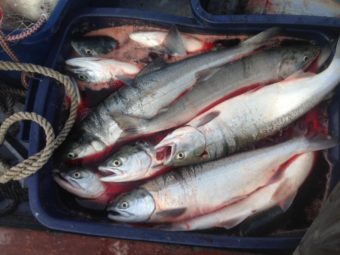
Wood River sockeye are pictured in this June 2016 photo. CREDIT KDLG NEWS
Wood River sockeye are pictured in this June 2016 photo.
(Photo by KDLG Staff)

Alaska’s sockeye salmon came back shorter and lighter than usual last year. As sockeye runs return this summer, biologists have been keeping an eye on their size, tracking whether they’ll be like last year – shorter and lighter than average – or back to their normal weights.

Longtime Bristol Bay fisherman John Bennett said that at least for the start of the Bristol Bay season, the sockeye in his net have been smaller than they used to be, just like last year.

“Everything’s changed,” he said in late June. “Even the size of the fish has changed, nothing’s the same.”

Fish and Game’s Jack Erickson said on July 3 that’s what he’s seeing in the numbers, too.

“We’re still looking at smaller fish, similar to last year’s numbers,” Erickson said.

So far, Erickson said the three-ocean fish, those that have spent three years in saltwater before swimming back, are a little smaller even than last year. The fish that have spent just two years at sea are a little larger than 2015.

“And on average right now, from our very initial catches, it’s averaging about the same as last year for size,” he said.

Fish size estimates come from samples taken at counting towers as well as in the commercial harvest. Although that data is available now, Erickson says it’s too early to draw very many other conclusions about the 2016 run, and the size info is far from final.

Prince William Sound and Cook Inlet also had small fish last year. But as the runs progress in those regions, they don’t appear to be quite as small.

“Well this year in Prince William Sound, we saw fish originally coming in a little bit smaller,” Erickson said. “But since the beginning of the season, the fish have gotten larger. I think we’ve put on an average of about half a pound. We’ve seen an increase in the average size of sockeye. So that’s good news to see out in Prince William Sound/Copper River.”

Erickson said the very first Cook Inlet fish have also been about half a pound larger than last year, too.

“So in those two areas we’re seeing some improvement,” he said. “And hopefully, we’ll see that larger size show up in Bristol Bay as well.”


Whale deaths near Anchorage, Glacier Bay prompt investigation

bears and dead fin whale
Bears feed on a fin whale carcass in Larson Bay near Kodiak, June 13, 2015. (Photo courtesy NOAA)

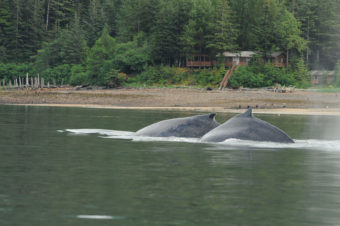
Researchers are trying to determine what caused the deaths of three large whales found along Alaska’s coastline within a single week in late June, and whether the fatal strandings might be related to a big spike in whale deaths in the region last year.

A fin whale died in Knik Arm near Anchorage on June 22. Four days later, a humpback was found dead off Point Carolus in Glacier Bay National Park. Two days after that, another humpback was found in Turnagain Arm near Hope.

Investigators with the National Oceanic and Atmospheric Administration and partner groups have taken tissue samples from all three whales. The Glacier Bay humpback, which had been observed by scientists since the late 1960s and was nicknamed “Festus,” may provide the most clues, because researchers were able to conduct a full necropsy.

British Columbia veterinary pathologist Steven Raverty led the postmortem, and said there was no evidence of skull or other bone fractures, but there were indications the whale wasn’t healthy.

Whales usually have copepod parasites known as whale lice, Raverty said, “and this animal had probably the most abundant numbers that we’ve seen in animals that have stranded throughout the area. And it would tend to suggest that the animal may have been debilitated or there was some degree of immunosuppression.”

In addition, he said, the whale had diminished fat reserves, which may mean it wasn’t consuming enough food.

NOAA officials don’t know if these recent deaths are related to the dozens of whale deaths in the Gulf of Alaska last year. Those 2015 strandings were labeled an “unusual mortality event,” and the cause is still under investigation. It could be a difficult mystery to solve, because so many of the carcasses were too decomposed or too remote to study.

Raverty said the recent whale deaths could help researchers to better understand last year’s die-off.

“We look at these individuals that are now stranding in 2016 as a really unique opportunity to try and establish baseline health and understanding, whether there may be evidence of ship strike, infectious disease, exposure to harmful algal blooms, and these will all be put in the context of what had occurred historically, but also during the unusual mortality event,” he said.

Tissue samples from all three whales have been sent to labs for analysis, but it’s not clear when researchers will know more about how and why they died.

Site notifications
Update notification options
Subscribe to notifications