Oceans

Homer council shows concern over proposed naval training

Homer City Council passed a resolution on Aug. 8, formally requesting changes to U.S. Navy training exercises in the Gulf of Alaska. The proposed training area is 24 nautical miles from the Kenai Peninsula shoreline, just south of Prince William Sound and east of Kodiak Island.
It covers more than 59,000 square miles, an area slightly larger than the state of Georgia.

Emily Stolarcyk, program manager for Cordova-based non-profit group Eyak Preservation Council, spoke in support of a resolution requesting changes to the proposed training August 8 at Homer City Council.

“These trainings are aimed at maintaining military readiness,” Stolarcyk said. “Everything used in the exercises is actually the same weapons that are used in war. So these are real bombs, real missiles, torpedoes, heavy deck guns and then of course, the active sonar.”

Although military preparedness is important, she said the needs of local communities and ecosystems should also be taken into account.

“We certainly can’t understate the need for national security, but we could go about it in a more sensitive way,” Stolarcyk said. “Sensitive to the people that live here, the communities, our industries, and then wildlife as well,”

Homer City Councilmember David Lewis sponsored the resolution. He’s concerned about the impact of Navy training on wildlife.

“It matters because all that comes into Kachemak Bay basically comes from the Gulf,” Lewis said.

The proposed training would begin in May 2017, but the resolution requests the Navy wait until mid-September to avoid impacts on migrating marine species.

Cook Inletkeeper executive director Bob Shavelson said the environmental impacts of naval training could be lessened by scheduling it later in the fall.

“These are migration corridors for our salmon and our halibut and our whales,” Shavelson said. “And we could reduce those impacts considerably if we change it to later in the year and push it further from the coast.”

Navy representative Alex Stone said the longer days and calmer waters in the summertime allow them to do more training exercises.

“We get more value for our investment if we can plan the exercise when it has a greater probability of better weather, better conditions for flying and for training,” Stone said.

The resolution also requests the Navy avoid using live ordnance and sonar in Marine Protected Areas. One concern is that these activities produce loud underwater sounds, which can physically harm marine mammals and alter their behavior.

Beaked whales appear to be particularly sensitive to sonar. said Scripps Institution of Oceanography professor John Hildebrand.

“There was an exercise in the Bahamas around 2000 where the Navy was conducting an exercise in a relatively confined space along a channel,” Hildebrand said. “And then you could see the beaked whales strand themselves along the channel pretty much in lock step with position of the sonars.”

Although the effect of sonar on larger whales isn’t well known, many of these species are endangered.

Any activities that could harm them receive an extra level of scrutiny, Hildebrand said .

“We’re worried about these animals already so we have kind of an extra layer of concern because there are already endangered,” Hildebrand said. “And now here’s another thing that could potentially impact them, even though we don’t know the details of how it might.”

Currently, the Navy visually monitors the area around vessels to look for marine mammals.

“Sonar could cause impacts to marine mammals if they’re close to the sonar source,” Navy representative Alex Stone said. “We have a safety zone around that area. So we observe that area and if there are marine mammals in that area we’ll power down the sonar or turn it off.”

In this case, Close is 1,000 yards, according to the Navy’s Environmental Impact Statement.

The resolution requesting changes to Navy training was unanimously approved by members of Homer City Council.

It now goes before Alaska Sen. Lisa Murkowski and Reps. Dan Sullivan and Don Young.

The final Environmental Impact Statement for the proposed training is available at goaeis.com. The 30 day public comment period ends August 29.

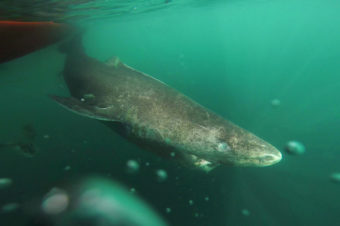
Massive carnivore Greenland shark is at least 272 years old

The long lifespan of the Greenland shark, shown here in the cold, deep waters of the Uummannaq Fjord, may only be surpassed by that of the ocean quahog, a clam known to live as long as 507 years.
The long lifespan of the Greenland shark, shown here in the cold, deep waters of the Uummannaq Fjord, may only be surpassed by that of the ocean quahog, a clam known to live as long as 507 years. (Julius Nielsen, Science)

Sharks can live to be at least 272 years old in the Arctic seas, and scientists say one recently caught shark may have lived as long as 512 years.

That’s according to a study published Thursday in the journal Science that says Greenland sharks can live longer than any other known animal advanced enough to have a backbone. Until now, the record-holder for the oldest vertebrate was the bowhead whale, known to have lived up to 211 years.

The Greenland shark, a massive carnivore that can be more than 16 feet long, hasn’t been studied much, and its life in the cold northern waters remains largely mysterious. Julius Nielsen, at the University of Copenhagen in Denmark, says that there had been some hints that Greenland sharks grow very slowly, perhaps less than a centimeter per year. That suggested the huge sharks might be ancient.

“We only expected that the sharks might be very old,” says Nielsen. “But we did not know in advance. And it was, of course, a very big surprise to learn that it was actually the oldest vertebrate animal.”

He and some colleagues obtained 28 female Greenland sharks taken by research vessels as unintended bycatch from 2010 to 2013. The researchers then used radiocarbon dating techniques on the lenses of the sharks’ eyes.

A Greenland shark caught as bycatch from research vessel Pâmiut in southwest Greenland. (Julius Nielsen, Science)

There’s a bit of uncertainty associated with the age estimates, but Nielsen says the most likely age for the oldest shark they found was about 390 years. “It was with, 95 percent certainty, between 272 and 512 years old,” he says. The researchers believe these sharks reach sexual maturity at about the age of 150 years.

“It’s a fascinating paper and certainly moves back the vertebrate longevity record by a substantial amount,” says Steven Austad, who studies the biology of aging at the University of Alabama at Birmingham. “Even if you look at the low end of their estimate — 272 years — that’s still substantially longer than any other documented vertebrate.”

He says there are lots of anecdotal accounts of long-lived turtles and fish, but this beats those by a long shot.

The Greenland shark’s lifespan may really only be surpassed by that of the ocean quahog. These clams have annual growth rings on their shell, and scientists have found that they can live as long as 507 years.

The Greenland shark, the bowhead whale, and the oldest ocean quahogs spend their long lives in cold northern waters, notes Austad, suggesting that low temperatures might have something to do with their unusual longevity.

“I don’t think that cold is the whole story,” says Austad. “It’s probably playing a role. But my guess is there are plenty of short-lived animals that are swimming around with this shark.”

Still, he says, just imagine what it would be like to have muscles, like these sharks, that have been working nonstop since the time of the Pilgrims.

“There’s something going on in those muscles that we’d very much like to know about,” says Austad.

He notes that Greenland sharks would not be easy to study in the lab, but perhaps people could study shark cells grown in a dish.

“Probably whatever sort of physiological tricks the sharks have to live that long, and the quahogs have to live that long, they’re probably something that humans don’t have,” says Austad. “But it’s something that, if we discover what it is, we might be able to adapt it to human use.”

He’s been studying the quahog, which has a beating heart, and whenever doctors who specialize in geriatrics stop by, he likes to hand them a 200-and-something-year-old clam and tell them they’re holding a beating heart that’s older than any heart they’ll encounter in their entire career.

Copyright 2016 NPR. To see more, visit http://www.npr.org/.

Report: 2015 was Earth’s warmest year on record

Surface temperatures
This image, courtesy of NOAA Climate.gov, shows differences in surface temperatures over time.

Rising sea levels, changes in marine habitat, decreasing Arctic sea ice and retreating mountain glaciers over the last 50 years all signal that the planet has long surpassed a tipping point in a changing global climate.

According to a new report on the status of the Earth’s climate, one of the strongest El Niño events in recent history and long-term climate change were responsible for record-setting warm conditions around the world last year. Average temperatures in 2015 were 0.1 degree Celsius above the record set in 2014. They are now a full degree Celsius or 1.8 degrees Fahrenheit above the mid-19th Century pre-industrial average.

The 300-page State of the Climate report was produced by the National Oceanic and Atmospheric Administration’s National Centers for Environmental Information and published in the August issue of the Bulletin of the American Meteorological Society.

“Over large parts of the world, we’re into uncharted territory as far as the warmth, persistence of the warmth, and – in some cases – even the magnitude of the warmth,” said Rick Thoman, a climatologist with the National Weather Service in Fairbanks. Thoman was not one of the 450 co-authors of this year’s State of the Climate report, but he routinely works with his NOAA colleagues at NCEI.

Surface temperatures

For just Alaska, 2015 was the second warmest year ever recorded, right behind the record set in 2014.

Warm sea surface temperatures in the Gulf of Alaska and the Bering Sea were likely a factor in warmer than average conditions in Alaska over the last three years. The decline in Arctic sea ice also means more moisture is being pulled up into the atmosphere. Thoman said that can affect inland areas of Alaska as well as the coast.

“A few days of really hot weather maybe get more people’s attention,” Thoman said. “‘Oh, gee. It’s really hot the last couple of days.’ But this slow grind of week after week, month after month of far above normal temperatures is what the environment is really going to key on. That’ll be the kind of thing that drives changes rather than individual weather extremes.”

Scientists expect the equatorial Pacific will cool this year. The developing La Niña is a reverse of the super strong El Niño that recently fizzled out. That may mean cooler conditions for the next year or so, but Thoman warns not to expect the long-term trend to ever reverse.

“You’re kind of on an escalator, but there’s still going to be steps up and down,” Thoman said. “So, it is by no means certain that next year will be warmer than this year. At some point, next year is going to be cooler than the preceding year just because of the random variability of the atmosphere. But, when you’re on that escalator, you can’t go down for very long.”

Carbon dioxide
This graph, courtesy NOAA Climate.gov, is based on data from ESRL’s Global Monitoring Division. (Creative Commons background photo by John Fowler)

The State of the Climate report noted that atmospheric concentrations of greenhouse gases set a new record. The average levels of carbon dioxide, methane and nitrous oxide rose to just over 400 parts per million for the first time ever.

Among some of the report’s other highlights, sea surface temperatures and average overall ocean heat content in 2015 surpassed the record set in 2014. Sea levels were also the highest on record, or about 2.75 inches above the 1993 average.

Some parts of the globe experienced an above-normal rainy season, partly because of the strong El Niño. But, overall, more areas around the globe experienced a severe drought.

How has the Earth been affected by warmer temperatures?

According to the State of the Climate report, the number of tropical cyclones was well above the average with most of the activity in the Pacific. The Atlantic was fairly quiet in 2015.

Sea ice remains low as the Arctic continues to warm at a faster rate than the mid-latitudes or the tropics.

Arctic fish species are being pushed out of their usual areas as warm-water species move in. Mammals such as walrus are forced to haul out on land instead of sea ice.

Algal blooms have affected marine life and coastal resources all along the northeast Pacific. Warm ocean conditions may be a factor in the severity and early onset of the blooms.

Glaciers continue to retreat and lose mass for the 36th consecutive year while record high temperatures have been measured at permafrost observatories in Alaska.

Mountain glaciers

YCC: Introducing Alaskan kids to the Aleutians and careers with FWS

What happens when five teenagers pile onto a research vessel and go island hopping through the Aleutians in the name of conservation? Science. Education. And maybe a peek into their futures.

It’s all part of an only-in-Alaska version of the federal Youth Conservation Corps or YCC. The goal is to introduce high school students to a stretch of protected land they’ve grown up near, but may not even know exists — all in the hope that someday these young Alaskans will become its next stewards.

Over the course of a season, the research vessel Tiglax can travel 20,000 nautical miles. For a week, five YCC corpsmembers, ranging in age from 16 to 18, join the crew exploring the vast Alaska Maritime National Wildlife Refuge, which stretches from the western end of the Aleutian Chain to islands like St. Lazaria near Sitka and even further north than Point Hope.

“It’s kind of cool being able to be on this huge vessel and have people teach you how they do it,” Aurora Waclawski, 18,  said. “It’s really interesting and awesome.”

She and the rest of the crew grew up in communities around the refuge, ranging from Homer, where she’s from, to Atka. But for most of them, this is the first time they’ve actually traveled through it.

Waclawski heads to college this fall, where she plans to study environmental engineering. The opportunity to explore the Maritime Refuge through the YCC program has been on her bucket list for years.

“Throughout my life, I’ve loved science and all that stuff and that’s kind of why I wanted to do this,” Waclawski said. “It’s cool seeing how this science that I’ve only really seen on paper actually goes on.” Science like surveying seabird colonies, and tracking the reproductive success of puffins on Aiktek.

During a week on the Tiglax, the YCC members see a sliver of the refuge, which provides essential habitat for 40 million seabirds — not to mention marine mammals and other migratory birds — but isn’t exactly a household name in the communities on is borders.

Take 18-year-old crew leader Marieana Larsen. Growing up in Sand Point, she didn’t know much about sea birds. But when she traveled to Saint Paul Island in the Pribilofs for the YCC, she says she finally understood the importance of the refuge.

“We made like 100 rat traps and I thought, ‘this is kind of pointless,'” Larsen said. “And then I thought about it and I was like, ‘oh wow birds are dying. No, rat traps are important.’ Because one rat gets on the island it could destroy all the seabirds and that’s no tourism and that’s no refuge and then people aren’t going to have their cultural foods.”

Larsen will take what she’s learned back to her community. Alongside the crew, she teaches environmental education classes at the annual culture camp in Sand Point.

“Its really fun to do classes with kindergarten through fourth grade and just kind of teach ’em different scientific things about nature because it’s not like they’re learning about it at culture camp,” Larsen said. “They’re learning about the cultural aspects.”

She hopes to bridge the gap — intertwining science with Alaska Native culture and finding more ways to connect kids to their landscape. The YCC crew are paid an hourly wage, with all their expenses covered.

Tiglax captain Billy Pepper said it’s one of the best ways the refuge spends money.

“If you’re going to try and tell somebody that wildlife and the environment is important, it’s harder to convince somebody in their 40s than in their teens,” Pepper said. “And if they get it in their teens they really become advocates for conservation.”

The experience has changed the course of some kids’ lives — giving their ambitions a real-world road test, he said.

“They come on,” Pepper said. “They think they’re going to do something and they’ve got a lot of ambition to do one thing and they’re seasick the whole time. And one kid was going to be a pilot that was the end of that. He couldn’t handle the movement. He didn’t have the make up to do it.”

For some, the experience is more successful. Larson is one of the youngest crew leaders and now, a youth ambassador with the Arctic Council. Since her first time aboard the Tiglax, Larsen slowly has been wiggling her way into the Fish and Wildlife Service, but she’s not the only one. At least four former YCC members have gone on to work for the refuge. Larsen thinks eventually she might like being a Refuge Information Technician or RIT.

“It’s like you’re the middle man for the people they want to talk to and telling them what they are doing on the refuge like with the communities close to it,” Larsen said.

That’s exactly the kind of middle men the program is hoping to create — liaisons between the refuge and the people who live near it. Right now, there is not a RIT position for the Alaska Maritime National Refuge. Staff members know Larsen is interested and said having her stationed in Sand Point representing the refuge is a possibility.

Oil spill cleanup demo coming to Dillingham

Officials from the Department of Environmental Conservation will explain how to use spill response equipment like oil booms. (Department of Energy Conservation)

State officials will be in Dillingham next week to demonstrate oil cleanup equipment and techniques.

A two-hour presentation will be Tuesday at the Bingo Hall, Dillingham, with more hands-on activities at the Harbor afterward.

Rick Bernhardt, the scientific support unit manager at the Department of Environmental Conservation, will discuss spill response and demonstrate how to use items in containers of cleanup materials.

“On average, we have about 2,000 spills reported to the Department of Environmental Conservation every year, and most of those are just teeny-tiny spills.”

A recent spill occurred at the Drift River Terminal on the West Side of Cook Inlet.

Most spills are small, but compounded a couple thousand times, they add up to a lot of environmental damage. DEC has shipping containers across the state stocked with cleanup materials ready to respond to spills. The containers contain absorbent and containment booms, storage tanks and the implements.

“We have 56 of these containers throughout the state,” Bernhardt said. “We like to consider them regional resources. We have two in Dillingham, but if a neighboring community had an oil spill, they are available for regional use.”

Swiss family sails around the world for climate change

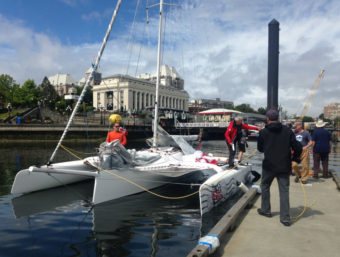
The Schwoerer family is sailing around the world educating people about climate change for ToptoTop Organization. Photo (Photo courtesy of TopToTop)

The Pachamama Band, also known to a few as the Schwoerer family singers, are all members of one Swiss family that has been living at sea for the past sixteen years. They’ve been sailing around the world in a boat called Pachamama, educating people about climate change and re-strengthening humanity’s relationship with nature.

“It’s about respect to nature, about giving back also to others, just to care about this planet like it’s your own mother,” Dario Schwoerer said.

As part of an organization the Schwoerer family started called ToptoTop, their goal was to reach the tops of the seven tallest mountains on each of the seven continents without using motorized transportation of any kind. ToptoTop also took on volunteers when possible to help crew the boat, collect data on climate change, and assist with the kids’ education. Currently, there are three volunteers living on board with the Schwoerers.

Dario Schwoerer, the father of five, said the plan was to take four years to complete this record feat, but the plan has changed slightly since he and his wife first started in the year 2000.

“So, our goal now is to go through the Northwest Passage to Greenland, and do, more or less, a figure eight… and on that figure eight, we will also sail south to Antarctica and hopefully do the mountain we tried to do in 2004 then,” Schwoerer said.

In 2004, Dario and his family attempted to reach Mt. Vinson, the tallest mountain in Antarctica, but their self-built vessel was so damaged by the icy waters that they couldn’t continue. The Schwoerers have faced a variety of challenges during their sixteen-year long sea voyage, including a lack of funding.

One of the sponsors for ToptoTop for eight years was SGS, an international inspection and certification company. But when a new CEO took over SGS, Dario said their educational project’s resources suffered; “now, we are running on half of our budget,” he said.

Currently, the rest of ToptoTop’s budget comes from individual donations and from their other sponsor, Victorinox. Victorinox manufactures apparel and travel gear, but they are more commonly known for making genuine Swiss Army knives. Being of Swiss heritage, The Schwoerer family brought many Swiss Army knives with them to serve different practical purposes on board — and, maybe, a not-so-practical one.

Sabine Schwoerer, a former nurse and now full time mother, used a Swiss Army knife during each of her children’s births. “We cut the umbilical cords… so we have five knives, and we will give them to them (the children) when they are 20,” she said with a laugh.

Five knives for five children: the oldest is Salina, then Andri, Noe, Allegra, and the newborn, Mia, who can be heard crying in the background. All of them were born at sea and have spent their entire lives on this floating home.

So when the children were asked how they felt about frequently moving from place to place, they said, “It’s good, it’s nice, you have to say ‘bye’ to a lot, that’s sad, but you get to say ‘hi’ to a lot, too.”

And the Schwoerer family has said “hi” to a lot, from Mt. Everest, to the Shanghai World Expo facilities, and small villages around the world where they have taught more than 80,000 children about climate change.

After seeing so many beautiful places, Dario still recalled one of his favorite sights, an ice ridge from the Piz Bernina Mountain in his homeland.

“There’s a wonderful ice ridge going to the top, it’s like a stairway to heaven out of ice, it’s really beautiful,” said Dario with a twinkle in his eyes.

Originally a Swiss mountain guide, Dario grew up in a remote village of 55 people located in a part of the Swiss mountains. When he saw climate change negatively affecting his workplace, Dario studied at a Swiss university to become a climatologist and made a plan to educate others about climate change.

That’s why Dario is encouraging and educating children all over the world, including his own.

Dario recalled, “nature teaches them something, every day, and I mean just the other day when we sailed in here and saw the Salmon Creek here. They catched (sic) more than 11 fish, and they have had a blast. Andri the 9-year-old taking them in, Noe the 6-year-old killing them, and Allegra the 5-year-old and Selena the 11-year-old cleaning them out. They came back at 10 o’clock at night, we didn’t know where they went, big smiles with all that salmon.”

The ToptoTop organization’s desire, and Dario’s wish, is that after this Pole-to-Pole expedition, then a younger generation will continue this for the Schwoerers.

Dario said the hope is, “that young people take over. ThatPachamama, that’s the name of the boat that stands for Mother Earth, goes around the planet many, many times more, inspiring young people, and that hopefully we get settled once then.”

Having visited cities and towns all over the world, the Schwoerers are unsure as to where they would like to make port permanently, but they say Alaska is towards the TOP of their list. For now, the family will stay in Nome for approximately a week and then sail to Barrow to determine if they can continue up the Northwest Passage.

Site notifications
Update notification options
Subscribe to notifications